The Life-Changing Magic of Unfollowing Almost Everybody

David Cain writes:

‘I unfollowed everybody except accounts who produce tweets I almost always want to see.

This is not the same as following people and businesses you like. That was a big discovery for me: simply liking someone or something isn’t a good reason to follow them on Twitter.

When you start going by whose tweets you like reading, as opposed to who you like for other reasons, you will probably end up following way fewer people.

Mostly, I stuck with:

  • People I know in real life (who aren’t in the habit of tweeting about horrible news events they don’t plan to do anything about)
  • Local events in my city
  • Local shops and businesses I would like to visit more
  • Certain kinds of humor
  • Certain kinds of discussion about certain topics

This kind of curation is definitely not what Twitter wants you to do, so you’ll have to turn to a third party app to efficiently cull your feed. I used Tokimeiki Unfollow, which cleverly allows you to Marie-Kondo-ize your feed, asking yourself if each account still “sparks joy.”

You’ll know what you feel about a given account when you see its name and avatar. You’ll feel a lot of aversion and indifference, and small moments of joy. When in doubt, unfollow. I was ruthless and regret nothing. It took ten minutes….’

Source: Raptitude

Trump makes golf gross again

‘…He cheats. He lies. He kicks. And not just his ball—yours, too. He props up a 2.8 handicap that’s faker than WrestleMania 35. He wins tournaments he never even played in. He wins tournaments that weren’t even held.

He does all of this because he has to win. A loss is to Donald Trump what a shower is to the Wicked Witch of the West. He has to win no matter how much cheating, lying, and pencil erasing it takes. He has to win whether you’ve caught him or not. Maybe it was his father beating into his kid brain, Win, win, win. Be a winner, over and over. Maybe it was where he learned the game—Cobbs Creek, a scruffy public course in Philadelphia full of hustlers and con men who taught him to cheat your opponent before he cheats you…’

Via The Atlantic

How ‘extinction neurons’ help us block out our worst memories

Stephen Johnson writes:

‘…[A] psychologist might recommend exposure therapy, in which people with specific fears are voluntarily and incrementally exposed to the very things they fear. The goal is to create new positive memories to silence the fearful ones. These are called “extinction memories.”

Scientists have long associated a part of the brain called the amygdala with fear. However, a new study focuses on the hippocampus — a brain region generally associated with memory and spatial navigation — and describes how extinction memories work not by replacing fearful memories, but rather by competing with them. This competition acts in two ways: by decreasing or silencing the activation of fear-inducing neurons and by activating a distinct set of neurons that help to reduce the fear response….’

Source: Big Think

Columbine students start campaign to share images of their death if they’re killed in gun violence

Dakin Andone writes:

‘Nearly 20 years after the mass shooting at Columbine High School captured the nation’s attention, some of the school’s current students are using its legacy to combat gun violence.
Their campaign, #MyLastShot, asks students to put a sticker on their ID or cellphone that indicates their desire for images of their body to be publicized and shared if they are killed as a result of gun violence.

“Our country has a history of photography effecting real change,” the campaign’s founder, 17-year-old Kaylee Tyner, told CNN in a phone interview Saturday.

Tyner said she was inspired by Emmett Till’s death, his legacy and how that was connected to the painful imagery of his body….’

Via CNN

Reports: increasingly frequent cannabis-related violent illness

UnknownOnly solution appears to be cessation of use:

’It’s no longer illegal to smoke marijuana in 10 U.S. states and its medical use is allowed in 33. In Colorado, it’s been fully legal since 2014, with a variety of THC — the active agent in grass — products available for sale. A new study, however, looks to harsh the buzz: There’s been a dramatic rise in emergency-room visits for cannabinoid hyperemesis syndrome, or CHS.

It’s a condition characterized by stomach pain, extreme nausea, and repeat vomiting. Researchers’ concern is exacerbated by the assumption that if this many people are showing up at ERs, many more are likely to be dealing with it on their own. Part of the appeal of marijuana has always been how unlikely it is that you’ll overdose on it. Doctors don’t yet know exactly what’s going on.…’

Via Big Think

Apparently not an April Fool’s piece.

Important Study About How Animals Relax

’Scientists have determined that the way an animal rests—reclining on its back, sprawling on its belly, standing up, or sitting, is determined by primarily by its size. But more importantly, the study authors have provided a large selection of images of animals luxuriating in various ways, and they are delightful…’

Via Gizmodo

Happy 100th birthday to Lawrence Ferlinghetti!

“The Beat poets began the counterculture movement in the arts that is the reason all the artists I know are still here in San Francisco,” said Andrew Sean Greer, a San Francisco-based novelist who won the 2018 Pulitzer Prize for “Less.”

“Ferlinghetti and his friends changed the city from men in gray flannel suits to poets in leaky basements, black and female and queer poets even then,” Greer tells CNN Travel. “We’re a continuation of that hope and rage and art. I still go to Caffe Trieste with a friend to write and Vesuvio to drink and City Lights for poetry.”

As he turns 100 on March 24, both Ferlinghetti and City Lights — which remains a beacon of poetry and progressive thought in San Francisco’s North Beach neighborhood– are celebrating.

City Lights is hosting an open house, galleries are featuring his photographs and paintings and San Francisco Mayor London Breed will declare March 24 Lawrence Ferlinghetti Day. There will also be events in New York City for the Bronxville native, who moved to San Francisco after attending University of North Carolina at Chapel Hill, serving in the US Navy during World War II and graduate school at Columbia University in New York and the Sorbonne in Paris.
“Sunday should be a great day of celebration in Lawrence’s honor,” said punk art surrealist Winston Smith, who designed the controversial Dead Kennedys’ album cover, “In God We Trust, Inc.” in 1981.
“He is so very beloved by his friends and neighbors in North Beach and people all round the world. Putting up with the human race for a full century deserves a reward.”

Via CNN

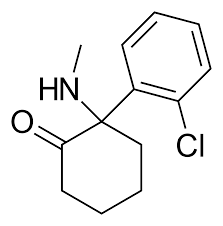
Ketamine: antidepressant, nonspecific euphoriant, or potential scourge?

Happy now?

US licensing of esketamine, a version of the drug ketamine, “could usher in a wave of fast-acting treatments, but experts are worried.”

As a clinical psychiatrist, wrestling with the treatment of severe resistant depressive conditions in my patients, I share some of the concerns about possible side effects, long-term risks and potential associated social ills raised in this Guardian article.

Ketamine has a broad range of brain effects. It is a euphoriant, a hallucinogen, a dissociant, and an anaesthetic in overlapping but different dosage ranges. The article quotes Dr Carlos Zarate, head of experimental therapeutics and pathophysiology at the US National Institute of Mental Health, who conducted the first clinical trial of ketamine for depression in 2006, who says, in part,

“What’s particularly interesting about ketamine is that it has multiple effects throughout different brain biologies… This makes it much more unique than other treatments. Many of the symptom domains seen in depression, but not all, seem to respond to it.”

Zarate and other prominent psychiatrists can perhaps be forgiven for their enthusiasm for what they describe as the first truly novel development in the drug treatment of depression in several decades. However, let’s look at what I see as the absurdity in this comment. ‘Depression’ is a catchall name for biologically diverse conditions and states of mind, and increasingly so in the past few decades as manufacturers have marketed the expansion of the term in order to expand demand for their antidepressant products. Ketamine is far from ‘unique’ in its nonspecificity! If it acts immediately and acts across a range of depressive types and symptoms, it is fairly certain that it is not addressing the underlying pathophysiology of the condition but rather providing a generic ‘feel-good’ effect. To mix metaphors, it is sort of like using a sledge hammer to drive in a thumb tack… and, if it’s the only tool you’ve got, then it pays to see everything as if it is a thumb tack, right? (Certainly, those who sell sledge hammers would have you see it that way!)

Any drug with nonspecific euphoriant effects will make depressed people feel better. Indeed, they make anyone feel better. In this manner of speaking, cocaine and stimulant drugs (‘speed’) ‘treat’ depression. In fact, there is a school of thought (the ‘drug-of-choice’ model, or ‘self-medication hypothesis’) that some proportion of substance abuse patients may be unknowingly treating an underlying psychiatric disorder through their drug use. This extends to other intoxicants such as alcohol and sedative-hypnotics as well. Using nonspecific euphoriants for their antidepressant effects causes immense problems, and the use of ketamine may fall into that category.

The first of these is potential tolerance. This refers to the fact that the brain inures itself over time to the effects of the substance. It is not clear that ketamine will cause physiological tolerance — and there have not been long-enough duration studies to tell — but it is certainly possible. The brain resists being pushed out of its usual range of functioning into a euphoric state. With increasing resistance, it takes more and more of the substance, or more and more frequent administration, to produce the desired effect. One will be chasing one’s tail, so to speak, in a vicious cycle — the more one uses, the more one needs. There may come to be less and less therapeutic benefit or benefit only at such dosage that toxic effects start to predominate. To maintain its antidepressant effect, current guidelines suggest a weekly interval for esketamine treatment. Given the chronicity of some depressive conditions, patients may need to continue treatment over a period of years or even indefinitely. Dosages may need to be higher or treatments more frequent as time goes on. One could imagine that the pharmaceutical industry would welcome such captive audiences requiring open-ended treatment modalities.

Closely related to the development of tolerance is the potential for dependency. Ketamine is probably not physiologically dependency-inducing (“addictive”), in the sense of needing to keep using it to stave off physiological withdrawal (“drug sickness”) upon cessation. But a substance that makes people feel good so quickly is highly reinforcing and may thus be psychologically addictive even if not physically.

Proponents point out that the benefits of treatment may outweigh the risks for patients who have no other options. This begs the question of whether its use will continue to be restricted to patients whose depression is treatment-resistant and has failed other available options. After all, the last innovation in antidepressant development, the introduction of the SSRIs (Prozac and its cousins) in the 1980’s was originally meant to rescue those whose depression was resistant to the treatments of the day (the tricyclics and monoamine oxidase inhibitors). Now they have become the first-line treatments, completely supplanting the older agents in modern psychiatric practice… and some argue that they are inferior antidepressant agents for clinically significant clinical depression. To call them good antidepressants, society has had to accept a vastly expanded definition of depression. This loss of linguistic precision contributes to the ongoing medicalization of everyday life problems, to our detriment.

(I’m talking about the circular reasoning pitfall here. If someone’depression seems happier on ketamine, then ketamine is having an antidepressant effect. And if it is seen as an antidepressant, then anyone who responds to it had depression. And so on.)

I share the misgivings of Dr. Julie Zito, professor of pharmacy and psychiatry at the University of Maryland, who sums it up:

“There’s been a huge expansion in what constitutes depression. There are low-moderate depressives who are going through a divorce or struggling with a new job… What they might really need is counselling. But in the US, we love our pills and simple solutions to very complex problems.”

A further complication of esketamine use may be that, once available in the marketplace, we may be unable to stem its diversion for street use, either for recreational use or unsupervised self-medication for self-diagnosed depression. After all, we haven’t done such a great job with prescription opiates, and it does not appear we have learned much from that.

It is also important to recognize that esketamine was approved after only four relatively small and short-lived clinical trials with decidedly mixed results. As Zito points out,

“The FDA created this new innovative study category, which means they only required one randomised, double-blind placebo-controlled trial, not two, which is usually the criterion for a new drug.”

Furthermore, not only the breadth or duration of the drug’s benefit but its depth are in question. A treatment may be found to be superior to placebo in the sense of demonstrating a statistical toy significant difference on an outcome measure in a clinical trial, but this may not translate into something clinically meaningful to the patient’s life. In other words, this may not be a distinction that makes a difference. Such logically fallacious conclusions are a generic problem in psychopharmacological research. Zito, again, on the ketamine trials:

“They evaluated the efficacy using symptom score change and there was only a three- to four-point improvement on a 60-point scale, which you have to say is very modest. And that is what the whole thing hangs on.”

In the absence of robust and extensive double blind placebo-controlled trials, the interest in ketamine relies heavily, then, on anecdotal and first-person accounts of dramatic improvement. The benefits may derive from suggestion effects — a substance that drastically alters consciousness or subjective experience, as ketamine does, is a strong candidate to mobilize the placebo response, inspiring in the recipient the self-fulfilling prophecy that it is having a powerful effect. I am not entirely scoffing about this; I believe that a good part of the effect of many of the medications we use arises from enlisting the patient in a belief system in which the medication is helping, thus mobilizing their self-healing.

Concerns have repeatedly been raised about effects of ketamine administration such as hallucinations, out-of-body experiences, and fluctuations in blood pressure. Patients receiving esketamine will be required to remain in the clinic or the doctor’s office for two hours of monitoring after each treatment. But people are different; who is to say that someone will be free of risk precisely at the two-hour point? In preapproval studies, there were three suicides in the esketamine group as well as a fourth death in which a patient crashed his motorcycle shortly after dosing. (Hard to say, but did that represent suicidal intent? Impairment of judgment? Or perceptual and coordination problems?)

Of course, the manufacturer asserts that all those events were unrelated to the actions of the drug, but there were no corresponding events in the placebo group. With such a small studied group, certainly this difference may have been statistical accident, and severe depression indubitably carries suicide risk. But there have also been concerns about exacerbation of suicidal tendencies with earlier antidepressants. Going into detail about this concern is the subject for a different essay, but I’ll mention several different potential dangerous mechanisms. First, any side effects that make a person more uncomfortable (e.g. the restlessness and agitation caused by several of the SSRIs) can be the straw that breaks the camel’s back, tipping them over the edge to decide not to endure discomfort any longer. Second, not all symptoms of depression respond to treatment at the same rate. If a person’s depressive lack of energy and paralysis of will improve before their despair does, their motivation to act on their despondency may be mobilized. Third, some drugs, and ketamine as a euphoriant may be among them, may act by lowering inhibitions, including control over latent self-destructive urges.

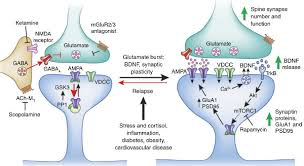
Advocates of the use of ketamine and esketamine, thus, may be ignoring the fact that the Emperor has no clothes. We know too little about the pathophysiology of depression and too little about the pharmacology of ketamine. Classically, exposition on antidepressants has relied on the ‘monoamine hypothesis’ for the illness and the fact that the drugs address monoamine (primarily norepinephrine and serotonin) deficits. Yet, that has clearly been an incomplete or inadequate explanation. More recently, the focus in depression and just about every other psychiatric condition has turned to a different neurotransmitter, glutamate. There’s a lot of handwaving but we do not have a precise or coherent understanding of how glutamate is implicated in the mechanism of various disorders; certainly nothing that would guide clinical practice. And, surely enough, ketamine is thought of, among other actions, as a glutamate receptor blocker. Post hoc ergo propter hoc?

Similarly, in this post-monoamine world, there is a lot of handwaving interest in the idea that depression treatments may also work by correcting physical damage to nerve cells implicated in depression. Sure enough, the article invokes this ‘neuromythology’:

“…one idea is that (ketamine) triggers the brain to regrow connections between cells that are involved in mood, but no one really knows for sure.”

A complicated set of misgivings. In short, let us hope that ketamine, through its hallucinogenic effect, is not causing us to hallucinate clothes on the Emperor.

Should we keep our problem cats and dogs even if they make us miserable?

Wanted dead or alive?

’We can’t blame people for giving up on a pet, especially when we don’t have the scaffolding in place to help them. And yet equally, if we say that animals are important to us, that they’re our family, and science demonstrates that they are capable of complex cognitive abilities and emotional states, then relinquishing them, knowing that it might kill them, is morally problematic.

The more we learn about animals – the more we force them into roles of friend, family member, surrogate child – the murkier become our obligations to them.

Maybe the solution is not keep pets at all…”The paradox is that the more we think of animals… as autonomous beings that have emotions and wants, the less right we have to keep them as a pet.” …’

Via Boston Globe

Tech billionaires can end global warming. Why aren’t they?

316+fVjaxCL’Saving the world from the apocalyptic impact of climate change should be a dream for many Silicon Valley titans concerned about legacy, says David Wallace-Wells, and yet few are dedicating themselves to addressing the catastrophe. Negative emissions technology funded by Bill Gates exists. It would cost $3 trillion per year to operate and would mean human industry could continue at current levels without global warming. That figure sounds astronomical, however global subsidies to fossil fuel industries cost $5 trillion per year.…’

Via Big Think

Trump’s John McCain funeral rant, decoded

Orange Menace continues to unravel:

1137080038 jpg 0’President Donald Trump has repeatedly attacked the late Sen. John McCain in the past weeks, for reasons known largely to himself. On Wednesday, Trump escalated his feud with a dead man, launching into an unprompted rant about McCain’s funeral (among other things) during a speech at a tank factory in Lima, Ohio.…’

Via Vox

5 ways life would be better if it were always daylight saving time

ImagesSteve Calandrillo, Professor of Law, University of Washington:

’In an effort to avoid the biannual clock switch in spring and fall, some well-intended critics of DST have made the mistake of suggesting that the abolition of DST – and a return to permanent standard time – would benefit society. In other words, the U.S. would never “spring forward“ or “fall back.”

They are wrong. DST saves lives and energy and prevents crime. Not surprisingly, then, politicians in Washington, California and Florida are now proposing to move to DST year-round.

Congress should seize on this momentum to move the entire country to year-round DST. In other words, turn all clocks forward permanently. If it did so, I see five ways that Americans’ lives would immediately improve.…’

Via Big Think

Volunteers Jumped Out of a Plane Without a Parachute to Test the Efficacy of Parachutes

Quote

‘Researchers from Harvard, the University of Michigan, and UCLA have conducted the first ever randomized controlled trial on the efficacy of parachutes. As detailed in a cheeky study published late last year in the prestigious British Medical Journal, the researchers enlisted 23 volunteers to jump out of a plane or helicopter to test whether the use of parachutes reduced risk of injury or death…

Remarkably, the researchers found that “parachute use did not significantly reduce death or major injury.” Indeed, there were zero deaths or serious injuries in either group. As the researchers noted in their conclusion, however, this likely had to do with the fact that… (more)’

via Motherboard

El Chapo Trial: The 11 Biggest Revelations From the Case


‘After a lengthy 11-week trial, a jury on Tuesday convicted Joaquín Guzmán Loera, the Mexican drug kingpin known as El Chapo. Mr. Guzmán, 61, faced 10 charges, including leading a criminal enterprise and the importation and sales of large amounts of narcotics into the United States. He now will likely spend the rest of his life in prison.

The trial allowed prosecutors to extensively detail the inner workings of Mr. Guzmán’s Sinaloa cartel, providing unparalleled insight into international drug trafficking. Here are 11 of the most important takeaways, in no particular order…’

Via New York Times

America’s Professional Elite: Wealthy, Successful and Miserable

‘“I feel like I’m wasting my life,” he told me. “When I die, is anyone going to care that I earned an extra percentage point of return? My work feels totally meaningless.” He recognized the incredible privilege of his pay and status, but his anguish seemed genuine. “If you spend 12 hours a day doing work you hate, at some point it doesn’t matter what your paycheck says,” he told me. There’s no magic salary at which a bad job becomes good. …’

Via New York Times

What Happens When Sister Cities Break Up?

Atlas Obscura reports on Osaka’s decision to ‘break up’ with San Francisco after the latter put up a statue honoring “comfort women,” who were enslaved in Japanese brothels during World War II. The incident is the occasion for a deeper examination of the fascinating and complicated history of the twinning phenomenon between cities.

House Opens Inquiry Into Proposed U.S. Nuclear Venture in Saudi Arabia

Middle East venture is treasonous:

Unknown

In a bombshell revelation, the The New York Times reports that House sources have revealed a Trump plan to open nuclear power plants across Saudi Arabia. Former national security adviser Michael Flynn is reportedly strongly involved in the plan. Trump apparently began thinking about this scheme right after his inauguration and, undissuaded by concerns about conflicts of interest and national security constraints, is still considering the plan. The export of nuclear technology could violate the US Atomic Energy Act of 1954, and the plan has been opposed by Trump advisers including the chief of the National Security Council. Usually, Congress needs to approve the foreign export of American technologies but the Trump administration reportedly ignored warnings about such constraints. The owners of Westinghouse Electric, a nuclear plant manufacturer, bailed out the family of Trump son-in-law Jared Kushner by investing in a property of theirs that was heavily in debt. All of this raises questions about Kushner’s impending Middle East trip.

Trump’s ‘SNL’ attack crosses the line (Opinion)

’Could Trump be laying the ground work to declare another national emergency to silence SNL?!

…My hope is that members of the media who interview Republican members of Congress in the next few days ask them point blank whether they would support Trump’s “retribution” and potential investigations into how SNL and other comedy shows create their shows. It is important Republicans make it explicitly clear that Trump’s war on freedom of expression is wrong…’

Via CNN

What Language Do People Speak in the Balkans, Anyway?

Dan Nosowitz writes:

‘IMAGINE A SITUATION IN WHICH an American defendant hires a British lawyer for a trial in an American courtroom. The accused then demands that a British interpreter be found. British-American legal interpreters are hard to find, so the demand could delay the case for years, possibly even long enough that the case has to be simply thrown out due to the statute of limitations—despite the fact that, obviously, a British lawyer is perfectly capable of being understood in an American courtroom.

This actually happens on a regular basis in the countries that once made up Yugoslavia. The language situation in the Balkans is so unusual that there is no consensus, either among native speakers or linguistic researchers, about what to even call the … thing people speak in Serbia, Croatia, Bosnia and Herzegovina, and Montenegro. Outside the region, it’s usually referred to as “Serbo-Croatian,” but neither linguists nor the people who actually speak it like to call it that. …’

Source: Atlas Obscura

The Cautious Case for Climate Optimism

Joe Darrow writes:

>’Whatever you may have read over the past year — as extreme weather brought a global heat wave and unprecedented wildfires burned through 1.6 million California acres and newspaper headlines declared, “Climate Change Is Here” — global warming is not binary. It is not a matter of “yes” or “no,” not a question of “fucked” or “not.” Instead, it is a problem that gets worse over time the longer we produce greenhouse gas, and can be made better if we choose to stop. Which means that no matter how hot it gets, no matter how fully climate change transforms the planet and the way we live on it, it will always be the case that the next decade could contain more warming, and more suffering, or less warming and less suffering. Just how much is up to us, and always will be….’

Source: NYMag

Michelob ASMR Superbowl ad freaked some people out

Christina Maxouris writes:

‘…[Y]es, a lot of people find ASMR relaxing. Others find it horrifying. Or at the very least it freaks them out, like the Michelob Ultra ad featuring Kravitz did.

It’s not Kravitz that’s the problem, it’s just that ASMR is not for everyone! For every person that chills out to the sound of someone rubbing Velcro or sipping from a beer bottle, there’s someone else who thinks ASMR feels like being haunted by a very quiet ghost with no sense of personal space. …’

Source: CNN

Happy Imbolc

UnknownToday is Groundhog Day and, this year, since Punxsutawney Phil did not see his shadow, spring is coming early. In the Pagan calendar, it is Imbolc (or Imbolg), which has marked the beginning of spring since ancient times, coming at the midpoint between the astronomical winter solstice (“Yule”) and the spring equinox (“Ostara”) in the northern hemisphere. It is one of the four Gaelic seasonal festivals that fall at the ‘quarter cross points’ between the equinoxes and the solstices, along with Beltane, Lugnasadh, and Samhain.

Imbolc was a time to celebrate Brigid (Brigit, Brighid, Bride, Bridget, Bridgit, Brighde, Bríd), the Celtic Goddess of inspiration, healing, and smithcraft with associations to fire, the hearth and poetry. When Ireland was Christianized in the 5th century, the festival of Brigid became Saint Brigid’s Day, although the chronology of the transmigration from the Celtic goddess to the Christian saint is not universally accepted. Imbolc derives from the Old Irish imbolg meaning in the belly, a time when sheep began to lactate and their udders filled and the grass began to grow.It thus coincided with the beginning of the lambing season, the spring sowing, and some of the earliest blooming plants. The gentle curve of a ‘just-showing’ pregnancy embodies the promise of renewal, expectancy and hope.

Evidence indicates that Imbolc has been an important date in the Irish, Scottish and Manx calendar since ancient times. The holiday was a festival of hearth and home with celebrations often embodying hearth fires, feasting, divination for omens of good fortune, and candles or bonfires representing the return of warmth and light. The point of many rituals seemed to be to invite Brigid, and the good fortune she would bring, into the home. Activities included:

— Brigid crosses, consisting of reeds or willows woven in a four-armed equilateral cross, often hung over doors, windows, or stables for protection

— making Bridey (Brideog, Breedhoge, or ‘Biddy’) dolls, representing Brigid, which were paraded from house to house. People would make a bed for her and leave her food and drink.Images

— visiting of holy wells, which are circled ‘sunwise’ and offerings left. Water from the well was used to bless home, family members, livestock and fields.

— a “spring cleaning” was customary

— Imbolc was traditionally a time of weather divination. Old traditions of watching to see if various animals returned from their winter dens seem to be forerunners of Groundhog Day.

Although many of the customary observances of Imbolc died out during the 20th century, it is still observed and in some places has been revived as a cultural event.Brigid’s Day parades have been revived in the town of Killorglin, County Kerry, which holds a yearly “Biddy’s Day Festival”. Men and women wearing elaborate straw hats and masks visit public houses carrying a Brídeóg to bring good luck for the coming year. They play folk music, dance and sing. The highlight of this festival is a torchlight parade through the town followed by a song and dance contest. Most recently, neopagans and Wiccans have observed Imbolc as a religious holiday.

’…It is the festival of the Maiden, for from this day to March 21st, it is her season to prepare for growth and renewal. Brighid’s snake emerges from the womb of the Earth Mother to test the weather, (the origin of Ground
Hog Day), and in many places the first Crocus flowers began to spring forth from the frozen earth.

The Maiden is honored, as the Bride, on this Sabbat. Straw Brideo’gas (corn dollies) are created from oat or wheat straw and placed in baskets with white flower bedding. Young girls then carry the Brideo’gas door to door, and gifts are bestowed upon the image from each household. Afterwards at the traditional feast, the older women make special acorn wands for the dollies to hold, and in the morning the ashes in the hearth are examined to see if the magic wands left marks as a good omen. Brighid’s Crosses are fashioned from wheat stalks and exchanged as symbols of protection and prosperity in the coming year. Home hearth fires are put out and re-lit, and a besom is place by the front door to symbolize sweeping out the old and welcoming the new. Candles are lit and placed in each room of the house to honor the re-birth of the Sun.

Inbolc7Another traditional symbol of Imbolc is the plough. In some areas, this is the first day of ploughing in preparation of the first planting of crops. A decorated plough is dragged from door to door, with costumed children following asking for food, drinks, or money. Should they be refused, the household is paid back by having its front garden ploughed up. In other areas, the plough is decorated and then Whiskey, the “water of life” is poured over it. Pieces of cheese and bread are left by the plough and in the newly turned furrows as offerings to the nature spirits. It is considered taboo to cut or pick plants during this time.

Various other names for this Greater Sabbat are Imbolgc Brigantia (Caledonni), Imbolic (Celtic), Disting (Teutonic, Feb 14th), Lupercus (Strega), St. Bridget’s Day (Christian), Candlemas, Candlelaria (Mexican), the Snowdrop Festival. The Festival of Lights, or the Feast of the Virgin. All Virgin and Maiden Goddesses are honored at this time…’

(Via Celtic Connection)

Imbolc also corresponds with Candlemas, the Christian observance of the baby Jesus’ presentation at the Temple in Jerusalem to officially induct him into Judaism when he was forty days old. It was originally described in the Gospel of Luke as a purification ritual. On Candlemas, a priest traditionally blesses candles which are distributed to the faithful for use throughout the year. In some places, they are placed in windows during storms to ward off damage.

Interestingly, in Scotland, along with Michaelmas, Lammas and Whitsun, Candlemas is one of the four  term and quarter days, the four divisions of the legal year, historically used as the days when contracts and leases would begin and end, servants would be hired or dismissed, and rent, interest on loans, and ministers’ stipends would become due. Although they were later fixed by law as falling on the 28th day every three months, they originally occurred on holy days, corresponding roughly to old quarter days used in both Scotland and Ireland.

Some foreign observances:

In France and Belgium, Candlemas (FrenchLa Chandeleur) is celebrated with crêpes.

In Italy, traditionally, it (Italian: La Candelora) is considered the last cold day of winter.

Tenerife (Spain), Is the day of the Virgin of Candelaria (Saint Patron of the Canary Islands). 2 February.

In Southern and Central Mexico, and Guatemala City, Candlemas (Spanish: Día de La Candelaria) is celebrated with tamales. Tradition indicates that on 5 January, the night before Three Kings Day (the Epiphany), whoever gets one or more of the few plastic or metal dolls (originally coins) buried within the Rosca de Reyes must pay for the tamales and throw a party on Candlemas. In certain regions of Mexico, this is the day in which the baby Jesus of each household is taken up from the nativity scene and dressed up in various colorful, whimsical outfits.

In Luxembourg, Liichtmëss sees children carrying lighted sticks visiting neighbors and singing a traditional song in exchange for sweets.

Sailors are often reluctant to set sail on Candlemas Day, believing that any voyage begun then will end in disaster—given the frequency of severe storms in February, this is not entirely without sense.

(Via Wikipedia)

Shhh…

‘Residents of Cremona, Italy, are hearing a lot of that lately. The city, the birthplace of the world’s finest string instruments, has thrown itself behind an effort to preserve every note before the instruments are too fragile to play.
That requires absolute silence in the cobblestoned area around the auditorium where the sounds of Stradivarius instruments are being recorded. The streets are shut down, and a dropped glass or even the sound of a woman’s high heels clicking make for an “an auditory nightmare,” said one of the people behind the project. …’

Source: The New York Times

Insect collapse: ‘We are destroying our life support systems’

Damian Carrington writes:

‘“We knew that something was amiss in the first couple days,” said Brad Lister. “We were driving into the forest and at the same time both Andres and I said: ‘Where are all the birds?’ There was nothing.”

His return to the Luquillo rainforest in Puerto Rico after 35 years was to reveal an appalling discovery. The insect population that once provided plentiful food for birds throughout the mountainous national park had collapsed. On the ground, 98% had gone. Up in the leafy canopy, 80% had vanished. The most likely culprit by far is global warming.

“It was just astonishing,” Lister said. “Before, both the sticky ground plates and canopy plates would be covered with insects. You’d be there for hours picking them off the plates at night. But now the plates would come down after 12 hours in the tropical forest with a couple of lonely insects trapped or none at all.”

“It was a true collapse of the insect populations in that rainforest,” he said. “We began to realise this is terrible – a very, very disturbing result.”

Earth’s bugs outweigh humans 17 times over and are such a fundamental foundation of the food chain that scientists say a crash in insect numbers risks “ecological Armageddon”. When Lister’s study was published in October, one expert called the findings “hyper-alarming”. …’

Source: The Guardian

Ranking Every Type of Sushi by How Healthy It Is

Ian Lecklitner writes:

‘The upshot here is, I feel like crap, partly because my body is full of plastic, but mostly because my insatiable, kraken-like desire for sushi is ruining the ocean. It’s true: Our collective sushi habits are certainly contributing to the deteriorating health of the oceans. “The United Nations comes out with The State of World Fisheries and Aquaculture every two years, and the 2016 version basically shows that we overfished more than one-third of all fisheries — another 55 percent were maxed out, meaning we would be overfishing those, too, if we removed any more fish,” Hunnes explains. “A mere nine percent of fisheries are underfished.”

More than anything, similar to our previous fish ranking, this list should also emphasize the importance of understanding both where and how your seafood is caught (sushi-grade or not), which can dramatically impact the health and sustainability of that meal. To keep track of that kinda stuff, we recommend checking out SeafoodWatch.org. …’

Source: MEL Magazine

Wonderful set of New Year’s wishes from Neil Gaiman

Neil Gaiman writes:

‘If you have come here for New Year’s Wishes, I don’t have a new one. But here are the ones that already exist. This is from 2014:

Fifteen Years ago, I wrote:

May your coming year be filled with magic and dreams and good madness. I hope you read some fine books and kiss someone who thinks you’re wonderful, and don’t forget to make some art — write or draw or build or sing or live as only you can. And I hope, somewhere in the next year, you surprise yourself.

And almost a decade ago I said,

…I hope you will have a wonderful year, that you’ll dream dangerously and outrageously, that you’ll make something that didn’t exist before you made it, that you will be loved and that you will be liked, and that you will have people to love and to like in return. And, most importantly (because I think there should be more kindness and more wisdom in the world right now), that you will, when you need to be, be wise, and that you will always be kind.

Half a decade ago, I wrote:

And for this year, my wish for each of us is small and very simple.

And it’s this.

I hope that in this year to come, you make mistakes.

Because if you are making mistakes, then you are making new things, trying new things, learning, living, pushing yourself, changing yourself, changing your world. You’re doing things you’ve never done before, and more importantly, you’re Doing Something.

So that’s my wish for you, and all of us, and my wish for myself. Make New Mistakes. Make glorious, amazing mistakes. Make mistakes nobody’s ever made before. Don’t freeze, don’t stop, don’t worry that it isn’t good enough, or it isn’t perfect, whatever it is: art, or love, or work or family or life.

Whatever it is you’re scared of doing, Do it.

Make your mistakes, next year and forever.

And here, from 2012 the last wish I posted, terrified but trying to be brave, from backstage at a concert:

It’s a New Year and with it comes a fresh opportunity to shape our world.

So this is my wish, a wish for me as much as it is a wish for you: in the world to come, let us be brave – let us walk into the dark without fear, and step into the unknown with smiles on our faces, even if we’re faking them.

And whatever happens to us, whatever we make, whatever we learn, let us take joy in it. We can find joy in the world if it’s joy we’re looking for, we can take joy in the act of creation.

So that is my wish for you, and for me. Bravery and joy.

I meant, and mean them all. I wasn’t going to write a new one this year. But…

Be kind to yourself in the year ahead.

Remember to forgive yourself, and to forgive others. It’s too easy to be outraged these days, so much harder to change things, to reach out, to understand.

Try to make your time matter: minutes and hours and days and weeks can blow away like dead leaves, with nothing to show but time you spent not quite ever doing things, or time you spent waiting to begin.

Meet new people and talk to them. Make new things and show them to people who might enjoy them.

Hug too much. Smile too much. And, when you can, love….’

Source: Neil Gaiman’s Journal

New Year’s Customs and Rituals

New Year Sunrise

New Year Sunrise

This is the annual update of my New Year post, a longstanding FmH tradition. Please let me know if you find any dead links:

I once ran across a January 1st Boston Globe article compiling folkloric beliefs about what to do, what to eat, etc. on New Year’s Day to bring good fortune for the year to come. I’ve regretted since — I usually think of it around once a year (grin) — not clipping out and saving the article. Especially since we’ve had children, I’m interested in enduring traditions that go beyond getting drunk [although some comment that this is a profound enactment of the interdigitation of chaos and order appropriate to the New Year’s celebration — FmH], watching the bowl games and making resolutions.

Marteniza-ball

A web search brought me this, less elaborate than what I recall from the Globe but to the same point. It is weighted toward eating traditions, which is odd because, unlike most other major holidays, the celebration of New Year’s in 21st century America does not seem to be centered at all around thinking about what we eat (except in the sense of the traditional weight-loss resolutions!) and certainly not around a festive meal. But…

Traditionally, it was thought that one could affect the luck they would have throughout the coming year by what they did or ate on the first day of the year. For that reason, it has become common for folks to celebrate the first few minutes of a brand new year in the company of family and friends. Parties often last into the middle of the night after the ringing in of a new year. It was once believed that the first visitor on New Year’s Day would bring either good luck or bad luck the rest of the year. It was particularly lucky if that visitor happened to be a tall dark-haired man.

“Traditional New Year foods are also thought to bring luck. Many cultures believe that anything in the shape of a ring is good luck, because it symbolizes “coming full circle,” completing a year’s cycle. For that reason, the Dutch believe that eating donuts on New Year’s Day will bring good fortune.

blackeye_peas_bowl_text
Many parts of the U.S. celebrate the new year by consuming black-eyed peas. These legumes are typically accompanied by either hog jowls or ham. Black-eyed peas and other legumes have been considered good luck in many cultures. The hog, and thus its meat, is considered lucky because it symbolizes prosperity. Cabbage is another ‘good luck’ vegetable that is consumed on New Year’s Day by many. Cabbage leaves are also considered a sign of prosperity, being representative of paper currency. In some regions, rice is a lucky food that is eaten on New Year’s Day.”

English: Fireworks over Edinburgh on New Year'...

Fireworks over Edinburgh on New Year’s Eve

The further north one travels in the British Isles, the more the year-end festivities focus on New Year’s. The Scottish observance of Hogmanay has many elements of warming heart and hearth, welcoming strangers and making a good beginning:

“Three cornered biscuits called hogmanays are eaten. Other special foods are: wine, ginger cordial, cheese, bread, shortbread, oatcake, carol or carl cake, currant loaf, and a pastry called scones. After sunset people collect juniper and water to purify the home. Divining rituals are done according to the directions of the winds, which are assigned their own colors. First Footing: The first person who comes to the door on midnight New Year’s Eve should be a dark-haired or dark-complected man with gifts for luck. Seeing a cat, dog, woman, red-head or beggar is unlucky. The person brings a gift (handsel) of coal or whiskey to ensure prosperity in the New Year. Mummer’s Plays are also performed. The actors called the White Boys of Yule are all dressed in white, except for one dressed as the devil in black. It is bad luck to engage in marriage proposals, break glass, spin flax, sweep or carry out rubbish on New Year’s Eve.”

Here’s why we clink our glasses when we drink our New Year’s toasts, no matter where we are. Of course, sometimes the midnight cacophony is louder than just clinking glassware, to create a ‘devil-chasing din’.

In Georgia, eat black eyed peas and turnip greens on New Year’s Day for luck and prosperity in the year to come, supposedly because they symbolize coppers and currency. Hoppin’ John, a concoction of peas, onion, bacon and rice, is also a southern New Year’s tradition, as is wearing yellow to find true love (in Peru and elsewhere in South America, yellow underwear, apparently!) or carrying silver for prosperity. In some instances, a dollar bill is thrown in with the other ingredients of the New Year’s meal to bring prosperity. In Greece, there is a traditional New Year’s Day sweetbread with a silver coin baked into it. All guests get a slice of the bread and whoever receives the slice with the coin is destined for good fortune for the year. At Italian tables, lentils, oranges and olives are served. The lentils, looking like coins, will bring prosperity; the oranges are for love; and the olives, symbolic of the wealth of the land, represent good fortune for the year to come.

A New Year’s meal in Norway also includes dried cod, “lutefisk.” The Pennsylvania Dutch make sure to include sauerkraut in their holiday meal, also for prosperity.

In Spain, you would cram twelve grapes in your mouth at midnight, one each time the clock chimed, for good luck for the twelve months to come. (If any of the grapes happens to be sour, the corresponding month will not be one of your most fortunate in the coming year.) The U. S. version of this custom, for some reason, involves standing on a chair as you pop the grapes. In Denmark, jumping off a chair at the stroke of midnight signifies leaping into the New Year.
In Rio,

The crescent-shaped Copacabana beach… is the scene of an unusual New Year’s Eve ritual: mass public blessings by the mother-saints of the Macumba and Candomble sects. More than 1 million people gather to watch colorful fireworks displays before plunging into the ocean at midnight after receiving the blessing from the mother-saints, who set up mini-temples on the beach.

When taking the plunge, revelers are supposed to jump over seven waves, one for each day of the week.

This is all meant to honor Lamanjá, known as the “Mother of Waters” or “Goddess of the Sea.” Lamanjá protects fishermen and survivors of shipwrecks. Believers also like to throw rice, jewelry and other gifts into the water, or float them out into the sea in intimately crafted miniature boats, to please Lamanjá in the new year.

In many northern hemisphere cities near bodies of water, people also take a New Year’s Day plunge into the water, although of course it is an icy one! The Coney Island Polar Bears Club in New York is the oldest cold-water swimming club in the United States. They have had groups of people enter the chilly surf since 1903.

Ecuadorian families make scarecrows stuffed with newspaper and firecrackers and place them outside their homes. The dummies represent misfortunes of the prior year, which are then burned in effigy at the stroke of midnight to forget the old year. Bolivian families make beautiful little wood or straw dolls to hang outside their homes on New Year’s Eve to bring good luck.

1cdd196c97bc4886c7d0b3a9c1b3dd97In China, homes are cleaned spotless to appease the Kitchen God, and papercuttings of red paper are hung in the windows to scare away evil spirits who might enter the house and bring misfortune. Large papier mache dragon heads with long fabric bodies are maneuvered through the streets during the Dragon Dance festival, and families open their front doors to let the dragon bring good luck into their homes.

The Indian Diwali, or Dipawali, festival, welcoming in the autumnal season, also involves attracting good fortune with lights. Children make small clay lamps, dipas, thousands of which might adorn a given home. In Thailand, one pours fragrant water over the hands of elders on New Year’s Day to show them respect.

10768-revelry
Elsewhere:

  • a stack of pancakes for the New Year’s breakfast in France.
  • banging on friends’ doors in Denmark to “smash in” the New Year, where it is also a good sign to find your doorstep heaped with broken dishes on New Year’s morning. Old dishes are saved all years to throw at your friends’ homes on New Year’s Eve. The more broken pieces you have, the greater the number of new friends you will have in the forthcoming twelve months.
  • going in the front door and out the back door at midnight in Ireland.
  • making sure the First Footer, the first person through your door in the New Year in Scotland, is a tall dark haired visitor.
  • water out the window at midnight in Puerto Rico rids the home of evil spirits.
  • cleanse your soul in Japan at the New Year by listening to a gong tolling 108 times, one for every sin
  • it is Swiss good luck to let a drop of cream fall on the floor on New Year’s Day.
  • Belgian farmers wish their animals a Happy New Year for blessings.
  • In Germany and Austria, lead pouring” (das Bleigießen) is an old divining practice using molten lead like tea leaves. A small amount of lead is melted in a tablespoon (by holding a flame under the spoon) and then poured into a bowl or bucket of water. The resulting pattern is interpreted to predict the coming year. For instance, if the lead forms a ball (der Ball), that means luck will roll your way. The shape of an anchor (der Anker) means help in need. But a cross (das Kreuz) signifies death. This is also a practice in parts of Finland, apparently.
  • El Salvadoreans crack an egg in a glass at midnight and leave it on the windowsill overnight; whatever figure it has made in the morning is indicative of one’s fortune for the year.
  • Some Italians like to take part in throwing pots, pans, and old furniture from their windows when the clock strikes midnight. This is done as a way for residents to rid of the old and welcome in the new. It also allows them to let go of negativity. This custom is also practiced in parts of South Africa, the Houston Press adds.
  • In Colombia, walk around with an empty suitcase on New Year’s Day for a year full of travel.
  • In the Philippines, all the lights in the house are turned on at midnight, and previously opened windows, doors and cabinets throughout the house are suddenly slammed shut, to ward off evil spirits for the new year.
  • In Russia a wish is written down on a piece of paper. It is burned and the ash dissolved in a glass of champagne, which should be downed before 12:01 am if the wish is to come true.
  • aptopix-romania-bear-ritual-89ecd02b044cc9131Romanians celebrate the new year by wearing bear costumes and dancing around to ward off evil
  • In Turkey, pomegranates are thrown down from the balconies at midnight for good luck.

It’s a bit bizarre when you think about it. A short British cabaret sketch from the 1920s has become a German New Year’s tradition. Yet, although The 90th Birthday or Dinner for One is a famous cult classic in Germany and several other European countries, it is virtually unknown in the English-speaking world, including Britain, its birthplace.” (Watch on Youtube, 11 min.)

So if the Germans watch British video, what do you watch in Britain? A number of sources have suggested that it is Jools Holland’s Hootenanny, “even though it’s awful and everyone hates it.

On a related theme, from earlier in the same week, here are some of the more bizarre Christmas rituals from around the world. 

Some history; documentation of observance of the new year dates back at least 4000 years to the Babylonians, who also made the first new year’s resolutions (reportedly voews to return borrowed farm equipment were very popular), although their holiday was observed at the vernal equinox. The Babylonian festivities lasted eleven days, each day with its own particular mode of celebration. The traditional Persian Norouz festival of spring continues to be considered the advent of the new year among Persians, Kurds and other peoples throughout Central Asia, and dates back at least 3000 years, deeply rooted in Zooastrian traditions.Modern Bahá’í’s celebrate Norouz (”Naw Ruz”) as the end of a Nineteen Day Fast. Rosh Hashanah (”head of the year”), the Jewish New Year, the first day of the lunar month of Tishri, falls between September and early October. Muslim New Year is the first day of Muharram, and Chinese New Year falls between Jan. 10th and Feb. 19th of the Gregorian calendar.

The classical Roman New Year’s celebration was also in the spring although the calendar went out of synchrony with the sun. January 1st became the first day of the year by proclamation of the Roman Senate in 153 BC, reinforced even more strongly when Julius Caesar established what came to be known as the Julian calendar in 46 BC. The early Christian Church condemned new year’s festivities as pagan but created parallel festivities concurrently. New Year’s Day is still observed as the Feast of Christ’s Circumcision in some denominations. Church opposition to a new year’s observance reasserted itself during the Middle Ages, and Western nations have only celebrated January 1 as a holidy for about the last 400 years. The custom of New Year’s gift exchange among Druidic pagans in 7th century Flanders was deplored by Saint Eligius, who warned them, “[Do not] make vetulas, [little figures of the Old Woman], little deer or iotticos or set tables [for the house-elf] at night or exchange New Year gifts or supply superfluous drinks [another Yule custom].” (Wikipedia)

The tradition of the New Year’s Baby signifying the new year began with the Greek tradition of parading a baby in a basket during the Dionysian rites celebrating the annual rebirth of that god as a symbol of fertility. The baby was also a symbol of rebirth among early Egyptians. Again, the Church was forced to modify its denunciation of the practice as pagan because of the popularity of the rebirth symbolism, finally allowing its members to cellebrate the new year with a baby although assimilating it to a celebration of the birth of the baby Jesus. The addition of Father Time (the “Old Year”) wearing a sash across his chest with the previous year on it, and the banner carried or worn by the New Year’s Baby, immigrated from Germany. Interestingly, January 1st is not a legal holiday in Israel, officially because of its historic origins as a Christian feast day.


Auld Lang Syne (literally ‘old long ago’ in the Scottish dialect) is sung or played at the stroke of midnight throughout the English-speaking world (and then there is George Harrison’s “Ring Out the Old”). Versions of the song have been part of the New Year’s festivities since the 17th century but Robert Burns was inspired to compose a modern rendition, which was published after his death in 1796. (It took Guy Lombardo, however, to make it popular…)

Should auld acquaintance be forgot
and never brought to mind?
Should auld acquaintance be forgot
and days of auld lang syne?
For auld lang syne, my dear,
for auld lang syne,
we’ll take a cup of kindness yet,
for auld lang syne.

Should auld acquaintance be forgot
and never brought to mind?
Should auld acquaintance be forgot
and days of auld lang syne?
And here’s a hand, my trusty friend
And gie’s a hand o’ thine
We’ll tak’ a cup o’ kindness yet
For auld lang syne

Here’s how to wish someone a Happy New Year around the world:

  • Arabic: Kul ‘aam u antum salimoun
  • Brazilian: Boas Festas e Feliz Ano Novo means “Good Parties and Happy New Year”
  • Chinese: Chu Shen Tan Xin Nian Kuai Le (thanks, Jeff)
  • Czechoslavakia: Scastny Novy Rok
  • Dutch: Gullukkig Niuw Jaar
  • Finnish: Onnellista Uutta Vuotta
  • French: Bonne Annee
  • German: Prosit Neujahr
  • Greek: Eftecheezmaenos o Kaenooryos hronos
  • Hebrew: L’Shannah Tovah Tikatevu
  • Hindi: Niya Saa Moobaarak
  • Irish (Gaelic): Bliain nua fe mhaise dhuit
  • Italian: Buon Capodanno
  • Khmer: Sua Sdei tfnam tmei
  • Laotian: Sabai dee pee mai
  • Polish: Szczesliwego Nowego Roku
  • Portuguese: Feliz Ano Novo
  • Russian: S Novim Godom
  • Serbo-Croatian: Scecna nova godina
  • Spanish: Feliz Ano Nuevo
  • Swedish: Ha ett gott nytt år
  • Turkish: Yeni Yiliniz Kutlu Olsun
  • Vietnamese: Cung-Chuc Tan-Xuan

[If you are a native speaker, please feel free to offer any corrections or additions!]

Which of these customs appeal to you? Are they done in your family, or will you try to adopt any of them? However you’re going to celebrate, my warmest wishes for the year to come… and eat hearty!

[thanks to Bruce Umbaugh (here or here) for research assistance]

Whr Hv All th Vwls Gn?

John Williams writes:

‘Time was that you had to be an experimental weirdo to ditch vowels. In “Finnegans Wake,” James Joyce used the word “disemvowelled” in a section thatincludes this exchange of crystal-clear dialogue:

— Nnn ttt wrd?

— Dmn ttt thg.

Before we are all Joyce — God bless him — I would suggest that we take a deep breath, a mndfl one even, and consider the culling of our five (maybe six) friends. After all, there are words that can hardly do without them: muumuu, audio and oboe, just to queue up a few. One cannot text someone “b” and expect them to know one is referring to an oboe.

And what about that old Scrabble lifesaver “euoi” — “a cry of impassioned rapture in ancient Bacchic revels?” If you know of another way to identify a cry of impassioned rapture in ancient Bacchic revels, I’d like to hear it. Really. I’ll wait.

Panicked that we might be sliding (even more quickly) toward a fully emoticon-based pictographic language, I called the linguist, Columbia professor and prolific author John McWhorter to ease my mind. First, he assured me I wasn’t crazy to suggest an uptick in this trend.

“There is a fashion in American language culture right now to be playful in a way that is often childlike,” Mr. McWhorter said. “This business of leaving out the vowels and leaving you to wonder how to pronounce something, it channels this kid-ness in a way — like saying ‘because science,’ or the way we’re using -y, when we say something like, ‘well, it got a little yell-y.’ ”

Mr. McWhorter acknowledges that the more often vowels are dropped, the more people get used to it and make adjustments to rapidly understand implied meanings. “You can imagine someone naming a band MGMT in 1976, and everyone would just be baffled,” he said. But he doesn’t see disemvowelling creeping into more formal areas, and expects the trend won’t move “beyond the realm of that which is ironic or iconic.” …’

Source: New York Times

Ready for a Super Blood Wolf Moon in January?

Emily Petsko writes:

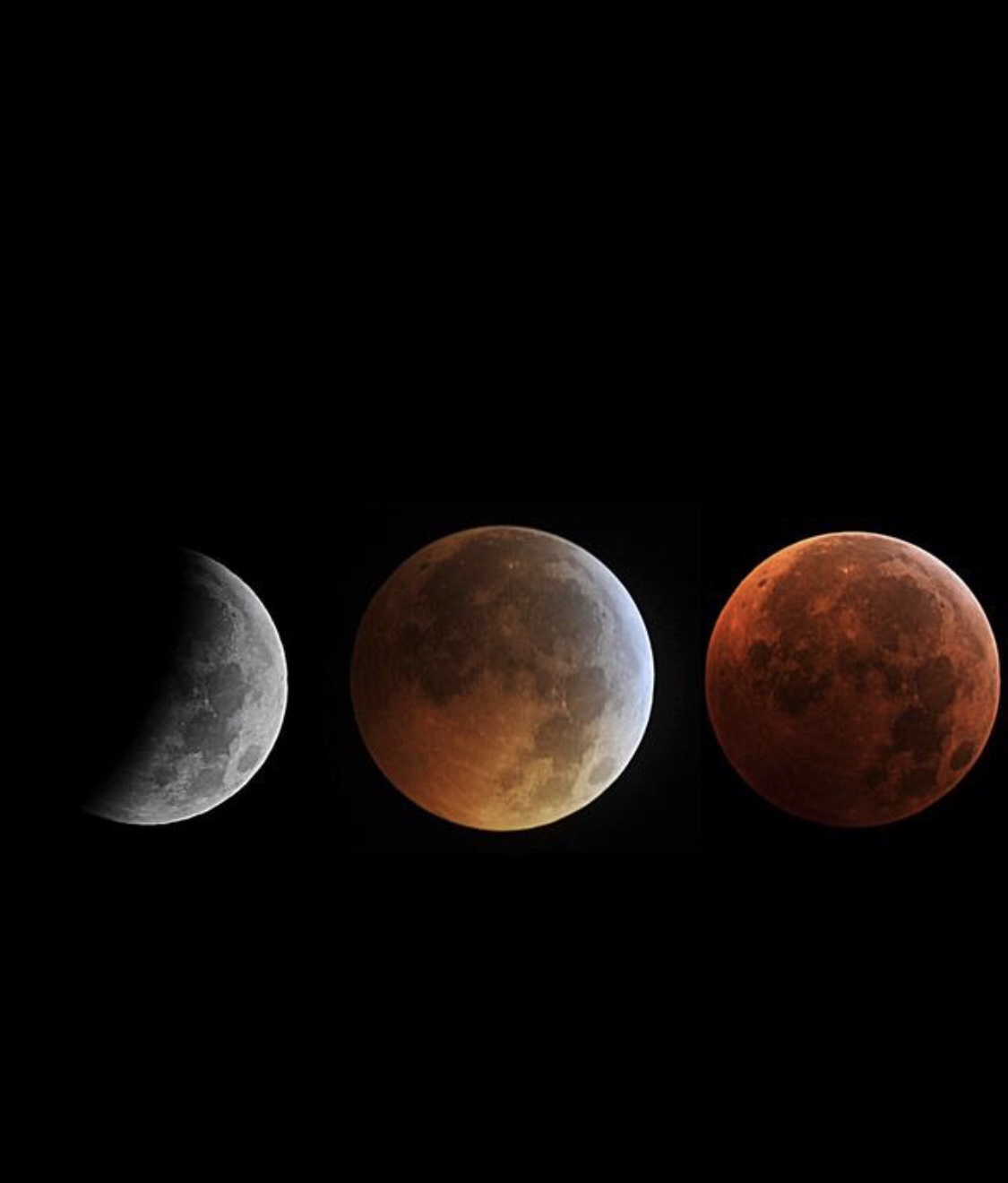
‘…The new year will get off to a brilliant start when a rare reddish-orange body called a Super Blood Wolf Moon graces the sky in January…

This phenomenon is actually the convergence of a few lunar events. For one, there’s a total lunar eclipse, also known as a Blood Moon… Secondly, the Super Blood Wolf Moon takes place during a supermoon. This occurs when a moon’s full phase coincides with the point in its orbit when it comes closest to Earth. These two factors make it look 14 percent larger and 30 percent brighter than it normally does, according to Space.com. Finally, a full moon in January has been called a Wolf Moon ever since colonial times, so that’s where the “wolf” part of the name comes from.

If you’re in North America, you can expect to see the Super Blood Wolf Moon on January 20. Totality will occur around 9:12 p.m. PST or 12:12 a.m. EST on January 21, but Forbes suggests pulling up a chair an hour beforehand to watch the moon change from partial eclipse to total eclipse….’

Source: Mental Floss

Best Epigraphs of 2018

Ashley Holstrom writes:

‘Epigraphs are a lovely part of books—usually a fancy line from a very old work that the author feels in their soul. This year was (another) hard one, and the epigraphs of 2018 are a comfort.

I once had a teacher who said epigraphs were snooty, and something only authors who think they’re as good as the greats do. But I disagree. They’re a great way to lead you to more books! And this year’s selections made my TBR list even longer.

Last year I collected the best epigraphs of the year, and it’s my new favorite end-of-year tradition. So let’s get to it! …’

Source: Book Riot

A Complete Guide to All 17 (Known) Trump and Russia Investigations

TrumpRussia 872734326’After three weeks of back-to-back-to-back-to-back bombshells by federal prosecutors and special counsel Robert Mueller, it’s increasingly clear that, as 2018 winds down, Donald Trump faces a legal assault unlike anything previously seen by any president—at least 17 distinct court cases stemming from at least seven different sets of prosecutors and investigators. (That total does not count any congressional inquiries, nor does it include any other inquiries into other administration officials unrelated to Russia.)…

Here’s a complete rundown of the various known investigations targeting Trump’s world from local, state, and federal prosecutors:..’

Via WIRED

Alzheimer’s Protein Accidentally Transmitted to Patients Via Discontinued Medical Treatments

’Researchers report human growth hormone, prepared from human tissue prior to 1985, may have been contaminated with seeds of the amyloid beta protein. In a new study, researchers injected mice with the original c-hGH batches containing amyloid beta which seeded amyloid pathology, even decades after storage. Findings support the hypothesis that the Alzheimer’s causing proteins can be transmitted to from contaminated materials.…’

Via Neuroscience News

After suicides in Acton and Boxborough, a communion of sorrow

Rinaldi09acton02 HERO

This Boston Globe article describes the grief and the search for answers in the aftermath of a suicide cluster (six adolescents and young adults within 20 months) in the communities served by the community hospital where I practice psychiatry. While I thought it was thoughtful and searching, I had several concerns (I wrote essentially a version of this post to the reporter and the editor of The Globe).

The article mentions almost in passing the opinion of one set of parents that antidepressant use may have increased their son’s suicidal thinking and contributed to his death. This comment goes unchallenged and unexplored despite the issue being complex and far from incontrovertible. The question of the possible exacerbation of  suicidal thoughts by antidepressants has largely been put to rest, after the concern emerged about a decade ago, by substantial sophisticated research and analysis by psychiatric experts in psychopharmacology and suicidology. In rare isolated cases with particularly vulnerable patients, the agitating side effects of some antidepressants could conceivably worsen their distress to a tipping point. But, in most of the cases where a patient feels that their suicidal thinking escalated after beginning a medication, it is more simply that the medication has not yet kicked in to be the hoped-for ‘fix’ to halt the ongoing progression of their depression.

Furthermore, antidepressant prescribing has increasingly migrated from the psychiatrist’s consulting room to the primary care practice over the past few decades. PCPs, internists, pediatricians and family practitioners have briefer and less frequent visits with their patients (Big Pharma has by and large succeeded in persuading them that antidepressant prescribing is simple, does not require much attention, and will facilitate getting nuisance patients without ‘real’ medical concerns out of their offices more quickly). I have many gifted and empathic primary care colleagues but, by and large, they have less specific training and experience than mental health professionals in creating an alliance with a closed-off patient who may not be communicating suicidal distress with clarity or candor. Medical practice increasingly subscribes to the mistaken notion that simply prescribing the right medicine, outside the context of a therapeutic healing relationship, is sufficient treatment. Nevertheless, prescribing the proper medication is an efficient, some say even essential, component of treating a suicidal depression. Not proposing an antidepressant medication to such a deeply depressed patient has been seen as medical malpractice. The danger of reductively suggesting an irrefutable harmful link between suicide and the antidepressants is that it will have a chilling effect discouraging some from accepting such treatment and depriving sufferers of potentially lifesaving options. We saw this a decade ago.

Parenthetically, of far more concern than antidepressants is that suicidal patients are quite commonly given anti-anxiety medications. These include benzodiazepines such as lorazepam [Ativan], diazepam [Valium], clonazepam [Klonopin], alprazolam [Xanax] and the like. These medications act, exactly like the more familiar effect of alcohol, to lower inhibitions. Shy people socialize more comfortably, with a looser tongue, under the influence of alcohol, and anxiolytics work by the same mechanism at the same brain loci. Unfortunately, among the inhibitions they loosen are our compunctions against acting on any self-destructive impulses we may harbor. Both alcohol and anxiolytics are implicated in a high proportion of suicide attempts and successful suicides and, in my opinion and that of many responsible mental health practitioners, should be avoided when one is struggling with suicidal thoughts or urges.

Particularly in this portrait of a grieving community searching for explanations, one must recognize the impact of the social forces that impede delivery of adequate outpatient care. When we are discharging patients from our acute-stay inpatient unit at my hospital after a suicide crisis, it is outrageous that it typically takes weeks or at times months until they can get an intake with a community mental health provider, especially a psychiatrist. Staffs of inpatient units that stabilize patients in dangerous and acute crises are universally demoralized that patients no matter how motivated will be frustrated in finding adequate support to maintain their gains and their safety in the ensuing months. There are far too few providers, for one thing because insurance company reimbursement for outpatient mental health services does not make it worth many providers’ while. Furthermore, in all too many states providers are not even required to provide coverage for mental health treatment in parity to that for other kinds of medical treatment. (Massachusetts is a parity state, not that it makes that much difference.) The relationship between suicide and inadequacy of community mental health service provision ought to be clear.

I’m not actually sure  I would call the six suicides in Acton-Boxborough in the past 20 months a ‘cluster’ and I have seen similar incidences in the other nearby communities involving Lincoln-Sudbury and Concord-Carlisle high schools serviced by my hospital. We have seen a wholesale failure to halt the society-wide increase in suicide, particularly among adolescents and young adults. The article considers the possible contribution of local stresses such as academic pressure to suicide. We have grappled with suicide all too often only on the level of individual emotional factors and circumstantial psychosocial stress. However, we ignore at our peril the fact that large-scale cultural stresses and societal breakdown undoubtedly play an important part in encouraging people to take their lives. Particularly since Trump came to power in 2016, Americans have experienced a drastic acceleration in the postmodern erosion of cohesion of the social fabric, the wholesale betrayal of the expectation of the moral integrity of public figures, and relativity in what is even true on all levels. It is essential not to overlook how social breakdown impacts our young adults at times when they have not yet established a sense of the meaning of their lives, what to believe, or whom to trust. In his seminal 1897 treatise Suicide, the luminary French sociologist Emile Durkheim helped us to understand that suicide correlates not just with individual emotional factors or situational stress but with such society-wide strife and anomie. It is now a given in grappling with suicide, and one cannot ignore this level of analysis.

A Summary Statement:

Michael A. Cohen writes:

‘There were extensive efforts by Russian officials to assist the Trump campaign and that multiple Trump aides were approached;

• These Trump aides have uniformly lied to the FBI and prosecutors about these contacts;

• Collusion between the Trump campaign and Russian officials, in some form, likely took place;

• Efforts to mislead the public and prosecutors, as well as obstruct justice, have continued into Trump’s presidency and will likely implicate White House officials, including the president, in wrong-doing;

• Donald Trump, his son Donald Trump Jr., his son-in-law Jared Kushner, and perhaps other officials are in serious legal peril.

If this is correct then the felony offenses prosecutors say Trump committed are small potatoes compared to what is looming on the horizon. …’

Source: Boston Globe

R.I.P. Dr. Lisa Schwartz

Critic of Medical Excess Is Dead at 55:

Merlin 147770952 b70924ad f148 4fcf a7e9 8181c78abd73 superJumbo’Dr. Lisa Schwartz, who with her husband devoted her life to warning patients about the dangers of unnecessary medical tests and treatment and excessive diagnoses, died on Nov. 29 in Lebanon, N.H. She was 55.

Her husband, Dr. Steven Woloshin, said the cause was cancer.

Dr. Schwartz and Dr. Woloshin were the directors of the Center for Medicine and Media at the Dartmouth Institute for Health Policy and Clinical Practice, part of Dartmouth College’s Geisel School of Medicine. There they trained hundreds of journalists to become more skeptical about claimed scientific breakthroughs and miracle cures, and to better communicate the benefits and risks of medical tests and treatments.…’

Via New York Times

Why Does Alex Acosta Still Have a Job?

The cabinet official’s connection to a shady deal for an alleged child molester:

03goldberg superJumboIt is the perverse good fortune of Alexander Acosta, Donald Trump’s secretary of labor, to be part of an administration so spectacularly corrupt that it’s simply impossible to give all its scandals the attention they deserve.

Last Wednesday, The Miami Herald published a blockbuster multipart exposé about how the justice system failed the victims of Jeffrey Epstein, a rich, politically connected financier who appears to have abused underage girls on a near-industrial scale. The investigation, more than a year in the making, described Epstein as running a sort of child molestation pyramid scheme, in which girls — some in middle school — would be recruited to give Epstein “massages” at his Palm Beach mansion, pressured into sex acts, then coerced into bringing him yet more girls. The Herald reported that Epstein was also suspected of trafficking girls from overseas.

What’s shocking is not just the lurid details and human devastation of his alleged crimes, but the way he was able to use his money to escape serious consequences, thanks in part to Acosta, then Miami’s top federal prosecutor. For reasons that are not entirely clear, Acosta took extraordinary measures to let Epstein — and, crucially, other unnamed people — off the hook.

The labor secretary, whose purview includes combating human trafficking, has done nothing so far to rebut The Herald’s reporting. (A spokesman for his department has referred reporters to his previous statements about the case.) It should end his career.…’

Via The New York Times

69-Year-Old Troll Loses Case to Make Himself 20 Years Younger

Waezdtkst8kohnje7h70’Emile Ratelband, a 69-year-old man who has insisted he should be allowed to legally change his age to make himself 20-years younger, finally had his day in court. As of Monday, December 3, 2018, he is still legally 69 years old, and time will continue to have its way with him, just as it does for all of us.

Last month, Ratelband gained international attention when he told a Dutch court that he doesn’t feel 69-years-old and his age hinders his ability to meet women on the Tinder dating app. He called himself a “young god” and complained that when his actual age is listed on Tinder no one wants to talk to him. He fantasized that were he allowed to be 49, “with the face I have, I will be in a luxurious position.” He also believes that he would have more job opportunities if he were younger. Ratelband is a motivational speaker whose website describes him as “a man who lives a dream and who didn’t even know he had one.”…’

Via Gizmodo

Strange seismic waves rippled around Earth, and nobody knows why

Detected as far as 10,000 miles away but, bizarrely, nobody seems to have felt them:

01 mayotte hw8hfe adapt 1900 1’On the morning of November 11, just before 9:30 UT, a mysterious rumble rolled around the world.
The seismic waves began roughly 15 miles off the shores of Mayotte, a French island sandwiched between Africa and the northern tip of Madagascar. The waves buzzed across Africa, ringing sensors in Zambia, Kenya, and Ethiopia. They traversed vast oceans, humming across Chile, New Zealand, Canada, and even Hawaii nearly 11,000 miles away. These waves didn’t just zip by; they rang for more than 20 minutes. And yet, it seems, no human felt them. Only one person noticed the odd signal on the U.S. Geological Survey’s real-time seismogram displays. An earthquake enthusiast who uses the handle @matarikipax saw the curious zigzags and posted images of them to Twitter. That small action kicked off another ripple of sorts, as researchers around the world attempted to suss out the source of the waves. Was it a meteor strike? A submarine volcano eruption? An ancient sea monster rising from the deep?

“I don’t think I’ve seen anything like it,” says Göran Ekström, a seismologist at Columbia University who specializes in unusual earthquakes. “It doesn’t mean that, in the end, the cause of them is that exotic,” he notes. Yet many features of the waves are remarkably weird—from their surprisingly monotone, low-frequency “ring” to their global spread. And researchers are still chasing down the geologic conundrum. Why are the low-frequency waves so weird? In a normal earthquake, the built-up tensions in Earth’s crust release with a jolt in mere seconds. This sends out a series of waves known as a “wave train” that radiates from the point of the rupture, explains Stephen Hicks, a seismologist at the University of Southampton. The fastest-traveling signals are Primary waves, or P-waves, which are compression waves that move in bunches, like what happens to an extended slinky that gets suddenly pushedat one end. Next come the secondary waves, or S-waves, which have more of a side-to-side motion. Both of these so-called body waves have relatively high frequencies, Hicks says, “a sort of ping rather than a rumbling.”

Earthquakes 101 Finally, chugging along at the end come slow, long-period surface waves, which are similar to the strange signals that rolled out from Mayotte. For intense earthquakes, these surface waves can zip around the planet multiple times, ringing Earth like a bell, Hicks says. However, there was no big earthquake kicking off the recent slow waves. Adding to the weirdness, Mayotte’s mystery waves are what scientists call monochromatic. Most earthquakes send out waves with a slew of different frequencies, but Mayotte’s signal was a clean zigzag dominated by one type of wave that took a steady 17 seconds to repeat. “It’s like you have colored glasses and [are] just seeing red or something,” says Anthony Lomax, an independent seismology consultant.

Mayotte’s volcanic roots Based on the scientific sleuthing done so far, the tremors seem to be related to a seismic swarm that’s gripped Mayotte since last May. Hundreds of quakes have rattled the small nation during that time, most radiating from around 31 miles offshore, just east of the odd ringing. The majority were minor trembles, but the largest clocked in at magnitude 5.8 on May 15, the mightiest in the island’s recorded history. Yet the frequency of these shakes has declined in recent months—and no traditional quakes rumbled there when the mystery waves began on November 11.

The French Geological Survey (BRGM) is closely monitoring the recent shaking, and it suggests that a new center of volcanic activity may be developing off the coast. Mayotte was formed from volcanism, but its geologic beasts haven’t erupted in over 4,000 years. Instead, BRGM’s analysis suggests that this new activity may point to magmatic movement offshore—miles from the coast under thousands of feet of water. Though this is good news for the island inhabitants, it’s irksome for geologists, since it’s an area that hasn’t been studied in detail. “The location of the swarm is on the edge of the [geological] maps we have,” says Nicolas Taillefer, head of the seismic and volcanic risk unit at BRGM. “There are a lot things we don’t know.” And as for the November 11 mystery wave, he says, “it’s something quite new in the signals on our stations.”

Motion in the ocean Though baffled, scientists aren’t without leads. For one, they know that Mayotte is on the move. Since mid-July, GPS stations on the island have tracked it sliding more than 2.4 inches to the east and 1.2 inches to the south, according to a BRGM report from November 12. Using these measurements, Taillefer notes, the agency estimates that a magma body that measures about a third of a cubic mile is squishing its way through the subsurface near Mayotte.…’

Via National Geographic

Trump Fears Someone Might Kill Him if He Visits the Troops

Steve Jones writes:

‘Since World War II, and especially since 9/11, American presidents have often dropped in to share holiday meals with U.S. troops deployed in combat zones or potentially dangerous areas.
But don’t expect that from Donald Trump.
The man who couldn’t venture out in the rain to honor fallen Americans in France on the centennial of the World War I armistice has admitted being afraid to visit U.S. troops deployed in hot spots around the world.
According to a Washington Post report, an anonymous White House insider reportedly said, “He’s never been interested in going. He’s afraid of those situations. He’s afraid people want to kill him.” …’

Source: Medium.

R.I.P. Nicolas Roeg

Merlin 147254736 993350a7 bb67 4bbf bc9a 478170bb9048 superJumboDirector of ‘The Man Who Fell to Earth’ Dies at 90:

’Nicolas Roeg, a British director acclaimed for a string of films in the 1970s that included the rite-of-passage tale “Walkabout,” the psychological thriller “Don’t Look Now” and the David Bowie vehicle “The Man Who Fell to Earth,” died on Friday. He was 90.…

Two of his movies made the British Film Institute’s list of the 100 best British movies ever made…’

Via The New York Times

Stop It!

I’ve been sending this Mad TV Bob Newhart Skit with Mo Collins around to all my friends in the psychiatric field for years. (If it is not what we actually do in dealing with some patients, perhaps it is what we ought to do??) You might find it amusing. It runs around 6 min. Via YouTube

What was the worst year in human history?

UnknownWhy 536 was ‘the worst year to be alive’


’Ask medieval historian Michael McCormick what year was the worst to be alive, and he’s got an answer: “536.” Not 1349, when the Black Death wiped out half of Europe. Not 1918, when the flu killed 50 million to 100 million people, mostly young adults. But 536. In Europe, “It was the beginning of one of the worst periods to be alive, if not the worst year,” says McCormick, a historian and archaeologist who chairs the Harvard University Initiative for the Science of the Human Past.

A mysterious fog plunged Europe, the Middle East, and parts of Asia into darkness, day and night—for 18 months. “For the sun gave forth its light without brightness, like the moon, during the whole year,” wrote Byzantine historian Procopius. Temperatures in the summer of 536 fell 1.5°C to 2.5°C, initiating the coldest decade in the past 2300 years. Snow fell that summer in China; crops failed; people starved. The Irish chronicles record “a failure of bread from the years 536–539.” Then, in 541, bubonic plague struck the Roman port of Pelusium, in Egypt. What came to be called the Plague of Justinian spread rapidly, wiping out one-third to one-half of the population of the eastern Roman Empire and hastening its collapse, McCormick says.

Historians have long known that the middle of the sixth century was a dark hour in what used to be called the Dark Ages, but the source of the mysterious clouds has long been a puzzle. Now, an ultraprecise analysis of ice from a Swiss glacier by a team led by McCormick and glaciologist Paul Mayewski at the Climate Change Institute of The University of Maine (UM) in Orono has fingered a culprit. At a workshop at Harvard this week, the team reported that a cataclysmic volcanic eruption in Iceland spewed ash across the Northern Hemisphere early in 536. Two other massive eruptions followed, in 540 and 547. The repeated blows, followed by plague, plunged Europe into economic stagnation that lasted until 640, when another signal in the ice—a spike in airborne lead—marks a resurgence of silver mining, as the team reports in Antiquity this week.…’

Via Science | AAAS

By comparison, read about the cataclysmic effects of the 1815 eruption of Mount Tambora, on the island of Sumbawa, in present-day Indonesia.. Everyone knows about Krakatoa in 1883, but this was an order of magnitude greater.

But the worst may be yet to come. Consider Ragnarok:Fenrir and Odin by Frølich

Described in several Norse sources (primarily Snorri Sturluson’s 13th century Prose Edda), Ragnarök begins with a brutal winter lasting three times longer than usual, driving mankind to lawless desperation. The stars disappear, and the giant wolf, Fenrir, breaks free of his chains and devours everything in his path. A gigantic sea-dwelling serpent named Jormungand rises, and the trickster god Loki leads an army of giants into battle against Odin and the other gods at Asgard. The gods perish, and whatever remains of the world sinks into the sea.

President Trump Admits Acting Attorney General Matthew Whitaker Was Installed Over Robert Mueller’s Russia Probe

Jack Holmes writes:

‘The president just admitted, unprompted, that he fired the head of the Justice Department and installed a loyalist over a Justice Department investigation into him and his associates. This is obstruction. This is corrupt. This is an untenable assault on the rule of law in a democratic republic. And the Republican majorities in Congress—to say nothing of his base—will happily let him get away with it. …’

Source: Esquire

This is Our Lane

UnknownAn Open Letter to the NRA from American Healthcare Professionals:

’Dear National Rifle Association, On Wednesday night (11/7/2018), in response to a position paper released by the American College of Physicians (ACP) Reducing Firearm Injuries and Death in the United States, your organization published the statement “Someone should tell self-important anti-gun doctors to stay in their lane.”

On that same day, the CDC published new data indicating that the death toll from gun violence in our nation continues to rise. As we read your demand for us doctors to stay in our lane, we awoke to learn of the 307th mass shooting in 2018 with another 12 innocent lives lost to an entirely preventable cause of death–gun violence.

Every medical professional practicing in the United States has seen enough gun violence firsthand to deeply understand the toll that this public health epidemic is taking on our children, families, and entire communities.

It is long past time for us to acknowledge the epidemic is real, devastating, and has root causes that can be addressed to assuage the damage. We must ALL come together to find meaningful solutions to this very American problem.

We, the undersigned – physicians, nurses, therapists, medical professionals, and other concerned community members – want to tell you that we are absolutely “in our lane” when we propose solutions to prevent death and disability from gun violence.

As the professionals who manage this epidemic, we bear witness to every trauma resuscitation, regardless of outcome:…’ (AFFIRM, the American Foundation for Firearm Injury Reduction in Medicine)

If you are a healthcare professional, you can add your signature to this letter, as I did.

Trump’s Vicious Proposed ‘Public Charge’ Rule Change

UnknownHelp Stop Trump Demonization of Immigrants:

An individual who might become a “public charge”, according to US immigration law, is inadmissible to the US and ineligible to become a permanent resident. However, up to now, receiving public benefits does not automatically qualify an immigrant as a public charge. Thus, non-citizens could apply for public benefits and participate in essential health, nutrition and housing  programs without jeopardizing their immigration status. (Via Public Charge Fact Sheet). 

However, the Trump administration has proposed changes to the “public charge” regulation to remove those essential protections. This would be Donald Trump’s most far-reaching immigration policy change and one of his most mean-spirited actions.

Under the proposed rule, the list of public benefits that count against an immigrant would greatly expand. The benefits that the administration proposes be added to the public charge list are benefits that support disadvantaged families and protect public health and child welfare. Immigrants currently receiving public services would incur increased risk of deportation and would be excluded from becoming permanent residents of the US. The chilling effect of the regulation would prevent many others from applying for benefits and services in the first place. If enacted, this regulation would dramatically enhance the misery of many immigrants who have already suffering severe misfortune.

You can submit written comments about this proposal by December 10, 2018, which must be taken into account before a final rule is issued.

So, please join me in voicing opposition to this proposed regulation.

You may submit comments on this proposed rule by any one of the following methods:

— Federal eRulemaking Portal (preferred): www.regulations.gov. Follow the website instructions for submitting comments.
— Mail: Samantha Deshommes, Chief, Regulatory Coordination Division, Office of Policy and Strategy, U.S. Citizenship and Immigration Services, Department of Homeland Security, 20 Massachusetts Avenue NW, Washington, DC 20529-2140.

To ensure proper handling, please reference DHS Docket No. USCIS-2010-0012 in your correspondence. Mail must be postmarked by the comment submission deadline.

One of many humanitarian agencies that offer further education on the proposed rule change and provide templates for drafting comments is CLINIC, the Catholic Legal Immigration Network.

Related:

How Will The Public Charge Rule Impact Employers And Immigrants? (Forbes)

Now the Trump administration is trying to punish legal immigrants for … (Washington Post)

Trump’s Public-Charge Rule Is a One-Two Punch Against Immigrants … (New Yorker)

Immigrants, fearing Trump crackdown, drop out of nutrition programs … (Politico)

Trump’s advisers worried about Mueller’s next steps in Russia probe

’The White House is bracing for the probe of Donald Trump’s presidential campaign to fire up again. Trump’s advisers are privately expressing worries that Robert Mueller, who’s been out of the news for the past month, has been stealthily compiling information and could soon issue new indictments or a damning final report. Trump abruptly altered the chain of command above Mueller on Wednesday, putting his work under the supervision of a Republican loyalist who has been openly sceptical of the special counsel’s authority and has mused about ways to curtail his power. But Trump and his aides are concerned about Mueller’s next move with the work that is complete, according to a White House official and a Republican with close ties to the administration.

More:

Robert Mueller’s final report on the Russian investigation is being written right now, reports says…’

Via Medium

Neuroscientists identify a surprising low-tech fix to the problem of sleep-deprived teens

Marissa Harris (UCLA):

’In a time of borderline hysteria over the effects of technology on sleep and brain development, little attention goes to the fundamental elements of good sleep in adolescents. Ensuring they have comfortable bedding may help improve sleep in all adolescents, particularly among poorer families. And it’s a lot easier to convince parents and teens to invest in pillows than to bicker over phone privileges.…’

Via The Conversation

Calling Bullshit

UnknownCan it become a sort of bullshitting itself?

’Calling bullshit has a venerable intellectual pedigree. Plato first carved out a space for philosophy by distinguishing the philosopher’s search for knowledge from the persuasive speech of the sophists, the bullshit artists of antiquity. These wandering debate coaches instructed the Greek political class in the art of making the weaker argument the stronger. The rhetoric of the sophists is just fancy talk that creates the impression of wisdom, Plato tells us, but philosophy offers the genuine article.

In recent years, calling bullshit has become its own cottage industry. Debunkers like Michael Shermer and James Randi make a healthy living by exposing pseudoscience, and Harry Frankfurt scored an unlikely best seller when Princeton University Press managed to package his essay “On Bullshit” into a very small book. The mathematician Alan Sokal landed a blow against postmodern pretension by publishing a sham article in the journal Social Text in 1996, and when a more ambitious act of pomo-baiting surfaced about a month ago—a team of three pranksters had successfully submitted seven sham articles to journals peddling in what they derisively called “Grievance Studies”—the hoax came to be known as “Sokal Squared.”

Bullshitting has its obvious incentives and pleasures: you get all the kudos of saying interesting and important things without any of the work of actually thinking interesting and important things. As Frankfurt notes, there’s even an enjoyable play in concocting bullshit. Less obvious are the incentives and pleasures of calling bullshit. And yet they’re pretty much the same: you get all the kudos of asserting your intellectual superiority to the bullshitters, and it brings a certain aesthetic enjoyment with it as well. Just saying “bullshit” is deeply satisfying, its rich soup of consonants opening with an aggressive plosive and then sliding into the disdainful slurred hiss of “shit.” Where the bullshitter gets to bask in the glow of unearned wisdom, the bullshit-caller gets to strike the pose of the undeceived straight-talker bravely swimming against a rising tide of baloney.…’

Via The Point Magazine

America’s Fever Is Still Rising

Andrew Sullivan writes:

‘Tuesday, if you step back, was an ordinary election in an extraordinary time. The swing against the president’s party in the first midterm election was not far off the historical range. The average loss for the president’s party in the House two years into a first term over the last century is 29. Trump’s GOP, at last estimate, lost 37. For some recent perspective: In 1982, Reagan’s GOP lost 26 seats; in 1990, George H.W. Bush’s GOP lost 8; in 1994, Clinton’s Democrats lost 54; in 2002, W.’s GOP gained 8 (but in the context of 9/11); in 2010, Obama’s Democrats lost a devastating 63 seats. In terms of the popular vote in the House, the Dems’ share — 51.7 percent — is also very close to the norm for the opposition in a first-term midterm.

There was, in other words, no blue wave. It was rather a familiar blue tide (which nonetheless looked more impressive by Thursday night than it did in the wee hours of Wednesday morning). If you just looked at the data, and knew nothing about the last two years, you’d think it was a conventional, even boring, election.

I wrote last week that the midterms would finally tell us what this country now is. And with a remarkable turnout — a 50-year high for a non-presidential election, no less — we did indeed learn something solid and eye-opening. We learned that the American public as a whole has reacted to the first two years of an unfit, delusional, mendacious, malevolent, incompetent authoritarian as president … with relative equanimity. The net backlash is milder than it was against Clinton or Obama (and both of them went on to win reelection). …’

Source: New York Magazine

Reverence for Hallowe’en: Good for the Soul

Three jack-o'-lanterns illuminated from within...

A reprise of my traditional Hallowe’en post of past years:

It is that time of year again. What has become a time of disinhibited hijinx and mayhem, and a growing marketing bonanza for the kitsch-manufacturers and -importers, has primeval origins as the Celtic New Year’s Eve, Samhain (pronounced “sow-en”). The harvest is over, summer ends and winter begins, the Old God dies and returns to the Land of the Dead to await his rebirth at Yule, and the land is cast into darkness. The veil separating the worlds of the living and the dead becomes frayed and thin, and dispossessed dead mingle with the living, perhaps seeking a body to possess for the next year as their only chance to remain connected with the living, who hope to scare them away with ghoulish costumes and behavior, escape their menace by masquerading as one of them, or placate them with offerings of food, in hopes that they will go away before the new year comes. For those prepared, a journey to the other side could be made at this time.

With Christianity, perhaps because with calendar reform it was no longer the last day of the year, All Hallows’ Eve became decathected, a day for innocent masquerading and fun, taking its name Hallowe’en as a contraction and corruption of All Hallows’ Eve.trick-or-treat-nyc

All Saints’ Day may have originated in its modern form with the 8th century Pope Gregory III. Hallowe’en customs reputedly came to the New World with the Irish immigrants of the 1840’s. The prominence of trick-or-treating has a slightly different origin, however.

The custom of trick-or-treating is thought to have originated not with the Irish Celts, but with a ninth-century European custom called souling. On November 2, All Souls Day, early Christians would walk from village to village begging for “soul cakes,” made out of square pieces of bread with currants. The more soul cakes the beggars would receive, the more prayers they would promise to say on behalf of the dead relatives of the donors. At the time, it was believed that the dead remained in limbo for a time after death, and that prayer, even by strangers, could expedite a soul’s passage to heaven.


English: A traditional Irish turnip Jack-o'-la...

English: A traditional Irish turnip Jack-o’-lantern from the early 20th century.

Jack-o’-lanterns were reportedly originally turnips; the Irish began using pumpkins after they immigrated to North America, given how plentiful they were here. The Jack-o-lantern custom probably comes from Irish folklore. As the tale is told, a man named Jack, who was notorious as a drunkard and trickster, tricked Satan into climbing a tree. Jack then carved an image of a cross in the tree’s trunk, trapping the devil up the tree. Jack made a deal with the devil that, if he would never tempt him again, he would promise to let him down the tree.

According to the folk tale, after Jack died, he was denied entrance to Heaven because of his evil ways, but he was also denied access to Hell because he had tricked the devil. Instead, the devil gave him a single ember to light his way through the frigid darkness. The ember was placed inside a hollowed-out turnip to keep it glowing longer.

Nowadays, a reported 99% of cultivated pumpkin sales in the US go for jack-o-lanterns.

Folk traditions that were in the past associated with All Hallows’ Eve took much of their power, as with the New Year’s customs about which I write here every Dec. 31st, from the magic of boundary states, transition, and liminality.

The idea behind ducking, dooking or bobbing for apples seems to have been that snatching a bite from the apple enables the person to grasp good fortune. Samhain is a time for getting rid of weakness, as pagans once slaughtered weak animals which were unlikely to survive the winter. A common ritual calls for writing down weaknesses on a piece of paper or parchment, and tossing it into the fire. There used to be a custom of placing a stone in the hot ashes of the bonfire. If in the morning a person found that the stone had been removed or had cracked, it was a sign of bad fortune. Nuts have been used for divination: whether they burned quietly or exploded indicated good or bad luck. Peeling an apple and throwing the peel over one’s shoulder was supposed to reveal the initial of one’s future spouse. One way of looking for omens of death was for peope to visit churchyards

La Catrina – In Mexican folk culture, the Catr...

The Witches’ Sabbath aspect of Hallowe’en seems to result from Germanic influence and fusion with the notion of Walpurgisnacht. (You may be familiar with the magnificent musical evocation of this, Mussorgsky’s Night on Bald Mountain.)

Although probably not yet in a position to shape mainstream American Hallowe’en traditions, Mexican Dia de los Muertos observances have started to contribute some delightful and whimsical iconography to our encounter with the eerie and unearthly as well. As this article in The Smithsonian reviews, ‘In the United States, Halloween is mostly about candy, but elsewhere in the world celebrations honoring the departed have a spiritual meaning…’

Reportedly, more than 80% of American families decorate their homes, at least minimally, for Hallowe’en. What was the holiday like forty or fifty years ago in the U.S. when, bastardized as it has now become with respect to its pagan origins, it retained a much more traditional flair? Before the era of the pay-per-view ’spooky-world’ type haunted attractions and its Martha Stewart yuppification with, as this irreverent Salon article from several years ago [via walker] put it, monogrammed jack-o’-lanterns and the like? One issue may be that, as NPR observed,

“Adults have hijacked Halloween… Two in three adults feel Halloween is a holiday for them and not just kids,” Forbes opined in 2012, citing a public relations survey. True that when the holiday was imported from Celtic nations in the mid-19th century — along with a wave of immigrants fleeing Irelands potato famine — it was essentially a younger persons’ game. But a little research reveals that adults have long enjoyed Halloween — right alongside young spooks and spirits.’

Is that necessarily a bad thing? A 1984 essay by Richard Seltzer, frequently referenced in other sources, entitled “Why Bother to Save Hallowe’en?”, argues as I do that reverence for Hallowe’en is good for the soul, young or old.

“Maybe at one time Hallowe’en helped exorcise fears of death and ghosts and goblins by making fun of them. Maybe, too, in a time of rigidly prescribed social behavior, Hallowe’en was the occasion for socially condoned mischief — a time for misrule and letting loose. Although such elements still remain, the emphasis has shifted and the importance of the day and its rituals has actually grown.…(D)on’t just abandon a tradition that you yourself loved as a child, that your own children look forward to months in advance, and that helps preserve our sense of fellowship and community with our neighbors in the midst of all this madness.”

Three Halloween jack-o'-lanterns.

That would be anathema to certain segments of society, however. Hallowe’en certainly inspires a backlash by fundamentalists who consider it a blasphemous abomination. ‘Amateur scholar’ Isaac Bonewits details academically the Hallowe’en errors and lies he feels contribute to its being reviled. Some of the panic over Hallowe’en is akin to the hysteria, fortunately now debunked, over the supposed epidemic of ‘ritual Satanic abuse’ that swept the Western world in the ’90’s.

Frankenstein

The horror film has become inextricably linked to Hallowe’en tradition, although the holiday itself did not figure in the movies until John Carpenter took the slasher genre singlehandedly by storm. Googling “scariest films”, you will, grimly, reap a mother lode of opinions about how to pierce the veil to journey to the netherworld and reconnect with that magical, eerie creepiness in the dark (if not the over-the-top blood and gore that has largely replaced the subtlety of earlier horror films).

The Carfax Abbey Horror Films and Movies Database includes best-ever-horror-films lists from Entertainment Weekly, Mr. Showbiz and Hollywood.com. I’ve seen most of these; some of their choices are not that scary, some are just plain silly, and they give extremely short shrift to my real favorites, the evocative classics of the ’30’s and ’40’s when most eeriness was allusive and not explicit. And here’s what claims to be a compilation of links to the darkest and most gruesome sites on the web. “Hours and hours of fun for morbidity lovers.”

Boing Boing does homage to a morbid masterpiece of wretched existential horror, two of the tensest, scariest hours of my life repeated every time I watch it:

‘…The Thing starts. It had been 9 years since The Exorcist scared the living shit out of audiences in New York and sent people fleeing into the street. Really … up the aisle and out the door at full gallop. You would think that people had calmed down a bit since then. No…’

Meanwhile, what could be creepier in the movies than the phenomenon of evil children? Gawker knows what shadows lurk in the hearts of the cinematic young:

‘In celebration of Halloween, we took a shallow dive into the horror subgenre of evil-child horror movies. Weird-kid cinema stretches back at least to 1956’s The Bad Seed, and has experienced a resurgence recently via movies like The Babadook, Goodnight Mommy, and Cooties. You could look at this trend as a natural extension of the focus on domesticity seen in horror via the wave of haunted-house movies that 2009’s Paranormal Activity helped usher in. Or maybe we’re just wizening up as a culture and realizing that children are evil and that film is a great way to warn people of this truth. Happy Halloween. Hope you don’t get killed by trick-or-treaters.’

In any case: trick or treat! …And may your Hallowe’en soothe your soul.

Related:

The Ghost Story Persists in American Literature. Why?

Parul Sehgal writes:

‘Literature — the top-shelf, award-winning stuff — is positively ectoplasmic these days, crawling with hauntings, haints and wraiths of every stripe and disposition. These ghosts can be nosy and lubricious, as in George Saunders’s “Lincoln in the Bardo,” which followed a group of spectral busybodies in purgatory, observing the arrival of Abraham Lincoln’s newly deceased young son. They can be confused by their fates, as in Martin Riker’s new novel, “Samuel Johnson’s Eternal Return,” in which a man is unsettled to discover that his essence has migrated into the body of the man who killed him. Spirits crop up in fiction about migration (Viet Thanh Nguyen’s “The Refugees”; Wayétu Moore’s “She Would Be King”) and complicate what might have been straightforward portraits of relationships (Ben Dolnick’s “The Ghost Notebooks,” Laura van den Berg’s “The Third Hotel,” Lauren Groff’s “Florida,” Helen Sedgwick’s “The Comet Seekers”). They terrify, instruct and enchant — sometimes all in the same book (Carmen Maria Machado’s short story collection, “Her Body and Other Parties,” features a veritable taxonomy of the type). …’

Source: The New York Times

What’s the frequency, Kenneth?

“Dan Rather, a longtime American television news anchor was returning from dinner at a friend’s Manhattan apartment on this day in 1986 when a man demanded, “Kenneth, what is the frequency?”

Told he had the wrong person, the man punched and kicked Mr. Rather, still yelling the question. Mr. Rather dashed into a building and was rescued by a doorman and building superintendent.

The police chalked it up to mistaken identity. Some people wondered if Mr. Rather had imagined it. It was unclear if one or two men had attacked.

Meanwhile, “What’s the frequency, Kenneth?” became a U.S. pop catchphrase. The band R.E.M. wrote a song by that name.

In 1997, it emerged that William Tager, a North Carolina man in prison by then, was Mr. Rather’s assailant. In 1994, Mr. Tager had shot and killed a television stagehand, saying the media was beaming messages into his brain. Shown photographs, Mr. Rather recognized him.

Mr. Tager was released from prison in 2010. His whereabouts is unknown…”

How to become a Trump judge

Retired Federal judge Nancy Gertner writes:

‘Kavanaugh’s performance at that hearing alone should be disqualifying. His behavior and affect, the pointed and partisan nature of his accusations, resonated with this President’s incivility and name calling. He was consumed with rage at his Democrat interlocutors, fairly spitting out his answers. He treated them with disrespect, interrupting, repeating his talking points rather than answering question. When Senator Patrick Leahy of Vermont asked him if he would call for an FBI investigation, to make the process more fair, he did not answer. He showed himself to be a zealot determined to get on the high court, at all costs.

With this performance, Kavanaugh became Trump’s version of what a judge should be, not unlike Trump’s version of what his attorney general should be. They were both supposed to be Trump partisans, not neutrals, and above all, ready for central casting. Trump reportedly was unhappy with Kavanaugh’s performance on “Fox News” several evenings before; Kavanaugh was “wooden,” he said, insufficiently assertive. So Kavanaugh changed his tune. Now, fully a Trump judge, he was playing to his base — President Trump. And it worked. Trump tweeted minutes after the hearing completed: ”Judge Kavanaugh showed America exactly why I nominated him.”

I had never heard a judge speak like that to a public audience, let alone during a confirmation hearing.

A judge is not only supposed to be unbiased, he is also to reflect the appearance of impartiality, avoiding situations in which reasonable people can believe he is partisan. How can Kavanaugh possibly meet that requirement given what we all saw on Thursday?

Consider this: Kavanaugh is confirmed is immediately sworn in by Justice John Roberts in the chambers of the Supreme Court. And on the docket is a challenge to gerrymandering brought by Democrats in one state; or another involving accusations of voter suppression against Republicans in a swing state. What about the cases that directly challenge presidential power, like the enforceability of a subpoena brought by special counsel Robert Mueller against Trump in the Russia investigation? How can he even appear remotely impartial in these cases when his presentation so fully and completely reflected the Republican party’s rage? He cannot. He is not.

Kavanaugh will not get his reputation back whether or not he is confirmed. These accusations, that performance, scotched all such hopes. But if he cared about the Supreme Court as an institution, he would withdraw now. Of course he will not; he wants this position, no matter what the cost, so stunning is his ambition. His body of work has been the functional equivalent of a 20-year application. He was a zealot in the Kenneth Starr investigation of President Bill Clinton, and then, when it suited him to be more neutral, wrote a law review article changing his tune; no president should be subject to the treatment, the very treatment he visited on Clinton. Serious issues were raised with respect to his truthfulness in his confirmation hearings concerning his role in the Bush administration.

He categorically denied Ford’s accusations again — even when he and others confirm at least part of it. He was the thinly-disguised Bart O’Kavanaugh in Mark Judge’s book, “Wasted,’’ passed out in a car. He joined a Yale fraternity famous for its wild drunken parties. At Yale Law School, my alma mater, he touted the all night parties, broken tables, etc. most recently in a 2014 speech. It was not such a leap to Ford’s account of drunken adolescents preying on a younger woman …’

Source: The Boston Globe

The Future of Forgiveness Is Online

NewImage

Alexandra Samuel writes:

’…I have found one personal rule that keeps my grudge-holding in check: Once I have forgotten the details of the original offence, I strictly forbid myself from maintaining my grudge. I may not be much good at forgive and forget, but once I forget, I require myself to forgive.

Thanks to the internet, however, I fear that forgetfulness is no longer a spiritual hall pass. How forgiving can any of us be, now that the internet logs all our online misdeeds forever?…’

Via JSTOR Daily

Guernsey woman uses Clameur de Haro to halt a construction project

Ephrat Livni writes:

‘Rosie Henderson raised the clameur on Aug. 14 by kneeling, calling for help, and reciting the Lord’s Prayer in Norman French, the Guardian reports. She protests a project to narrow a road in St. Peter Port, arguing that it will endanger both pedestrians and motorists in the self-governing UK possession.

The law Henderson invoked is enforceable and creates an immediate injunction. She had 24 hours after issuing the plea to register her claim in court. Work on the road project stopped as soon as the miffed citizen invoked the ancient rule and construction will remain halted until a court decides the case.

The clameur was first recorded in Norman law in the 13th century. Its use is believed to have originated in the 10th century as an appeal to Rollo, Viking founder of the Norman dynasty, according a 2008 article in the Jersey and Guernsey Law Review (pdf) by lawyer and legal historian Andrew Bridgeford.

… The clameur is serious business. “[I]t enables the private individual to co-opt the power of the courts in proclaiming an injunction,” Bridgeford says. “Such a powerful tool is not to be invoked incautiously. A claimant who is found to have raised the Clameur de Haro incorrectly risks not merely a penalty in costs but also punishment for contempt of court.” …’

Source: Quartz

Three Hard Truths About American Collapse

Umair Haque writes:

‘America’s probably not going to recover in our lifetimes, if ever (even if the good guys win the next election.) Let me start with some alarming and necessary factoids. America’s a country whose three main indicators are all blinking nine-alarm red — they’re what “collapse” really means. Life expectancy’s falling. Real incomes are shrinking. And 80% of people live paycheck to paycheck. By all means — elect someone not quite so terrible as Trump. It might mitigate those, but it’s not going to magically alter the downwards trajectory. The American future is a grim choice between a return to yesterday’s slow collapse and the continuation of today’s light-speed implosion — probably not anything remotely like Europe or Canada’s gentle, hopeful upwards trend in quality of life. …’

Source: Eudaimonia and Co

As Google Maps Renames Neighborhoods, Residents Fume

Jack Nicas writes:

‘Google Maps has now become the primary arbiter of place names. With decisions made by a few Google cartographers, the identity of a city, town or neighborhood can be reshaped, illustrating the outsize influence that Silicon Valley increasingly has in the real world.

…[But how] Google arrives at its names in maps is often mysterious. The company declined to detail how some place names came about, though some appear to have resulted from mistakes by researchers, rebrandings by real estate agents — or just outright fiction…’

Source: New York Times

This May Be the Most Dangerous U.S. Volcano

‘Supervolcanoes sound terrifying, but the risks they pose don’t usually match their fearsome reputations. Yellowstone in particular often makes its way into headlines, as every earthquake swarm or change in geyser activity spawns unfounded rumors of an apocalyptic eruption.

However, ask a volcanologist where the real risk in the U.S. lurks, and there’s a good chance that they will turn their gaze to the Pacific Northwest.

Nestled among the Cascade mountain range sits Mount Rainier, a postcard-perfect natural wonder—and a volcano that causes scientists genuine concern. It’s unclear when it will stir from its long slumber, and there’s no sign that anything is imminent. Nevertheless, a future eruption could cause one of the worst natural disasters in the U.S. …’

Source: National Geographic

What happened the last time a President chose America’s enemies over its friends

Manisha Sinha, Draper Chair in American History at the University of Connecticut, writes:

‘ Donald Trump likes to compare himself to Andrew Jackson, but the Andrew he really resembles is Andrew Johnson. What they have in common are delusions of personal grandeur and a tainted ascent to the presidency. Trump was elected by a minority of the American electorate, with help from the vagaries of the Electoral College system and from considerable Russian interference.

Johnson became president thanks to an assassin’s bullet. While Johnson immodestly compared himself to Jesus and Moses, Trump claims he is the best at everything, even boasting recently on Twitter that his popularity among Republicans exceeds that of Abraham Lincoln.

Indeed, pundits have likened today’s partisan divisions to those of the Civil War era. But they more closely resemble the politics of Reconstruction, the period after the war when for the first time in history, an American president, Johnson, was impeached by the House of Representatives…’

Source: CNN

Vox on Execrable Trump-Putin Meeting

NewImageTrump-Putin meeting in Helsinki: what we know is damning

‘Today, in Helsinki, the president of the United States held a friendly meeting with the Russian leader who sabotaged an American election on his behalf, and who has been rewarded by seeing American foreign policy pivot in a pro-Russian direction….’

Russian news editor explains how Putin turned Trump into his puppet

‘They consider him a stupid, unstrategic politician….’

Donald Trump isn’t confused about what collusion means

‘White House aides want you to believe the president stands with Putin because he doesn’t get what’s going on….’

Former CIA Director: Trump-Putin press conference “nothing short of treasonous”

 ‘John Brennan: “Not only were Trump’s comments imbecilic, he is wholly in the pocket of Putin.”…’

Putin doesn’t deny possessing compromising materials on his Chump

‘Yes, this is about the “pee tape.”…’


Trump’s presidency is illegitimate

Lucian K. Truscott IV writes that Mueller’s indictment of twelve Russian intelligence agents offers Prof Paige that the Kremlin stole the election for the Orange Menace:

‘It’s all right there in the indictment — day by day, hack by hack, theft by theft — how agents of the Russian intelligence service, the GRU, set out in the spring of 2016 to steal the election for Donald Trump. When you track the actions taken by Russian intelligence in the indictment with statements made by Trump and actions taken on his behalf by members of his campaign, the picture is as clear as an iPhone photo. Agents of the Russian government coordinated with members of the Trump campaign and took cues from Trump himself in order to influence the election of 2016…’

Source: Salon

Periodic Disclaimers and Warnings

Allergen Information: produced in a facility that uses peanuts, tree nuts, soy, wheat, milk and shellfish.
Do not use if you have ever had an allergic reaction to this product or any of its ingredients.
Failure to follow all instructions and warnings can result in serious injury.
Any resemblance to actual persons living or dead is purely coincidental.
Please leave as clean on leaving as you would like to find on entering.
Nontransferable and is the sole responsibility of the recipient.
Place all seat backs and tray tables in fully upright position.
Post office will not deliver without proper postage affixed.
Do not operate heavy machinery while reading this weblog.
Caution: Dates on calendar are closer than they appear.
No animals were harmed in the production of this page.
Please note locations of emergency exits upon arrival.
May be used as flotation device in case of emergency.
Anything you say can and will be used against you.
No ideas were harmed in the making of this weblog.
Names have been changed to protect the innocent.
Satisfaction guaranteed; return for full refund.
All questions answered, all answers questioned.
Caution: do not swallow. May cause irritation.
Detach and include upper portion with payment.
If condition persists, consult your physician.
Nutritional need is not established in humans.
Objects on screen are closer than they appear.
Do not use if safety seal is torn or missing.
May incur damages arising from use or misuse.
Please inform author if you cannot read this.
In emergency, break glass, pull down handle.
Product is sold by weight and not by volume.
Provided “as is” and without any warranties.
Caution! The edge is closer than you think.
Contents may have settled during shipment.
Do not fold, staple, spindle or mutilate.
Subject to all applicable fees and taxes.
Prices subject to change without notice.
Freshest if used before date specified.
Valid only at participating locations.
If swallowed, do not induce vomiting.
Take two and call me in the morning.
You have the right to remain silent.
Do not remove under penalty of law.
This page intentionally left blank.
Available for a limited time only.
Use only in well-ventilated areas.
Additional parts sold separately.
Do not exceed recommended dosage.
No user-serviceable parts inside.
Subject to change without notice.
Alarm will sound if door opened.
Warning, contents are flammable.
No shirt, no shoes, no service.
You break it, you’ve bought it.
You need not be present to win.
First pull up, then pull down.
Keep out of reach of children.
Lost ticket pays maximum rate.
Part of a daily balanced diet.
Apply only to affected areas.
Other restrictions may apply.
Void where prohibited by law.
Close cover before striking.
Do not think of an elephant.
Use under adult supervision.
Not a birth control device.
Sealed for your protection.
Terms and conditions apply.
You must be present to win.
Caution, low-flying ideas.
Colors may fade over time.
For recreational use only.
Honk if you can read this.
Viewer discretion advised.
Handle with extreme care.
Internet access required.
Limit one (1) per person.
More taste, less filling.
No purchase is necessary.
We prosecute trespassers.
Charge before first use.
Batteries not included.
Do not inflate indoors.
Don’t try this at home.
Employee entrance only.
Lights on when raining.
Not a low-calorie food.
Some assembly required.
Wash hands after using.
Consume in moderation.
Edited for television.
For external use only.
Last exit before toll.
Lather, rinse, repeat.
Mix well before using.
Shake well before use.
Store in a cool place.
Void where prohibited.
Your mileage may vary.
Money-back guarantee.
Remove before flight.
Use only as directed.
Beware of jet blast.
Consume responsibly.
Do not put in mouth.
For office use only.
Results not typical.
Ignore this notice.
Overhead utilities.
Danger: keep away.
One size fits all.
Remove before use.
Slippery when wet.
For deposit only.
No preservatives.
Same-day service.
Unplug after use.
Kilroy was here.
No trespassing.
This side down.
Do not shake.
Not a toy.
No exit.
No.

Donald Trump’s New Campaign Slogan Is From A Horror Movie

Bill Bradley writes:

‘To understand this saga, you need to go back to January 2017, when The Washington Post reported that Trump had revealed his new campaign.

“‘Keep America Great,’ exclamation point,” he told the paper, seemingly off the cuff.

According to the Post, Trump called a lawyer in during the interview to trademark and register two different “Keep America Great” slogans ― one with an exclamation point and one without ― on the spot. “Got it,” the lawyer replied, and business seemed to be handled.

The only problem? Apparently unbeknownst to Trump, his lawyer and The Washington Post, the slogan had already appeared in a poignantly titled 2016 horror movie: “The Purge: Election Year.” By using “Keep America Great” in its promotional materials, “Purge: Election Year” ― which, like its franchise predecessors, centers on the one night a year when people can legally murder the hell out of each other as an act of radical catharsis ― seemingly mocked Trump’s “Make America Great Again” phrase, effectively likening Trump’s America to its cinematic nightmare.

Two years later, Trump’s re-election campaign is actually trying to use “Keep America Great” itself, even though the horror movie connection went comically viral soon after the Washington Post interview. …’

Source: HuffPost

When It’s Too Late to Stop Fascism, According to Stefan Zweig

Austrian writer Stefan Zweig fled Nazism, eventually taking his life in despair and loneliness. His biographer, George Prochnik, writes:

‘I wonder how far along the scale of moral degeneration Zweig would judge America to be in its current state. We have a magnetic leader, one who lies continually and remorselessly—not pathologically but strategically, to placate his opponents, to inflame the furies of his core constituency, and to foment chaos. The American people are confused and benumbed by a flood of fake news and misinformation. Reading in Zweig’s memoir how, during the years of Hitler’s rise to power, many well-meaning people “could not or did not wish to perceive that a new technique of conscious cynical amorality was at work,” it’s difficult not to think of our own present predicament. Last week, as Trump signed a drastic immigration ban that led to an outcry across the country and the world, then sought to mitigate those protests by small palliative measures and denials, I thought of one other crucial technique that Zweig identified in Hitler and his ministers: they introduced their most extreme measures gradually—strategically—in order to gauge how each new outrage was received. “Only a single pill at a time and then a moment of waiting to observe the effect of its strength, to see whether the world conscience would still digest the dose,” Zweig wrote. “The doses became progressively stronger until all Europe finally perished from them.”

And still Zweig might have noted that, as of today, President Trump and his sinister “wire-pullers” have not yet locked the protocols for their exercise of power into place. One tragic lesson offered by “The World of Yesterday” is that, even in a culture where misinformation has become omnipresent, where an angry base, supported by disparate, well-heeled interests, feels empowered by the relentless lying of a charismatic leader, the center might still hold. In Zweig’s view, the final toxin needed to precipitate German catastrophe came in February of 1933, with the burning of the national parliament building in Berlin–an arson attack Hitler blamed on the Communists but which some historians still believe was carried out by the Nazis themselves. “At one blow all of justice in Germany was smashed,” Zweig recalled. The destruction of a symbolic edifice—a blaze that caused no loss of life—became the pretext for the government to begin terrorizing its own civilian population. That fateful conflagration took place less than thirty days after Hitler became Chancellor. The excruciating power of Zweig’s memoir lies in the pain of looking back and seeing that there was a small window in which it was possible to act, and then discovering how suddenly and irrevocably that window can be slammed shut. …’

Source: The New Yorker

10 Stages of Genocide

Prof. Gregory Stanton, of the School for Conflict Analysis and Resolution at George Mason University, writes of the ten predictable and recognizable stages in the development of genocide in any society, listing preventive measures that can stop it at every stage.Source: Genocide Watch (via kottke).

Leading psychiatrists: roll back Goldwater rule

 ‘Twenty-two psychiatrists and psychologists, including some of the field’s most prominent thinkers, are calling on the American Psychiatric Association on Thursday to substantially revise its controversial Goldwater rule, which bars APA members from offering their views of a public figure’s apparent psychological traits or mental status.

In a letter to be delivered to the APA, Dr. Robert Jay Lifton, one of the world’s leading experts on the psychological effects of war and political violence; Philip Zimbardo of the “Stanford prison experiment”; violence expert Dr. James Gilligan; and their colleagues argued that the Goldwater rule, which the APA adopted in 1973, deprives the public of expert opinion on crucial questions, such as the mental health and stability of elected officials.

While the policy holds that it would be unethical for mental heath professionals to offer their opinions on anyone they have not examined, the letter’s signers argue it would be unethical to withhold their views. Psychiatrists and psychologists, they contend, have “an affirmative responsibility” to publicly discuss “mental health issues discerned in public figures” when they pose “a clear and present danger to the public’s health and well-being.” …’

Source: Statnews

Elie Wiesel on our shared duty in ending injustice

1986 Nobel Peace Prize acceptance speech:

‘I remember: it happened yesterday or eternities ago. A young Jewish boy discovered the kingdom of night. I remember his bewilderment, I remember his anguish. It all happened so fast. The ghetto. The deportation. The sealed cattle car. The fiery altar upon which the history of our people and the future of mankind were meant to be sacrificed.

I remember: he asked his father: “Can this be true?” This is the twentieth century, not the Middle Ages. Who would allow such crimes to be committed? How could the world remain silent?

And now the boy is turning to me: “Tell me,” he asks. “What have you done with my future? What have you done with your life?”

And I tell him that I have tried. That I have tried to keep memory alive, that I have tried to fight those who would forget. Because if we forget, we are guilty, we are accomplices. And then I explained to him how naïve we were, that the world did know and remained silent. And that is why I swore never to be silent whenever and wherever human beings endure suffering and humiliation.

We must always take sides. Neutrality helps the oppressor, never the victim. Silence encourages the tormentor, never the tormented. Sometimes we must interfere. When human lives are endangered, when human dignity is in jeopardy, national borders and sensitivities become irrelevant. Wherever men or women are persecuted because of their race, religion, or political views, that place must — at that moment — become the center of the universe…’

Thoreau:

‘Who can be serene in a country where both the rulers and the ruled are without principle? The remembrance of my country spoils my walk. My thoughts are murder to the State, and involuntarily go plotting against her. …’

Via Austin Kleon

Return of the Blood Libel

Paul Krugman writes:

‘The speed of America’s moral descent under Donald Trump is breathtaking. In a matter of months we’ve gone from a nation that stood for life, liberty and the pursuit of happiness to a nation that tears children from their parents and puts them in cages.

What’s almost equally remarkable about this plunge into barbarism is that it’s not a response to any actual problem. The mass influx of murderers and rapists that Trump talks about, the wave of crime committed by immigrants here (and, in his mind, refugees in Germany), are things that simply aren’t happening. They’re just sick fantasies being used to justify real atrocities.

And you know what this reminds me of? The history of anti-Semitism, a tale of prejudice fueled by myths and hoaxes that ended in genocide. …’

Source: New York Times op-ed

Here’s Stephen Miller’s Cell Phone Number, If You Need It

‘The Trump administration’s policy of separating immigrant children from their families has been credited primarily to the strenuous efforts of White House adviser Stephen Miller. Perhaps you would like to call him about it. The New York Times reported that Miller, the wolfish young Trump whisperer, has been the most effective driving force behind the implementation of the brutal policy that is now leading the national news—a policy that Miller himself called “a simple decision.” And while citizens plan protest marches and scream at Kirstjen Nielsen as she eats dinner, Miller himself has been rather unavailable for direct feedback from the public.

We all know that Donald Trump is a great fan of facilitating direct feedback from the public, because he personally published the cell phone numbers of both his Republican primary opponent Lindsey Graham and Univision anchor Jorge Ramos. So it is fair to assume he would support the public’s right to call (or text) Stephen Miller.

Miller’s cell phone number is 202-881-8641. He’s a busy guy, but maybe you can get ahold of him long enough to have a productive discussion…’

Source: Splinter News

In Your Name: The Wretched Reality of American Fascism

NewImageHundreds of children wait in Border Patrol facility in Texas

(Via Associated Press)


‘Prison-like’ migrant youth shelter is understaffed, unequipped for Trump’s ‘zero tolerance’ policy, insider says

(Via LA Times)


What’s Really Happening When Asylum-Seeking Families Are Separated?

(Via Texas Monthly)


Laura Bush: Separating children from their parents at the border ‘breaks my heart’

(Via Washington Post op-ed)


Secret recording of weeping children begging for their parents while a Border Patrol official mocks them

(Via Boing Boing)


America’s ‘Detention Centers’ Added to Wikipedia List of Concentration Camps

(Via Gizmodo)

How to Fight Trump’s Policy of Separating Children From Their Parents

NewImage‘Slate has a long list of organizations fighting the separation of immigrant families, which could all use donations or volunteer work (especially from lawyers or translators). If Slate’s growing list is overwhelming, you can just donate money at this ActBlue page to fund eight organizations fighting for immigration rights, including the ACLU and Kids In Need of Defense, which provides legal representation for children.

The newsletter “Activism for Non-Activists” includes an easy script for calling your congressional representative (which does make a difference), plus some first steps for protesting, volunteering, and checking that you’re still registered to vote…’

Via Lifehacker

I just watched Trump flunky DHS Secretary Kirstjen Nielsen’s outrageous baldfaced lying performance excusing and justifying our inhumane, immoral and illegal actions at the border,  facing unanimous outrage (that Sarah Saunders was unwilling to do on her own). at this afternoon’s press conference. I seem to recall a generation of Americans vow that the internment of the Japanese-Americans during WWII could never happen again, but it is. In your name, concentration camps enacting child abuse are now active at the border. Do something.

Addendum: Glad to hear that the governors of Colorado and my state, Massachusetts (Charlie Baker, who is a Republican) have announced that they will not allow state resources to be used in support or enforcement of this policy.