Via Ars Technica:
‘If it’s like related viruses, it could cause seasonal outbreaks for years….’

‘During a totally unhinged coronavirus briefing that was a verbal abuse session and campaign rally, impeached and manifestly unfit U.S. president Donald Trump said “When somebody is the President of the United States, the authority is total.”
TRUMP:
When somebody’s the president of the United States, the authority is total. And that’s the way it’s gotta be… It’s total and the governors know that.That’s it, folks. That’s the blog post.
Nothing matters….’
Something that at any other point in history would be considered infamously momentous barely rates a notice now.
‘During a coronavirus task force briefing, America learned today that impeached and manifestly unfit U.S. President Donald Trump has just ordered a halt to funding for the World Health Organization….’
Via Boing Boing
Via MSNBC
‘Ray Harryhausen was a pioneer of stop-motion animation who won the Academy Award for Best Visual Effects in 1949 for his work on Mighty Joe Young with Willis H. O’Brien.
He was created the infamous skeleton sword fight from 1963’s Jason and the Argonauts, and also worked on similar big-monster classics like The 7th Voyage of Sinbad and Clash of the Titans. As you can see in the video, it’s an impressively meticulous body of work!…’
Utterly delightful. The stuff of my childhood nightmares.

‘No conventions. No rallies. No get-out-the-vote. Insiders are starting to rethink how politics is even going to work….’

‘A team of astrophysicists has found evidence that a collapsing magnetic field causes gamma-ray bursts.
Gamma-ray bursts are the most powerful and brightest explosions in the universe….’

‘Back in 2016, a telescope spotted a supernova flaring so brightly that it far outshone its own galaxy. The exploded star continued emitting radiation for more than 1,000 days, unleashing more energy than any supernova previously documented. But that’s only the start of the story.
The supernova, named SN2016aps, was unlike any supernova on record, lasting for so long that postdocs became professors while still studying it. Not only was it a big show, but it was also a massive one, with five to 10 times the mass of a typical supernova. It was one of the largest stars ever seen to explode. Researchers hope it will help them understand some of the universe’s early epochs….’
‘Some of President Trump’s closes allies would like him to stop talking now.
And they’re saying it publicly.
While the New York Times cited several unnamed sources in this new report on Trump’s coronavirus briefings, there were also a handful of familiar names who spoke on the record urging Trump to stop participating in the daily pressers. Several White House allies, campaign members and Republicans lawmakers told the Times that Trump’s appearance is hurting him more than helping him.
Sen. Lindsey Graham (R-SC), a close ally and golf partner of the President, told the Times that Trump “sometimes drowns out his own message” and said he has encouraged Trump to decrease his appearances to “a once-a-week show.” Other Republican senators were willing to openly cringe at the daily briefings on-the-record as well: Sen. Shelly Moore (WV) said they tend to go “off the rails a little bit” and Sen. Susan Brooks (IN) criticized the length.
But the TV President is unlikely to be swayed. Administration officials told the Times that he’s expressed to aides he enjoys the free air time, which is unsurprising for a president who tweets about the “ratings” of his pandemic mitigating press conferences as thousands of Americans die of the virus…’
‘Our goal is to learn and predict which geographical areas will be most impacted by coronavirus based on how you are feeling. This information will be used to inform local and national responses, such as redirecting medical resources or improving policies and public guidance. Given the 9-10 day delay between onset of symptoms and hospitalization, and the 20% hospitalization rate of patients, tools like this will be necessary to truly track and fight the spread.
Your involvement will hopefully help save lives….’

‘President Donald Trump reportedly has been privately suggesting an eyebrow-raising solution to the COVID-19 outbreak consuming the nation: Let it keep doing that.
The Washington Post reported on Saturday that during a Situation Room meeting on the pandemic in March, Trump asked White House coronavirus task force member Dr. Anthony Fauci, “Why don’t we let this wash over the country?”
Two unnamed sources told the Post that Fauci was stunned by the question.
“Mr. President, many people would die,” the doctor reportedly told Trump.
Other unnamed officials said that Trump has “repeatedly” (in the Post’s words) asked the same question in the Oval Office.
Trump reportedly began mulling over the idea after hearing about the United Kingdom’s now-abandoned “mitigation” strategy that would let COVID-19 spread throughout the country with few movement restrictions imposed on the population in the hopes of building a “herd immunity” against the virus.
However, a study by medical advisers to the British government found in mid-March that the strategy would “likely result in hundreds of thousands of deaths,” prompting the U.K. to drop the plan.
The same study also predicted that 1.1 to 1.2 million Americans would die if the strategy were adopted in the U.S….’

Opinion pages are starting to focus on what the world will look like after the pandemic. Wishful thinking, since we are still in the thick of things, but yearning for renewal comes easier around the spring equinox when we literally turn toward the light; Easter, channeling its pagan spring festival antecedents’ theme of rebirth; and Passover, embodying the notion of deliverance from oppression.
But, as Viet Thanh Nguyen writes in The New York TImes on ‘The Ideas That Won’t Survive the Coronavirus’, “Even if America as we know it survives the coronavirus, it can hardly emerge unscathed. ” For Nguyen, our collective near-fatal experience can disabuse us of the illusion of invincibility rooted in ‘the hearty good cheer’ of American exceptionalism, unmasking the symptoms of the social virus with which America is afflicted – ‘inequality, callousness, selfishness and a profit motive that undervalues human life and overvalues commodities’. Perhaps the sensation of imprisonment during quarantine can facilitate empathy with real imprisonment, confinement in refugee and detention camps which are de facto prisons, and the economic imprisonment of ‘poverty and precariousness’ where many live paycheck to paycheck and ‘where illness without health insurance can mean death.’ Nguyen can only note the hope that imprisonment often radicalizes and births new consciousnesses.
As a writer, Nguyen hopes that our struggle with the pandemic may echo the archetypical ‘hero’s journey’ in which a struggle with a truly monstrous ‘worthy opponent’ creates fundamental transformation. The hero is the body politic, the opponent not Covid–19 (‘which, however terrible, is only a movie villain’) but our response, shaped by the structural inequalities of our society, e.g. a government prioritizing the protection of the least vulnerable. And, of course, our response to the coronavirus pandemic is merely a template for the final battle — climate catastrophe. ‘If our fumbling of the coronavirus is a preview of how the United States will handle that disaster, then we are doomed.’
‘But amid the bumbling, there are signs of hope and courage: laborers striking over their exploitation; people donating masks, money and time; medical workers and patients expressing outrage over our gutted health care system; a Navy captain sacrificing his career to protect his sailors; even strangers saying hello to other strangers on the street, which in my city, Los Angeles, constitutes a nearly radical act of solidarity.’
The question of which ideas have survived once we make it through the crisis is one of ‘which story will let the survivors truly live.’
Paul Krugman writes about how the pandemic is hastening the death of American democracy, reflecting on the Wisconsin election this week where the Supreme Court required in-person voting despite the epidemic, and where many who requested absentee ballots never received them. ‘[D]emocracy, once lost, may never come back. And we’re much closer to losing our democracy than many people realize.’
He draws parallels to Hungary over the past decade ‘to see how a modern democracy can die.’ Beginning in 2011 that country’s white nationalist ruling party essentially made its rule permanent by rigging the electoral system and consolidated its control by suppressing independent news media, rewarding friendly business interests and punishing critics. [Sound familiar?] Until recently, such ‘soft authoritarianism’ was as far as it went, ‘neutralizing and punishing opposition without actually making criticism illegal.’ But the coronavirus crisis has been used as an excuse to abandon even the pretense of constitutional government and give Viktor Orban the power to rule by decree.
‘If you say that something similar can’t happen here, you’re hopelessly naïve. In fact, it’s already happening here, especially at the state level. Wisconsin, in particular, is well on its way toward becoming Hungary on Lake Michigan, as Republicans seek a permanent lock on power.’
The parallel process of consolidation of power, suppression of opposition, and rigging of the electoral process underway in Wisconsin for the past two years culminated in Tuesday’s election. The Democratic primary was a moot point with Biden the de facto candidate, but a seat on the State Supreme Court was also at stake. And the insistence on a ‘normal’ election disproportionately suppressed turnout in Democratic-leaning urban areas as opposed to Republican-heavy rural and suburban areas.
‘So the state G.O.P. was nakedly exploiting a pandemic to disenfranchise those likely to vote against it. What we saw in Wisconsin, in short, was a state party doing whatever it takes to cling to power even if a majority of voters want it out — and a partisan bloc on the Supreme Court backing its efforts.’
As I pointed out in an earlier post here, ‘Donald Trump, as usual, said the quiet part out loud: If we expand early voting and voting by mail, “you’d never have a Republican elected in this country again.” ’ Does anyone doubt that the same thing could happen, sooner rather than later, at the national level? The prospect of Trump gaining a second term by using voter suppression to eke out an Electoral College win is very real. And, if he does, Krugman finds it likely he will ‘do a full Hungary.’ And, if he loses, would the GOP and Fox News support his likely contention that Biden’s victory was based on voter fraud?
‘[W]hat just happened in Wisconsin …shows that one of our two major parties simply doesn’t believe in democracy. Authoritarian rule may be just around the corner.’
Jamelle Bouie agrees that ‘Trump Wants 50 Wisconsins on Election Day,’ with a more detailed examination of how the state’s GOP pulled off its subversion of a free and fair electoral process and why it mattered so much.
‘Wisconsin Republicans will do anything to protect their hold on the reins, especially when that power has national implications. Wisconsin is a tipping point state in the upcoming presidential election, and a party that controls the rules of the game is one that can put its thumb on the scale for its allies.’
He too points to the extraordinary admission by Trump that his side will lose if every eligible person who wants to vote can cast a ballot. But this is not merely Trump’s demagoguery; the Republican Party in general agrees that it is impossible to persuade a majority of voters to support their agenda in the court of public opinion, so instead they have decided to rig the court itself.
Timothy Egan sounds a more hopeful note, observing that some of the greatest advances in American history were birthed by disaster, citing Emancipation, Social Security, and robust clean air and water mandates.
One prospect is for a government-run health care system for all.
’When even the most dreadful Republicans — but I repeat myself — say that virus testing and treatment should be free, the door has opened to the obvious next step. Since the outbreak, one in four Republicans have suddenly come around to some version of what most nations already have.
Now, try running for office on a platform of taking away people’s health care. Or tolerating the condition that leaves nearly 28 million Americans with no health care at all. Yep, that’s the current Republican policy, led by President Trump’s attempt to gut Obamacare through the courts. Good luck with that in November.’
In the area of employment policy, ‘progressive pipe dreams’ like paid family leave, working from home, universal sick leave, subsidized day care, and a liveable minimum wage, all seem more plausible all of a sudden. And, given that Covid–19 death are disproportionately related to diet-related impairments of health, we have the opportunity to make some structural changes in the food system. He lists universal free school meals; allowing the >40 million Americans receiving food stamps to shop online and get their groceries delivered like everyone else; standardizing food labelling so that “expired” food that is perfectly safe to eat can be used by food banks; and remedying the harrassment and demeaning of farmworkers, many of whom are undocumented immigrants.
Cleaner air appears to be a momentary byproduct of people working at home, bolstered by the projected decrease in emissions to come from our virus-connected economic downturn (although we need to worry about the stimulus to consumption from crashing oil prices). But a lasting influence on the trajectory of climate change will require more global change.
‘We have only a few years to save ourselves from ourselves. Our trashed and overheated world is a slower pandemic. The good news is that, even with the crash in oil prices, renewable energy use is on an upward course. Coal is yesterday, no matter how much Trump tries to promote it and China drags its heels. More than anything, the pandemic has shown how quickly things can change if they must. Carpe diem.’
![]()
‘There has never been an American president as spiritually impoverished as Donald Trump. And his spiritual poverty, like an overdrawn checking account that keeps imposing new penalties on a customer already in difficult straits, is draining the last reserves of decency among us at a time when we need it most.
I do not mean that Trump is the least religious among our presidents, though I have no doubt that he is; as the scholar Stephen Knott pointed out, Trump has shown “a complete lack of religious sensibility” unique among American presidents. (Just recently he wished Americans a “Happy Good Friday,” which suggests that he is unaware of the meaning of that day.) Nor do I mean that Trump is the least-moral president we’ve ever had, although again, I am certain that he is. John F. Kennedy was, in theory, a practicing Catholic, but he swam in a pool of barely concealed adultery in the White House. Richard Nixon was a Quaker, but one who attempted to subvert the Constitution. Andrew Johnson showed up pig-drunk to his inauguration. Trump’s manifest and immense moral failures—and the shameless pride he takes in them—make these men seem like amateurs by comparison.
And finally, I do not mean that Trump is the most unstable person ever to occupy the Oval Office, although he is almost certain to win that honor as well. As Peter Wehner has eloquently put it, Trump has an utterly disordered personality. Psychiatrists can’t help but diagnose Trump, even if it’s in defiance of the old Goldwater Rule against such practices. I know mental-health professionals who agree with George Conway and others that Trump is a malignant narcissist.
What I mean instead is that Trump is a spiritual black hole. He has no ability to transcend himself by so much as an emotional nanometer. Even narcissists, we are told by psychologists, have the occasional dark night of the soul. They can recognize how they are perceived by others, and they will at least pretend to seek forgiveness and show contrition as a way of gaining the affection they need. They are capable of infrequent moments of reflection, even if only to adjust strategies for survival.
Trump’s spiritual poverty is beyond all this. He represents the ultimate triumph of a materialist mindset. He has no ability to understand anything that is not an immediate tactile or visual experience, no sense of continuity with other human beings, and no imperatives more important than soothing the barrage of signals emanating from his constantly panicked and confused autonomic system.
The humorist Alexandra Petri once likened Trump to a goldfish, a purely reactive animal lost in a “pastless, futureless, contextless void.” This is an apt comparison, with one major flaw: Goldfish are not malevolent, and do not corrode the will and decency of those who gaze on them….’
‘Thursday night CNN held a virtual town hall, hosted by noted radiology expert Dr. Sanjay Gupta and Anderson Cooper, in which viewers could submit coronavirus questions to Robert Redfield, CDC Director. The questions were captured in a chyron, and finally it looked like a question we all wanted asked on CNN would be asked.
“Is Stage-4 TDS considered an underlying morbidity?”
How did that get past the screeners?
If you’re not aware, TDS is referring to Trump Derangement Syndrome, an extremely serious mental condition permeating the nation’s mainstream media newsrooms, the staff of The Bulwark, Rick Wilson, and Expert Something Tom Nichols. Every day that Trump serves as POTUS seems to worsen the condition….’

‘Since face coverings can be worn without disrupting much of daily life, experts predict they will be worn until a vaccine is developed and deployed….’

‘On Saturday, the archbishop of Turin, Cesare Nosiglia, responded to calls for spiritual solace in these unprecedented days by announcing plans for an extraordinary showing of the Shroud of Turin on the day before Easter.
This object, the supposed burial cloth of Jesus Christ, is famous for its faint impressions of Christ’s bloodstained body that adhered to it, allegedly by miracle. But it is also well-known for the contentious debates over authenticity that still boil even three decades after a carbon-dating analysis determined that the cloth originated in the medieval period. Much of the shroud’s allure comes from its mystery and secrecy. Since it is only rarely shown to the public, announcements like this one are headlining events.
But as a testament to the realities of the COVID-19 crisis, this exhibition will take place over television and through livestreaming social media venues. (You can watch the English-language version on YouTube. It will begin at 5 p.m. local time, 11 a.m. Eastern in the U.S.) Whether Nosiglia knows it or not, his decision to exhibit the Shroud of Turin virtually in real time during a global pandemic finds neat points of synchronicity with the history of the shroud’s rise to becoming Christianity’s most famous—and notorious—sacred artifact. It also forces us to rethink the limits and capabilities of digital mediation as life is exiled to virtual platforms….’
Via Slate

‘We study partisan differences in Americans’ response to the COVID-19 pandemic. Political leaders and media outlets on the right and left have sent divergent messages about the severity of the crisis, which could impact the extent to which Republicans and Democrats engage in social distancing and other efforts to reduce disease transmission. We develop a simple model of a pandemic response with heterogeneous agents that clarifies the causes and consequences of heterogeneous responses. We use location data from a large sample of smartphones to show that areas with more Republicans engage in less social distancing, controlling for other factors including state policies, population density, and local COVID cases and deaths. We then present new survey evidence of significant gaps between Republicans and Democrats in beliefs about personal risk and the future path of the pandemic. …’ ‘
![]()
‘Over the past few days, I’ve been reading the major plans for what comes after social distancing. You can read them, too. There’s one from the right-leaning American Enterprise Institute, the left-leaning Center for American Progress, Harvard University’s Safra Center for Ethics, and Nobel Prize-winning economist Paul Romer.
I thought, perhaps naively, that reading them would be a comfort — at least then I’d be able to imagine the path back to normal. But it wasn’t. In different ways, all these plans say the same thing: Even if you can imagine the herculean political, social, and economic changes necessary to manage our way through this crisis effectively, there is no normal for the foreseeable future. Until there’s a vaccine, the US either needs economically ruinous levels of social distancing, a digital surveillance state of shocking size and scope, or a mass testing apparatus of even more shocking size and intrusiveness….’
‘The Trump administration is plagued by the Dunning-Kruger effect — the overconfidence of the ignorant. And it’s making the rest of America sick….’
Via Vox

‘European starlings are astonishingly good at mimicking sounds. This intrepid wildlife rehabber taught it to say words related to its introduction to North America….’

‘A new survey finds that a startling proportion of Americans remain confused or misinformed about the local public-health advice….’

Plug in your zip code and find out if your region can handle a projected surge based on an assumption that 2 out of 10 adults are infected.
Almost 17 million adults, or 6.5 percent of the U.S. adult population, live in communities where covid-19 patients could overwhelm hospital beds, needing more than all available.
76 million adults, or 30 percent of the U.S. adult population, live where patients could overwhelm intensive-care beds.
125 million adults, or 48 percent of the U.S. adult population, live where virus patients could overwhelm the supply of mechanical ventilators. Those breathing machines are among the key hospital resources that can help patients facing death when the disease attacks their lungs.

‘… I am both exhilarated and worried as I watch the unprecedented pace and implementation of medical research currently being done. Speed is, of course, important when a crisis such as COVID-19 is at hand. But speed – in research, the interpretation and the implementation of science – is a risky endeavor….’

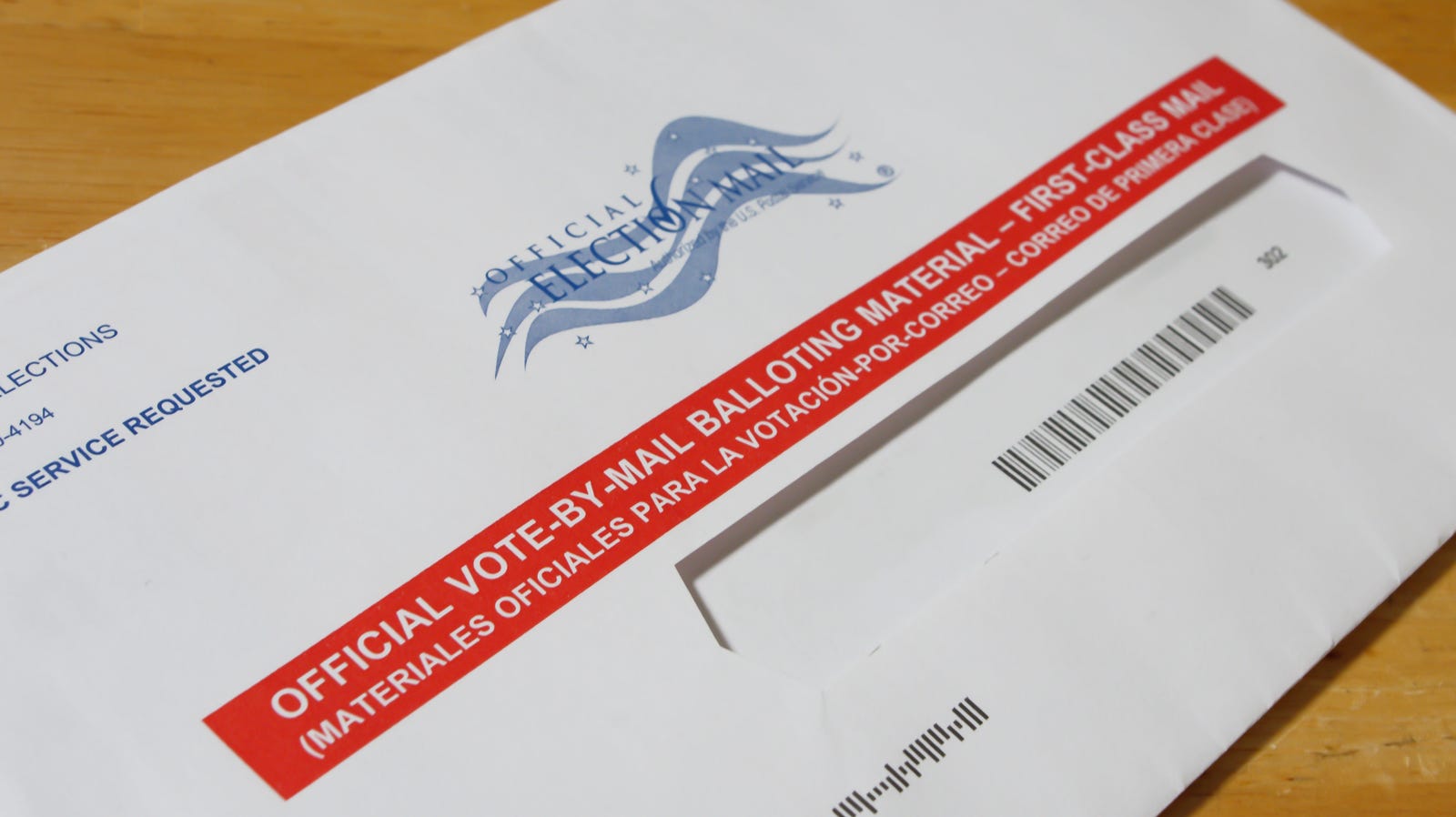
‘…The idea of more states moving toward a mail-in system ahead of November’s election is gaining steam amid the coronavirus pandemic. The dilemma Wisconsin voters faced on Tuesday between staying safe at home or heading to polling places to vote is one most states are interested in helping their citizens avoid. Trump, however, has other, more self-interested concerns.
Not only is the president leading Republican efforts to prevent federal funds from being used for mail-in efforts, but the briefing on Wednesday revealed he really doesn’t have any good reasons for his position.
Trump was pressed on the point during the White House coronavirus task force briefing by CNN’s Jim Acosta. Acosta referenced claims the president made the day before about why he thinks mail-in voting is bad — “You get thousands and thousands of people sitting in somebody’s living room, signing ballots all over the place,” Trump said — and asked him to back it up.
“I think there is a lot of evidence, but we’ll provide you with some. There’s evidence that’s being compiled just like it’s being compiled in the state of California, where they settled with Judicial Watch saying that a million people should not have been voting. You saw that? I am telling you, in California, in the great state of California, they settled and we could’ve gone a lot further. Judicial Watch settled where they agreed that a million people should not have voted, where they were 115 years old and lots of things and people were voting in their place.”
…Judicial Watch is a right-wing nonprofit led by staunch Trump loyalist Tom Fitton. The settlement Trump referred to is a January 2019 agreement between the organization and Los Angeles County that required the county to remove inactive registrations from the voter rolls. By definition, these people hadn’t voted — that’s why their registrations were inactive. Yet Trump has somehow spun this into an unfounded claim about a million people casting illegal ballots….’

‘You can’t usually train Face ID while you’re wearing a mask, because the iPhone doesn’t recognize that you are even showing it a face. Just like how Portrait mode on the camera sometimes refuses to lock on, if you simply don a mask and try to train Face ID, it will fail.
What you need is a way to trick the Face ID training app into recognizing you. The trick, according to students at the Xuanwu Lab, is to wear half a mask. If you fold the mask — any kind of mask will work — in half, vertically, then the iPhone will see the other half of your face. It takes some finessing, but once it locks on, you’re good to go.
Step one is to fold your mask in half and stand in front of a mirror. The mask should cover the parts of your face that it will cover when you’re wearing it normally. This includes (half of) the tip of the nose. Use the mirror to get everything right, then open up the Face ID section of the Settings app on your iPhone: Settings > Face ID & Passcode. If you only set up one Face ID appearance, then tap on the button to add an alternative appearance. If you’ve already added an alternative, you should reset Face ID and begin over.
Now, proceed as usual. If the app doesn’t recognize your face, move the mask to occlude your face a little more. Then, gradually reveal it again, until the app’s scanner locks on. Finally, move your head as instructed to scan your new masked appearance.
If you have trouble holding the mask in place (it shouldn’t move relative to your face), keep your head still and move the iPhone instead….’
‘Although President Trump has directed states and hospitals to secure what supplies they can, the federal government is quietly seizing orders, leaving medical providers across the country in the dark about where the material is going and how they can get what they need to deal with the coronavirus pandemic.
Hospital and clinic officials in seven states described the seizures in interviews over the past week. The Federal Emergency Management Agency is not publicly reporting the acquisitions, despite the outlay of millions of dollars of taxpayer money, nor has the administration detailed how it decides which supplies to seize and where to reroute them.
Officials who’ve had materials seized also say they’ve received no guidance from the government about how or if they will get access to the supplies they ordered. That has stoked concerns about how public funds are being spent and whether the Trump administration is fairly distributing scarce medical supplies….’

‘Our constitutional tradition gives us hardly any tools to address what is happening now: a president who has proved unwilling or unable to meet a genuine disaster with decisive action. The Constitution’s preamble speaks of promoting the general welfare and providing for the common defense, but courts have never read this language to create enforceable duties. Nearly all U.S. constitutional rights are so-called negative rights against government interference, not positive rights that force public officials into action. And unlike many other democracies, our Constitution lacks a “no-confidence” mechanism that could allow a poorly performing president to be replaced immediately with a more effective one.
The upshot, in this case, is a kind of invisible breakdown in our constitutional system. If Trump had taken strong steps over the past two months to limit the spread of COVID-19, those steps could have been tested for conformity with individual liberties, federalism principles, and the separation of powers, as well as relevant statutes. Yet by jeopardizing our national security through inaction, Trump has insulated himself from legal scrutiny or accountability.
Only one institution can remedy this breakdown. In area after area where government intervention might be useful, Congress has the power, under Article I of the Constitution, to compel the executive branch to act.
Recognizing as much, congressional Democrats have introduced bills that would require the executive branch to oversee the production of specific quotas of N95 face masks, face shields, and ventilators. The Defense Production Act of 1950 already empowers the president to do what is “necessary to create, maintain, expedite, expand, protect, or restore production and deliveries or services essential to the national defense,” but Trump did not utilize this power at all until March 27 (he invoked it again last Friday), and even then in a limited manner that falls far short of what many experts recommend. The new bills would give him no choice but to press harder….’

‘an emerging body of data suggests that there are probably a significant number of infected people who don’t have symptoms but are likely to be transmitting the virus. Since they may not know that they’re sick, they may be taking fewer precautions than people with symptoms.
Researchers still don’t know how common these cases are or how much they are driving the pandemic. On Monday, the director of the CDC told NPR that the number of asymptomatic individuals “may be as many as 25%.”…’

‘The deserted streets will fill again, and we will leave our screen-lit burrows blinking with relief. But the world will be different from how we imagined it in what we thought were normal times. This is not a temporary rupture in an otherwise stable equilibrium: the crisis through which we are living is a turning point in history.
The era of peak globalisation is over. An economic system that relied on worldwide production and long supply chains is morphing into one that will be less interconnected. A way of life driven by unceasing mobility is shuddering to a stop. Our lives are going to be more physically constrained and more virtual than they were. A more fragmented world is coming into being that in some ways may be more resilient….’
‘President Donald Trump said on Friday that the Centers for Disease Control will soon officially begin recommending the public use of non-medical, non-surgical grade masks to slow the spread of COVID-19.
“You don’t have to do it. … I don’t think I am going to be doing it,” Trump said about wearing a face mask, during his announcement that the CDC now recommends people wear face masks.
“We’re healing,” the president added, without evidence….’

‘As it turns out, my notebooks—with their pressed flowers, theater-ticket stubs, different colors of sand glued onto the page, the shells, old photographs that have tumbled out of drawers—are like that red wheelbarrow, beside the white chickens, upon which so much depends. William Carlos Williams, as poet and medical doctor, would have appreciated what neuroscientists call the efficacy of writing on paper. Besides offering a sense of control, paper and pens and anything else we take to it helps us make sense of things. Students who take lecture notes by hand retain and understand the information more deeply than those who take notes on computers because something beautiful and mysterious happens when we relinquish speed to the human pace of thought, physicalized on the page.
But that’s not why my notebook comes with me everywhere. I take it with me because it helps me track the uncharted territory of the present moment. In this act of gathering—scrawls about things noticed on the way to a store, the playbill for my son’s brief acting career, glue-sticked to the page—I’m forced to slow down and tend to the parts that evoke a whole. Sometimes they plant the seed for an idea that I might write about later on. But mostly, I relish in the quiet engagement of pen on paper, my hand working with my brain to create something concrete and real, something that can’t be deleted in an instant after it is read….’

‘The entire world is scrambling to mitigate the novel coronavirus pandemic. By now, a majority of US states are under some kind of stay-at-home order, with governors nationwide asking or requiring non-essential businesses to close and everyone to plant their butts at home as much as possible.
As the disease continues to march its way across the country and the globe, though—as of this writing, there have been more than 250,000 US diagnosed cases—officials, regulators, and we the work-from-home masses are all wondering: are we all actually complying with these new rules, or is it still chaos on the streets out there somewhere?
Google has unfathomable reams of data from billions of individuals worldwide, and it has pulled some of that location information together into community mobility reports to try to answer that question. Here’s the good news: by and large, trips to virtually everywhere that isn’t “home” have dropped a whole lot.
To make the reports, Google used location data from any account that has opted into allowing Google to store location history. The company’s services have billions of active daily users, so even if only a minority of users allowed location use, it would still create an enormous data set. Google broke down locations into six broad categories: Retail and recreation, such as malls, restaurants, and museums; grocery and pharmacy, which includes farmer’s markets and food warehouses along with supermarkets and drugstores; parks, including local, national, and state parks; transit stations; workplaces; and residential.
The reports, which so far go through March 29 (last Sunday), are broken down by country. For the United States, Google has also provided state-level reports which show data at the county level. While there’s a fair amount of variation, the trend across the board shows a huge drop in non-essential travel and significantly reduced travel in the grocery and pharmacy category as well. The “residential” category is also up across the board, showing that people are staying home.
The regional reports are more robust for urban centers than rural ones, simply because more densely populated areas have more data for Google to draw from. For example, Kings County, New York—better known as the borough of Brooklyn—has a population of about 2.5 million packed into its borders. That’s a large enough data set for Google, which found that Brooklyn residents are indeed making significantly fewer trips through transit stations and to retailers. Travel to workplaces is also down, likely due to a combination of people working from home where possible and being laid off or furloughed where not….’
Via Digg:‘Covering 121 questions and 400 characters, this “which character are you” test from Open-Source Psychometrics Project isn’t your regular BuzzFeed personality quiz.
What it is instead is an extremely extensive test that gives you an understanding of which fictional characters you are most similar to with a level of detail uncommon for most personality quizzes. There are different versions of the test — the most comprehensive version requires you to answer 121 questions while the standard version only comprises 28 — but for each version, you answer questions about yourself by moving a slider between two adjectives and gauge where your personality falls on the spectrum. The test then matches your personal assessment with the personality profiles of different fictional characters, which are compiled from data from user surveys….’
![]()
‘Quick, decide: If 20 percent of a city’s police department is infected or quarantined because of the coronavirus, how should the remaining officers decide which problems to take on? …
Also decide: Which patients should doctors and nurses prioritize for life-saving efforts if hospitals simply become overwhelmed? Who wants to write that policy? …
Then decide: Should schools even try to open anytime soon? …
On these and other ugly questions, recent experience suggests that the White House is unlikely to do anything more than provide broad guidance to states—and then leave the hard part to them. That’s no way to fight a 50-state disaster, but federalism is a convenient way for a president to let somebody else take the blame…’

‘The coronavirus pandemic has brought chaos to lives and economies around the world. But efforts to curb the spread of the virus might mean that the planet itself is moving a little less. Researchers who study Earth’s movement are reporting a drop in seismic noise — the hum of vibrations in the planet’s crust — that could be the result of transport networks and other human activities being shut down. They say this could allow detectors to spot smaller earthquakes and boost efforts to monitor volcanic activity and other seismic events….’
Speaker Nancy Pelosi says there are “serious constitutional” concerns with remote voting. Is she right?
via Vox
Congress could become incapacitated either by members contracting coronavirus or their reluctance to assemble and risk contagion. Remote voting might be an answer, given surmounting the technological and security challenges. But constitutionality is also a serious barrier, raising the danger of implementing a novel process at risk of being struck down by court challenge. Provisions of the Constitution are open to the interpretation that lawmakers are required to gather together in a single location, the Founding Fathers of course unable to be be faulted for not anticipating cyberspace or virtual reality. However, legislative bodies are empowered to establish their own rules about how votes are to be cast. Democrats worry that the Supreme Court under Roberts would not agree with this argument, especially given the vastly increased tendency of this Court to overturn precedent. The author suggests a mechanism of getting an advisory ruling on the constitutionality of remote voting before a test case is brought, so that the partisan Court would not be considering a specific legal provision that one party supports and the other opposes. However, although used on the state level, Federal advisory opinions are currently unconstitutional and would require an amendment to permit them.
As the coronavirus pandemic grows, it brings a secondary, economic disaster—unemployment, small business closings, local government budget shortfalls. Given the way our economy is structured, widespread job losses and plummeting consumer demand trigger a whole lot of suffering. But, as philosopher Barbara Muraca explained in 2013, the activist and scholarly movement known as degrowth is building a vision of a society where economies would get smaller by design—and people would be better off for it.
Muraca traces the start of the degrowth movement to the 1972 publication of Limits to Growth, an influential report by the Club of Rome. The report presented an ecological argument—that humans were unsustainably consuming the Earth’s resources. In the years that followed, French scholars expanded the argument into social and psychological realms. They critiqued the central role of constant growth in modern western societies. By the early 2000s, degrowth had come to include criticism of wealthy countries’ advocacy of “Western-style” growth-oriented economies in the Global South. For example, some degrowth writers embrace the struggles of indigenous people in Ecuador and Bolivia to achieve a constitutional right to a “buen vivir”—a concept of community-level well-being rooted in economic and cultural relationships with local ecological systems.
When it comes to what an ideal degrowth society would look like, the writers Muraca cites are not a unified bloc. Some focus on small-scale democracy and economic activity, such as local food systems. Others envision the centrally planned production and distribution of a minimal set of goods to satisfy everyone’s basic needs. Some degrowth thinkers have also advocated universal basic income or jobs guarantees as ways to provide for people’s basic necessities while reducing overall economic activity and resource use.
Whatever the specifics, degrowth is a radical idea. But it’s gotten increasing traction among activists and scholars in rich countries, particularly since the worldwide recession in 2008. Given the need to reduce carbon emissions to lessen the impacts of climate change, curbing material consumption in rich places seems to many like a necessary goal.
via JSTOR Daily
The number of MoMA-CIA crossovers is highly suspicious, to say the least….
In the battle for “hearts and minds,” modern art was particularly effective. John Hay Whitney, both a president of MoMA and a member of the Whitney Family, which founded the Whitney Museum of American Art, explained that art stood out as a line of national defense, because it could “educate, inspire, and strengthen the hearts and wills of free men.”
via JSTOR Daily
Michael Hill has no intention of letting a global pandemic cancel plans for the League of the South’s annual conference.
The 68-year-old Hill, president of the League, posted the following to the group’s website March 18.
“At present, we are doing more than simply ‘monitoring’ the situation. We are actively making plans and raising funds to help our members who are in financial straits, and we are moving ahead with our plans for upcoming events, including our 2020 national conference in late June.”
Hill’s decision goes against the Centers for Disease Control and Prevention’s (CDC) recommendations against gatherings of more than 10 people. Older adults in particular are likely at higher risk for the disease, the CDC notes. The average age of the League’s state chairmen and national staff is roughly 57.
via Boing Boing
Although I must be breaking some PC principle to do so, since it doesn’t appear that others are saying this, this and other recent stories, such as —
— have me stating the obvious. The pandemic seems poised as a proof of concept re: social Darwinism. It may be selecting against the unfittest in terms of factors like respect for scientific (e.g. epidemiological and public health) principles, deference for experts, altruistic concern for the good of one’s peers, and openness to being educated. (If only their selfish ignorance did not place the potentially innocent around them at risk too.) I wonder if there is any empirical data that people in such a demographic are being infected at higher rates?
…[W]hat you’re washing with has a much bigger statistical effect than how long you’re washing….
Another good example is the temperature you wash at. Namely, it doesn’t matter. Again, the issue is about the soap and about how you’re rubbing your hands around. That will work in cold water as well as warm. But the Food and Drug Administration’s food code for restaurant safety still expects hand-washing sinks to be able to deliver very hot water.
For authoritarian-minded leaders, the coronavirus crisis is offering a convenient pretext to silence critics and consolidate power. Censorship in China and elsewhere has fed the pandemic, helping to turn a potentially containable threat into a global calamity. The health crisis will inevitably subside, but autocratic governments’ dangerous expansion of power may be one of the pandemic’s most enduring legacies.
The biopharmaceutical industry will be able to make a Covid-19 vaccine— probably a few of them—using various existing vaccine technologies. But many people worry that Covid-19 will mutate and evade our vaccines, as the flu virus does each season. Covid-19 is fundamentally different from flu viruses, though, in ways that will allow our first-generation vaccines to hold up well. To the extent that Covid does mutate, it’s likely to do so much more slowly than the flu virus does, buying us time to create new and improved vaccines.
via 3 Quarks Daily
The response to the pandemic illustrates five actions we can take to address the global climate change crisis:
- Rethink risk
- Global perspective
- Prioritize people
- Trust experts
- Make a cultural shift
via Big Think
Taking time for thoughtful consideration has fallen out of fashion, writes Emily Chamlee-Wright. How can we restore good faith and good judgement to our increasingly polarized conversations?
…Emily Chamlee-Wright recommends practicing the presumption of good faith. That means that we should presume, unless we have good evidence to the contrary, that the other person’s intent is not to deceive or to offend us, but to learn our point of view.
via Big Think
‘President Trump on Monday morning became the latest in a procession of Republicans to say making it easier for more people to vote would hurt his party politically.
In an interview on “Fox & Friends,” Trump referenced proposals from Democrats in the coronavirus stimulus negotiations that would have vastly increased funding for absentee and vote-by-mail options. The final package included $400 million for the effort, which was far less than what Democrats had sought.
“The things they had in there were crazy,” Trump said. “They had things — levels of voting that, if you ever agreed to it, you’d never have a Republican elected in this country again.”…’
Via Washington Post

‘Besides connecting with those closest to us, many of us can sleep in and organize lives in ways that suit our biological ticker. Larks can go to bed earlier and owls can snooze in. Families can synchronize their meal and play routines in new ways, honoring the time of their internal clock (what chrono-biologists call the ‘circadian’ phase’). For most of our history we slept with one another when our bodies told us too, not by ourselves and only when work allowed. This may be an unprecedented opportunity to embrace a basic human need to switch off on a regular basis, helping human bodies fight the wars only those bodies know how….’

‘Three progressively heavier copies of each type of matter particle exist, and no one knows why. A new paper by Steven Weinberg takes a stab at explaining the pattern….’
![]()
‘In terms of bacterial shedding, “there is no difference in bearded and non-bearded men,” said Carrie Kovarik, an associate professor of dermatology and medicine at the University of Pennsylvania. In her study of the phenomenon, Dr. Kovarik found that bearded people might actually carry fewer germs than their clean-shaven counterparts — perhaps because the “micro-trauma” that shaving inflicts on the skin opens up space for bacteria to congregate. But while Park’s lactic fearmongering might seem like the bygone panic of another era, the associations of beards with disease have proven strangely resilient….’

‘At a White House briefing on the coronavirus on March 20, President Trump called the State Department the “Deep State Department.” Behind him, Dr. Anthony S. Fauci, the director of the National Institute of Allergy and Infectious Diseases, dropped his head and rubbed his forehead.
Some thought Dr. Fauci was slighting the president, leading to a vitriolic online reaction. On Twitter and Facebook, a post that falsely claimed he was part of a secret cabal who opposed Mr. Trump was soon shared thousands of times, reaching roughly 1.5 million people.
A week later, Dr. Fauci — the administration’s most outspoken advocate of emergency measures to fight the coronavirus outbreak — has become the target of an online conspiracy theory that he is mobilizing to undermine the president.
That fanciful claim has spread across social media, fanned by a right-wing chorus of Mr. Trump’s supporters, even as Dr. Fauci has won a public following for his willingness to contradict the president and correct falsehoods and overly rosy pronouncements about containing the virus.
An analysis by The New York Times found over 70 accounts on Twitter that have promoted the hashtag #FauciFraud, with some tweeting as frequently as 795 times a day. The anti-Fauci sentiment is being reinforced by posts from Tom Fitton, the president of Judicial Watch, a conservative group; Bill Mitchell, host of the far-right online talk show “YourVoice America”; and other outspoken Trump supporters such as Shiva Ayyadurai, who has falsely claimed to be the inventor of email….’
All I can say is that the contempt of the contemptible is a compliment.
‘Mr. Penderecki was regarded as Poland’s pre-eminent composer for more than half a century, and in all those years he never seemed to sit still. Beginning in the 1960s with radical ideas that placed him firmly in the avant-garde, he went on to produce dozens of compositions including eight symphonies, four operas, a requiem and other choral works, and several concertos he cheerfully described as being almost impossible to play….’
![]()
‘As pictures of empty shelves dominated our social-media feeds here…, armchair critics denounced their fellow citizens as selfish and greedy. Stop hoarding! End the panic-buying!
Hang on, though. Were hordes of selfish [shoppers] really squirreling away 90 tins of tuna each? As the fog of panic dissipates, the answer is clear: No. Instead, the data show that small changes in the habits of a minority of shoppers prompted lurid headlines about empty shelves—which then made others, quite rationally, change their behavior. That has led to short-term supply issues. (Neither of the two stores closest to me… has any eggs in stock, for example.)
Any student of economics will tell you that modern supply chains rely on just-in-time ordering. In the case of … supermarkets, production schedules are tailored precisely to demand, so that unused stock does not sit in warehouses or go to waste. In the current crisis, [we have] not run out of essential goods such as toilet paper; the difficulty is getting them onto the shelves quickly enough….’
From a stately Scottish elm to a might Russian oak, competitors for the title of European tree of the year do their nations proud

The Guardian of the Flooded Village, Chudobín, Czech Republic. Photograph: Marek Olbrzymek/2020 European Tree of the Year
Last week, a pine tree near a flooded Czech village was voted European tree of the year. Known to the locals of Chudobín as the Guardian of the Flooded Village, the tree is estimated to be 350 years old – the villagers attribute its supernatural powers to tales of a devil who played the violin beneath it during the night. Once part of a larger forest, it was left isolated after the area was flooded during the construction of a dam.

The Allerton Oak. Photograph: Christopher Thomond/The Guardian
England’s finalist in the tree of the year vote was the Allerton Oak in Calderstones Park, Liverpool. It is thought to be about 1,000 years old, and has a girth of 5.5 metres, producing 100,000 acorns per year. In medieval times, court cases were held beneath its canopy and more recently, it is thought Paul McCartney and John Lennon would cycle past the tree on their way to college.

The Last Ent of Affric. Photograph: Niall Benvie
This elm, nicknamed after the sentient trees in JRR Tolkien’s The Lord of the Rings trilogy, was crowned Scotland’s tree of the year. The Last Ent of Affric is a lonely specimen, but isolation protected it from Dutch elm disease – social distancing for trees, if you will. It grows near Glen Affric in the Highlands. Its remote location meant it was long forgotten until it was rediscovered in 2012.

The Bird Tree of Ghisonaccia. Photograph: Pierre Huchette/2019 European Tree of the Year
The 2019 French tree of the year was the Bird Tree of Ghisonaccia, in the Haute-Corse area of Corsica. A cork oak about 200-230 years old, it is so named because of its unusual silhouette – similar to a bird of prey with extended wings. The curious shape is thought to have been caused by a fire.

The Abramtsevo Oak. Photograph: treeoftheyear.org
In 2019, Russia nominated this oak, which stands in the grounds of the Abramtsevo museum, a former artists’ colony north-east of Moscow. The 249-year-old specimen with an impressively far-reaching crown is claimed to have inspired many Russian writers and artists – from the novelist Ivan Turgenev to landscape painters Isaac Levitan and Viktor Vasnetsov.
Via The Guardian

The prevalence of autism spectrum disorder in eleven surveillance sites is 1 in 54 among children aged eight. This is a 10% increase from 2014 when it was 1 in 59. Since 2000, prevalence rates of ASD have almost tripled, from 0.67% to 1.85%., according to Johns Hopkins Bloomberg School of Public Health
The media is replete with COVID–19 stories about people clearing supermarket shelves – and the backlash against them. Have people gone mad? How can one individual be overfilling his own cart, while shaming others who are doing the same?
As a behavioral neuroscientist who has studied hoarding behavior for 25 years, I can tell you that this is all normal and expected. People are acting the way evolution has wired them.
Via Boing Boing:We’re not sure why Dean Allyson Green thought that a video of herself dancing to Rem’s “Losing My Religion” would be in any way a helpful response to NYU students’ recent requests for a tuition refund, given that virtual classes weren’t what they signed up for, especially considering NYU’s costly tuition.
According to Michael Price, the NYU student who uploaded the video on Twitter, Green asked the students to “dance along with her” in the email after explaining that the school wouldn’t be able to give them refunds.

‘Health-care providers are bound by oath — and in some states, by law — to do everything they can within the bounds of modern technology to save a patient’s life, absent an order, such as a DNR, to do otherwise. But as cases mount amid a national shortage of personal protective equipment, or PPE, hospitals are beginning to implement emergency measures that will either minimize, modify or completely stop the use of certain procedures on patients with covid-19….’
I can’t tell you how upset I am by this trend, although I assume it is being blown out of proportion in the service of sensationalism. It is much more likely that there will be some triaging around the futility of heroic measures on a case-by-case basis. And, let’s not kid ourselves — there always is and always has been in the practice of medicine, it is just not publicized or codified in an official change in hospital policy as is being discussed now.
If all it took us to get to this point is a looming shortage of personal protective equipment for frontline healthcare workers, then place American industry on a wartime footing and make the damn PPE! Instead, leaping to a blanket override on the advanced directive wishes of patients, or families of patients, with a particular disease is such a wholesale abandonment of ethical principles at the first sign of adversity (yes, I know, not actually the first sign) that it makes a mockery of there being any ethical standards at all, makes a mockery of the supposedly altruistic motives that make the practice of medicine a worthwhile endeavor. Not only will it kill people en masse but it will kill the souls of those who participated for the rest of their careers.
Via Myths of Vision Science:‘…[T]he popular type of study I’ve just described is known not to replicate. And while a lot of ink has been spilled (not least in the pages of Nature) over the ongoing “replication crisis” in neuroscience; while we even have a “Center for Reproducible Neuroscience” at Stanford; while paper after paper has pointed out the barrenness of the procedure (Jonas & Kording’s (2017) “Can a neuroscientist understand a microprocessor?” was a popular one); while the problems with post hoc inferences have been known to philosophers and scientists for hundreds of years; the technique remains the dominant one. As Konrad Kording has admitted, practitioners get around the non-replication problem simply by avoiding doing replications.
So there you have it; a sure-fire method for learning…nothing….’
(Thanks, Noah)
Via Boing Boing:‘”KUOW is monitoring White House briefings for the latest news on the coronavirus — and we will continue to share all news relevant to Washington State with our listeners. However, we will not be airing the briefings live due to a pattern of false or misleading information provided that cannot be fact checked in real time.”…’
Mark Joseph Stern writing in Slate:‘…[T]he 1st U.S. Court of Appeals ruled on Tuesday that the administration’s assault on sanctuary cities is illegal. The panel’s unanimous decision—joined, notably, by retired Supreme Court Justice David Souter —affirms cities’ right to keep unauthorized immigrants out of their own jails and help them avoid federal detention….’
Political strategist Stanley Greenberg writing in The Atlantic:‘The release on Friday of an ABC News/Ipsos poll indicating that 55 percent of Americans approved of Donald Trump’s handling of the coronavirus—12 points higher than the previous week—prompted another round of fatalistic chatter in certain quarters of the political establishment. Shocked by Trump’s victory in 2016, some left-leaning commentators and rank-and-file Democrats alike have been steeling themselves for his reelection in 2020, noting that most presidents win second terms; that, at least before the pandemic, the economy was humming along; and more recently that, during moments of national disaster, Americans tend to rally around the leader they have.
But these nuggets of conventional political wisdom obscure something fundamental—something that even Democrats have trouble seeing: The United States is in revolt against Donald Trump, and the likely Democratic nominee, former Vice President Joe Biden, already holds a daunting lead over Trump in the battleground states that will decide the 2020 election. By way of disclosure, I am a Democratic pollster; for professional and personal reasons alike, I want Democratic candidates to succeed. But no matter what, I also want candidates and party operatives to base decisions—such as where and how to campaign—on an accurate view of the political landscape. At the moment, Democrats are underestimating their own strength and misperceiving the sources of it….’
Psychologist Linda Michaels writing in Aeon:‘the biomedical model (favoured by psychiatry) and the short-term, structured therapy model (favoured by psychology) don’t work as well as they should. These treatments seem easy to administer, but is a ‘quick fix’ really what’s called for when addressing complex problems in life? Is it possible that one type of therapy – CBT and its family of treatments – can work for nearly every person and every problem so successfully?…’
Olga Khazan writing in The Atlantic:‘…[C]reative types, such as artists and writers, were more likely than, say, businesspeople to be considered “odd or peculiar” as children, and more likely than public officials or soldiers to be considered “different” as adults. In his 1962 study of architects, the psychologist Donald W. MacKinnon similarly found that the families of more creative architects had moved around a lot when they were kids, which appeared “to have resulted frequently in some estrangement of the family from its immediate neighborhood,” he said. Not surprisingly, many of the more creative architects said they’d felt isolated as children.
An unusual childhood is not the only thing that can make you more creative. Being considered “weird” in your culture can also enhance an element of creativity called “integrative complexity.” People who are strong in integrative complexity tend to handle uncertainty well and excel at reconciling conflicting information. They’re often able to see problems from multiple perspectives….’
‘President Trump and some of his senior officials are losing patience with the doctors’ orders.
Amid dire predictions for jobs and the economy, the White House is beginning to send signals to business that there’s light at the end of the tunnel — that the squeeze from nationwide social distancing won’t be endless… Senior Trump officials, including the president himself, have only limited patience for keeping the economy shut down. They are watching stocks tumble and unemployment skyrocket.
Trump tweeted at 10 minutes to midnight: “WE CANNOT LET THE CURE BE WORSE THAN THE PROBLEM ITSELF. AT THE END OF THE 15 DAY PERIOD [which began a week ago, March 16], WE WILL MAKE A DECISION AS TO WHICH WAY WE WANT TO GO!” …
At the end of the 15-day period, there will likely be a serious clash between the public health experts — who will almost certainly favor a longer period of nationwide social distancing and quarantining — versus the president and his economic and political aides, who are anxious to restart the economy….’
Via Axios
‘As we spend time in self-isolation, let’s think about all the people who depend on us to make a living: the Lyft driver, the dry cleaner, the child-care provider, the barista at the coffee shop. As everything from sports games to evenings out with friends gets canceled because of covid-19, economic activity is grinding to a halt?
People are starting to practice not only social distancing but also economic distancing, which leaves a lot of people — especially the most economically vulnerable — in the lurch. It’s easy to feel powerless watching the human toll mount. What can we do to make a difference when we’re stuck at home, disconnected both socially and economically?…’
Lili Loofbourow writing in Slate:‘People familiar with Trump’s limited but effective toolbox will recognize by now that the turn to racism is a sign of Trumpian distress. It means that Trump—who hasn’t been able to hold rallies amid his adoring fans—is feeling not just insecure but trapped. He thought the coronavirus was one more narrative he could control. He couldn’t. And so, perhaps sometime around March 16, when he first used the phrase “Chinese Virus” on Twitter himself, it became clear that the president was ready to embrace an ugly construction Mike Pompeo and others had earlier tried to mainstream….’
Robby Berman writing in Big Think:‘I turns out that stress activates nerves associated with our basic fight-or-flight system, and these nerves permanently damage pigment-regenerating melanocyte stem cells in hair follicles, causing them to cease production of melanin that normal provides color to hair follicles…’
Molly Hanson writing in Big Think:‘Here’s one less coronavirus worry: Your pets are likely safe from the virus according to medical experts.
Last month, a dog was quarantined in Hong Kong after having tested a “weak positive” for the novel coronavirus igniting public worry about the possibility of pets becoming infected.
Medical experts are saying that there is no evidence that the virus that causes COVID-19 can infect pets, which have different cell receptors….’

’The president of the United States is a menace to public health.
I don’t mean that I disagree with him on policy, although I do. I don’t mean that I abhor the president’s expressed bigotry toward religious and ethnic minorities, although that is also true. I am not referring to Donald Trump’s efforts to corrupt the Justice Department, shield his criminal associates from legal peril, or funnel taxpayer money to his tacky hotels and golf courses, although all of these things are reason enough to oppose the president.
What I am referring to is the fact that, soon after the coronavirus outbreak emerged in China, the rest of the world began to regard it as a threat to public health, while Trump has seen it as a public-relations problem. Trump’s primary method of dealing with public-relations problems is to exert the full force of the authoritarian cult of personality that surrounds him to deny that a problem even exists. This approach has paid political dividends for the Republican Party, in the form of judicial appointments, tax cuts for the wealthy, and a rapid erosion of the rule of law. But applied to the deadly pandemic now sweeping the planet, all it has done is exacerbate the inevitable public-health crisis, while leaving both the federal government and the entire swath of the country that hangs on his every word unprepared for the catastrophe now unfolding in the United States. The cardinal belief of Trumpism is that loyalty to Trump is loyalty to the country, and that equation leaves no room for the public interest….’
Esther Wang writing in Jezebel:‘As more Americans are being asked to shelter in place and practice social distancing to stop the spread of the novel coronavirus, one group of people will be particularly impacted—survivors of domestic violence and abuse, for whom home is dangerous…
Jezebel spoke with advocates in states around the country to hear from them on how they are responding in this moment, why they believe that they will see an increased need for shelter and other forms of support for survivors, and what we can do to help both survivors and the organizations that work with them….’
Cory Doctorow, Science Fiction Author on one of his ‘Cool Tools’:‘Libro.fm is an independent audio book platform that sells every single audio book in MP3 form, with the exception of Audible originals. But every other audio book, in every publisher’s catalog is available for sale from Libro.fm at the same price that Audible sells it at, but without DRM. And you tell them what your favorite bookstore is, and they will give them a commission every time you buy it, on the grounds that you’ve probably gone into that bookstore, perused the book in paper edition and then got back and bought the audio version from Libro….’
If you’re not on the go as much now, you might have more time to actually read a book instead of listening to one (which I do on my commutes), but this may be useful nonetheless.
Tomas Pueyo writing in Medium:
‘Strong coronavirus measures today should only last a few weeks, there shouldn’t be a big peak of infections afterwards, and it can all be done for a reasonable cost to society, saving millions of lives along the way. If we don’t take these measures, tens of millions will be infected, many will die, along with anybody else that requires intensive care, because the healthcare system will have collapsed….’ (Via Kottke)
‘We’ve known about SARS-CoV-2 for only three months, but scientists can make some educated guesses about where it came from and why it’s behaving in such an extreme way….’
— Ed Yong writing in The Atlantic
One of the science writers I consider most lucid and erudite.
So you’re stuck at home. There’s a pandemic. What to do?
Maybe you’re into art. Or maybe you’re not — but you always secretly thought you might be if you only had the chance.
Well, now you have the chance. But of course, there’s a problem. Almost all of the art museums have closed. It’s depressing. The incredible Degas show …? Shut. The Gerhard Richter show — maybe the last major one in his lifetime — at the Met Breuer? Closed for business. Just like everything else.
Don’t worry, friends! The museums will eventually reopen. But in the meantime: We are so lucky. There are options galore online…
From the soothing how-to-paint videos of Bob Ross — perfect if you’re feeling anxious — to William Kentridge’s 2012 Charles Eliot Norton Lectures at Harvard University — the most brilliant, challenging and entertaining series of lectures on art ever delivered — there’s something to suit every mood, every taste, every flavor of idleness.
Here are some of my favorites…
Via Washington Post
Via WIRED:‘The country has the second-oldest population on earth, and its young mingle more often with elderly loved ones….’
Beth Skwarecki writing in Lifehacker:‘…[T]he World Health Organization issued guidelines a few years ago about naming diseases in a way that describes them accurately, without stigmatizing people or places or inciting unnecessary fear. Diseases are now supposed to be named after their symptoms, characteristics, and the cause of the disease if known. COVID-19, short for “coronavirus disease discovered in 2019,” is an appropriate name. Here’s what they don’t recommend:
Terms that should be avoided in disease names include geographic locations (e.g. Middle East Respiratory Syndrome, Spanish Flu, Rift Valley fever), people’s names (e.g. Creutzfeldt-Jakob disease, Chagas disease), species of animal or food (e.g. swine flu, bird flu, monkey pox), cultural, population, industry or occupational references (e.g. legionnaires), and terms that incite undue fear (e.g. unknown, fatal, epidemic).
So, yes, there were diseases named that way in the past, but the public health community learned from their mistakes and we don’t do that anymore.Anybody who is arguing, today, in 2020, for a geographical name for a disease is either naive of this history (send them this article!) or is trying to deliberately stir up xenophobic sentiments. World leaders are now blaming each other for the virus, which is silly. It’s just a virus. So let’s take it seriously and call it by its real name….’
There’s something harmful and horrific spreading across this country, and it’s not a biological illness. It’s the idea that calling coronavirus “kung flu” is funny.
I shouldn’t have to say this. You know not to be a racist xenophobic jerk, right? Many of you reading this would, in fact, never consider making such jokes. And for this you shall be awarded one gold star and the responsibility to stare dead-eyed at your friends who say racist things and say “Wait, I don’t get it. Explain to me again why that’s funny?”
PS: The ‘Spanish Flu’ probably started in Kansas.
‘So the message has now gone forth: It’s time for Trump supporters to stop denying that the coronavirus is a big deal and focus on praising Trump’s extraordinary leadership in this time of crisis.
This is a shift that will take a bit of time to diffuse through the right, but it has a few key elements to it….’
— Paul Waldman writing in The Washington Post
Quinn Myers writing in Mel:‘Dasani… along with Smartwater, Aquafina and “any other bottled water that doesn’t say ‘spring water’ on the bottle,” is a capitalistic abomination. They take tap water and filter out all of the minerals and chemical contaminants before inserting some combination of minerals until the combination creates a flavor profile people like. “It’s the biggest lie on planet Earth,”…’
Gideon Lichfield writing in MIT Technology Review:‘Social distancing is here to stay for much more than a few weeks. It will upend our way of life, in some ways forever.
To stop coronavirus we will need to radically change almost everything we do: how we work, exercise, socialize, shop, manage our health, educate our kids, take care of family members….’
‘…(I)n recent days, a group of contrarian political leaders, ethicists and ordinary Americans have bridled at what they saw as a tendency to dismiss the complex trade-offs that the measures collectively known as “social distancing” entail.
Besides the financial ramifications of such policies, their concerns touch on how society’s most marginalized groups may fare and on the effect of government-enforced curfews on democratic ideals. Their questions about the current approach are distinct from those raised by some conservative activists who have suggested the virus is a politically inspired hoax, or no worse than the flu….’
Via New York Times
Olivia Messer writing in Yahoo! News:‘William Haseltine, president of the global health think tank ACCESS Health International, who recently chaired the U.S.-China Health Summit in Wuhan, where the virus likely originated, has a theory.
“There are four ways,” the doctor told The Daily Beast. “One, it peters out with the weather. Two, everybody gets infected, so it’s got no new places to go… so it ends—but that’s a pretty horrible ending. Three is a vaccine, which is about a year away. Fourth way is the most likely: We’re going to have a few drugs, within a few weeks to a few months, that prevent people from getting infected—like PrEP for HIV—and for treatment.”…’
Trump has told the American people to dismiss what the media is telling them. First, Trump insisted initial reporting on the crisis was deliberately hyped to harm him. Now Trump is claiming efforts to hold him accountable for all the failings that flowed from that impulse are just more “fake news.”
The big story here is that we’re now seeing just how catastrophically unsuited Trump’s brand of autocracy truly is in the face of a crisis like this one. As Anne Applebaum details, Trump’s enforcement of a loyalty code against civil service professionals, and his retaliation against them for exposing inconvenient truths, paved the way for Trump’s pathologies to hamper the response, because “Trump has very few truth-tellers around him anymore.”
‘There is something we can do immediately that will dramatically help hospitals free up beds and medical equipment to help those suffering from covid-19.
This proposal will save lives the minute that states and other authorities adopt it.
We are in urgent need of emergency laws, or executive orders, in every state that temporarily relax the legal standard of medical malpractice…This is not an end-run to bring about tort reform. It is an emergency step, necessary in a national emergency, to save lives. Here’s why:…
This is not triage. It is a protection that doctors need to avoid exposing uninfected patients to the virus and for ensuring we will have capacity to treat those with advanced cases of covid-19
If we don’t act now, we will exceed our hospital capacity far sooner than we can afford as a society.
The change need not, and should not, be permanent. A three-month suspension would be enough. But we need to make this change immediately.
Changing the legal standard will make it possible for doctors to immediately treat more of the most critically ill patients, while legally protecting them in sending less sick patients home. It will determine how many patients we can treat before the system ceases to function…I know doctors, and I know hospital administrators and lawyers. Removing these concerns will change physician behavior immediately…’
Use acetaminophen (Tylenol) instead?‘French health officials … made a stunning discovery as they’ve been battling the local epidemic: Common drugs you have around the house may worsen your condition if you have an unconfirmed COVID-19 infection.
Nonsteroidal anti-inflammatory drugs (NSAIDs) are a class of medicine that can decrease fever, reduce pain, and prevent blood clots. You may know them by common names like Advil, Ibuprofen, and aspirin. Many of them are sold over the counter without a prescription and are an everyday go-to for some of the symptoms above. (A list of NSAIDs is available over on Wikipedia.)
The coronavirus infection doesn’t necessarily have specific symptoms, and it can mimic cold or flu symptoms. Treating headaches or fever with Advil, Ibuprofen, and any other similar drug might be the usual course of action for many people. But French physicians discovered aggravated cases in COVID-19 patients who weren’t tested for the disease before using Ibuprofen to treat their symptoms at home….’
Via Coronavirus infection may be worsened by a common household drug – BGR
‘The nation’s top infectious disease researchers have repeatedly warned, if not begged, Americans to practice social distancing as the contagious coronavirus spreads through the population.
That’s because, due to a woeful lack of testing in the nation, no one knows how many Americans are infected — and the resulting respiratory disease (COVID-19) is 10 times more lethal than the flu. Sunday morning, Marc Lipsitch, an infectious disease epidemiologist at Harvard University, emphasized this point, noting that the true number of infections is certainly “much higher” than confirmed cases.
But, though some folks are social distancing, many still clearly aren’t. Some are even actively bragging about not doing it. This weekend, journalists and others reported that bars across the nation were packed in Boston, Chicago, Nashville, and New York City.
For those eager to ignore the recommendations of scientists who have squelched deadly virus epidemics in the past — like immunologist Mark Cameron who helped put SARS to rest — consider this: Between 20 to 60 percent of adults globally are expected to become infected, and some 15 percent of cases are severe or critical. It is people over 60 who are most vulnerable. So stopping the virus’ spread will help your older relatives or parents from falling extremely ill, or worse.
“Social distancing is based on the principle of altruism,” Jason Farley, a nurse practitioner for the Division of Infectious Diseases AIDS Service at the Johns Hopkins School of Medicine, told Mashable last week. “Treating everyone around you like it’s your 80-year-old grandmother is the circumstance we need to think about.”…’
Neuroskeptic writing in Discover Magazine:‘Thirty-three brave volunteers took part in an experiment on the effects of psychedelic drugs on creativity. After passing rigorous medical screening, the volunteers were admitted to a specially prepared hospital room, where they were each given a 4 mg dose of a synthetic hallucinogen.
Within fifteen minutes or so, they began to feel the effects, including perceptual distortions mood changes, and sometimes anxiety. Several participants reported changes in experience stronger than those previously seen in people after moderate or high doses of LSD and other psychedelics.
Finally, after 3 and a half hours, the experiment was over and the effects had worn off. The lead experimenter gathered the volunteers together and announced that the whole thing had been an elaborate fake. The pills they had taken were only placebos.
This is the story reported in a lovely new paper published in Psychopharmacology from researchers Jay A. Olson of McGill university. It’s called Tripping on nothing: placebo psychedelics and contextual factors.
The paper describes how the researchers went to great lengths to create a believable appearance of a drug study, and thus facilitate the placebo effect….’
Let’s conservatively assume that there are 2,000 current cases in the US today, March 6th. This is about 8x the number of confirmed (lab-diagnosed) cases. We know there is substantial under-Dx due to lack of test kits; I’ll address implications later of under-/over-estimate.
We can expect that we’ll continue to see a doubling of cases every 6 days (this is a typical doubling time across several epidemiological studies). Here I mean actual cases. Confirmed cases may appear to rise faster in the short term due to new test kit rollouts.
We’re looking at about 1M US cases by the end of April, 2M by ~May 5, 4M by ~May 11, and so on. Exponentials are hard to grasp, but this is how they go.
As the healthcare system begins to saturate under this case load, it will become increasingly hard to detect, track, and contain new transmission chains. In absence of extreme interventions, this likely won’t slow significantly until hitting >>1% of susceptible population.
What does a case load of this size mean for healthcare system? We’ll examine just two factors — hospital beds and masks — among many, many other things that will be impacted.
The US has about 2.8 hospital beds per 1000 people. With a population of 330M, this is ~1M beds. At any given time, 65% of those beds are already occupied. That leaves about 330k beds available nationwide (perhaps a bit fewer this time of year with regular flu season, etc).
Let’s trust Italy’s numbers and assume that about 10% of cases are serious enough to require hospitalization. (Keep in mind that for many patients, hospitalization lasts for weeks — in other words, turnover will be very slow as beds fill with COVID19 patients).
By this estimate, by about May 8th, all open hospital beds in the US will be filled. (This says nothing, of course, about whether these beds are suitable for isolation of patients with a highly infectious virus.)
If we’re wrong by a factor of two regarding the fraction of severe cases, that only changes the timeline of bed saturation by 6 days in either direction. If 20% of cases require hospitalization, we run out of beds by ~May 2nd.
If only 5% of cases require it, we can make it until ~May 14th. 2.5% gets us to May 20th. This, of course, assumes that there is no uptick in demand for beds from other (non-COVID19) causes, which seems like a dubious assumption.
As healthcare system becomes increasingly burdened, Rx shortages, etc, people w/ chronic conditions that are normally well-managed may find themselves slipping into severe states of medical distress requiring intensive care & hospitalization. But let’s ignore that for now.
Alright, so that’s beds. Now masks. Feds say we have a national stockpile of 12M N95 masks and 30M surgical masks (which are not ideal, but better than nothing).
There are about 18M healthcare workers in the US. Let’s assume only 6M HCW are working on any given day. (This is likely an underestimate as most people work most days of the week, but again, I’m playing conservative at every turn.)
As COVID19 cases saturate virtually every state and county, which seems likely to happen any day now, it will soon be irresponsible for all HCWs to not wear a mask. These HCWs would burn through N95 stockpile in 2 days if each HCW only got ONE mask per day.
One per day would be neither sanitary nor pragmatic, though this is indeed what we saw in Wuhan, with HCWs collapsing on their shift from dehydration because they were trying to avoid changing their PPE suits as they cannot be reused.
How quickly could we ramp up production of new masks? Not very fast at all. The vast majority are manufactured overseas, almost all in China. Even when manufactured here in US, the raw materials are predominantly from overseas… again, predominantly from China.
Keep in mind that all countries globally will be going through the exact same crises and shortages simultaneously. We can’t force trade in our favor.
Now consider how these 2 factors – bed and mask shortages – compound each other’s severity. Full hospitals + few masks + HCWs running around between beds without proper PPE = very bad mix.
HCWs are already getting infected even w/ access to full PPE. In the face of PPE limitations this severe, it’s only a matter of time. HCWs will start dropping from the workforce for weeks at a time, leading to a shortage of HCWs that then further compounds both issues above.
We could go on and on about thousands of factors – # of ventilators, or even simple things like saline drip bags. You see where this is going.
Importantly, I cannot stress this enough: even if I’m wrong – even VERY wrong – about core assumptions like % of severe cases or current case #, it only changes the timeline by days or weeks. This is how exponential growth in an immunologically naïve population works.
Undeserved panic does no one any good. But neither does ill-informed complacency. It’s wrong to assuage the public by saying “only 2% will die.” People aren’t adequately grasping the national and global systemic burden wrought by this swift-moving of a disease.
I’m an engineer. This is what my mind does all day: I run back-of-the-envelope calculations to try to estimate order-of-magnitude impacts. I’ve been on high alarm about this disease since ~Jan 19 after reading clinical indicators in the first papers emerging from Wuhan.
Nothing in the last 6 weeks has dampened my alarm in the slightest. To the contrary, we’re seeing abject refusal of many countries to adequately respond or prepare. Of course some of these estimates will be wrong, even substantially wrong.
But I have no reason to think they’ll be orders-of-magnitude wrong. Even if your personal risk of death is very, very low, don’t mock decisions like canceling events or closing workplaces as undue “panic”.
These measures are the bare minimum we should be doing to try to shift the peak – to slow the rise in cases so that healthcare systems are less overwhelmed. Each day that we can delay an extra case is a big win for the HC system.
And yes, you really should prepare to buckle down for a bit. All services and supply chains will be impacted. Why risk the stress of being ill-prepared?
Worst case, I’m massively wrong and you now have a huge bag of rice and black beans to burn through over the next few months and enough Robitussin to trip out.
One more thought: you’ve probably seen multiple respected epidemiologists have estimated that 20-70% of world will be infected within the next year. If you use 6-day doubling rate I mentioned above, we land at ~2-6 billion infected by sometime in July of this year.
Obviously I think the doubling time will start to slow once a sizeable fraction of the population has been infected, simply because of herd immunity and a smaller susceptible population.
But take the scenarios above (full beds, no PPE, etc, at just 1% of the US population infected) and stretch them out over just a couple extra months.
That timeline roughly fits with consensus end-game numbers from these highly esteemed epidemiologists. Again, we’re talking about discrepancies of mere days or weeks one direction or another, but not disagreements in the overall magnitude of the challenge.
This is not some hypothetical, fear-mongering, worst-case scenario. This is reality, as far as anyone can tell with the current available data.
‘For the vast majority of people nationwide and worldwide, this virus is not about you. This is one of those times in life, in history, when your actions are about something bigger. They are about someone else. They are about something greater, a greater good that you may not ever witness. A person you will save who you will never meet….’
Azby Brown and Sean Bonner writing in Bulletin of the Atomic Scientists:‘Since the Fukushima disaster in March 2011, Safecast—a volunteer-driven nonprofit organization that enables individuals to share radiation measurements and other data—has accumulated a lot of experience and insight about trust, crisis communication, public perception, and what happens when people feel threatened by a lack of reliable information. As our team at Safecast observes the global spread of the coronavirus and the poor responses to it, we can’t help but feel a strong sense of déjà vu….’
Charles Ornstein writing in ProPublica:‘Longtime health reporter Charles Ornstein says that comparing the novel coronavirus to the flu is dangerously inaccurate. Not one public health expert he trusts has called that comparison valid. Here’s why….’
Via WIRED:‘…the US is pretty much the only place that uses the middle-endian date format of month/day/year. If you go with the little-endian format of day/month/year, then today is 14/3—which is obviously not pi. (In that case I suggest July 22, since the fraction 7/22 is a fairly decent approximation for pi.)
Anyway, my traditional way of celebrating Pi Day is to find a new way each year of calculating a numerical value for pi. It’s just what I do. I’ve been at this for quite some time now, so here are some of my favorites:
Finding pi using random numbers (and Python)
Determining the value of pi using a mass oscillating on a spring
Actually measuring the circumference and diameter of real circles I have even more Pi Day posts here.
But now let’s try this a new way. Let’s see how close we can get to pi by drawing a circle.
Here’s how this will work. You draw a circle. From that circle, you can determine both the circumference and the radius. Then the value of pi would be the circumference divided by twice the radius. Simple, right?…’
‘Fatality is the wrong yardstick. Catching the virus can mess up your life in many, many more ways than just straight-up killing you. “We are all young”—okay. “Even if we get the bug, we will survive”—fantastic. How about needing four months of physical therapy before you even feel human again. Or getting scar tissue in your lungs and having your activity level restricted for the rest of your life. Not to mention having every chance of catching another bug in hospital, while you’re being treated or waiting to get checked with an immune system distracted even by the false alarm of an ordinary flu. No travel for leisure or business is worth this risk.
Now, odds are, you might catch coronavirus and might not even get symptoms. Great. Good for you. Very bad for everyone else, from your own grandparents to the random older person who got on the subway train a stop or two after you got off. You’re fine, you’re barely even sneezing or coughing, but you’re walking around and you kill a couple of old ladies without even knowing it. Is that fair? You tell me.
My personal as well as professional view: we all have a duty to stay put, except for very special reasons, like, you go to work because you work in healthcare, or you have to save a life and bring someone to hospital, or go out to shop for food so you can survive. But when we get to this stage of a pandemic, it’s really important not to spread the bug. The only thing that helps is social restriction. Ideally, the government should issue that instruction and provide a financial fallback—compensate business owners, ease the financial load on everyone as much as possible and reduce the incentive of risking your life or the lives of others just to make ends meet. But if your government or company is slow on the uptake, don’t be that person. Take responsibility. For all but essential movement, restrict yourself.
This is epidemiology 101. It really sucks. It is extreme—but luckily, we don’t have pandemics of this violence every year. So sit it out. Stay put. Don’t travel. It is absolutely not worth it.
It’s the civic and moral duty of every person, everywhere, to take part in the global effort to reduce this threat to humanity. To postpone any movement or travel that are not vitally essential, and to spread the disease as little as possible. Have your fun in June, July and August when this—hopefully—is over. Stay safe. Good luck.’
Richard L. Hasen writing in Slate:‘Most immediately, in light of the uncertain time frame for disruption of life and political activities due to the coronavirus, Congress should pass a law requiring states to offer no-excuse absentee balloting for the November elections. Congress has the power to do so, and it should fully fund the efforts. The bill has to be drafted carefully to protect all voters. But time is short. For this to happen, it must happen quickly….’
Mark Stern writing in Slate:‘There’s a perfectly legal shortcut around a free and fair presidential election….’
Liz Specht writing in WIRED:‘In addition to trying to round up the latest stampeding pandemic, we need to examine the circumstances that enable these zoonotic diseases to leap from another species to humans. Fortunately, we now know the circumstances that give rise to zoonotic outbreaks, and we have the technology to vastly reduce this risk by modernizing our food system….’
Via WIRED:‘Some experts have emphasized the difficulty of calculating the fatality rate of an emerging pandemic, explaining that current estimates are biased by a deficit of testing and by the lag time between onset of illness and death. Despite this counsel, news coverage and social media discourse has obsessed over CFRs and how they compare across pandemics throughout history. A popular refrain is that the new coronavirus has a frighteningly high fatality rate of at least 2 percent, which is supposedly comparable to that of the 1918 influenza pandemic, also known as the Spanish flu—one of the deadliest viral outbreaks in history. The truth is that this comparison is severely flawed and that the numbers it relies on are almost certainly wrong….’
Neuroscience News:‘For decades, the routine treatment for Lyme disease has been standard antibiotics, which usually kill off the infection. But for up to 20% of people with the tick-borne illness, the antibiotics don’t work, and lingering symptoms of muscle pain, fatigue and cognitive impairment can continue for years — sometimes indefinitely.
A new Stanford Medicine study in lab dishes and mice provides evidence that the drug azlocillin completely kills off the disease-causing bacteria Borrelia burgdorferi at the onset of the illness. The study suggests it could also be effective for treating patients infected with drug-tolerant bacteria that may cause lingering symptoms.
“This compound is just amazing,” said Jayakumar Rajadas, PhD, assistant professor of medicine and director of the Biomaterials and Advanced Drug Delivery Laboratory at the Stanford School of Medicine. “It clears the infection without a lot of side effects. We are hoping to repurpose it as an oral treatment for Lyme disease.” Rajadas is the senior author of the study, which was published online March 2 in Scientific Reports. The lead author is research associate Venkata Raveendra Pothineni, PhD….’
I’m not an infectious disease expert but I’m pretty sure this is a ridiculous puff piece. For one thing, any novel antibiotic to which an organism is sensitive will show spectacular results at the outset, until the bacteria develop resistance. The use-it-or-lose-it school of thought about new drugs contrasts dramatically with the need to avoid indiscriminate overuse of any agent to preserve it against breeding resistant strains.
Secondly, Pothineni and Rajadas have patented the compound and stand to profit from its success. If I were them, I would continue to quickly flood the media with claims about how freakin’ spectacular this medication is so they can sell the rights to Big Pharma for a killing before it stops working.
You have got to wonder about researchers would would patent an exciting new breakthrough for a rare disease causing great suffering, which would drastically inflate the cost either to the sufferer or her insurance company.
Finally, buried in the piece is a crucial observation, which many medical thinkers find credible, that, after the initial infectious course, persistent symptoms when Lyme disease becomes chronic are due not to a continued infectious process from persistent bacterial presence in the body but from the body’s persisting autoimmune reaction to first exposure to the bacteria, causing persistent inflammation whether the bacteria have been eradicated from the body or not. Autoimmune inflammation vs. continued infection — antibiotics would be useless against the former.
Jim Richardson writing in Instagram:‘When the moonlight shines down on the Stones of Stenness, it’s no wonder people have been drawn to this place for 5,000 years. Five of the original 12 or so stones still stand, but the henge (surrounding ditch) is gone. This stone circle is thought to be the oldest in the British Isles. (This is possibly where the Stonehenge folk got the idea.) The Watchstone is only a couple hundred yards away, about the same distance as the Barnhouse Settlement to the north. One can imagine people bringing the bones of their ancestors here before taking them on to the Maeshowe tomb less than a mile away. Sit here for a while and the moon can conjure magic….’
PF Sloan-penned lyrics (1965):'The eastern world it is explodin' Violence flarin', bullets loadin' You're old enough to kill but not for votin' You don't believe in war, what's that gun you're totin' And even the Jordan river has bodies floatin' But you tell me over and over and over again my friend Ah, you don't believe we're on the eve of destruction Don't you understand, what I'm trying to say? Can't you see the fears that I'm feeling today? If the button is pushed, there's no running away There'll be no one to save with the world in a grave Take a look around you, boy, it's bound to scare you, boy And you tell me over and over and over again my friend Ah, you don't believe we're on the eve of destruction Yeah, my blood's so mad, feels like coagulatin' I'm sittin' here, just contemplatin' I can't twist the truth, it knows no regulation Handful of Senators don't pass legislation, And marches alone can't bring integration When human respect is disintegratin' This whole crazy world is just too frustratin' And you tell me over and over and over again my friend Ah, you don't believe we're on the eve of destruction Think of all the hate there is in Red China Then take a look around to Selma, Alabama! Ah, you may leave here, for four days in space But when you return, it's the same old place The poundin' of the drums, the pride and disgrace You can bury your dead, but don't leave a trace Hate your next-door-neighbour, but don't forget to say grace And you tell me over and over and over and over again my friend You don't believe we're on the eve of destruction No no you don't believe we're on the eve of destruction...'
Read more on Wikipedia