“An electron’s spin might arise because space at very small distances is not smooth, but rather segmented , like a chessboard…” (via Hindustan Times).


“An electron’s spin might arise because space at very small distances is not smooth, but rather segmented , like a chessboard…” (via Hindustan Times).

The Fatal Menace of MRSA: “MRSA (Methicillin Resistant Staphyoloccus Aureus) kills more people every year than AIDS. In the US alone 19,000 die from it each year, and another 369,000 are hospitalized because of it. The World Health Organization calls MRSA the most important health issue of the 21st century.
I interviewed McKenna about her book and MRSA. You can read it below. You can also listen to the audio recording of my interview.” (via Boing Boing)

We continually underestimate the frequency and severity of so-called ‘low-probability high-impact events’, or ‘black swans’ (in the words of Nassim Nicholas Taleb), to our peril. Taleb, whose book I was uncannily reading when Japanese events unfolded, would go further, saying they drive human history. It is hubris to continue to make predictions based on what we know, when what we do not know may be more determinative.

A compendium post written by members of MIT’s Dept. of Nuclear Science and Engineering describes the fundamentls of plant construction, the nature of the fission reaction, and what is known about the accident. (via MIT NSE Nuclear Information Hub (http://web.mit.edu/nse/).
NHK’s 24-hour live news stream in English. NHK, for those who are not familiar with it, is Japan’s national public broadcasting system. Japanese friends have told me that this news stream is the best way to get English-language coverage of Japanese news. “It’s much less sensational than CNN and it is for the English speaking people who actually live in Japan…” as one described it.
Folk Singer and Keeper of the Flame, Dies at 63: ‘Jack Hardy, a folk singer and folk music promoter whose Greenwich Village recordings and songwriting workshops kept alive the neighborhood tradition of counterculture troubadours, died on Friday in Manhattan. He was 63.The cause was complications of lung cancer, his son, Malcolm, said.
Mr. Hardy wrote hundreds of songs — protest songs, political talking songs and romantic ballads — his lyrics often consciously literary, his music tinged with a Celtic sound. With a singing voice raspy and yearning, he performed in clubs and coffeehouses in New York and elsewhere and recorded more than a dozen albums, many of them self-produced, though two boxed sets of his work were released by a small, independent label in 2000.
“I’m undoubtedly the least famous person with a boxed set,” he boasted in an interview that year.
Perhaps he wasn’t famous, but he was, in his way, influential.
In the early 1980s, after Bob Dylan had gone electric and folk music had been shunted aside by disco and punk, Mr. Hardy helped found a musical cooperative for like-minded folkies. It established a performance space and made more than 1,000 low-budget recordings of local performers and distributed them to subscribers and radio stations, along with a newsletter, under the rubric the Fast Folk Musical Magazine.
Lyle Lovett, Suzanne Vega, Tracy Chapman and Shawn Colvin all recorded first for Fast Folk, according to the Smithsonian Institution, which holds tapes of the original recordings and the magazine archives. (A two-CD set is available from the institution’s nonprofit record label, Smithsonian Folkways.) Mr. Hardy’s song “St. Clare” was covered by Ms. Vega and appears on her 2001 album “Songs in Red and Gray.” ‘ (via NYTimes obit).
Artisan of Acid Is Dead at 76: ‘Owsley Stanley (left, with Jerry Garcia), the prodigiously gifted applied chemist to the stars, who made LSD in quantity for the Grateful Dead, the Beatles, Jimi Hendrix, Ken Kesey and other avatars of the psychedelic ’60s, died on Sunday in a car accident in Australia. He was 76 and lived in the bush near Cairns, in the Australian state of Queensland
His car swerved off a highway and down an embankment before hitting trees near Mareeba, a town in Queensland, The Associated Press reported. Mr. Stanley’s wife, Sheilah, was injured in the accident.
Mr. Stanley, the Dead’s former financial backer, pharmaceutical supplier and sound engineer, was in recent decades a reclusive, almost mythically enigmatic figure. He moved to Australia in the 1980s, as he explained in his rare interviews, so he might survive what he believed to be a coming Ice Age that would annihilate the Northern Hemisphere.
Once renowned as an artisan of acid, Mr. Stanley turned out LSD said to be purer and finer than any other. He was also among the first individuals (in many accounts, the very first) to mass-produce the drug; its resulting wide availability provided the chemical underpinnings of an era of love, music, grooviness and much else. Conservatively tallied, Mr. Stanley’s career output was more than a million doses, in some estimates more than five million.
His was the acid behind the Acid Tests conducted by the novelist Ken Kesey and his Merry Pranksters, the group of psychedelic adherents whose exploits were chronicled by Tom Wolfe in his 1968 book The Electric Kool-Aid Acid Test.The music world immortalized Mr. Stanley in a host of songs, including the Dead’s “Alice D. Millionaire” (a play on a newspaper headline, describing one of his several arrests, that called him an “LSD Millionaire”) and Steely Dan’s “Kid Charlemagne.” ‘ (via NYTimes.com obit)
Overwhelming: satellite photos show how much of Japanese coastal towns were swept away by the tsunami. (Interactive Feature – NYTimes)
(via YouTube.). In honor of the upcoming Pi Day.(thanks, noah)

Image via Wikipedia

Gov. Pat Quinn
The governor said he followed his conscience. He said he believed in signing the bill he also should “abolish the death penalty for everyone,” including those already on death row.” (via Chicago Tribune)


Image by Arrr! via Flickr
“Tomorrow the Senate will take up its Continuing Resolution (CR) to fund the federal government for the next 7 months. This spending bill must be kept clean from any language attempting to hurt our environment and endangered species. Tell your Senator to pass a CR that is free of anti-environmental policy provisions (riders) before it is too late.
Unfortunately, the Senate CR unveiled on Friday is being used as a vehicle to delist wolves in the Northern Rockies from the Endangered Species Act. Meanwhile, the House-passed version of the CR was loaded up with nearly two dozen anti-environmental riders that threaten our air, water and wildlife.
The bill produced by the Senate Appropriations Committee is being used to delist wolves from the Endangered Species Act in Montana, Idaho, Utah, Oregon and Washington by reversing a federal court ruling in2009. Using a federal spending bill to overturn court rulings and strip Endangered Species Act protections would allow politicians not wildlife experts to decide the fate of a species. If signed into law this would be the first time that Congress has ever acted to delist an endangered species. Such a precedent opens the door to the next “inconvenient” species that powerful industries want the politicians they support to remove from the Endangered Species Act.
Passing a Senate CR containing a wolf rider also makes it far more difficult for the White House and the Senate to say no to the all of the harmful anti-environmental policy riders that have been included in the House-passed CR when it gets down to negotiating a final spending bill that would go to the President’s desk.
Please tell the Senate the CR must be kept clean. Please tell your Senator to vote NO on H.R. 1 and pass a clean CR out of the Senate.” (via Earthjustice)

Don’t let’s be entertained by this supreme misogynist: “Even now — after Mr. Sheen began carpet-bombing his bosses in radio rants, prompting CBS to shut down production on the show — observers still seem more entertained than outraged, tuning in to see him appear on every talk show on the planet and coming up with creative Internet memes based on his most colorful statements. And while his self-abuses are endlessly discussed, his abuse of women is barely broached.
Our inertia is not for lack of evidence. In 1990, he accidentally shot his fiancée at the time, the actress Kelly Preston, in the arm. (The engagement ended soon after.) In 1994 he was sued by a college student who alleged that he struck her in the head after she declined to have sex with him. (The case was settled out of court.) Two years later, a sex film actress, Brittany Ashland, said she had been thrown to the floor of Mr. Sheen’s Los Angeles house during a fight. (He pleaded no contest and paid a fine.)
In 2006, his wife at the time, the actress Denise Richards, filed a restraining order against him, saying Mr. Sheen had shoved and threatened to kill her. In December 2009, Mr. Sheen’s third wife, Brooke Mueller, a real-estate executive, called 911 after Mr. Sheen held a knife to her throat. (He pleaded guilty and was placed on probation.) Last October, another actress in sex films, Capri Anderson, locked herself in a Plaza Hotel bathroom after Mr. Sheen went on a rampage. (Ms. Anderson filed a criminal complaint but no arrest was made.) And on Tuesday, Ms. Mueller requested a temporary restraining order against her former husband, alleging that he had threatened to cut her head off, “put it in a box and send it to your mom.” (The order was granted, and the couple’s twin sons were quickly removed from his home.) “Lies,” Mr. Sheen told People magazine.
The privilege afforded wealthy white men like Charlie Sheen may not be a particularly new point, but it’s an important one nonetheless. Lindsay Lohan and Britney Spears are endlessly derided for their extracurricular meltdowns and lack of professionalism on set; the R&B star Chris Brown was made a veritable pariah after beating up his equally, if not more, famous girlfriend, the singer Rihanna. Their careers have all suffered, and understandably so.
This hasn’t been the case with Mr. Sheen, whose behavior has been repeatedly and affectionately dismissed as the antics of a “bad boy” (see: any news article in the past 20 years), a “rock star” (see: Piers Morgan, again) and a “rebel” (see: Andrea Canning’s “20/20” interview on Tuesday). He has in essence, achieved a sort of folk-hero status; on Wednesday, his just-created Twitter account hit a million followers, setting a Guinness World Record.” (writer Anna Holmes via NYTimes op-ed).

Image by Getty Images via @daylife
“Last year, researchers uncovered the largest virus yet discovered. With a genome that is over 700,000 base pairs long, the CroV virus has more DNA than some bacteria. Fortunately, it infects a small, unicellular organism that’s very distantly related to humans. Now, the same research team is back, this time announcing that they’ve discovered a virus that attacks CroV, and may just have given rise to all transposable elements, sometimes known as jumping genes.” (via Nobel Intent)

“… among 74,571 adult respondents in 12 states, 35.3% reported having <7 hours of sleep on average during a 24-hour period, 48.0% reported snoring, 37.9% reported unintentionally falling asleep during the day at least 1 day in the preceding 30 days, and 4.7% reported nodding off or falling asleep while driving in the preceding 30 days…” (via CDC)
…not to be delighted by this (YouTube).

‘KC McLawson works for a cafe near Seattle-Tacoma International Airport, and since the body-scan and patdown controversy last November, she says her boss has taken extraordinary measures to ensure the TSA knows of his displeasure.
“We have posted signs on our doors basically saying that they aren’t allowed to come into our business,” she says. “We have the right to refuse service to anyone.”
…McLawson (an apparent pseudonym) explains:
My boss flies quite a bit and he has an amazing ability to remember faces. If he sees a TSA agent come in we turn our backs and completely ignore them, and tell them to leave.
Their kind aren’t welcomed in our establishment.
A large majority of our customers — over 90 percent — agree with our stance and stand by our decision.
We even have the police on our side and they have helped us escort TSA agents out of our cafe. Until TSA agents start treating us with the respect and dignity that we deserve, then things will change for them in the private sector.’ (via elliott.org.
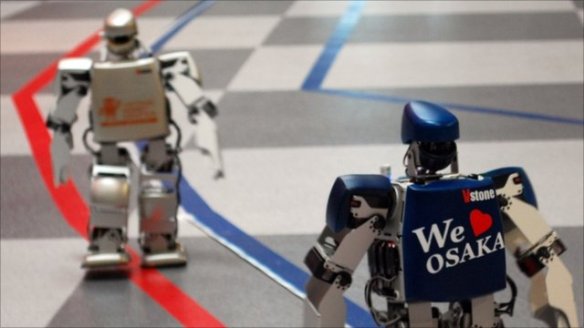
“Five knee-high androids have crossed the starting line in the world’s first marathon for two-legged robots.The contest is being held in the Japanese city of Osaka.The contestants are expected to take four days to complete the course, which involves 423 laps of an indoor track.Operators are allowed to change the robots’ batteries and motors but if the machines fall over they must get up by themselves.” (via BBC News)

Same-Sex Marriage in the US
‘President Obama, in a striking legal and political shift, has determined that the Defense of Marriage Act — the 1996 law that bars federal recognition of same-sex marriages — is unconstitutional, and has directed the Justice Department to stop defending the law in court, the administration said Wednesday.
Advocates of same-sex marriage hailed the president’s decision; critics called it a politicization of the Justice Department.
Attorney General Eric H. Holder Jr. announced the decision in a letter to members of Congress. In it, he said the administration was taking the extraordinary step of refusing to defend the law, despite having done so during Mr. Obama’s first two years in the White House.’ (via NYTimes)
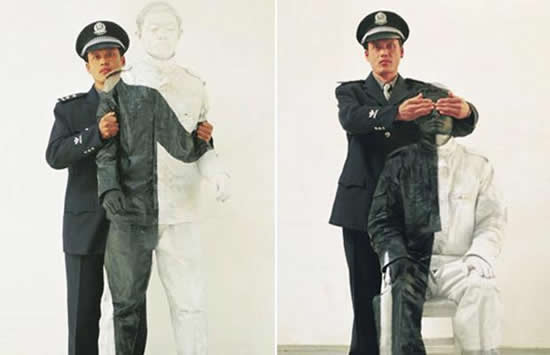
“Liu Bolin‘s body art began when he lost his house in Beijing for the city’s preparations for the 2008 Olympics Games. He used his body to camouflage in his surroundings as a sign of protest.”
A future of socially networked neurons? ‘World Wide Mind by Michael Chorost argues that we will soon be able to wire our brains directly to one another. But would you want to?’


Apologizes for Reform Judaism remarks.‘On the radio this morning, Glenn Beck lead his show with an apology for comments he made Tuesday about rabbis of Reform Judaism. “It’s almost like Islam … radicalized Islam in a way,” said Beck. “Radicalized Islam is less about religion than it is about politics. When you look at the Reform Judaism, it is more about politics.”
Beck called it one of the “worst analogies of all time.”
“I was wrong on this … and I apologize for it,” said Beck. “In this case I did not do enough homework.”
“Somebody has called me ignorant for what I said on Tuesday, and I think that’s a pretty good description of what I said.”‘ (via TVNewser).


Image via Wikipedia
‘Quantum Mechanics or Relativity? It Depends on What “Understand” Means’ (via Uncertain Principles)

Image via Wikipedia
How will we build it? Well, the numbers at first look daunting…. But given how rapidly a modern industrial nation can build things like tanks and airplanes — as the American experience during the Second World War proves — the author’s argument that we DO have the technology is pretty convincing.” (via Class M}.

Miguel de Icaza


Image via Wikipedia
This is fascinating to me. I asked a Swedish friend of mine if he knew anyone fluent in Danish who could give me an accurate English rendering of the passage. He said that a Swedish-speaker can read Danish. (His translation of the passage is below.) He commented further:
Here is his translation of the Ekstra Bladet article:
Who or what is Gelwane? Do you know anything? Do you have a clue? Drop us a line!”
(Thank you, Sten)
![[Image 'er er Jellingestenen i computeranimeret original - FØR grafitti-hærværket. ' cannot be displayed]](http://multimedia.ekstrabladet.dk/archive/00544/weekend-6sp-jelling_544065d.jpg "er er Jellingestenen i computeranimeret original - FØR grafitti-hærværket.") Do I have any readers who are fluent in Danish? This came to my attention today. The (very imperfect) Google translation seems to say something about the words ‘Gelwan E’ defacing a historic monument:
Do I have any readers who are fluent in Danish? This came to my attention today. The (very imperfect) Google translation seems to say something about the words ‘Gelwan E’ defacing a historic monument:
I have an obvious curiosity about this and would appreciate anyone who could shed any light on this for me. Can you give me a more reasonable translation from the Danish? Thanks.
Longtime FmH readers may know, from past postings here, of my intermittent interest in searching out other “Gelwans”, it being a very rare name. This incident and the post above raises an angle I had never considered; could “Gelwan” also have some relationship with “Gelwane“, a better-represented surname on the web?
Addendum: a slightly better translation from the Microsoft translation service:
” ‘ Gelwan ‘ E: Can you fix the code?
Over the weekend have unknown perpetrators painted graffiti on what are known as Denmark’s birthright, Jellingestenen. The word was: Gelwan E
Here is Jellingestenen in the computer-animated original-BEFORE graffiti-desecration.
25 cm high letters with the words: ‘ GELWAN E ‘ was written on the largest of the old stones, which around the year 965 was raised by Harald I of Denmark.
Also the smaller stones, Gorms stone, a jernkors, standing by the monuments, as well as the Church of Jelling Church, there were sprayet on.
Disrespectful
-It is clear that in the case of our historical monuments belongs to, so we make us extra due diligence to identify perpetrators. It is a culture of idiotic action, and I think not even that the kind of want to win respect in graffiti-circles. On The Contrary. It is disruptive, says politikommissær His Hoffensetz, there is a section head in should be strengthened in Vejle police, who Jelling is subject.
What? Whom?
But what does the Gelwan E-or maybe Gelwane? To search on the net you get immediately very peripheral response-there are several named Gelwane on Facebook, but they don’t work as any that might have something to do with the desecration?
Who or what is Gelwan E? Do you know something? Do you have a guess? Type including!”

Hypochondriacs have never had it so good: “In Overdiagnosed, H. Gilbert Welch, Lisa Schwartz and Steven Woloshin argue that as definitions of diseases broaden, so do the risks to healthy people…” (via New Scientist) .
“The Offensive Internet, a collection of powerful academic essays, weighs the case that the internet offends as much as it empowers…

This is not a book for those already “living online”, many of whom may see feminism as a spent force and total exposure as harmless, even good. But it is for those who care how the internet has complicated privacy, speech and reputation, and for those who may have to rescue it from itself.” (via New Scientist).

“The Lunar New Year, or more accurately the lunisolar new year, began February 4 and in most countries that celebrate it ushered in the Year of the Rabbit according to the Chinese zodiac. In China Lunar New Year is the most important date on the calendar and triggers over a month of holiday travel which is often described as the largest annual human migration in the world. Hundreds of millions tax the transport system. The new year also marks the beginning of the Spring Festival in China which continues until the Lantern Festival on the fifteenth day. Lunar New Year is celebrated in many countries, with many different traditions as well. Gathered here are pictures of China’s travel wave and celebrations, as well as pictures from other countries’ Lunar New Year observations.” (via The Big Picture – Boston.com.)

Gallup Poll: “Four in 10 Americans, slightly fewer today than in years past, believe God created humans in their present form about 10,000 years ago. Thirty-eight percent believe God guided a process by which humans developed over millions of years from less advanced life forms, while 16%, up slightly from years past, believe humans developed over millions of years, without God’s involvement.”

“In the weird world of quantum physics, two linked particles can share a single fate, even when they’re miles apart.
Now, two physicists have mathematically described how this spooky effect, called entanglement, could also bind particles across time.
…
“You can send your quantum state into the future without traversing the middle time,” said quantum physicist S. Jay Olson of Australia’s University of Queensland, lead author of the new study.” (via Wired).
The article discusses some of the surprising implications, even using a Star Trek analogy.

People may be familiar with the transmissible facial tumor that is decimating the Tasmanian Devil population. One unfortunate animal contracts it when bitten by another affected individual. This New York Times story describes another infectious malignancy, the Canine Transmissible Venereal Tumor (CTVT) (thanks to Steve Silberman).
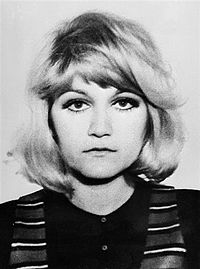
Vesna Vulović, … a former Serbian flight attendant, …holds the world record, according to the Guinness Book of Records, for surviving the highest fall without a parachute: 10,160 meters (33,330 feet).
…
She suffered a fractured skull, three broken vertebrae (one crushed completely) that left her temporarily paralyzed from the waist down and two broken legs. She was in a coma for 27 days. In an interview she commented that, according to the man who found her, “…I was in the middle part of the plane. I was found with my head down and my colleague on top of me. One part of my body with my leg was in the plane and my head was out of the plane. A catering trolley was pinned against my spine and kept me in the plane. The man who found me, says I was very lucky. He was in the German Army as a medic during World War two. He knew how to treat me at the site of the accident.” (via Wikipedia)

.
“The red supergiant star Betelgeuse is getting ready to go supernova, and when it does Earth will have a front-row seat. The explosion will be so bright that Earth will briefly seem to have two suns in the sky.
The star is located in the Orion constellation, about 640 light-years away from Earth… In stellar terms, it’s predicted to explode in the very near future. Of course, the conversion from stellar to human terms is pretty extreme, as Betelgeuse is predicted to explode anytime in the next million years.
But still, whether the explosion occurs in 2011 or 1002011 (give or take 640 years for the light to reach Earth), it’s going to make for one of the most unforgettable light shows in our planet’s history.” (via io9)

…as if we didn’t know: “Howard Kurtz on Olbermann’s career highlights and his clashes with network brass.” (via The Daily Beast).
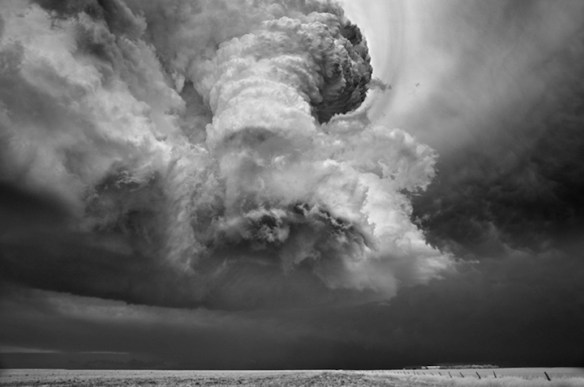
“Los Angeles-based photographer Mitch Dobrowner takes incredibly striking black-and-white photos of landscapes in the likeness of his inspiration, Ansel Adams. His most breathtaking series is about ominous storms that form over Wyoming, Kansas, North Dakota and Oklahoma..”.(Via My Modern Metropolis)
.
Douglas Copeland with 45 tips for survival “and a matching glossary of the new words you’ll need to talk about your messed-up future.” You won’t like some of this but you had best listen. (via The Globe and Mail).

Frank Rich: “Of the many truths in President Obama’s powerful Tucson speech, none was more indisputable than his statement that no one can know what is in a killer’s mind. So why have we spent so much time debating exactly that?
The answer is classic American denial. It was easier to endlessly parse Jared Lee Loughner’s lunatic library — did he favor “The Communist Manifesto” or Ayn Rand? — than confront the larger and harsher snapshot of our current landscape that emerged after his massacre. A week on, that denial is becoming even more entrenched. As soon as the president left the podium Wednesday night, we started shifting into our familiar spin-dry post-tragedy cycle of the modern era — speedy “closure,” followed by a return to business as usual, followed by national amnesia.
If we learn nothing from this tragedy, we are back where we started. And where we started was with two years of accelerating political violence — actual violence, not to be confused with violent language — that struck fear into many, not the least of whom was Gabrielle Giffords.
For the sake of this discussion, let’s stipulate that Loughner was a “lone nutjob” who had never listened to Glenn Beck or been a card-carrying member of either the Tea or Communist parties. Let’s also face another tragedy: The only two civic reforms that might have actually stopped him — tighter gun control and an effective mental health safety net — won’t materialize even now.
Gun and ammunition sales spiked last week, especially for the specific varieties given the Loughner imprimatur. No editorial — or bloodbath — will move Congress to enact serious gun control (which Giffords herself never advocated and Obama has rarely pushed since 2008). Enhanced mental health coverage is also a nonstarter when the highest G.O.P. priority is to repeal the federal expansion of health care. In Arizona, cutbacks are already so severe that terminally ill patients are being denied life-saving organ transplants.” (via NYTimes).

“In The Science of Kissing, Sheril Kirshenbaum approaches the kiss through biology, history, culture, psychology, even zoology – but some secrets remain.” (via New Scientist).
Scientists think the antimatter particles were formed inside thunderstorms in a terrestrial gamma-ray flash (TGF) associated with lightning. It is estimated that about 500 TGFs occur daily worldwide, but most go undetected.”

(via NASA Science).

“Hanny’s Voorwerp—a glowing, green blob in space—is unexpectedly giving birth to stars, a new Hubble Space Telescope picture has revealed.
The odd object was discovered in 2007 by a Dutch schoolteacher participating in Galaxy Zoo—”voorwerp” is Dutch for “object.” The online project had public citizens worldwide helping to classify galaxies in the Sloan Digital Sky Survey catalog.
(See related pictures of the “green pea” class of galaxies discovered via Galaxy Zoo.)
Although it’s the size of our Milky Way galaxy, Hanny’s Voorwerp is not itself a galaxy, but a cloud of gas near the spiral galaxy IC 2497, which lies about 650 million light-years from Earth.
The new Hubble picture—the sharpest yet taken of the brilliant cloud—shows that gas in a small region of Hanny’s Voorwerp is collapsing and forming stars, the youngest of which are just a couple million years old.” (via National Geographic).
“Today, Congresswoman Gabrielle Giffords (D-AZ) and 19 others were shot in Tucson, Arizona. Six of the shooting victims were killed. Police say Giffords was the target of the attack. Local law enforcement have identified the shooting suspect as Jared Lee Loughner, 22. A police manhunt is under way for a second “person of interest.
As blogged here earlier, Loughner posted material to a number of social media sites— he also had an active YouTube channel under the user name “Classitup10.” The bio for that channel is written in the past tense. It appears he maintained a previous channel under the user name “Starhitshnaz.” The sole video in that channel is embedded above, and shows a burning flag in front of a desert scene, with Drowning Pool’s song “Bodies” (“Let the bodies hit the floor”) as soundtrack.
In this post, we archive all of the currently known YouTube videos believed to have been created and published by Jared Lee Loughner, with text transcripts and screengrabs.
Themes and terms present throughout include: terrorism and a fixation on Loughner himself being characterized as a terrorist; creating “a new currency” to be introduced by “lethal or non-lethal means”; English literacy, “mind control and brainwash,” “political weapons,” “conscience dreaming,” and scattered references to the Constitution and the American government controlling people through brainwashing and mind control.” (Boing Boing).
This is a prepublication .pdf of a paper by Cornell psychologist Daryl Bem detailing experimental evidence for precognition, accepted for publication by a respected peer-reviewed psychological journal. (link).

“This – I think, I fear, I suspect – is going to suck, unless the Obama administration gets out of their permanent crouch and finally starts fighting back against a newly-empowered GOP, and the lies that will be pouring fourth like polluted water from an open spigot. The simple fact that Mr. Obama tapped William Daley, a JPMorgan Chase executive whose purview was “corporate responsibility,” to be the new White House Chief of Staff does not bode well at all. Try not to laugh too hard at seeing the words “JPMorgan Chase” and “corporate responsibility” in the same sentence.Yeah. I’m pretty sure this is going to suck.” — William Rivers Pitt (Truthout).

‘Mark Twain’s Adventures of Huckleberry Finn is a classic by most any measure—T.S. Eliot called it a masterpiece, and Ernest Hemingway pronounced it the source of “all modern American literature.” Yet, for decades, it has been disappearing from grade school curricula across the country, relegated to optional reading lists, or banned outright, appearing again and again on lists of the nation’s most challenged books, and all for its repeated use of a single, singularly offensive word: “nigger.”
Twain himself defined a “classic” as “a book which people praise and don’t read.” Rather than see Twain’s most important work succumb to that fate, Twain scholar Alan Gribben and NewSouth Books plan to release a version of Huckleberry Finn, in a single volume with The Adventures of Tom Sawyer, that does away with the “n” word (as well as the “in” word, “Injun”) by replacing it with the word “slave.” ‘ (Publisher’s Weekly).
“Skywatchers throughout much of Europe, North Africa, and Central Asia, were treated to the first eclipse of the new year on January 4, a partial eclipse of the Sun. But traveling to the area around Muscat, capital city of Oman, photographer Thierry Legault planned to simultaneously record two eclipses on that date, calculating from that position, for a brief moment, both the Moon and the International Space Station could be seen in silhouette, crossing the Sun. His

sharp, 1/5000th second exposure is shown here, capturing planet Earth’s two largest satellites against the bright solar disk. As the partial solar eclipse unfolded, the space station (above and left of center) zipped across the scene in less than 1 second, about 500 kilometers from the photographer’s telescope and camera.” (Astronomy Picture of the Day via abby).

The thinking is that they were startled by fireworks and died of blunt trauma after flying into obstacles. (NYTimes.com)
2000 vs. 2010 at a glance (io9).
This is the annual update of my New Year’s post, a tradition I started early on on FmH:
 I once ran across a January 1st Boston Globe article compiling folkloric beliefs about what to do, what to eat, etc. on New Year’s Day to bring good fortune for the year to come. I’ve regretted since — I usually think of it around once a year (grin) — not clipping out and saving the article. Especially since we’ve had children, I’m interested in enduring traditions that go beyond getting drunk [although some comment that this is a profound enactment of the interdigitation of chaos and order appropriate to the New Year’s celebration — FmH], watching the bowl games and making resolutions.
A web search brought me this, less elaborate than what I recall from the Globe but to the same point. It is weighted toward eating traditions, which is odd because, unlike most other major holidays, the celebration of New Year’s in 21st century America does not seem to be centered at all around thinking about what we eat (except in the sense of the traditional weight-loss resolutions!) and certainly not around a festive meal. But…
Traditionally, it was thought that one could affect the luck they would have throughout the coming year by what they did or ate on the first day of the year. For that reason, it has become common for folks to celebrate the first few minutes of a brand new year in the company of family and friends. Parties often last into the middle of the night after the ringing in of a new year. It was once believed that the first visitor on New Year’s Day would bring either good luck or bad luck the rest of the year. It was particularly lucky if that visitor happened to be a tall dark-haired man.
“Traditional New Year foods are also thought to bring luck. Many cultures believe that anything in the shape of a ring is good luck, because it symbolizes “coming full circle,” completing a year’s cycle. For that reason, the Dutch believe that eating donuts on New Year’s Day will bring good fortune.
 “Many parts of the U.S. celebrate the new year by consuming black-eyed peas. These legumes are typically accompanied by either hog jowls or ham. Black-eyed peas and other legumes have been considered good luck in many cultures. The hog, and thus its meat, is considered lucky because it symbolizes prosperity. Cabbage is another ‘good luck’ vegetable that is consumed on New Year’s Day by many. Cabbage leaves are also considered a sign of prosperity, being representative of paper currency. In some regions, rice is a lucky food that is eaten on New Year’s Day.”
The further north one travels in the British Isles, the more the year-end festivities focus on New Year’s. The Scottish observance of Hogmanay has many elements of warming heart and hearth, welcoming strangers and making a good beginning:
“Three cornered biscuits called hogmanays are eaten. Other special foods are: wine, ginger cordial, cheese, bread, shortbread, oatcake, carol or carl cake, currant loaf, and a pastry called scones. After sunset people collect juniper and water to purify the home. Divining rituals are done according to the directions of the winds, which are assigned their own colors. First Footing:The first person who comes to the door on midnight New Year’s Eve should be a dark-haired or dark-complected man with gifts for luck. Seeing a cat, dog, woman, red-head or beggar is unlucky. The person brings a gift (handsel) of coal or whiskey to ensure prosperity in the New Year. Mummer’s Plays are also performed. The actors called the White Boys of Yule are all dressed in white, except for one dressed as the devil in black. It is bad luck to engage in marriage proposals, break glass, spin flax, sweep or carry out rubbish on New Year’s Eve.”
Here’s why we clink our glasses when we drink our New Year’s toasts, no matter where we are. Of course, sometimes the midnight cacophony is louder than just clinking glassware, to create a ‘devil-chasing din’.
 In Georgia, eat black eyed peas and turnip greens on New Year’s Day for luck and prosperity in the year to come, supposedly because they symbolize coppers and currency. Hoppin’ John, a concoction of peas, onion, bacon and rice, is also a southern New Year’s tradition, as is wearing yellow to find true love (in Peru, yellow underwear, apparently!) or carrying silver for prosperity. In some instances, a dollar bill is thrown in with the other ingredients of the New Year’s meal to bring prosperity. In Greece, there is a traditional New Year’s Day sweetbread with a silver coin baked into it. All guests get a slice of the bread and whoever receives the slice with the coin is destined for good fortune for the year. At Italian tables, lentils, oranges and olives are served. The lentils, looking like coins, will bring prosperity; the oranges are for love; and the olives, symbolic of the wealth of the land, represent good fortune for the year to come.
A New Year’s meal in Norway also includes dried cod, “lutefisk.” The Pennsylvania Dutch make sure to include sauerkraut in their holiday meal, also for prosperity.
In Spain, you would cram twelve grapes in your mouth at midnight, one each time the clock chimed, for good luck for the twelve months to come. (If any of the grapes happens to be sour, the corresponding month will not be one of your most fortunate in the coming year.) The U. S. version of this custom, for some reason, involves standing on a chair as you pop the grapes. In Denmark, jumping off a chair at the stroke of midnight signifies leaping into the New Year. In Rio, you would be plunging into the sea en masse at midnight, wearing white and bearing offerings. In many northern hemisphere cities near bodies of water, they will have a tradition of people plunging into the cold water on New Year’s Day. The Coney Island Polar Bears Club in New York is the oldest cold-water swimming club in the United States. They have had groups of people enter the chilly surf since 1903.
Ecuadorian families make scarecrows stuffed with newspaper and firecrackers and place them outside their homes. The dummies represent misfortunes of the prior year, which are then burned in effigy at the stroke of midnight to forget the old year. Bolivian families make beautiful little wood or straw dolls to hang outside their homes on New Year’s Eve to bring good luck.
 In China, homes are cleaned spotless to appease the Kitchen God, and papercuttings of red paper are hung in the windows to scare away evil spirits who might enter the house and bring misfortune. Large papier mache dragon heads with long fabric bodies are maneuvered through the streets during the Dragon Dance festival, and families open their front doors to let the dragon bring good luck into their homes.
 The Indian Diwali festival, welcoming in the autumnal season, also involves attracting good fortune with lights. Children make small clay lamps, dipas, thousands of which might adorn a given home. In Thailand, one pours fragrant water over the hands of elders on New Year’s Day to show them respect.
 In Germany and Austria, lead pouring” (das Bleigießen) is an old divining practice using molten lead like tea leaves. A small amount of lead is melted in a tablespoon (by holding a flame under the spoon) and then poured into a bowl or bucket of water. The resulting pattern is interpreted to predict the coming year. For instance, if the lead forms a ball (der Ball), that means luck will roll your way. The shape of an anchor (der Anker) means help in need. But a cross (das Kreuz) signifies death.
Some history; documentation of observance of the new year dates back at least 4000 years to the Babylonians, who also made the first new year’s resolutions (reportedly voews to return borrowed farm equipment were very popular), although their holiday was observed at the vernal equinox. The Babylonian festivities lasted eleven days, each day with its own particular mode of celebration.  The traditional Persian Norouz festival of spring continues to be considered the advent of the new year among Persians, Kurds and other peoples throughout Central Asia, and dates back at least 3000 years, deeply rooted in Zooastrian traditions.Modern Bahá’í’s celebrate Norouz (”Naw Ruz”) as the end of a Nineteen Day Fast. Rosh Hashanah (”head of the year”), the Jewish New Year, the first day of the lunar month of Tishri, falls between September and early October. Muslim New Year is the first day of Muharram, and Chinese New Year falls between Jan. 10th and Feb. 19th of the Gregorian calendar.
 The classical Roman New Year’s celebration was also in the spring although the calendar went out of synchrony with the sun. January 1st became the first day of the year by proclamation of the Roman Senate in 153 BC, reinforced even more strongly when Julius Caesar established what came to be known as the Julian calendar in 46 BC. The early Christian Church condemned new year’s festivities as pagan but created parallel festivities concurrently. New Year’s Day is still observed as the Feast of Christ’s Circumcision in some denominations. Church opposition to a new year’s observance reasserted itself during the Middle Ages, and Western nations have only celebrated January 1 as a holidy for about the last 400 years. The custom of New Year’s gift exchange among Druidic pagans in 7th century Flanders was deplored by Saint Eligius, who warned them, “[Do not] make vetulas, [little figures of the Old Woman], little deer or iotticos or set tables [for the house-elf] at night or exchange New Year gifts or supply superfluous drinks [another Yule custom].” (Wikipedia)
 The tradition of the New Year’s Baby signifying the new year began with the Greek tradition of parading a baby in a basket during the Dionysian rites celebrating the annual rebirth of that god as a symbol of fertility. The baby was also a symbol of rebirth among early Egyptians. Again, the Church was forced to modify its denunciation of the practice as pagan because of the popularity of the rebirth symbolism, finally allowing its members to cellebrate the new year with a baby although assimilating it to a celebration of the birth of the baby Jesus. The addition of Father Time (the “Old Year”) wearing a sash across his chest with the previous year on it, and the banner carried or worn by the New Year’s Baby, immigrated from Germany. Interestingly, January 1st is not a legal holiday in Israel, officially because of its historic origins as a Christian feast day.
 Auld Lang Syne (literally ‘old long ago’ in the Scottish dialect) is sung or played at the stroke of midnight throughout the English-speaking world (and then there is George Harrison’s “Ring Out the Old”). Versions of the song have been part of the New Year’s festivities since the 17th century but Robert Burns was inspired to compose a modern rendition, which was published after his death in 1796. (It took Guy Lombardo, however, to make it popular…)
Should auld acquaintance be forgot
and never brought to mind?
Should auld acquaintance be forgot
and days of auld lang syne?
For auld lang syne, my dear,
for auld lang syne,
we’ll take a cup of kindness yet,
for auld lang syne.Should auld acquaintance be forgot
and never brought to mind?
Should auld acquaintance be forgot
and days of auld lang syne?
And here’s a hand, my trusty friend
And gie’s a hand o’ thine
We’ll tak’ a cup o’ kindness yet
For auld lang syne
![//www.sfgate.com/chronicle/pictures/2005/02/09/ga_lunar01.jpg' cannot be displayed]](http://www.sfgate.com/chronicle/pictures/2005/02/09/ga_lunar01.jpg "Wake Up!")
Here’s how to wish someone a Happy New Year around the world:
- Arabic: Kul ‘aam u antum salimoun
- Brazilian: Boas Festas e Feliz Ano Novo means “Good Parties and Happy New Year”
- Chinese:
Chu Shen TanXin Nian Kuai Le (thanks, Jeff)- Czechoslavakia: Scastny Novy Rok
- Dutch: Gullukkig Niuw Jaar
- Finnish: Onnellista Uutta Vuotta
- French: Bonne Annee
- German: Prosit Neujahr
- Greek: Eftecheezmaenos o Kaenooryos hronos
- Hebrew: L’Shannah Tovah Tikatevu
- Hindi: Niya Saa Moobaarak
- Irish (Gaelic): Bliain nua fe mhaise dhuit
- Italian: Buon Capodanno
- Khmer: Sua Sdei tfnam tmei
- Laotian: Sabai dee pee mai
- Polish: Szczesliwego Nowego Roku
- Portuguese: Feliz Ano Novo
- Russian: S Novim Godom
- Serbo-Croatian: Scecna nova godina
- Spanish: Feliz Ano Nuevo
- Swedish: Ha ett gott nytt år
- Turkish: Yeni Yiliniz Kutlu Olsun
- Vietnamese: Cung-Chuc Tan-Xuan
- [If you are a native speaker, please feel free to offer any corrections or additions!]

However you’re going to celebrate, my warmest wishes for the year to come… and eat hearty! [thanks to Bruce Umbaugh for research assistance]
 Julius and Ethel Rosenbergs’ son: “The Espionage Act is a huge danger to our open society; it’s been used to send hundreds of dissenters to jail just for voicing their opinions, transforming dissent into treason.”(via AlterNet).

“Tuesday’s FCC ruling on net neutrality shifts billions in profits and boils down to one fact: There will soon be a fast Internet for the rich and a slow Internet for the poor.” (via Daily Beast).
“Captain Beefheart’s music career stretched from 1966 to 1982, and from straight rhythm and blues by way of the early Rolling Stones to music that sounded like a strange uncle of post-punk. He is probably best known for “Trout Mask Replica,” a double album from 1969 with his Magic Band.
A bolt-from-the-blue collection of precise, careening, surrealist songs with clashing meters, brightly imagistic poetry and raw blues shouting, “Trout Mask Replica” had particular resonance with the punk and new wave generation to come a decade later, influencing bands like Devo, the Residents, Pere Ubu and the Fall.
Mr. Van Vliet’s life story is caked with half-believable tales, some of which he himself spread in Dadaist, elliptical interviews. He claimed he had never read a book and had never been to school, and answered questions with riddles. “We see the moon, don’t we?” he asked in a 1969 interview. “So it’s our eye. Animals see us, don’t they? So we’re their animals.” (via NYTimes.com obit).

“The lunar eclipse of Dec. 21st falls on the same date as the northern winter solstice. Is this rare? It is indeed, according to Geoff Chester of the US Naval Observatory, who inspected a list of eclipses going back 2000 years. “Since Year 1, I can only find one previous instance of an eclipse matching the same calendar date as the solstice, and that is Dec. 21, 1638,” says Chester. “Fortunately we won’t have to wait 372 years for the next one…that will be on Dec. 21, 2094.”
The total eclipse lasts more than an hour from 02:41 am to 03:53 am EST on Tuesday morning, Dec. 21st. Any time within that interval is a good time to look. For other time zones, consult Shadow & Substance’s animated eclipse.” (via SpaceWeather.com)


‘Flash opera’ at Macy’s Phila., 11/01/2010: “A flash mob hit Macy’s in Center City on Saturday – 650 vocalists who, unknown to shoppers, had arranged to burst into song at noon.” (Philly.com)

“It is the silly season so it was only right to announce that supercomputing giant IBM are so confident in the processing abilities of their new Watson machine that they are pitting it against two human contestants on popular TV show
Jeopardy in a three night special that starts on February 14th according to the BBC.
The prize fund on the night will be $1m, though it’s unclear at this time what the computer would spend it on if it won.” (Ghacks Technology News)

It seems oxygen is far more abundant than we ever suspected, particularly on moons that seem to be completely frozen solid. We recently found evidence of oxygen on Jupiter’s moons Europa and Ganymede, and now this finding on Rhea. In fact, because the region of space surrounding Saturn’s rings has an oxygen atmosphere, it’s thought even more of the icy moons within the gas giant’s magnetosphere likely have little atmospheres of their own.” (io9)

When Your Company Kills Your iPhone : Beware. If you have your smartphone configured to receive mail from your company’s Microsoft Exchange Server, you have given the company’s IT dept. the capability to remotely control a number of your phone’s functions, including doing a remote wipe of all your content. (NPR)

As Elizabeth Currid-Halkett explains in her fascinating, well-researched new book, Starstruck: The Business of Celebrity, recent developments in the celebrity industry can tell us a great deal about our changing global culture. In an era in which more and more people are feeling alienated from their peers, stars give us a common language and allow a greater degree of social cohesion. They also fuel enormous industries — celebrity-driven occupations generate $1.5 billion in salary in Los Angeles alone. Elsewhere in the book, Currid-Halkett, the author of The Warhol Economy and an assistant professor at the University of Southern California, uses party photographs and Google to draw fascinating conclusions about the geography and social stratification of the celebrity world (Note to Angelina Jolie: Getting photographed in Las Vegas might actually hurt your fame).
Salon spoke to Currid-Halkett over the phone from Los Angeles, about our changing star culture, our obsession with celebrity minutiae, and why Paris Hilton actually deserves our respect.’ (Salon.com).


She has built a television studio in her house in Wasilla so that she can loop into Fox News broadcasts — she earns $1 million a year as a commentator — at will. She is the first former office-holder and vice-presidential candidate to star in her own reality show, Sarah Palin’s Alaska, for which she is earning $2 million and which debuted last week on TLC to record-breaking numbers. Five million people watched, making it the highest-rated premiere in the channel’s history.
These are branding opportunities that, even a few years ago, would’ve been considered too down-market and damaging for a potential presidential candidate. They are working.’ (NYPOST.com)

How many of these have you visited? I have been in three of the ten, bookshop aficionado as I am.


The Not-So Private Parts: “One of the interesting claims in the current brief that was not included in EPIC’s original request for a stay is the allegation of a violation of the Video Voyeurism Prevention Act. That would be the law passed by Congress in 2004 that is used, in part, to fight upskirt filming. The Act [PDF] prohibits the filming of private parts — it makes an exception for cleavage — when individuals have a reasonable expectation of privacy, even if they are in a public place.
The law specifies that it applies in “circumstances in which a reasonable person would believe that a private area of the individual would not be visible to the public, regardless of whether that person is in a public or private place.” So if people know that their private areas are visible, does the law apply? If there are representational avatars instead of real naked people — a software fix devised by scanner makers L-3 Communications Holdings Inc. and OSI Systems Inc. — does it apply?
These questions and the constitutional privacy issues raised by the scanners will be hashed out soon enough. The government will be filing its reply brief by December 1, and then the case should move on to oral arguments. If the court were to rule in EPIC’s favor, the TSA will have to “revise its airport screening program so that it complies with federal law,” says EPIC president Marc Rotenberg.” (via Kashmir Hill – Forbes)
…without the hysteria: “Here’s a scenario:
Middle Eastern terrorists hijack a U.S. jetliner bound for Italy. A two-week drama ensues in which the plane’s occupants are split into groups and held hostage in secret locations in Lebanon and Syria.
While this drama is unfolding, another group of terrorists detonates a bomb in the luggage hold of a 747 over the North Atlantic, killing more than 300 people.
Not long afterward, terrorists kill 19 people and wound more than a hundred others in coordinated attacks at European airport ticket counters.
A few months later, a U.S. airliner is bombed over Greece, killing four passengers.
Five months after that, another U.S. airliner is stormed by heavily armed terrorists at the airport in Karachi, Pakistan, killing at least 20 people and wounding 150 more.
Things are quiet for a while, until two years later when a 747 bound for New York is blown up over Europe killing 270 passengers and crew.
Nine months from then, a French airliner en route to Paris is bombed over Africa, killing 170 people from 17 countries.
That’s a pretty macabre fantasy, no? A worst-case war-game scenario for the CIA? A script for the End Times? Except, of course, that everything above actually happened, in a four-year span between 1985 and 1989. The culprits were the al-Qaidas of their time: groups like the Abu Nidal Organization and the Arab Revolutionary Cells, and even the government of Libya…
I bring all of this up for a couple of reasons.
If nothing else, it demonstrates how quickly we forget the past. Our memories are short, and growing shorter, it seems, all the time. Our collective consciousness seems to reinvent itself daily, cobbled from a media blitz of short-order blurbs and 30-second segments. There will be a heavy price to pay, potentially, for having developed such a shallow and fragile mind-set.
With respect to airport security, it is remarkable how we have come to place Sept. 11, 2001, as the fulcrum upon which we balance almost all of our decisions. As if deadly terrorism didn’t exist prior to that day, when really we’ve been dealing with the same old threats for decades. What have we learned? What have we done?” (via Ask the Pilot – Salon)
According to court documents, 67-year-old Steven Cowan became enraged while watching Palin dance on Monday evening. He felt Palin was not a good dancer…” (via Wausau Daily Herald)

“The Leonid meteor shower rolls through the sky once a year, peaking in mid-November. It’s caused by a trail of debris that travels along the orbit of the comet Tempel-Tuttle.The 2010 Leonid meteor shower runs from Wednesday, Nov. 10, through Sunday, Nov. 21. The peak will be the nights between the 17th and the 19th.The Leonids are famous for being spectacular storms — since the orbit of the Temple-Tuttle comet intersects with that of Earth, the debris cloud our planet passes through each year is dense and full of particles and meteoroids. In optimal viewing conditions on a good year, you can see between 15 and 30 meteors per hour streaking across the sky during the peak.” (via Wired How-To Wiki)
‘Follow Me Here’ celebrates 11 years of weblogging today.Yes, eleven years. I once was totally cutting edge, I fancied! In any case, many thanks to my loyal readers, new and old.
Why don’t you leave a comment telling me what you found to be the most memorable FmH post of the past year? or the most unmemorable (grin)?
It is also the 11th blogiversary of Kevin Murphy’s Ghost in the Machine, the ‘blog twin’ of FmH. All the best, Kevin! And many happy returns.

Steve Silberman
My story is about the surprising power of the placebo effect — what happens in the brain and body when you think you’re taking medicine or receiving treatment — and the problems in the pharmaceutical industry caused by the increasing number of experimental drugs that are failing in clinical trials to outperform dummy pills used as controls.
It’s always gratifying to see a story you’ve worked hard on be embraced by readers, linked to by other journalists, and recognized by a venerable institution like the AAAS. Even Stephen Colbert ended up riffing on the seemingly absurd notion that sugar pills could perform better in a trial than an expensive experimental drug…”
Although my praise is not as important as that of the AAAS, I too found the piece lucid and important. Perhaps that is because it agrees with my own biases; I have often said that most of healing relies on the placebo effect, i.e. mobilizing the body and mind’s own powers.

Happy Guy Fawkes Night: “Guy Fawkes Night originates from the Gunpowder Plot of 1605, a failed conspiracy by a group of provincial English Catholics to assassinate the Anglican King James I of England and VI of Scotland and replace him with a Catholic head of state. The survival of the king was first celebrated on 5 November 1605, after Guy Fawkes, left in charge of the gunpowder placed underneath the House of Lords, was discovered and arrested.
The same month the surviving conspirators were executed, in January 1606 the Observance of 5th November Act 1605, commonly known as the “Thanksgiving Act” was passed, ensuring that for more than 250 years 5 November was kept free as a day of thanksgiving. According to historian and author Antonia Fraser, a study of the sermons preached on the first anniversary of 5 November demonstrates an anti-Catholic concentration “mystical in its fervour”. Each anniversary of the plot’s failure was for years celebrated by the ringing of church bells, special sermons, and the lighting of bonfires. Further controversies such as the marriage of Charles I to the Catholic Henrietta Maria of France and the 1679 Popish Plot helped fuel the popularity of the events, which at times became a celebration not of the deliverance of a monarch, but of anti-Papist sentiment…
Historically the date has been celebrated by the burning of effigies of contemporary hate-figures… Some modern instances of burning effigies exist; in Lewes in 1994 revellers immolated the effigies of politicians such as Margaret Thatcher and John Major, alongside Fawkes.” (via Wikipedia)

This is not the point of Thomas Friedman’s op-ed piece, but it is the interesting part:

Obama’s visit comes shortly after the emergence of shocking video footage showing Indonesian soldiers torturing two villagers in the West Papuan highlands. The Indonesian government has admitted that the torturers were its soldiers.
Controversially, in July this year, the Obama administration lifted its ban on assistance to Indonesia’s notorious elite special forces, Kopassus. Kopassus had been barred from receiving US military aid for more than a decade because of human-rights abuses including killings, disappearances and torture.
The President, who spent part of his childhood in Indonesia, will make his first official visit to the country since taking office.” (via Survival International)


Bush said he wanted to put an end to assertions by critics that Cheney was the real decision-maker and to “demonstrate that I was in charge.” ‘ (via The Associated Press)
(Yes, the puppeteer allows the puppet to think about cutting his strings.)
“…if everyone who fought for change in 2008 shows up to vote in 2010, we will win this election, I’m confident that we will.” –President Barack Obama

The neuroscientist was Daniel Levitin, a psychologist at McGill University and author of the bestsellers This is Your Brain on Music and The World in Six Songs. He was joined onstage by the Kitchener-Waterloo Symphony and its conductor, Edwin Outwater. Together they took the audience a guided tour of Beethoven’s Fifth Symphony, perhaps the best-known work in the Western musical canon. Audience members were given electronic “clickers” with which they could respond to Levitin’s questions and voice their own reactions to what was being played; the results were displayed on a giant screen in real time.” (via New Scientist CultureLab)
“With his new film, writer-director Gareth Edwards says he set out to make the most realistic monster movie ever. Not that he wanted the most biological plausible aliens or the highest possible quality of special effects. He wanted a film about a story that might happen if aliens really had invaded Earth. Has he succeeded? ” (via New Scientist CultureLab)

‘…so I’m voting, and I ain’t voting Republican’ (Youtube).


![//tonos.ru/images/articles/dragon/ouroboros.jpg' cannot be displayed]](http://tonos.ru/images/articles/dragon/ouroboros.jpg "Ouroboros")
![//www.elanguages.org/images/16245' cannot be displayed]](http://www.elanguages.org/images/16245 "Revelry")

![[Image 'https://i0.wp.com/graphics8.nytimes.com/images/2010/12/18/arts/BEEFHEART-obit/BEEFHEART-obit-articleLarge.jpg' cannot be displayed]](http://graphics8.nytimes.com/images/2010/12/18/arts/BEEFHEART-obit/BEEFHEART-obit-articleLarge.jpg)