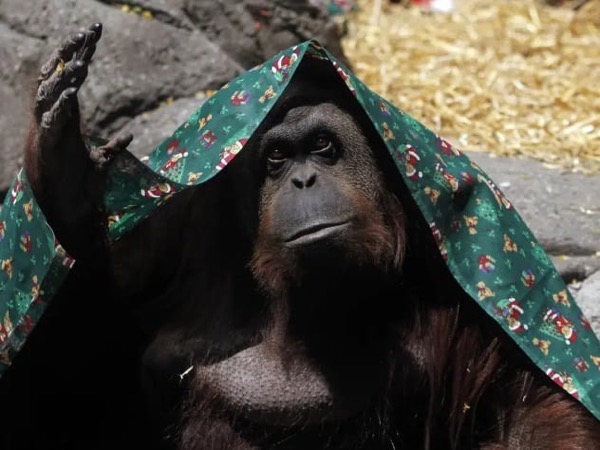
 Courts can grant human rights to nonhuman entities such as rivers, forests, mountains, and nonhuman animals. When this is done, harm against the entity carries the same punishment as harm against humans.
Via Listverse

Courts can grant human rights to nonhuman entities such as rivers, forests, mountains, and nonhuman animals. When this is done, harm against the entity carries the same punishment as harm against humans.
Via Listverse
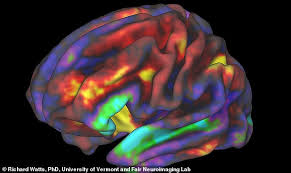 New, ethically controversial, era of neurointervention:
’A team of scientists in Spain is getting ready to experiment on prisoners. If the scientists get the necessary approvals, they plan to start a study this month that involves placing electrodes on inmates’ foreheads and sending a current into their brains. The electricity will target the prefrontal cortex, a brain region that plays a role in decision-making and social behavior. The idea is that stimulating more activity in that region may make the prisoners less aggressive.
This technique — transcranial direct current stimulation, or tDCS — is a form of neurointervention, meaning it acts directly on the brain. Using neurointerventions in the criminal justice system is highly controversial. In recent years, scientists and philosophers have been debating under what conditions (if any) it might be ethical.
The Spanish team is the first to use tDCS on prisoners. They’ve already done it in a pilot study, publishing their findings in Neuroscience in January, and they were all set to implement a follow-up study involving at least 12 convicted murderers and other inmates this month. On Wednesday, New Scientist broke news of the upcoming experiment, noting that it had approval from the Spanish government, prison officials, and a university ethics committee. The next day, the Interior Ministry changed course and put the study on hold.…’
Via Vox
 Thomas Nagel:
’Christine Korsgaard is a distinguished philosopher who has taught at Harvard for most of her career. Though not known to the general public, she is eminent within the field for her penetrating and analytically dense writings on ethical theory and her critical interpretations of the works of Immanuel Kant. Now, for the first time, she has written a book about a question that anyone can understand. Fellow Creatures: Our Obligations to the Other Animals is a blend of moral passion and rigorous theoretical argument. Though it is often difficult—not because of any lack of clarity in the writing but because of the intrinsic complexity of the issues—this book provides the opportunity for a wider audience to see how philosophical reflection can enrich the response to a problem that everyone should be concerned about.
Since the publication of Peter Singer’s Animal Liberation in 1975, there has been a notable increase in vegetarianism or veganism as a personal choice by individuals, and in the protection of animals from cruel treatment in factory farms and scientific research, both through law and through public pressure on businesses and institutions. Yet most people are not vegetarians: approximately 9.5 billion animals die annually in food production in the United States, and the carnivores who think about it tend to console themselves with the belief that the cruelties of factory farming are being ameliorated, and that if this is done, there is nothing wrong with killing animals painlessly for food. Korsgaard firmly rejects this outlook, not just because it ignores the scale of suffering still imposed on farmed animals, but because it depends on a false contrast between the values of human and animal lives, according to which killing a human is wrong in a way that killing an animal is not.…’

’This photo, courtesy of the British Tarantula Society, shows the recently-discovered burrow-dwelling spider [Birupes simoroxigorum] in its full glory.
It’s been described as the most beautiful spider (more via Metafilter) but not without controversy.…’
Via Boing Boing
 Let’s stop kidding ourselves about that:
’The normalization of Trump’s unpredictable, spasmodic presidency, as well as the fact that so many of us don’t have the stomach to tolerate two-plus hours of watching him, are perhaps the only reasons why more Americans aren’t gathered as we speak, devising how best to legally remove him from office. For what it’s worth, I propose here and now that this conversation must begin in earnest.
Trump’s obvious mental instability and emotionally erratic behavior has reached a harrowing new depth. They need to be addressed by our political leadership with the same urgency as the myriad investigations into his crimes. This has to begin now before it’s too late. He will clearly do and say whatever it takes to secure his status, and it’s the presidency alone that’s keeping him out of federal prison. He’s at least competent enough to understand this, and he might be crazy enough to do anything to avoid accountability. We’re in new territory. There is no road map, and what we do now will determine whether Trump is the last Trump, or possibly the first of many Trumps along the not-so-lengthy journey into a permanent form of lunatic authoritarianism. It’s time to take his madness seriously now before he levels-up again.…’
Via Salon.com
‘Cant was a lawless language. If it got into your head, it might make you lawless, too…’
via JSTOR Daily
’Even as the 2020 race begins in earnest, President Donald Trump is already suggesting that Democrats cannot beat him fairly – raising the specter that if he loses next November, he will suggest that the election was not legitimate.…’
Via CNNPolitics
 Eric Boehlert in AlterNet:
‘If over the weekend you saw a rambling madman give a frighteningly incoherent, sweaty, two-hour shoutfest of a speech at a right-wing summit, then you viewed a president coming unglued on national television in a way that has probably never been seen before in United States history. And that is extraordinary cause for alarm. But if, instead, you saw nothing more than a “fiery” Donald Trump give a “zigzagging,” “wide-ranging,” “campaign-like” address where the Republican really “let loose,” then you likely work for the D.C. press, which once again swung and missed when it came to detailing the escalating threat that Trump represents to the country.…’
Via 3 Quarks Daily
’The New York Times reports that a team of scientists plan to announce tomorrow that a patient in London has been effectively cured of HIV. The cure reportedly was the result of a bone-marrow transplant that came with a genetic mutation that naturally blocks HIV from spreading throughout the body. This approach isn’t quite practical to implement on a large scale, but the knowledge gained from it will likely help scientists develop more scalable approaches.…’
Via Big Think
’Rest assured, potential Republican challengers are making secret plans to be the literal white knight to rescue the Party from the chaos that is Trump. Presenting themselves as the rational alternative to the man circling the political drain. It’s the Democrats who must have a strategy besides running against Donald J. Trump. What if the only message they have is, “Trump is bad,” and it turns out he isn’t on the ballot?
At the moment, enough Republicans have tied themselves to the Trump anchor that it’s hard to see a Republican victory. But it’s a long time between now and the election in November of 2020. Democrats need to have a plan for a different Nominee…’
Via Medium
‘Researchers from Harvard, the University of Michigan, and UCLA have conducted the first ever randomized controlled trial on the efficacy of parachutes. As detailed in a cheeky study published late last year in the prestigious British Medical Journal, the researchers enlisted 23 volunteers to jump out of a plane or helicopter to test whether the use of parachutes reduced risk of injury or death…
Remarkably, the researchers found that “parachute use did not significantly reduce death or major injury.” Indeed, there were zero deaths or serious injuries in either group. As the researchers noted in their conclusion, however, this likely had to do with the fact that… (more)’
via Motherboard

’Utterly broken but oddly confident, Cohen gave answers both crisp and precise. He often corrected basic facts from his congressional questioners and clarified specifically both answers and questions. He laid out reasons for seeking redemption that seemed relatable and understandable. In the process, he gave the most sensible narrative to date of Donald Trump’s unsavory journey to the White House.…’
Via WIRED
The Journal of Health Psychology has just published an extraordinary pair of papers that call for a new inquiry into a 30-year old case of probable scientific fraud.
According to Anthony J. Pelosi, author of the main paper, the case was “one of the worst scientific scandals of all time” and yet has never been formally investigated. The journal’s editor, David F. Marks, agrees and, in an editorial, also calls for the retraction or correction of up to 61 papers.
The scandal in question is one I had never heard of before, but the facts are jaw-dropping. Beginning in 1980, a Dr Roland Grossarth-Maticek reported that he had discovered a cancer-prone ’emotionally repressed’ personality. Someone with this personality type was, he claimed, at very high risk of later developing cancer. A second personality type predicted ‘internal diseases’, such as stroke and hypertension. Even more remarkably, Grossarth-Maticek said, a brief course of psychotherapy was enough to virtually eliminate the excess risks.
Despite the fact that Grossarth-Maticek was claiming to have found a way to prevent most cancers, his work was largely ignored. Then, at the end of the 1980s, he started a collaboration with Prof. Hans Eysenck, of the Institute of Psychiatry in London (now part of King’s College London).
Eysenck was an eminent and extremely influential psychologist in Britain, perhaps the most prominent of his era, so the papers that Eysenck and Grossarth-Maticek published together around 1990 were widely read. Eysenck had no role in the data collection of any of these studies, but his name was an endorsement of their credibility.…’
Via Neuroskeptic
’A new study of thousands links right-wing authoritarian attitudes and feeling one’s life is more meaningful.…’
Via Big Think
 An extraordinary assertion first observed by Richard Feynman — the correct laws of physics are expressible in a multiplicity of ways. This doesn’t work if the laws are misstated. This “Rashomon effect… raises metaphysical questions about the meaning of physics and the nature of reality.”
Via 3 Quarks Daily
’Not having a meaningful life can be dreadful, and psychologist Viktor Frankl thought it was the root cause of many neuroses. His ideas became Logotherapy, which focuses on the need for a meaningful life and has shown success in many areas. Many studies agree that leading a meaningful life has tangible benefits and lacking meaning can lead to problems.…’
Via Big Think
‘After a lengthy 11-week trial, a jury on Tuesday convicted Joaquín Guzmán Loera, the Mexican drug kingpin known as El Chapo. Mr. Guzmán, 61, faced 10 charges, including leading a criminal enterprise and the importation and sales of large amounts of narcotics into the United States. He now will likely spend the rest of his life in prison.The trial allowed prosecutors to extensively detail the inner workings of Mr. Guzmán’s Sinaloa cartel, providing unparalleled insight into international drug trafficking. Here are 11 of the most important takeaways, in no particular order…’
Via New York Times
‘“I feel like I’m wasting my life,” he told me. “When I die, is anyone going to care that I earned an extra percentage point of return? My work feels totally meaningless.” He recognized the incredible privilege of his pay and status, but his anguish seemed genuine. “If you spend 12 hours a day doing work you hate, at some point it doesn’t matter what your paycheck says,” he told me. There’s no magic salary at which a bad job becomes good. …’
Via New York Times
’New findings released on Wednesday show that at current emissions rates, we’re just five generations away from creating an atmosphere the likes of which hasn’t been seen in 56 million years. The last time carbon dioxide levels were as high as we’re headed for, it helped create one of the greatest die offs in recent Earth history.…’
Via Earther
’Zebras are famous for their contrasting black and white stripes – but until very recently no one really knew why they sport their unusual striped pattern. It’s a question that’s been discussed as far back as 150 years ago by great Victorian biologists like Charles Darwin and Alfred Russel Wallace.
Since then many ideas have been put on the table but only in the last few years have there been serious attempts to test them. These ideas fall into four main categories: Zebras are striped to evade capture by predators, zebras are striped for social reasons, zebras are striped to keep cool, or they have stripes to avoid attack by biting flies.
Only the last one stands up to scrutiny. And our latest research helps fill in more of the details on why.…’
Via The Conversation
Atlas Obscura reports on Osaka’s decision to ‘break up’ with San Francisco after the latter put up a statue honoring “comfort women,” who were enslaved in Japanese brothels during World War II. The incident is the occasion for a deeper examination of the fascinating and complicated history of the twinning phenomenon between cities.
’On Friday, President Trump tossed precedent out the window and declared a national emergency to pay for an unneeded border wall he previously promised Mexico would pay for.
His declaration isn’t just setting up a massive court battle. It also opens the door to imagining how a Democratic president could wield emergency powers to tackle climate change, something Republicans are already worrying about and Democrats are already embracing as a path forward given the years of Republican filibustering, inaction, and denial.…’
Via Lifehacker

In a bombshell revelation, the The New York Times reports that House sources have revealed a Trump plan to open nuclear power plants across Saudi Arabia. Former national security adviser Michael Flynn is reportedly strongly involved in the plan. Trump apparently began thinking about this scheme right after his inauguration and, undissuaded by concerns about conflicts of interest and national security constraints, is still considering the plan. The export of nuclear technology could violate the US Atomic Energy Act of 1954, and the plan has been opposed by Trump advisers including the chief of the National Security Council. Usually, Congress needs to approve the foreign export of American technologies but the Trump administration reportedly ignored warnings about such constraints. The owners of Westinghouse Electric, a nuclear plant manufacturer, bailed out the family of Trump son-in-law Jared Kushner by investing in a property of theirs that was heavily in debt. All of this raises questions about Kushner’s impending Middle East trip.
’Could Trump be laying the ground work to declare another national emergency to silence SNL?!
…My hope is that members of the media who interview Republican members of Congress in the next few days ask them point blank whether they would support Trump’s “retribution” and potential investigations into how SNL and other comedy shows create their shows. It is important Republicans make it explicitly clear that Trump’s war on freedom of expression is wrong…’
Via CNN
’The assumption “that without memory, there can be no self” is wrong, say researchers.…’
Via Big Think
’When you lose your sense of smell, everything from coffee to sex is just not as much fun. After a year of suffering, a rigorous regimen of smell training brought it back.…’
Via Narratively
 Indiana University School of Medicine researchers:
’“We have developed a prototype for a blood test that can objectively tell doctors if the patient is in pain, and how severe that pain is. It’s very important to have an objective measure of pain, as pain is a subjective sensation. Until now we have had to rely on patients self-reporting or the clinical impression the doctor has. When we started this work it was a farfetched idea. But the idea was to find a way to treat and prescribe things more appropriately to people who are in pain.”…’
’A man is suing his parents for giving birth to him without his consent. That might sound ridiculous, but he has a point. The plaintiff behind the lawsuit, 27-year-old Raphael Samuel, believes in “anti-natalism,” namely the philosophical theory that parents do not have moral standing to bring an unwitting child into the world. And there are some seriously legitimate philosophers who advocate for this argument.…’
Via 3 Quarks Daily
Dan Nosowitz writes:
‘IMAGINE A SITUATION IN WHICH an American defendant hires a British lawyer for a trial in an American courtroom. The accused then demands that a British interpreter be found. British-American legal interpreters are hard to find, so the demand could delay the case for years, possibly even long enough that the case has to be simply thrown out due to the statute of limitations—despite the fact that, obviously, a British lawyer is perfectly capable of being understood in an American courtroom.
This actually happens on a regular basis in the countries that once made up Yugoslavia. The language situation in the Balkans is so unusual that there is no consensus, either among native speakers or linguistic researchers, about what to even call the … thing people speak in Serbia, Croatia, Bosnia and Herzegovina, and Montenegro. Outside the region, it’s usually referred to as “Serbo-Croatian,” but neither linguists nor the people who actually speak it like to call it that. …’
Source: Atlas Obscura
’
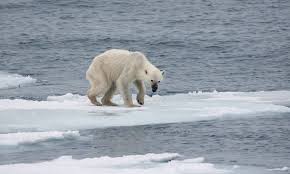
Russian authorities have declared a state of emergency in the remote, sparsely populated Novaya Zemlya islands in the Arctic Ocean, the BBC reported this weekend, after “dozens” of polar bears whose food sources are limited due to climate change started rooting through homes and other buildings near the settlement of Belushya Guba looking for something to eat.
According to the BBC, officials said that the bears no longer fear either police patrols or the signals used to keep them away from humans, and that they have even crossed onto the grounds of the local air defense garrison. Though the animals are considered endangered by Russia (the IUCN Red List classifies them as “vulnerable,” with a decreasing population), officials said that if non-lethal means fail to drive the bears away, they may be forced to cull the animals, the BBC added.…’
Benjamin Dreyer sees language the way an epicure sees food. And he finds sloppiness everywhere he looks:
’With his finely tuned editing ear, Benjamin Dreyer often encounters things so personally horrifying that they register as a kind of torture, the way you might feel if you were an epicure and saw someone standing over the sink, slurping mayonnaise directly from the jar.…’
Via New York Times
 Could Have Its Own Gene:
’In 1909, the Japanese scientist Kuniomi Ishimori collected spinal fluid from sleep-deprived dogs and injected it into active, rested pooches. Within hours, the latter fell into a deep sleep. By coincidence, a pair of French researchers did the same experiments a few years later and got the same results. These studies, and others like them, suggested that the blood of sleepy animals contains some kind of soporific secret sauce of chemicals. Ishimori called these “hypogenic substances.” Others labeled them “somnogens.”
The sources of these sleep-inducing chemicals have proved surprisingly elusive, and scientists have found only a few that fit the bill. Now Hirofumi Toda from the University of Pennsylvania has discovered another—a gene called nemuri that triggers sleep, at least in fruit flies. Unexpectedly, it also becomes active during infections and acts to kill incoming microbes. It seems to be part of a self-regulating system, analogous enough to an internal thermostat that we might call it a sleep-o-stat. It can send animals to sleep when they most need shut-eye, whether because they’re sick or because they just haven’t slept enough.
This sleep-o-stat works separately from the daily body clocks that make us feel more tired at night.…’
Via The Atlantic
’The reason it’s hard to love our “neighbor” is because, from an evolutionary standpoint, people outside of our groups have always been suspected as possible threats. The way to love “others” is by engaging with them long enough that we begin to see, in them, ourselves. That is, we see our own struggles and challenges reflected back. …[T]he “last thing” Jesus wanted to do was found a religion that would divide humanity even more. Jesus would be “mortified” …that his followers started a religion in his name.…’
’Here are some facts that might surprise you.
In 1971, two years before Roe v. Wade legalized abortion, the biggest white evangelical group in America, the Southern Baptist Convention, supported its legalization. The group continued that support through much of the 1970s. And the late Jerry Falwell, founder of the Moral Majority, did not give his first antiabortion speech until 1978, five years after Roe.
Though opposition to abortion is what many think fueled the powerful conservative white evangelical right, 81 percent of whom voted for Donald Trump, it was really school integration, according to Randall Balmer, chairman of the religion department at Dartmouth.…’
Via The Boston Globe
 Editor’s note:
’In conjunction with the Feb. 5 op-ed “The case for starting impeachment hearings,” by Ben Clements and Ron Fein, we asked readers whether, in the case of President Trump, it was too soon to start the process or long overdue. We received nearly 50 responses, and sentiments ran about 4 to 1 in favor of beginning the move toward impeachment (though many of the nays were just as critical of the president). The following is an edited sample:…’
Via The Boston Globe
 Bandy X. Lee and Leonard L. Glass on ‘Malignant Normalcy’:
’A year ago, we affirmed our duty as psychiatrists to alert the public about a president’s mental state if it posed a danger to society. To fulfill that responsibility, we both contributed to the book “The Dangerous Case of Donald Trump: 27 Psychiatrists and Mental Health Experts Assess a President.” Now, almost two years later, there appears to be consensus among all but the president’s most loyal supporters that Trump is indeed unstable and dangerous. Yet the voice of those most qualified to assess mental impairment has been largely absent, slowing the public’s understanding, and hampering its ability to demand protective action.
…What was remarkable and alarming was that, in the face of this overwhelming agreement, the APA decided to escalate the Goldwater rule into a total gag order, so that a member who speaks out about a public figure and identifies himself/herself as a psychiatrist is in violation of the APA’s ethical code. This is unlike any other medical speciality…
To make matters worse, around this time last year, the emergency medicine specialist and White House physician Dr. Ronny Jackson, without proper training in mental health and without appropriate independence, declared his employer and commander in chief “mentally fit to serve.” He did so based on a 10-minute dementia screen that has been discouraged from use for ruling out dementia after several studies in 2015 showed full-blown Alzheimer patients and hospitalized schizophrenia patients scored in the normal range. Specialists therefore recommend that full neuropsychiatric testing still be performed for those suspected of having early dementia. Dr. Jackson’s actions have only served further to eclipse the opinions of mental health professionals in the face of perhaps the greatest public mental health crisis we have faced in our lifetimes, but this is not new: White House physicians are known to cover up presidents’ conditions in ways that are thought to have negatively influenced the course of history. Authoritative scholars, therefore, suggest that the White House physician remain strictly the president’s personal physician, and that fitness for office tests be outsourced to an independent body.
Dr. Robert Jay Lifton called this the spread of “malignant normality,” based on his study of how Nazi doctors were acculturated into accepting the task they were given in the killing process at Auschwitz as “normal.” Human beings are very adaptable, and there is almost no degree of pathology we could not grow accustomed to, unless those with clear knowledge of what was happening were to speak out. Based on the experience of physician compliance with Nazism, we now have the Declaration of Geneva, the universal physician’s pledge that recognizes either silence or active cooperation with a destructive regime as running counter to medicine’s humanitarian goals. For this reason, we continue to believe that public discourse by mental health professionals on what is at the source a national mental health crisis is the first step to having clarity and empowering the people. The American Psychiatric Association has failed to respond to this emergency; at a minimum, it should cease threatening and demeaning those psychiatrists who do…’
’
Via Boston Globe
’Historian Tiffany Watt Smith argues that schadenfreude, the joy we derive from another’s misfortune, is just a natural part of the very complex emotional responses we have as human beings.…’
Via Longreads
 > ‘In May, Denver will vote on whether or not to decriminalize magic mushrooms. In addition to their ability to combat depression and anxiety, magic mushrooms can also affect people’s perspective, including their political positions….’
Via Big Think
Joe Darrow writes:
 >’Whatever you may have read over the past year — as extreme weather brought a global heat wave and unprecedented wildfires burned through 1.6 million California acres and newspaper headlines declared, “Climate Change Is Here” — global warming is not binary. It is not a matter of “yes” or “no,” not a question of “fucked” or “not.” Instead, it is a problem that gets worse over time the longer we produce greenhouse gas, and can be made better if we choose to stop. Which means that no matter how hot it gets, no matter how fully climate change transforms the planet and the way we live on it, it will always be the case that the next decade could contain more warming, and more suffering, or less warming and less suffering. Just how much is up to us, and always will be….’
Source: NYMag
 Christina Maxouris writes:
‘…[Y]es, a lot of people find ASMR relaxing. Others find it horrifying. Or at the very least it freaks them out, like the Michelob Ultra ad featuring Kravitz did.
It’s not Kravitz that’s the problem, it’s just that ASMR is not for everyone! For every person that chills out to the sound of someone rubbing Velcro or sipping from a beer bottle, there’s someone else who thinks ASMR feels like being haunted by a very quiet ghost with no sense of personal space. …’
Source: CNN
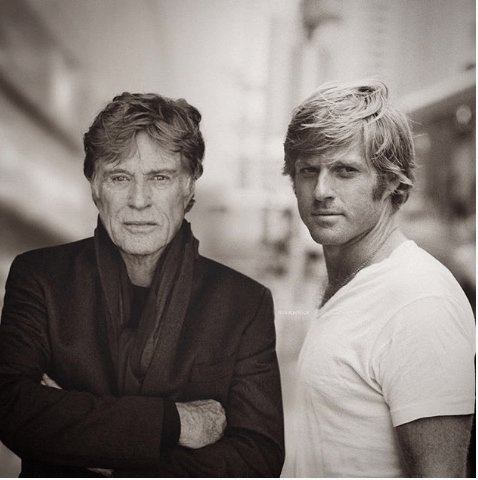 Celebrities pose with their younger selves in the work of Dutch photographer @ardgelinck.
Via Instagram
’In what is now an annual tradition, when the temperatures in some part of the US plunge below zero degrees on the Fahrenheit scale, some nitwit Republican climate change-denier live-tweets from the back pocket of industry something like “It’s so cold out where’s the global warming when we need it???? #OwnTheLibs”. This time around, it was our very own Shitwhistle-in-Chief who tweeted merrily about the current polar vortex bearing down on the Midwest…’
Via kottke
As the article tells it, there are two major factors in the relationship between climate change and severe cold snaps. The first is perception. Quite simply, as it warms up, cold snaps that used to be more typical now seem more memorably extreme. The second reason is a more meteorological one. Global warming is causing a warming in polar latitudes that diminishes the temperature gradient between the poles and the middle latitudes. As a result, the jet stream is weakened and slowed. It thus takes a more meandering course and, in so doing, splits the stratospheric polar vortex into eddying swirls, some of which wander southward and bring their cold air to lower latitudes.
 Engineers create a robot that can imagine itself:
’Robots that are self-aware have been science fiction fodder for decades, and now we may finally be getting closer. …Columbia Engineering researchers have made a major advance in robotics by creating a robot that learns what it is, from scratch, with zero prior knowledge of physics, geometry, or motor dynamics. Initially the robot does not know if it is a spider, a snake, an arm—it has no clue what its shape is. After a brief period of “babbling,” and within about a day of intensive computing, their robot creates a self-simulation. The robot can then use that self-simulator internally to contemplate and adapt to different situations, handling new tasks as well as detecting and repairing damage in its own body. The work is published today in Science Robotics.…’
Via 3 Quarks Daily
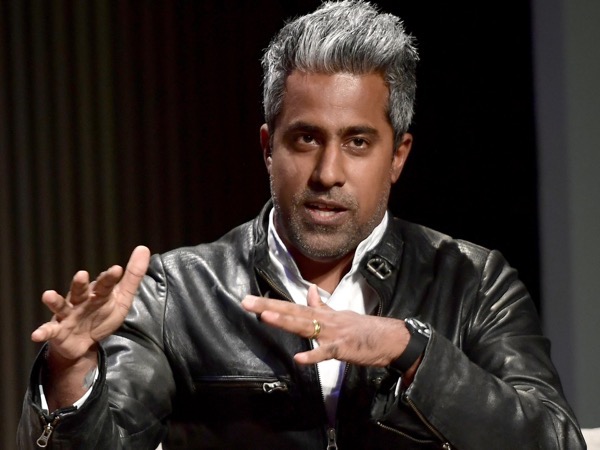 Anand Giridharadas, the critic who has the world’s richest people buzzing:
’Q: What does Davos stand for in your view? Do you have any particular thoughts on this year’s, specifically?
Anand Giridharadas: I think Davos is a family reunion for the plutocrats that broke the modern West. I’ve never been to it, so I’m a cultural critic looking from a distance, but it seems to me to be a gathering of people who think that they are changing the world when they are exactly what needs changing. A gathering of people who use the idea of making a difference as a kind of lubricant in the engine of making a killing, of people who promote generosity as a cheap substitute for justice.…’
Via Business Insider
 Today is Groundhog Day and, this year, since Punxsutawney Phil did not see his shadow, spring is coming early. In the Pagan calendar, it is Imbolc (or Imbolg), which has marked the beginning of spring since ancient times, coming at the midpoint between the astronomical winter solstice (“Yule”) and the spring equinox (“Ostara”) in the northern hemisphere. It is one of the four Gaelic seasonal festivals that fall at the ‘quarter cross points’ between the equinoxes and the solstices, along with Beltane, Lugnasadh, and Samhain.
Imbolc was a time to celebrate Brigid (Brigit, Brighid, Bride, Bridget, Bridgit, Brighde, Bríd), the Celtic Goddess of inspiration, healing, and smithcraft with associations to fire, the hearth and poetry. When Ireland was Christianized in the 5th century, the festival of Brigid became Saint Brigid’s Day, although the chronology of the transmigration from the Celtic goddess to the Christian saint is not universally accepted. Imbolc derives from the Old Irish imbolg meaning in the belly, a time when sheep began to lactate and their udders filled and the grass began to grow.It thus coincided with the beginning of the lambing season, the spring sowing, and some of the earliest blooming plants. The gentle curve of a ‘just-showing’ pregnancy embodies the promise of renewal, expectancy and hope.
Evidence indicates that Imbolc has been an important date in the Irish, Scottish and Manx calendar since ancient times. The holiday was a festival of hearth and home with celebrations often embodying hearth fires, feasting, divination for omens of good fortune, and candles or bonfires representing the return of warmth and light. The point of many rituals seemed to be to invite Brigid, and the good fortune she would bring, into the home. Activities included:
— Brigid crosses, consisting of reeds or willows woven in a four-armed equilateral cross, often hung over doors, windows, or stables for protection
— making Bridey (Brideog, Breedhoge, or ‘Biddy’) dolls, representing Brigid, which were paraded from house to house. People would make a bed for her and leave her food and drink.
— visiting of holy wells, which are circled ‘sunwise’ and offerings left. Water from the well was used to bless home, family members, livestock and fields.
— a “spring cleaning” was customary
— Imbolc was traditionally a time of weather divination. Old traditions of watching to see if various animals returned from their winter dens seem to be forerunners of Groundhog Day.
Although many of the customary observances of Imbolc died out during the 20th century, it is still observed and in some places has been revived as a cultural event.Brigid’s Day parades have been revived in the town of Killorglin, County Kerry, which holds a yearly “Biddy’s Day Festival”. Men and women wearing elaborate straw hats and masks visit public houses carrying a Brídeóg to bring good luck for the coming year. They play folk music, dance and sing. The highlight of this festival is a torchlight parade through the town followed by a song and dance contest. Most recently, neopagans and Wiccans have observed Imbolc as a religious holiday.
’…It is the festival of the Maiden, for from this day to March 21st, it is her season to prepare for growth and renewal. Brighid’s snake emerges from the womb of the Earth Mother to test the weather, (the origin of Ground
Hog Day), and in many places the first Crocus flowers began to spring forth from the frozen earth.The Maiden is honored, as the Bride, on this Sabbat. Straw Brideo’gas (corn dollies) are created from oat or wheat straw and placed in baskets with white flower bedding. Young girls then carry the Brideo’gas door to door, and gifts are bestowed upon the image from each household. Afterwards at the traditional feast, the older women make special acorn wands for the dollies to hold, and in the morning the ashes in the hearth are examined to see if the magic wands left marks as a good omen. Brighid’s Crosses are fashioned from wheat stalks and exchanged as symbols of protection and prosperity in the coming year. Home hearth fires are put out and re-lit, and a besom is place by the front door to symbolize sweeping out the old and welcoming the new. Candles are lit and placed in each room of the house to honor the re-birth of the Sun.
Another traditional symbol of Imbolc is the plough. In some areas, this is the first day of ploughing in preparation of the first planting of crops. A decorated plough is dragged from door to door, with costumed children following asking for food, drinks, or money. Should they be refused, the household is paid back by having its front garden ploughed up. In other areas, the plough is decorated and then Whiskey, the “water of life” is poured over it. Pieces of cheese and bread are left by the plough and in the newly turned furrows as offerings to the nature spirits. It is considered taboo to cut or pick plants during this time.
Various other names for this Greater Sabbat are Imbolgc Brigantia (Caledonni), Imbolic (Celtic), Disting (Teutonic, Feb 14th), Lupercus (Strega), St. Bridget’s Day (Christian), Candlemas, Candlelaria (Mexican), the Snowdrop Festival. The Festival of Lights, or the Feast of the Virgin. All Virgin and Maiden Goddesses are honored at this time…’
(Via Celtic Connection)
Imbolc also corresponds with Candlemas, the Christian observance of the baby Jesus’ presentation at the Temple in Jerusalem to officially induct him into Judaism when he was forty days old. It was originally described in the Gospel of Luke as a purification ritual. On Candlemas, a priest traditionally blesses candles which are distributed to the faithful for use throughout the year. In some places, they are placed in windows during storms to ward off damage.
Interestingly, in Scotland, along with Michaelmas, Lammas and Whitsun, Candlemas is one of the four term and quarter days, the four divisions of the legal year, historically used as the days when contracts and leases would begin and end, servants would be hired or dismissed, and rent, interest on loans, and ministers’ stipends would become due. Although they were later fixed by law as falling on the 28th day every three months, they originally occurred on holy days, corresponding roughly to old quarter days used in both Scotland and Ireland.
Some foreign observances:
In France and Belgium, Candlemas (French: La Chandeleur) is celebrated with crêpes.
In Italy, traditionally, it (Italian: La Candelora) is considered the last cold day of winter.
Tenerife (Spain), Is the day of the Virgin of Candelaria (Saint Patron of the Canary Islands). 2 February.
In Southern and Central Mexico, and Guatemala City, Candlemas (Spanish: Día de La Candelaria) is celebrated with tamales. Tradition indicates that on 5 January, the night before Three Kings Day (the Epiphany), whoever gets one or more of the few plastic or metal dolls (originally coins) buried within the Rosca de Reyes must pay for the tamales and throw a party on Candlemas. In certain regions of Mexico, this is the day in which the baby Jesus of each household is taken up from the nativity scene and dressed up in various colorful, whimsical outfits.
In Luxembourg, Liichtmëss sees children carrying lighted sticks visiting neighbors and singing a traditional song in exchange for sweets.
Sailors are often reluctant to set sail on Candlemas Day, believing that any voyage begun then will end in disaster—given the frequency of severe storms in February, this is not entirely without sense.
(Via Wikipedia)
 Death Cap Mushrooms are Spreading Across North America:
’…Dr. Kathy Vo, a medical toxicologist in San Francisco, publishes case studies on rare or unusual poisonings. Amanita phalloides poisonings, she told me, are some of the worst. “When the liver starts to fail, you see bleeding disorders, brain swelling, multi-organ failure. It’s very, very rough,” she said.
The levels of fluid loss, Vo said, are some of the most dramatic she’s seen. The body flushes everything it has. “There’s not an antidote,” she said. “That’s what makes this particularly deadly. We institute a variety of therapies, but there’s not an A, B, C, D. It’s not always the same. The best bet for the patient is fluid, fluid, fluid; keep watching the liver, and if the liver is failing, go for a transplant.”
On average, one person a year has died in North America from ingesting death caps, though that number is rising as the mushroom spreads. More than 30 death-cap poisonings were reported in 2012, including three fatalities, while 2013 saw five cases and no deaths. In 2014, one person died of death-cap poisoning in Michigan; two in California; and one in Vancouver, after a Canadian man traveled to California, ate the mushrooms as part of a meal, and returned to Vancouver, where he became ill and died.
Amanita phalloides are said to be quite tasty, and a person who eats one could feel fine for a day or two before illness sets in. The poison is taken up by the liver cells, where it inhibits an enzyme responsible for protein synthesis; without protein, the cells begin to die, and the patient may start to experience nausea and diarrhea—symptoms that can easily be attributed to general food poisoning or other ailments. “If the patient doesn’t realize the connection, doesn’t see the illness as a result of eating a mushroom a day or two earlier, it’s a hard diagnosis,” said Vo.…’
Via The Atlantic
’Why are we so much less violent day-to-day within our communities (in pretty much all cultures) than our closest primate relatives, chimpanzees, are within theirs? At the same time, how is it that human violence directed toward perceived enemy groups has been so destructive?…’
Via 3 Quarks Daily
 A selection of famous, but different, anarchists:
’It takes an independent mind to declare oneself an anarchist, but even so, the stories and characters of people who identify as anarchists can be surprising. Here’s five snapshots of different anarchists, each with a different take on the controversial political philosophy and different experiences. As a quick note, this list is in no way meant to be exhaustive; there are many more influential, controversial, famous, and infamous anarchists out there other than those described here.…’
Via Big Think
Elephant seals lounging on Drakes Beach.
’During the government shutdown, while nobody was looking, a herd of elephant seals took over a popular California beach and forced authorities to close the area to visitors.
The opportunistic animals are iconic residents of Point Reyes National Seashore in Marin County near San Francisco, where they can usually be seen lounging on the sand from afar.
But with National Park Service employees furloughed, and no one around to wrangle them, 50 to 60 seals moved into Drakes Beach, known by locals for its expansive shoreline and pristine views.
Had the shutdown not occurred, “we probably would have tried to move the seals further away from the parking area,” John Dell’Osso, chief of interpretation and resource education at Point Reyes National Seashore, told Motherboard in an email.
“This would be done by a standard practice of using tarps and waving them at the seals to the point where they turn around and go further down the beach,” Dell’Osso explained.
A mid-January storm, coupled with extreme tides called “king tides,” drove the seals away from Chimney Rock, a secluded point on the peninsula where the animals tend to congregate, Dell’Osso theorized.…’
Via Motherboard
’The sunflower sea star, one of the largest starfish species in the world, has been practically wiped out along the west coast of North America, putting ecosystems at risk, according to a study published Wednesday in Science Advances.
Led by Drew Harvell, a Cornell University professor of ecology and evolutionary biology, the authors found that a recent outbreak of sea star wasting disease reduced the population by 80 to 100 percent across 3,000 kilometers of its territory.…’
Via Motherboard
’The research lends strong support to a decade-old theory that attributes the trippy effects of many psychedelics to a breakdown of information processing in a region of the brain that regulates how we respond to internal and external stimuli.…’
Via Motherboard
’The CDC has identified an outbreak of salmonella caused by contact with hedgehogs. A hedgehog can appear healthy and still carry salmonella. Conscientious hygiene is required for anyone living with a hedgie.…’
Via Big Think
’If you bled when you brushed your teeth this morning, you might want to get that seen to. We may finally have found the long-elusive cause of Alzheimer’s disease: Porphyromonas gingivalis, the key bacteria in chronic gum disease.
That’s bad, as gum disease affects around a third of all people. But the good news is that a drug that blocks the main toxins of P. gingivalis is entering major clinical trials this year, and research published today shows it might stop and even reverse Alzheimer’s. There could even be a vaccine.
Alzheimer’s is one of the biggest mysteries in medicine. As populations have aged, dementia has skyrocketed to become the fifth biggest cause of death worldwide. Alzheimer’s constitutes some 70 per cent of these cases and yet, we don’t know what causes it.…’
Via New Scientist
’Buster Benson (a marketing manager at Slack) decided to organize 175 known biases into a giant codex… Benson (with help from illustrations by John Manoogian III), sorted biases for duplicates and grouped them into four larger categories, each called a “conundrum” or “problem”. All four of these limit our intelligence but are actually trying to be helpful. According to Benson, “Every cognitive bias is there for a reason — primarily to save our brains time or energy.” But the end result of utilizing such mental shortcuts, which are often useful, is that they also introduce errors into our thinking. By becoming aware of how our minds make decisions, we can be mindful of the inherent inaccuracies and fallacies and hopefully act with more fairness and grace.…’
Via Big Think

’The public finally had a chance in 2017 to see some of the government’s tightly guarded UFO footage — never mind the sudden admission that it existed in the first place. The handful of clips that were de-classified were eye-popping, depicting flying somethings with ridiculous maneuvering capabilities, far beyond anything we’d seen in human craft. Sure, we wondered where they came from and who was driving those things, but just as urgent was a desire to wrap our heads around how they were doing the things they were doing. Apparently, the Department of Defense (DOD) was right there with us, because their recently published reading list suggests their suspicions went in some seriously sci-fi directions.…’
Via Big Think
 Sure, it sounds like science fiction. But some researchers suggest that warp drives might actually be a possibility:
’…nothing in relativity suggests that spacetime cannot contract or stretch faster than light. If spacetime around the ship bends in a certain way, the craft can be swiftly propelled and, in theory, travel a vast distance in little time.
The ship itself does not violate the Einsteinian prohibition on faster-than-light travel because, within its bubble of spacetime, the ship is not traveling faster than light. To a stationary observer, the ship would appear to be moving at light speed (or close to it). But it is actually the surrounding distortion of spacetime that is driving the bubble from origin to destination, kind of like a surfer riding a wave. Consequently, the ship is not empirically moving faster than light relative to anything else in its bubble. Yet if the ship and light leave the same space at the same time, the ship might get there faster than the light does.…’
Via JSTOR Daily
For the Greater Glory of the Orange Infant:
’This absurd conversation was actually televised at the time, and mentioned in the New York Times coverage of the conversation, which speculated that he had made the suggestion “perhaps jokingly.”
But according to Sims new book, Trump was dead serious.
In the lead up to the interview, Sims says, the situation was tense. Due to the position of the ISS, there was only a 20 minute period in which the interview could be accomplished, so Trump had to be right on time.
Then, according to Sims, Trump went off on a tangent about Mars, and demanded that NASA send a manned mission there before the end of his term.
Then, something happened. Trump “suddenly appeared distracted, distant,” wrote Sims. “I could sense the gears inside of his head starting to turn. I was losing him.” As the clock ticked down, Trump “suddenly turned toward the NASA administrator.” He asked: “What’s our plan for Mars?”
When the NASA administrator explained that it would take until the 2030s to send a manned mission, Trump didn’t accept it.“Trump bristled,” Sims writes. The president allegedly asked, “But is there any way we could do it by the end of my first term?”
President Deals then tried to negotiate.
Trump did not seem worried about the time. Sims wrote that he leaned in toward Lightfoot and made him an offer. “But what if I gave you all the money you could ever need to do it?” Trump asked. “What if we sent NASA’s budget through the roof, but focused entirely on that instead of whatever else you’re doing now. Could it work then?”
Lightfoot told him he was sorry, but he didn’t think it was possible. This left Trump “visibly disappointed,” Sims wrote. “But I tried to refocus him on the task at hand. We were now about 90 seconds from going live.”
As if this could get any more absurd, with only seconds to spare before the absolute deadline to connect with the ISS, Trump stopped to look in a bathroom mirror.
“Space Station, this is your President,” Trump said to his own reflection, according to Sims.…’
Via Splinter
10 of the most sandbagging, red-herring, and effective logical fallacies.
‘…Many an otherwise-worthwhile argument has been derailed by logical fallacies. Sometimes these fallacies are deliberate tricks, and sometimes just bad reasoning. Avoiding these traps makes disgreeing so much better.…’
Via Big Think
’How you talk to people with drug addiction might save their life.…’
Via Big Think
Abstract:
’Screaming is arguably one of the most relevant communication signals for survival in humans. Despite their practical relevance and their theoretical significance as innate [1] and virtually universal [2, 3] vocalizations, what makes screams a unique signal and how they are processed is not known. Here, we use acoustic analyses, psychophysical experiments, and neuroimaging to isolate those features that confer to screams their alarming nature, and we track their processing in the human brain. Using the modulation power spectrum (MPS, [4, 5]), a recently developed neurally-informed characterization of sounds, we demonstrate that human screams cluster within restricted portion of the acoustic space (between ∼30–150 Hz modulation rates) that corresponds to a well-known perceptual attribute, roughness. In contrast to the received view that roughness is irrelevant for communication [6], our data reveal that the acoustic space occupied by the rough vocal regime is segregated from other signals, including speech, a pre-requisite to avoid false-alarms in normal vocal communication. We show that roughness is present in natural alarm signals as well as in artificial alarms, and that the presence of roughness in sounds boosts their detection in various tasks. Using fMRI, we show that acoustic roughness engages subcortical structures critical to rapidly appraise danger. Altogether, these data demonstrate that screams occupy a privileged acoustic niche that, being separated from other communication signals, ensures their biological and ultimately social efficiency.…’
Via Current Biology
’Twitter CEO Jack Dorsey thinks the company’s “protocol” for politicians who seem to violate the site’s rules is clear. So clear, in fact, that he refused to say if Twitter would ban the president should he explicitly ask his followers to do a bunch of murders.…’
Via Gizmodo
‘Residents of Cremona, Italy, are hearing a lot of that lately. The city, the birthplace of the world’s finest string instruments, has thrown itself behind an effort to preserve every note before the instruments are too fragile to play.
That requires absolute silence in the cobblestoned area around the auditorium where the sounds of Stradivarius instruments are being recorded. The streets are shut down, and a dropped glass or even the sound of a woman’s high heels clicking make for an “an auditory nightmare,” said one of the people behind the project. …’
Source: The New York Times
Damian Carrington writes:
‘“We knew that something was amiss in the first couple days,” said Brad Lister. “We were driving into the forest and at the same time both Andres and I said: ‘Where are all the birds?’ There was nothing.”
His return to the Luquillo rainforest in Puerto Rico after 35 years was to reveal an appalling discovery. The insect population that once provided plentiful food for birds throughout the mountainous national park had collapsed. On the ground, 98% had gone. Up in the leafy canopy, 80% had vanished. The most likely culprit by far is global warming.
“It was just astonishing,” Lister said. “Before, both the sticky ground plates and canopy plates would be covered with insects. You’d be there for hours picking them off the plates at night. But now the plates would come down after 12 hours in the tropical forest with a couple of lonely insects trapped or none at all.”
“It was a true collapse of the insect populations in that rainforest,” he said. “We began to realise this is terrible – a very, very disturbing result.”
Earth’s bugs outweigh humans 17 times over and are such a fundamental foundation of the food chain that scientists say a crash in insect numbers risks “ecological Armageddon”. When Lister’s study was published in October, one expert called the findings “hyper-alarming”. …’
Source: The Guardian
 Jeremy Lent in openDemocracy:
’Pinker is… an intellectual darling of the most powerful echelons of global society. He spoke to the world’s elite this year at the World’s Economic Forum in Davos on the perils of what he calls “political correctness,” and has been named one of Time magazine’s “100 Most Influential People in the World Today.” Since his work offers an intellectual rationale for many in the elite to continue practices that imperil humanity, it needs to be met with a detailed and rigorous response.…’
Via openDemocracy
’Something strange is going on at the top of the world. Earth’s north magnetic pole has been skittering away from Canada and towards Siberia, driven by liquid iron sloshing within the planet’s core. The magnetic pole is moving so quickly that it has forced the world’s geomagnetism experts into a rare move.
On 15 January, they are set to update the World Magnetic Model, which describes the planet’s magnetic field and underlies all modern navigation, from the systems that steer ships at sea to Google Maps on smartphones.
The most recent version of the model came out in 2015 and was supposed to last until 2020 — but the magnetic field is changing so rapidly that researchers have to fix the model now. “The error is increasing all the time,” says Arnaud Chulliat, a geomagnetist at the University of Colorado Boulder and the National Oceanic and Atmospheric Administration’s (NOAA’s) National Centers for Environmental Information.
The problem lies partly with the moving pole and partly with other shifts deep within the planet. Liquid churning in Earth’s core generates most of the magnetic field, which varies over time as the deep flows change. In 2016, for instance, part of the magnetic field temporarily accelerated deep under northern South America and the eastern Pacific Ocean. Satellites such as the European Space Agency’s Swarm mission tracked the shift.…’
Via Nature
Mainstay of the Art Ensemble of Chicago:
’Joseph Jarman, a saxophonist, flutist, woodwind player and percussionist who helped expand the parameters of performance in avant-garde jazz, especially as a member of the Art Ensemble of Chicago, died on Wednesday at the Lillian Booth Actors Home in Englewood, N.J. He was 81.
His former wife, the writer and scholar Thulani Davis, said the cause was cardiac arrest as a result of respiratory failure.
Over the last two decades Mr. Jarman was less active in music than in other pursuits, notably his ministrations as a Buddhist priest and aikido instructor. With Ms. Davis, he founded the Brooklyn Buddhist Association in 1990. And his students at the Jikishinkan Aikido Dojo, which he established in Brooklyn, typically did not enroll there because of his jazz career; some may not have known much about it.
But Mr. Jarman was revered for his tenure in the Art Ensemble, from its inception in the late 1960s, through his departure in the early 1990s and again early in this century.
The group was an indomitable presence in experimental music, and a flagship of the Association for the Advancement of Creative Musicians, a nonprofit cooperative with a focus on new music and African-American artists. It drew inspiration not only from jazz and blues but also from world music, ritual and folklore, all keen interests of Mr. Jarman’s.…’Via New York Times obituary
Ian Lecklitner writes:
‘The upshot here is, I feel like crap, partly because my body is full of plastic, but mostly because my insatiable, kraken-like desire for sushi is ruining the ocean. It’s true: Our collective sushi habits are certainly contributing to the deteriorating health of the oceans. “The United Nations comes out with The State of World Fisheries and Aquaculture every two years, and the 2016 version basically shows that we overfished more than one-third of all fisheries — another 55 percent were maxed out, meaning we would be overfishing those, too, if we removed any more fish,” Hunnes explains. “A mere nine percent of fisheries are underfished.”
More than anything, similar to our previous fish ranking, this list should also emphasize the importance of understanding both where and how your seafood is caught (sushi-grade or not), which can dramatically impact the health and sustainability of that meal. To keep track of that kinda stuff, we recommend checking out SeafoodWatch.org. …’
Source: MEL Magazine
’Last year astronomers witnessed an explosion like no other. Now astronomers are debating if what they witnessed was the exact moment a star became a black hole.…’
Via Motherboard
’…may be causing both memory loss and uncomfortable identity discrepancies.…’
Via The Next Web
 She met mere mortals with and without the Vatican’s approval.
’For centuries, the Virgin Mary has appeared to the faithful, requesting devotion and promising comfort.
These maps show the geography of Marian apparitions – the handful approved by the Vatican, and many others.
Historically, Europe is where most apparitions have been reported, but the U.S. is pretty fertile ground too.…’
Via Big Think
 The states with the happiest Americans spend more money on ‘public goods’.
’Study reveals the Americans who live in states that spend more on tangible “public goods” are happier.
This spending makes communities “more livable.”
Pain of higher property taxes largely balanced out by higher property values and quality of life.…’
Via Big Think
’The corporate lawyer and former chief U.S. law enforcement officer nominated to replace Jeff Sessions at the Justice Department has a controversial past involving the warrantless surveillance of Americans and once fought to make it easier for phone companies to secretly hand over customer records to the government, legal experts at the American Civil Liberties Union warned on Wednesday.
In 1992, William Barr, who previously served as U.S. attorney general under President H.W. Bush, was instrumental in the development of a program that enabled the Justice Department and Drug Enforcement Agency to collect the telephone records of millions of Americans, regardless of whether they were suspected of criminal activity.…’
Via Gizmodo

’The long and the short of it? Travel by air at your own risk during the government shutdown. The president says his shutdown is all about making Americans safer. But that doesn’t seem to include Americans flying on planes.…’
Via Gizmodo
As both candidate and president, Trump has a habit of calling himself an expert on a LOT of different things. MSNBC’s Brian Williams takes a look:
Via MSNBC – YouTube (thanks, Jim)
 Ron Rosenbaum:
’The world is divided between those who willingly waste precious moments, hours, weeks, years of life doing crosswords, double-crostics, sudoku, and other word and number puzzles—and those (like myself) who are virtually allergic to them. (The puzzles, not the people.)
I’m not claiming any superiority for those who share my allergy. (Well, that’s my story, anyway, and I’m sticking to it.) I just think our brains are wired differently. Really differently.
Try this experiment at a dinner party (if you want to ruin it). Mention a frequent obsession of puzzle people, the NPR “news quiz” show, Wait Wait … Don’t Tell Me! (Or, as I call it, “Wait Wait … Please Kill Me!”) About half the attendees will exhibit violent, often physical reactions ranging from cringing to shuddering. Meanwhile, the other half will have sublime self-satisfied smiles. They sometimes get the answers before the guests! The show is so mentally stimulating!
What always gets to me is the self-congratulatory assumption on the part of puzzle people that their addiction to the useless habit somehow proves they are smarter or more literate than the rest of us. Need I suggest that those who spend time doing crossword puzzles (or sudoku)—uselessly filling empty boxes (a metaphor for some emptiness in their lives?)—could be doing something else that involves words and letters? It’s called reading.…’
Via Slate
’In the U.S., 18th and 19th century burials involved at most, a pine casket and a plot in a cemetery or on your land. But embalming techniques pioneered during the Civil War so thousands of soldiers could be brought home helped spawn the modern funeral industry. The death of Abraham Lincoln and the public viewings of his embalmed body as it was brought from Washington, D.C. to its final resting in Springfield, Illinois likely also contributed to the shift in how Americans conceive of death.
“The reports we get from that era is he [Lincoln] looked pretty doggone good for being dead after being assassinated with a bullet to the head,” Bill Hoy, an end of life expert at Baylor University, told Earther. “That confirmed that [embalming] is especially helpful for two things: One, when our dead’s death occurs a few days from home, and two, when an injury or disease process was such that dead just look horrible, and people thought ‘I don’t want that to be my last picture.’”
But while the growth of arterial embalming fluid gave loved ones more time to say goodbye and create a last memory, the processes also cuts bodies off from what some would argue is their final purpose, of giving life the Earth.
The modern green burial movement is a sort of course correction for the Western world. Acciavatti said that it’s always been much bigger in Europe compared to the U.S. “[i]n part because embalming was never really a thing there, but also because we’re so behind the curve in terms of green movements in the U.S.” But the U.S. is now catching up.
Ramsey Creek Preserve, the first modern green burial cemetery in the U.S., opened 20 years ago in South Carolina. Since then, roughly 150 green burial sites have opened their gates (if they even have them), allowing family and friends to bury loved ones in a more natural way. That generally means wrapping their body in a shroud, digging a grave that’s three feet deep—far enough down to not be detected by scavengers but not so far down as to be cut off from microbial decay—and keeping the grave unmarked.…’
Via Earther
’If December’s multiple meteor showers left you craving more, you’re in luck! Tonight is the peak of the quadrantid meteor shower, and we’ve got your list of all the major meteor showers to put on your calendar for 2019.…’
Via Lifehacker
Efforts to fill the periodic table raise questions of special relativity that “strike at the very heart of chemistry as a discipline.”
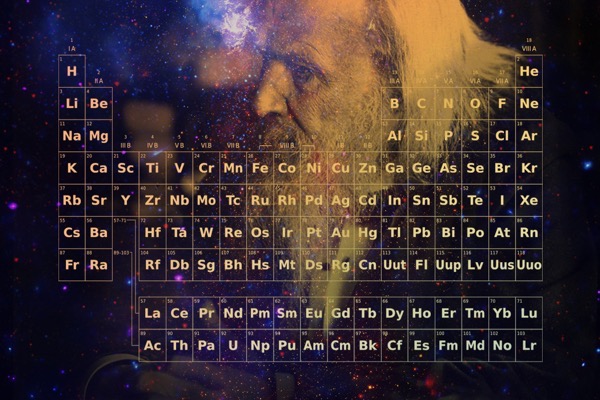
’Until December 2015, there were holes in the periodic table, elements synthesized but not yet officially recognized. But as we enter the International Year of the Periodic Table, the classic periodic table has been filled to its seventh row: In late 2015, the International Union of Pure and Applied Chemistry officially confirmed elements 113, 115, 117, and 118. The new elements also received their final names: nihonium, moscovium, tennessine, and oganesson. Efforts to find the next elements, 119 and 120, are underway.
Exactly how many elements are still to be discovered? Is there an end to the periodic table? When will we reach it? What does it teach us about the nature of the elements?…’
Via JSTOR Daily
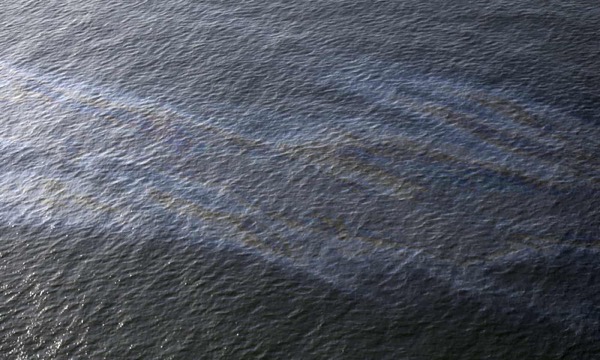 Janis Searles Jones and Philippe Cousteau:
’Eight years ago, the BP Deepwater Horizon oil spill in the Gulf of Mexico devastated communities, wildlife and livelihoods all along the Gulf coast. While dying dolphins and oil-soaked marsh grass dominated the headlines, the human cost was catastrophic. Now, it appears that a new disaster is slowly unfolding that may soon eclipse that horrific event to become the worst environmental disaster in US history.
In 2004, Hurricane Ivan triggered an undersea mudslide that sank an oil platform owned by Taylor Energy. Since then, between 300 and 700 barrels of oil have been spewing into the Gulf of Mexico every day. Let’s put that into perspective. The Deepwater Horizon disaster spilled almost 200m gallons of oil into the Gulf. To date, the Taylor spill has released as much as 140m gallons of oil into the Gulf.…’
Via The Guardian
Neil Gaiman writes:
‘If you have come here for New Year’s Wishes, I don’t have a new one. But here are the ones that already exist. This is from 2014:
Fifteen Years ago, I wrote:
May your coming year be filled with magic and dreams and good madness. I hope you read some fine books and kiss someone who thinks you’re wonderful, and don’t forget to make some art — write or draw or build or sing or live as only you can. And I hope, somewhere in the next year, you surprise yourself.
And almost a decade ago I said,
…I hope you will have a wonderful year, that you’ll dream dangerously and outrageously, that you’ll make something that didn’t exist before you made it, that you will be loved and that you will be liked, and that you will have people to love and to like in return. And, most importantly (because I think there should be more kindness and more wisdom in the world right now), that you will, when you need to be, be wise, and that you will always be kind.
Half a decade ago, I wrote:
And for this year, my wish for each of us is small and very simple.
And it’s this.
I hope that in this year to come, you make mistakes.
Because if you are making mistakes, then you are making new things, trying new things, learning, living, pushing yourself, changing yourself, changing your world. You’re doing things you’ve never done before, and more importantly, you’re Doing Something.
So that’s my wish for you, and all of us, and my wish for myself. Make New Mistakes. Make glorious, amazing mistakes. Make mistakes nobody’s ever made before. Don’t freeze, don’t stop, don’t worry that it isn’t good enough, or it isn’t perfect, whatever it is: art, or love, or work or family or life.
Whatever it is you’re scared of doing, Do it.
Make your mistakes, next year and forever.
And here, from 2012 the last wish I posted, terrified but trying to be brave, from backstage at a concert:
It’s a New Year and with it comes a fresh opportunity to shape our world.
So this is my wish, a wish for me as much as it is a wish for you: in the world to come, let us be brave – let us walk into the dark without fear, and step into the unknown with smiles on our faces, even if we’re faking them.
And whatever happens to us, whatever we make, whatever we learn, let us take joy in it. We can find joy in the world if it’s joy we’re looking for, we can take joy in the act of creation.
So that is my wish for you, and for me. Bravery and joy.
…
I meant, and mean them all. I wasn’t going to write a new one this year. But…
Be kind to yourself in the year ahead.
Remember to forgive yourself, and to forgive others. It’s too easy to be outraged these days, so much harder to change things, to reach out, to understand.
Try to make your time matter: minutes and hours and days and weeks can blow away like dead leaves, with nothing to show but time you spent not quite ever doing things, or time you spent waiting to begin.
Meet new people and talk to them. Make new things and show them to people who might enjoy them.
Hug too much. Smile too much. And, when you can, love….’
Source: Neil Gaiman’s Journal
 Associated Press:
‘ Human feces, overflowing garbage, illegal off-roading and other damaging behavior in fragile areas were beginning to overwhelm some of the American west’s most popular national parks on Monday, as a partial government shutdown left the areas open to visitors but with little staff on duty.…’
Source: The Guardian
Our best bet for survival? Lie low.
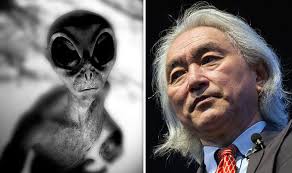
’If advanced alien civilizations do exist, theoretical physicist Michio Kaku asks: Why would they want anything to do with us? It would be like an academic talking to a squirrel, he suggests, and he has a great point.
Hollywood and science fiction novels have conditioned us for years to believe that aliens either want to hang out on our intellectual level and learn from us… or destroy us. If alien life really does have the technology and know-how to make it all the way here, perhaps we should just play it cool and not assume that we are the top species in the universe.
Kaku speculates that our hypothetical demise would come at the hands of an intelligence civilization that sees us as no more than deer in the woods and wipes us out by accident — just as we have done to (what we deem) less remarkable species since time immemorial…’
Via Big Think

New Year Sunrise
This is the annual update of my New Year post, a longstanding FmH tradition. Please let me know if you find any dead links:
I once ran across a January 1st Boston Globe article compiling folkloric beliefs about what to do, what to eat, etc. on New Year’s Day to bring good fortune for the year to come. I’ve regretted since — I usually think of it around once a year (grin) — not clipping out and saving the article. Especially since we’ve had children, I’m interested in enduring traditions that go beyond getting drunk [although some comment that this is a profound enactment of the interdigitation of chaos and order appropriate to the New Year’s celebration — FmH], watching the bowl games and making resolutions.

A web search brought me this, less elaborate than what I recall from the Globe but to the same point. It is weighted toward eating traditions, which is odd because, unlike most other major holidays, the celebration of New Year’s in 21st century America does not seem to be centered at all around thinking about what we eat (except in the sense of the traditional weight-loss resolutions!) and certainly not around a festive meal. But…
Traditionally, it was thought that one could affect the luck they would have throughout the coming year by what they did or ate on the first day of the year. For that reason, it has become common for folks to celebrate the first few minutes of a brand new year in the company of family and friends. Parties often last into the middle of the night after the ringing in of a new year. It was once believed that the first visitor on New Year’s Day would bring either good luck or bad luck the rest of the year. It was particularly lucky if that visitor happened to be a tall dark-haired man.
“Traditional New Year foods are also thought to bring luck. Many cultures believe that anything in the shape of a ring is good luck, because it symbolizes “coming full circle,” completing a year’s cycle. For that reason, the Dutch believe that eating donuts on New Year’s Day will bring good fortune.

Many parts of the U.S. celebrate the new year by consuming black-eyed peas. These legumes are typically accompanied by either hog jowls or ham. Black-eyed peas and other legumes have been considered good luck in many cultures. The hog, and thus its meat, is considered lucky because it symbolizes prosperity. Cabbage is another ‘good luck’ vegetable that is consumed on New Year’s Day by many. Cabbage leaves are also considered a sign of prosperity, being representative of paper currency. In some regions, rice is a lucky food that is eaten on New Year’s Day.”

Fireworks over Edinburgh on New Year’s Eve
The further north one travels in the British Isles, the more the year-end festivities focus on New Year’s. The Scottish observance of Hogmanay has many elements of warming heart and hearth, welcoming strangers and making a good beginning:
“Three cornered biscuits called hogmanays are eaten. Other special foods are: wine, ginger cordial, cheese, bread, shortbread, oatcake, carol or carl cake, currant loaf, and a pastry called scones. After sunset people collect juniper and water to purify the home. Divining rituals are done according to the directions of the winds, which are assigned their own colors.
First Footing: The first person who comes to the door on midnight New Year’s Eve should be a dark-haired or dark-complected man with gifts for luck. Seeing a cat, dog, woman, red-head or beggar is unlucky. The person brings a gift (handsel) of coal or whiskey to ensure prosperity in the New Year. Mummer’s Plays are also performed. The actors called the White Boys of Yule are all dressed in white, except for one dressed as the devil in black. It is bad luck to engage in marriage proposals, break glass, spin flax, sweep or carry out rubbish on New Year’s Eve.”
 Here’s why we clink our glasses when we drink our New Year’s toasts, no matter where we are. Of course, sometimes the midnight cacophony is louder than just clinking glassware, to create a ‘devil-chasing din’.
 In Georgia, eat black eyed peas and turnip greens on New Year’s Day for luck and prosperity in the year to come, supposedly because they symbolize coppers and currency. Hoppin’ John, a concoction of peas, onion, bacon and rice, is also a southern New Year’s tradition, as is wearing yellow to find true love (in Peru and elsewhere in South America, yellow underwear, apparently!) or carrying silver for prosperity. In some instances, a dollar bill is thrown in with the other ingredients of the New Year’s meal to bring prosperity. In Greece, there is a traditional New Year’s Day sweetbread with a silver coin baked into it. All guests get a slice of the bread and whoever receives the slice with the coin is destined for good fortune for the year. At Italian tables, lentils, oranges and olives are served. The lentils, looking like coins, will bring prosperity; the oranges are for love; and the olives, symbolic of the wealth of the land, represent good fortune for the year to come.
A New Year’s meal in Norway also includes dried cod, “lutefisk.” The Pennsylvania Dutch make sure to include sauerkraut in their holiday meal, also for prosperity.
In Spain, you would cram twelve grapes in your mouth at midnight, one each time the clock chimed, for good luck for the twelve months to come. (If any of the grapes happens to be sour, the corresponding month will not be one of your most fortunate in the coming year.) The U. S. version of this custom, for some reason, involves standing on a chair as you pop the grapes. In Denmark, jumping off a chair at the stroke of midnight signifies leaping into the New Year.
In Rio,
The crescent-shaped Copacabana beach… is the scene of an unusual New Year’s Eve ritual: mass public blessings by the mother-saints of the Macumba and Candomble sects. More than 1 million people gather to watch colorful fireworks displays before plunging into the ocean at midnight after receiving the blessing from the mother-saints, who set up mini-temples on the beach.
When taking the plunge, revelers are supposed to jump over seven waves, one for each day of the week.
This is all meant to honor Lamanjá, known as the “Mother of Waters” or “Goddess of the Sea.” Lamanjá protects fishermen and survivors of shipwrecks. Believers also like to throw rice, jewelry and other gifts into the water, or float them out into the sea in intimately crafted miniature boats, to please Lamanjá in the new year.
In many northern hemisphere cities near bodies of water, people also take a New Year’s Day plunge into the water, although of course it is an icy one! The Coney Island Polar Bears Club in New York is the oldest cold-water swimming club in the United States. They have had groups of people enter the chilly surf since 1903.
Ecuadorian families make scarecrows stuffed with newspaper and firecrackers and place them outside their homes. The dummies represent misfortunes of the prior year, which are then burned in effigy at the stroke of midnight to forget the old year. Bolivian families make beautiful little wood or straw dolls to hang outside their homes on New Year’s Eve to bring good luck.
 In China, homes are cleaned spotless to appease the Kitchen God, and papercuttings of red paper are hung in the windows to scare away evil spirits who might enter the house and bring misfortune. Large papier mache dragon heads with long fabric bodies are maneuvered through the streets during the Dragon Dance festival, and families open their front doors to let the dragon bring good luck into their homes.
The Indian Diwali, or Dipawali, festival, welcoming in the autumnal season, also involves attracting good fortune with lights. Children make small clay lamps, dipas, thousands of which might adorn a given home. In Thailand, one pours fragrant water over the hands of elders on New Year’s Day to show them respect.
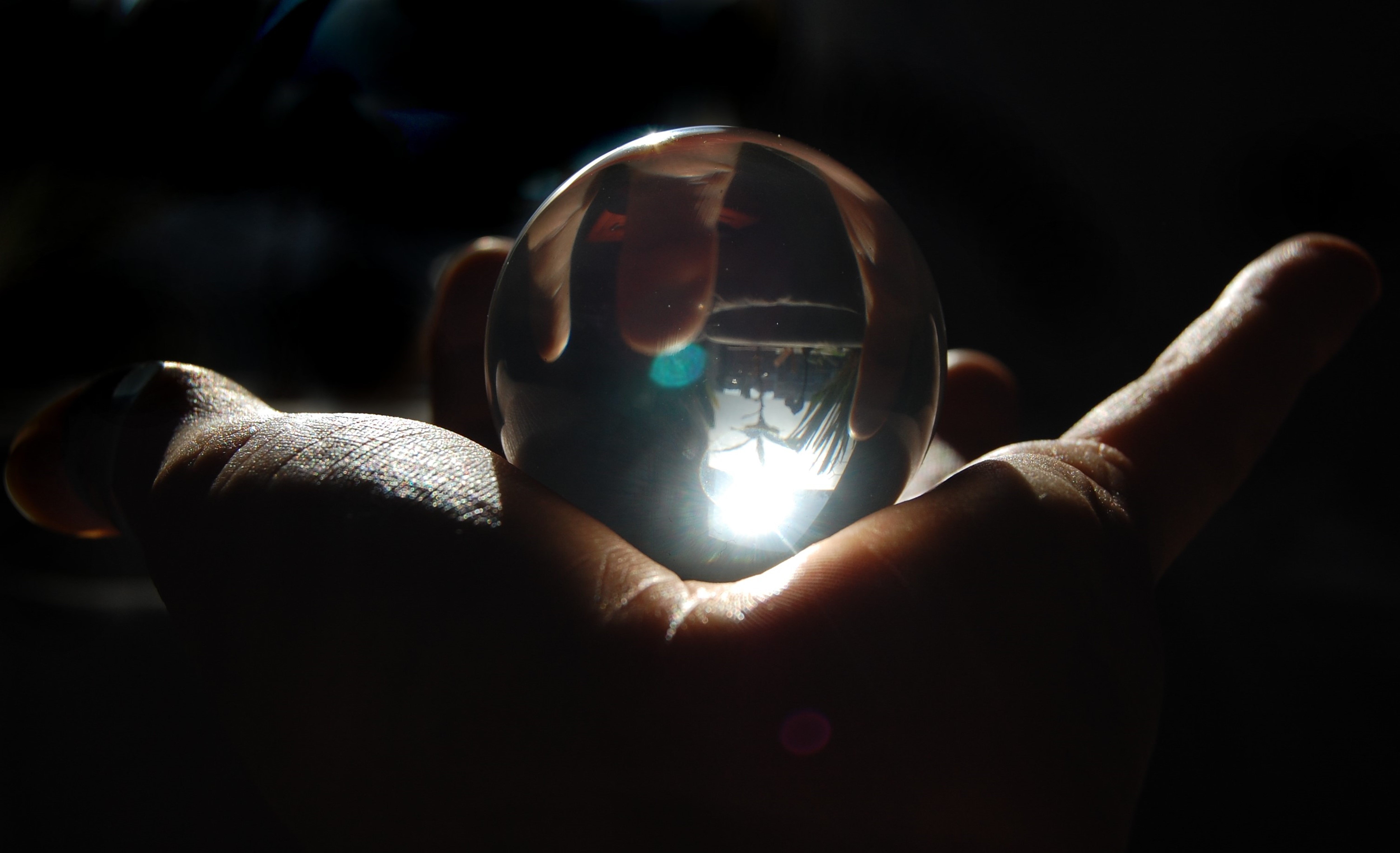 In Germany and Austria, lead pouring” (das Bleigießen) is an old divining practice using molten lead like tea leaves. A small amount of lead is melted in a tablespoon (by holding a flame under the spoon) and then poured into a bowl or bucket of water. The resulting pattern is interpreted to predict the coming year. For instance, if the lead forms a ball (der Ball), that means luck will roll your way. The shape of an anchor (der Anker) means help in need. But a cross (das Kreuz) signifies death. This is also a practice in parts of Finland, apparently.
 El Salvadoreans crack an egg in a glass at midnight and leave it on the windowsill overnight; whatever figure it has made in the morning is indicative of one’s fortune for the year.
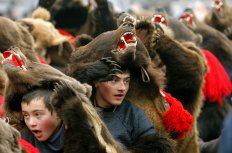 Romanians celebrate the new year by wearing bear costumes and dancing around to ward off evil
“It’s a bit bizarre when you think about it. A short British cabaret sketch from the 1920s has become a German New Year’s tradition. Yet, although The 90th Birthday or Dinner for One is a famous cult classic in Germany and several other European countries, it is virtually unknown in the English-speaking world, including Britain, its birthplace.” (Watch on Youtube, 11 min.)
So if the Germans watch British video, what do you watch in Britain? A number of sources have suggested that it is Jools Holland’s Hootenanny, “even though it’s awful and everyone hates it.”
On a related theme, from earlier in the same week, here are some of the more bizarre Christmas rituals from around the world.
Some history; documentation of observance of the new year dates back at least 4000 years to the Babylonians, who also made the first new year’s resolutions (reportedly voews to return borrowed farm equipment were very popular), although their holiday was observed at the vernal equinox. The Babylonian festivities lasted eleven days, each day with its own particular mode of celebration.  The traditional Persian Norouz festival of spring continues to be considered the advent of the new year among Persians, Kurds and other peoples throughout Central Asia, and dates back at least 3000 years, deeply rooted in Zooastrian traditions.Modern Bahá’í’s celebrate Norouz (”Naw Ruz”) as the end of a Nineteen Day Fast. Rosh Hashanah (”head of the year”), the Jewish New Year, the first day of the lunar month of Tishri, falls between September and early October. Muslim New Year is the first day of Muharram, and Chinese New Year falls between Jan. 10th and Feb. 19th of the Gregorian calendar.
 The classical Roman New Year’s celebration was also in the spring although the calendar went out of synchrony with the sun. January 1st became the first day of the year by proclamation of the Roman Senate in 153 BC, reinforced even more strongly when Julius Caesar established what came to be known as the Julian calendar in 46 BC. The early Christian Church condemned new year’s festivities as pagan but created parallel festivities concurrently. New Year’s Day is still observed as the Feast of Christ’s Circumcision in some denominations. Church opposition to a new year’s observance reasserted itself during the Middle Ages, and Western nations have only celebrated January 1 as a holidy for about the last 400 years. The custom of New Year’s gift exchange among Druidic pagans in 7th century Flanders was deplored by Saint Eligius, who warned them, “[Do not] make vetulas, [little figures of the Old Woman], little deer or iotticos or set tables [for the house-elf] at night or exchange New Year gifts or supply superfluous drinks [another Yule custom].” (Wikipedia)
 The tradition of the New Year’s Baby signifying the new year began with the Greek tradition of parading a baby in a basket during the Dionysian rites celebrating the annual rebirth of that god as a symbol of fertility. The baby was also a symbol of rebirth among early Egyptians. Again, the Church was forced to modify its denunciation of the practice as pagan because of the popularity of the rebirth symbolism, finally allowing its members to cellebrate the new year with a baby although assimilating it to a celebration of the birth of the baby Jesus. The addition of Father Time (the “Old Year”) wearing a sash across his chest with the previous year on it, and the banner carried or worn by the New Year’s Baby, immigrated from Germany. Interestingly, January 1st is not a legal holiday in Israel, officially because of its historic origins as a Christian feast day.
Auld Lang Syne (literally ‘old long ago’ in the Scottish dialect) is sung or played at the stroke of midnight throughout the English-speaking world (and then there is George Harrison’s “Ring Out the Old”). Versions of the song have been part of the New Year’s festivities since the 17th century but Robert Burns was inspired to compose a modern rendition, which was published after his death in 1796. (It took Guy Lombardo, however, to make it popular…)
Should auld acquaintance be forgot
and never brought to mind?
Should auld acquaintance be forgot
and days of auld lang syne?
For auld lang syne, my dear,
for auld lang syne,
we’ll take a cup of kindness yet,
for auld lang syne.Should auld acquaintance be forgot
and never brought to mind?
Should auld acquaintance be forgot
and days of auld lang syne?
And here’s a hand, my trusty friend
And gie’s a hand o’ thine
We’ll tak’ a cup o’ kindness yet
For auld lang syne
Here’s how to wish someone a Happy New Year around the world:
- Arabic: Kul ‘aam u antum salimoun
- Brazilian: Boas Festas e Feliz Ano Novo means “Good Parties and Happy New Year”
- Chinese:
Chu Shen TanXin Nian Kuai Le (thanks, Jeff)- Czechoslavakia: Scastny Novy Rok
- Dutch: Gullukkig Niuw Jaar
- Finnish: Onnellista Uutta Vuotta
- French: Bonne Annee
- German: Prosit Neujahr
- Greek: Eftecheezmaenos o Kaenooryos hronos
- Hebrew: L’Shannah Tovah Tikatevu
- Hindi: Niya Saa Moobaarak
- Irish (Gaelic): Bliain nua fe mhaise dhuit
- Italian: Buon Capodanno
- Khmer: Sua Sdei tfnam tmei
- Laotian: Sabai dee pee mai
- Polish: Szczesliwego Nowego Roku
- Portuguese: Feliz Ano Novo
- Russian: S Novim Godom
- Serbo-Croatian: Scecna nova godina
- Spanish: Feliz Ano Nuevo
- Swedish: Ha ett gott nytt år
- Turkish: Yeni Yiliniz Kutlu Olsun
- Vietnamese: Cung-Chuc Tan-Xuan
[If you are a native speaker, please feel free to offer any corrections or additions!]

Which of these customs appeal to you? Are they done in your family, or will you try to adopt any of them? However you’re going to celebrate, my warmest wishes for the year to come… and eat hearty!
[thanks to Bruce Umbaugh (here or here) for research assistance]
’New research shows that people with depression use absolute words, such as “always,” “nothing,” or “completely,” more often than others.…’
Via JSTOR Daily
 John Williams writes:
‘Time was that you had to be an experimental weirdo to ditch vowels. In “Finnegans Wake,” James Joyce used the word “disemvowelled” in a section thatincludes this exchange of crystal-clear dialogue:
— Nnn ttt wrd?
— Dmn ttt thg.
Before we are all Joyce — God bless him — I would suggest that we take a deep breath, a mndfl one even, and consider the culling of our five (maybe six) friends. After all, there are words that can hardly do without them: muumuu, audio and oboe, just to queue up a few. One cannot text someone “b” and expect them to know one is referring to an oboe.
And what about that old Scrabble lifesaver “euoi” — “a cry of impassioned rapture in ancient Bacchic revels?” If you know of another way to identify a cry of impassioned rapture in ancient Bacchic revels, I’d like to hear it. Really. I’ll wait.
Panicked that we might be sliding (even more quickly) toward a fully emoticon-based pictographic language, I called the linguist, Columbia professor and prolific author John McWhorter to ease my mind. First, he assured me I wasn’t crazy to suggest an uptick in this trend.
“There is a fashion in American language culture right now to be playful in a way that is often childlike,” Mr. McWhorter said. “This business of leaving out the vowels and leaving you to wonder how to pronounce something, it channels this kid-ness in a way — like saying ‘because science,’ or the way we’re using -y, when we say something like, ‘well, it got a little yell-y.’ ”
Mr. McWhorter acknowledges that the more often vowels are dropped, the more people get used to it and make adjustments to rapidly understand implied meanings. “You can imagine someone naming a band MGMT in 1976, and everyone would just be baffled,” he said. But he doesn’t see disemvowelling creeping into more formal areas, and expects the trend won’t move “beyond the realm of that which is ironic or iconic.” …’
Source: New York Times
 Paul Nicklen:
’I have either lived or worked in the Arctic for most of my life. There is no place that I love more. The Arctic is also warming twice as fast as anywhere else on Earth. On this day, four years ago, I photographed two young bears who were lying dead next to one another. Top polar bear scientists are saying that we will likely lose 30 percent of the polar bear population by 2050 due to starvation and we could lose polar bears all together within a hundred years. I want the world to realize that these are not just data points falling off a sheet paper. These are individuals that are and will starve to death due to the lack of sea ice. What is it going to take for us to wake up? It was on this day that @sealegacy was born. I am proud of the work that @sealegacy is doing. We have come a long way but we are only just getting started. If we are going to create real and lasting change for our planet, then we need to quickly scale our organization and take on bigger campaigns. Please go to the link in my bio and please consider a donation of any size. Please join us in #turnthetide #becomepartofthesolution #gratitude…’
Via Instagram
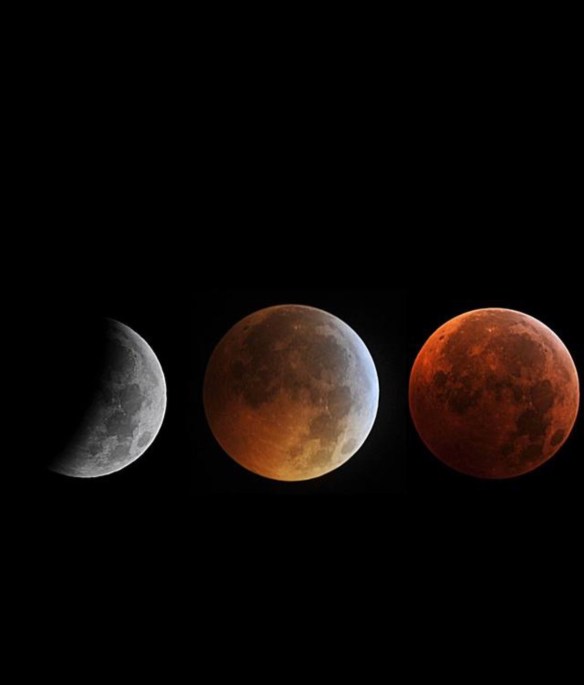 Emily Petsko writes:
‘…The new year will get off to a brilliant start when a rare reddish-orange body called a Super Blood Wolf Moon graces the sky in January…
This phenomenon is actually the convergence of a few lunar events. For one, there’s a total lunar eclipse, also known as a Blood Moon… Secondly, the Super Blood Wolf Moon takes place during a supermoon. This occurs when a moon’s full phase coincides with the point in its orbit when it comes closest to Earth. These two factors make it look 14 percent larger and 30 percent brighter than it normally does, according to Space.com. Finally, a full moon in January has been called a Wolf Moon ever since colonial times, so that’s where the “wolf” part of the name comes from.
If you’re in North America, you can expect to see the Super Blood Wolf Moon on January 20. Totality will occur around 9:12 p.m. PST or 12:12 a.m. EST on January 21, but Forbes suggests pulling up a chair an hour beforehand to watch the moon change from partial eclipse to total eclipse….’
Source: Mental Floss
 Ashley Holstrom writes:
‘Epigraphs are a lovely part of books—usually a fancy line from a very old work that the author feels in their soul. This year was (another) hard one, and the epigraphs of 2018 are a comfort.
I once had a teacher who said epigraphs were snooty, and something only authors who think they’re as good as the greats do. But I disagree. They’re a great way to lead you to more books! And this year’s selections made my TBR list even longer.
Last year I collected the best epigraphs of the year, and it’s my new favorite end-of-year tradition. So let’s get to it! …’
Source: Book Riot
’During a CNN appearance on December 24, Clark stressed that “there doesn’t seem to be any strategic rational for the decision. And if there is no strategic rational, then you have to ask, ‘Why was the decision made? I can tell you that people around the world are asking this. And some of our friends and our allies in the Middle East are asking, ‘Well, did Erdogan blackmail the president? Was there a payoff or something? Why would a guy make a decision like this?’”…’
Via Salon.com
‘If the ACME Corporation were a real company, its R&D department would have been pretty busy. The fake manufacturer, featured in the Looney Tunes’s Wile E. Coyote and Road Runner cartoons, seemingly made every type of product in the Looney Tunes universe, from explosives to refrigerators to trampolines to instructional karate manuals.
Chicago-based artist Rob Loukotka knows them all. His studio, Fringe Focus, has put them all on one 24-inch by 36-inch poster, creating an exhaustive illustrated compendium of all of the ACME-brand products that fueled the endless coyote-on-bird rivalry.
First designed as part of a wildly successful Kickstarter campaign—it vastly overshot its $3000 goal, raising more than $105,000 in less than a month—the poster features all 126 ACME products (the full list is here) that appear in the Wile E. Coyote and Road Runner sketches.
To come up with the design, Loukotka watched 43 Wile E. Coyote/Road Runner cartoons that aired between 1949 and 1994, spending more than 100 hours creating intricate renderings of products like the ACME Bird Seed, ACME Glue, the ACME Instant Icicle Maker, the book Birds and Their Habitat, and more.
Spend enough time with the poster and you’ll no doubt start wishing you could buy some of the whimsical inventions for yourself, forgetting that most of them ended up spectacularly backfiring on the poor coyote.…’
Via Mental Floss
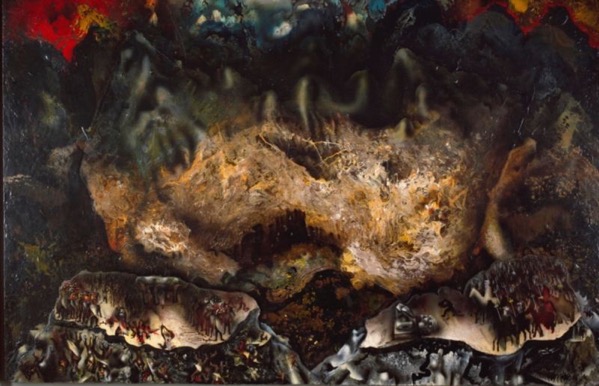 Collective Suicide (1936), by Mexican muralist David A. Siqueiros, is an example of the “accidental painting” technique developed by the artist.
’In the 1930s, a small group of New York City artists began experimenting with novel painting techniques and materials, including Mexican muralist David A. Siqueiros and Jackson Pollock. For the last few years, a team of Mexican physicists has been studying the physics of fluids at work in those techniques, concluding that the artists were “intuitive physicists,” using science to create timeless art.
“One of the things I have come to realize is that painters have a deep understanding of fluid mechanics as they manipulate their materials,” said Roberto Zenit, a physicist at the National Autonomous University of Mexico who is leading the research. “This is what fluid mechanicians do. The objective is different, but the manipulation of these materials that flow is the same. So it is not a surprise that fluid mechanics has a lot to say about how artists paint.”
Zenit is not the first physicist to be fascinated by Pollock’s work in particular. Back in 2001, for instance, physicist Richard Taylor found evidence of fractal patterns in Pollock’s seemingly random drip patterns. His hypothesis met with considerable controversy, both from art historians and a few fellow physicists. In a 2006 paper published in Nature, for instance, Case University physicists Katherine Jones-Smith and Harsh Mathur claimed Taylor’s work was “seriously flawed” and “lacked the range of scales needed to be considered fractal.” (To prove the point, Jones-Smith created her own version of a fractal painting—using Taylor’s criteria—in about five minutes using Photoshop.)
Then, in 2011, Boston College physicist Andrzej Herczynski^ and Harvard mathematician Lakshminarayanan Mahadevan collaborated with art historian Claude Cernuschi on an article for Physics Today examining Pollock’s use of a coiling instability in his paintings. It’s basically a mathematical description for how a viscous fluid folds onto itself like a coiling rope—just like pouring maple syrup on pancakes. The patterns that form depend on how thick the fluid is (its viscosity) and how fast it’s moving. Thick fluids form straight lines when being spread rapidly across a canvas, but will form loops and squiggles and figure eights if poured slowly.…’
Via Ars Technica
’To understand what goes through the minds and bodies of opioid users, The New York Times spent months interviewing users, family members and addiction experts. Using their insights, we created a visual representation of how the strong lure of these powerful drugs can hijack the brain.
Dr. Pedro Mateu-Gelabert, one of the nation’s top opioid researchers, said this work brings “an emotional understanding” to the epidemic but “without glamorizing or oversimplifying.”…’
The ‘visual representation’ is hokey and adds nothing but glitz to the narrative. Nevertheless, it is insightful. However, it is hard to understand why it took the Times months of interviewing, when the reporters could have interviewed Dr Nora Volkow, director of the National Institute of Drug Abuse, or read one of her review papers on the neurobiology of addiction, deriving the same sophisticated understanding in thirty minutes or less.
Regardless, it is important to understand that addiction is not just a weakness of will and that recovery is not just a matter of determination. Motivation and commitment are necessary but far from sufficient in the face of the powerful neurobiological changes precipitated by a period of consistent use of an addictive drug. And this is true not only with respect to opioids (so fashionable to think about given the nationwide ‘epidemic’) but but any class of addictive drug. (And, for that matter, we speculate that non-drug-related ‘addictive’ behaviors such as gambling may involve similar mechanisms.). Essentially, the machinery of pleasure, reward and satisfaction have been hijacked by the substance use. With abstinence, such changes do not reverse for months or even years.
’It’s the 50th anniversary of perhaps the most remarkable photograph ever taken, Earthrise… In what was at that time the biggest television broadcast in terms of audience ever, the crew described the moon as they orbited it, and then ended the broadcast with a reading from Genesis and, finally, with this:
“And from the crew of Apollo 8, we close with good night, good luck, a Merry Christmas – and God bless all of you, all of you on the good Earth.”
The crew fired their engine to leave lunar orbit and return to Earth on Christmas Day from behind the moon, out of radio contact with the rest of humanity. When they finally saw the Earth again, Jim Lovell broke radio silence to declare, “Please be informed there is a Santa Claus.”…’
Via Six Colors
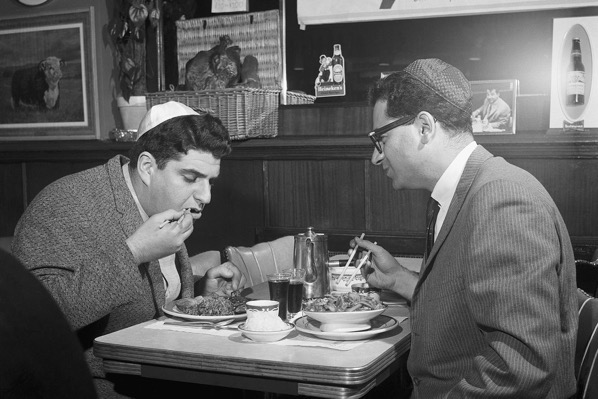 As explained by a rabbi:
’For over a century, American Jews have eaten American Chinese food on Christmas. This pastime has evolved to a near-holy tradition, parodied on Saturday Night Live, analyzed in academic papers, and reaffirmed by Supreme Court Justice Elena Kagan.
Perhaps the foremost expert on the practice is Rabbi Joshua Eli Plaut, PhD, executive director of American Friends of Rabin Medical Center, rabbi of Metropolitan Synagogue in New York, and author of A Kosher Christmas, the premier (and only?) comprehensive study of what Jews do at Christmastime.
I spoke to Plaut about Chinese food on Christmas, and why he used to sit on Santa Claus’s lap.…’
Via Vox
’Dear Anonymous,
It’s time we revisit that famous op-ed of yours.
In September, you acknowledged that you were a member of the “quiet resistance” within Donald Trump’s administration. You told us that you and others were “working diligently” to “frustrate parts of his agenda and his worst inclinations.” You said that while you agreed with many of the president’s policies, you were appalled by the president’s amorality, his chaotic management, his “repetitive rants,” his fondness for dictators.
You also believed that your efforts to resist Trump were often successful. On foreign policy, you noted, the administration’s policies were far more sober and serious than the president’s reckless rhetoric.
You were wrong. This week proves it. Assuming you haven’t departed the administration already, now would be the time for you to go. Ditto for all of your fellow “resisters.”
This is the central lesson of James Mattis’s stunning resignation on Thursday. Secretaries of defense come and go — we’ve had five in the last eight years — and some of them run afoul of the president they serve.
But Mattis is the highest-ranking cabinet member to resign over differences of policy and principle since Cyrus Vance quit the State Department in 1980 after Jimmy Carter’s Desert One fiasco. He is the only defense secretary to leave this way since the position was created in 1947.Mattis resigned because he no longer shares your analysis. He no longer believes he can be a steadying or blocking force in the councils of government because it isn’t clear there are “councils of government.” Donald Trump made a snap decision to remove U.S. troops from Syria following a phone call with Turkish president Recep Tayyip Erdogan. He did so over the unanimous objections of his national-security team. He did so after leading members of that team had said publicly and recently that the U.S. would not withdraw.
A president who sticks it to his own team while sticking with a foreign strongman is not worth sticking by.
Mattis also resigned because he has concluded that the problem with Trump isn’t that he’s an empty vessel. It’s that he’s a malignant one.
Here was the fundamental mistake in your view of Trump: You thought he could be handled. You thought of him as a child who simply needed to be kept away from dangerous toys, as former economic adviser Gary Cohn did when he removed a letter from the president’s desk ordering the end of the Korea-U.S. free trade agreement.
But our Commodus-in-Chief isn’t just an irascible buffoon whose worst impulses can be confined to Twitter but whose policy instincts largely align with yours. Trump thinks of himself as a man of ideas. Withdrawal from Syria, along with partial withdrawal from Afghanistan, is consonant with the quasi-isolationism he’s preached for decades. He is sympathetic to Erdogan, as he is to other tyrants, because he is indifferent to considerations of human rights and civil liberties.…’
Mark Manson writes:
‘…[D]esiring a positive experience is itself a negative experience; accepting a negative experience is a positive experience. …’
Source: Mark Manson
’In 2014, BBC aired a two-part documentary that featured intimate and close-up footage of dolphins using remote-controlled cameras disguised as sea creatures like turtles and fish. In one of the scenes, a group of adolescent dolphins captures a puffer fish and passes the ball-shaped little guy around. But as narrator David Tennant explains, what the dolphins really appear to be after is the toxin released by the puffer.
When attacked, puffer fish release a neurotoxin. In high doses, it can kill, but in small doses, it has a narcotic effect. It seems to be affecting the dolphins. They appear totally blissed out by the whole experience. And remarkably, all take turns in passing the puffer around.…’
Via Kottke

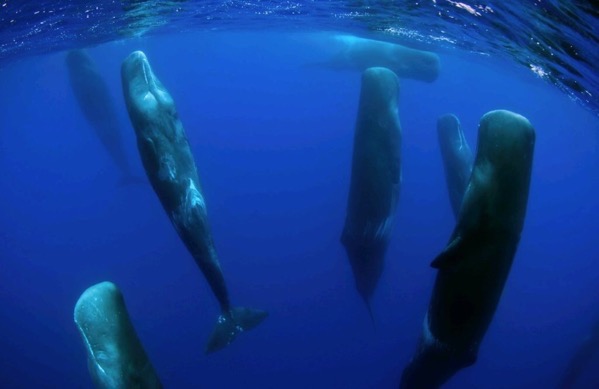


 ’Its molecular makeup makes it the perfect
  When I posted (