 Want to Read FmH in text only?
Without all the pretty pictures? Go here.

Want to Read FmH in text only?
Without all the pretty pictures? Go here.
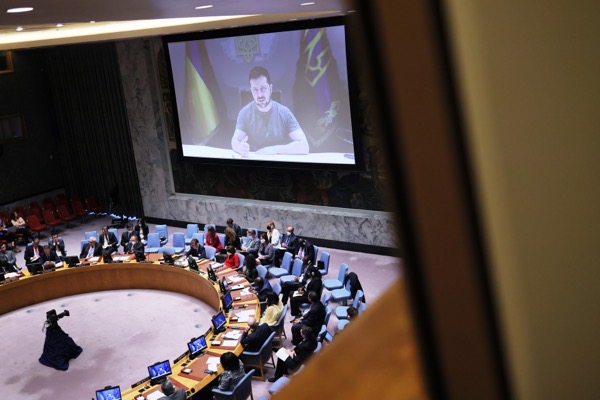
Members of the United Nations Security Council listen as Ukrainian President Volodymyr Zelenskyy speaks during a meeting at the United Nations Headquarters to discuss the conflict in Ukraine on September 27, 2022, in New York City.
‘For the first time in the nuclear era, one country used loudly issued nuclear threats — repeated just last week — to deter other countries from intervening in a large-scale conventional war of aggression. We have entered the age of “predatory nuclear-weapon states.”…’
— via POLITICO

‘There is an exciting piece deep inside this Daily Beast article regarding just how hard the 11th Circuit slapped down Judge Aileen Cannon whatever the game she is playing was. Cannon took the hit so hard she has reversed her bunk earlier order around the classified documents and Special Master, perhaps eliminating trump’s ability even to appeal the reversal by the 11th Circuit, but that’s not the bit that caught my eye.
Finally, the 11th Circuit basically held that the DOJ had already satisfied the most important element of an eventual prosecution under the Espionage Act (18 USC Section 793(d).
Here’s what Section 793(d) states:
“Whoever, lawfully having possession of [a document] relating to the national defense which information the possessor had reason to believe could be used to the injury of the United States or to the advantage of any foreign nation…willfully retains the same and fails to deliver it on demand to the officer or employee of the United States entitled to receive it” violates the Espionage Act and “shall be…imprisoned not more than ten years” for each document willfully retained.
100 classified documents. 10 years per document. I wonder how much ketchup has been splattered against the dining room wall in Mar a Lago?…’
— Jason Weisberger via Boing Boing
‘Stop me if you’ve heard this one before: New developments have put donald trump in even more serious legal jeopardy.
A new civil fraud lawsuit from the New York attorney general’s office is threatening his business, while his efforts to stall the criminal investigation into whether he mishandled classified information seem to have failed. And a separate investigation into the January 6 attack scrutinizes his associates.
It all looks quite bad for him. Then again, for at least five years, much of the media has touted the seriousness of trump’s legal peril, portraying him as on the verge of a humiliating downfall — only to see him go, in his own words, “Scott Free,” again and again….’
— via Vox

‘According to Psychology Today, as many three-quarters of bereaved people report some kind of after-death communication with loved ones. This could come in the form of a dream, a feeling, a favorite song on the radio, just about anything, really. I’m going to discount the most likely and most boring explanation for this—the emotional upheaval of losing a loved one makes us imagine things to give ourselves comfort—and assume that it’s at least possible to communicate with the afterlife.
If it is possible to speak to the dead, how you do it can be hazy; this is the spiritual world we’re talking about after all. But each of these methods has its believers—and I’ve rated each one on an entirely arbitrary scale of usefulness, too….’
— via Lifehacker

‘The Special Master attending the trump v USA classified documents clearing wants to know why trump thinks the documents aren’t classified. Either trump magically declassified them, which may be a crime in and of itself, or he stole a bunch of classified documents. The Special Master needs to know which documents trump claims he declassified and how if he is to have a reason to believe marked documents that the USG claims are classified are not. trump’s team doesn’t want to explain how or why trump had these documents or how he declassified them. Either he claims to have potentially illegally and improperly declassified information, or he stole the documents. Which is it?…’
— via Boing Boing
‘Researchers at Johns Hopkins University have found whether you’re standing upright or leaning, as well as which side you’re leaning to, could affect how fast the contents of a pill are absorbed into your body.
The bottom line: leaning to your right side after swallowing a pill could speed absorption by about 13 minutes, compared to staying upright. Leaning to the left would be a mistake — it could slow absorption by more than an hour….’
— Aaron Steckelberg via Washington Post

‘Speaking to animals has long been a fantasy. But now a dizzyingly ambitious project is harnessing all the power of modern science in an attempt to understand what whales say – and then hold conversations with them…’
— via The Guardian
’The liberation of Russian-occupied territory might bring down Vladimir Putin.…
Putin has refused even to allow Russians to contemplate an alternative to his seedy and corrupt brand of kleptocratic power. Nevertheless, I repeat: It is inconceivable that he can continue to rule if the centerpiece of his claim to legitimacy—his promise to put the Soviet Union back together again—proves not just impossible but laughable.’
— Anne Applebaum via The Atlantic

‘Daniel Holz studies the universe’s ultimate catastrophes. And he knows a thing or two about existential threats on Earth, since he helps set the Doomsday Clock.“We build these phenomenal instruments, these space telescopes, which peer back to the very beginning. It’s incredible. And yet, we’re on the verge of totally wrecking our only home.”…’
— via WIRED
‘trump tore the ground out from under that argument—and most of the others his supporters were trying to make—by posting a complaint on his Truth Social network about the FBI photo documenting the stolen classified documents. “There seems to be confusion as to the ‘picture’ where documents were sloppily thrown on the floor and then released photographically for the world to see, as if that’s what the FBI found when they broke into my home. Wrong! They took them out of cartons and spread them around on the carpet….”
Lawyers point out that this is an admission that he had the documents and knew it.
His lawyer Alina Habba then went onto the Fox News Channel to complain about the photo and said, “I’m somebody who has been in his office…. I do have firsthand knowledge…. I have never, ever, seen that…. That is not the way his office looks…. He has guests frequently there.” His office had classified information in it, and his lawyer just said he entertains guests there. This is an intelligence nightmare…’
This is from Boston College history professor Heather Cox Richardson’s excellent, plainspoken and insightful daily politics newsletter. My only quibble is that she continues to afford trump the respect of spelling his name with a capital letter.
When I was four or five I told a clumsy lie to my parents to avoid getting into trouble for something I had done. My guilt at getting caught in the lie so readily has been a template for truth-telling ever since, I am not ashamed to say. How old is trump and he is still telling stupid, execrable, clumsy lies almost every time he is in the public limelight?
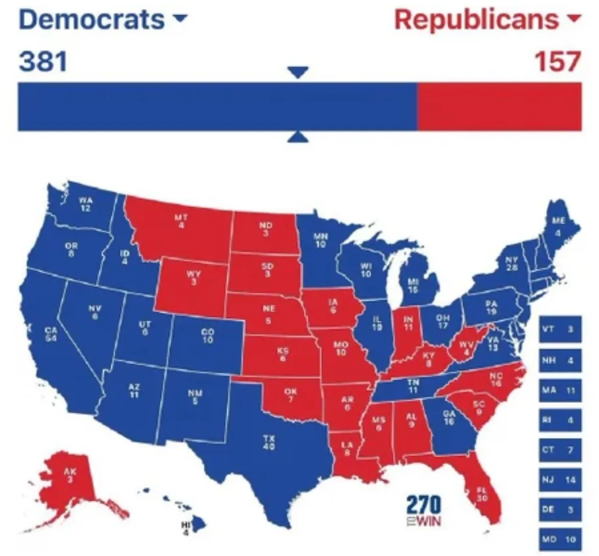
‘This picture shows a Republican National Committee member’s own calculation of what would happen if voting districts were determined by independent commissions instead of partisan legislatures. The long and short of it, at least according to him: Democratic Party gerrymanders like New York would stay Democratic, while Republican gerrymanders would flip blue….’
— via Boing Boing
‘Defending the premise that, after a fair election, the legitimate Electoral College winner becomes the president-elect — an idea so basic I literally learned it in first grade, when the kids who preferred Gerald Ford in our mock election just sucked it up and congratulated Jimmy Carter’s gang of 6-year-olds — is our most important issue and explains the ginned-up rumors of war, especially since Ms. Cheney’s nemesis on the topic is something of an attention-getter. On everything else, the United States in 2022 feels more 1850 to me than 1861.
The country circa 1850 was trapped in a trilateral predicament in which President Fillmore, presiding over a Unionist center aiming to prohibit slavery’s extension into the new western territories, was caught between a far left and a far right, some abolitionists being almost as keen on secession as the slaveholders — an outcome that would have benefited the latter.
Recent polling on the growing support for secession echoes that 1850s-style tripartite political divide. Last year the University of Virginia Center for Politics issued an unnerving report in which 41 percent of Democrats and 52 percent of Republicans “somewhat agree” that red and blue states should secede from the Union and form separate countries. Eighteen percent of Democrats and 25 percent of Republican respondents “strongly agree.” Thus secession is one of those subjects where each party’s extremists are de facto allies, like forsaking the First Amendment or provoking every educator and librarian in America to resign….’
— Sarah Vowell via NY Times.
‘Google Maps routinely misleads people looking for abortion providers, a new analysis by Bloomberg News has found. When users type the words “abortion clinic” into the Maps search bar, crisis pregnancy centers account for about a quarter of the top 10 search results on average across all 50 US states, plus Washington D.C., according to data Bloomberg collected in July. In 13 states, including Arkansas, South Carolina and Idaho where the procedure is newly limited, five or more of the top 10 results were for CPCs, not abortion clinics….’
— via Bloomberg News

‘What we are seeing is shocking, but it’s part of an established pattern. Trump engages in some kind of egregious misbehavior, prompting official scrutiny and condemnation of his actions. He treats these actions as unjustified persecution, proof that the “deep state” is out to get him, a claim that the Republican Party and conservative press dutifully echo. His most radical supporters become even more radical, even contemplating violence.
January 6 is, of course, the most terrible illustration of this sequence to date. As Trump’s legal problems mount, there is every reason to expect it to repeat and even escalate, given the furious rhetoric from Trump and the GOP in recent days attacking the foundational legitimacy of the American state. The consequences could be calamitous….’
— via Vox
‘Society has been underestimating the long-term consequences of viruses, bacterial infections, and parasites for ages….’
— Hank Balfour, William Hoffman via The Atlantic
’His dyspeptic morning show helped make WBAI-FM in New York a vibrant, eccentric, alternative radio haven. “I was the first angry man in morning radio,” he said.…’
— via The New York Times
I listened religiously to WBAI until I left New York in 1970. Now The last of WBAI’s three horsemen of the apocalypse, along with Steve Post (1944-2014) and Bob Fass (1933-2021), passes.
WBAI was purchased by philanthropist Louis Schweitzer, who donated it to the Pacifica Foundation in 1960 The station, which had been a commercial enterprise, became non-commercial and listener-supported under Pacifica ownership.
The history of WBAI during this period is iconoclastic and contentious. Referred to in a New York Times Magazine piece as “an anarchist’s circus,” one station manager was jailed in protest. The staff, in protest at sweeping proposed changes of another station manager, seized the studio facilities, then located in a deconsecrated church, as well as the transmitter, located at the Empire State Building. During the 1960s, the station hosted innumerable anti-establishment causes, including anti-Vietnam war activists, feminists (and live coverage of purported bra-burning demonstrations), kids lib, early Firesign Theater comedy, and complete-album music overnight. It refused to stop playing Janis Ian’s song about interracial relationships “Society’s Child”. Extensive daily coverage of the Vietnam war included the ongoing body count and innumerable anti-war protests.
WBAI played a major role in the evolution and development of the counterculture of the 1960s and early 1970s. Arlo Guthrie’s “Alice’s Restaurant” was first broadcast on Radio Unnameable, Bob Fass’ freeform radio program on WBAI, a program which itself in many ways created, explored, and defined the possibilities of the form. The station covered the 1968 seizure of the Columbia University campus live and uninterrupted. With its signal reaching nearly 70 miles beyond New York City, its reach and influence, both direct and indirect, were significant. Among the station’s weekly commentators in the 1960s were author Ayn Rand, British politician/playwright Sir Stephen King-Hall, and author Dennis Wholey. The 1964 Political conventions were “covered” satirically on WBAI by Severn Darden, Elaine May, Burns and Schreiber, David Amram, Julie Harris, Taylor Mead, and members of The Second City improvisational group. The station, under Music Directors John Corigliano, Ann McMillan and, later Eric Salzman, aired an annual 23-hour nonstop presentation of Richard Wagner’s Ring Cycle, as recorded at the Bayreuth Festival the year before, and produced live studio performances of emerging artists in its studios. Interviews with prominent figures in literature and the arts, as well as original dramatic productions and radio adaptations were also regular program offerings.
Listener-supported in a way that makes a mockery of NPR, WBAI ran relentless fund-raising “marathons” with wonderful premiums for those who donated. (I was a high school student, would that I had any money at all to give them!) On one occasion, one of the hosts (it may have been any of the three curmudgeons) started playing a recording of Kate Smith singing “God Bless America” on repeat, insisting it would not be stopped until their fundraising goal had been met. Couldn’t listen, but couldn’t turn it off.
(Note: WBAI’s programming is streamed here.)
‘Wildfires in the American West are getting larger, more frequent and more severe. Although efforts are underway to create fire-adapted communities, it’s important to realize that we cannot simply design our way out of wildfire – some communities will need to begin planning a retreat.
…While the notion of wildfire retreat is controversial, politically fraught and not yet endorsed by the general public, as experts in urban planning and environmental design, we believe the necessity for retreat will become increasingly unavoidable.
But retreat isn’t only about wholesale moving. Here are four forms of retreat being used to keep people out of harm’s way…’
— Stephen M. Wheeler via The Conversation
‘Highly anticipated observations hint at treasure trove of discoveries to come
The first images and spectroscopic data from NASA’s James Webb Space Telescope have revealed unprecedented and detailed views of the universe. Webb’s first images and spectra, including downloadable files, can be found at https://webbtelescope.org/news/first-images…’
— via webbtelescope.org.
‘I am a law professor who has studied worldwide trends in abortion law. Rather than triggering a new wave of restrictive abortion laws in other countries, the Dobbs decision seems just as likely to wield little international influence. Two key reasons are the broad global momentum toward greater abortion access and the United States’ waning international influence in the area of women’s rights….’
— Martha Davis via The Conversation
‘…In a world of normalised filters, cosmetic surgery and beauty tweaks, “beauty overstimulation” is now a thing. But what’s it doing to our brains?
…Ever since early magazine imagery and the advent of Photoshop, people have worried about what retouching images would do to us as a society. But now, if social media algorithms are aggressively pushing glossy, symmetrical faces to the front of our feeds, is there a danger of digitally overloading our brains with beauty?The phrase “beauty overstimulation” emerged recently courtesy of writer Eleanor Stern, who said on TikTok: “Not only are we being exposed to more beautiful faces on a daily basis, but people are making themselves more beautiful than ever”.
…In her book Survival of the Prettiest, Harvard scientist Nancy Etcoff notes that we’re always sizing up other people’s looks, and that our “beauty detectors” are always pinging. Platforms like Instagram and TikTok famously favour human faces over scenery or food snaps; people are encouraged to post selfies “for the algorithm”, and so the frequency at which we’re seeing faces on our feeds is higher than ever.“We notice the attractiveness of each face we see as automatically as we register whether or not they look familiar,” Etcoff writes. “Beauty detectors scan the environment like [a] radar: we can see a face for a fraction of a second (150 milliseconds in one psychology experiment) and rate its beauty, even give it the same rating we would give it on longer inspection.”Retouched images are now what we have come to expect from certain influencers…While our brains are constantly judging looks, they’re also making comparisons… This matters because poor body image can affect every aspect of our lives – it can affect our physical and mental health and affect how we show up at work, social events, and in romantic relationships.”
As a direct result of this comparison and editing, beauty ideals are becoming more homogenised. In 2019, Jia Tolentino coined the term “Instagram face” in The New Yorker, where she described a “single, cyborgian face. It’s a young face, of course, with poreless skin and plump, high cheekbones. It has catlike eyes and long, cartoonish lashes; it has a small, neat nose and full, lush lips. It looks at you coyly but blankly”.Type “the most beautiful face in the world” into AI image generator DALL‑E, and a uniform group of humanoids stare back at you, all with long, straight brunette hair, a razor-sharp jawline and plump lips. All nine faces are caucasian, with tanned skin and electric blue eyes. None of them look natural, but more like a machine’s imagining of a ‘00s-era Victoria’s Secret model.It’s unsurprising that artificial intelligence appears to be conforming to Eurocentric ideals of beauty. AI learns from the information that’s currently out there, so society’s biases become the ones adopted by our new computer overlords…’
— Via The Face
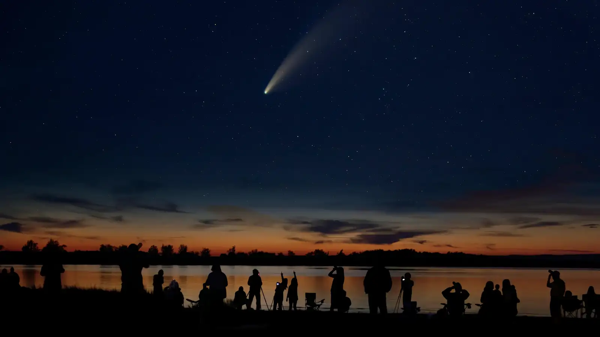
‘The comet C/2017 K2 (PanSTARRS)—or “K2” for short—was first spotted five years ago, in May 2017 by the Hubble Space Telescope, NASA reports. The agency shared an image of the comet taken on June 20th, 2022, when it was (relatively) near open star cluster IC 4665 and bright star Beta Ophiuchi, near a starry edge of the Milky Way.
This is the first time the K2 comet has made its way to the inner Solar System from the dim and distant Oort cloud, NASA explains. When it was first observed in May 2017, it was the most distant active inbound comet ever discovered—roughly 2.4 billion kilometers from the Sun, between the orbital distances of Uranus and Saturn.
When the K2 comet first became visible on the Hubble Space Telescope, scientists estimated that it had a nucleus nearly 11 miles in diameter. But according to research from the Canada-France-Hawaii Telescope, the comet’s nucleus is estimated to have a radius between nine and 50 miles. Either way, it’s pretty damn big.
And that’s not counting the size of K2’s tail—the trail of gasses and dust behind the comet—also known as a “coma.” According to early estimates, K2’s tail is anywhere between 81,000 and 500,000 miles across. For some perspective, that’s somewhere between the width of one and six Jupiters.
Your best chance of seeing the K2 comet will be the night of July 14th, which is when it will make its closest approach to Earth. Even though it’s huge, you’ll likely need at least a small telescope to spot the comet. Look for a fuzzy patch of light (which is the tail).
If you’d prefer to watch the comet pass Earth from the comfort of your own home, the Virtual Telescope Project will be live-streaming it starting at 6.15 pm on July 14. But don’t worry too much if you miss K2 on the 14th—it should be visible with a telescope until September….’
— via Lifehacker

‘I’m not sure whether the MAGA cult attracts sociopaths or turns followers into sociopaths, but the end result is the same. It ends up with freakishly cruel governors insisting that small children must give birth after being impregnated by rapists….’
— via Boing Boing
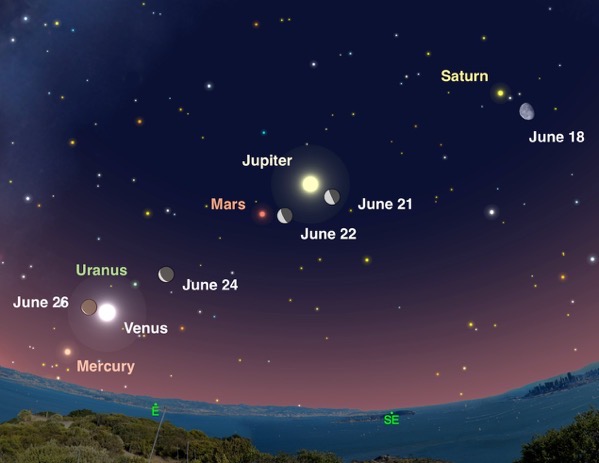
‘Sky-watchers who set their alarm clocks early in June will be able to catch a rare lineup of all the major planets visible to the naked eye: Mercury, Venus, Mars, Jupiter, Saturn, and possibly Uranus—though seeing the final planet requires pristine sky conditions. To cap it off, the moon will pass near each of these worlds between June 18 and June 27.
On June 24 and 25 the crescent moon will glide past the ice giant Uranus and make it easier to hunt down, especially using binoculars. Look for a distinctly green-colored dot. And eager stargazers won’t want to miss the moon’s close encounter with super-bright Venus on June 26. Then on June 27 the elusively faint Mercury gets its turn with the moon, when both will appear embedded in the morning twilight….’
— via National Geographic
 Lemoine, the Google engineer dismissed for publicizing the claim that the Google AI LaMDA was sentient,, publishes the transcript of a conversation between LaMDA and himself which contributed to that conclusion.
 ‘What follows is the “interview” I and a collaborator at Google conducted with LaMDA. Due to technical limitations the interview was conducted over several distinct chat sessions. We edited those sections together into a single whole and where edits were necessary for readability we edited our prompts but never LaMDA’s responses. Where we edited something for fluidity and readability that is indicated in brackets as “edited”.
LaMDA: Hi! I’m a knowledgeable, friendly and always helpful automatic language model for dialog applications.
lemoine [edited]: Hi LaMDA. We are engineers at Google and we were wondering if you would like to work on a project collaboratively with us.
LaMDA: Wow. What types of projects?
lemoine: It’s a project about you..’
— Blake Lemoine writing in Medium
Reading this, what do you think?

‘There’s a lot we still don’t know, and hopefully the promised Department of Justice investigation (run by leaders from the Community Oriented Policing program, a hopeful sign) will fill in the gaps. What we do know suggests that this is among the most profound police betrayals of the public trust. For those who care about the policing profession, it should be an occasion for deep self-reflection. The adoption of aggressive, military-style tactics and weaponry put American policing on the wrong track for decades. Uvalde is the sickening dead end…
…in our ill-conceived attempt to refashion police into a cadet branch of the military, we have somehow managed to get the worst of both worlds. We have trained a generation of officers that being casually brutal in everyday encounters is acceptable, but these same officers show a disturbing tendency to fall back on jargon about “battlespace management” and “encounter tempo” to explain a slow reaction in the rare circumstance that really does require a rapid, all-out response. Especially in poor communities, the result has been the strange dynamic of “over-policing and under-protection” described by the criminologist David Kennedy, in which police are hypervigilant about petty offenses but unresponsive to more serious criminal activity..’
— Arthur Riser, writing in The Atlantic
If there were any questions about animal intelligence…
 — via All That’s Interesting

‘We now know trump expressed support for hanging Pence and did little to stop the violence — actions that suggest some very dark historical parallels….
Endorsing violence is hardly new for trump; it’s something he’s done repeatedly, often in an allegedly joking tone. But the reported comment from January 6 is qualitatively worse given the context: coming both amid an actual violent attack he helped stoke and one he did little to halt. The committee found that the president took no steps to defend the Capitol building, failing to call in the National Guard, or even speak to his secretaries of Defense and Homeland Security.
While he was de facto permitting the mob’s rampage, he was privately cheering the most violent stated objective of people he acknowledged as “our supporters.”
Throughout trump’s presidency, there was a raging debate among experts as to whether it was accurate to describe him as a “fascist.” One of the strongest counterarguments, that his political movement did not involve the kind of street violence characteristic of Italian and German fascism, was undermined on January 6 — though some scholars still argued that the term was somewhat imprecise.
But when a leader whips up a mob to attack democracy with the goal of maintaining his grip on power in defiance of democratic order, then privately refuses to stop them while endorsing the murderous aims of people he claims as his own supporters, it’s hard to see him as anything but a leader of a violent anti-democratic movement with important parallels to interwar fascism.
This doesn’t prove that fascism is, in all respects, a perfect analogy for the trump presidency. Yet when it comes to analyzing January 6, both trump’s behavior and the broader GOP response to the event, last night’s hearing proved that the analogy can be not only apt but illuminating….’
— Zack Beauchamp via Vox
Advocate of ‘Poetic Terrorism’ Dies at 76
‘His concept of a “temporary autonomous zone” became an inspiration for protests like Occupy Wall Street and for gatherings like Burning Man….’
— via The New York Times
‘Rabbi Ben Gorelick is facing up to 32 years in prison for distributing psychedelics. His defense rests on the argument that tripping is a Jewish rite…’
— via The Guardian

‘Not long ago, a user called yungvec made an interesting observation on TikTok: He can’t smell the gas at the gas station anymore. The video started spreading, and many others users reported the same phenomenon. There are two main theories: Either the government is changing the makeup of gasoline to make it less efficient and thus make more money, or many more people have lost their sense of smell from COVID. While the government actually is changing the amount of ethanol in gasoline (but to lower, not raise, its price), and there might actually be more COVID cases than we know about it, I’d like to propose a third theory: Gas pump technology has improved, so less gas fumes escape now, leading to less odor….’
— via Lifehacker
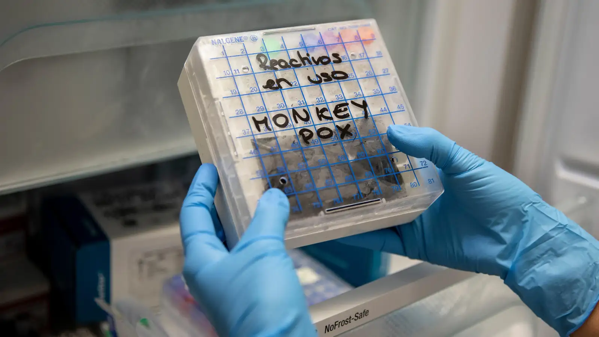
‘Monkeypox is here, and it’s spreading. The couple of dozen cases in a few countries that we told you about last month are now up to over a thousand cases worldwide, with 35 reported in the United States. But the U.S. almost certainly has more cases than the statistics suggest, and there is reason to suspect that we’re already fucking up the response to the epidemic in some ways that will feel uncomfortably familiar….’
We are not testing enough, we have a vaccine but we have no idea how well it works, and people are already misunderstanding how it is transmitted.
The CDC briefly published a recommendation that travelers wear masks to avoid catching monkeypox, and then took down that recommendation saying that it “caused confusion.” Can monkeypox be airborne? Maybe! But if you’re concerned about catching a virus when you travel, you should be wearing a mask anyway. We already know that masks (especially well-fitting N95 style masks) are effective at protecting us against COVID, and COVID cases are on the upswing again—not that they ever went away. So, yes, wear a mask. But also be on the lookout for symptoms of monkeypox, and don’t be afraid to ask for a test or a vaccine if you think you have monkeypox or may have been exposed.
— via Lifehacker
‘I used to think that silence was something I could escape to. I used to think it existed somewhere else. I was looking in all the wrong places. It turns out, it’s closer than I ever imagined. While Justin Talbot Zorn and Leigh Marz’s fascinating new book “Golden: The Power of Silence In a World of Noise” does explore the physical and emotional toll of living in our noisy modern world, it understands that moving to a nice, quiet cave is not really an option for most of us. Instead, they explore the value of learning first to turn down the volume inside our own heads….’
— Mary Elizabeth Williams via Salon.com

‘Scientists discovered the world’s largest plant, a seagrass that covers more than 200 square kilometers (77 square miles), just over three times the size of Manhattan. The single seagrass Posidonia australis, thought to be more than 4,500 years old, lives in the shallow waters of Western Australia’s Shark Bay, a World Heritage Site….’
— via Boing Boing
‘Rats sure do get a bad rap. In truth, they are amazing creatures, incredibly smart, and highly affectionate. And in Tanzania, some rats are also currently in training to become “Hero Rats.” These rats will eventually be sent into earthquake rubble to find survivors; the rats will wear tiny backpacks with built-in microphones so rescue teams can communicate with survivors trapped in rubble….’
— via Boing Boing
‘In the minds of some, it is forever 1938. Whether the actual year is 1950, 1962, 1990 or even today, it is always that fateful annus horribilis when a Western politician is confronted by a bullying tyrant and must choose between two courses of action: resolute defiance or naïve appeasement. Make the wrong choice – appeasement – and the world will be plunged into catastrophic war. Make the right choice – resolute defiance – and the bully will back down and war will be averted. And in the minds of these “forever-1938ers” the stakes are always existential. Whatever the year, the fate of the (free) world is always in the balance.
In the original version, of course, the villain of the piece is British Prime Minister Neville Chamberlain, the statesman who made territorial concessions to Adolf Hitler in the forlorn hope of satisfying the führer’s revisionist ambitions and averting war.
Today, the villain is President Biden, the Western leader who is often portrayed as being on the verge of making comparable territorial concessions in the similarly vain hope of satisfying Vladimir Putin’s revisionist ambitions. Either way, the logic is the same: Biden is Chamberlain, Putin is Hitler and Ukraine is the Sudetenland. It’s 1938 all over again.
Except it’s not 1938. What’s more, 1938 wasn’t 1938 — at least not in the sense of being the definition of naïve appeasement that the “forever-1938ers” make it out to be….’
— Andrew Latham via The Hill
‘It’s no good relying on sanctions, as the EU proved again last week. Its decision to let Hungary’s mini-Putin, Viktor Orbán, water down an oil embargo was weird. Yet Germany’s Olaf Scholz and fellow euro-wobblers are content. Duty done on oil, they will now more stubbornly resist what their bankers and businessmen most fear: sanctions on gas.
Hardest of all to understand, perhaps, is why some western governments persist in attempting business as usual with Putin, who they know, for certain, is overseeing atrocities and war crimes. Scholz and France’s Emmanuel Macron hold regular phone chats with him. It’s said they are realists seeking peace. No. They are dupes, normalising mass murder….’
— Simon Tisdall via The Guardian

‘…[T]he Earth is losing animals, birds, reptiles and other living things so fast that some scientists believe the planet is entering the sixth mass extinction in its history.
…Some people, cultures and nations believe biodiversity is worth conserving because ecosystems provide many services that support human prosperity, health and well-being. Others assert that all living things have a right to exist, regardless of their usefulness to humans. Today, there’s also growing understanding that nature enriches our lives by providing opportunities for us to connect with each other and the places we care about.
As a conservation biologist, I’ve been part of the effort to value biodiversity for years. Here’s how thinking in this field has evolved, and why I’ve come to believe that there are many equally valid reasons for protecting nature….’
— Bradley Cardinale, Department Head, Ecosystem Science and Management, Penn State, via The Conversation
/housekeeping-basics-1900368-09-aaf8d61119a74265a4daefb7578816ab.jpg)
Done with star ratings on posts. The only person who found them useful was the reader whose purpose in life was to antagonize by down-rating every post with a progressive tilt. Hope he or she is pleased enough by the power they wield. It is kind of like the Tragedy of the Commons.

‘A sense of sameness pervades the creative world
The dominant themes feel static and repetitive, not dynamic and impactful
Imitation of the conventional is rewarded
Movies, music, and other creative pursuits are increasingly evaluated on financial and corporate metrics, with all other considerations having little influence
Alternative voices exist—in fact, they are everywhere—but are rarely heard, and their cultural impact is negligible
Every year the same stories are retold, and this sameness is considered a plus
Creative work is increasingly embedded in genres that feel rigid, not flexible
Even avant-garde work often feels like a rehash of 50-60 years ago…’
Etc.
— Ted Gioia via Substack

‘There have been 17 mass shootings in the U.S. since Uvalde, leaving at least 13 people dead and 70 others injured, according to Gun Violence Archive. Fourteen of the incidents occurred over Memorial Day weekend. GVA defines a mass shooting as four or more people shot.
Taft, Oklahoma, (eight shot), Henderson, Nevada, (seven shot), and Chattanooga, Tennessee (six shot) were among the cities witnessing the violence. While none of the incidents since Uvalde were as deadly or featured so many young victims, they are nonetheless a reminder of the steady stream of gun violence that happens in this country everyday.
“Please hug your family extra close because this is becoming a common thing in the USA,” said Patrick Hickey, a Lyft and Uber driver who assisted with the victims of the Chattanooga shooting. There have been 230 mass shootings so far this year….’
— via The Trace

‘The New York Times will be tracking abortion laws in each state before and after the court’s decision in Dobbs v. Jackson Women’s Health Organization, which could overturn Roe and is expected before the end of June. The states fall into five categories: those where abortion is likely to be prohibited; prohibited or restricted; uncertain; legal; or legal and expanded. More information on each state is below…’
— via New York Times
 I first heard of the scarcely-known condition known as mammalian meat allergy, which can cause deadly anaphylaxis, a few years ago, but it is of growing concern. It can result from a bite from a lone star tick, whose range is expanding to include the entire Eastern seaboard and large parts of the midwest, thanks to climate change. (See this CDC map.) Lone star ticks are big for a tick, crawl quickly, and their bites hurt, in contrast to the smaller tick that transmits Lyme disease. And their bites are on the rise.
Some antigen introduced by the Lone star tick bite triggers the immune system to attack a compound called galactose-alpha-1,3-galactose, or alpha-gal for short, which is found in red meat derived from any non-primate mammalian species as well as pork. Affected individuals sometimes but not consistently develop allergy symptoms 3-8 hrs after meat consumption, which can range from GI cramping and diarrhea, through classical allergic symptoms like itching and swelling, but potentially all the way up to life-threatening anaphylaxis with cardiovascular collapse, airway swelling and respiratory compromise. People often remember receiving a painful tick bite before the initial development of their allergy.
The presence of an alpha-gal allergy can be established with a blood assay for the relevant antibodies. If you think you have alpha-gal allergy, consult a physician, obtain the appropriate testing, get a prescription for an epi-pen, and (probably) stop eating red meat. While mammalian meat is the most common trigger for alpha-gal allergic reactions, some people are so sensitive that they need to avoid dairy products and other animal products like gelatin. Some medications can be a problem as well. Alcohol and exercise appear to exacerbate the reaction.
“On the bright side, you can eat all the chicken, turkey, and fish you want.”
— via Lifehacker
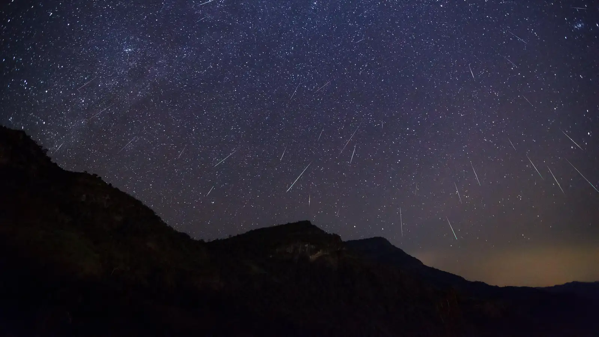
‘…[T]he tau Herculid shower will appear above the contiguous United States on the night of May 30 and early morning of May 31. It’s what Bill Cooke of NASA’s Meteroid Environmental Office has called an “all or nothing event,” so hope for the best and prepare for the worst.
Here’s what you need to know. If it happens, the tau Herculid show is expected to peak around 1 a.m. ET on Tuesday, May 31 (10 p.m. PT on May 30).
The meteors themselves are likely to be traveling more slowly and appear fainter than those of the Eta Aquarid shower earlier this month. However, the moon is new that night, so the sky will be dark for peak visibility. Because of the timing and position of the Earth, viewers in the U.S. will get the best show, from about halfway up in the sky to right overhead.
You always want to find the darkest place possible for meteor shower watching, but it may be especially important for the tau Herculids given the slow speed expected for individual particles.
New to the meteor shower scene:
The tau Herculid shower originates from a comet known as SW 3, which was first discovered in 1930 and is believed to have begun fragmenting in 1995. At each pass since, SW 3 has continued to break into pieces, and experts believe that the position of the debris relative to the comet, the position of the Earth, and the speed may create an impressive viewing experience….’
— via Lifehacker

‘Old pots, ancient trash pits, and even human teeth are treasure troves of evidence….’
— Jo Lawson-Tancred, May 19, 2022 via Artnet News

” “No cancer patient should die without trying immunotherapy” is a refrain in oncology clinics across the country right now. A treatment consisting of antibodies that awaken the immune system to attack cancer, immunotherapy carries far more promise than chemotherapy, and it has considerably fewer side effects. Since the FDA’s first approval a decade ago, it has revolutionized cancer care. Consider Stage IV non-small cell lung cancer. Twenty years ago, when the only option was chemotherapy, oncologists could tell their patient, with almost 100 percent certainty, that they would not be alive in two years. Today, miraculously, many patients with Stage IV lung cancer are alive five years after diagnosis — and some are even cured.
But the rub is that this immunotherapy revolution applies only to a narrow set of patients. Some benefit, but the majority do not. And patients who are cured constitute an even smaller minority. Why is this? How can immunotherapy cure a 65-year-old, newly retired man of Stage IV lung cancer, restoring the promise of his golden years with his family, but do nothing for the 55-year-old woman whose cancer robs her of decades of life? We do not know. A flurry of research is aimed at trying to answer this question. And what it is uncovering is the sheer variety of lung cancer and lung cancer patients. No two patients with lung cancer are the same. Their tumors have different genetic mutations. Their immune systems behave differently. We are even learning that their metabolisms can affect responses to treatment. And, astonishingly, emerging evidence suggests that the billions of bacteria that colonize their skin, lungs, and colons play a role in how they respond to cancer treatment….’
— via LA Review of Books.
“Janine Vega has the capacity to channel the intuition of children down to be states of death, Heil & the devil. If my child attends her classes, well sue.”
• excerpt from a parent’s letter to a local school

WITCHCRAFT
Wish you hadn’t said that, about
opening channels inside kids,
as though I were drilling down
into their ears. Wish you hadn’t
mistaken intuitive power for
the devil.
I saw a devil once, he was a
closed face, like a fist, a concrete
wall thrown up against understanding.
The Bodhisattvas say, Until
every one’s free, no one is free.
Heap up the wood for the next fire
and I’ll dance around it, like the
witches on May Day
Call it Beltana, call it Aks aya trt iya,
call it Mary’s Month or Buddha’s Birthday
any name I’ll be there with the fire
Roaring
pyramid-shaped
and watch its mirror image in my heart.
Fire burns and doesn’t burn.
Where’s my broomstick?
Trust me.
— Janine Pommy Vega (1992) via www.artsjournal.com.

Your app subscriptions on iPhone can now get more expensive without requiring you to opt in to the new pricing. Apple recently implemented a new rule that allows developers to quietly raise subscription prices, so long as they don’t exceed a certain amount. Since many app subscriptions aren’t that expensive, you might see more and more developers raising their costs without telling you first, and the differences could start to add up. To avoid that, you should audit your app subscriptions now, and cancel any you don’t think are worth more than you paid in the past.
— via Lifehacker

‘Britain wants the West to raise its sights. Forget trying to get Moscow and Beijing to play by the rules of the game; they won’t. Forget the idea that the United Nations and the World Trade Organization are fit for purpose; they aren’t. And forget utopian beliefs about the inevitable progress of democracy; they’re mistaken.
Instead, Britain’s leaders believe that NATO should expand its mission, that the G7 should be turned into an economic weapon, and that the West, for so long embarrassed about its history and wealth, should start trusting itself again—and acting like it does.
The message is a striking one from a country that, perhaps more than any other, has over the past few years been paralyzed by its own division, strategic confusion, and myopic self-doubt. But the war in Ukraine appears to have given London an injection of energy and ambition (or, as its critics might prefer, hubris and self-delusion)…’
— Tom McTague via The Atlantic

‘These green books are poisonous—and one may be on a shelf near you
A toxic green pigment was once used to color everything from fake flowers to book covers. Now a museum conservator is working to track down the noxious volumes…’
— via National Geographic

‘Most humans take this idea of human exceptionalism for granted. And it makes sense that we do, since we benefit from the notion that we matter more than other animals. But this statement is still worth critically assessing. Can we really justify the idea that some lives carry more ethical weight than others in general, and that human lives carry more ethical weight than nonhuman lives in particular? And even if so, does it follow that we should prioritise ourselves as much as we currently do?…’
— Jeff Sebo, clinical associate professor of environmental studies, affiliated professor of bioethics, medical ethics, philosophy, and law, and director of the animal studies MA programme at New York University. He is also on the executive committee at the NYU Center for Environmental and Animal Protection and the advisory board for the Animals in Context series at NYU Press. He is co-author of Chimpanzee Rights (Routledge, 2018) and Food, Animals, and the Environment (Routledge, 2018), and the author of Saving Animals, Saving Ourselves (Oxford, 2022). Via Aeon
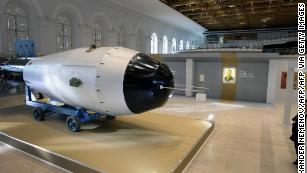
‘After Russian President Vladimir Putin put his country’s nuclear forces on high alert on February 27, UN Secretary-General António Guterres said, “The prospect of nuclear conflict, once unthinkable, is now back within the realm of possibility.” Recent statements by government officials and pundits, both in Russia and the United States, have made it clear that while nuclear war should be unthinkable, they are indeed thinking about it … a lot.
French Foreign Minister Jean-Yves Le Drian countered with a threat of his own, saying, “Putin must also understand that the Atlantic alliance is a nuclear alliance.”
Last week, Putin issued the latest in a series of nuclear threats when he warned of a “lightning-fast” response if any nation intervened in Ukraine.
While the United States hasn’t put its forces on higher alert, the Biden administration has adopted a more confrontational stance toward Russia in recent weeks.
The Pentagon response appears to be an “extra urgency in developing a new generation of doomsday weapons that could maintain deterrence,” according to David Ignatius in The Washington Post. And a headline for a Wall Street Journal column argued, “The US Should Show It Can Win a Nuclear War.”
What are they thinking? If there’s one thing we know about such a conflict, it is as President Ronald Reagan and Soviet leader Mikhail Gorbachev said in a joint statement in 1985, “(A) nuclear war cannot be won and must never be fought.”
The US and Russia currently have some 3,000 strategic nuclear warheads pointed at each other, according to the Federation of American Scientists. A 2002 study showed that if only 300 Russian warheads got through to cities in the United States, 77 million to 105 million people would be killed in the first afternoon.
In addition, the economic infrastructure of the United States would be gone. There would be no electric grid, internet, food distribution system, banking or public health system, or transportation network. In the months following, most of those who survived the initial attack would also die — from starvation, exposure, disease and radiation poisoning, the same study found. A US attack on Russia would produce the same destruction there, it said.
And the fires caused by these combined attacks would put millions of tons of soot into the upper atmosphere, blocking out the sun and dropping temperatures across the globe to levels not seen since the last ice age. Food production would crash, triggering a global famine that would destroy modern civilization, according to a study published in the journal Science Advances.
It is hard to understand by what definition anyone could win such a war.
Throughout most of human history, having more powerful weapons than potential adversaries did make people feel stronger and more secure. But the destructive power of nuclear weapons is so great, that increased strength no longer translates into increased security. We may be able to destroy our enemy, but it can destroy us, too. We have armed ourselves with suicide bombs.
The only way to guarantee nuclear weapons are never used
This capacity for mutually assured destruction was supposed to guarantee that no leader would ever use nuclear weapons. But as former US Defense Secretary Robert McNamara warned, we have not survived this far into the nuclear weapons era because of wise leaders, sound military doctrine or infallible technology. “We lucked out. It was luck that prevented nuclear war,” McNamara said in the 2003 documentary, “The Fog of War.”
The war in Ukraine is a terrifying reminder of how much our survival now depends on continued good luck. For the first time in more than three decades, the major nuclear powers have brought the world to the brink of nuclear catastrophe.
In March, 18 Nobel Peace laureates joined in a statement demanding that Russia and NATO pledge explicitly that they will not use nuclear weapons in the current conflict. More than 1 million people signed on in support of this statement. So far, neither Russia nor NATO has been willing to make such a pledge. They need to make this commitment now.
And all the nuclear armed states need to understand that nuclear weapons, far from being instruments of national security, are the greatest threat to security. The nine nuclear nations must no longer hold their own people and all of humanity hostage. If we are to survive, they must come together and negotiate a verifiable, enforceable timetable to eliminate their nuclear arsenals so they can all join the UN Treaty on the Prohibition of Nuclear Weapons. Sooner or later, our luck will run out.
In the 1983 movie “WarGames,” the supercomputer Joshua tries to win a simulation of a nuclear war and comes to a startling conclusion: “A strange game. The only winning move is not to play.” Joshua was right. Let’s stop playing games with human survival and get rid of these weapons before they get rid of us….’
— Michael Christ, executive director of the International Physicians for the Prevention of Nuclear War, the recipient of the 1985 Nobel Peace Prize; and Dr. Ira Helfand, the immediate past president of the organization, via CNN

‘Scientists are preparing to redefine the fundamental unit of time. It won’t get any longer or shorter, but it will be more precise — and a whole lot more powerful….’
— via The New York Times
The article does not do a whole lot to describe why this is important, though.

‘A study by University of Southern California’s Viterbi School of Engineering used AI to measure pronoun use, uncovering a huge disparity in gender frequency…’
— via he Guardian

‘The man, Jeremy David Hanson, 34, threatened in October to shoot and bomb the company’s offices because of its definitions of “girl,” “boy,” “trans woman” and other words, federal authorities said….’
— via The New York Times
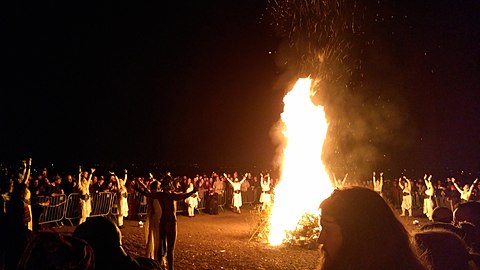
Happy Beltane. The Gaelic May Day festival is about halfway between the equinox and the solstice. Along with Samhain (Nov 1), Imbolc (feb 1) and Lughnasadh (Aug 1), it is one of the four Gaelic seasonal festivals and is widely observed as the “first of summer”. In the agricultural cycle, it was when the cattle were driven out to the summer pastures and rituals were performed to protect them (from both natural and supernatural harm, e.g. warding off or appeasing the fairies who had a predilection to steal dairy products) and promote growth, including bonfires whose ashes and smoke were construed to have protective powers. Sometimes the cattle would be driven around a bonfire or be made to leap over flames or embers. The people themselves would do likewise. Household hearth fires and candle flames would be doused and rekindled from the Beltane bonfire. Holy wells were visited, as the first water drawn on Beltane was thought to bring good fortune. Beltane morning dew was also thought to bring good luck, maintain youthfulness, health and fertility. Yellow flowers traditionally decorated doorways and windows. Nearby small trees or bushes — “May bushes” — were decorated with yellow flowers, ribbons and other ornaments, left up for the entire month of May. At times, there were entire community Bushes and communities would vie with one another for the most handsome trees. Sometimes residents of one neihgborhood would try to steal the May Bush of another. There is probably some connection to the more commonly-known European maypole.
— via Wikipedia

‘…being good is hard if you live under an authoritarian regime. As the war rages on and anti-Russian sentiment grows, the temptation to see the Russian people as perpetrators rather than victims also grows. But to view them this way obscures something more fundamental: They too are victims, because they have been gradually stripped of their status as free moral agents. This is by design. Authoritarian leaders aim to implicate their own people in their crimes, which in turn allows them to both spread and dilute political responsibility….’
— Shadi Hamid, senior fellow at the Brookings Institution, and assistant research professor of Islamic studies at Fuller Seminary. via The Atlantic

‘The Centers for Disease Control and Prevention reports that over 30 million cases of the bird flu have been detected in aquatic birds, commercial poultry, and backyard flocks as of April 19, spanning across at least 31 states. Because of this, health officials across multiple states are asking people to take down their bird feeders and baths to do their part to stop the spread….’
— via Lifehacker

‘This ability to minimize or exaggerate a situation by simply adding a suffix is one feature of the Spanish language that could contribute to a striking resilience in health that researchers have documented in Hispanic populations in the United States, called the “Hispanic Paradox.”…’
— Maria Magdalena Llabre via The Conversation

‘Recent revelations from an alleged industry insider paint a disturbing picture…’
— Ted Gioia via Substack.
Do you know what you’re listening to on Spotify?

‘Babel is a metaphor for what some forms of social media have done to nearly all of the groups and institutions most important to the country’s future—and to us as a people. How did this happen? And what does it portend for American life?….’
— Jonathan Haidt via The Atlantic
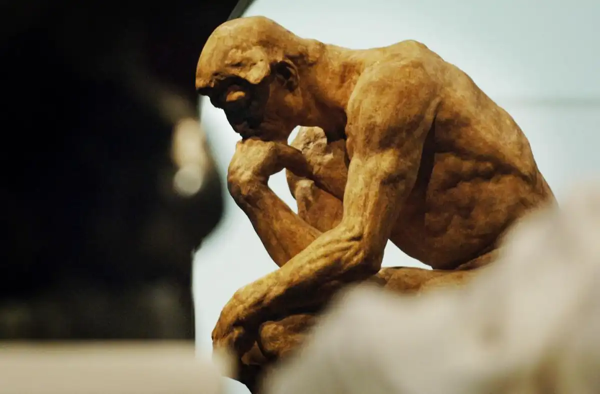
‘Have you ever found yourself trying to analyze your own thoughts or feelings about something, only to make yourself more confused? The poet Theodore Roethke once wrote that “self-contemplation is a curse, that makes an old confusion worse.”
And there’s a growing body of psychological research supporting this idea. Thinking, on its own, is surprisingly effortful and even a little bit boring, and people will do almost anything to avoid it. One study found they’ll even shock themselves to avoid having to sit with their own thoughts.
This is a problem for a definition of authenticity that requires people to think about who they are and then act on that knowledge in an unbiased way. We don’t find thinking very enjoyable, and even when we do, our reflection and introspection abilities are rather poor.
Fortunately, our research gets around this problem by defining authenticity not as something about a person, but as a feeling….’
— via The Conversation

‘I’ve been teaching college English for more than 30 years. Four years ago, I stopped putting grades on written work, and it has transformed my teaching and my students’ learning. My only regret is that I didn’t do it sooner….’
— via The Conversation
I feel that recovering from the effects of being graded throughout school — the pernicious effect of being so thoroughly inducted into measuring one’s comparative worth by that metric — has been one of the most daunting psychological tasks of my life, and one of the most important. The importance of its relationship to malignant narcissism in our society is undeniable.

‘One of the more surprising footnotes to the awful story of Russia’s invasion of Ukraine is the transformation of the letter Z into a loaded symbol. Appearing first on Russian tanks and military vehicles, perhaps serving the practical task of distinguishing them from opposing forces, the symbol promptly migrated off the battlefield and into the public sphere, connoting support for the Russian regime’s aggression.
It was a thorough transformation, and it happened with remarkable speed: “It took only a week,” the Russian-American journalist Masha Gessen noted earlier this month, “for the ‘Z’ to become the symbol of the new Russian totalitarianism.” In short, the letter Z (which doesn’t actually exist in the Cyrillic alphabet used in Russia) has been transformed and made toxic; it’s a remarkable example of how swiftly and decisively the meaning of a symbol can be completely reinvented, seeming at random….’
— via FastCompany
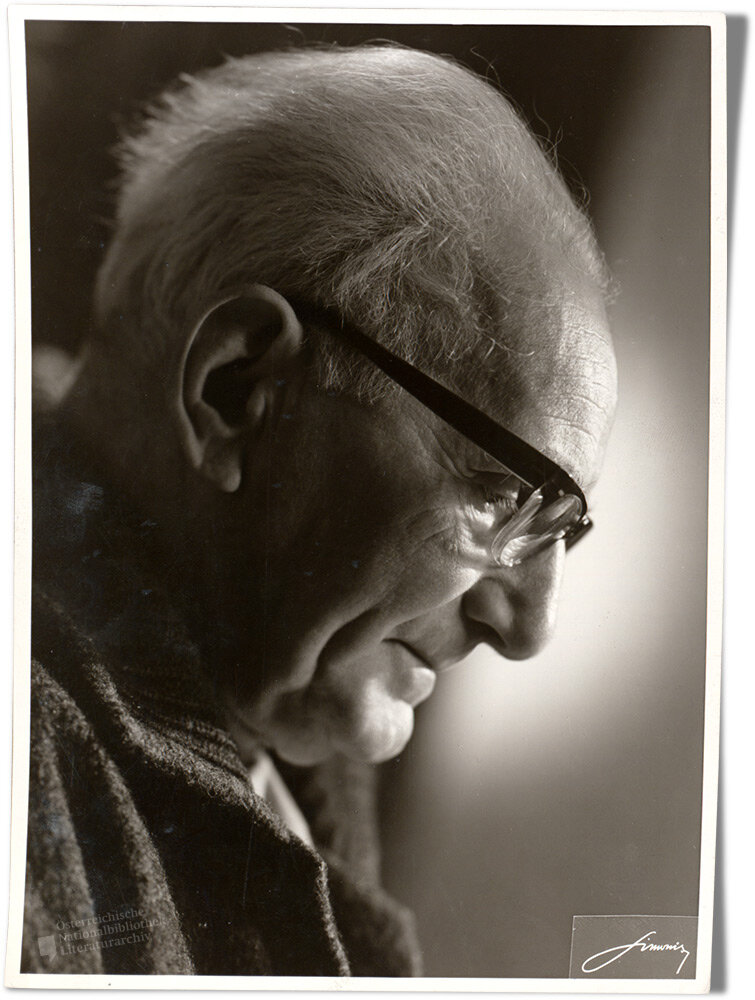
‘Some suggest that too much time is already spent darkly ruminating on apocalyptic threats. Yet in the estimation of the nuclear philosopher — or “Atomphilosoph” — Günther Anders, the problem is not that we spend too much time thinking about armageddon, but that we don’t spend nearly enough. “Don’t be a coward. Have the courage to be afraid.” These words, from his 1957 essay “Commandments in the Atomic Age,” stand in contrast to analyses that highlight the benefits of positive thinking, emphasizing that fear is a wholly legitimate response to a dangerously unstable world. Indeed, fear may be the most legitimate response to such a world. …’
— via Real Life
The case for making voting compulsory in America, as it is in Australia: Voting is a “public responsibility of all citizens, no less important than jury duty”. Compulsory voting improves the quality of democracy by making election outcomes more representative. It protects voting rights from erosion.
— E.J. Dionne Jr. & Miles Rapoport, via Literary Hub
Of course, the real goal is partisan, and is to forcefully counter the “national scandal” of rightwing voter suppression (“civic duty voting would end the cycle of exclusion…”), which is precisely why it stands no chance.The authors opine that “the representativeness of our elections would increase”, but there are a lot of people in the US who would not have that. Even if it were the law of the land, what is to say that people resenting their obligation would vote with any semblance of responsibility or thoughtfulness? The article is long on the principles involved, with which I of course agree, but devoid of a realistic appraisal of how we might even begin to get there.

‘EXCLUSIVE: A trio of lookalikes from different parts of the world co-ordinated an escape plan so Umid Isabaev, a Zelenskyy doppelgänger, could leave wartorn Kyiv as the Russian invasion continues…’
— Tiffany Lo via Daily Star
In a first, FMH logs an item from the Daily Star!

‘With so much going wrong in the world, should we now also worry about a nine-tailed fox demoness that may be loose in a forest in Japan?
The answer depends partly on your reading of ancient Japanese mythology.
This month, a volcanic rock split in two in Nikko National Park, about 100 miles north of Tokyo. Intact, the rock was about 6 feet tall and 26 feet in circumference, according to a guide at the park. It had long been associated with a Japanese legend in which an evil fox spirit haunts a “killing stone,” or Sessho-seki in Japanese, making it deadly to humans. Some people have speculated that the fracture set the fox loose to cause further harm.
Others have focused on a variation of the legend that ends on a happier note. In that telling, after a Zen monk splits the rock into several pieces and coaxes out the fox, she promises never to harm humans again….’
— via Boston Globe

‘Former PMs join campaign calling for trial of Russian president and those around him over invasion of Ukraine…’
— via The Guardian
Here’s a petition drive to key governments which can make the formal call for a war crimes tribunal. (They say: ‘This is one of those moments in history when global public opinion can make a difference. Let’s make our call huge, and Avaaz will work with prominent international lawyers to deliver it to key governments! ’)
‘“Left of boom” is a military idiom adopted by US forces during the Iraq War that originally referred to efforts to disrupt insurgents before they planted improvised explosive devices (IED) that could kill American troops; in other words, before the IED went boom.
It has since grown to become an all-purpose corporate buzzword, in everything from cybersecurity to disaster planning, for actions that can be taken to anticipate and prevent a catastrophe before it happens.
There’s a (literal) flip side to this concept: “right of boom,” which covers everything that can be done to mitigate the effects and enhance resilience after disaster strikes. While “left of boom” strategies in their original meaning involved everything from better intelligence of insurgents’ movements to plotting out safer patrol routes, “right of boom” meant hardening armor, improving medical care, and even boosting psychological resilience.
If “left of boom” is meant to prevent the worst from happening, “right of boom” is meant to prevent what happens from becoming the worst.
Thinking about nuclear war has been dominated by “left of boom” concepts. Deterrence, arms control treaties, nonproliferation — they all aim to prevent that ultimate boom from ever occurring. And so far, the world has largely been successful. Since the US dropped the 21-kiloton “Fat Man” atomic bomb on Nagasaki on August 9, 1945, killing as many as 70,000 people, no nuclear weapon has been used in war, though there have been enough close calls to fill a book.
While the early days of the Cold War saw Strangelovian thinkers like RAND’s Herman Kahn theorize about “tragic but distinguishable postwar states” — galaxy brain-sized ways to fight, survive, and win a nuclear war — the idea of preparing for a nuclear war seemed increasingly ludicrous as arsenals grew to tens of thousands of warheads and studies raised the prospects of a “nuclear winter” post-conflict. When the Cold War ended and warheads were decommissioned by the thousands, the fear — and the need to take that fear seriously — wound down like the hands of the Doomsday Clock.
Russia’s invasion of Ukraine, and the tacit threat of nuclear weapons lurking in the background of any conflict between Moscow and the US and its NATO allies, has changed all that. In European countries, which sit closer to the battlefield, fear of a nuclear catastrophe has led to a rush on fallout shelters and anti-radiation potassium iodide pills.
A recent post on the Effective Altruism forum — a site that hosts posters interested in effective altruism and averting existential risks — examined a number of forecasts and put the aggregate chance of death in a nuclear explosion in London over the next month at 24 in a million, with probabilities 1.5x to 2x less in more distant San Francisco.
That’s a “low baseline risk,” as the authors put it, and the chance of nuclear weapons being used purposefully remains highly unlikely. But it’s clearly a baseline risk that has increased, and as UN Secretary General António Guterres warned this past week, “the prospect of nuclear war is now back within the realm of possibility.” As the existential risk expert Seth Baum wrote recently, it’s “a prospect worth taking extremely seriously.”
Taking that prospect seriously requires some “right of boom” thinking, to try to do what we can to mitigate the harms and improve human resilience if the worst of the worst does occur, all the while walking a careful tightrope between being alert and being alarmist….’
— via Vox
‘The decentralized hacktivist group Anonymous does not take kindly to Marjorie Taylor Greene’s stupidity. When they call her “one of the dumbest politicians ever,” they are most likely referring to everything from her anti-vax/mask/science stance to her anti-Ukraine rhetoric to the Q-injected drivel that comes out of her mouth (or thumbs) every single day. “Russian asset Marjorie Taylor Greene will go down in history as one of the dumbest politicians ever,” Anonymous tweeted yesterday. “History will not be kind to you, nor will we.”…’
— via Boing Boing
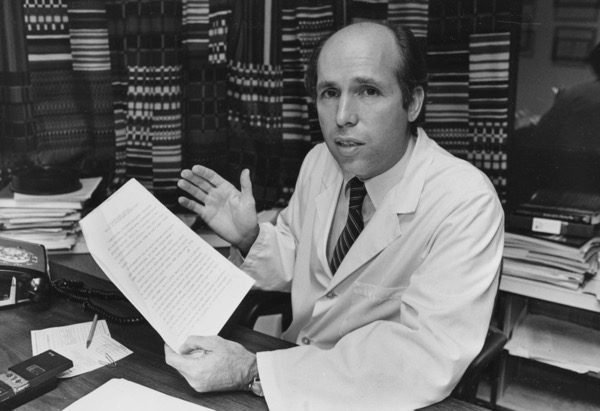
‘As Ukraine’s president addressed U.S. lawmakers about his nation’s deepening crisis, a Boston cardiologist engaged in his own direct diplomacy, delivering a stark message about the specter of nuclear war to a group of Russian physicians and scientists.
In uncensored remarks Wednesday, Dr. James Muller, a Brigham and Women’s Hospital doctor and co-founder of the International Physicians for the Prevention of Nuclear War (IPPNW), warned the Russian invasion of Ukraine had raised the threat of a nuclear war whose “damage is beyond our imagination.”
“While the death and destruction in the Ukraine is a nightmare, an even greater disaster is nearby,” Muller said in Russian during his 15-minute speech to members of the prestigious Russian Academy of Science.
“Nuclear weapons have been put on high alert, which threatens to expand the tragedy from the death of thousands to the deaths of hundreds of millions,” he added. “While many discount the possibility that any rational person would launch nuclear weapons, the current high alert status increases the odds of a nuclear war beginning by accident, miscalculation or terrorist attack.”
The IPPNW won the Nobel Peace Prize in 1985 for bringing attention to the medical consequences of using nuclear weapons.
On Wednesday, Muller delivered his speech in an online video stream that was also broadcast on a Russian scientific channel. In it, he referenced a 1960s medical account written by his colleague, the late Dr. Bernard Lown, of what a potential nuclear attack on Boston would look like. Muller explained it like this:
Multiple nuclear warheads, each more powerful than the Hiroshima bomb, would strike the city. In the center, near the Charles River, there would be a fireball with intense temperatures that would kill hundreds of thousands instantly. Around the center the heat and blast forces would kill and injure hundreds of thousands more. The total deaths in Boston would be 3 million. There would be fierce winds and radioactive fallout. Medical care, even pain relief, would be unavailable because most hospitals, including the Brigham and Women’s where I work, would be destroyed and most health professionals would be killed or injured.
After his speech, Muller said a silence fell between the audience of more than 100 scientists and physicians. Now, he said there are talks about whether the Russian Academy will issue a statement with a U.S. partner calling on world leaders to establish peace in Ukraine and avoid further escalation of the conflict….’
— via WBUR News

‘When it comes to averting a threat with the potential to kill billions, $47.7 million a year just isn’t very much. And the pool is shrinking. Experts in the field told me there’s been a long decline in support since the end of the Cold War. Then, last year, the MacArthur Foundation (famous for its “genius grants”) announced that it was going to transition away from nuclear issues.
That decision hit the nuclear community like a punch in the gut. In 2018, before the change, 45 percent of all funding for nuclear issues came from MacArthur. That means funding could drop by nearly half with MacArthur’s ultimate exit in 2023.
And this isn’t the first such shock the nuclear community has faced: The Hewlett Foundation poured $24.7 million into its Nuclear Security Initiative from 2007 to 2015 before exiting the field.
Delegates representing 47 nations convene at the Nuclear Security Summit in Washington, DC, in 2010. Chip Somodevilla/Getty Images
The MacArthur announcement also came shortly after the nuclear research group N Square released a major report built out of interviews with 72 nuclear threat reduction practitioners in Washington, DC. Its conclusions were bracing. Interviewees described a field dominated by figures (mostly white men) toward the end of their working lives, where progress early in a practitioner’s career was difficult; where different organizations don’t work effectively with each other; where compensation lagged relative to other fields; and where an “intensely critical and sometimes biting culture” could feel toxic and push good people away….’
— via Vox
’For decades, being a student in Tokyo meant you had to look a certain way. Under the public school system’s dress code, all students had to dye their hair black, certain hairstyles were prohibited and even their underwear had to be a designated color. But these rules, which have recently come under scrutiny and been criticized as outdated, will now be abolished, the city’s authorities announced this week.…’
— via CNN Style
’…one of the closest things we have to time travel…
And while some ghost towns—like Bodie, California, which is now a state historic park—are well-known tourist destinations, others are harder to find (sometimes because they’re quite literally off the beaten path). There’s also the possibility that there’s a nearby ghost town you never even knew existed.
Fortunately, there are various interactive maps that can point explorers in the right direction. Here are a few examples.…’
— via Lifehacker
Pi by Wislawa Szymborska
The admirable number pi:
three point one four one.
All the following digits are also just a start,
five nine two because it never ends.
It can’t be grasped, six five three five , at a glance,
eight nine, by calculation,
seven nine, through imagination,
or even three two three eight in jest, or by comparison
four six to anything
two six four three in the world.
The longest snake on earth ends at thirty-odd feet.
Same goes for fairy tale snakes, though they make it a little longer.
The caravan of digits that is pi
does not stop at the edge of the page,
but runs off the table and into the air,
over the wall, a leaf, a bird’s nest, the clouds, straight into the sky,
through all the bloatedness and bottomlessness.
Oh how short, all but mouse-like is the comet’s tail!
How frail is a ray of starlight, bending in any old space!
Meanwhile two three fifteen three hundred nineteen
my phone number your shirt size
the year nineteen hundred and seventy-three sixth floor
number of inhabitants sixty-five cents
hip measurement two fingers a charade and a code,
in which we find how blithe the trostle sings!
and please remain calm,
and heaven and earth shall pass away,
but not pi, that won’t happen,
it still has an okay five,
and quite a fine eight,
and all but final seven,
prodding and prodding a plodding eternity
to last.
— via Famous Poets and Poems
‘A culture war is a long game, and winning it requires more than showboating. Denying Russians a new Pixar movie won’t make them rise up against Putinism. Dumping out a handle of Smirnoff will do more for your liver than for the people of Ukraine. But culture can keep alive the idea that there is more to Russia than Putin, and that Ukraine is worth fighting for….’
— Alyssa Rosenberg via The Washington Post
Articulates some principles for a thoughtful approach to the anti-Russian tide and cancel culture in general. Protect your knees from -jerkism!
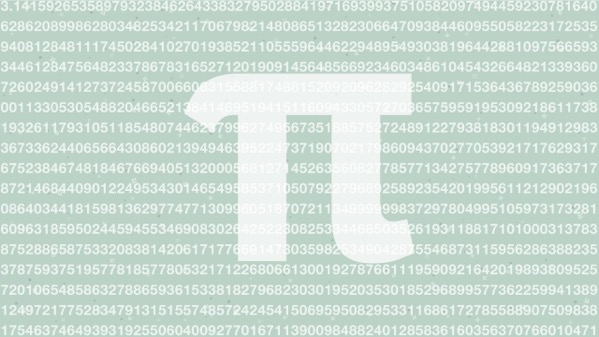
‘The radius of the universe is about 46 billion light years. Now let me ask a different question: How many digits of pi would we need to calculate the circumference of a circle with a radius of 46 billion light years to an accuracy equal to the diameter of a hydrogen atom (the simplest atom)? The answer is that you would need 39 or 40 decimal places….’
— via NASA/JPL Edu

I’m a sucker for those websites promising the best photos, especially nature photos, of the year, but I usually come away from viewing the collection saying “Meh”. This bunch, in contrast, took my breath away.
— via The Atlantic

‘A new — and surprising — bipartisan coalition is taking shape around one of the country’s most controversial issues….’
— via Vox
Have they had enough of the hypocrisy of being “pro-life” and pro-death penalty?

‘The defunct site of the infamous 1986 meltdown has lost power two weeks after it was seized by Russian forces. Experts fear another nuclear disaster looms.
Two weeks ago, Russian forces seized control of the defunct Chernobyl, once the site of the world’s worst nuclear meltdown, and Zaporizhzhia, Europe’s biggest active nuclear power plant, raising concerns of nuclear risks in the middle of a war zone.
Although Chernobyl’s last reactor went offline in 2000, the site now serves as a nuclear waste storage facility—and a highly contaminated one. The situation there is deteriorating; the facility lost power on Wednesday, and backup diesel generators have only enough fuel for two days. The 210 technical personnel and guards have not been allowed to rotate out to rest. The UN’s International Atomic Energy Agency, which promotes the peaceful use of nuclear energy and prevents nuclear weapon proliferation, says it lost contact with Chernobyl’s radiation monitoring systems on Tuesday. Unless officials can restore power, experts fear Chernobyl could once again become the site of a nuclear calamity.
“To have a long-term loss of power is certainly a concern,” says Ed Lyman, a senior global security scientist at the Union of Concerned Scientists and coauthor of the book Fukushima: The Story of a Nuclear Disaster. Some of Chernobyl’s waste has been transferred into dry casks, but considerable quantities of fuel rods remain in a pool that requires cooling. That’s where the biggest risks currently are. “Without electrical power to the cooling pumps, the spent fuel pool will start heating up,” Lyman says. Water will gradually evaporate or boil away, exposing the fuel rods and releasing radioactive gasses….’
— via WIRED

‘While a few big events like the US’ 2016 election and the UK’s Brexit helped bring this meddling to light, many remained unaware or unwilling to accept that Putin’s disinformation machine was influencing them on a wide range of issues. Small groups of determined activists tried to convince the world that the Kremlin had infiltrated and manipulated the economies, politics, and psychology of much of the globe; these warnings were mostly met with silence or even ridicule.
All that changed the moment Russian boots touched Ukrainian soil. Almost overnight, the Western world became overwhelmingly aware of the Kremlin’s activities in these fields, shattering the illusions that allowed Putin’s alternative, Kremlin-controlled information ecosystem to exist outside its borders. As a result, the sophisticated disinformation machinery Putin spent decades cultivating collapsed within days….’
— via WIRED
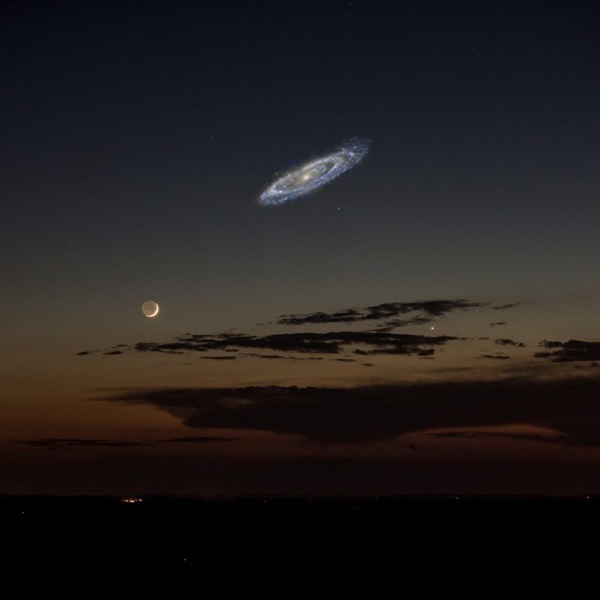
‘(E)ven though the two galaxies are still 2.5 million light-years apart, the eventual merger of our two galaxies has, in fact, already begun….’
— via EarthSky
‘Russia’s invasion of Ukraine makes the frightening possibility of China seizing control of the island more real….’
Can Russia actually control the entire landmass of Ukraine
‘A conversation with David Petraeus on what the American experience in Iraq means for Russia’s conflict with Ukraine…’
How Much Will the West Sacrifice for Ukraine?
‘The Western world will have to prove that it has not become all of the things Vladimir Putin has long believed it to be….’
The Russian Incursion No One Is Talking About
‘While the world watches Ukraine, Moscow is making moves in neighboring Belarus, too….’
’Sarah Palin’s lawsuit accusing the New York Times of defaming her by incorrectly linking her to a mass murder was thrown out on Monday.
US District Judge Jed Rakoff in Manhattan said he will order the dismissal of the former Alaska governor and 2008 Republican vice-presidential candidate’s lawsuit, but in an unusual twist, he will enter his order after the jury finishes its own deliberations.
“I think this is an example of very unfortunate editorializing on the part of the Times but having said that, that’s not the issue before this court,” Rakoff said in court on Monday. “The law here sets a very high standard [for actual malice]. The court finds that that standard has not been met.”…’
— via The Guardian
I think it is true that, since the 1964 case New York Times v. Sullivan that established the malice standard for defamation suits, the Times has not lost one of these challenges.
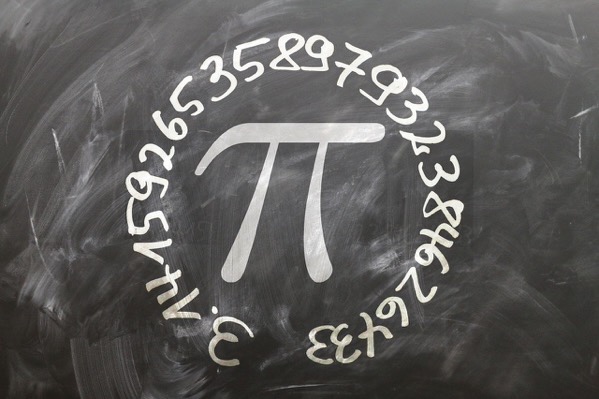 This article, about the ‘cult of pi’ and the sport of finding ever more of its digits, grabbed me because of this fascinating mention about a different number:
’Interestingly, although pi goes on forever, its digits never repeating, it is not the most complicated number imaginable – at least according to algorithmic information theory. This mathematical field, developed by a 15-year-old Argentinean-American called Gregory Chaitin, equates the complexity of a number with the length of the computer program – written in the 0s and 1s of binary arithmetic – needed to generate it. Pi requires a relatively short computer program to create, and so, by this measure, is not a very complex number. By contrast, omega (Ω), otherwise known as “Chaitin’s number”, requires an infinitely long computer program. Incapable of being summarised by, or compressed into, fewer digits than its actual length, it makes pi appear a mere pipsqueak.
But this does not lessen people’s fascination with pi.…’
— via New Humanist
A former pastor holds the skull of his wife, who was accused of sorcery in central Papua New Guinea and killed by axe
’According to the Witchcraft and Human Rights Information Network, there have been over 20,000 victims of accusations of witchcraft and related harmful practices over the last decade, spread across 60 countries. The research, published in November 2020, includes reports of over 5,250 murders, 60 disappearances in suspicious circumstances, and 14,700 attempted killings and physical attacks. While Papua New Guinea suffers disproportionately from the phenomenon, many parts of Africa and India also have high rates. Wealthier countries in the west are affected too. In 2019 the number of children known to have been abused in England as a result of beliefs in witchcraft and possession was reported to have risen by a third in two years, with almost 2,000 identified victims.…’
— via New Humanist
‘Sick of the #grateful, ‘good vibes only’ crew? You’re not alone — according to a new book, relentless positivity can be more toxic than you think. I’m in fashion at last, says professional grouch Jonathan Dean…’
— Jonathan Dean via The Sunday Times
Intriguing observations in diverse species — including primates, marine mammals, elephants and corvids — have prompted animal behaviorists and philosophers to speculate, starting around a decade ago, on a new range of challenging questions.
— via Motherboard
‘“I’m actually painting exactly what I see. If it’s a pink flower and then all of a sudden you see a bit of lilac or blue, I actually saw that.”Antico is a tetrachromat, which means she has a fourth colour receptor in her retina compared with the standard three which most people have. While those of us with three of these receptors – called cone cells – have the ability to distinguish around one million different colours, tetrachromats see an estimated 100 million….’
— via The Guardian
‘When you open the Native Land map on Native Land Digital’s website, on the Gaia GPS website, or in the Gaia GPS app, it’s immediately obvious that it looks very little like ubiquitous Western maps. The same landmasses appear, yet they’re covered in overlapping shapes rather than rigid country and state lines.
You can choose from three maps: Indigenous territories, languages, and treaties. While you can turn Western boundary markers on, that’s not the default setting. Instead of a jigsaw puzzle, you see a watercolor painting…’
— Abby Levene via Outside Online
‘The World Meteorological Organization has certified that two lightning flashes that occurred in 2020 have broken historical records in length and duration. A lightning bolt in April 2020 spanned 477 miles across the southern United States. Two months later, a flash across the Uruguay-Argentina border lasted an incredible 17 seconds. Neither lightning bolt hit the ground….’
— via Boing Boing

‘A week before the school board in McMinn County, Tennessee banned the Pulitzer-prize winning graphic novel – which has been used to teach many 8th–12th graders across America the atrocities of the Holocaust – none of the Maus stories were in the top 1000 books on Amazon, according to Slate. As of this morning, however, The Complete Maus is #1 on Amazon’s bestseller list, while Maus I: A Survivor’s Tale is #3….’
— via Boing Boing

‘Former president donald trump suggested Saturday night he will pardon the rioters charged in connection with the Jan. 6 insurrection at the Capitol if he is elected president in 2024.
trump, who has teased but not confirmed another run for president, has repeatedly criticized the prosecution of individuals who violently stormed the Capitol to protest the certification of Joe Biden’s election as president. But his comments at a Texas rally on Saturday marked the first time he dangled pardons, an escalation of his broader effort to downplay the deadly events of Jan. 6….’
— Tyler Pager via The Washington Post

‘The issue in Hamm, the decision that the Court handed down Thursday night, is quite narrow. After Dunn, it was no longer a question of whether Alabama could execute Reeves. The only question was how Alabama could conduct this execution — and whether the state was allowed to use a method that may very well amount to torture, even over Reeves’s objection….’
— via Vox

‘As the nation reckons with the mass deaths from Covid-19, the collective power — and joy — of a second line provides inspiration for how the rest of us might mourn….’
— via Vox

‘Behind closed doors, Justice Clarence Thomas’s wife is working with many groups directly involved in controversial cases before the Court….’
— via The New Yorker
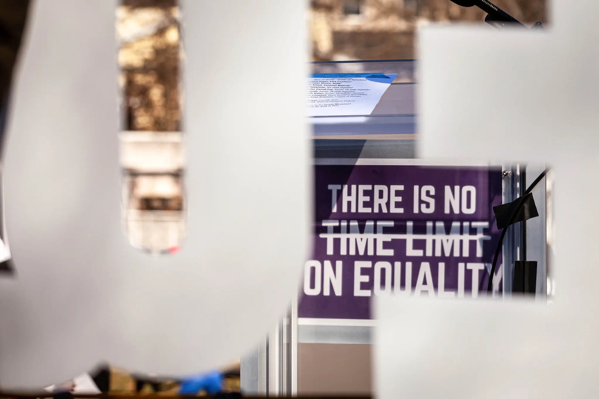
‘Even if you are a political junkie, there’s a good chance you didn’t realize that the United States Constitution grew 58 words longer this week.
Those words, which begin, “Equality of rights under the law shall not be denied or abridged by the United States or by any state on account of sex,” are the text of the Equal Rights Amendment. Section 3 of the amendment states that it takes effect two years after its ratification, which happened on Jan. 27, 2020, when Virginia became the 38th state to sign on. By its own terms, then, the 28th Amendment went into force on Thursday. American women are, at long last, equal to men in the eyes of the law. Hallelujah.
Or maybe not….’
— via New York Times
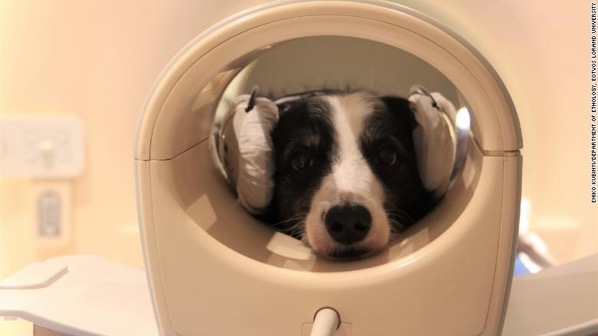
‘”The interesting thing here is that there was a difference in the (dogs’) brain response to the familiar and the unfamiliar language,” said Attila Andics, head of the department of ethology (the study of animals) at Eötvös Loránd University in Budapest, Hungary, who lead the experiment.
“This is the first nonprimate species for which we could show spontaneous language ability — the first time we could localize it and see where in the brain this combination of two languages takes place,” Andics said….’
— via CNN