Extraordinary Artificial Skin Can Transmit Sense Of Touch To Brain Cells

‘Even though there have been incredible advancements in the field of prosthetics, including some more unorthodox ones, those who are unfortunate enough to lose a body part will be unable to replicate the sense of touch with their artificial limb. A remarkable new study by a team of Stanford University engineers, published today in Science, has perhaps begun to finally address this problem: they have created a plastic skin that can “feel,” transmitting sensory information as an electric signal to the brain.’

Source: IFLScience

How the illusion of control leads you to perpetually wait for your life to begin

‘As the Bennetts explain in the book, most people seek a therapist in an effort to actively deny that they don’t have any control over their emotions. Stuck in a neurotic, fruitless loop, people begin to wonder why they can’t achieve perpetual happiness or erase their proclivity to procrastinate. If they could just fix the things they see as broken, they could then become the people they’ve always wanted to be and finally begin their lives. But just how much control do you really have over your feelings or your essential nature? According to the Bennetts, much less than you would like to believe. Your efforts are better spent elsewhere. In this episode, listen as Michael and Sarah explain what you should be doing instead, and why they say – “Fuck feelings.” ‘

Source: Boing Boing

Delete these genes, extend your life by as much as 60 percent

‘A 10-year effort to identify the genes responsible for ageing has led to researchers finding 238 specific genes that, when removed, significantly extend the lifespan of yeast cells in laboratory testing.If the results of this genetic editing can be replicated in humans – which is a possibility, since many of the genes and genetic pathways involved are also found in higher life forms – we may be able to seriously boost human lifespans by turning off ageing processes. The researchers found that the life of yeast could be extended by as much as 60 percent in some circumstances…’

Source: ScienceAlert via Newsvine

We’re flushing all these antidepressants into our water. How big is the problem?

‘There’s no way around it, the headlines are disturbing. And they come, not from tabloids or click-bait blogs, but from papers published in scientific journals. They describe fish and birds responding with altered behavior and reproductive systems to antidepressants, diabetes medication, and other psychoactive or hormonally active drugs at concentrations found in the environment. They report on opiods, amphetamines and other pharmaceuticals found in treated drinking water; antibiotics in groundwater capable of altering naturally occurring bacterial communities; and over-the-counter and prescription drugs found in water leaching from municipal landfills. And these are just some of many recent studies examining the countless pharmaceuticals that are now being found just about everywhere scientists have looked for them in the environment…’

Source: Vox

We have passed Peak Fish

‘I noted the other day that since the early 1980s, the world has lost about half of its coral reefs. According to a recent study, there’s more to worry about in the sea: the ocean contains half the fish it did 45 years ago.’

Source: kottke

The Internet May Be Changing Your Brain In Ways You’ve Never Imagined

Five years ago, journalist Nicholas Carr wrote in his book The Shallows: How The Internet Is Changing Our Brains about the way technology seemed to be eroding his ability to concentrate. “Once I was a scuba diver in the sea of words,” he wrote. “Now I zip along the surface like a guy on a Jet Ski.”

In the book, which became a New York Times bestseller and Pulitzer Prize finalist, Carr explored the many ways that technology might be affecting our brains. Carr became particularly concerned about how the Internet seemed to be impairing our ability to think deeply and to focus on one subject for extended periods.

Today, social media and digital devices have an arguably greater place in our lives and hold on our attention spans than they did in 2011. So what has  changed since Carr wrote his seminal work five years ago? We chatted with the journalist and author about how our increasing interactions with mobile technology might be affecting the most important organ in our bodies…’

Source: Huffington Post

The Home Depot shooter must be jailed

The NRA encourages a culture of irresponsible gun ownership: ‘Those who oppose even the smallest movement towards better gun safety policies do so love to invoke the figure of the “responsible gun owner” as their reason for wanting more unfettered gun access. “Law-abiding gun owners will not accept blame for acts of criminals,” NRA head Wayne LaPierre said in his 2013 remarks to Congress. “Teaching safe and responsible gun ownership works.

”It all sounds good on paper, but Detroit got to see what that mentality actually looks like in practice this week, when a woman who was certified for concealed carry—meaning she had to take gun safety classes and everything—decided that the best way to deal with a shoplifting that had nothing whatsoever to do with her was to pull out her gun and open fire in a Home Depot parking lot. This is what you get from the simplistic dividing of people into “law-abiding” and “criminal”, as well as assuring people that taking a few classes makes you a responsible gun owner: A woman who was so sure of her righteousness and responsibility that it didn’t even occur to her not to do something so immoral and stupid. Immoral because under no circumstances should the penalty for shoplifting be death at the hands of a vigilante. Stupid because she was in a parking lot, where innocent people are milling around, with soft bodies that will take a stray bullet whether the NRA considers them law-abiding or not.

But the fact that there are idiots in this world isn’t the most troubling fact about this story. No, what is even more troubling is that the woman remains unarrested and uncharged, and may not be facing any criminal charges at all. Unfortunately, under Michigan law, it may not be possible to charge her with a crime at all because, foolishly, the state allows people to take potshots at people who are fleeing from the commission of a felony…’

Source: Salon.com

Meet the Chimps That Lawyers Argue Are People

‘Earlier this summer, these two chimps received worldwide attention when activists with the Nonhuman Rights Project argued in a New York courtroom that Leo and Hercules should legally be considered people with a right to be free. Absent from those proceedings were Hercules and Leo themselves. News stories about the lawsuit—eventually dismissed, currently being appealed—were illustrated with stock chimpanzee photographs. A video accompanying the new study is the first chance most people will have to see the chimps, and their appearance raises anew the question: Is a chimpanzee a person?’

Source: National Geographic

Ebola Nations Declare First Week With No New Cases

‘The recent Ebola outbreak in West Africa has claimed the lives of over 11,000 people to date, mainly in Liberia, Guinea, and Sierra Leone, as reported by BBC News. Today, it is a pleasure to report that these three countries at the very heart of the deadly epidemic have recorded their first week with no new cases since the outbreak began in March of last year…’

Source: IFLScience

The placebo effect grows stronger

‘It’s getting more difficult for new painkilling drugs to be approved because the rate of effectiveness vs. placebos in drug tests is falling. But oddly, the drop is only being seen in the US. Based on patients’ ratings of their pain, the effect of trialled drugs in relieving symptoms stayed the same over the 23-year period — but placebo responses rose. In 1996, patients in clinical trials reported that drugs relieved their pain by 27% more than did a placebo. But by 2013, that gap had slipped to just 9%. The phenomenon is driven by 35 US trials; among trials in Europe, Asia and elsewhere, there was no significant change in placebo responses. The analysis is in press in the journal Pain…’

Source: Kottke

There Is Red Water on Pluto

“New Horizons has detected numerous small, exposed regions of water ice on Pluto,” NASA noted in the press release. NASA doesn’t know yet why water appears on some regions of Pluto and not others, but it notes that Pluto’s watery regions are a deep red color.“I’m surprised that this water ice is so red,” Silvia Protopapa, New Horizons scientist at the University of Maryland, College Park. “We don’t yet understand the relationship between water ice and the reddish tholin colorants on Pluto’s surface.”..’

Source: Motherboard

How To Talk To A Grieving Person 

‘In the weeks and months after my father died, “How are you?” became my least favorite question. It was always benign and well-intentioned, but it also inevitably reminded me that I felt like shit. I’d rather have given a gruesome blow-by-blow account of how my father died than talk about how I felt. But talking—or, more importantly, finding someone who will listen—is what grieving people so desperately need.

There is a gulf between mourners and the rest of the world. We want to talk, but we don’t want to make people uncomfortable. We can tell they want to say something, but they don’t know how. But how the hell do you talk to a grieving person? It can be baffling, especially when a simple “Hey, what’s up?” can set someone off.

But you have to start somewhere. “I think it’s important for people who haven’t lost someone to say, ‘I have no idea what you’re going through, but I’m here to listen,’” my friend Tessa told me of her own experience mourning her father. “And for people that have been through it, share that. It makes us feel less alone, I think.”

True, you might say the wrong thing! It’s okay, though…’

Source: Dead Spin

How guards and prosecutors retaliate against solitary confinement prisoners who blow the whistle / Boing Boing

‘The Dallas Six is a group of prisoners who were beaten, shocked and gassed by prison guards who had previously beaten them in retaliation for complaints about abuse in solitary confinement.

The letters of grievance the men sent were intercepted by guards who violently retaliated against them, sparking a nonviolent protest (the men covered the windows of their cells). This, in turn, was used as a pretense for “cell extractions” during which the non-violent prisoners were beaten, shocked, gassed and left in their underwear, covered in gas residue, shackled in stress positions.

Prosectors collaborated with the guards who attacked the men, bringing trumped up assault charges against the men for allegedly resisting the guards, though the videos don’t support the charge (the prosectors have argued against introducing the videos into evidence).

The story of the Dallas 6 is a microcosm for the everyday torture in the American penal system, which imprisons more people than any other country in the world’s history. It’s not a coincidence that the Dallas 6 are black, nor that they began their journey into the penal system with zero-tolerance busts for petty crap like shouting at their elementary school teachers.

Molly Crabapple’s reporting on the Dallas 6 is a must-read, and her accompanying illustrations are beautiful and haunting.’

Source: Boing Boing

Without People, Wildlife Make a Comeback at Chernobyl

The accident at the Chernobyl Nuclear Power Plant in 1986 had a devastating impact on the local population and forced 116,000 people to permanently leave their homes. But now researchers have discovered that, while the people may not have returned, the contaminated area of Belarus is teeming with wild animals, including elk, wild boar, deer and wolves. Perhaps surprisingly, many of these numbers seem to be on the rise and some of them are higher than in uncontaminated areas.

The abandoned area around the nuclear power plant, known as the Chernobyl exclusion zone, includes about 4750 square kilometres of land in both Ukraine and Belarus. The contamination in the exclusion zone is patchy, as the distribution of radioactive isotopes on the ground was influenced by the weather conditions at the time of the accident and the days following it. The radiation levels have reduced over the nearly 30 years since the accident, but in many parts of the zone they are too high for people to return.

Source: Gizmodo

Reddit Without Comments!

‘Reddit is launching a brand new website today to unearth news from its social aggregator. Called Upvoted, the site will surface pictures, videos and commentary from Reddit and present it as news — without the option to comment on a single thing.Wired reports that the new website, which is set to launch later today, “looks and feels much like any other news site out there.” That means you should expect stories, pictures, videos, infographics, podcasts and the like, covering anything from politics and science to sports and, presumably, cats. The Verge suggests that the new website will dig a little deeper, too, “providing more context on their background through interviews with the Reddit users behind the stories” — something that will be powered by a dedicated editorial team.’

Source: Gizmodo

Want to get American gun violence to European levels? Then you need to confiscate guns.

President Obama is clearly fed up. His speeches after mass shootings — speeches that have become a bit of a morbid ritual, given how regularly the shootings occur — have grown angrier, more emotional, and more disgusted at America’s gun violence problem and Congress’s unwillingness to do literally anything to stop it. “This is a political choice that we make,” Obama declared Thursday night, after the 294th mass shooting of 2015, “to allow this to happen every few months in America.”But let’s be clear about precisely what kind of choice this is. Congress’s decision not to pass background checks is not what’s keeping the US from European gun violence levels. The expiration of the assault weapons ban is not behind the gap. What’s behind the gap, plenty of research indicates, is that Americans have more guns. The statistics are mind-blowing: America has 4.4 percent of the world’s population but almost half of its civilian-owned guns.

Source: Vox

Why is there something rather than nothing?

That is the question that physicist Lawrence Krauss answers in his book, A Universe from Nothing. The book’s trailer provides a little more context. Everything we see is just a 1% bit of cosmic pollution in a Universe dominated by dark matter and dark energy. You could get rid of all the things in the night sky — the stars, the galaxies, the planets, everything — and the Universe would be largely the same.And my favorite line from the trailer: Forget Jesus, the stars died so you could be born.

Source: Kottke

An Ancient Volcanic Collapse Triggered an 800 Foot Tsunami Wave

‘Scientists have just uncovered one of the largest tsunami events in the geologic record, and naturally, it started with an epic splash. 73,000 years ago, the eastern flank of Cape Verde’s Fogo volcano collapsed into the sea, kicking up an 800-foot wave.

Think about that for a sec. That’s two thirds the height of the Empire State Building. If a mega-tsunami of that size struck a coastal city today, the consequences would be pretty apocalyptic. And such events aren’t outside the realm of possibility.

“Most of these fairly young oceanic volcanoes — such as in the Azores and the Canary Islands and Hawaii — are incredibly high and steep, so the potential energy for a collapse to happen again is there,”said Ricardo Ramalho, a co-author on a study describing the mega-tsunami that was published this week in Science Advances.’

Source: Gizmodo

Check Out the Ghost Shark!

‘The ghost shark is creepy as hell. It floats around the darkest part of the ocean looking like a fallen angel that just clawed its way out of hell. It’s not entirely a shark. It’s more like a shark’s earlier, eerier relative.’

Source: io9

Western Philosophy: Derived from Eastern Spiritualism?

‘In a fascinating piece in this month’s Atlantic, UC Berkeley professor Alison Gopnik details her four year journey out of a mid-life crisis via David Hume and Buddhism. The just-turned-fifty Gopnik begins reading Buddhism, connects the religion’s ideas to those of the eighteenth century philosopher, then launches an ambitious research project driven by the question of how Hume came up with his philosophy that was “so profoundly at odds with the Western philosophy and religion of his day.”

Hume is most famous for his rejection of the idea of an inherent self. He also had gone through a psychological crisis. To help calm his nerves, he moved to small town in France and finished what would become one of the most substantial works of Western philosophy–A Treatise of Human Nature. Relying on the hunch that Hume would have had to have known something about Buddhist philosophy in order to write Treatise, Gopnik digs through archives and travels to Europe to discover that the Jesuit priests in that provincial French town had indeed heard of Buddhism and possibly even had copies of certain Tibetan texts. Although she admits that she can’t be certain, she determines that “Hume could indeed have known about Buddhist philosophy” at the time he wrote Treatise.

If true, this discovery would be remarkable because it’s widely assumed that Buddhism didn’t make it to the European continent until the nineteenth century.’

Source: Big Think

NASA Discovers Evidence for Liquid Water on Mars

‘For years, scientists have known that Mars has ice locked away within its rusty exterior. More elusive, though, is figuring out how much of that water is actually sloshing around in liquid form. Now, NASA scientists have found compelling evidence that liquid water—life-giving, gloriously wet H 20—exists on Mars.

We’re not talking gushing rivers or oceans here. These scientists have been investigating “recurring slope lineae,” patches of precipitated salt that appear to dribble down Mars’ steep slopes like tears rolling gently down a cheek. Planetary scientists hypothesized that the streaky formations were products of the flow of water, but they didn’t have concrete, mineralogical evidence for that idea until now, says Lujendra Ojha, a scientist at Georgia Tech who first spotted the lineae back in 2010. In a new Nature Geoscience paper, published online today, Ojha and his colleagues present “smoking gun validation” that it was liquid water flowing on Mars’ surface that formed these tear stains.’
Source: WIRED

Assisted Death Laws Won’t Make It Better to Die in the US 

‘Currently sitting on Governor Jerry Brown’s desk is a bill that, if signed into law, would allow doctors to prescribe life-ending drugs. Not surprisingly, this is controversial. Proponents believe the law would save diseased people from the worst days of their prognoses. Opponents say the law violates the sanctity of life, and can be exploited by ill-meaning family, physicians, and insurance companies at the patient’s expense.

But there’s a third group who believe this debate misses the real problem: that the American health care system is just an all around miserable place to die.’

Source: WIRED

How to Invent a Language, From the Guy Who Made Dothraki

‘IF YOU’RE A science fiction or fantasy fan, chances are you’ve heard a language constructed by David J. Peterson. He created both Dothraki and Valyrian for HBO’s Game Of Thrones, as well as written or spoken languages for Thor: The Dark World, SyFy’s Defiance and Dominion, and The CW’s The 100 and Star-Crossed. And in becoming the most recognizable name in the conlang (constructed language) community, he’s been instrumental in raising not just awareness of constructed languages, but their quality as well. By now, viewers expect their alien or foreign tongues to sound like they have syntax and grammar. No longer would a scene like this one from Return of the Jedi—Princess Leia/bounty hunter Boushh speaking fictional language Ubese to Jabba—pass muster.

Peterson has already written a guide to Dothraki, but his new book has even larger ambitions. The Art of Language Invention, out tomorrow, is a combination knowledge base and history lesson for those interested in constructing languages. It’s a distillation of the knowledge Peterson gained from the original email listserv that popularized the term “conlang,” blended with some of what he studied as a linguistics Ph.D. student at UC San Diego. But while it’s presented as an introduction for anyone interested in learning more about conlangs, it’s still incredibly dense. Unless you’ve taken a fair amount of linguistics, or are innately familiar with phonetic inventories and symbols, there’s a high barrier to entry for the average pop culture fan curious about how Dothraki came to be. The best parts of the book come at the end of the four main sections, where Peterson presents case studies on issues he face in creating languages for Game Of Thrones and Defiance, and how the knowledge he gained from the online community and his university training assisted in construction.

So rather than trying to explicate the book for you, we talked to Peterson himself—focusing on the community at large and its changing place in popular culture. Not surprisingly, he’s got some bold ideas for how the conlang community is dealing with being under a spotlight, and how innovative language creation can aid humanity’s future.’

Source: WIRED

Laurel and Hardy: it’s still comedy genius

Frank Skinner once admitted that new girlfriends were always “subjected to the Laurel and Hardy test”, when he would play a video of the Laurel and Hardy dance sequence from Way Out West. “If she didn’t laugh, I instantly wrote her off as a future companion,” said Skinner, conceding that this wasn’t exactly rational behaviour.

Perhaps we can all be divided by that Laurel and Hardy test. Those who love the Way Out West dance, which captures perfectly the charm and on-screen chemistry of the comedy duo, will already have been delighted by the news that the BBC1 is to show in 2015 a one-off 90-minute drama called Stan and Ollie – written by Jeff Pope of Philomena note – which is based around their 1953 tour of the UK, during which Hardy suffered a heart attack.

Source: Telegraph.co.uk

A Pill Doesn’t Have to Cost $750 To Be Outrageous and Exploitative

The internet’s villain of the month is easily Martin Shkreli, CEO of Turing Pharmaceuticals. In August, Turing, a pharma startup that had just received its first round of financing, bought the rights to manufacture an anti-parasitic drug called Daraprim. Turing’s first act was to jack the price of Daraprim from $13.50 to $750 per tablet, inciting much justifiable outrage.

Here’s the thing though: The drug was already priced outrageously and prohibitively. Daraprim is a very old and off-patent drug—just a few years ago, when the drug was still being manufactured by GlaxoSmithKline, it cost $1 per pill. When GSK sold it to CorePharma in 2010 (CorePharma was eventually bought by Impax Labs, who sold the drug to Turing), the price went up to $13.50. Which is indeed much cheaper than $750 per pill, but relative cheapness doesn’t translate to accessibility. For many patients, a $13.50 daily medication might as well cost $750.

Source: Motherboard

Today’s Hero of the False-Equivalence Struggles: On the Media

‘False equivalence, for those joining us late, is the almost irresistible instinct in mainstream journalism to present differing views as being equally valid “sides” of an argument, even if one of them is objectively true and the rest are not.

False equivalence: “President Obama claims that he was born in the United States and thus is eligible to serve as president; his critics disagree on both counts.”

Actual truth: “Barack Obama was born in Hawaii in 1961; a persistent ‘birther’ movement denies this fact.”

As chronicled over the years in posts collected here, the “both sides make their claims, who are we to judge?” reflex is very powerful in our business. That is largely because we’re most comfortable when acting in the role of a referee at a sporting event, a judge at a trial, a moderator at a debate, or some similar figure letting presumptively legitimate contenders fight it out on their own. To intervene directly and say “There are two sides here, but one of them is bunk” is uncomfortable, because it seems “partisan.” It is also risky, because it requires the reporter to learn enough about an issue to judge claims of relative truth.

Our friends at WNYC’s On the Media—Brooke Gladstone, Bob Garfield, and their team, whom I know and like—have done two very strong recent episodes on the false-equivalence snarl. In general you should listen to their show, but here are two especially worth seeking out.’

Source: The Atlantic

Why Everything Is Bad for You

Via The New York Times: ‘Health-scare stories, even those that are not overblown, draw their special power from the fact that we go through the days denying our mortality. Each one reminds us anew that there’s no way out. Unable to avoid this tragic and absurd-seeming condition, we lash out against our fates by finding fresh reasons to make a villain out of the one thing that is doing its part to keep us alive: food. We add salt to the psychic wound when we momentarily trick ourselves into believing that bugs, worms and dirt are the only things fit for human consumption. I’m not falling for it anymore. I’m going back to bologna and cheese…’

Is it Lying that Makes Us Truly Human?

Not only do we have a propensity for lying, we have built-in barriers that prevent us from detecting others when they do… People are social beings who require constant interaction and communication in order to survive. If we were constantly suspicious that everyone was lying, we’d probably all be holed up in a cabin like the Unabomber.

Source: Big Think

Two new studies show the FDA is rushing more drugs to market based on shoddy evidence

There was a time when the Food and Drug Administration was so sluggish and conservative in approving new drugs that people who desperately needed access to medicines would die waiting.

But fast forward to the early 1990s. By then, Congress had created four programs to expedite the development and approval process for new pharmaceuticals. These pathways were intended to push innovative new drugs — drugs to treat rare, serious, or life-threatening diseases — through the FDA more quickly.

Since these medicines were sorely needed, the idea was that rushing them through, often on the basis of more limited and preliminary clinical trials data, would help patients languishing with unmet medical needs.

Today, the FDA is now considered the fastest regulatory agency in the world. But there’s some concern that these expedited pathways are being used by drug companies to speed through medicines that aren’t actually helping patients with unmet medical needs — and that often aren’t any improvement over what’s already on the market.

Source: Vox

If You’re From One of These States and Planning to Fly in 2016, LOL Sorry

Attention driver’s license holders from the great lands of New York, Louisiana, New Hampshire, Minnesota, and American Samoa: The Department of Homeland Security has no love for you.

[Update: Let’s add Alaska, Arizona, Idaho, Louisiana, Maine, Minnesota, Missouri, Montana, New Hampshire, Oklahoma, Oregon, Pennsylvania, South Carolina, Virginia, and Washington to the list.]

In 2016, the final phase of the Real ID Act—passed in Congress way back in 2005 under the recommendation of your friends at the 9/11 Commission (never forget)—goes into effect. The Real ID Act defines “real IDs” as those that are obtained only with proof of U.S. citizenship. In the aforementioned States of the Damned, driver’s licenses do not require proof of citizenship and are considered “non-compliant” with the Real ID act, and thus they will no longer be acceptable forms of identification when boarding federally regulated commercial aircraft. This is a significant setback, as Travel + Leisure reports, because 38% of Americans don’t have passports.

Source: Flygirl

Six Easy Ways to Tell If That Viral Story Is a Hoax

“And so it begins … ISIS flag among refugees in Germany fighting the police,” blared the headline on the Conservative Post; “with this new leaked picture, everything seems confirmed”. The image in question purported to show a group of Syrian refugees holding ISIS flags and attacking German police officers.

Only it was a fake. It’s fairly easy to find photo or video ‘evidence’ to bolster a scurrilous political position (in this case, the anti-immigration argument that we are allowing Islamist infiltration), and the resulting misinformation can easily go viral. Corrections by investigative journalists or private citizens do not get anything like the notice that the original lies did. Here are six tools for digital information verification.

Source: Gizmodo

This Is What Happens When an Indie Band Experiments at the LHC

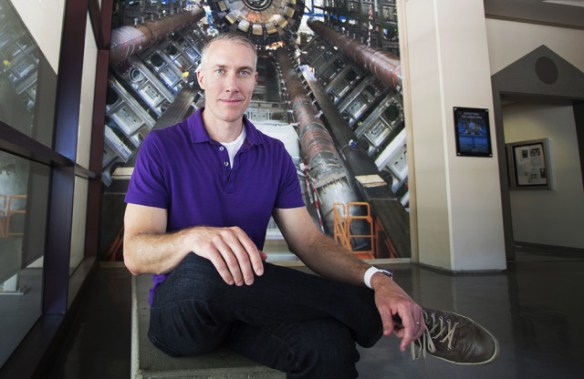
It’s normally just researchers that get to experiment at the LHC. But one physicist has decided to invite a series of bands to play around at the world’s largest science lab — and this is the result.

The first event of a new an initiative called Ex/Noise/CERN, that’s led by Dr. James Beacham, saw the experimental indie band Deerhoof set up their gear in CERN’s magnet test facility. In a press release, Beacham described what he was hoping to achieve:

“Musical curiosity is similar to scientific curiosity and, on a personal level, Deerhoof has inspired me as much as Einstein. They’re explorers and this sense of exploration is what you feel in the air at CERN right now, and so the pairing of Deerhoof and CERN was natural.”

This particular musical outing was in honour of the LHC’s recent ramp up to 13 TeV. The idea was to “draw inspiration from CERN physics and create impromptu musical arrangements amongst CERN equipment.”

The video below captures some of what happened during the day. It might not be melodic indie pop, but it is certainly interesting and exploratory kind of hard to understand, a bit like a musical version of what happens at CERN.

Source: Gizmodo

Concorde Will Fly Again, Says Group With Massive War Chest 

Via Flightclub: ‘Club Concorde, a group of ex-pilots, maintainers, engineers, airline execs and ConcVia : ‘orde enthusiasts has unveiled a plan that aims to put a Concorde back in the air by 2019, and supposedly they have a pile of cash to see their plans through to fruition.

It has been more than a decade since Concorde took its last flight, ending its career on October 24th, 2003. Examples are now strewn across the globe in the aviation museums and science centers where they were sent with no intention of ever flying again. As such, it is not as if you can just go out and buy a surplus Concorde.

…Or can you?..’

The US Forest Service Is Trying To Bury a Crucial Journal Article

Via Motherboard: ‘On Thursday, Science magazine published a crucial and overdue commentary lamenting the current state of wildfire management on US public lands. Among the authors was Malcolm North, a plant ecologist at the US Forest Service’s Pacific Southwest Research Station in California.

As it turns out, the USFS was none too pleased about the piece or North’s name being attached to it. According to Valley Public Radio, the central California NPR affiliate, the agency has barred North from discussing the paper and had even attempted to prevent Science from publishing it.

“The Pacific Southwest Research Station says its role is to conduct and publish research, not to evaluate land management policy,” VPR’s Amy Quinton reports. “Editors at Science refused to hold the article from publication or remove North’s name and affiliation. A disclaimer was added telling readers that the content does not necessarily reflect the views of the US Forest Service.”

The Science commentary, which Motherboard covered in more depth here, basically argues that we’re doing wildfires all wrong. 98 percent of all fires are quashed before they can grow in size and consume their host forests’ overaccumulation of fuels. And so the accumulation continues year after year until a deadly, catastrophic wildfire hurricane shreds 70,000 acres in a weekend…’

Trumpet sounds heard across Jakarta signal end of the world

Via Boing Boing: ‘Last Friday evening, numerous people in Jakarta, Indonesia reported and recorded mysterious, low trumpet-like sounds in the sky. Listen for yourself below. Scientists often try to explain away these strange noises as “Earth sounds” caused by shifting tectonic plates, atmospheric phenomena, geomagnetic activity, or the like. But we all know it’s really the trumpets of the apocalypse…”

Arab-looking man of Syrian descent found in garage building what looks like a bomb

Via Boing Boing: ‘Omar Ghabra won Twitter with these photos, and this quip: “An Arab-looking man of Syrian descent in a garage w/his accomplice building what appears to be a bomb. Arrest them.”The tweet was a response to the story everyone’s outraged about today: Ahmed Mohamed, the kid in Texas whose wonderful homemade clock sparked a racist reply by his school, and by authorities.Apple founder Steve Jobs, seen here in classic “garage” photos with Steve Wozniak, was the son of a Syrian migrant to the United States…’

Want to Know if Someone is a Narcissist? Just Ask.

Via The Ohio State University (thanks to Boing Boing): ‘Scientists have developed and validated a new method to identify which people are narcissistic: Just ask them.In a series of 11 experiments involving more than 2,200 people of all ages, the researchers found they could reliably identify narcissistic people by asking them this exact question (including the note):To what extent do you agree with this statement: “I am a narcissist.” (Note: The word “narcissist” means egotistical, self-focused, and vain.)Participants rated themselves on a scale of 1 (not very true of me) to 7 (very true of me).(How narcissistic are you? Take the test here.)Brad BushmanResults showed that people’s answer to this question lined up very closely with several other validated measures of narcissism, including the widely used Narcissistic Personality Inventory….’

Every Single GOP Candidate’s Proposed Secret Service Code Name Is Unimaginably Hilarious

Via Gawker: ‘After nearly three hours of monotone droning by a bunch of sweaty old people who will almost certainly never be president, tonight’s Republican debate finally delivered with a bizarre question about potential Secret Service names that produced incredibly absurd answers from every single candidate.

The final segment of the debate was devoted to free association-style questions. The dais was first asked which woman they would put on the $10 bill, with the most popular answer being: myyyy wiiiife. Then each candidate was prompted to offer what their Secret Service code name would be if they were elected president, and holy hell was each answer absolutely nuts.Here are the candidates’ real, actual answers, each of which delivers such a perfect morsel of conservative id:

  • Chris Christie: “True Heart”
  • John Kasich: “Unit One”
  • Carly Fiorina: “Secretariat”
  • Scott Walker: “Harley”
  • Jeb Bush: “Ever-Ready”
  • Donald Trump: “Humble”
  • Ben Carson: “One Nation”
  • Ted Cruz: “Cohiba”
  • Marco Rubio: “Gator”
  • Mike Huckabee: “Duck Hunter”
  • Rand Paul: “Justice Never Sleeps”

Cohiba! Duck Hunter! Justice Never Sleeps! Secretariat!!!I swear this is the funniest thing I’ve ever seen in my entire life.’


Scientists to awaken ancient ‘giant virus’

Via The Independent: ‘French scientists are preparing to wake up a 30,000-year-old ‘giant’ virus.

A team from the French National Centre for Scientific Research discovered the prehistoric virus, called Mollivirus sibericum, underground in north-eastern Siberian permafrost, reports CNET.

And now they plan to give it its first “wake-up call” since the last Ice Age…’

The High-Resolution Images of Pluto Begin to Arrive

Via NASA: ‘New close-up images of Pluto from NASA’s New Horizons spacecraft reveal a bewildering variety of surface features that have scientists reeling because of their range and complexity.

“Pluto is showing us a diversity of landforms and complexity of processes that rival anything we’ve seen in the solar system,” said New Horizons Principal Investigator Alan Stern, of the Southwest Research Institute (SwRI), Boulder, Colorado. “If an artist had painted this Pluto before our flyby, I probably would have called it over the top — but that’s what is actually there.”

New Horizons began its yearlong download of new images and other data over the Labor Day weekend. Images downlinked in the past few days have more than doubled the amount of Pluto’s surface seen at resolutions as good as 400 meters (440 yards) per pixel. They reveal new features as diverse as possible dunes, nitrogen ice flows that apparently oozed out of mountainous regions onto plains, and even networks of valleys that may have been carved by material flowing over Pluto’s surface. They also show large regions that display chaotically jumbled mountains reminiscent of disrupted terrains on Jupiter’s icy moon Europa…’

Scientists Urge Caution in Wake of “Transmittable” Alzheimer’s Claim

Via i09: ‘A provocative new paper published in Nature suggests that neurodegenerative disorders such as Alzheimer’s and Parkinson’s may be transmissible through certain medical procedures. It’s an alarming claim—but one that will require more proof if it’s to be accepted by the scientific community.

… While performing an autopsy on eight individuals who died between the ages of 36 and 51, and who caught their CJD from contaminated HGH injections, the researchers unexpectedly discovered severe to moderate grey matter and vascular amyloid beta pathology in four of them. This was a surprise because of the relatively young age of the subjects, and because none of these patients had problematic mutations or predispositions to Alzheimer’s.

The researchers suspect that, when these individuals were administered their HGH treatments, the growth hormone was also contaminated with the amyloid beta protein, which then spread through their brains. This would suggest that the “seeds” responsible for certain neurodegenerative diseases can be transmitted during certain medical procedures or via contaminated surgical instruments…’

If Only One-third of Published Psychology Research is Reliable, Now What?

Via io9: ‘A small but vocal contingent of researchers – addressing fields ranging from physics to medicine to economics – has maintained that many, perhaps most, published studies are wrong. But how bad is this problem, exactly? And what features make a study more or less likely to turn out to be true?

We are two of the 270 researchers who together have just published in the journal Science the first-ever large-scale effort trying to answer these questions by attempting to reproduce 100 previously published psychological science findings…’

1927 news report: Donald Trump’s dad arrested in KKK brawl with cops

Via Boing Boing: ‘According to a New York Times article published in June 1927, a man with the name and address of Donald Trump’s father was arraigned after Klan members attacked cops in Queens, N.Y.nyttrump In an article subtitled “Klan assails policeman”, Fred Trump is named in among those taken in during a late May “battle” in which “1,000 Klansmen and 100 policemen staged a free-for-all.”

…To be clear, this is not proof that Trump senior—who would later go on to become a millionaire real estate developer—was a member of the Ku Klux Klan or even in attendance at the event. Despite sharing lawyers with the other men, it’s conceivable that he may have been an innocent bystander, falsely named, or otherwise the victim of mistaken identity during or following a chaotic event…’

Climate change denier Rupert Murdoch just bought National Geographic, which gives grants to scientists

Via Boing Boing: ‘The National Geographic magazine has been a nonprofit publication since inception in 1888, but that ends today. The long-running American publication becomes very much for-profit under a $725 million dollar deal announced today with 21st Century Fox, the entertainment company controlled by the family of Rupert Murdoch.Murdoch is a notorious climate change denier, and his family’s Fox media empire is the world’s primary source of global warming misinformation. Which would be no big deal here, I guess, were it not for the fact that the National Geographic Society’s mission includes giving grants to scientists…’

Piercing the Surface: Thomas Merton’s Zen Photography

Via Big Think: ‘Near the end of his life, during a trip to Asia in 1968, Trappist monk, poet, theologian, and social activist Thomas Merton (shown below) came away from seeing ancient carved Buddhas deeply moved. “I don’t know what else remains,” Merton wrote, “but I have now seen and have pierced through the surface and have got beyond the shadow and the disguise.” Merton studied comparative theology not to reduce other faiths to some shadow of his own Christianity, but rather to synthesize them into some deeper, common belief that “pierced through the surface” to get “beyond the shadow and disguise.”

Zen Buddhism struck a chord within Merton as achieving the same sense of interior wholeness that mystics such as Meister Eckhart and St. John of the Cross had in the Christian tradition. For Merton, a man deeply steeped in words, however, writing failed to convey the wordless qualities of Zen. A Hidden Wholeness: The Zen Photography of Thomas Merton, a new exhibition to mark the centennial of Merton’s birth, demonstrates how Merton found in photography the perfect medium for his Zen studies, not just to make images of Zen, but also to practice Zen itself…’

World’s largest natural sound archive now fully digitized and online

Quote

via Cornell University: ‘In terms of speed and the breadth of material now accessible to anyone in the world, this is really revolutionary,” says audio curator Greg Budney, describing a major milestone just achieved by the Macaulay Library archive at the Cornell Lab of Ornithology. All archived analog recordings in the collection, going back to 1929, have now been digitized and can be heard at http://www.MacaulayLibrary.org…’

The Opposite of Hoarding

Via The Atlantic: Getting rid of belongings is generally seen as positive, even healthy—but when the need becomes compulsive, it can be a sign of a life-consuming disorder. And the cultural embrace of decluttering can make it hard for someone who does it compulsively to get help.

Next generation of Army leadership will be brain-damaged

Via NYTimes.com: ’For generations, freshmen cadets at the United States Military Academy have marked the end of a grueling summer of training with a huge nighttime pillow fight that is billed as a harmless way to blow off steam and build class spirit.

But this year the fight on the West Point, N.Y., campus turned bloody as some cadets swung pillowcases packed with hard objects, thought to be helmets, that split lips, broke at least one bone, dislocated shoulders and knocked cadets unconscious. The brawl at the publicly funded academy, where many of the Army’s top leaders are trained, left 30 cadets injured, including 24 with concussions, according to West Point…’

Psychological disorder causes you to hallucinate your doppelgänger

Via Boing Boing: ‘In the book The Man Who Wasn’t There, Anil Ananthaswamy explores mysteries of self, including the weirdness of autoscopic phenomena, a kind of hallucination in which you are convinced that you are having an out-of-body experience or face to face with your non-existent twin. From a BBC feature based on one of the book chapters…’

Of the lectures I have given, one of those that most fascinated my audience, and which I have therefore rolled out over and over to entertain, has been a roundup of odd and offbeat psychiatric disorders. These include autoscopic phenomena, as noted above, as well as Fregoli, Cotard’s, apotemnophilia, Alice in Wonderland syndrome, Munchausen’s (of course) and my personal favorite, Capgras, about some of which I have written here in the past and all of which challenge fundamental aspects of our perception of reality. Do a Google search on “odd unusual psychiatric|psychological syndromes” to explore these topics further.

Obama: Denali, not McKinley

Via Vox: ‘On Sunday, the Obama administration announced that the peak formerly known as Mount McKinley will henceforth be known as “Denali,” its traditional Native Alaskan name.The mountain was officially named after President William McKinley in 1917, a gesture originally proposed by an Alaska gold prospector in recognition of McKinley’s support for the gold standard.The Denali name is widely supported by Alaskans regardless of ethnicity.Politicians from McKinley’s home state of Ohio are leading the opposition to the change.’

R.I.P. Oliver Sacks

Via The New York Times: ‘Casting Light on the Interconnectedness of Life: Dr. Sacks, who died on Sunday at 82, was a polymath and an ardent humanist, and whether he was writing about his patients, or his love of chemistry or the power of music, he leapfrogged among disciplines, shedding light on the strange and wonderful interconnectedness of life — the connections between science and art, physiology and psychology, the beauty and economy of the natural world and the magic of the human imagination. In his writings, as he once said of his mentor, the great Soviet neuropsychologist and author A. R. Luria, “science became poetry.”..’

Meet the world’s foremost Loch Ness Monster hunter

Via Salon.com: ‘The monster hunter isn’t quitting.

Do not believe the news reports that pinged around the world last month faster than the flick of a dragon’s tail.

Steve Feltham, full-time professional seeker of the Loch Ness Monster, holder of the Guinness World Record for longest continuous vigil for “Nessie,” has reached no conclusions about the cryptid that may or may not inhabit this freshwater lake in the Scottish Highlands.

He has not determined that Nessie is a giant catfish. He has not ended his search. He is not walking away from his dream.

“I’m not leaving Loch Ness,” Feltham, 52, says in a video filmed inside the van where he lives and posted to his website. “Never have intended to. Never will, until we solve this mystery.”..’

What the world would look like if humans had never existed

Via Independent.UK: ‘Put simply, Danish researchers behind a new study believe that without humans, most of northern Europe would be home to bears, elephants and rhinoceroses: areas where they were historically hunted to extinction by Homo sapiens…’

Unsurprising.

Users describe the effects of the drug some are calling ‘weaponised marijuana’

Via Matti Viikate – Newsvine: ‘Synthetic marijuana, also referred to as ‘replacement cannabis’, ‘K2’, and ‘Spice’, is a lab-produced mind-altering drug that aims to mimic the effects of marijuana, but is known to have unpredictable and sometimes dangerous effects, despite its marketing as a safe, legal alternative to marijuana. New York City’s police commissioner, William Bratton, recently said that the drug, which he referred to as “weaponised marijuana” is of “great and growing concern” to the city’s police force, which has seen a spike in hospitalisations from the drug..’

The End of Walking

Via Antonia Malchick – Aeon: ‘For decades, Americans have been losing their ability, even their right, to walk. There are places in the United States – New York City, for example – where people walk as a matter of habit and lifestyle, commuting in ways familiar to residents of London or Paris. But there are vast blankets and folds of the country where the ability to walk – to open a door and step outside and go somewhere or nowhere without getting behind the wheel of a car – is a struggle, a fight. A risk…’

Staring Into Someone’s Eyes For 10 Minutes Can Alter Your Consciousness

Via IFLScience: ‘Forget LSD: eyes are the new high. Of course, we’re not talking about consuming them, but rather staring intensely into a pair for a prolonged period of time. Apparently, this can make people enter into an altered state of consciousness.

This intriguing discovery was made by vision researcher Giovanni Caputo from the University of Urbino in Italy, but it isn’t his first staring contest study. A few years ago, the scientist recruited 50 volunteers and got them to gaze upon their reflections in a mirror for 10 minutes in a dimly lit room. For many of them, it took less than one minute to start experiencing something trippy.

Their faces began to warp and change, taking on the appearance of animals, monsters or even deceased family members; a phenomenon imaginatively named the “strange-face illusion.” But it seems the bizarre effects are even more dramatic when the mirror is swapped for another person…’

10 of Our Favorite Orangutan Pictures

10 of Our Favorite Orangutan Pictures

Via National Geographic: ‘On International Orangutan Day, we take a look at these lovable tree-dwelling apes, whose numbers are plummeting fast due to deforestation.

Solitary and intelligent, the orangutan is the only great ape native to Asia—but it’s possible the continent may soon have none. That’s because orangutan numbers are dwindling as the animals are driven from their habitats by deforestation for palm oil plantations.

The island of Borneo may house only 54,000 of the endangered animal, and on Sumatra (map), just 6,600 remain, according to WWF. That’s a drop from possibly 230,000 of the primates a century ago.

But there’s one bright spot for this fiery-furred ape: Many companies have committed to only using palm oil from areas that weren’t destroyed by logging…’

According To New Study, A Blood Test Could Predict Suicide Risk

Via IFLScience: ‘In what is sure to be highly controversial research, a new study claims to be able to predict a person’s risk of committing suicide with over 90% accuracy, using only a blood test coupled with a questionnaire.

According to the researchers from Indiana University School of Medicine, they have developed a simple test that looks for 11 biomarkers in a patient’s blood. When they coupled this with an app-based questionnaire, they say they were able to predict which individuals in a group of patients already being treated for psychiatric disorders would go on to develop suicidal thoughts over a period of two years…’

The Death of LOL

Via The Awl: ‘“A new report from Facebook into how users express laughter shows that ‘haha’ and its variants are by far the most common terms used on the social network. They accounted for 51.4 percent of mirth in the anonymized comments and posts looked at by Facebook’s data team, with laughter emoji claiming 33.7 percent, and ‘hehe’ and its cognates 13.1 percent. The once-mighty ‘lol’ only appeared in 1.9 percent of the text sampled by Facebook — a pretty staggering fall for an expression that was once synonymous with online txt speak. Although not surprising for such a venerable term, ‘lol’ proved slightly more popular with older users. Differences between generations were not heavily pronounced, but it was emoji that were most popular with users with the youngest median age, while ‘haha,’ ‘hehe,’ and ‘lol’ were favored by progressively older individuals.”..’

Are There Too Many Meta-Analyses?

Via Neuroskeptic: ‘Meta-analyses are systematic syntheses of scientific evidence, most commonly randomized controlled clinical trials. A meta-analysis combines the results of multiple studies and can lead to new insights and more reliable results.

However, according to Italian surgeon Giovanni Tebala writing in Medical Hypotheses, meta-analyses are becoming too popular, and are in danger of taking over the medical literature.

…Why is this? Tebala suggests that researchers are turning to meta-analyses to bolster their CVs:

Randomized controlled trials require hard work and financial commitment, whereas meta-analyses and systematic reviews can be relatively easy to perform and often get published in high impact journals. Many researchers might decide to devote themselves to the latter approach.

…Tebala doesn’t actually spell out why the glut of meta-analyses is a problem for science; he seems to be concerned at the unfairness of meta-analysts getting credit for their work with “someone else’s data”.

Nonetheless I think there is a scientific problem, which is that as the ratio of meta-analyses to actual data increases, the scientific literature becomes dominated by interpretation and analysis resting on a limited amount of evidence. Put simply, the risk is that science will get “top heavy”…’

The Universe Is Dying; Nice Knowing You

Via IFLScience: ‘We’re all screwed. Well, if you’re planning to stick around for a few more billion years.

Researchers have found that galaxies are losing energy at a rather alarming rate, and confirm that all energy in the universe will eventually dissipate into nothingness. A study of 200,000 galaxies found they had lost half their energy in just two billion years. “The universe is slowly dying,” a statement from the European Southern Observatory (ESO) somberly says.

The theory that the universe is dying through an increase in entropy is not new, but this is the most extensive analysis yet of what’s going on. The energy output of a large portion of space containing the galaxies was measured more precisely than ever before. It was studied in 21 wavelengths, from ultraviolet to the far infrared, and all were found to be decreasing…’

A Child in Los Angeles Has the Plague

Via Gizmodo: ‘A Los Angeles County child is recovering from the plague, and public health agencies are searching the wilderness for the source of the infection.

It’s the third case of plague this year in the U.S. The first two both happened in Colorado, and both were fatal. Earlier this week, an adult in Pueblo County, Colorado, died of the plague, and back in June, the disease killed a Larimer County high school student.

There are about 7 cases of plague in the U.S. every year, mostly in the West, where the disease is endemic among wild mammals, especially rodents, in rural or wilderness areas…’

Mimas and Dione Beam up at Saturn in a Stunning Portrait

Via Gizmodo: ‘The Moon may be Earth’s kid brother, but Saturn’s moons seem more gnats on an elephant in this incredible image captured by the Cassini probe.

Pictured here are Saturn’s moons Mimas (right) and Dione (left) staring up at their behemoth of a planet, with the unilluminated side of the rings angled about one degree from the ring plane. They’re certainly large enough to be spotted, but at 240 and 698 miles across respectively, Mimas and Dione are quite a bit smaller than Earth’s moon (2160 miles across). And they’re total pipsqueaks on the scale of the Saturn system: The gas giant itself measures 75,400 miles across, and its ring system extends more than a thousand fold further out into space.

We all grew up learning that the gas giants are massive, but images like this really help put the numbers in perspective….’

This Frightening Animation Shows Every Single Nuclear Explosion That Occurred Between 1945 And 1998

Via IFLScience: ‘Japanese artist Isao Hashimoto created the animation to display the number of nuclear explosions that went off between 1945 and 1998: a staggering 2,053.

Beginning with the Manhattan Project’s first nuclear device detonated near Los Alamos, New Mexico, the number of explosions starts slowly at first and then quickly speeds up right through to Pakistan’s own nuclear tests in 1998.

Each explosion corresponds to a beep and a flash of color, with the totals for each country rapidly stacking up. It is especially poignant given that today is the 70th anniversary of the bomb that was dropped on Hiroshima, “Little Boy”, at the end of World War Two.

Hashimoto created the animation in 2003, which is why more recent nuclear tests such as those by North Korea in 2006, 2009 and 2013 are excluded.’

Read the Full Text of John Hersey’s “Hiroshima,” A Story of 6 Survivors​

Read the Full Text of John Hersey's "Hiroshima," A Story of 6 Survivors

For the 70th anniversary of the atomic bombing of Hiroshima, The New Yorker has published online the full text of John Hersey’s “Hiroshima,” to which the magazine devoted the entire editorial space of its August 31, 1946 issue. “It does so in the conviction that few of us have yet comprehended the all but incredible destructive power of this weapon,” wrote the magazine’s editors, “and that everyone might well take time to consider the terrible implications of its use.”

National Geographic Changed Its Maps To Reflect The Effects Of Climate Change In The Arctic

Via IFLScience: ‘Picture the Arctic and you’re probably imagining vast expanses of pure, white ice or enormous cliffs of jagged glaciers surrounded by icy waters. However, the ice sheets of the Arctic are melting so quickly and in such large amounts that maps of the world must reflect these momentous changes. Atlas of the World makers National Geographic announced last year that there would be major changes made to the 10th edition of its map. In his announcement of plans to fight global warming, President Obama referred to these changes in a speech given at the White House. “Shrinking ice caps forced National Geographic to make the biggest change in its atlas since the Soviet Union broke apart,” Obama said….’

Astronomers Discover Enormous Structure 5 BILLION Light-Years Across

Via IFLScience: ‘It’s pretty hard to fathom just how big some things in the universe are, but this possible feature is so large that it borders on the ridiculous.

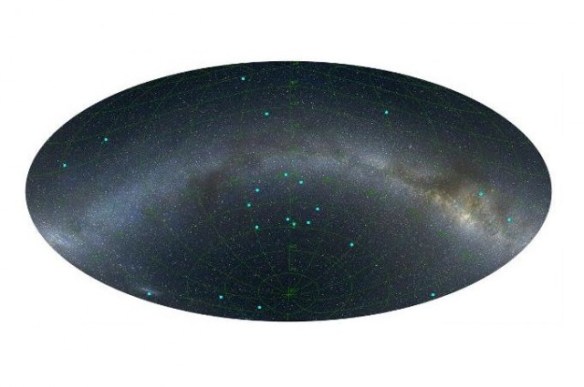
Astronomers think they have found a ring of nine gamma ray bursts (GRBs) inside galaxies that, together, measure 5 billion light-years across. For a comparison, that’s about 50,000 times bigger than the Milky Way, or more than one-ninth the size of the observable universe. The research was published in the journal Monthly Notices of the Royal Astronomical Society.

A GRB is an intense flash of gamma rays caused by a supernova, the dramatic death of a fiery star, and thus their detection indicates the presence of a galaxy – suggesting all nine of the GRBs are in separate galaxies. They are the brightest electromagnetic events in the universe, releasing more energy in a few seconds than the Sun in its entire 10 billion-year lifetime, and thus they can be used to detect distant galaxies.

While it is not one physical whole structure, the Hungarian-American team who made the discovery think the nine galaxies are gravitationally bound to each other – just as our Local Group contains the Milky Way and a few dozen other galaxies.

In this case, all the GRBs studied by a variety of observatories are about 7 billion light-years away from Earth, suggesting that we are seeing the structure “face on.” Alternatively, we may be seeing a projection of a “sphere.”

But there’s one problem. The structure, if confirmed, would break our current models of how large things can be; a previous theoretical limit stood at 1.2 billion light-years. On large scales, the cosmos should be uniform and not have structures like this….’

What if your hometown were hit by the Hiroshima atomic bomb?

Via Public Radio International: ‘While the graying Hiroshima Generations who survived the atomic bomb attack seven decades ago are struggling to pass their memories to the younger generations, much of the world has allowed that fateful morning on Aug 6, 1945 to slip from their minds.

About 66,000 people, mostly civilians, perished, according to a report prepared by the US Army one year after the attack. Another 69,000 were injured and tens of thousands more were affected by radiation disease.

But how to show the damage more clearly? We’ve developed an application that allows you to visualize the damage of the same atomic bomb on another location in today’s world, such as your hometown. You may be surprised at the extent of the damage….’

Ebola Vaccine Proves 100% Effective in Its First Trial

Via Big Think: ‘A vaccine that did not exist a year ago has proven 100 percent effective at preventing people who are at extremely high risk of infection from contracting the Ebola virus.

The recent trial took place in Guinea, a West African nation that, along with Liberia and Sierra Leone, was hit hard by an Ebola epidemic that has killed more than 11,000 people since December 2013…

The vaccine, called rVSV-ZEBOV, is composed of “an attenuated livestock virus engineered to produce an Ebola protein…

Still, the rVSV-ZEBOV vaccine is considered a first-generation tool, especially since it must be stored at –80° C and it protects against a limited number of species of the Ebola virus. Researchers are already hard at work developing second-generation iterations….’ 

Hitchhiking Robot Lasts Just Two Weeks in US Because Humans Are Terrible

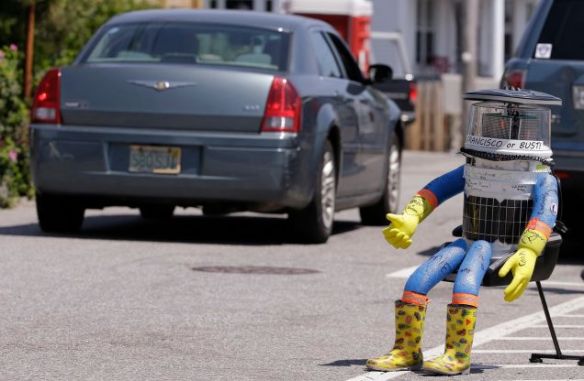
Via Gizmodo: ‘When hitchBOT the hitchhiking robot started his journey in Boston two weeks ago he wanted to see the entire country. Unfortunately, he never made it out of the Northeast. The researchers who built hitchBOT announced today that they need to stop the experiment because hitchBOT was vandalized in Philadelphia.

From the researchers who built hitchBOT:

hitchBOT’s trip came to an end last night in Philadelphia after having spent a little over two weeks hitchhiking and visiting sites in Boston, Salem, Gloucester, Marblehead, and New York City. Unfortunately, hitchBOT was vandalized overnight in Philadelphia; sometimes bad things happen to good robots. We know that many of hitchBOT’s fans will be disappointed, but we want them to be assured that this great experiment is not over. For now we will focus on the question “what can be learned from this?” and explore future adventures for robots and humans.

The goal of the hitchhiking trip was to see how humans would interact with hitchBOT. And apparently the answer was “not well.” HitchBOT has been around the world, including trips across the entirety of Canada and Germany without major incident. But America is clearly a hard land for our robot brothers and sisters….’

How To Survive The Cascadia Tsunami

Via io9: ‘Schulz, the author of the New Yorker piece, feels safe enough to continue spending her summers in the Northwest, the area that will be affected by the earthquake. In her follow up bit about survival advice, she strongly suggests that readers avoid spending even one night in the tsunami inundation zone.

“Of the almost thirteen thousand people expected to die in the Cascadia event, one thousand will perish in the earthquake,” Schulz writes. “The others will be killed by the tsunami—and they amount to nearly one in five people who are in the zone when the water arrives. That’s a grim enough figure that it changed my own beach-going behavior in the Northwest. Go to the coast by day, for sure. But if you’re staying overnight, book a vacation rental, hotel room, or campsite outside the inundation zone.”…’

Delusions of a madman

Via Salon.com:

‘Future president Lindsey Graham declares victory in the war with Iran he’s probably (definitely) going to start…’

R.I.P. George Coe

Actor and Director of a Bergman Parody, Dies at 86 (New York Times obituary): ‘George Coe, a film, stage and television actor who earned an Oscar nomination for his single picture as a director — the 1968 short feature De Düva: The Dove, a mock-Swedish-inflected sendup of Ingmar Bergman that has endured as a cult favorite — died on July 18 in Santa Monica, Calif. He was 86.’

I recall seeing De Düva at the late lamented Orson Welles Cinema in Cambridge in the early ’70’s. After twenty minutes or so, a member of the audience suddenly stood up in the front row, threw his arms heavenward, and shouted out to the audience, “My God! I’m so stoned I can understand Swedish!”

A De Düva lexicon, via The New York Times:

‘Mooska: Cow

Zooner-or-lätsker: Eventually

Skå she vinska, you godda set her freesk: If she wins, you must set her free.

Me yoost haf dis schmatte waschen: I just had this clothing washed.

H20ska: Water

Phalliken zymbol: Cigar…’

ISIS Transforming Into Functioning State That Uses Terror as Tool

ViaThe New York Times: ‘While no one is predicting that the Islamic State will become the steward of an accountable, functioning state anytime soon, the group is putting in place the kinds of measures associated with governing: issuing identification cards for residents, promulgating fishing guidelines to preserve stocks, requiring that cars carry tool kits for emergencies. That transition may demand that the West rethink its military-first approach to combating the group.

“I think that there is no question that the way to look at it is as a revolutionary state-building organization,” said Stephen M. Walt, a professor of international affairs at the John F. Kennedy School of Government at Harvard. He is one of a small but growing group of experts who are challenging the conventional wisdom about the Islamic State: that its evil ensures its eventual destruction….’

Why Does Asking Siri to Charge Your Phone Call the Cops?

Via Gizmodo: ‘Utter the words—and we don’t suggest you do—“charge my phone 100 percent” to Siri, and your iPhone will try and call the emergency services, after a five-second grace period in which you can cancel it. But why?

It might be a bug. Or, as The Verge suggests, it could be a feature that allows you to secretly call the police if you’re in trouble. It seems unlikely, but stranger things have happened (like a woman getting in touch with Pizza Hut to save her from a knife attack). So far Apple is yet to confirm why it’s a thing. Any ideas?…’