…as if we didn’t know: “Howard Kurtz on Olbermann’s career highlights and his clashes with network brass.” (via The Daily Beast).


…as if we didn’t know: “Howard Kurtz on Olbermann’s career highlights and his clashes with network brass.” (via The Daily Beast).
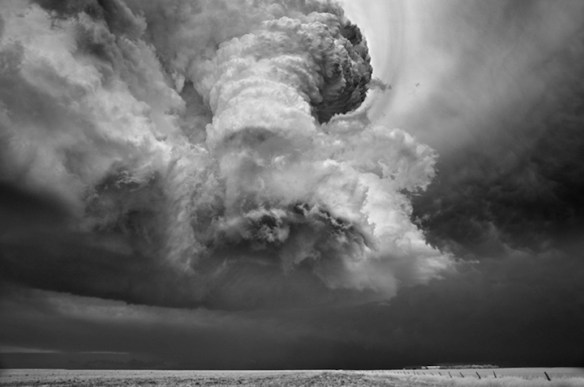
“Los Angeles-based photographer Mitch Dobrowner takes incredibly striking black-and-white photos of landscapes in the likeness of his inspiration, Ansel Adams. His most breathtaking series is about ominous storms that form over Wyoming, Kansas, North Dakota and Oklahoma..”.(Via My Modern Metropolis)
.
Douglas Copeland with 45 tips for survival “and a matching glossary of the new words you’ll need to talk about your messed-up future.” You won’t like some of this but you had best listen. (via The Globe and Mail).

Frank Rich: “Of the many truths in President Obama’s powerful Tucson speech, none was more indisputable than his statement that no one can know what is in a killer’s mind. So why have we spent so much time debating exactly that?
The answer is classic American denial. It was easier to endlessly parse Jared Lee Loughner’s lunatic library — did he favor “The Communist Manifesto” or Ayn Rand? — than confront the larger and harsher snapshot of our current landscape that emerged after his massacre. A week on, that denial is becoming even more entrenched. As soon as the president left the podium Wednesday night, we started shifting into our familiar spin-dry post-tragedy cycle of the modern era — speedy “closure,” followed by a return to business as usual, followed by national amnesia.
If we learn nothing from this tragedy, we are back where we started. And where we started was with two years of accelerating political violence — actual violence, not to be confused with violent language — that struck fear into many, not the least of whom was Gabrielle Giffords.
For the sake of this discussion, let’s stipulate that Loughner was a “lone nutjob” who had never listened to Glenn Beck or been a card-carrying member of either the Tea or Communist parties. Let’s also face another tragedy: The only two civic reforms that might have actually stopped him — tighter gun control and an effective mental health safety net — won’t materialize even now.
Gun and ammunition sales spiked last week, especially for the specific varieties given the Loughner imprimatur. No editorial — or bloodbath — will move Congress to enact serious gun control (which Giffords herself never advocated and Obama has rarely pushed since 2008). Enhanced mental health coverage is also a nonstarter when the highest G.O.P. priority is to repeal the federal expansion of health care. In Arizona, cutbacks are already so severe that terminally ill patients are being denied life-saving organ transplants.” (via NYTimes).

“In The Science of Kissing, Sheril Kirshenbaum approaches the kiss through biology, history, culture, psychology, even zoology – but some secrets remain.” (via New Scientist).
Scientists think the antimatter particles were formed inside thunderstorms in a terrestrial gamma-ray flash (TGF) associated with lightning. It is estimated that about 500 TGFs occur daily worldwide, but most go undetected.”

(via NASA Science).

“Hanny’s Voorwerp—a glowing, green blob in space—is unexpectedly giving birth to stars, a new Hubble Space Telescope picture has revealed.
The odd object was discovered in 2007 by a Dutch schoolteacher participating in Galaxy Zoo—”voorwerp” is Dutch for “object.” The online project had public citizens worldwide helping to classify galaxies in the Sloan Digital Sky Survey catalog.
(See related pictures of the “green pea” class of galaxies discovered via Galaxy Zoo.)
Although it’s the size of our Milky Way galaxy, Hanny’s Voorwerp is not itself a galaxy, but a cloud of gas near the spiral galaxy IC 2497, which lies about 650 million light-years from Earth.
The new Hubble picture—the sharpest yet taken of the brilliant cloud—shows that gas in a small region of Hanny’s Voorwerp is collapsing and forming stars, the youngest of which are just a couple million years old.” (via National Geographic).
“Today, Congresswoman Gabrielle Giffords (D-AZ) and 19 others were shot in Tucson, Arizona. Six of the shooting victims were killed. Police say Giffords was the target of the attack. Local law enforcement have identified the shooting suspect as Jared Lee Loughner, 22. A police manhunt is under way for a second “person of interest.
As blogged here earlier, Loughner posted material to a number of social media sites— he also had an active YouTube channel under the user name “Classitup10.” The bio for that channel is written in the past tense. It appears he maintained a previous channel under the user name “Starhitshnaz.” The sole video in that channel is embedded above, and shows a burning flag in front of a desert scene, with Drowning Pool’s song “Bodies” (“Let the bodies hit the floor”) as soundtrack.
In this post, we archive all of the currently known YouTube videos believed to have been created and published by Jared Lee Loughner, with text transcripts and screengrabs.
Themes and terms present throughout include: terrorism and a fixation on Loughner himself being characterized as a terrorist; creating “a new currency” to be introduced by “lethal or non-lethal means”; English literacy, “mind control and brainwash,” “political weapons,” “conscience dreaming,” and scattered references to the Constitution and the American government controlling people through brainwashing and mind control.” (Boing Boing).
This is a prepublication .pdf of a paper by Cornell psychologist Daryl Bem detailing experimental evidence for precognition, accepted for publication by a respected peer-reviewed psychological journal. (link).

“This – I think, I fear, I suspect – is going to suck, unless the Obama administration gets out of their permanent crouch and finally starts fighting back against a newly-empowered GOP, and the lies that will be pouring fourth like polluted water from an open spigot. The simple fact that Mr. Obama tapped William Daley, a JPMorgan Chase executive whose purview was “corporate responsibility,” to be the new White House Chief of Staff does not bode well at all. Try not to laugh too hard at seeing the words “JPMorgan Chase” and “corporate responsibility” in the same sentence.Yeah. I’m pretty sure this is going to suck.” — William Rivers Pitt (Truthout).

‘Mark Twain’s Adventures of Huckleberry Finn is a classic by most any measure—T.S. Eliot called it a masterpiece, and Ernest Hemingway pronounced it the source of “all modern American literature.” Yet, for decades, it has been disappearing from grade school curricula across the country, relegated to optional reading lists, or banned outright, appearing again and again on lists of the nation’s most challenged books, and all for its repeated use of a single, singularly offensive word: “nigger.”
Twain himself defined a “classic” as “a book which people praise and don’t read.” Rather than see Twain’s most important work succumb to that fate, Twain scholar Alan Gribben and NewSouth Books plan to release a version of Huckleberry Finn, in a single volume with The Adventures of Tom Sawyer, that does away with the “n” word (as well as the “in” word, “Injun”) by replacing it with the word “slave.” ‘ (Publisher’s Weekly).
“Skywatchers throughout much of Europe, North Africa, and Central Asia, were treated to the first eclipse of the new year on January 4, a partial eclipse of the Sun. But traveling to the area around Muscat, capital city of Oman, photographer Thierry Legault planned to simultaneously record two eclipses on that date, calculating from that position, for a brief moment, both the Moon and the International Space Station could be seen in silhouette, crossing the Sun. His

sharp, 1/5000th second exposure is shown here, capturing planet Earth’s two largest satellites against the bright solar disk. As the partial solar eclipse unfolded, the space station (above and left of center) zipped across the scene in less than 1 second, about 500 kilometers from the photographer’s telescope and camera.” (Astronomy Picture of the Day via abby).

The thinking is that they were startled by fireworks and died of blunt trauma after flying into obstacles. (NYTimes.com)
2000 vs. 2010 at a glance (io9).
This is the annual update of my New Year’s post, a tradition I started early on on FmH:
 I once ran across a January 1st Boston Globe article compiling folkloric beliefs about what to do, what to eat, etc. on New Year’s Day to bring good fortune for the year to come. I’ve regretted since — I usually think of it around once a year (grin) — not clipping out and saving the article. Especially since we’ve had children, I’m interested in enduring traditions that go beyond getting drunk [although some comment that this is a profound enactment of the interdigitation of chaos and order appropriate to the New Year’s celebration — FmH], watching the bowl games and making resolutions.
A web search brought me this, less elaborate than what I recall from the Globe but to the same point. It is weighted toward eating traditions, which is odd because, unlike most other major holidays, the celebration of New Year’s in 21st century America does not seem to be centered at all around thinking about what we eat (except in the sense of the traditional weight-loss resolutions!) and certainly not around a festive meal. But…
Traditionally, it was thought that one could affect the luck they would have throughout the coming year by what they did or ate on the first day of the year. For that reason, it has become common for folks to celebrate the first few minutes of a brand new year in the company of family and friends. Parties often last into the middle of the night after the ringing in of a new year. It was once believed that the first visitor on New Year’s Day would bring either good luck or bad luck the rest of the year. It was particularly lucky if that visitor happened to be a tall dark-haired man.
“Traditional New Year foods are also thought to bring luck. Many cultures believe that anything in the shape of a ring is good luck, because it symbolizes “coming full circle,” completing a year’s cycle. For that reason, the Dutch believe that eating donuts on New Year’s Day will bring good fortune.
 “Many parts of the U.S. celebrate the new year by consuming black-eyed peas. These legumes are typically accompanied by either hog jowls or ham. Black-eyed peas and other legumes have been considered good luck in many cultures. The hog, and thus its meat, is considered lucky because it symbolizes prosperity. Cabbage is another ‘good luck’ vegetable that is consumed on New Year’s Day by many. Cabbage leaves are also considered a sign of prosperity, being representative of paper currency. In some regions, rice is a lucky food that is eaten on New Year’s Day.”
The further north one travels in the British Isles, the more the year-end festivities focus on New Year’s. The Scottish observance of Hogmanay has many elements of warming heart and hearth, welcoming strangers and making a good beginning:
“Three cornered biscuits called hogmanays are eaten. Other special foods are: wine, ginger cordial, cheese, bread, shortbread, oatcake, carol or carl cake, currant loaf, and a pastry called scones. After sunset people collect juniper and water to purify the home. Divining rituals are done according to the directions of the winds, which are assigned their own colors. First Footing:The first person who comes to the door on midnight New Year’s Eve should be a dark-haired or dark-complected man with gifts for luck. Seeing a cat, dog, woman, red-head or beggar is unlucky. The person brings a gift (handsel) of coal or whiskey to ensure prosperity in the New Year. Mummer’s Plays are also performed. The actors called the White Boys of Yule are all dressed in white, except for one dressed as the devil in black. It is bad luck to engage in marriage proposals, break glass, spin flax, sweep or carry out rubbish on New Year’s Eve.”
Here’s why we clink our glasses when we drink our New Year’s toasts, no matter where we are. Of course, sometimes the midnight cacophony is louder than just clinking glassware, to create a ‘devil-chasing din’.
 In Georgia, eat black eyed peas and turnip greens on New Year’s Day for luck and prosperity in the year to come, supposedly because they symbolize coppers and currency. Hoppin’ John, a concoction of peas, onion, bacon and rice, is also a southern New Year’s tradition, as is wearing yellow to find true love (in Peru, yellow underwear, apparently!) or carrying silver for prosperity. In some instances, a dollar bill is thrown in with the other ingredients of the New Year’s meal to bring prosperity. In Greece, there is a traditional New Year’s Day sweetbread with a silver coin baked into it. All guests get a slice of the bread and whoever receives the slice with the coin is destined for good fortune for the year. At Italian tables, lentils, oranges and olives are served. The lentils, looking like coins, will bring prosperity; the oranges are for love; and the olives, symbolic of the wealth of the land, represent good fortune for the year to come.
A New Year’s meal in Norway also includes dried cod, “lutefisk.” The Pennsylvania Dutch make sure to include sauerkraut in their holiday meal, also for prosperity.
In Spain, you would cram twelve grapes in your mouth at midnight, one each time the clock chimed, for good luck for the twelve months to come. (If any of the grapes happens to be sour, the corresponding month will not be one of your most fortunate in the coming year.) The U. S. version of this custom, for some reason, involves standing on a chair as you pop the grapes. In Denmark, jumping off a chair at the stroke of midnight signifies leaping into the New Year. In Rio, you would be plunging into the sea en masse at midnight, wearing white and bearing offerings. In many northern hemisphere cities near bodies of water, they will have a tradition of people plunging into the cold water on New Year’s Day. The Coney Island Polar Bears Club in New York is the oldest cold-water swimming club in the United States. They have had groups of people enter the chilly surf since 1903.
Ecuadorian families make scarecrows stuffed with newspaper and firecrackers and place them outside their homes. The dummies represent misfortunes of the prior year, which are then burned in effigy at the stroke of midnight to forget the old year. Bolivian families make beautiful little wood or straw dolls to hang outside their homes on New Year’s Eve to bring good luck.
 In China, homes are cleaned spotless to appease the Kitchen God, and papercuttings of red paper are hung in the windows to scare away evil spirits who might enter the house and bring misfortune. Large papier mache dragon heads with long fabric bodies are maneuvered through the streets during the Dragon Dance festival, and families open their front doors to let the dragon bring good luck into their homes.
 The Indian Diwali festival, welcoming in the autumnal season, also involves attracting good fortune with lights. Children make small clay lamps, dipas, thousands of which might adorn a given home. In Thailand, one pours fragrant water over the hands of elders on New Year’s Day to show them respect.
 In Germany and Austria, lead pouring” (das Bleigießen) is an old divining practice using molten lead like tea leaves. A small amount of lead is melted in a tablespoon (by holding a flame under the spoon) and then poured into a bowl or bucket of water. The resulting pattern is interpreted to predict the coming year. For instance, if the lead forms a ball (der Ball), that means luck will roll your way. The shape of an anchor (der Anker) means help in need. But a cross (das Kreuz) signifies death.
Some history; documentation of observance of the new year dates back at least 4000 years to the Babylonians, who also made the first new year’s resolutions (reportedly voews to return borrowed farm equipment were very popular), although their holiday was observed at the vernal equinox. The Babylonian festivities lasted eleven days, each day with its own particular mode of celebration.  The traditional Persian Norouz festival of spring continues to be considered the advent of the new year among Persians, Kurds and other peoples throughout Central Asia, and dates back at least 3000 years, deeply rooted in Zooastrian traditions.Modern Bahá’í’s celebrate Norouz (”Naw Ruz”) as the end of a Nineteen Day Fast. Rosh Hashanah (”head of the year”), the Jewish New Year, the first day of the lunar month of Tishri, falls between September and early October. Muslim New Year is the first day of Muharram, and Chinese New Year falls between Jan. 10th and Feb. 19th of the Gregorian calendar.
 The classical Roman New Year’s celebration was also in the spring although the calendar went out of synchrony with the sun. January 1st became the first day of the year by proclamation of the Roman Senate in 153 BC, reinforced even more strongly when Julius Caesar established what came to be known as the Julian calendar in 46 BC. The early Christian Church condemned new year’s festivities as pagan but created parallel festivities concurrently. New Year’s Day is still observed as the Feast of Christ’s Circumcision in some denominations. Church opposition to a new year’s observance reasserted itself during the Middle Ages, and Western nations have only celebrated January 1 as a holidy for about the last 400 years. The custom of New Year’s gift exchange among Druidic pagans in 7th century Flanders was deplored by Saint Eligius, who warned them, “[Do not] make vetulas, [little figures of the Old Woman], little deer or iotticos or set tables [for the house-elf] at night or exchange New Year gifts or supply superfluous drinks [another Yule custom].” (Wikipedia)
 The tradition of the New Year’s Baby signifying the new year began with the Greek tradition of parading a baby in a basket during the Dionysian rites celebrating the annual rebirth of that god as a symbol of fertility. The baby was also a symbol of rebirth among early Egyptians. Again, the Church was forced to modify its denunciation of the practice as pagan because of the popularity of the rebirth symbolism, finally allowing its members to cellebrate the new year with a baby although assimilating it to a celebration of the birth of the baby Jesus. The addition of Father Time (the “Old Year”) wearing a sash across his chest with the previous year on it, and the banner carried or worn by the New Year’s Baby, immigrated from Germany. Interestingly, January 1st is not a legal holiday in Israel, officially because of its historic origins as a Christian feast day.
 Auld Lang Syne (literally ‘old long ago’ in the Scottish dialect) is sung or played at the stroke of midnight throughout the English-speaking world (and then there is George Harrison’s “Ring Out the Old”). Versions of the song have been part of the New Year’s festivities since the 17th century but Robert Burns was inspired to compose a modern rendition, which was published after his death in 1796. (It took Guy Lombardo, however, to make it popular…)
Should auld acquaintance be forgot
and never brought to mind?
Should auld acquaintance be forgot
and days of auld lang syne?
For auld lang syne, my dear,
for auld lang syne,
we’ll take a cup of kindness yet,
for auld lang syne.Should auld acquaintance be forgot
and never brought to mind?
Should auld acquaintance be forgot
and days of auld lang syne?
And here’s a hand, my trusty friend
And gie’s a hand o’ thine
We’ll tak’ a cup o’ kindness yet
For auld lang syne
![//www.sfgate.com/chronicle/pictures/2005/02/09/ga_lunar01.jpg' cannot be displayed]](http://www.sfgate.com/chronicle/pictures/2005/02/09/ga_lunar01.jpg "Wake Up!")
Here’s how to wish someone a Happy New Year around the world:
- Arabic: Kul ‘aam u antum salimoun
- Brazilian: Boas Festas e Feliz Ano Novo means “Good Parties and Happy New Year”
- Chinese:
Chu Shen TanXin Nian Kuai Le (thanks, Jeff)- Czechoslavakia: Scastny Novy Rok
- Dutch: Gullukkig Niuw Jaar
- Finnish: Onnellista Uutta Vuotta
- French: Bonne Annee
- German: Prosit Neujahr
- Greek: Eftecheezmaenos o Kaenooryos hronos
- Hebrew: L’Shannah Tovah Tikatevu
- Hindi: Niya Saa Moobaarak
- Irish (Gaelic): Bliain nua fe mhaise dhuit
- Italian: Buon Capodanno
- Khmer: Sua Sdei tfnam tmei
- Laotian: Sabai dee pee mai
- Polish: Szczesliwego Nowego Roku
- Portuguese: Feliz Ano Novo
- Russian: S Novim Godom
- Serbo-Croatian: Scecna nova godina
- Spanish: Feliz Ano Nuevo
- Swedish: Ha ett gott nytt år
- Turkish: Yeni Yiliniz Kutlu Olsun
- Vietnamese: Cung-Chuc Tan-Xuan
- [If you are a native speaker, please feel free to offer any corrections or additions!]

However you’re going to celebrate, my warmest wishes for the year to come… and eat hearty! [thanks to Bruce Umbaugh for research assistance]
 Julius and Ethel Rosenbergs’ son: “The Espionage Act is a huge danger to our open society; it’s been used to send hundreds of dissenters to jail just for voicing their opinions, transforming dissent into treason.”(via AlterNet).

“Tuesday’s FCC ruling on net neutrality shifts billions in profits and boils down to one fact: There will soon be a fast Internet for the rich and a slow Internet for the poor.” (via Daily Beast).
“Captain Beefheart’s music career stretched from 1966 to 1982, and from straight rhythm and blues by way of the early Rolling Stones to music that sounded like a strange uncle of post-punk. He is probably best known for “Trout Mask Replica,” a double album from 1969 with his Magic Band.
A bolt-from-the-blue collection of precise, careening, surrealist songs with clashing meters, brightly imagistic poetry and raw blues shouting, “Trout Mask Replica” had particular resonance with the punk and new wave generation to come a decade later, influencing bands like Devo, the Residents, Pere Ubu and the Fall.
Mr. Van Vliet’s life story is caked with half-believable tales, some of which he himself spread in Dadaist, elliptical interviews. He claimed he had never read a book and had never been to school, and answered questions with riddles. “We see the moon, don’t we?” he asked in a 1969 interview. “So it’s our eye. Animals see us, don’t they? So we’re their animals.” (via NYTimes.com obit).

“The lunar eclipse of Dec. 21st falls on the same date as the northern winter solstice. Is this rare? It is indeed, according to Geoff Chester of the US Naval Observatory, who inspected a list of eclipses going back 2000 years. “Since Year 1, I can only find one previous instance of an eclipse matching the same calendar date as the solstice, and that is Dec. 21, 1638,” says Chester. “Fortunately we won’t have to wait 372 years for the next one…that will be on Dec. 21, 2094.”
The total eclipse lasts more than an hour from 02:41 am to 03:53 am EST on Tuesday morning, Dec. 21st. Any time within that interval is a good time to look. For other time zones, consult Shadow & Substance’s animated eclipse.” (via SpaceWeather.com)


‘Flash opera’ at Macy’s Phila., 11/01/2010: “A flash mob hit Macy’s in Center City on Saturday – 650 vocalists who, unknown to shoppers, had arranged to burst into song at noon.” (Philly.com)

“It is the silly season so it was only right to announce that supercomputing giant IBM are so confident in the processing abilities of their new Watson machine that they are pitting it against two human contestants on popular TV show
Jeopardy in a three night special that starts on February 14th according to the BBC.
The prize fund on the night will be $1m, though it’s unclear at this time what the computer would spend it on if it won.” (Ghacks Technology News)

It seems oxygen is far more abundant than we ever suspected, particularly on moons that seem to be completely frozen solid. We recently found evidence of oxygen on Jupiter’s moons Europa and Ganymede, and now this finding on Rhea. In fact, because the region of space surrounding Saturn’s rings has an oxygen atmosphere, it’s thought even more of the icy moons within the gas giant’s magnetosphere likely have little atmospheres of their own.” (io9)

When Your Company Kills Your iPhone : Beware. If you have your smartphone configured to receive mail from your company’s Microsoft Exchange Server, you have given the company’s IT dept. the capability to remotely control a number of your phone’s functions, including doing a remote wipe of all your content. (NPR)

As Elizabeth Currid-Halkett explains in her fascinating, well-researched new book, Starstruck: The Business of Celebrity, recent developments in the celebrity industry can tell us a great deal about our changing global culture. In an era in which more and more people are feeling alienated from their peers, stars give us a common language and allow a greater degree of social cohesion. They also fuel enormous industries — celebrity-driven occupations generate $1.5 billion in salary in Los Angeles alone. Elsewhere in the book, Currid-Halkett, the author of The Warhol Economy and an assistant professor at the University of Southern California, uses party photographs and Google to draw fascinating conclusions about the geography and social stratification of the celebrity world (Note to Angelina Jolie: Getting photographed in Las Vegas might actually hurt your fame).
Salon spoke to Currid-Halkett over the phone from Los Angeles, about our changing star culture, our obsession with celebrity minutiae, and why Paris Hilton actually deserves our respect.’ (Salon.com).


She has built a television studio in her house in Wasilla so that she can loop into Fox News broadcasts — she earns $1 million a year as a commentator — at will. She is the first former office-holder and vice-presidential candidate to star in her own reality show, Sarah Palin’s Alaska, for which she is earning $2 million and which debuted last week on TLC to record-breaking numbers. Five million people watched, making it the highest-rated premiere in the channel’s history.
These are branding opportunities that, even a few years ago, would’ve been considered too down-market and damaging for a potential presidential candidate. They are working.’ (NYPOST.com)

How many of these have you visited? I have been in three of the ten, bookshop aficionado as I am.


The Not-So Private Parts: “One of the interesting claims in the current brief that was not included in EPIC’s original request for a stay is the allegation of a violation of the Video Voyeurism Prevention Act. That would be the law passed by Congress in 2004 that is used, in part, to fight upskirt filming. The Act [PDF] prohibits the filming of private parts — it makes an exception for cleavage — when individuals have a reasonable expectation of privacy, even if they are in a public place.
The law specifies that it applies in “circumstances in which a reasonable person would believe that a private area of the individual would not be visible to the public, regardless of whether that person is in a public or private place.” So if people know that their private areas are visible, does the law apply? If there are representational avatars instead of real naked people — a software fix devised by scanner makers L-3 Communications Holdings Inc. and OSI Systems Inc. — does it apply?
These questions and the constitutional privacy issues raised by the scanners will be hashed out soon enough. The government will be filing its reply brief by December 1, and then the case should move on to oral arguments. If the court were to rule in EPIC’s favor, the TSA will have to “revise its airport screening program so that it complies with federal law,” says EPIC president Marc Rotenberg.” (via Kashmir Hill – Forbes)
…without the hysteria: “Here’s a scenario:
Middle Eastern terrorists hijack a U.S. jetliner bound for Italy. A two-week drama ensues in which the plane’s occupants are split into groups and held hostage in secret locations in Lebanon and Syria.
While this drama is unfolding, another group of terrorists detonates a bomb in the luggage hold of a 747 over the North Atlantic, killing more than 300 people.
Not long afterward, terrorists kill 19 people and wound more than a hundred others in coordinated attacks at European airport ticket counters.
A few months later, a U.S. airliner is bombed over Greece, killing four passengers.
Five months after that, another U.S. airliner is stormed by heavily armed terrorists at the airport in Karachi, Pakistan, killing at least 20 people and wounding 150 more.
Things are quiet for a while, until two years later when a 747 bound for New York is blown up over Europe killing 270 passengers and crew.
Nine months from then, a French airliner en route to Paris is bombed over Africa, killing 170 people from 17 countries.
That’s a pretty macabre fantasy, no? A worst-case war-game scenario for the CIA? A script for the End Times? Except, of course, that everything above actually happened, in a four-year span between 1985 and 1989. The culprits were the al-Qaidas of their time: groups like the Abu Nidal Organization and the Arab Revolutionary Cells, and even the government of Libya…
I bring all of this up for a couple of reasons.
If nothing else, it demonstrates how quickly we forget the past. Our memories are short, and growing shorter, it seems, all the time. Our collective consciousness seems to reinvent itself daily, cobbled from a media blitz of short-order blurbs and 30-second segments. There will be a heavy price to pay, potentially, for having developed such a shallow and fragile mind-set.
With respect to airport security, it is remarkable how we have come to place Sept. 11, 2001, as the fulcrum upon which we balance almost all of our decisions. As if deadly terrorism didn’t exist prior to that day, when really we’ve been dealing with the same old threats for decades. What have we learned? What have we done?” (via Ask the Pilot – Salon)
According to court documents, 67-year-old Steven Cowan became enraged while watching Palin dance on Monday evening. He felt Palin was not a good dancer…” (via Wausau Daily Herald)

“The Leonid meteor shower rolls through the sky once a year, peaking in mid-November. It’s caused by a trail of debris that travels along the orbit of the comet Tempel-Tuttle.The 2010 Leonid meteor shower runs from Wednesday, Nov. 10, through Sunday, Nov. 21. The peak will be the nights between the 17th and the 19th.The Leonids are famous for being spectacular storms — since the orbit of the Temple-Tuttle comet intersects with that of Earth, the debris cloud our planet passes through each year is dense and full of particles and meteoroids. In optimal viewing conditions on a good year, you can see between 15 and 30 meteors per hour streaking across the sky during the peak.” (via Wired How-To Wiki)
‘Follow Me Here’ celebrates 11 years of weblogging today.Yes, eleven years. I once was totally cutting edge, I fancied! In any case, many thanks to my loyal readers, new and old.
Why don’t you leave a comment telling me what you found to be the most memorable FmH post of the past year? or the most unmemorable (grin)?
It is also the 11th blogiversary of Kevin Murphy’s Ghost in the Machine, the ‘blog twin’ of FmH. All the best, Kevin! And many happy returns.

Steve Silberman
My story is about the surprising power of the placebo effect — what happens in the brain and body when you think you’re taking medicine or receiving treatment — and the problems in the pharmaceutical industry caused by the increasing number of experimental drugs that are failing in clinical trials to outperform dummy pills used as controls.
It’s always gratifying to see a story you’ve worked hard on be embraced by readers, linked to by other journalists, and recognized by a venerable institution like the AAAS. Even Stephen Colbert ended up riffing on the seemingly absurd notion that sugar pills could perform better in a trial than an expensive experimental drug…”
Although my praise is not as important as that of the AAAS, I too found the piece lucid and important. Perhaps that is because it agrees with my own biases; I have often said that most of healing relies on the placebo effect, i.e. mobilizing the body and mind’s own powers.

Happy Guy Fawkes Night: “Guy Fawkes Night originates from the Gunpowder Plot of 1605, a failed conspiracy by a group of provincial English Catholics to assassinate the Anglican King James I of England and VI of Scotland and replace him with a Catholic head of state. The survival of the king was first celebrated on 5 November 1605, after Guy Fawkes, left in charge of the gunpowder placed underneath the House of Lords, was discovered and arrested.
The same month the surviving conspirators were executed, in January 1606 the Observance of 5th November Act 1605, commonly known as the “Thanksgiving Act” was passed, ensuring that for more than 250 years 5 November was kept free as a day of thanksgiving. According to historian and author Antonia Fraser, a study of the sermons preached on the first anniversary of 5 November demonstrates an anti-Catholic concentration “mystical in its fervour”. Each anniversary of the plot’s failure was for years celebrated by the ringing of church bells, special sermons, and the lighting of bonfires. Further controversies such as the marriage of Charles I to the Catholic Henrietta Maria of France and the 1679 Popish Plot helped fuel the popularity of the events, which at times became a celebration not of the deliverance of a monarch, but of anti-Papist sentiment…
Historically the date has been celebrated by the burning of effigies of contemporary hate-figures… Some modern instances of burning effigies exist; in Lewes in 1994 revellers immolated the effigies of politicians such as Margaret Thatcher and John Major, alongside Fawkes.” (via Wikipedia)

This is not the point of Thomas Friedman’s op-ed piece, but it is the interesting part:

Obama’s visit comes shortly after the emergence of shocking video footage showing Indonesian soldiers torturing two villagers in the West Papuan highlands. The Indonesian government has admitted that the torturers were its soldiers.
Controversially, in July this year, the Obama administration lifted its ban on assistance to Indonesia’s notorious elite special forces, Kopassus. Kopassus had been barred from receiving US military aid for more than a decade because of human-rights abuses including killings, disappearances and torture.
The President, who spent part of his childhood in Indonesia, will make his first official visit to the country since taking office.” (via Survival International)


Bush said he wanted to put an end to assertions by critics that Cheney was the real decision-maker and to “demonstrate that I was in charge.” ‘ (via The Associated Press)
(Yes, the puppeteer allows the puppet to think about cutting his strings.)
“…if everyone who fought for change in 2008 shows up to vote in 2010, we will win this election, I’m confident that we will.” –President Barack Obama

The neuroscientist was Daniel Levitin, a psychologist at McGill University and author of the bestsellers This is Your Brain on Music and The World in Six Songs. He was joined onstage by the Kitchener-Waterloo Symphony and its conductor, Edwin Outwater. Together they took the audience a guided tour of Beethoven’s Fifth Symphony, perhaps the best-known work in the Western musical canon. Audience members were given electronic “clickers” with which they could respond to Levitin’s questions and voice their own reactions to what was being played; the results were displayed on a giant screen in real time.” (via New Scientist CultureLab)
“With his new film, writer-director Gareth Edwards says he set out to make the most realistic monster movie ever. Not that he wanted the most biological plausible aliens or the highest possible quality of special effects. He wanted a film about a story that might happen if aliens really had invaded Earth. Has he succeeded? ” (via New Scientist CultureLab)

‘…so I’m voting, and I ain’t voting Republican’ (Youtube).


A reprise of my Hallowe’en post of past years:

It is that time of year again. What has become a time of disinhibited hijinx and mayhem, and a growing marketing bonanza for the kitsch-manufacturers and -importers, has primeval origins as the Celtic New Year’s Eve, Samhain (pronounced “sow-en”). The harvest is over, summer ends and winter begins, the Old God dies and returns to the Land of the Dead to await his rebirth at Yule, and the land is cast into darkness. The veil separating the worlds of the living and the dead becomes frayed and thin, and dispossessed dead mingle with the living, perhaps seeking a body to possess for the next year as their only chance to remain connected with the living, who hope to scare them away with ghoulish costumes and behavior, escape their menace by masquerading as one of them, or placate them with offerings of food, in hopes that they will go away before the new year comes. For those prepared, a journey to the other side could be made at this time. It is fortunate that Hallowe’en falls on a Monday this year, as there is evidence that the pagan festival was celebrated for three days.
With Christianity, perhaps because with calendar reform it was no longer the last day of the year, All Hallows’ Eve became decathected, a day for innocent masquerading and fun, taking its name Hallowe’en as a contraction and corruption of All Hallows’ Eve. All Saints’ Day may have originated in its modern form with the 8th century Pope Gregory III. Hallowe’en customs reputedly came to the New World with the Irish immigrants of the 1840’s. The prominence of trick-or-treating has a slightly different origin, however.
The custom of trick-or-treating is thought to have originated not with the Irish Celts, but with a ninth-century European custom called souling. On November 2, All Souls Day, early Christians would walk from village to village begging for “soul cakes,” made out of square pieces of bread with currants. The more soul cakes the beggars would receive, the more prayers they would promise to say on behalf of the dead relatives of the donors. At the time, it was believed that the dead remained in limbo for a time after death, and that prayer, even by strangers, could expedite a soul’s passage to heaven.

Jack-o’-lanterns were reportedly originally turnips; the Irish began using pumpkins after they immigrated to North AMerica, given how plentiful they were here.
The Jack-o-lantern custom probably comes from Irish folklore. As the tale is told, a man named Jack, who was notorious as a drunkard and trickster, tricked Satan into climbing a tree. Jack then carved an image of a cross in the tree’s trunk, trapping the devil up the tree. Jack made a deal with the devil that, if he would never tempt him again, he would promise to let him down the tree.
According to the folk tale, after Jack died, he was denied entrance to Heaven because of his evil ways, but he was also denied access to Hell because he had tricked the devil. Instead, the devil gave him a single ember to light his way through the frigid darkness. The ember was placed inside a hollowed-out turnip to keep it glowing longer.
Folk traditions that were in the past associated wtih All Hallows’ Eve took much of their power, as with the New Year’s customs about which I write here every Dec. 31st, from the magic of boundary states, transition and liminality.
The idea behind ducking, dooking or bobbing for apples seems to have been that snatching a bite from the apple enables the person to grasp good fortune. Samhain is a time for getting rid of weakness, as pagans once slaughtered weak animals which were unlikely to survive the winter. A common ritual calls for writing down weaknesses on a piece of paper or parchment, and tossing it into the fire. There used to be a custom of placing a stone in the hot ashes of the bonfire. If in the morning a person found that the stone had been removed or had cracked, it was a sign of bad fortune. Nuts have been used for divination: whether they burned quietly or exploded indicated good or bad luck. Peeling an apple and throwing the peel over one’s shoulder was supposed to reveal the initial of one’s future spouse. One way of looking for omens of death was for peope to visit churchyards

The Witches’ Sabbath aspect of Hallowe’en seems to result from Germanic influence, and fusion with the notion of Walpurgisnacht. (Familiar with the magnificent musical evocation of this, Mussorgsky’s Night on Bare Mountain?) Although probably not yet in a position to shape mainstream American Hallowe’en traditions, Mexican Dia de los Muertos observances have started to contribute some delightful and whimsical iconography to our encounter with the eerie and unearthly as well.
What was Hallowe’en like forty or fifty years ago in the U.S. when, bastardized as it has become with respect to its pagan origins, it retained a much more traditional flair? For my purposes, suffice it to say that it was before the era of the pay-per-view ’spooky-world’ type haunted attractions and its Martha Stewart yuppification with, as this irreverent Salon article from several years ago [via walker] puts it, monogrammed jack-o’-lanterns and the like. Related, a 1984 essay by Richard Seltzer, frequently referenced in other sources, entitled “Why Bother to Save Hallowe’en?”, argues as I do that reverence for Hallowe’en is good for the soul.
…(D)on’t just abandon a tradition that you yourself loved as a child, that your own children look forward to months in advance, and that helps preserve our sense of fellowship and community with our neighbors in the midst of all this madness.”
 That would be anathema to certain segments of society, however. Hallowe’en certainly inspires a backlash by fundamentalists who consider it a blasphemous abomination. ‘Amateur scholar’ Isaac Bonewits details academically the Hallowe’en errors and lies he feels contribute to its being reviled. Some of the panic over Hallowe’en is akin to the hysteria, fortunately now debunked, over the supposed epidemic of ‘ritual Satanic abuse’ that swept the Western world in the ’90’s.
The horror film has become inextricably linked to Hallowe’en tradition, although the holiday itself did not figure in the movies until John Carpenter took the slasher genre singlehandedly by storm. Googling “scariest films”, you will, grimly, reap a mother lode of opinions about how to pierce the veil to journey to the netherworld and reconnect with that magical, eerie creepiness in the dark (if not the over-the-top blood and gore that has largely replaced the subtlety of earlier horror films).
In any case: trick or treat!

Tea Party Strikes Back at Rove after Palin Attack :
Levi Russell, spokesperson for the Tea Party Express: …
“The difference is that Rove is a D.C. analyst, and Sarah Palin is a leader.” Russell described Palin as “unquestionably the most electrifying figure in politics today,” while Rove “strikes me as a guy who would cross his arms and scowl at the thought of some Hollywood actor named Reagan running for Governor of California. …Personally I’ve always liked Rove, but it is painfully obvious that he is losing his connection with the American people, and no longer has his finger on the very strong pulse of the conservative movement in this country, which is fueled by the tea party and figures such as Gov. Palin.”
Karl Rove:
“There are high standards that the American people have for it [the presidency] and they require a certain level of gravitas, and they want to look at the candidate and say ‘that candidate is doing things that gives me confidence that they are up to the most demanding job in the world’…”
(via The Daily Beast)

The failure of diplomacy so far in dealing with Iran has apparently prompted a debate in the Obama administration about threatening Iran more directly with military intervention. But it is a bad idea and it will not work, says Marc Lynch (Foreign Policy).
Dawkins has argued, for example, that suicide bombers are brainwashed in religious schools. Yet none of the 9/11 hijackers or the Madrid train-bombers attended a religious school, and the one London Underground bomber who did so attended only briefly. Indeed evidence shows that in Muslim communities the deeper a person’s religious scholarship, the less likely he or she is to be involved in jihadist activities.
The suggestion by Harris and others that the world would be less violent without religion – and especially without Islam – also looks hollow when you consider the crimes against humanity committed by atheists. Prior to 2001, for instance, one of the most prolific dispensers of suicide terrorism was the secular Tamil Tigers. In trying to understand, or predict, terrorist activity, it makes scientific sense to look beyond religion, such as to the social dynamics of particular friendship networks and the recruitment strategies of jihadist organisations whose agendas are usually avowedly political.” (via CultureLab)

“Odd, small and unappealing animals on the brink of extinction are still one-of-a kind works of evolutionary art, sculpted over millions of years. Leaf through these critters that the U.S. Fish and Wildlife Service decided this year to consider for endangered status.” (via Wired Science)

Drug Co. Flattery Wins Docs, Influences Prescriptions : Part of an NPR exposé on a major way in which the pharmaceutical industry gets doctors to whore for it. It was of course obvious to me that the main purpose of funding doctors’ educational talks was to make a profit, but I was surprised (although, after listening to this series, it seems indubitable) that the major impact of enlisting a physician into a “speakers’ bureau” is to influence not the prescribing practices of his or her audiences but that of the speaker h’self.


It was just about that time that local police officers were offering something totally different that they hoped would stem a rising tide of robberies that occur mainly in the immigrant neighborhoods of this rough-and-tumble port city. The new system involved an employee-activated device that sprays a fine, barely visible mist laced with synthetic DNA to cover anyone in its path, including criminals, and simultaneously alerts the police to a crime in progress.
The mist — visible only under ultraviolet light — carries DNA markers particular to the location, enabling the police to match the burglar with the place burgled. Now, a sign on the front door of the McDonald’s prominently warns potential thieves of the spray’s presence: “You Steal, You’re Marked.”
The police acknowledge that they have yet to make an arrest based on the DNA mist, which was developed in Britain by two brothers, one a policeman and the other a chemist.” (via NYTimes.com)


“Is there really such a thing as delicious, healthy, guilt-free chocolate? Imagine my fascination… to learn of a chocolate product that promises to satisfy those of us who happen to lack self-control. Raw chocolate—the unrefined fruit of the cacao tree, without added sugar, milk or vegetable fat—is nutritionally superior to even the highest quality dark chocolate. This is because it isn’t roasted, but minimally processed at temperatures below 42 degrees Celsius (above which the nutrients of any foodstuff start to diminish). It also boasts a significantly higher antioxidant rating than almost any other food, including blueberries, and is possibly the richest dietary source of magnesium available to us. It is typically sweetened not with sugar but agave nectar, so its impact on one’s blood sugar level is gradual, unlike the intense spike and fall that comes from candy.
Raw chocolate is a true superfood—but can it ever be truly scrumptious? On unwrapping a bar of raw chocolate, the first thing that hits me is the powerful aroma, which is far more intense than a regular bar. Texturally, it is rather fudgy and mildly grainy, without the “snap” of typical chocolate. The absence of sugar, milk and vegetable fat is immediately evident, but not in a bad way. What I encounter as it gradually melts against the roof of my mouth is a slow release of pure, intense cacao. It also gives me quite a buzz, thanks to the theobromine (a natural stimulant) and caffeine content of the raw cacao. It’s no substitute for the real, roasted thing, but as a health food it makes me very happy indeed.” (via …More Intelligent Life)


.

The study of remains and literature from ancient Egypt and Greece and earlier periods – carried out at Manchester’s KNH Centre for Biomedical Egyptology and published in Nature Reviews Cancer – includes the first histological diagnosis of cancer in an Egyptian mummy.
Finding only one case of the disease in the investigation of hundreds of Egyptian mummies, with few references to cancer in literary evidence, proves that cancer was extremely rare in antiquity. The disease rate has risen massively since the Industrial Revolution, in particular childhood cancer – proving that the rise is not simply due to people living longer.” (Phys.org)

The 57-kilometre (35.4-mile) Gotthard base tunnel will form the lynchpin of a new network between northern and southeastern Europe that could shift truck freight onto rail and decongest the Alps in central Switzerland when it opens in 2017.
Passengers will ultimately be able to speed from the Italian city of Milan to Zurich in less than three hours and further north into Germany, cutting the journey time by an hour.’ (phys.org)


(adafruit)
I have always loved these three objects (especially the poiuyt, to which I was first introduced here) and they have occupied a prominent position in my doodling life for years. Never before seen them juxtaposed in this way, though. I think the nuts are a kind of round tuit, by the way. I always wanted to get a round tuit.

Astounding photos, some magnified as much as 22 million times, from Brandon Bolls’ book Microcosmos, taken with the colored scanning electron microscope. (via bookofjoe)


Albert Mohler: The body is not a ‘vehicle for reaching consciousness with the divine’ (msnbc.com).

Mr. Donilon was the odds-on favorite to succeed General James Jones, the outgoing national security adviser. General Jones is actually happy to be leaving. The job really wasn’t the best fit for him. He’s not a politician or a strategist, and he did not fit in with the Obama crowd. He became passive and isolated. It was quite sad. The general had been an outstanding Commandant of the Marine Corps and NATO’s chief commander. He was widely respected and admired in all his previous roles.
The president and his team expected that General Jones’ remarkable standing in the military and in conservative circles would protect President Obama’s right flank. They expected him to explain the president’s policies to the military, and to keep the generals in line. Things just didn’t work that way. It seemed as if the general just lost heart to be a major player.
Tom Donilon, on the other hand, was charged with running the inter-agency meetings process—and virtually everyone felt that he alone was responsible for getting things done and for whatever coherence there was to the administration’s foreign policy. In this capacity, Mr. Donilon was already actually chairing meetings where the secretaries of State and Defense and other cabinet-level officials participated. In other words, the top people in the administration are already used to Donilon’s running the meetings.” (The Daily Beast)

“Three new studies led by Notre Dame Psychology Professor Darcia Narvaez show a relationship between child rearing practices common in foraging hunter-gatherer societies (how we humans have spent about 99 percent of our history) and better mental health, greater empathy and conscience development, and higher intelligence in children.” (Science Daily)


Using the “sketching the agent” result alone, it was possible to identify 80% of the truth tellers and 87% of the liars–results superior to most traditional interview techniques.
The main reason drawing seems to be effective in identifying liars is that they have less time to work out the details. Someone who is telling the truth already has a visual image of where they were and what happened (even if it’s not perfect, which of course it never is), but liars have to manufacture the details. It’s easier to concoct something verbally than to first visualize and then create it on paper.” (Psychology Today)
.

While the effectiveness of antipsychotic drugs in some patients remains a matter of great debate, how these drugs became so ubiquitous and profitable is not. Big Pharma got behind them in the 1990s, when they were still seen as treatments for the most serious mental illnesses, like hallucinatory schizophrenia, and recast them for much broader uses, according to previously confidential industry documents that have been produced in a variety of court cases.
Anointed with names like Abilify and Geodon, the drugs were given to a broad swath of patients, from preschoolers to octogenarians. Today, more than a half-million youths take antipsychotic drugs, and fully one-quarter of nursing-home residents have used them. Yet recent government warnings say the drugs may be fatal to some older patients and have unknown effects on children.
The new generation of antipsychotics has also become the single biggest target of the False Claims Act, a federal law once largely aimed at fraud among military contractors. Every major company selling the drugs — Bristol-Myers Squibb, Eli Lilly, Pfizer, AstraZeneca and Johnson & Johnson — has either settled recent government cases for hundreds of millions of dollars or is currently under investigation for possible health care fraud.
Two of the settlements, involving charges of illegal marketing, set records last year for the largest criminal fines ever imposed on corporations….” (NYTimes.com).


Using superprecise atomic clocks, scientists have witnessed time dilation — the bizarre speeding up or slowing down of time described by Einstein’s theories of relativity. The experiments are presented in the Sept. 24 Science.
“Modern technology has gotten so precise you can see these exotic effects in the range of your living room,” says physicist Clifford Will of Washington University in St. Louis. The experiments don’t reveal any new physics, Will says, but “what makes it cute and pretty cool is they have done it on a tabletop.” ‘ (Wired.com).


On average, people who took the survey answered half the questions incorrectly, and many flubbed even questions about their own faith.
Those who scored the highest were atheists and agnostics, as well as two religious minorities: Jews and Mormons. The results were the same even after the researchers controlled for factors like age and racial differences.
“Even after all these other factors, including education, are taken into account, atheists and agnostics, Jews and Mormons still outperform all the other religious groups in our survey,” said Greg Smith, a senior researcher at Pew.
That finding might surprise some, but not Dave Silverman, president of American Atheists, an advocacy group for nonbelievers that was founded by Madalyn Murray O’Hair.
“I have heard many times that atheists know more about religion than religious people,” Mr. Silverman said. “Atheism is an effect of that knowledge, not a lack of knowledge. I gave a Bible to my daughter. That’s how you make atheists.” ‘ ( – NYTimes)


“Why I falsely accused my father: More than 20 years ago, Meredith Maran falsely accused her father of molestation. That she came to believe such a thing was possible reveals what can happen when personal turmoil meets a powerful social movement. In her book My Lie: A True Story of False Memory (the introduction of which is excerpted on Salon), Maran recounts the 1980s feminist-inspired campaign to expose molestation, which hit feverish levels in 1988 with the book The Courage to Heal. As an early reporter on the story, Maran observed family therapy sessions, interviewed molesters and steeped herself in cases where abuse clearly took place. Meanwhile, she divorced her husband and fell in love with a woman who was also an incest survivor. Maran began having nightmares about her own molestation and soon what had been a contentious relationship with her father turned into accusations of unspeakable crimes. Eventually, she came to realize the truth. She was the person who had done wrong.
Toward the end of her memoir, her father asks her, “What I really want to know is how the hell you could have thought that of me.” Salon wanted to know, too. We spoke with Maran recently about how a false memory is born, what she thinks of Courage to Heal today, and what her story can teach us about such dangerous political narratives as the undying “Obama is Muslim” lie.” (Salon)

by Andy Denzler (but does it float)

One of them, ICBM launch officer Captain Robert Salas, was on duty during one missile disruption incident at Malmstrom Air Force Base and was ordered to never discuss it. Another participant, retired Col. Charles Halt, observed a disc-shaped object directing beams of light down into the RAF Bentwaters airbase in England and heard on the radio that they landed in the nuclear weapons storage area. Both men will provide stunning details about these events, and reveal how the U.S. military responded.” (Reuters via Julia)

It’s a reaction that the British Columbia Automobile Association Traffic Safety Foundation is hoping lots of people have. In an effort to get speeding drivers to slow down, they’re painting an image of a child playing with a ball on the road in a school zone. The image is painted in an elongated manner, so that at the right distance, it appears three-dimensional.” (Discovery News)

A Renaissance of Wonder: My online friend, journalist Steve Silberman, returns to weblogging. As he explains, he was one of the first, at hotwired.com. I have always appreciated his incisive articles, especially those on neuroscience, for Wired, although I first became familiar with his name as a luminary in the Deadhead world. Now, he introduces his new smart science blog for PLoS.

![//tonos.ru/images/articles/dragon/ouroboros.jpg' cannot be displayed]](http://tonos.ru/images/articles/dragon/ouroboros.jpg "Ouroboros")
![//www.elanguages.org/images/16245' cannot be displayed]](http://www.elanguages.org/images/16245 "Revelry")

![[Image 'https://i0.wp.com/graphics8.nytimes.com/images/2010/12/18/arts/BEEFHEART-obit/BEEFHEART-obit-articleLarge.jpg' cannot be displayed]](http://graphics8.nytimes.com/images/2010/12/18/arts/BEEFHEART-obit/BEEFHEART-obit-articleLarge.jpg)


