
“Flying over the unlit side of Saturn’s rings, the Cassini spacecraft captures Saturn’s glow, represented in brilliant shades of electric blue, sapphire and mint green, while the planet’s shadow casts a wide net on the rings.” (Wired)

Abstract mathematics may be next front in culture war
- The intersection of A and B*, denoted A ∩ B. (*Just as long as A and B aren’t of the same sex.)
‘The next front in the culture war for America’s resurgent Christian fundamentalist movement may be set theory. That’s right; some fundies find the mathematical theory of sets right down there with critical thinking, mainstream paleontology and Ozzy Osbourne records:
“Unlike the “modern math” theorists, who believe that mathematics is a creation of man and thus arbitrary and relative, A Beka Book teaches that the laws of mathematics are a creation of God and thus absolute….A Beka Book provides attractive, legible, and workable traditional mathematics texts that are not burdened with modern theories such as set theory.”
Why do the fundamentalists find set theory so objectionable? It seems to be not because of what it says (unlike, say, evolutionary biology) but because of the kinds of thought it may encourage; set theory, you see, with its paradoxes and its heretical notion of there being different kinds of infinity (i.e., the set of all real numbers and the set of all integers are both infinite, but the former is greater than the latter) could subtly seduce even the most rigorously home-schooled children into modernist habits of thinking, not based in absolute truths and rigid, God-given hierarchies but in ungodly paradoxes. And if there is more than one infinity and the the set of all statements is either incomplete or inconsistent, they may start to wonder what other statements they had accepted on divinely-ordained authority are incorrect, and before you know it, you have atheism, Red Communism and buggery on the Sabbath.’ (The Null Device).

Related articles


Why the NRA Won’t Take “Yes” for an Answer
Dylan Otto Krider: “President Obama is more gun friendly than the previous Democratic president by an order of magnitude. Bill Clinton, a southerner, passed the assault weapons ban; Obama has not pushed for any gun control measures as President (Congress let it expire in 2004 and though Obama says he favors reinstatement, he doesn’t expect Congress to act). “With the election of Obama, the Democrats essentially cried uncle in the hopes the NRA would stop hitting them–and who knew? Perhaps a few gun owners might even bring themselves to vote in their economic interests once their pistols were secured. The NRA had won, all that was left to do was for it to accept the surrender.
Yet if anything, the animosity from gun owners has gotten worse.
With no actual opposition to speak of, the NRA chose to fabricate one out of thin air–if gun store owners are to be believed, consistently sparking runs on gun stores before Obama’s non-existent proposals took to take weapons away took effect. With a President content to leave them be, conservative media latched onto the Fast and Furious program, begun under Bush, weaving an intricate plot that allowed them to gin up just the kind of public outcry the Democrats are now sidestepping with Aurora.
The more Obama let the NRA be, the more convince it became he was out to get them. Out to take those guns away. If not now, then with secret plans that would begin in his second term…” (The Intersection).
Related articles


Michael Tomasky on Romney’s ‘Stunning, Terrible’ Choice of Ryan for VP
“…So he’ll get some good press, and he’ll generate great enthusiasm among conservative intellectuals. But the introduction of him to the American people will inevitably involve some other things, too. It will involve explanations from the media that he is the GOP’s archconservative theoretician. It will involve explaining who Ayn Rand is. It will involve going into detail on his budget, and in particular his plans for Medicare. Learn that now, folks, if you don’t know it already. It will involve endless interpretations exactly like mine, about Romney sending a signal that he is running an ultraconservative campaign. The Ryan controversy will overtake the campaign. Romney will become in some senses the running mate—the ticket’s No. 2. Think of it: The candidate will be running on his vice president’s ideas! (The Daily Beast)

Related articles


Dump Rominee: Sara and David Bethel
DUMP ROMinee: Why Tampa’s Republican Delegates must Dump Romney to Defeat Obama, is based on a memo going to GOP delegates and officials of the August, 2012 Republican National Convention. Given a weak incumbent and economy, it argues that Romney ought to be ahead in the race for the White House, yet he’s losing to President Obama by a projected 332-206 votes in the Electoral College, according to RealClearPolitics.com. Meanwhile, New York Times political analyst Nate Silver rates Romney’s odds of victory at around 23%.
The book contends that no delegates are actually “bound” to vote for Romney, that all are free to “conscientiously abstain” on the all-important first ballot and that to win the White House and toss-up Senate seats, Tampa’s conventioneers must exercise their “small-r” republican rights to dump the frontrunner for a better GOP ticket leader.
“DUMP ROMinee,” also argues that conventioneers must avoid Romney because much worse is ahead: If Romney heads the GOP ticket, crucial swing state voters will almost certainly reject him as they come to learn about his Mormon dogmas and personal history – and what they mean for explosive issues of race, religion and sexuality. Citing a June Gallup poll which indicates 18% of Americans won’t vote for a Mormon, the book says, “No mere adherent, Romney presided as the LDS equivalent of Boston’s Cardinal Law. In 2008, Obama had his Jeremiah Wright problem; in 2012, Mormon Bishop Romney is Jeremiah Wright.”
More excerpts:
• “Few Tampa delegates have had any disclosure on the racially-toxic [Book of Mormon] texts to which Willard M. Romney is tied – and which he has yet to repudiate; same with the anti-Semitic writings.”
• “Can there be any real doubt that the fascinating metaphysics of Mitt’s Mormonism – which belligerently declares all other faiths to be “ABOMINATIONS” – will soon find wide distribution in Bible Belt areas of FL, VA, IA and MO?”
• “Who seriously harbors any doubt that Romney’s exotic beliefs – e.g., that the Garden of Eden was in Missouri, that Jesus is Satan’s brother, that God the Father physically and sexually penetrated the Virgin Mary, that each of us can become gods – will get spun this fall as those of a religious whack-o?”
• “Who seriously imagines that Romney’s creeper roots – naked temple rites and all – won’t soon be subject to blistering heat?”
• Romney is “ ‘America’s Founding Father of Gay Marriage,’ the reason Obama could safely come out” for same-sex marriage along with, it is expected, the Democratic National Platform at the DNC convention in Raleigh, NC. The book claims that Romney – supporting gays in the military, gay adoption and gay youth pride proclamations for years – brought about the USA’s first same-sex weddings as governor of Massachusetts in 2004. That act, the book contends, was likely with an eye to a U.S. Supreme Court dissent by Justice Scalia shortly beforehand which argued that if laws impeding homosexuality should fall, so too must those against bigamy/polygamy. The book argues that “Historic Mormon doctrines and practices of systemic adultery, ‘spiritual wifery,’ polygamous ‘plural marriage,’ [and] child brides” help explain Romney’s “hostility to hetero-monogamy.” The book says “Romney has even ripped the Boy Scouts for their prudent good sense on homo/bisex Scoutmasters.”
Researched and written by a subcommittee of the group Jews and Christians Together, edied by Sara and David Bethel, the book aims “to provide thoughtful, responsible and dutiful GOP delegates with a pathway out of their and our nation’s current, fatal problem, that the Republican Party is on the brink nominating sure loser,” said Steve Baldwin, a substantial contributor to the book, a former Republican Whip of the California State Assembly and former Executive Director of the Council for National Policy (CNP), a powerhouse Washington-based conservative organization.
via Amazon.com: Dump Rominee (9780985872328): Sara and David Bethel: Books.
33-year wait to see The Who rewarded
“In 1979, 11 peopled died in a stampede before a stop on The Who’s Quadrephenia tour in Cincinnati when not enough doors were opened to let in the crowd. Providence mayor Buddy Cianci canceled a concert two weeks later at the Providence Civic Center, and The Who hasn’t ever been back to Providence. Last week, the GM of the PCC, now called the Dunkin’ Donuts Center announced he’d accept unrefunded tickets for The Who’s February, 2013 concert.
Tuesday, as the Providence Journal reports, “the patience and tenacity of 10 Who fans was rewarded … at the Dunkin’ Donuts Center, where they traded in 14 tickets to the band’s canceled 1979 Providence performance in exchange for tickets to their February 2013 show at the Dunk.” The ProJo has video. Fan Ed McConnell says he knew exactly where his two ’79 tickets were: one was in a cigar box in a closet and the other one “was stuck on a cork bulletin board in my parent’s house in my brother’s old bedroom.”
About 10 fans exchanged their tickets, including one fan who had waited in line for 3 days to get tickets in 1978.” (kottke).

How the FBI sees the psychopath
- 06 Hare’s Psychopathy Checklist-Revised (PCL-R)
“The latest FBI Law Enforcement Bulletin is a special issue on the criminal psychopath. Apart from the use of eye-scorching clip-art, it’s notable more what it tells us about how the FBI approaches the concept of psychopathy than necessarily being a great introduction to the topic. Some of the most revealing articles are written by agents and give advice on how to interrogate the ‘psychopath’ as if it was a single type of person and not a relatively consistent pattern of characteristics found within unique individuals…
Despite some overconfident conclusions, several of the articles do give some good accounts of actual cases and the issue remains an interesting peek into how the FBI sees the psychopath.” (Mind Hacks)

Related articles


Autoscopy

I’m posting a small literature review I wrote for some colleagues about a fascinating and unusual psychiatric symptom, autoscopy. FYI.
Autoscopy is a rare syndrome in which, while retaining insight into the unreality of the phenomenon, the individual while believing himself to be awake sees his or her body at another location. Autoscopy comes from the ancient Greek autos (“self”) and scopos (“watcher”). Autoscopy has intrigued humankind from time immemorial and is abundant in the folklore, mythology, and spiritual narratives of most ancient and modern societies. The related term Heautoscopy is defined as a reduplication not only of bodily appearance but also of aspects of one’s psychological self, and has been considered as one possible explanation for the doppelgänger phenomena. In an autoscopic hallucination the observer’s perspective is clearly body-centred, and the visual image of one’s own body is usually said to appear as a mirror reversal. Illness, injury, hospitalization, sleep deprivation and stress have long been associated with the disorder. Faguet, in 1979 (Gen Hospital Psychiatry 1:311-14), posited a relationship with persons with highly developed visual memories. Autoscopy is probably underreported, as Grotstein observed in 1983 (Hillside J Clin Psychiatry 5:259-304). There is limited medical literature referring to the phenomenon. It certainly seems as if much more attention has been paid to the phenomenon in European circles than in North American psychiatry.
In 1989, Devinsky et al (Arch Neurol 46: 1080-88) reported on a case series of 10 patients with seizures and autoscopic phenomena and reviewed 33 additional cases from the literature, noting that these experiences may be ictal symptoms of simple partial, complex partial or generalized seizures. They concluded that seizures may be more common in autoscopy than previously appreciated. In patients in whom a seizure focus could be identified, the temporal lobe was involved in 86%. There was no clear lateralization of lesions. Brugger et al, from University Hospital Zurich (1994, J Neurol Neurosurg Psychiatry 57:838-9), noted the longstanding association of autoscopic phenomena (or doppelganger experiences) with epilepsy and suicidal behavior in literary accounts. In 1994, Dening and Berrios, from Cambridge UK (Br J Psychiat 165:808-17), reviewing 53 case reports of autoscopy published since 1935, found that 59% had identified neurological illness (commonly epilepsy) and 59% had psychiatric conditions (frequently delirium, depression or psychosis). If the images spoke, the patients were more likely to be male, younger, have psychotic illnesses, longer duration of the images, and association with hypnagogic or hypnopompic experiences. Arias et al, from Santiago Chile, described in 1996 (Neurologia, 11:230-32) a case of a woman with clinically established multiple sclerosis and autoscopic experiences. EEG and EEG-Holter studies were normal. MRI revealed multiple areas of bitemporal white matter hyperintensities. Episodes remitted with carbamazepine treatment. Podoll and Robinson, from Aachen, Germany (1999, Cephalalgia 19:886-96), examined migraine art and concluded that autoscopic and related perceptual disturbances could occur as migraine aura symptoms.
In 2004, Blanke et al from Geneva (Brain, 127[2]:243-58) described the phenomenological, neuropsychological and neuroimaging correlates of autoscopic (the subject sees an image of his body in extrapersonal space) and out-of-body (the subject seems to see the world and his body from a location outside the physical body) experiences, relating them to pathological sensations of position, movement and perceived completeness of one’s own body. In five of six patients, brain damage or dysfunction was localized to the temporoparietal junction. Also in 2004, Maillard et al from Nancy, France, reported on three epilepsy patients with autoscopy who had MRI lesions of the nondominant (right) parietal region and their autoscopic experiences occurred in association with other ictal signs supporting a right parietal seizure focus. Zamboni et al, from Modena and Reggio Emilia, Italy, described in 2005 a case of a patient with longstanding autoscopic experiences after post-eclamptic brain damage. The MRI showed lesions involving the occipital cortex and the basal ganglia bilaterally. A 2011 report by Anzellotti and associates, from d’Annunzio University in Italy (Behav Brain Funct 7:2) described a case in which EEG recordings during a patient’s autoscopic experiences showed a right parietal focus. In 2012, Hoepner et al, Mara Hospital, Bielefeld Germany (Epilepsy Behav, 23:360-3), reported on a series of seven patients, and reviewed another seven cases reported in the literature, with lateralizing autoscopic experiences. In 12 of the 14 cases, there was a well-defined epileptic focus contralateral to the side of the autoscopic images in space.
Brugger, from Zurich, in 2002 (Cogn Neuropsychiatry (7:179-94) placed these reduplicative phenomena on a phenomenological continuum depending on the subject’s point of view, positing a relationship between spatial perspective and psychological perspective:
In an autoscopic hallucination the observer’s perspective is clearly body-centred, and the visual image of one’s own body appears as a mirror reversal. Heautoscopy (i.e., the encounter with an alter ego or doppelgänger), is defined as a reduplication not only of bodily appearance, but also of aspects of one’s psychological self. The observer’s perspective may alternate between egocentric and ”alter-ego-centred”. As a consequence of the projection of bodily feelings into the doppelgänger (implying a mental rotation of one’s own body along the vertical axis), original and reduplicated bodies are not mirror images of one another. This also holds for OBEs, where one’s self is not reduplicated but appears to be completely dissociated from the body and observing it from a location in extracorporeal space.
Tadokoro et al, for Aichi Medical University in Japan, surveyed the literature of epilepsy-associated autoscopy and described a case of a patient with partial epilepsy who experienced postictal, rather than ictal, autoscopy for nearly 30 years. They suggested as a potential mechanism “wish-fulfilling fantasies released as a result of a shaken integrity regarding personal bodily image”. In 2010, Bolognini et al, from Bologna, Italy, reported a case of longlasting autoscopy in a patient with a right occipital lesion. Noting that, instead of the common frontal view, the patient saw her head and upper trunk laterally in profile view, suggesting a multisensory origin of the phenomenon and an important contribution from proprioceptive signals.
Related articles


Morgellons: What Is it?

morgellons forest
This is a repost of a 2006 piece I wrote here, well, just because I liked it.
This MetaFilter query (http://www.metafilter.com/mefi/51559) prompted a reader (thanks, Stan) to ask my opinion about the controversial medical condition referred to as Morgellons Disease, written about on only one academic paper (http://www.ncbi.nlm.nih.gov/entrez/query.fcgi?cmd=Retrieve&db=PubMed&list_uids=16489838&dopt=Citation) by Savely, Leitao and Stricker in the American Journal of Clinical Dermatology in 2006. When I read the abstract —
“Morgellons disease is a mysterious skin disorder that was first described more than 300 years ago. The disease is characterized by fiber-like strands extruding from the skin in conjunction with various dermatologic and neuropsychiatric symptoms. In this respect, Morgellons disease resembles and may be confused with delusional parasitosis. The association with Lyme disease and the apparent response to antibacterial therapy suggest that Morgellons disease may be linked to an undefined infectious process. Further clinical and molecular research is needed to unlock the mystery of Morgellons disease.”
— I was struck by several details. ‘First described more than 300 years ago’ but obviously not developing much of a medical following; an outlandish and medically implausible lead symptom; the assertion that it is ‘confused’ with delusional parasitosis (but is not delusional parasitosis per se), an ‘association’ with Lyme Disease, which, although a real illness, attracts a large number of wannabees hoping to explain diverse symptoms, many of them in the emotional or psychiatric spheres; and the dramatic language about ‘unlocking the mystery’ — all of these combine to spell ‘histrionic’.
The ‘disease’ has its own foundation, the Morgellons Research Foundation, which keeps a tally of the number of ‘registered households’ (3492 as I write this). Its website (http://www.morgellons.org/) expands on the attributes of the condition, citing cardinal features of “disturbing crawling, stinging, and biting sensations”, non-healing skin lesions, and associated, striking fiber-like or filamentous projections as well as “seed-like granules and black speck-like material associated with their skin.” The website features a 10x magnified photo of the lip of an affected 3 year-old boy and an “object from the same lip” at 60x. The pictures make discussants of the condition on MetaFilter squirm, the only consensus emerging from the message thread there. (http://www.metafilter.com/mefi/51559)
In noting that “the most significant element of the infection appears to be the effect on the central nervous system”, the web site notes that concentration and memory problems are nearly universal, that mood disorders are very common, and that the majority of affected children have “ADHD, ODD, mood disorders or autism”. Only one direction of causality is considered — that the supposed infection has CNS effects. But it seemed more likely to me that the causal flow is in the opposite direction — from the emotional to the (imagined) physical. So many of the attributes of this condition smack of the other controversial syndromes of which I have written which patients adopt as explanations for their distress and dysfunction, with implausible and inconsistent core symptoms and definitions. Although many of these conditions have a medical reality at their core, diagnostic criteria are applied loosely and diffusely by wannabee sufferers and unrigorous clinicians swept up in the bandwagon effect. Interest in and information about them (much of it inaccurate and imprecise) is spread largely by the media and particularly the internet. An everchanging constellation of trendy syndromes or ‘diseases’ serve these roles. La plus ca change, la plus c’est la meme chose, as the saying goes…
Although searching academic resources such as Medline or Google Scholar for ‘Morgellons Disease’, (http://scholar.google.com/scholar?hl=en&newwindow=1&q=Morgellons+Disease&spell=1) as proponents dub it, yields only these few resources, a search on ‘Morgellons’ alone (http://www.google.com/search?q=Morgellons&start=0&ie=utf-8) is more revealing. Weeding out the sensationalistic and the partisan, the best overview of the status of Morgellons is the Wikipedia article here (http://en.wikipedia.org/wiki/Morgellons). Lo and behold, modern interest in Morgellons is largely the product of one evangelist, the aforementioned journal article author Mary Leitao, who coined the term in 2002 while investigating her son’s unexplained rash. Not a medical professional herself, she has a degree in biology and has worked as a chemist and electron microscope operator. Far from having a 300-year history, it is merely named after a condition described 300 years ago to which it is analogous but certainly not identical. Thus, it is a bit disingenuous to aspire to legitimacy by the claim to a legacy.
Leitao is the founder of the aforementioned Morgellons Research Foundation. It would be tempting to suggest that she seems to have a sense of mission about this condition and that it is somewhat self-serving now that nonprofit dollars and the preservation of her foundation are at stake. Most of the other Morgellons boosters are not medical doctors either. And, uh-oh, the sensationalism is fueled (http://www.mysanantonio.com/global-includes/printstory.jsp?path=/news/metro/stories/MYSA051106.morgellans.KENS.32030524.html) by one nurse practioner who claims to have identified and treated ‘the majority’ of these patients. Sure, you might argue that that is because she is a pioneer who recognizes a condition to which others are blind in a geographic area which for some inexplicable reason has a cluster of cases, but more likely it is because she sees what she wants to see in a self-fulfilling prophecy sort of way.
The Wikipedia article notes the extent to which the condition embodies indicators of delusional parasitosis:
- The presentation of physical evidence such as skin scrapings and debris
- Obsessive cleaning and use of disinfectants and insecticides
- Rejection of the possibility of psychological or other explanations
- Emotional trauma, desperation, social isolation.
- Having seen numerous physicians, to no avail
While some clinicians report response of symptoms in several weeks with antipsychotic medication, I wonder whether it is necessary to invoke delusionality per se as an explanation. A delusion is a psychotic symptom representing a fixed disorder of thought not amenable to reasoning, and it is premature, even if one is debunking the disorder, to say that Morgellons sufferers are frankly delusional, rather than just insistent seekers of somatic explanations for emotional distress. Antipsychotics work in nonpsychotic conditions as well; most of them by the way are anti-pruritics, i.e. they have anti-itch properties. Using them in this condition, however, may be akin to using a sledgehammer to drive in a thumbtack.
This June, 2005 article (http://www.popularmechanics.com/science/medicine/1662162.html?page=1&c=y) in, of all places, Popular Mechanics, takes an expanded look at the phenomenon and ultimately shares my conclusion that sufferers convinced they have something real called Morgellons are leaping to conclusions. A number of doctors have sent samples from the skin lesions of affected patients to pathology labs and state health boards, standard practice in dermatological diagnosis. Investigations of samples uniformly fail to reveal any signs of infection or infectious organisms. Nevertheless, members of the Morgellons.org online community demand that the CDC investigate the condition as an infectious disease, a plaint recently taken up by Sens. Dianne Feinstein and Dick Durbin. Believers can write to Congress (http://www.morgellons.org/congress.html) from the website.
Circumspect practitioners report that the nonhealing skin lesions go away if the affected area is casted for several weeks, preventing sufferers from scratching and picking at their sores, as our mothers taught us not to do when we were children. And what of the bizarre core symptom of the spinous or filamentous extrusions from the skin lesions? One Morgellons debunker (http://morgellonswatch.blogspot.com/) found the photomicrographs touted by proponents to be almost identical to pictures at the same magnification of kleenex fibers stained with blood. It seems likely to me that most people would dab a weeping or oozing lesion with kleenex at least intermittently. I am tempted to elaborate that the absorptive properties of the fibers of kleenex would draw blood or serous secretions up and, as they dried, the fibers would stiffen. Probably the strands and fibers sufferers report are heterogeneous; perhaps some are fungal hyphae too, others clothing fibers and other adherent fiber fragments. The vehemence and histrionics with which the debunker’s explanation is dismissed in the comments by Morgellons proponents, unwilling to entertain any suggestion contradicting their fervent convictions, is quite telling. [See the same in the comments to this post. -FmH]
Morgellons is fascinating, but although certainly new medical syndromes are being discovered and/or codified all the time, it almost certainly does not belong among my occasional ‘Annals of Emerging Disease’ features here in FmH. Rather, I firmly believe it is of interest as a snapshot of medical sociology, illness subculture and the spread of trendy pseudodiagnosis in the age of the internet. Just as most fibromyalgia is chronic fatigue with muscle aches, this is chronic fatigue with skin lesions. And, although there may be a germ of truth (pun intended) at the core of all of these disorders, most sufferers have nothing very different than, yes, conditions described hundreds of years ago — neurasthenia, (http://en.wikipedia.org/wiki/Neurasthenia) depression and hysteria (http://en.wikipedia.org/wiki/Hysteria).
Update:
“The Morgellons Research Foundation (MRF) is no longer an active organization and is not accepting registrations or donations. The MRF donated remaining funds to the Oklahoma State University Foundation to support their Morgellons disease research. Click here to learn more about this research.”
Related articles


Are Butterflies Two Different Animals in One?
The Death And Resurrection Theory : ‘Here’s a dangerous, crazy thought from an otherwise sober (and very eminent) biologist, Bernd Heinrich. He’s thinking about moths and butterflies, and how they radically change shape as they grow, from little wormy, caterpillar critters to airborne beauties. Why, he wondered, do these flying animals begin their lives as wingless, crawling worms? Baby ducks have wings. Baby bats have wings. Why not baby butterflies?
His answer — and I’m quoting him here — knocked me silly.
“[T]he radical change that occurs,” he says, “does indeed arguably involve death followed by reincarnation.” ‘ (Krulwich Wonders… : NPR)

Related articles


From Bench to Bunker
How a 1960s discovery in neuroscience spawned a military project: “Some critics view these projects with suspicion and raise ethical objections: They see Darpa initiating a military invasion of the mind that warps the goals of basic research to fit the battlefield. “As a scientist I dislike that someone might be hurt by my work. I want to reduce suffering, to make the world a better place, but there are people in the world with different intentions, and I don’t know how to deal with that,” Vincent P. Clark, an associate professor of psychology at the University of New Mexico whose work with brain stimulation has influenced the military, told The Guardian earlier this year.” (The Chronicle of Higher Education).

Does Quantum Physics Make it Easier to Believe in God?
Schrödinger equation (1927)
“Not in any direct way. That is, it doesn’t provide an argument for the existence of God. But it does so indirectly, by providing an argument against the philosophy called materialism (or “physicalism“), which is the main intellectual opponent of belief in God in today’s world.” (Big Questions Online)

Related articles


Finally – A Higgs Boson Story Anyone Can Understand
“…[O]n July 4, the universe started to sound weird and unnecessarily complicated. Physicists worldwide were celebrating an elusive thing called the Higgs Boson, which had apparently made a brief appearance.
They kept repeating that it was important because it gives matter mass, but they didn’t say how such an important job can be done by a particle that needs an $8 billion device to coax it into existence for less than a nanosecond before it returns to oblivion.
The news sounded more like the twisted logic of credit default swaps than the rational progression of science. But now that the physicists have had time to catch up on their sleep and science reporters have recovered from their 4th of July hangovers, a coherent and even comprehensible picture is starting to emerge.
And who better to tell the story than Higgs the cat. I’ve decided to ask a few very simple questions to help Higgs spin the tale.” (Philly.com)
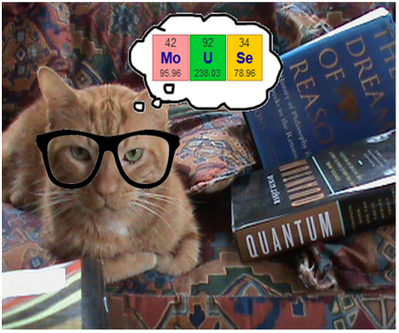
Dosimetric investigation of the solar erythermal UV radiation protection provided by beards and moustaches
“An excess of electromagnetic radiation in the ultraviolet waveband can cause severe damage to skin cells and their DNA. Fortunately, various natural protection mechanisms exist, but until recently, one has been almost entirely overlooked in the dosimetric literature. New details are revealed in the latest (July 2012) edition of the journal Radiation Protection Dosimetry, which features a paper from a cross faculty team at the University of Southern Queensland, Australia.” (Improbable Research)

[As someone who has shaved only three times in more than forty years, I knew this…]
Related articles


Also see: Solar Ultraviolet Protection Provided by Human Head Hair (Photochemistry and Photobiology, Volume 85, Number 1, January/February 2009 , pp. 250-254)
BONUS (unrelated): Feline Reactions to Bearded Men
Greenland’s ‘Extreme Melt Event’
‘In a five-day period in July, Greenland experienced an “extreme melt event.” On July 8, about 40 percent of the ice cover had thawed a bit at the surface. Five days later, an estimated 97 percent of the surface area was thawing. Nearly the entire surface of the ice sheet, from the very edges to the very center, saw some thawing…
NASA says that it is normal for Greenland’s ice to melt a bit in the summer; what is abnormal is the extent. Normally, only about half of the ice sheet’s surface sees any melting. This year, that proportion just about doubled. NASA additionally said that its satellites were recording uncharacteristically high temperatures over the island. Those warmer temperatures were brought by a bubble of warm air (a “heat dome”), the latest in a series of such ridges that have moved over Greenland this year.’ (The Atlantic)

Related articles


Blind Mice Temporarily Regain Vision After Chemical Injection
“Our ability to see depends on two factors: light-sensitive rods and cones in the retina, and the nerves that transmit signals from these cells to the brain (along with the brain itself, of course). When the rods and cones die, which can occur as the eye ages or in the retina-damaging eye disease retinitis pigmentosa, the nerves can sometimes still function—if they have a new, working sensor for light. To replace the rods and cones, previous treatments have used electronic implants, which require surgery, or gene therapy, which relies on injections deep into the eye. But in a new technique, all it takes to restore vision—at least partially—is a much less invasive injection of the chemical AAQ.” (80beats | Discover Magazine)

“Music Was Better in the Sixties, Man”
‘Actually, popular music is arguably “better” today. But in the Sixties it was more creative — or at least more experimental. So says science. (Via Kevin Drum.)
The science under consideration was carried out by a group of Spanish scientists led by Joan Serrà, and appeared in Scientific Reports, an open-access journal published by Nature. They looked at something called the Million Song Dataset, which is pretty amazing in its own right. The MSD collects data from over a million songs recorded since 1955, including tempo and volume and some information about the pitches of the actual notes (seems unclear to me exactly how detailed this data is).
And the answer is … popular music is in many ways unchanged over the years. The basic frequencies of different notes and so forth haven’t changed that much. But in certain crucial ways they have: in particular, they’ve become more homogeneous.’ (Cosmic Variance | Discover Magazine).

Related articles


Eradicating Taste Buds and Poverty With Chili Peppers

“In 2007, the bhut jolokia, 100 times hotter than the average jalapeño, made it into the Guinness Book of World Records as the world’s hottest chili…only to be dethroned in the book’s latest edition by the Trinidad Scorpion Butch T. Although the bhut jolokia has lost its world-record title, it’s recently found a more practical role: alleviating poverty in its home province of Assam.
At The Guardian, Helen Pidd describes how bhut jolokia, also known as the ghost chili, became a lucrative crop for impoverished Assamese farmers when its world-record status drove fans of spicy foods to offer enormous sums for the fiery chili.” (Discover Magazine)
Has anyone ever tried a jolokia? or a Scorpion?
Related articles


Todd Roy: Oh this? …

“… Its nothing, just a picture of 2 perfectly round concentric circles that your brain will refuse to see.” (Twitter / Todd_Roy)
R.I.P. George Miller

George Miller, who wrote the almost-magical essay “The Magical Number Seven, Plus or Minus Two”, died this past week. The essay appeared in the Psychological Review(vol. 101, no. 2, 1956, pp. 343-352). It begins:
“My problem is that I have been persecuted by an integer. For seven years this number has followed me around, has intruded in my most private data, and has assaulted me from the pages of our most public journals. This number assumes a variety of disguises, being sometimes a little larger and sometimes a little smaller than usual, but never changing so much as to be unrecognizable. The persistence with which this number plagues me is far more than a random accident. There is, to quote a famous senator, a design behind it, some pattern governing its appearances. Either there really is something unusual about the number or else I am suffering from delusions of persecution…”
Happy 70th birthday, Jerry!
> 08/01/42 – 08/09/95
The Usefulness of Useless Knowledge
- Abraham Flexner
“In an age obsessed with practicality, productivity, and efficiency, I frequently worry that we are leaving little room for abstract knowledge and for the kind of curiosity that invites just enough serendipity to allow for the discovery of ideas we didn’t know we were interested in until we are, ideas that we may later transform into new combinations with applications both practical and metaphysical.
This concern, it turns out, is hardly new. In The Usefulness of Useless Knowledge (PDF), originally published in the October 1939 issue of Harper’s, American educator Abraham Flexner explores this dangerous tendency to forgo pure curiosity in favor of pragmatism — in science, in education, and in human thought at large — to deliver a poignant critique of the motives encouraged in young minds, contrasting those with the drivers that motivated some of history’s most landmark discoveries.” (Brain Pickings).

Angry people in local newspapers: a weblog

“I feel sorry for local news photographers. They are hugely skilled and poorly paid, and sent out to photograph miserable people pointing at dog turds. Here, we celebrate their work…” (Angry people in local newspapers).
Another Tick-Borne Disease to Guard Against
“Despite its many delights, summer also brings its fair share of pestilence. One, called babesiosis, has only recently been widely recognized as a potentially serious outdoor hazard. According to a very detailed study conducted on Block Island, R.I., it could eventually rival Lyme disease as the most common tick-borne ailment in the United States.” (NYTimes)

I have also just learned of a disease I had never heard of, called anaplasmosis, which is caused by a rickettsial organism also spread by tickbites. It was while starting to read about anaplasmosis that I noticed that there is alot on the radar screens just now about babesiosis.
Related articles


Iain Sinclair: Games A ‘Smoke And Circuses’ Affair
“Thousands of elite athletes have descended on London for the 2012 Olympic Games, and spectators the world over are tuning in to enjoy the action.
But five years’ worth of development has left some locals feeling invaded, and some austerity-weary Britons resenting the bill. Between construction and security, the British government’s budget has soared past $14 billion, about $10 billion over original projections.
East London, home to Olympic Park, the hub of the games, is also home to some of the poorest parts of England. Officials have touted the long-term benefits the games are bringing to the area, like low-income housing and better infrastructure. But author and longtime East London resident Iain Sinclair isn’t buying it.
Sinclair’s latest book is called Ghost Milk: Recent Adventures Among the Future Ruins of London on the Eve of the Olympics. He tells NPR’s Guy Raz that the 2012 Olympics have been challenging for the people living closest.” (NPR)

Related articles


The Big Higgs Question

- Steven Weinberg

Preeminent physicist Steven Weinberg writes in that preeminent scientific journal, The New York Review of Books: “It is often said that what was at stake in the search for the Higgs particle was the origin of mass. True enough, but this explanation needs some sharpening.” (NYRblog). It turns out to be a succinct statement of why the Higgs boson was sought in the first place.
Related articles


Study: HIV Undetectable in 2 Men After Bone Marrow Transplants
HIV Particle (Photo credit: AJC1)
“…[R]esearchers suspect that bone marrow transplantation along with continuation of antiretroviral therapy resulted in the dramatic effects evident eight months post-transplant. They are scheduled to present these preliminary findings Thursday at the International AIDS Conference in Washington, D.C.
HIV patients on antiretroviral therapy often achieve “undetectable viral loads,” meaning there are no virus particles in their blood. But they still have latent HIV in their lymphocytes, and if antiretroviral therapy were discontinued, the latent HIV could reactivate.” (drugs.com)

Related articles


Six facts about guns, violence, and gun control
“The aftermath of the Aurora, Colorado shootings has been thick with calls to avoid “politicizing” the tragedy. That is code, essentially, for “don’t talk about reforming our gun control laws.”
Let’s be clear: This is a form of politicization… That said, it’s important to be clear about what Aurora is: A tragedy that may or may not tell us anything useful about the general trends in guns and violence in the United States. And so this post is about those trends, some of which may surprise you.” (Washington Post, thanks to tom).

Related articles


There’s a word for it: the smell of rain
“Petrichor is the scent of rain on dry earth. The word is constructed from Greek, petra, meaning stone + ichor, the fluid that flows in the veins of the gods in Greek mythology.
The term was coined in 1964 by two Australian researchers, Bear and Thomas, for an article in the journal Nature.[1] In the article, the authors describe how the smell derives from an oil exuded by certain plants during dry periods, whereupon it is absorbed by clay-based soils and rocks. During rain, the oil is released into the air along with another compound, geosmin, a metabolic by-product of bacteria, which is emitted by wet soil, producing the distinctive scent; ozone may also be present if there is lightning.” (Wikipedia)

Related articles


Are Warnings About the Side Effects of Drugs Making Us Sick?

Steve Silberman: “…[A] provocative new report by Winfried Häuser, Ernil Hansen, and Paul Enck in the journal of the German Medical Association suggests that the side effects of some drugs, and the discomfort of certain medical procedures, may be inadvertently intensified by doctors and nurses trying to keep patients fully informed of the consequences of their medical care. The culprit behind this phenomenon is the nocebo effect.” (NeuroTribes).
Related articles


Five Delusions About Our Broken Politics
Thomas E. Mann & Norman J. Ornstein: “Finding an American who does not think our politics are dysfunctional is much harder these days than finding Waldo. Approval of Congress hovers around 10 percent, limited, John McCain often jokes, to “paid staff and blood relatives.” Of course, Congress rarely enjoys a high approval rating, even when things are operating well. But to the two of us, with more than 42 years each of experience immersed in the corridors of Washington at both ends of Pennsylvania Avenue, this dysfunction is worse than we have ever seen it, and it is not limited to Capitol Hill. The partisan and ideological polarization from which we now suffer comes at a time when critical problems cry out for resolution, making for a particularly toxic mix.
It is not going to be easy to find structural fixes to our problems because many of them flow from an increasingly corrosive culture, not just from institutional breakdowns. We have many ideas for significant reforms and other changes, but before we can consider remedies for our political dysfunction, we need to rid ourselves of much seductive wishful thinking. Here are five bromides to avoid.” (The American Interest Magazine).

Related articles


Bill McKibben on why we’re losing the war against climate change
“If the pictures of those towering wildfires in Colorado haven’t convinced you, or the size of your AC bill this summer, here are some hard numbers about climate change: June broke or tied 3,215 high-temperature records across the United States. That followed the warmest May on record for the Northern Hemisphere – the 327th consecutive month in which the temperature of the entire globe exceeded the 20th-century average, the odds of which occurring by simple chance were 3.7 x 10-99, a number considerably larger than the number of stars in the universe.
Meteorologists reported that this spring was the warmest ever recorded for our nation – in fact, it crushed the old record by so much that it represented the “largest temperature departure from average of any season on record.” The same week, Saudi authorities reported that it had rained in Mecca despite a temperature of 109 degrees, the hottest downpour in the planet’s history.
Not that our leaders seemed to notice…” (Rolling Stone)

Related articles


Autistic man survived desert ordeal on will power
“An autistic man who survived weeks in the Utah wilderness on snakes, frogs and roots described his ordeal as spiritual and said the desert was calling him.
“I’ve eaten things that would probably gross you out,” William LaFever told KSL-TV after his release Thursday from a St. George hospital, nearly 40 pounds lighter than his normal weight of 165. He boarded a bus for his hometown of Colorado Springs, Colo.
Authorities say the 28-year-old man is lucky to be alive after setting out for an estimated 150-mile journey from Boulder, Utah, to Page, Ariz., without a backpack full of gear he says was stolen, and with few provisions.
Garfield County deputies said LaFever was probably only 24 hours from dying when a search helicopter found him July 12, cooling off in the Escalante River in his underwear. LaFever said he spent nights shivering from cold.
“It was the most honest meditation I have ever done,” LaFever told KSL. “It wasn’t even a bad experience.”
Authorities estimated LaFever spent three weeks bushwhacking along the wild Escalante River, but the man says his ordeal lasted weeks longer. In a somewhat confusing account, he recalled setting out June 3.” (SFGate via Steve Silberman)

Names of infamy: deny killers the notoriety they seek

David Brin
Timothy McVeigh
“Journalists and shrinks and the public fret over each killer’s declared motives, From Brevik’s islamophobia to Timothy McVeigh‘s war against government, to Al Qaeda suicide bombers, to the murderous students at Columbine High School who appeared to be seeking vengeance for bullying. Yet, when we step back and look for common threads, the emerging pattern seems to be less about specific hatreds, racism or anti-Semitism than frenzied, bloody tantrums staged by a string of losers with one common goal — to grab headlines…
…Courts already do have some authority to order name-changes. Suppose that power were widened — any criminal sentenced for a truly heinous crime could be renamed as part of his punishment, with a moniker that invites disdain… Who would choose the new names? Judges could get creative, or the public might be invited to suggest appropriate derogations. Or something random might be the greatest punishment of all. However it’s done, won’t it make sense for ridicule to replace some of the grotesque fashionableness that’s now attached to terror? It would reflect society’s determination to allocate fame properly, to those who earn it. We would be saying — “You can’t win celebrity this way. By harming innocents, you’re only destroying your own name.” (– David Brin, CONTRARY BRIN)

“Right. Show no photos of the actors, use ‘unsub’ or some other neutral, impersonal term for them, pay them no attention at all. That’s the way we treat the enemy killers in wars, after all, while we pay all of the attention (but still too little) to the victims.”
R.I.P. Alexander Cockburn at 71
The left loses one of its most outspoken straight-shooters. I have read Cockburn with delight since his Village Voice days. “Mr. Cockburn had, at various times, regular columns in ideologically disparate publications like The Nation and The Wall Street Journal and became known as an unapologetic leftist, condemning what he saw as the outrages of the right but also castigating the American liberal establishment when he thought it was being timid.” (NYTimes obituary)
Related articles


Night Sounds: The Gamelan Music of Bali
“Larry Reed presents a selection of recordings of gamelan music, recorded in Bali, Indonesia in 1979. The program begins with a brief field recording of frogs, crickets and other night creatures, the rhythm of which it has been suggested served as a template for early gamelan ensembles. We then hear a “Pemungkah,” the introductory music of a traditional Balinese shadow play, performed by a gender wayang, the smallest (four piece) of the gamelan ensembles. This is followed by an example of a larger 20 piece gamelan orchestra called gamelan angklung, recorded in Tunjuk, Indonesia in 1979. The program concludes with an example of gamelan leko, used as accompaniment for legong dancers, and also recorded in Tunjuk.” (radiOM.org).

Related articles


“Now I Am Become Shiva, The Destroyer of Worlds.”
“Most films of nuclear explosions are dubbed. If they do contain an actual audio recording of the test blast itself (something I’m often suspicious of — I suspect many were filmed silently and have a stock blast sound effect), it’s almost always shifted in time so that the explosion and the sound of the blast wave are simultaneous.
This is, of course, quite false: the speed of light is much faster than the speed of sound, and the cameras are kept a very healthy distance from the test itself, so in reality the blast wave comes half a minute or so after the explosion. Basic physics that even a non-technical guy like me can understand.
It’s rare to find footage where the sound has not been monkeyed with in post-processing. So I was pleased when a Russian correspondent sent me a link to footage digitized by the National Archives of a 1953 nuclear test. The footage is very raw: it hasn’t been edited much, and is a bit washed out, but the audio is still in “correct,” original sync.
Click the image to go to a YouTube edit of the video that I made. You can see the original via NARA’s page….
The video starts off pretty dark and muddled, but don’t let that turn you off. What’s interesting about this clip is not the visual aspects. The test looks like any old nuclear test, but with poor film quality.
The audio is what makes this great. Put on some headphones and listen to it all the way through — it’s much more intimate than any other test film I’ve seen. You get a much better sense of what these things must have been like, on the ground, as an observer, than from your standard montage of blasts. Murmurs in anticipation; the slow countdown over a megaphone; the reaction at the flash of the bomb; and finally — a sharp bang, followed by a long, thundering growl. That’s the sound of the bomb.” (Restricted Data: The Nuclear Secrecy Blog)
Related articles


If You Are Hit By Two Atomic Bombs, Should You Have Kids?

“…[R]oughly 150 people were unlucky enough to be in both in Nagasaki and Hiroshima when the bombs hit, but very few, only a handful, were in both blast zones, within 1.5 mile zone of intense radiation. Across Japan, the assumption was that these people shouldn’t have children, that the gamma ray damage would be too heavy, too long-lasting to make child bearing safe.” The story of one man who beat the odds. (Krulwich Wonders… : NPR)
Oxytocin is not a love drug. Don’t give it to kids with autism
Monogamy
“Oxytocin hype might be storming the heavens, but oxytocin science is still finding its footing. Early studies certainly bathed the hormone in a shiny glow, but later ones uncovered a darker side. The “love hormone” fosters trust and generosity in some situations but envy and bias in others, and it can produce opposite effects in different people. A more nuanced view of oxytocin is coming to light—one that’s inconsistent with the simplistic “moral molecule” moniker.” (Slate)

Related:


Housekeeping
You may have seen a comment entered by a ‘Mike Hunter’ (who did not have the courage of his convictions to include an email address), which amounted to nothing more than a rude epithet. Thanks for the nomination, Mr. Hunter, but I respectfully decline; I have deleted the comment and will do so again if ever there are further such postings from this or any other username. I know my response here gratifies the urge of such trolls to provoke; sorry to disappoint but I won’t do so again, your comment will just inexplicably disappear. I suggest that if Mr. Hunter or other readers takes offense at any of my views, they meet minimal standards of intelligence by discussing the issues and not just calling names if they want their comments to survive my editing.
Mitt Romney: Release Your Tax Returns

“A Swiss bank account. Offshore investments in the Cayman Islands. And now evidence that he may have lied about when he left his role at Bain Capital. What is Mitt Romney hiding? Romney needs to fully release his tax returns and stop hiding the truth about how he makes his money and where he stashes it. Sign the petition to ask Romney to release his tax returns to show the American people who he really is.” (MoveOn.org)
Suicide Murder: Shortcut to Heaven?

Map of death penalty
“While the hideous practice of killing someone to bring on an execution has ended in Europe it still goes on in countries that retain the death penalty.” (Suite101.com)
‘I get knocked down…’

Chumbawamba Break Up: “They started out, implausibly enough, as an anarcho-punk collective, paragons of the same scene that Crass helped to birth. They’d been around for years, experimenting with different sounds and ideas before signing a deal with EMI and stumbling into fleeting international fame with “Tubthumping.” They kept soldiering on after that song became a kitsch relic, too, and they’re only now announcing that they’re disbanding.” (Stereogum).
Related articles


Some Discussion of Higgs Boson Discovery

Interactions (Photo credit: Wikipedia)
Selected links:
- After Higgs boson discovery, what’s next for physicists? (Washington Post)
- Why the Higgs Boson Discovery Is Disappointing, According to the Smartest Man in the World (Atlantic)
- Peter Higgs (Wikipedia)
- Higgs boson discovery: now the real work begins (Guardian.UK)
- The Higgs boson discovery is another giant leap for humankind (Guardian. UK)
- How to explain Higgs boson discovery (Guardian.UK)
- Higgs boson discovery could usher in ‘new, wonderful technologies,’ says physicist (CSM video)
- Why the Higgs boson announcement is so important (CSM video)
- A Quantum Leap: The discovery of the Higgs boson particle puts our understanding of nature on a new firm footing. (Slate)
- What happens next after Higgs boson discovery? (BBC)
- Higgs Boson Explained By MinutePhysics (HuffPo video)
- 10 people who think the Higgs boson is about God (o.canada.com)
- The Higgs Boson (boston.com)
- Higgs Boson, Explained by Cartoons (neatorama.com)
- Happy Higgs Boson Day! (makezine.com)
- What Does the Discovery of Higgs Boson Mean? [VIDEO] (mashable.com)
- Can you explain the Higgs boson in a tweet?(telegraph.co.uk)
Here is my own (small) connection to the Higgs story. When theoretical physicist Peter Higgs proposed the existence of the Higgs Field and predicted the particle in 1964, he was on the faculty of the University of Edinburgh. (Higgs projected that the particle would not be discovered in his lifetime.) The University has just announced the establishment of the Higgs Centre for Theoretical Physics, with a $1.2 million annual budget. And my son is about to start as an undergraduate at the University of Edinburgh this fall.
How Obama Can Really Hurt the GOP: Focus on Its Radical Economic Plan

Michael Tomasky: “The president can sink Romney by trumpeting the details of the ludicrous economic solutions he’s been backing. How Mitt would turn America into one big Pottersville.” (The Daily Beast).
Birds with arms

An entire Tumbler site full of ’em. (kottke via Boing Boing).
Leap Second bug takes down Reddit and a bunch of other sites

‘Reddit, Foursquare, Mozilla, and a number of other companies were hit with technical problems Saturday evening when a single “leap second” was added to the world’s atomic clocks. And so, the “leap second bug” was born.’ (VentureBeat).
Candidate fundraising email
“Candidate fundraising emails becoming increasingly hard to differentiate from Nigerian banking scams…” (Twitter / fivethirtyeight)
Monoculture
- C.S. Lewis
Kevin Kelly: “Years back, in CS Lewis’ essay ‘On The Reading of Old Books,’ I encountered a suggestion that has stuck with me ever since. Lewis posited that each generation of humanity takes certain things for granted: assumptions that go unexamined and unquestioned because they are commonly held by all. It was Lewis’ opinion that reading books written by prior generations would help us to see around these generational blind spots.
In her new book, Monoculture: How One Story Is Changing Everything, FS Michaels suggests that just such a blind spot has, over the course of generations, come to dominate the narrative and values that our society lives by. From education and the arts to how we eat, think, and play, Michaels asserts that we have been steeped in a single point of view, the economic, where value is reduced to what can be sold and worth is determined by financial expediency. Michael’s writing is clear and sharp as she brings the impact of this pervasive global philosophy down to the personal level, showing how it affects our lives in the everyday.
Michaels spent years researching this book and it shows. This book is packed full of observations and opinions from a wide range of economists, artists, philosophers and scholars, and Michaels introduces each new section of the book with a concise historical context outlining how things once were, how they developed, and how we arrived where we are. Michaels presents a clear argument without resorting to soapboxing, emotional appeals, or badgering. There is no guilt trip here, just a careful deconstruction of philosophical assumptions that too often go unquestioned. And while it is intellectually satisfying, Monoculture is no overbearing academic tome. Michaels’ writing is engaging and accessible for readers with a wide range of ability and interest. This is not a pounded pulpit, but a door opening into a discussion that we as a society badly need to have.
In a time of seemingly constant budget cuts and belt-tightening, this book is a valuable tool in provoking thought and discussion about how we as a society value the arts, education, and health. This is a book I have found myself recommending and lending out time and again as I talk with friends about what constitutes quality of life and what we each seek to gain from life and the world around us. Regardless of your political or philosophical point of view, Monoculture is a valuable discussion-starter in considering the shape of our world.” (Cool Tools).

What Should You Do If You Are Attacked by a Pack of Wolves
“Whatever you do, don’t run. Wolves are what is known as coursing predators meaning they take their prey on the run. If you watch wolves hunt you’ll immediately see this in action. Wolves will attempt to get the animals they prey upon to run. If they don’t run wolves usually don’t pursue the attack.” (Read full answer).

E.J. Dionne Jr.: Justice Scalia should resign
“So often, Scalia has chosen to ignore the obligation of a Supreme Court justice to be, and appear to be, impartial. He’s turned “judicial restraint” into an oxymoronic phrase. But what he did this week, when the court announced its decision on the Arizona immigration law, should be the end of the line. ” (Washington Post).

Berries
Are you at all botanically interested? If so, you will be amazed by what are and aren’t considered to be berries, in a technical sense. (Wikipedia).

Black bear spotted in Brookline

I don’t know if this was nationwide news but it was quite the sensation in Massachusetts last month when this bear was popping in and out of hiding on Cape Cod. But this is even more amazing, and it is my town adjacent to Boston!
“The bear found in a towering pine tree in the yard of a multimillion-dollar home here today is the same male bear who rambled across Cape Cod before being captured two weeks ago and then exiled to Central Massachusetts, state officials said.
After being captured and relocated on June 11, the stubborn bear trekked 100 miles eastward before ending up at around 7:30 a.m. in the backyard of a $4.9 million home on Pine Road, officials said.
Officials said the bear, one of an estimated 4,000 in the state, embarked on his odyssey in an effort to establish his own territory. The bear weighs about 180 pounds and is about 2½ years old. He is being taken back to the countryside today — this time he’ll be released farther from Boston than before.” (Boston Globe).
Facebook Changed Everyone’s Email to @Facebook.com; Here’s How to Fix Yours

“Facebook just removed everyone’s email address from their profile and replaced it with an @facebook.com email address without asking you. Here’s how to easily fix the problem.” (Lifehacker).
Chronicling Mitt’s Mendacity

Romney is one of the most disingenuous men who has ever run for President. I’m not sure if he is crafty or simply cannot recognize when he is not telling the truth, but either is of great concern. This series chronicles his lies on a weekly basis; this week’s edition catalogs thirty. (The Maddow Blog).
Michael Tomasky: Democrats Should Come Out Swinging Against the Court

- Michael Tomasky
“If the Supreme Court overturns the health-care law, Democrats will be tempted to sulk and feel sorry for themselves. But that’s the last thing they should do….
I’ll be watching for rhetoric, tone, even body language. And on those counts, they had damn well better dispense with the usual liberal woe-is-me hand-wringing and shoulder slumping and come out swinging. They had better communicate to their base that they stand for something, that it’s important to them, and they’re pissed. And if they do it the right way, they can make the Supreme Court an issue this fall in a way that might even persuade some swing voters that the Court overstepped its bounds. I’d go so far as to say that an aggressive response can reset and reframe the whole health-care debate, once Americans have had their minds focused on this by a blatantly partisan Court…” (The Daily Beast)
Ever Heard of ASMR?

“Autonomous Sensory Meridian Response (ASMR) is a physical sensation characterized by a pleasurable tingling that typically begins in the head and scalp, and often moves down the spine and through the limbs.
Most ASMR episodes begin by an external or internal trigger, and are so divided for classification. Type A episodes are elicited by the experiencer using no external stimuli, and are typically achieved by specific thought patterns unique to the individual. Type B episodes are triggered involuntarily by an external trigger, via one or more senses, and may also involve specific thought patterns associated with the triggering event. Both types of triggers vary between individuals, but many are common to a large portion of ASMR enjoyers.
Common external triggers:
- Exposure to slow, accented, or unique speech patterns
- Viewing educational or instructive videos or lectures
- Experiencing a high empathetic or sympathetic reaction to an event
- Enjoying a piece of art or music
- Watching another person complete a task, often in a diligent, attentive manner – examples would be filling out a form, writing a check, going through a purse or bag, inspecting an item closely, etc.
- Close, personal attention from another person
- Haircuts, or other touch from another on head or back”
Related articles


Injection wells: The poison beneath us
“Over the past several decades, U.S. industries have injected more than 30 trillion gallons of toxic liquid deep into the earth, using broad expanses of the nation’s geology as an invisible dumping ground.
No company would be allowed to pour such dangerous chemicals into the rivers or onto the soil. But until recently, scientists and environmental officials have assumed that deep layers of rock beneath the earth would safely entomb the waste for millennia.
There are growing signs they were mistaken.” (Salon)

Related articles


The cult of TED
“Falling animals, misbehaving toddlers and footage of Justin Bieber may populate the bulk of any YouTube most-viewed list. But amid the viral clips and pop music promos is a series of videos that seems to go against all received wisdom about what online audiences like to consume.Their tone is sunnily optimistic, go-getting, Californian, with titles like Information Is Food, Crowdsource Your Health and Inventing Is the Easy Part. They feature luminaries such as Stephen Hawking, JK Rowling and Bono delivering 18-minute lectures about big ideas – technology, culture, the environment, science, social trends. Yet although there is nary a Lolcat in sight, the YouTube channel of the Technology Entertainment and Design (TED) conference has attracted nearly 112 million views.” (BBC News)

Ring of Fire – Horseshoe Bend
“05-20-2012 I wanted to capture this remarkable experience of the Annular Solar Eclipse at Horseshoe Bend in Northern Arizona. This large panoramic composite image measuring 14531×9211 and is made from about 48 images, 30 frames were shot with a Canon 5dmk3 with a 24mm lens with a 3 frame per shot in-camera HDR that make up the body of the image and 18 frames shot with a Canon 5dmk2 with a 400mm for the composited eclipse of the sun in place over the canyon. What make this a fun image is the hundreds of photographers all capturing this extraordinary event lining the canyon rim with a thousand foot drop to the Colorado River below.” (Milky Way Scientist).

Jonah Lehrer’s tight spot
‘This week, …Jonah Lehrer of the New Yorker …has found himself in a tight spot. On Tuesday morning, the media reporter Jim Romenesko pointed out that the opening paragraphs of Lehrer’s mid-June post to his New Yorker blog, Frontal Cortex, had previously made an appearance in an October Op-Ed Lehrer wrote for the Wall Street Journal. By midday, a reporter at New York magazine’s Daily Intel blog spotted a few more double-dips — anecdotes and examples reused in different stories — and everyone was off to the races. The New Yorker added unhappy-sounding caveats to most of Lehrer’s posts (“We regret the duplication of material”). A freelancer began cataloging, on his Tumblr, passages from Lehrer’s old New York Times Magazine pieces that later resurfaced in Lehrer’s posts at Wired. By Wednesday morning, the literary blogger Ed Champion had compiled an incredibly long list of repurposed material in Lehrer’s books and articles, and he was only a couple hundred pages into the book. Late yesterday, Lehrer finally commented, to the New York Times, that “It was a stupid thing to do and incredibly lazy and absolutely wrong.” But so far, he still has a job at the New Yorker.’ ( Salon).

Why the Dalai Lama is Hopeful
Jonathan Mirsky: ‘ “I told President Obama the leaders of the Chinese Communist Party are missing a part of the brain, the part that contains common sense,” the Dalai Lama said to me during our conversation in London Wednesday.
“But it can be put back in. I am hopeful about the new Chinese leadership beginning late this year. The Communist leaders now lack self-confidence, but I have heard from my Chinese friends that after a year or two the new ones will take some initiatives, so more freedom, more democracy.”
The Dalai Lama, with whom I have been talking periodically since 1981, was in an ebullient mood even for him. He was here referring to his meeting with Obama in 2011. I had asked the Dalai Lama about those national leaders throughout the world, from South Africa to Britain, who refuse to hold formal meetings with him because they fear Beijing’s anger. President Obama declined to meet him in 2009, the first rebuff from an American president since the Tibetan leader began visiting Washington in 1991.’ ( The New York Review of Books).

The crayola-fication of the world

“In Japan, people often refer to traffic lights as being blue in color. And this is a bit odd, because the traffic signal indicating ‘go’ in Japan is just as green as it is anywhere else in the world. So why is the color getting lost in translation? This visual conundrum has its roots in the history of language.
Blue and green are similar in hue. They sit next to each other in a rainbow, which means that, to our eyes, light can blend smoothly from blue to green or vice-versa, without going past any other color in between. Before the modern period, Japanese had just one word, Ao, for both blue and green. The wall that divides these colors hadn’t been erected as yet. As the language evolved, in the Heian period around the year 1000, something interesting happened. A new word popped into being – midori – and it described a sort of greenish end of blue. Midori was a shade of ao, it wasn’t really a new color in its own right.
One of the first fences in this color continuum came from an unlikely place – crayons. In 1917, the first crayons were imported into Japan, and they brought with them a way of dividing a seamless visual spread into neat, discrete chunks. There were different crayons for green (midori) and blue (ao), and children started to adopt these names. But the real change came during the Allied occupation of Japan after World War II, when new educational material started to circulate. In 1951, teaching guidelines for first grade teachers distinguished blue from green, and the word midori was shoehorned to fit this new purpose.
Reconstructing the rainbow. Stephanie, who blogs at 52 Kitchen Adventures, took a heat gun to a crayola set.
In modern Japanese, midori is the word for green, as distinct from blue. This divorce of blue and green was not without its scars. There are clues that remain in the language, that bear witness to this awkward separation. For example, in many languages the word for vegetable is synonymous with green (sabzi in Urdu literally means green-ness, and in English we say ‘eat your greens’). But in Japanese, vegetables are ao-mono, literally blue things. Green apples? They’re blue too. As are the first leaves of spring, if you go by their Japanese name. In English, the term green is sometimes used to describe a novice, someone inexperienced. In Japanese, they’re ao-kusai, literally they ‘smell of blue’. It’s as if the borders that separate colors follow a slightly different route in Japan.
And it’s not just Japanese. There are plenty of other languages that blur the lines between what we call blue and green. Many languages don’t distinguish between the two colors at all.” (Empirical Zeal).
Why Republicans Oppose the Individual Health-Care Mandate
“The Republicans have made the individual mandate the element most likely to undo the President’s health-care law. The irony is that the Democrats adopted it in the first place because they thought that it would help them secure conservative support. It had, after all, been at the heart of Republican health-care reforms for two decades.”
In 2010, no serious constitutional scholar dreamed that the individual mandate could be overturned on constitutional grounds. Now, most says its chances are around fifty-fifty. ( The New Yorker).
Physics Community Afire With Rumors of Higgs Boson Discovery
- Daniel Higgs
“The Higgs boson may finally, really have been discovered.
Ever since tantalizing hints of the Higgs turned up in December at the Large Hadron Collider, scientists there have been busily analyzing the results of their energetic particle collisions to further refine their search.
“The bottom line though is now clear: There’s something there which looks like a Higgs is supposed to look,” wrote mathematician Peter Woit on his blog, Not Even Wrong. According to Woit, there are rumors of new data that would be the most compelling evidence yet for the long-sought Higgs.
The possible news has a number of physics bloggers speculating that LHC scientists will announce the discovery of the Higgs during the International Conference on High Energy Physics, which takes place in Melbourne, Australia, July 4 to 11.” (Wired Science).

Related articles
40 years after Watergate: “Nixon was far worse than we thought”

Woodward and Bernstein: Often characterized as a “third-rate burglary,” history proved that [Watergate] was anything but.
“Two years later, Richard Nixon would become the first and only U.S. president to resign, his role in the criminal conspiracy to obstruct justice — the Watergate coverup — definitively established. Another answer has since persisted, often unchallenged: the notion that the coverup was worse than the crime. This idea minimizes the scale and reach of Nixon’s criminal actions.” (The Washington Post).
Why Smart People Are Stupid

- Daniel Kahneman

JonahLehrer writes in the New Yorker on the work of Kahneman and others,showing that we are not nearly as rational as we would like to believe. Moreover, the Smarter People Are, the More Susceptible They Are to Cognitive Bias.
San Andreas Fault may be more hazardous than thought

- USGS diagram

“Geologists Thomas Fumal and Timothy Dawson dug trenches across the San Andreas Fault in the Santa Cruz Mountains, about 5 miles (8 km) northwest of Watsonville and discovered traces of four large past earthquakes. Broken sediment revealed quakes occur more often than earlier estimated, and two historic earthquakes reached further south than found before. In the trenches, Dawson and Fumal found a clear record of the great San Francisco quake of 1906. The three additional earthquakes hit in 1522, 1686 and either 1748 or 1838, give or take a few decades, which means this segment of the San Andreas Fault averages a big shaker every 125 years. That’s twice as often as estimates calculated by the Working Group On California Earthquake Probabilities, the group responsible for official earthquake forecasts.”
Related articles
- San Andreas Fault tool listens for signs of quakes (sfgate.com)
- New observations on the San Andreas Fault in Santa Cruz Mountains, Seattle Fault Zone (eurekalert.org)
- A Megaquake becomes a Megapuzzle (seismo.berkeley.edu)
- Earthquakes in a Box (news.sciencemag.org)
“Why I Hate Dreams”
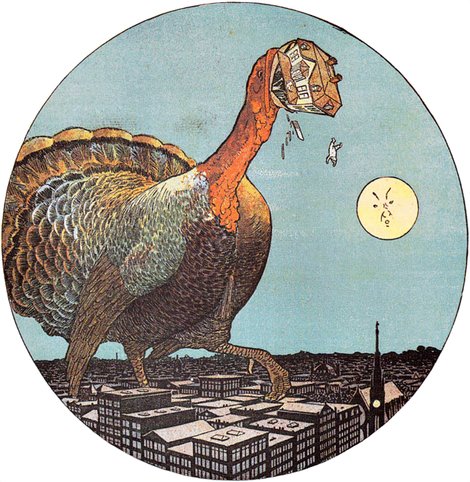
Michael Chabon: “I hate dreams. Dreams are the Sea Monkeys of consciousness: in the back pages of sleep they promise us teeming submarine palaces but leave us, on waking, with a hermetic residue of freeze-dried dust. The wisdom of dreams is a fortune on paper that you can’t cash out, an oasis of shimmering water that turns, when you wake up, to a mouthful of sand. I hate them for their absurdities and deferrals, their endlessly broken promise to amount to something, by and by. I hate them for the way they ransack memory, jumbling treasure and trash. I hate them for their tedium, how they drag on, peter out, wander off.” (The New York Review of Books).
The illustration is from Winsor McKay’s “Little Nemo” comic strip from the early 1900’s. If you are not familiar with it, you owe it to yourself.
Unplanned Freefall?

Happy Bloomsday!

The World Celebrates James Joyce: ‘There is additional cause for celebration on this year’s Bloomsday. Seventy years after the author’s death, the copyright on his works has expired and they have entered the public domain. As PBS noted: “Many events in Dublin and elsewhere can finally put on performances and readings of entire sections of the novel without fear of legal recourse by the Joyce estate.”
It marked “a new era for biographers and scholars who are now free to publish him or parts of his work without the permission of the fiercely protective, and often litigious, Joyce estate,” the Irish broadcaster RTE commented.’ (NYTimes)
How Organic Food Puts You in a Bad Mood

“New research shows that organic food makes people more judgmental and less likely to help others.” (Brain Blogger).
‘Sticker Lady’ Sets a Dare for Singapore

“‘Singapore) A street artist known as “Sticker Lady” has mounted a challenge to this city-state’s obsession with order. In her portfolio: stickers pasted onto traffic-signal buttons with messages such as “Press to Time Travel” or “Press to Stop Time.” ‘ (WSJ.com).
Lost Wormhole

Who is Ray, the boy with the ‘adventurous story’?
‘

‘Berlin police have released a photograph of the mysterious “forest boy” who turned to authorities nine months ago saying he lived in a wood for five years and did not know who he was. Police in the German capital sent a picture of the smiling blond boy wearing a T-shirt and a gold necklace to news outlets asking for help in getting to the bottom of a story that captured the world’s imagination last year.
“Despite the extensive studies and investigations, the youth office and the Berlin police were still not successful in identifying the boy who calls himself Ray,” the police statement, which was published in German and English, said. “Who knows the person shown in this picture? Who can give any information about his identity? Who can give any information about the person’s possible relatives?”
Giving his name only as Ray and his date of birth as June 20, 1994, the teenager sought help on September 5 at Berlin’s City Hall speaking English and just a few words of German. “He claimed he only knew his date of birth and his first name. He was sent to youth emergency services,” police said. “There he told an adventurous story.” The boy was unable, or refused, to give his family name, birthplace or any other biographical information but said he had spent the last five years living in a forest with his father until he died suddenly in August.
Ray told police he had buried his father “in a hole in the forest underneath some stones” but, after “walking north for five days” to Berlin, could not explain how he had died or where authorities could find his body. “A corresponding dead body has still not been found,” police said. Ray said his mother Doreen had died in a car accident, which he also did not remember, when he was 12 and that he assumed scars on his face were incurred in the crash.’ (Sydney Morning Herald).
Are the New Atheists Responsible for the Creationist Menace?

- Richard Dawkins

“A few decades ago, Darwinians and creationists had a de facto nonaggression pact: Creationists would let Darwinians reign in biology class, and otherwise Darwinians would leave creationists alone. [However], afew years ago, such biologists as Richard Dawkins and PZ Myers started violating the nonaggression pact.” ( The Chronicle of Higher Education).
Obama Adds a Fresh Metaphor to a Familiar Campaign Message
Had just been getting impatient with the President rolling over on Republican lies about the budget deficit when he finally decided to go on the offensive about the issue, with an apt comparison:
When Mitt Romney and other Republicans carp about the dismal economy without mentioning that Mr. Obama inherited a $1 trillion deficit from his Republican predecessor, “it’s like somebody goes to a restaurant, orders a big steak dinner, martini, all that stuff,” Mr. Obama said, winding up to his punch line as his audience tittered. “And then, just as you’re sitting down, they leave, and accuse you of running up the tab!” (NYTimes)
How’s this for a non sequitur? It reminds me of this classic Abbott and Costello routine my friend Bob had just forwarded to me (what, you don’t know Abbott and Costello??!!), from The Noose Hangs High (1948):
Bring me the head of George W Bush

‘Game of Thrones’ puts former POTUS on a spike: ‘In the commentary track on the tenth episode of the first season of HBO’s Game of Thrones DVD, David Benioff, co-creator of the show reveals an amusing secret about one of the severed heads seen on spikes: “The last head on the left is George Bush” and then his partner chimes in “George Bush’s head appears in a couple beheading scenes.”“It’s not a choice, it’s not a political statement,” explained Benioff. “It’s just, we had to use what heads we had around.”A likely story…They’ve got the video at io9.’ (Dangerous Minds).
Related articles
- George W. Bush’s decapitated head appeared on Game of Thrones [Video] (io9.com)
- W Loses his Head, Makes Guest Appearance on “Game of Thrones” (dvorak.org)
- ‘Game of Thrones’ scoop: Season 3 character list revealed – EXCLUSIVE (insidetv.ew.com)
Let’s Not Lose Our Heads
Image

What does it mean to be cool?
It may not be what you think. “Do rebelliousness, emotional control, toughness and thrill-seeking still make up the essence of coolness? Can performers James Dean and Miles Davis still be considered the models of cool?
Research led by a University of Rochester Medical Center psychologist and published by the Journal of Individual Differences has found the characteristics associated with coolness today are markedly different than those that generated the concept of cool…
In the journal article, the research is described as the first systematic, quantitative examination of what characteristics recur in popular understandings of the cool personality…
At some levels, participants in the study still appreciated the traditional elements of cool, such as rebelliousness and detachment, but not as strongly as friendliness and warmth.” (medicalxpress.com).

Science: You Can Judge People By Their Shoes
“Researchers at the University of Kansas say that people can accurately judge 90 percent of a stranger’s personality simply by looking at the person’s shoes. “Shoes convey a thin but useful slice of information about their wearers,” the authors wrote in the new study published in the Journal of Research in Personality. “Shoes serve a practical purpose, and also serve as nonverbal cues with symbolic messages.” (National Review Online).

Related articles
- How to tell a good sole: You really can judge a person by their shoes….and you do not need to look at anything else (investmentwatchblog.com)
- Psychologist Say, Shoes Really Do Make the Person (shoeblogs.com)
10 biggest puzzles of human evolution

‘We are the ape that stood on two feet, lost its fur and crossed the globe – but why? New Scientist explores these and other enduring riddles of our past…’ (New Scientist).
Related articles
- Evolution acceptance still flatlined in America (whyevolutionistrue.wordpress.com)
- Humans-A Different Breed-Evolution Theories (eauinsite.wordpress.com)
- The argumentative ape: Why we’re wired to persuade (newscientist.com)
- The Fight Over Evolution Isn’t Actually All That Important (motherjones.com)
A Random Walk with Pi

“…[A] team of researchers from Australia, Lawrence Berkeley National Laboratory, and Simon Fraser University [did] some elegant visualizations of π. In a recent paper, they used a classic method of visualizing large strings of numbers: the random walk. (Wired)
The European Atrocity You Never Heard About
‘Between 1945 and 1950, Europe witnessed the largest episode of forced migration, and perhaps the single greatest movement of population, in human history. Between 12 million and 14 million German-speaking civilians—the overwhelming majority of whom were women, old people, and children under 16—were forcibly ejected from their places of birth in Czechoslovakia, Hungary, Romania, Yugoslavia, and what are today the western districts of Poland. As The New York Times noted in December 1945, the number of people the Allies proposed to transfer in just a few months was about the same as the total number of all the immigrants admitted to the United States since the beginning of the 20th century. They were deposited among the ruins of Allied-occupied Germany to fend for themselves as best they could. The number who died as a result of starvation, disease, beatings, or outright execution is unknown, but conservative estimates suggest that at least 500,000 people lost their lives in the course of the operation.
Most disturbingly of all, tens of thousands perished as a result of ill treatment while being used as slave labor (or, in the Allies’ cynical formulation, “reparations in kind”) in a vast network of camps extending across central and southeastern Europe—many of which, like Auschwitz I and Theresienstadt, were former German concentration camps kept in operation for years after the war. As Sir John Colville, formerly Winston Churchill’s private secretary, told his colleagues in the British Foreign Office in 1946, it was clear that “concentration camps and all they stand for did not come to an end with the defeat of Germany.” Ironically, no more than 100 or so miles away from the camps being put to this new use, the surviving Nazi leaders were being tried by the Allies in the courtroom at Nuremberg on a bill of indictment that listed “deportation and other inhumane acts committed against any civilian population” under the heading of “crimes against humanity.” ‘ (The Chronicle of Higher Education).

Giant Tortoises End Marriage After 115 Years

‘They’ve been together since … well, since before any of us are alive, actually – but 115 years apparently is long enough. The century-old marriage between giant tortoises Bibi and Poldi in the Happ Reptile Zoo in Klagenfurt, Austria, is on the rocks. The world’s oldest animal marriage looks set to have turtley ended after an incredible 115 years when the two Giant Turtles at an Austrian zoo refused to share their cage anymore. Zoo boss Helga Happ said: “We get the feeling they can’t stand the sight of each other anymore.” ‘ (Neatorama).
Lose Yourself – Becoming the Characters You Read

Is this any surprise to you?
“New research now shows that, in addition to just learning about other people, places, and things, readers actually take on the experiences and beliefs of the characters in books.
In a study published by the Journal of Personality and Social Psychology, researchers at Ohio State University report the results of six experiments that tested the degree to which people found themselves feeling the emotions, thoughts, behaviors, goals, and traits of the characters in fictional stories. Overall, the authors report that this phenomenon, called “experience-taking,” can lead to real changes in the lives of the readers, albeit temporary.” (Brain Blogger).
The Amygdala Made Me Do It
- Think Tank
“Why are we thinking so much about thinking these days? Near the top of best-seller lists around the country, you’ll find Jonah Lehrer’s “Imagine: How Creativity Works,” followed by Charles Duhigg’s book “The Power of Habit: Why We Do What We Do in Life and Business,” and somewhere in the middle, where it’s held its ground for several months, Daniel Kahneman’s “Thinking, Fast and Slow.” Recently arrived is “Subliminal: How Your Unconscious Mind Rules Your Behavior,” by Leonard Mlodinow.
It’s the invasion of the Can’t-Help-Yourself books. …These books possess a unifying theme: The choices we make in day-to-day life are prompted by impulses lodged deep within the nervous system. Not only are we not masters of our fate; we are captives of biological determinism. Once we enter the portals of the strange neuronal world known as the brain, we discover that — to put the matter plainly — we have no idea what we’re doing.” (NYTimes)

Toilet psychology

Nick Haslam: “In 30 years of studying the field I rarely came across any recognition that human beings are creatures who excrete. Much of what we psychologists care about is on the mental side of the mind/body divide, but even when we go corporeal we eliminate elimination. Psychologists have examined the psychobiology of eating, sleeping and sex at great length, and devoted numerous journals and professional associations to them. We have investigated how substances cross from outer to inner but largely ignored traffic in the other direction.” (The Psychologist).
The history of the paper clip:
It was invented in 1899. It hasn’t been improved upon since. – “…if the paper clip can be a symbol for endless drudgery, it can also be twisted, pulled apart, and used as a tool. And in this capacity, many of the practices to which it is best suited are the opposite of the commercially productive, sanitary, and morally meaningless act of clipping together papers. Paper clips can be used to pick locks, clean under fingernails, and hack into phones. Straightened out, they are used by office workers to distract themselves from the monotony of their intended use. Nearly every reader of Joshua Ferris’ novel of office life, Then We Came to the End, becomes part of his collective narrator as they read the sentence, “If a stray paper clip happened to be lying around we were likely to bend it out of shape,” and every white-collar underling must find familiar David Foster Wallace’s description of office life in The Pale King: “The way hard deskwork really goes is in jagged little fits and starts, brief intervals of concentration alternated with frequent trips to the men’s room, the drinking fountain, the vending machine, constant visits to the pencil sharpener, phone calls you suddenly feel are imperative to make, rapt intervals of seeing what kinds of shapes you can bend a paperclip into, &c.” The paper clip, which possesses inexpensiveness, interchangeability and consistency, has also been used as a symbol for the numerous: a Tennessee school collected 6 million paper clips to symbolize the Jews killed during the Holocaust, a project documented in a 2004 Miramax film. And its affordability can be a symbol of humble beginnings: In 2005, a Canadian named Kyle McDonald took a red paper clip and began a series of online trades that eventually netted him a house (not to mention a blog, a book, and a lot of public speaking gigs). A philosophical conceit called the “paperclip maximizer” is an artificial intelligence that, programmed by humans solely to manufacture as many paper clips as possible, eventually takes over the Earth and increasing portions of space in its quest for material, leaving trillions of paper clips with no one to use them.
Finally, the simplicity of the paper clip has allowed it to become a graphic symbol on the digital desktop. For many a 21st-century office worker, it is more often encountered as the “attachment” icon in an email program than in the physical form of a bent steel wire. As we move further and further toward a paperless society, that loop-the-loop form might become more familiar in two dimensions than in three….” (Slate )

White phosphorus: The new napalm?

“Forty years after Vietnam‘s most famous photo, incendiary weapons still kill and injure children.” (Salon)
Related articles
- AP ‘napalm girl’ photo from Vietnam War turns 40 (3quarksdaily.com)
- ‘Napalm Girl’ Reunion 40 Years Later (abcnews.go.com)
- Vietnam War’s ‘napalm girl’ photo turns 40 (wnd.com)
Sick justice

Robert Reich: “The public’s growing disdain of the Supreme Court increases the odds that a majority will uphold the constitutionality of Obamacare.” (Salon.com).
See if you believe this argument.
World’s first Parkinson’s vaccine is trialled

“Ten people with Parkinson’s disease this week received injections of the first vaccine aimed at combating the condition. Called PD01A, the drug primes the body’s immune system to destroy alpha-synuclein, a protein thought to trigger the disease by accumulating in the brain and disrupting dopamine production.” (New Scientist)
The secret lives of citrus fruit
‘Okay, I had no idea that lemons and grapefruit are actually hybrid mixes of other fruits. How did I get to age 31 and miss this? Better yet, both citruses were born accidentally, of illicit love affairs not arranged by human hands. Lemons are the love child of citron and orange. Grapefruit the natural daughter of Asian pomelo and Barbados sweet orange.’ (Boing Boing).

I only recently learned this myself after starting to eat pomelos and wanting to research what relationship they have to grapefruit.
‘Physicists, Stop the Churlishness’, Cautions New York Times
‘A kerfuffle has broken out between philosophy and physics. It began earlier this spring when a philosopher (David Albert) gave a sharply negative review in this paper to a book by a physicist (Lawrence Krauss) that purported to solve, by purely scientific means, the mystery of the universe’s existence. The physicist responded to the review by calling the philosopher who wrote it “moronic” and arguing that philosophy, unlike physics, makes no progress and is rather boring, if not totally useless. And then the kerfuffle was joined on both sides.
This is hardly the first occasion on which physicists have made disobliging comments about philosophy. Last year at a Google “Zeitgeist conference” in England, Stephen Hawking declared that philosophy was “dead.” Another great physicist, the Nobel laureate Steven Weinberg, has written that he finds philosophy “murky and inconsequential” and of no value to him as a working scientist. And Richard Feynman, in his famous lectures on physics, complained that “philosophers are always with us, struggling in the periphery to try to tell us something, but they never really understand the subtleties and depths of the problem.”
Why do physicists have to be so churlish t’ward philosophy? Philosophers, on the whole, have been much nicer about science….’ — Jim Holt, author of the forthcoming book Why Does the World Exist? An Existential Detective Story (NYTimes).

For extra credit: who’s with Hawking in the photo?
‘End of an Era’ Dept: ‘Car Talk’ Ending

‘The comic mechanics on NPR’s “Car Talk” are pulling in to the garage.Brothers Tom and Ray Magliozzi said Friday they will stop making new episodes of their joke-filled auto advice show at the end of September, 25 years after “Car Talk” began in Boston. Repurposed versions of old shows will stay on National Public Radio indefinitely, however.The show airs every Saturday morning and is NPR’s most popular program.”We’ve managed to avoid getting thrown off NPR for 25 years, giving tens of thousands of wrong answers and had a hell of a time every week talking to callers,” Ray Magliozzi said. “The stuff in our archives still makes us laugh. So we figured, why keep slaving over a hot microphone?” ‘ (Huffington Post with thanks to Kathleen).
A man who won’t forget Ray Bradbury
“Neil Gaiman remembers his friend Ray Bradbury who has died at the age of 91…” (guardian.co.uk. via Boing Boing)

8 Great ‘Alien’ References in ‘Prometheus’
“Warning: Below are spoilers that will enter your system and burst out of your chest…” (NextMovie).
Is ‘Prometheus’ an ‘Alien’ Prequel?

R.I.P. Bob Welch
- Bob Welch
Ex-Fleetwood Mac member Bob Welch dead: ‘Bob Welch, an early member of rock band Fleetwood Mac who enjoyed a successful solo career with hits such as “Ebony Eyes,” died on Thursday of an apparent suicide at home in Nashville. He was 66.
Police said Welch’s body was found by his wife Wendy with a single gunshot wound to the chest, and he had left a suicide note. Welch suffered from health problems, but police did not disclose what those issues were.
Mick Fleetwood, one of the founding members of Fleetwood Mac and Welch’s manager during his solo career, had remained in close contact with his former band mate over the years and told Reuters that Welch’s suicide was “incredibly out of character.” ‘ (Reuters)

Symbols of Power: Adinkras and the Nature of Reality

Theoretical Physicist S. James Gates: “For the past five years, I and a group of my colleagues (including Charles Doran, Michael Faux, Tristan Hubsch, Kevin Iga, Greg Landweber and others) have been following the geometric-physics path pioneered by Kepler and Gell-Mann. The geometric objects that interest us are not triangles or octagons, but more complicated figures known as “adinkras“, a name Faux suggested. The word “adinkra” is of West African etymology, and it originally referred to visual symbols created by the Akan people of Ghana and the Gyamen of Côte d’Ivoire to represent concepts or aphorisms. However, the mathematical adinkras we study are really only linked to those African symbols by name. Even so, it must be acknowledged that, like their forebears, mathematical adinkras also represent concepts that are difficult to express in words. Most intriguingly, they may even contain hints of something more profound — including the idea that our universe could be a computer simulation, as in the Matrix films.” (On Being).
