“Tomorrow, a tyrannosaur will go up for auction in New York City. It shouldn’t. The Tarbosaurus – lot 49315 – was illegally collected and smuggled out of Mongolia.” (via Wired, with thanks to hal)


“Tomorrow, a tyrannosaur will go up for auction in New York City. It shouldn’t. The Tarbosaurus – lot 49315 – was illegally collected and smuggled out of Mongolia.” (via Wired, with thanks to hal)
‘In 1987, he was invited to a White House dinner by Ronald Reagan. Few of the guests appeared to know who he was. During dinner, Nancy Reagan turned to him and asked what he’d done with his life to merit an invitation. Straight-faced, Davis replied: “Well, I’ve changed the course of music five or six times. What have you done except fuck the president?” ‘ (via Boing Boing)

Carl Elliott: “Wittgenstein is a notoriously difficult philosopher, and anyone approaching his work will inevitably ask themselves the question: Is it going to be worthwhile? It’s a common problem, of course. Do I really want to set aside the enormous amount of time and effort that it will take to understand Heidegger, or Derrida, or Deleuze? Often the answer is no (and for good reason). Part of what convinced me early on that Wittgenstein would be worth the effort was the portrait of Wittgenstein that emerges in Malcolm’s memoir: a man of fierce, extraordinary intelligence who was driven by the very deepest questions of human life.
And, of course, who despised being a philosophy professor.” (via The Chronicle of Higher Education).
- Todd Gitlin
“I have no idea whether the three young men in Chicago charged with terrorism-related felonies are guilty as charged. Prosecutors say they are “members” of “the ‘Black Bloc’ group,” which is not so much a group that has members as a shifting population of enragés who take advantage of large demonstrations which they haven’t organized to break things. …
God knows, I was warning against violence on the fringe of peaceable assemblies in Chicago in 1968, and against violent agents provocateurs, who produce the same results. (They did.) I was recently worrying aloud that this week’s Chicago protests would be sabotaged by incendiaries, literal ones or not.
In the fullness of time, we’ll know more about what “22-year-old Brian Church, of Ft. Lauderdale, Fla.; 27-year-old Jared Chase, of Keene, N.H.; and 24-year-old Brent Betterly, who told police he resides in Massachusetts” were up to. In the meantime, Chicago’s police are trampling liberties and this is an unwarranted outrage.” (via The Chronicle of Higher Education).

‘The paper “Industrial Society and Its Future” makes the case that modern technology has restricted freedom, ruined the environment, and caused untold human suffering. People have become overstressed and oversocialized. Humanity, the author writes, is at a crossroads, and we can either turn the clock back to a happier, more primitive time or face destruction.
The author has occasionally been praised for understanding the unforeseen consequences of technology in modern life. Kevin Kelly, a co-founder of Wired magazine who, even though he disagrees with the author’s conclusion, devotes a section of his latest book to these ideas, calling the paper “one of the most astute analyses” of technological systems he has ever read.
But for the most part the 35,000-word manifesto, first published in September 1995, has been dismissed as a rant.
That’s because the author is Ted Kaczynski, also known as the Unabomber, who terrorized academics for nearly 20 years by sending a series of mail bombs that killed three people and injured 23. His demand, accepted by authorities in the hope that granting it would unearth clues to his whereabouts, was for a major newspaper to publish that manifesto.
Media profiles from the time of his capture, several months after the manifesto’s publication, paint Kaczynski as a kind of comic-book villain, a scruffy loner in a hooded sweatshirt whose failure in relationships drove him to insane acts of violence.
But when David F. Skrbina, a lecturer in philosophy at the University of Michigan here, read the manifesto in The Washington Post on the day it was published, he saw value in the message. He was particularly impressed by its clarity of argument and its references to major scholars on the philosophy of technology. He saw a thinker who wrongly turned to violence but had an argument worthy of further consideration. That argument certainly wasn’t perfect in Skrbina’s view, and he had some questions.’ (via The Chronicle of Higher Education).
Reviewed by Joe Queenan: “In 299 sometimes illuminating, sometimes screwy, but always self-referential pages, Koestenbaum the Deconstructor attempts to link Harpo’s work with Adolf Hitler, Charles Dickens, Marcel Duchamp, John Milton, Richard Strauss, Gilbert and Sullivan, André Breton, Frederic Chopin, Fyodor Dostoyevsky, Frank O’Hara, Henri Bergson, Gérard de Nerval, Richard Wagner, Ludwig Wittgenstein, Walter Benjamin, Charles Baudelaire, Arnold Schoenberg and John Kennedy Jr.” (via The Globe and Mail).
‘Antonin Scalia once said that no one had ever been executed in the US for a crime they didn’t commit. Well, the Columbia Human Rights Law Review is devoting its entire spring issue to the case of Carlos DeLuna, who was executed by the state of Texas in 1989 for the murder of Wanda Lopez. Their investigation reveals that another Carlos, Carlos Hernandez, actually committed the murder.’ (via kottke).

“We all believe that death is bad. But why is death bad? In thinking about this question, I am simply going to assume that the death of my body is the end of my existence as a person. But if death is my end, how can it be bad for me to die? After all, once I’m dead, I don’t exist. If I don’t exist, how can being dead be bad for me?” — Shelly Kagan, professor of philosophy at Yale University and author of Death, published last month by Yale University Press (via The Chronicle of Higher Education).
“An innocuous-seeming U.S. Air Force press release. A serendipitous satellite image in Google Earth. Snapshots from a photographer on assignment at a Spanish air base. The crash of an Air Force F-15E Strike Eagle fighter-bomber in the United Arab Emirates. These are some of the fragments of information that Italian aviation blogger David Cenciotti has assembled to reveal the best picture yet of the Pentagon’s secretive war in the Arabian Peninsula and East Africa.
In a series of blog posts over the past two weeks, Cenciotti has described in unprecedented detail the powerful aerial force helping wage Washington’s hush-hush campaign of air strikes, naval bombardments and commando raids along the western edge of the Indian Ocean, including terror hot spots Yemen and Somalia. Cenciotti outlined the deployment of eight F-15Es from their home base in Idaho to the international air and naval outpost at Camp Lemonnier in Djibouti, north of Somalia.
Over the years there have been hints of the F-15s’ presence in East Africa, but “their actual mission remains a (sort-of) mystery,” Cenciotti writes. Based on the evidence, he proposes that the twin-seat fighter-bombers — one of the Air Force’s mainstay weapon systems in Afghanistan — are dropping bombs on al-Qaida-affiliated militants in Yemen. If true, that means the U.S. intervention in the western Indian Ocean is far more forceful, and risky, than previously suggested.” (via Wired).
‘Most of us have done it – told someone their performance was great when it was in fact woeful. But whose ego were we protecting? Theirs or our own? A new study has teased these possibilities apart by inviting 263 undergrad participants to read and provide feedback on an essay by another student on media violence and aggression.’ (via BPS Research Digest).
It’s Winter in New York
and I’m flyin’ the friendly sky
and I can’t seem to make up my mind
O my melancholy baby
I’m undecided now
for you took away my heart
and left me with the hesitation blues
Can’t seem to make up my mind
you know you know
you could be my jazz baby
beyond the blue horizon
you could even be my satin doll
until I wouldn’t even know what time it is
O baby you stir my fire
I’m just sayin’ gimme time gimme time baby-face
’cause I’ve got the hesitation blues
and this poem is for you
You could be my Tokyo
even by my Janis my Billie
and bayybee I could be your Bobby McGee
but I’m still tryin’ to tame the lion for real
doin’ the money-musk farewell to whiskey
and stompin’ at the Pink Pony
so even tho the heat is on
and I’m moanin’ buried alive in the blues
afraid but thinkin’
of a second time around
I just can’t make up my mind
knowin’ there’ll never be another you
it’s as simple as that
just one of those things
like blues in the nite
I think I’ll have to get outta town
go about 500 miles away
all boogied out and bewildered
so for now I’m just sayin’
I’m undecided now
but remember
love can move mountains
and this poem is for you
“One of the universe’s greatest injustices is that poets, whose minds dwell far beyond the middling realities of the mundane world, have to worry about making a living. Poetry—even more than other arts—is a notoriously unprofitable endeavor, and in recent history great poets have spent their weekdays working as dreamy doctors, unlikely insurance salesmen, disaffected journalists—the list goes on. It’s probably safe to assume, however, that among them there was only one candy store owner, and that’s Herschel “Hersch” Silverman, who is turning 86 this year.” (via Tablet Magazine).
- ”Portrait of Dr. Gachet (1st version)” 1890
‘It is hard to pinpoint when exactly Vincent van Gogh crossed over from being a mere titan of modern art to a general symptom of our culture—a painter whose name adorns bottles of vodka and whose supposedly liberating madness is regarded with worshipful reverence. Twenty-five years ago, his paintings ushered in the era of stratospheric prices for leading Modernists, with the sale of “Sunflowers” for $39.7 million and “Irises” for $52.9 million—at the time, three- and fourfold increases over the previous world record for any work of art. Not long after that, Japanese industrialist Ryoei Saito set a new mark again by paying $82.5 million for “Portrait of Dr. Gachet” and then suggested that he might have it cremated and buried with him.
But despite continual invocation in exhibitions, movies and books, little of the legend of mad Vincent withstands serious scrutiny. If anything characterizes Van Gogh’s intensely felt landscapes and portraits, the critic Robert Hughes long ago observed, it is lucidity, not lunacy. And the scrupulous recent biography by Steven Naifeh and Gregory White Smith, while continuing the tradition of viewing the artist’s work as an expression of his “fanatic” personality, nevertheless concludes that his untimely death by a gunshot wound was more likely an accident than a raving suicide. What is perhaps more surprising is that almost as many questions surround the art as the life. In the past two decades, museums around the world have quietly downgraded some 40 works formerly attributed to the artist, and doubts have been raised about even highly sought-after paintings like the record-breaking “Sunflowers.” ‘ (via WSJ.com).

The Moral Limits of Markets: “…[H]ow long will it be before a severely cash-strapped government will be tempted to sell people-killing licenses? There are sure to be people out there who would pay to shoot, say, a condemned murderer. One could add to the fun by setting the the murderer free in the fields, and the shooters could go after him in helicopters — an updated version of the Roman circus where gladiators dispose of those already given the thumbs-down. Come to think of it: what about creating a market in killing Taliban, allowing people to buy an opportunity to do so from a drone-control center in the safety of Texas? The variations and possibilities are legion. But if (as I hope we do) we think these are horrible suggestions, then we think that there are moral limits to markets…” (via The Barnes & Noble Review).
‘Contrary to myth, Christianity’s concept of marriage has not been set in stone since the days of Christ, but has constantly evolved as a concept and ritual. Prof. John Boswell, the late Chairman of Yale University’s history department, discovered that in addition to heterosexual marriage ceremonies in ancient Christian church liturgical documents, there were also ceremonies called the “Office of Same-Sex Union” (10th and 11th century), and the “Order for Uniting Two Men” (11th and 12th century).’ (via anthropologist)
“You wouldn’t know it, not right away, but there is something strange about this picture. It’s a sunset, yes, but notice the blush of color right above the sun. It’s blue. And as you look up, the blue fades into a faint rose or pink.
Now think about the sunsets you’ve seen, how often the sky can turn golden, or orange, sometimes pink, red, but when you look up, away from the setting sun, those colors fade back to a pale, twilight blue? It’s rare to see a sunset dipped in blue.
So this photo is a puzzle: it’s blue where the red should be and red where the blue should be. Why?” (via Krulwich Wonders… : NPR).
- Tikal
“In a striking find, archaeologists in Guatemala report the discovery of a small building whose walls display not only a stunningly preserved mural of a brightly adorned Mayan king, but also calendars that destroy any notion that the Mayans predicted the end of the world in 2012… The mural is the first Mayan painting found in a small building instead of a large public space. And it’s also the oldest known preserved Mayan painting. ” (via Washington Post).
So if you were planning to rack up massive amounts of credit card debt in the waning part of the year, think again.

Timeless Photography of Past and Present: Plus ca change, plus c’est la meme chose (via WebUrbanist)
“On May 8th, the people of North Carolina voted in support of Amendment One, a constitutional amendment that discriminates against LGBT people, couples & their families. In protest, the Democratic National Convention Committee should MOVE its convention (September 2012) to a state that upholds values of equality & liberty, and which treats ALL citizens equally.” (via Change.org).
- Hans Baldung Grien, Witches, woodcut, 1508.
“A month after the authorities began taxing Romania’s witches and fortunetellers on their trade, Parliament is considering a new bill that would subject them to fines or even prison if their predictions do not come true. Superstition is taken seriously in Romania, and officials passed the tax bill in an effort to increase revenues. The new bill would also require witches to have permits and provide their customers with receipts, and it would bar them from practicing near schools and churches. Witches argue they should not be blamed for the failure of their tools.” (via NYTimes with thanks to rich)
“…[M]embers of the animal kingdom dig the 9.7-inch tablet too — particularly a clan of six orangutans at the Miami Zoo.
At the Miami Zoo’s Jungle Island, handlers are interacting with orangutans using the iPad. The apes use the tablet to identify items they’re familiar with, and express their wants and needs. This is done primarily through an app designed for autistic children that displays an array of object images onscreen.
“We’ll ask them to identify ‘Where’s the coconut?’, and they’ll point it out,” Linda Jacobs, who oversees the Jungle Island program, told Wired. “We want to build from that and give them a choice in what they have for dinner — show them pictures of every vegetable we have available that day, and let them pick, giving them the opportunity to have choices.”
Orangutans are very intelligent, but lack voice boxes and vocal cords, which can make communication difficult. Up until now, zoo keepers have been using sign language to communicate with them. Using the iPad gives the orangutans another form of communication with humans, provides them with mental stimulation, and also gives those who don’t know sign language a chance to interact with humans.” (via Wired.com).

“The fight for fairness and equal treatment under the law for all Americans took a critical step forward today when President Obama went on record stating that he believes the freedom to marry should be extended to same sex couples. Please join us in thanking him.” (via American Civil Liberties Union)
- NFL conferences
“The NFL is done for the year, but it is not pure fantasy to suggest that it may be done for good in the not-too-distant future. How might such a doomsday scenario play out and what would be the economic and social consequences?
By now we’re all familiar with the growing phenomenon of head injuries and cognitive problems among football players, even at the high school level. In 2009, Malcolm Gladwell asked whether football might someday come to an end, a concern seconded recently by Jonah Lehrer.
Before you say that football is far too big to ever disappear, consider the history: If you look at the stocks in the Fortune 500 from 1983, for example, 40 percent of those companies no longer exist. The original version of Napster no longer exists, largely because of lawsuits. No matter how well a business matches economic conditions at one point in time, it’s not a lock to be a leader in the future, and that is true for the NFL too. Sports are not immune to these pressures. In the first half of the 20th century, the three big sports were baseball, boxing, and horse racing, and today only one of those is still a marquee attraction.
The most plausible route to the death of football starts with liability suits….” (via Grantland).

‘Claude is 100 times bigger than a standard UK shore crab. Yet he is still a juvenile and will grow to double his weight. Claude was caught off the coast of Tasmania last month, but was sold to the Sea Life group along with two other Tasmanian giant crabs.’ (via Mail Online, with thanks to lloyd).
‘…[W]hen the language style of two people matched, when they used pronouns, prepositions, articles and so forth in similar ways at similar rates, they were much more likely to end up on a date… This is not because similar people are attracted to each other, Pennebaker says; people can be very different. It’s that when we are around people that we have a genuine interest in, our language subtly shifts.
But some of his most interesting work has to do with power dynamics. He says that by analyzing language you can easily tell who among two people has power in a relationship, and their relative social status. “It’s amazingly simple,” Pennebaker says, “Listen to the relative use of the word “I.” What you find is completely different from what most people would think. The person with the higher status uses the word “I” less….. We use “I” more when we talk to someone with power because we’re more self-conscious. We are focused on ourselves – how we’re coming across – and our language reflects that….’ (via NPR).
“Why did guys stop wearing headgear in midcentury America? Think Of A Three Letter Word Beginning With ‘I’ “. (via Krulwich Wonders… : NPR, with thanks to Si). Krulwich describes the theory of his father, who was a hatmaker. By the way, for all who care, I have gotten back into headwear in my dotage (and I don’t mean baseball caps).
Every day
I see or hear
something
that more or less
kills me
with delight,
that leaves me
like a needle
in the haystack
of light.
It was what I was born for –
to look, to listen,
to lose myself
inside this soft world –
to instruct myself
over and over
in joy,
and acclamation.
Nor am I talking
about the exceptional,
the fearful, the dreadful,
the very extravagant –
but of the ordinary,
the common, the very drab,
the daily presentations.
Oh, good scholar,
I say to myself,
how can you help
but grow wise
with such teachings
as these –
the untrimmable light
of the world,
the ocean’s shine,
the prayers that are made
out of grass?
“Astronomers have gathered the most direct evidence yet of a supermassive black hole shredding a star that wandered too close.
Supermassive black holes, weighing millions to billions times more than the Sun, lurk in the centers of most galaxies. These hefty monsters lay quietly until an unsuspecting victim, such as a star, wanders close enough to get ripped apart by their powerful gravitational clutches.
Astronomers have spotted these stellar homicides before, but this is the first time they can identify the victim. Using a slew of ground- and space-based telescopes, a team of astronomers led by Suvi Gezari of The Johns Hopkins University in Baltimore, Md., has identified the victim as a star rich in helium gas. The star resides in a galaxy 2.7 billion light-years away.” (via HubbleSite)
Lunar perigee and apogee apparent size comparison
“The full Moon has a reputation for trouble. It raises high tides, it makes dogs howl, it wakes you up in the middle of the night with beams of moonlight stealing through drapes. If a moonbeam wakes you up on the night of May 5th, 2012, you might want to get out of bed and take a look. This May’s full Moon is a “super Moon,” as much as 14% bigger and 30% brighter than other full Moons of 2012.
The scientific term for the phenomenon is “perigee moon.” Full Moons vary in size because of the oval shape of the Moon’s orbit. The Moon follows an elliptical path around Earth with one side (“perigee”) about 50,000 km closer than the other (“apogee”). Full Moons that occur on the perigee side of the Moon’s orbit seem extra big and bright.” (via NASA Science).
Antonin Scalia
- Anders Breivik
David Barash, University of Washington psychologist: “What to do with psychopaths? They’re the Anders Breivik’s, the Ted Bundy’s, the people who kill without remorse, sometimes for sport, profit, out of boredom, or for no particular reason at all, their despicable actions lubricated by a literally inhuman lack of empathy. And, as I noted earlier, there is no known treatment for psychopathy.
For all of my oft-expressed lefty political positions (on war – especially nuclear weapons – social justice, environmental protection, health care, etc.) the more I know about psychopathy the more readily my opinion on one issue at least converges with such hanging judges as the right-wing lunatic Antonin Scalia. Thus, even though I am against the death penalty generally, believing that the state shouldn’t kill people in an effort to demonstrate that people shouldn’t kill people, I’m not so sure I feel that way when it comes to clearly diagnosed, murderous psychopaths.
Given that psychopaths appear to derive their behavior from nervous systems that function differently than the rest of us, they raise an interesting question: Can such people be held legally responsible for their actions? To tell the truth, I don’t really care. To my mind, psychopaths are so dangerous (and intractable) that I’m much less concerned about their rights than about our rights to be protected from their depredations.” (via The Chronicle of Higher Education).

…you’re in the wrong room. (Google search)
Have you heard about this?
“BPA is a chemical used in something that passes through our hands every day, the cash register receipt. But even though Canada has declared BPA to be toxic, many companies continue to use this chemical in receipt paper manufacturing as well as in many other common everyday household items. Why haven’t companies quit using BPA in their products; after all does BPA really pass through a person’s skin?
Does BPA really get absorbed through contact with your skin?
Recent research has proven that this harmful chemical really does pass through your skin and can be absorbed into your blood stream. In the case of cash register receipt paper, BPA is in a powdered form that coats the paper and then can be rubbed off onto your skin. The pores in your skin can absorb the chemical and then it can be transmitted throughout your body through your blood stream.” (via Yahoo! Voices ).

Perhaps it is not a stage of decline but a crowning achievement of human evolution? (via The Washington Post.)

‘Did Neanderthals sing? Is there a “music gene”? Two scientists debate whether our capacity to make and enjoy songs comes from biological evolution or from the advent of civilization.’ (via The Atlantic).
Kooser was recovering from cancer and a crisis of faith in poetry when he began to take early morning walks and was inspired to begin sending a friend short poems on postcards. This is one. It is National Poetry Month and today is Poem in Your Pocket Day. If you like this poem, print it out, carry it around in your pocket today, pass it around, unfold it at some time and share it. Or do so with a different poem.
The quarry road tumbles before me
out of the early morning darkness,
lustrous with frost, an unrolled bolt
of softly glowing fabric, interwoven
with tiny glass beads on silver thread,
the cloth spilled out and then lovingly
smoothed by my father’s hand
as he stands behind the wooden counter
(dark as these fields) at Tilden’s Store
so many years ago. “Here,” he says smiling,
“you can make something special with this.”
— Ted Kooser (thanks, Barbara)
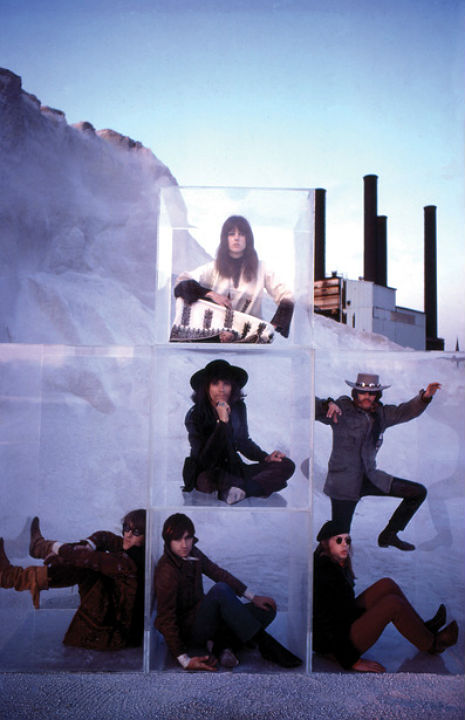
Courtesy of the incomparable pipes of Grace Slick, backed by Jorma’s soaring guitar. Jefferson Airplane on the Dick Cavett Show on 08-19-1969, the day after Woodstock. If they paid attention to the lyrics, this might have been the end of the line for the Airplane’s credibility with some Cavett viewers (and the beginning of their cred for others). (via Dangerous Minds). [Do these terms mean anything to you: Grace Slick? Jefferson Airplane? Dick Cavett? Woodstock? ‘Up against the wall, motherfucker’?]
“If you visit a Northwest ocean beach this summer, you’ll likely run across objects from last year’s Japanese tsunami.
The things you’ll likely see include milk jugs, detergent bottles, tooth brushes and bottles for water, pop or juices with Japanese stamps, marks and labels. Perhaps a soccer ball or a volleyball — two that washed up on an Alaskan island have been claimed by their Japanese owners.
The things you are highly unlikely to see are human remains, refrigerators or anything else that would have to be sealed to float or can come apart, like bigger parts of houses. Months on the ocean will breakup anything with parts, experts say.” (via KPLU News for Seattle and the Northwest).
Paul Krugman: “So Mitt Romney gave a speech at a closed Ohio drywall factory, which he tried to use as a symbol of Obama’s economic failure. The symbolism was perfect — not as an illustration of Obama’s failure, but as an illustration of just how stupid Romney thinks we are.
Even regular reporters noticed that the factory in question closed under, yes, George W. Bush — a fact Romney failed to mention, although his campaign scrambled to cover for him afterwards.
What I didn’t see mentioned was the point that this was a drywall factory — that is, a supplier of a product largely used in home construction. It’s one thing to say that Obama should have revived the economy as a whole; it’s another to say that he should have brought back the housing bubble!
Finally, why should we believe that Romney’s policies — basically tax cuts for the rich, as usual — would yield great economic results? Well, I guess you can point to Bush’s example; how did his administration at this point compare with Obama? From BLS data:
You can offer various excuses for Bush’s record, I guess. But on the face of it, what possible reason is there to think that Bush-like policies would be an improvement?” (via NYTimes.com).

“While baboons can’t read, they can tell the difference between real English words and nonsensical ones, a new study reports.” (via NYTimes).

The name of the author is the first to go
followed obediently by the title, the plot,
the heartbreaking conclusion, the entire novel
which suddenly becomes one you have never read,
never even heard of,
as if, one by one, the memories you used to harbor
decided to retire to the southern hemisphere of the brain,
to a little fishing village where there are no phones.
Long ago you kissed the names of the nine Muses goodbye
and watched the quadratic equation pack its bag,
and even now as you memorize the order of the planets,
something else is slipping away, a state flower perhaps,
the address of an uncle, the capital of Paraguay.
Whatever it is you are struggling to remember,
it is not poised on the tip of your tongue,
not even lurking in some obscure corner of your spleen.
It has floated away down a dark mythological river
whose name begins with an L as far as you can recall,
well on your own way to oblivion where you will join those
who have even forgotten how to swim and how to ride a bicycle.
No wonder you rise in the middle of the night
to look up the date of a famous battle in a book on war.
No wonder the moon in the window seems to have drifted
out of a love poem that you used to know by heart.
— Billy Collins

“As you educate yourself about your own talent and ambitions, you graduate from doing a task right to doing the right task. It takes some experience to realize that a lot of work is better left undone. It might be busywork that is performed out of habit, or it might be work that is heading in the wrong direction. Working smart means making sure you are spending your time on jobs that are effective and that actually need to be done.” (via Smarterware).
“I’m typically a year or two behind any cultural trend, so you probably already know about gender-reveal parties. I first heard of them over the weekend: a couple, strangers to me, had invited friends and relatives over to bite into cupcakes at the same instant and share the moment when the blue or pink custard inside would inform them all of the sex of the baby. (The sonogram result had gone from lab to baker without being seen by anyone else, including the parents-to-be.) Other couples choose different methods of revelation: grip the knife together and cut into a cake with blue or pink filling. Open a sealed box that releases pink or blue helium balloons. Then put the scene on the Web so that everyone not invited can participate vicariously.
These events are becoming more and more popular. The first video of a gender-reveal party was posted on YouTube in 2008, but in just the last six months almost two thousand have been uploaded. You can watch one from last month. (Spoiler alert: it’s a girl.)
Maybe it was the context—I happened to hear about the gender-reveal party in a rundown inner-city café full of ex-felons who were having a very hard time finding jobs—but my initial take was incredulity trending negative. These parties seem to marry the oversharing of Facebook and Instagram with the contrived ceremonies that modern people in search of meaning impose on normal life events: food journaling, birthday parties for grownups, workout diaries, birth-experience planning. (One birth-planning center offers a “baby gender selection kit” involving three safe and natural steps that turn sex itself into a gender-reveal party.)
In the case of gender-reveal parties, couples take a private moment made possible by science and oblige others to join in, with the result—as in so many invented rituals of our day—that the focus turns from where it ought to be (in this case, the baby) to the self. At a bris or christening, the emotional emphasis falls on the arrival of a new life in the embrace of family and community. At a gender-reveal party, the camera is on the expectant father tearing up at the sight of pink cake.
That’s the nature of manufactured customs and instant traditions. They emerge from an atomized society in order to fill a perceived void where real ceremonies used to be, and they end by reflecting that society’s narcissism. Is it too much to say that gender-reveal parties are a mild symptom of cultural despair?” (via The New Yorker)
Flying Burrito Brother Dies at 65: “Chris Ethridge, a founding member of the country-rock band “The Flying Burrito Brothers,”died here on Monday. He was 65.He learned he had pancreatic cancer in September, his family said.Mr. Ethridge, a bassist and a songwriter, spent eight years on the road with Willie Nelson. He played alongside Gram Parsons in the Flying Burrito Brothers and the International Submarine Band and co-wrote several of Mr. Parsons’ solo tunes.In later years, Mr. Ethridge played with Jackson Browne, Linda Ronstadt, Ry Cooder and other stars, both as a session musician and touring player.” (NYTimes.com obituary)
Ethridge was smack dab at the center of the musical scene I enjoyed so much back in those years. Along with Levon Helm’s passing, the music is much diminished this week.
“Last Friday, …we asked readers to propose a single English word that should be eliminated from the language. Suggestions were made via Facebook or Twitter, with the hashtag #tnyquestion. We started the contest with high hopes that readers would help to streamline the language, but the first wave of responses was not auspicious…” (via The New Yorker).
Some of the scurrilous suggestions are not surprising, but the runaway favorite is.
The Forty-Year Itch (Adam Gopnik): “So it seems time to pronounce a rule about American popular culture: the Golden Forty-Year Rule. The prime site of nostalgia is always whatever happened, or is thought to have happened, in the decade between forty and fifty years past. (And the particular force of nostalgia, one should bear in mind, is not simply that it is a good setting for a story but that it is a good setting for you.)” (via The New Yorker).
Here’s something I said on FmH ten years ago today:
“In case any FmH readers were wondering how I’ve come by my opinionated gall, it may have something to do with the fact that I turn 50 years old today. (Others may be thinking I probably shouldn’t be doing this at my age…). And my son turns eight today…”
So today my son is eighteen, and I’ve put on a few years too. Thanks to everyone for all the wonderful birthday greetings.
‘Dmitri Krioukov, a senior research scientist at UCSD, successfully appealed his failure-to-stop ticket using a physics and math argument that ultimately swayed a San Diego judge.
In the paper, entitled “The Proof of Innocence,” Krioukov offered a series of equations and graphs to show that it was physically impossible for him to have broken the law, as an officer claimed.
The judge was “very, very smart,” Krioukov told The Times. “She got my point, I think, very precisely.”
Krioukov compared the problem to the way a person sees a train approaching from the platform and thinks it is moving slowly, when in fact it is barreling down the track. Using math and physics, Krioukov determined that a car moving at a constant speed can appear to move in the same way as a car that is moving fast but stops for a short time and then accelerates again.
In other words, a car that appears to be moving at a constant speed through a stop sign could have actually stopped at the stop sign, before speeding up again.’ (via LATimes).

Levon Helm performing with The Band. Hamburg, May 1971.
Sad news. Levon Helm is near death, according to this note posted on his website by his family:
“Dear Friends,
Levon is in the final stages of his battle with cancer. Please send your prayers and love to him as he makes his way through this part of his journey.
Thank you fans and music lovers who have made his life so filled with joy and celebration… he has loved nothing more than to play, to fill the room up with music, lay down the back beat, and make the people dance! He did it every time he took the stage…
We appreciate all the love and support and concern.
From his daughter Amy, and wife Sandy”
The Band‘s brown album would be one of my ten desert island discs, for sure, and always has heavy rotation on my iPod. My best friend, if anything a more intense fiend for the Band, and I were always planning to get to one of the Midnight Rambles Helm had been holding on his farm. Sorrowfully, not to be. Saving grace is that he is soon to join Richard Manuel and Rick Danko in the Angel Band. (via Levon Helm Studios, with thanks to abby for the original heads-up).
And: Levon Helms’ finest musical moments. (via Recordonline)
“Exactly one hundred years ago Sunday, an ocean liner struck a block of ice and sank in the North Atlantic. The story of the ocean liner has been told hundreds of times. This story is about the block of ice.
[These] photos … are quite possibly the only known photographic evidence of the actual iceberg that struck the Titanic. Understandably, nobody had bothered to snap any photographs while the ship was actually sinking, so it’s impossible to make an absolutely confirmed positive identification. But both photographs feature the telltale sign of a collision with a ship, and likely a recent one at that: a streak of red paint.” (via Wired)
“A massive genetics study relying on fMRI brain scans and DNA samples from over 20,000 people has revealed what is claimed as the biggest effect yet of a single gene on intelligence…” (via New Scientist).
But that is not the most significant aspect of this finding. The effect, although real, was miniscule, accounting for less than 2 points in IQ. So, is it any surprise that the authors conclude that, to the extent that genetics influences intelligence, it is a function of the interplay of multiple genes, not just one?

“An incredibly stunning solar flare erupted from the sun’s surface, throwing charged particles and searing plasma millions of miles out into space on Apr. 16.
NASA’s Solar Dynamics Observatory captured data from the flare — a medium-sized M-class event — which was turned into a movie by Steele Hill, media specialist at the Goddard Space Flight Center. The blast was not directed at the Earth and is unlikely to hit any of the planets in our solar system….
The sun is currently entering a time of renewed activity, following a quiet period in its 11-year solar cycle. Peak action is expected from early- to mid-2013. Though it is predicted to be one of the least active cycles in the last 100 years, we have already witnessed several massive flares this year.” (via Wired).
- Michael Apted
‘The latest installment of the Up Series of documentary films is due out in the UK in May. The films have followed the development of fourteen British children since 1964 with a new film appearing every seven years…the participants are now 56.
…
This may be the last film in the series…director Michael Apted will be 78 when the next film is due and he’s unwilling to pass it off to someone else to finish.” (via kottke)
Any documentary lover and any Anglophile (I count myself as both) should have been following this fascinating and unprecedented series of films.
Language Log discusses the New York Times’ relationship with obscenity. Update here.

“The New York Times won two Pulitzer Prizes on Monday, for its reporting on Africa and for an investigative series on obscure tax code provisions that let the wealthiest Americans and corporations avoid paying taxes. And in a sign of the changing media landscape, online news outlets made a significant mark among the winners, with The Huffington Post and Politico capturing their first Pulitzer Prizes.
Also notable this year was the absence of prizes in two categories. The Pulitzer Prize Board at Columbia University in New York, which administers the awards, did not name a winner in the editorial writing category and more notably declined to name a winner of the coveted prize for fiction. The last time no winner was named for fiction was in 1977.” (via NYTimes).
- 3D representation of brodmann areas
“It has not been know exactly how ECT works. It is known that ECT reduces brain activity and raises seizure threshold (makes it less likely to have a seizure). This implies that overall neuronal activity is reduced, so perhaps ECT is inhibiting overactivity in a part of the brain that is driving the depression. That hypothesis is supported by a recent study that uses fMRI scanning to look at brain activity in nine patients with major depression before and after ECT. They found:
A comparison of pre- and posttreatment functional connectivity data in a group of nine patients revealed a significant cluster of voxels in and around the left dorsolateral prefrontal cortical region (Brodmann areas 44, 45, and 46), where the average global functional connectivity was considerably decreased after ECT treatment (P < 0.05, family-wise error-corrected). This decrease in functional connectivity was accompanied by a significant improvement (P < 0.001) in depressive symptoms
Once way to interpret this result is that some patients with major depression have overactive connectivity between that part of the brain that generates the emotion of depression and the part of the brain involved in cognition and concentration. In these patients, therefore, their depressed mood has a significant effect on their thoughts and ability to concentrate. ECT appears to reduce this hyperconnectivity, which should significantly reduce the symptoms of depression.
This is all consistent with prior research on depression, and makes good sense. Still, it’s a small study that needs to be replicated and the whole question further explored.” (via NeuroLogica Blog ).
“When traveling across the United States, it sometimes feels like the locals are speaking a whole different language. That’s where the Dictionary of American Regional English comes to the rescue. The last installment of this staggering five-volume tome, edited by Joan Houston Hall, was published last month, and let me tell you, it’s a whoopensocker.
In celebration of slang, here’s a list of 19 delightful obscure words from around the U.S. that you’ll want to start working into conversation.” (via Mental Floss).
“A blind woman who did not realise the novel she was writing was blank after her pen ran out has been saved after a police force used forensic techniques to recover the words. Forensics experts agreed to use a special scientific process to recover what Trish Vickers had written by examining the dents she had made in the pages.
Mrs Vickers, 59, was left devastated when she learned that her pen had run out and there was nothing on the first 26 pages of the book. She lost her sight seven years ago through diabetes and decided to write a novel to pass the time and keep her mind active. She quickly penned the opening chapters while using a system of elastic bands to keep the lines separated on the pages of paper she was using. She waited for her son Simon to visit so he could read it back to her. But when he arrived he had to tell her that the pages were blank.
Incredibly, however, the manuscript was recovered after the family took it to their local police HQ and asked for help. Forensic experts worked in their spare time to read the indentations left on the A4 pages using a system of lights. It took five months of painstaking work, but the forensic team was able to recover the whole text – and they said how much they had enjoyed it and couldn’t wait for the rest. A Dorset police spokesman said a member of staff had completed the work during her lunch hours.” (via Telegraph.UK, with thanks to Steve)
“The wind map is a personal art project, not associated with any company. We’ve done our best to make this as accurate as possible, but can’t make any guarantees about the correctness of the data or our software. Please do not use the map or its data to fly a plane, sail a boat, or fight wildfires…” (via Wind Map)

Nietzsche, summer 1899
‘Henri is the anti-Hello Kitty, a morose French feline who spends his time dissecting the absurdity of his daily grooming rituals and the despair of his solitary existence. Oh, and sometimes he updates his Facebook page. “I suppose that’s my lot in life,” he sighs. “To be watched endlessly, but never understood.” After seeing this, you’ll either immediately click to get to Henri’s first video or spend the afternoon wondering whatever happened to your Nietzsche-reading sophomore year roommate.’ (via msnNOW).

Richard Metzger wishes Samuel Beckett a happy 106th birthday on Dangerous Minds.

Single-exposure shot from the photographer’s apartment window. Wow. (Laughing Squid)

“One hundred years after Alan Turing was born, his eponymous test remains an elusive benchmark for artificial intelligence. Now, for the first time in decades, it’s possible to imagine a machine making the grade…. There is reason to believe that code kernels for the first Turing-intelligent machine have already been written.” (via Wired.com).
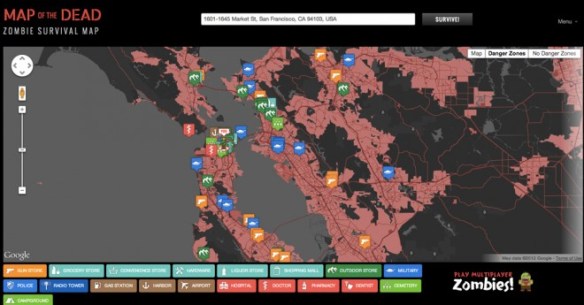
“…The Map of the Dead from Doejo… overlays zombie danger zones and potential supply locations on a Google Map of your local haunts. Red areas denote population centers where zombies might graze, while dark gray zones cover parks and wilderness areas, which are most likely to be walker-free. Supply locations are annotated with helpful descriptions — liquor stores, hospitals, gun shops, military bases and cemeteries are just some of the locations highlighted.” (via Wired.com).
“Connecticut is set to become the fifth American state in as many years to abolish capital punishment, in one of the less commented trends in recent years. It would mean that over a third of the Union’s states are free of capital punishment, but the real coup would be if abolition campaigners won the battle in California, which will decide in November.” (via Telegraph.UK)
…a phenomenon attracting more attention in the European press than the US.

“We’re probably in a bubble in terms of the way we talk about reading longer pieces of writing. But where did #longreads and longform come from?” (via BuzzFeed).


‘In what is being touted as “the world’s largest dream experiment,” a psychologist from Britain’s University of Hertfordshire is inviting volunteers to try using an iPhone app to control their dreams.’ (via GizMag).
”

“A very happy birthday to the great Paul Krassner (left, with Tuli Kupferberg and unidentified party)! The father of the underground press (although he demanded a paternity test), editor of The Realist, Yippie co-founder and inspiration to two generations of rabble-rousers, turns 80 today.” (via Dangerous Minds)
Review of Going Solo: The Extraordinary Rise and Surprising Appeal of Living Alone by Eric Klinenberg, a sociologist at New York University:
“…[S]ingle living [is] not a social aberration but an inevitable outgrowth of mainstream liberal values. Women’s liberation, widespread urbanization, communications technology, and increased longevity—these four trends lend our era its cultural contours, and each gives rise to solo living. Women facing less pressure to stick to child care and housework can pursue careers, marry and conceive when they please, and divorce if they’re unhappy. The “communications revolution” that began with the telephone and continues with Facebook helps dissolve the boundary between social life and isolation. Urban culture caters heavily to autonomous singles, both in its social diversity and in its amenities: gyms, coffee shops, food deliveries, laundromats, and the like ease solo subsistence. Age, thanks to the uneven advances of modern medicine, makes loners of people who have not previously lived by themselves. By 2000, sixty-two per cent of the widowed elderly were living by themselves, a figure that’s unlikely to fall anytime soon.
What turns this shift from demographic accounting to a social question is the pursuit-of-happiness factor: as a rule, do people live alone because they want to or because they have to?” (via The New Yorker).

“Tom Lehrer – mathematician, satirist, singer-songwriter and hero to geeks taking chemistry tests everywhere – was born on April 9, 1928, making today his 84th birthday! …Mr. Lehrer, from all of the geeks who loved (and were educated by) your songs as kids, and who now teach those songs to our own children – thank you, and a very happy birthday to you!” (via Wired.com).

“Across the country, more than 7,700 daily temperature records were broken last month, on the heels of the fourth warmest winter on record.
While it might be time to lie on a blanket in the park, climate scientists are worried. They say all these sunny days are actually an extreme weather event, one with local and global implications.” (via NPR).
Thirty-four years after California’s Proposition 7 sailed through, making the state’s death penalty one of the toughest in the country, the two men who were the driving force behind its crafting are leading the charge to repeal the death penalty in that state. Their reasons are partly moral, but good politics as well. (via New York Times)

Death-penalty

“There’s no easy way to say it. You’ve probably been playing Hangman wrong your entire life.” (via Lifehacker). And, it turns out, I have.
Won’t make you look like Robocop: “The good news: Google has started testing those augmented reality glasses we heard about earlier in the year. The bad news: if the artsy shots of the test units are to be believed, they won’t make you look like some ’80s cinematic anti-hero. In fact, the things wouldn’t look too out of place in a New York Times style story. The software giant let it be known that, while it hasn’t quite got a sale date on the wearables, it’s ready to test ProjectGlass amongst the non-augmented public. The company is also looking for feedback on the project, writing in a post today, “we want to start a conversation and learn from your valuable input.” Want some idea of what ProjectGlass might offer the public? Sure, it’s not quite as good as strapping a pair on your own eyes, but interested parties can check out a video of Google’s vision…” at the link (Engadget).

“Violence Transformed is an annual series of visual and performing arts events that celebrate the power of art, artists and art-making to confront, challenge and mediate violence.
Based primarily in the center and surrounding neighborhoods of Greater Boston and drawing upon the creative energies of artists throughout New England, Violence Transformed documents the ways in which our diverse communities harness art’s potential to effect social change and materially transform our environments.
Violence Transformed also represents a unique collaboration among artists, activists, museum professionals, academics, and community service providers from diverse segments of the greater Boston area. We share the conviction that art and art-making are essential to the well-being and vibrancy of our communities.”

Do not use if you have ever had an allergic reaction to this product or any of its ingredients.
Failure to follow all instructions and warnings can result in serious injury.
Please leave as clean on leaving as you would like to find on entering.
Any resemblance to actual persons living or dead is purely coincidental.
Place all seat backs and tray tables in fully upright position.
Post office will not deliver without proper postage affixed.
Do not operate heavy machinery while reading this weblog.
Caution: Dates on calendar are closer than they appear.
Please note locations of emergency exits upon arrival.
No animals were harmed in the production of this page.
May be used as flotation device in case of emergency.
No ideas were harmed in the making of this weblog.
Anything you say can and will be used against you.
Satisfaction guaranteed; return for full refund.
Names have been changed to protect the innocent.
All questions answered, all answers questioned.
Objects on screen are closer than they appear.
If condition persists, consult your physician.
Detach and include upper portion with payment.
Nutritional need is not established in humans.
Caution: do not swallow. May cause irritation.
Do not use if safety seal is torn or missing.
Please inform author if you cannot read this.
Product is sold by weight and not by volume.
In emergency, break glass, pull down handle.
Caution! The edge is closer than you think.
Contents may have settled during shipment.
Do not fold, staple, spindle or mutilate.
Prices subject to change without notice.
Freshest if used before date specified.
Valid only at participating locations.
If swallowed, do not induce vomiting.
You have the right to remain silent.
Do not remove under penalty of law.
This page intentionally left blank.
Use only in well-ventilated areas.
Do not exceed recommended dosage.
No user-serviceable parts inside.
Warning, contents are flammable.
No shirt, no shoes, no service.
Alarm will sound if door opened.
You break it, you’ve bought it.
You need not be present to win.
Keep out of reach of children.
Part of a daily balanced diet.
First pull up, then pull down.
Void where prohibited by law.
Apply only to affected areas.
Other restrictions may apply.
Close cover before striking.
Do not think of an elephant.
Viewer discretion advised.
You must be present to win.
Caution, low-flying ideas.
Honk if you can read this.
No purchase is necessary.
More taste, less filling.
Internet access required.
Not a low-calorie food.
Don’t try this at home.
Wash hands after using.
Consume in moderation.
Store in a cool place.
For external use only.
Mix well before using.
Your mileage may vary.
Shake well before use.
Use only as directed.
Results not typical.
Consume responsibly.
Ignore this notice.
Slippery when wet.
Unplug after use.
Same-day service.
No preservatives.
No trespassing.
No exit.
“I wrote a program that takes any text and tries to find any accidental limericks that might be hiding within (based on syllable counts and rhyme, ignoring punctuation and intent).
Limericks have a fairly loose form. The rhyme scheme is always AABBA, but the syllable count can be anything along the lines of 7-or-8-or-9/7-or-8-or-9/5-or-6/5-or-6/7-or-8-or-9. And as if that weren’t loosey-goosey enough, they can have either anapaestic meter (duh-duh-DUM, duh-duh-DUM) or amphibrachic meter (duh-DUM-duh, duh-DUM-duh)!
…(So) Nantucket is set to look for limericks that are AABBA (rhyme scheme) and 8/8/5/5/9 (syllable count per line). It currently ignores meter, but I may add that requirement in later. It also only looks at words through an American English accent.” (Danielle Sucher, via Neal Stephenson)

“James McCartney Looking to Form Band with Sean Lennon, Dhani Harrison and Zak Starkey…” (via Cool Album of the Day). Do those names mean anything to you? Do you expect that the music would be very good?

Think Again : “Everybody knows that there’s just one moon orbiting the Earth. But a new study by an international team of astronomers concludes that everybody is dead wrong about that.” (via NPR).

21 of them, in the Telegraph.UK’s opinion. On the other hand, I don’t know much about architecture but about half of these inspire admiration and wonder, not revulsion or derision, in me.
‘
At Cult of Mac, John Brownlee writes about Girls Around Me, a creepy app that exploited geolocation APIs to make it easy to stalk women.
These are all girls with publicly visible Facebook profiles who have checked into these locations recently using Foursquare. Girls Around Me then shows you a map where all the girls in your area trackable by Foursquare area. If there’s more than one girl at a location, you see the number of girls there in a red bubble. Click on that, and you can see pictures of all the girls who are at that location at any given time. The pictures you are seeing are their social network profile pictures.
See also Charlie Sorrel’s guide to kill the Facebook and FourSquare features that enable apps like this.’ (via Boing Boing, with thanks to kerry).
Tell your daughters, wives, significant others, friends about this.

Exiles mourn latest in string of self-immolation suicide protests: “Dozens of Tibetans have self-immolated in the past year to protest Chinese oppression. In addition to dousing themselves with fuel, some drink kerosene, so that the flames will explode from within.” (via Boing Boing). Why is this phenomenon being largely ignored by the world press?
“MIT researchers have shown, for the first time ever, that memories are stored in specific brain cells. By triggering a small cluster of neurons, the researchers were able to force the subject to recall a specific memory. By removing these neurons, the subject would lose that memory.As you can imagine, the trick here is activating individual neurons, which are incredibly small and not really the kind of thing you can attach electrodes to. To do this, the researchers used optogenetics, a bleeding edge sphere of science that involves the genetic manipulation of cells so that they’re sensitive to light. These modified cells are then triggered using lasers; you drill a hole through the subject’s skull and point the laser at a small cluster of neurons.” (via ExtremeTech).

‘Think of Jennifer, or as we like to call her, “Jen.” Jen of the dazzling smile, Jen of the gorgeous chin, Jen with her hair down, Jen tousled, Jen as Rachel, Jen with Brad; Jen without Brad, Jen with Vince, Jen at the Oscars, and, of course, Jen as a neuron in the medial part of the temporal lobe.
Maybe you missed that last Jen.’ (via Krulwich Wonders… : NPR).
A review of T. M. Luhrmann’s When God Talks Back: Understanding the American Evangelical Relationship with God: “Luhrmann is a well-qualified guide: an anthropologist specializing in esoteric faiths. Her dissertation was on witch-and-warlock cults in contemporary England. Later, she wrote a book on the Parsis, a Zoroastrian community in India. Her most recent book was the highly praised Of Two Minds, a study of psychiatric residents and their handling of patients who had visions, among other problems. Almost always, Luhrmann has written with sympathy, not scorn, for these convinced people.
Nevertheless, she is a scientist, and believes in evidence. She spent two years as a full-time member of an evangelical church in Chicago, and another two years in a congregation in Palo Alto. (Those are the cities where she was teaching during that period, first at the University of Chicago, then at Stanford.) Both churches were part of the Vineyard Christian Fellowship, which came together in California in the nineteen-sixties and seventies, and now has about fifteen hundred congregations around the world. Most of the members of the churches that Luhrmann attended were white, middle class, college-educated, and centrist. They weren’t Pentecostals (that is, most of them didn’t speak in tongues or heal the sick). But neither were they just conservative Christians. In Luhrmann’s words, they placed “a flamboyant emphasis on the direct experience of God.” If you made contact with him, they believed, he would become your intimate, someone “who loves and cuddles you.
How do you find this God?” (via The New Yorker)
A review of War and the American Difference by Stanley Hauerwas: “…the American version of modernity is uniquely defined by two special errors: the illusion that modern freedom and Christian witness are reconciled in America and the belief that America’s wars are redemptive, replacing the truly redemptive sacrifice of Christ with the blood sacrifices of soldiers who kill and die from one American generation to the next.
These two errors become one error: American patriotism becomes a false form of Christian piety, and killing for the nation becomes a dark and devilish project of killing for God. War, as Hauerwas puts it, is America’s altar.” (via First Things)

April 2 has been designated as World Autism Awareness Day (did you know?). But Steve Silberman explains why that is not enough:
“No matter where you stand on the rising numbers, there is one undeniably shocking thing about them. Once that 1-in-88 kid grows to adulthood, our society offers little to enable him or her to live a healthy, secure, independent, and productive life in their own community. When kids on the spectrum graduate from high school, they and their families are often cut adrift — left to fend for themselves in the face of dwindling social services and even less than the meager level of accommodations available to those with other disabilities.
Meanwhile, the lion’s share of the money raised by star-studded “awareness” campaigns goes into researching potential genetic and environmental risk factors — not to improving the quality of life for the millions of autistic adults who are already here, struggling to get by. At the extreme end of the risks they face daily is bullying, abuse, and violence, even in their own homes…”
He goes on to ask a group of self-advocates, parents and teachers how to go beyond once-a-year ‘awareness’ to create a truly neurodiverse society. (via NeuroTribes)

“As an American, I demand the basic freedom to walk my streets in safety — including the freedom to go to the store and buy Skittles without getting shot.” (via Brady Campaign to Prevent Gun Violence; thanks, laurie)
“The recent remark by Mitt Romney’s senior adviser Eric Fehrnstrom that upon clinching the Republican nomination Mr. Romney could change his political views “like an Etch A Sketch” has already become notorious. The comment seemed all too apt, an apparent admission by a campaign insider of two widely held suspicions about Mitt Romney: that he is a) utterly devoid of any ideological convictions and b) filled with aluminum powder.
The imagery may have been unfortunate, but Mr. Fehrnstrom’s impulse to analogize is understandable. Metaphors like these, inexact as they are, are the only way the layman can begin to grasp the strange phantom world that underpins the very fabric of not only the Romney campaign but also of Mitt Romney in general. For we have entered the age of quantum politics; and Mitt Romney is the first quantum politician.” (via NYTimes)

A home-made heroin substitute is having a horrific effect on thousands of Russia’s drug addicts. (via Independent.UK)
‘His best books combine comedy and moral outrage, which he combined and lighted on the page like diesel fuel. Their swaggering characters had outsize personalities; so did he. A gruff gallery of faces squint from his dust jackets, from the grizzled swamp sage on the back of his 1978 memoir “A Childhood” to the Mohawk haircut and pit-bull grimace he later favored.Mr. Crews wrote about the South’s white poor, a world he knew intimately. He was a tenant farmer’s son, and he felt the burden of his hard upbringing. In an Esquire magazine essay, later collected in a book called “Blood and Grits,” he wrote:“I was so humiliated by the fact that I was from the edge of the Okefenokee Swamp in the worst hookworm and rickets part of Georgia I could not bear to think of it … Everything I had written had been out of a fear and loathing for what I was and who I was. It was all out of an effort to pretend otherwise.” ‘ (via NYTimes)

“The origins of April Fools’ Day are shrouded in mystery, experts say.” (via National Geographic).

“A controversial type of pesticide linked to declining global bee populations appears to scramble bees’ sense of direction, making it hard for them to find home. Starved of foragers and the pollen they carry, colonies produce fewer queens, and eventually collapse.
The phenomenon is described in two new studies published March 29 in Science. While they don’t conclusively explain global bee declines, which almost certainly involve a combination of factors, they establish neonicotinoids as a prime suspect.
“It’s pretty damning,” said David Goulson, a bee biologist at Scotland’s University of Stirling. “It’s clear evidence that they’re likely to be having an effect on both honeybees and bumblebees.” (via Wired)
“Poor little guy. Starting in the fall, Canada’s government will stop producing the lowly Canadian penny. The fact that pennies are expensive to make and are virtually worthless in today’s economy led them to fall victim to Ottawa’s budget cuts. The government says the measure will save around $11 million a year because each new penny costs 1.6 Canadian cents to produce. (One Canadian dollar is essentially equal to $1 in the U.S.) And a Canadian penny buys you only about 1/20th of what it could when it was introduced in 1858: A penny that could hypothetically buy a whole loaf of bread then would only buy a few bites of bread now.
Canadian consumers will be able to use the 1¢ coins indefinitely, but the government is encouraging businesses to start rounding to the nearest nickel. Lest people forget their arithmetic lessons, the government has put out a fact sheet on proper rounding techniques.
The Canadian move, which cites costs and inflation, follows the long-held logic trumpeted by many economists to get rid of 1¢ pieces in the U.S. Economist Stephen Dubner alone has nearly 20 entries on his Freakonomics blog begging for a U.S. penny death. “Can we please be next?” he wrote this morning after learning of Canada’s move.
A 2008 New Yorker article lays out the counterarguments that have prevented the penny’s seemingly inevitable extinction. There are objections to rounding, which one economist estimated could cost U.S. consumers as much as $1.5 billion over five years. Also, cutting out the penny may just put more reliance on the nickel—which is even more expensive to produce. In the U.S. loses 1.4¢ on each penny it makes and 6.2¢ on each nickel, according to Coin Update, an industry news source. Plus, plenty of Americans like pennies and their Honest Abe heritage. Those enthusiasts, along with industry lobbies, have rallied to support the coins when there has been movement to kill them.” (via Businessweek)

Anti-fascists mobilise against English Defence League summit in Denmark: “Hundreds of demonstrators will confront the English Defence League tomorrow as the far-right group holds its first ever European summit in a bid to set up a Continent-wide alliance of anti-Islamic organisations.
Danish activists claimed that as many as 4,000 anti-fascist activists would make their way to the town of Aarhus, where the meeting is due to take place tomorrow afternoon, from the UK, Denmark and Germany.
Organisers said they would march one hour before an EDL rally in the town, in what they predicted would be the country’s largest anti-fascist mobilisation in 15 years.” (via Independent.UK)

Image from the backscatter advanced imaging technology (AIT) machine used by the TSA to screen passengers. This is what the remote TSA agent would see on their screen.
A reader wrote to see if my audience would be interested in seeing this well-done infographic about TSA waste. (Thanks, Tony) If you think the tax dollars you have contributed to funding the TSA have made you safer, I’ve got a bridge to sell you.