‘Donald Trump’s lawyers and the federal government that he controls will try again this week to topple his 34 felony convictions from his New York criminal case by seeking to move the case to federal court.
In its latest effort, Trump’s Justice Department will be continuing its practice of trying to erase his criminal record — and the history that led to it — while prosecuting his enemies under the same charges leveled against him and his supporters.…’ (Adam Klasfeld via All Rise)
‘As tensions between Washington and Tehran remain high, China’s role is under growing scrutiny. How far would Beijing go to support Iran — and where are the limits if conflict broke out with the US?…’ (via DW In Focus)
‘Primordial black holes could rewrite our understanding of dark matter and the early universe. A record-breaking detection at the bottom of the Mediterranean Sea has some physicists wondering if we just spotted one… …The day after the KM3NET collaboration announced the detection , the physicist David Kaiser walked into a room full of his colleagues at the Massachusetts Institute of Technology with a bold proposition: What if the monster neutrino came from an exploding primordial black hole? Such black holes “could form before there were even atoms, let alone stars,” said Kaiser, who has been heavily involved in the hunt for these hypothetical objects.’ (By Jonathan O’Callaghan via Quanta Magazine)
‘(Watching) Trump Attorney General Pam Bondi appear on Fox News after Customs and Border Protection agents killed Alex Pretti in Minneapolis: “How did these people go out and get gas masks?” she asked, incredulously. “These protesters — would you know how to walk out on the street and buy a gas mask, right now? Think about that.”
As a longtime gas mask user, I can sympathize. There isn’t a lot of reliable information out there about how to buy a gas mask, especially for the specific purpose of living under state repression. But hopefully after reading this guide you’ll feel equipped to make an educated decision.…’ (Sarah Jeong via The Verge)
Smart people are not especially prone to confusing correlation with causation because they are careless with evidence. They fall into the trap for a more interesting reason: the human mind is exquisitely tuned to detect patterns and to explain them. When two variables move together in a stable way, the brain does not experience this as a neutral observation. It experiences it as a problem demanding resolution. Something must be connecting these things. Once that question arises, the mind does what it always does—it supplies an answer.
Causal explanations are particularly seductive because they take the form of stories. A correlation merely states that two things vary together; a causal account explains why. The latter feels complete in a way the former does not. Humans are not comfortable leaving relationships unexplained, and “they just co-occur” rarely feels like a satisfying endpoint. As a result, the presence of a correlation creates a vacuum that narrative quickly fills, often long before alternative explanations have been seriously considered.
One reason this happens so reliably is that confounding variables are usually invisible. When people see two associated variables, they instinctively reason as if those variables exist in isolation. The possibility that both are being driven by a third factor—season, population size, illness severity, socioeconomic context—does not announce itself. It has to be actively sought. Without deliberate effort, the mind defaults to a simple two-variable world, even when reality is plainly more complicated.
Reverse causation adds another layer of difficulty. The idea that A causes B fits comfortably with everyday intuition. The idea that B might be causing A, or that both might be downstream effects of something else entirely, is cognitively awkward. It requires slowing down and suspending the initial narrative impulse. In practice, many causal claims rest not on evidence that the proposed direction is correct, but on the fact that it feels natural.
Large datasets and clean statistical results can amplify the problem. A strong correlation, a smooth graph, or a strikingly small p-value creates an aura of authority. The rigor of the mathematics is quietly misattributed to the interpretation. Statistical strength begins to stand in for causal proof, even though the two are conceptually unrelated. The result is an overconfidence that is not warranted by the data.
Ironically, expertise does not reliably protect against this error and can sometimes worsen it. Experts are better at inventing mechanisms, and once a plausible mechanism can be imagined, skepticism often relaxes. The story sounds right, fits existing knowledge, and aligns with professional intuitions. At that point, the correlation no longer feels like a hypothesis-generating observation; it feels like confirmation, even if the proposed mechanism has never been directly tested.
This is why causal claims built on correlation should trigger disciplined discomfort rather than immediate assent. A genuine causal relationship requires more than co-movement. It requires a defensible mechanism, serious attention to confounders, careful consideration of directionality, and evidence that the relationship persists when baseline risk or severity is accounted for. It also requires remembering that group-level associations often fail when projected onto individuals.
Correlation is not meaningless. It is often the first sign that something interesting is happening. But it answers only a narrow question: do these variables change together? The harder question—what, if anything, is causing what—lies downstream. Confusing the two is not a rookie mistake. It is a deeply human one.
When I read Michael Shermer’s recent Washington Post piece on UFOs—now more carefully labeled unidentified anomalous phenomena—I found myself less drawn to the familiar question—are these extraterrestrial?—than to a more interesting one: why does uncertainty in this domain exert such gravitational pull on the modern imagination?
Unidentified phenomena, in the literal sense, are unremarkable. Every mature scientific field has residual anomalies—observations that resist immediate classification because the data are partial, the instruments imperfect, or the conceptual framework still evolving. Aviation and sensor-rich environments are no exception. What is distinctive here is not the existence of unexplained sightings, but the interpretive haste that often follows.
In clinical work, one becomes attuned to the difference between experience and explanation. People encounter events—internal or external—that feel discontinuous with their prior understanding of the world. The event itself may be brief and ambiguous; what endures is the pressure to make it intelligible. Meaning-making is not optional. It is constitutive of human cognition.
UAPs sit at an uncomfortable intersection of perception, technology, and ontology. They are often described under conditions that privilege ambiguity: high speed, unusual vantage points, degraded sensory input, unfamiliar contexts. In such circumstances, the mind reliably does what it has always done—infers agency, intention, or design. This tendency is not pathological. It is an evolved bias toward coherence.
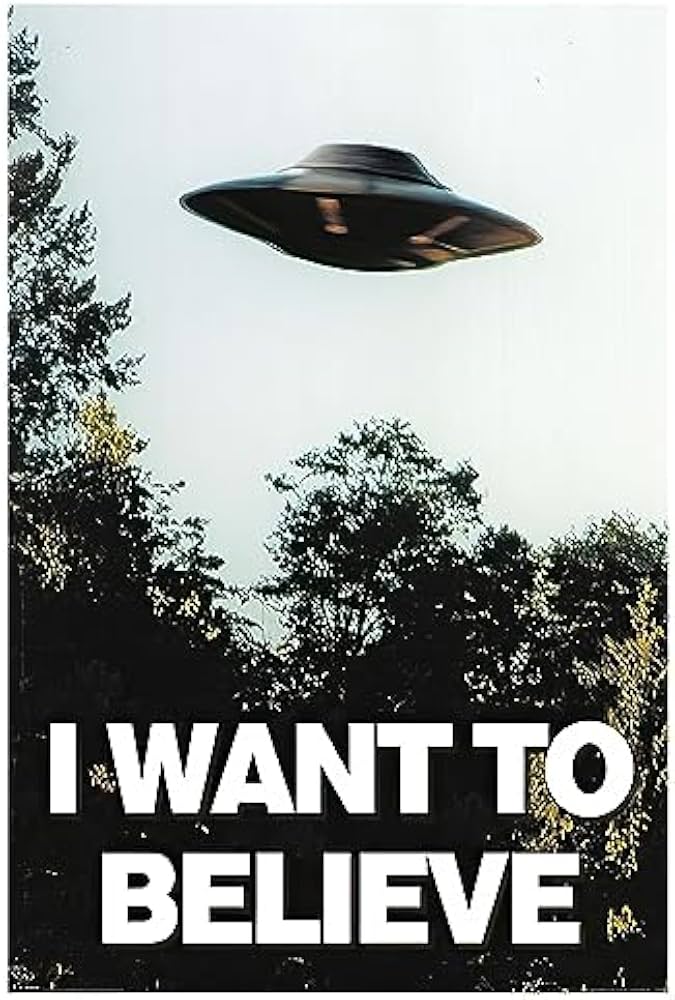
As compelling as Fox Mulder’s “I Want to Believe” is, what Shermer insists upon—quietly but firmly—is epistemic restraint. Most cases dissolve into prosaic explanations when examined carefully. A smaller subset remains unresolved, not because it points clearly toward new physics or nonhuman intelligence, but because the evidentiary chain is weak. From a scientific standpoint, “unexplained” is not a conclusion; it is a placeholder.
What complicates matters is that extraterrestrial explanations do more than explain. They situate. They place human affairs within a broader cosmological narrative at a time when many traditional sources of orientation—religious, institutional, even scientific—feel unstable or distrusted. In that sense, contemporary UFO discourse functions less as hypothesis-testing and more as symbolic reasoning.
This is where psychiatric perspective becomes useful, not as debunking but as contextualization. Humans tolerate uncertainty poorly when it touches existential questions. We are more comfortable with speculative answers than with suspended judgment. The danger lies not in curiosity, but in prematurely converting ambiguity into belief—mistaking narrative closure for understanding.
None of this forecloses the possibility of future discovery. It simply insists on proportionality. Claims that would radically revise our understanding of physics, biology, and history demand correspondingly robust evidence. At present, that threshold has not been met.
What seems most valuable, then, is a capacity increasingly in short supply: the ability to remain intellectually open without being epistemically promiscuous; to acknowledge the limits of current knowledge without filling the gap with certainty; to say, without embarrassment, we do not yet know.
In that sense, UFOs may be less a problem for astrophysics than for intellectual temperament. They test whether we can live with unanswered questions—whether mystery must always be resolved, or whether it can sometimes be allowed to remain, provisionally, unexplained.