R.I.P. Don Van Vliet, Captain Beefheart

[Image 'https://i0.wp.com/graphics8.nytimes.com/images/2010/12/18/arts/BEEFHEART-obit/BEEFHEART-obit-articleLarge.jpg' cannot be displayed]Captain Beefheart’s music career stretched from 1966 to 1982, and from straight rhythm and blues by way of the early Rolling Stones to music that sounded like a strange uncle of post-punk. He is probably best known for “Trout Mask Replica,” a double album from 1969 with his Magic Band.

A bolt-from-the-blue collection of precise, careening, surrealist songs with clashing meters, brightly imagistic poetry and raw blues shouting, “Trout Mask Replica” had particular resonance with the punk and new wave generation to come a decade later, influencing bands like Devo, the Residents, Pere Ubu and the Fall.


Mr. Van Vliet’s life story is caked with half-believable tales, some of which he himself spread in Dadaist, elliptical interviews. He claimed he had never read a book and had never been to school, and answered questions with riddles. “We see the moon, don’t we?” he asked in a 1969 interview. “So it’s our eye. Animals see us, don’t they? So we’re their animals.” (via NYTimes.com obit).

R.I.P. Vic Chesnutt

[Image 'https://i0.wp.com/graphics8.nytimes.com/images/2009/12/26/nyregion/26chesnutt_CA0/articleInline.jpg' cannot be displayed]

Singer and Songwriter Dies at 45: Vic Chesnutt, whose darkly comic songs about mortality, vulnerability and life’s simple joys made him a favorite of critics and fellow musicians, died Friday in a hospital in Athens, Ga., a family spokesman said. He was 45 and lived in Athens.

He had been in a coma after taking an overdose of muscle relaxants earlier this week.

Mr. Chesnutt had a cracked, small voice but sang with disarming candor about a struggle for peace in a life filled with pain. A car crash at age 18 left him partly paralyzed, and he performed in a wheelchair.

The accident, he has said, focused him as a songwriter, and it became the subject of some of his earliest recordings. “I’m not a victim/Oh, I am an atheist,” Mr. Chesnutt sang in “Speed Racer,” from his first album, “Little,” produced by Michael Stipe of R.E.M. and released in 1990.

In a recent interview on the public radio show “Fresh Air,” he told Terry Gross: “It was only after I broke my neck and even like maybe a year later that I really started realizing that I had something to say.”

Although he never had blockbuster record sales, Mr. Chesnutt was a prolific songwriter who remained a mainstay on the independent music circuit for two decades, making more than 15 albums.

Musicians flocked to work with him: he recorded with the bands Lambchop, Widespread Panic and Elf Power, as well as the jazz guitarist Bill Frisell, and in a recent burst of creative activity he made two albums with a band that included Guy Picciotto of Fugazi and members of the Montreal indie-rock group Thee Silver Mt. Zion.

Because of Mr. Chesnutt’s fondness for simple guitar chords — after his accident his fingers could no longer form the jazzier ones, he has said — his work was often described as a variant of folk-rock. But the sound of his albums changed with their revolving collaborators, from stark recordings of Mr. Chesnutt alone to finessed full-band arrangements.

…He sings about suicide in “Flirted With You All My Life,” from his recent album “At the Cut,” describing death as a lover he must break up with because his accomplishments in life are incomplete:

When you touched a friend of mine I thought I would lose my mind

But I found out with time that really, I was not ready, no no, cold death

Oh death, I’m really not ready.

(New York Times obituary)

Posted in Uncategorized | Tagged ,

R.I.P. James Gurley, Big Brother Guitarist

[Image 'https://i0.wp.com/graphics8.nytimes.com/images/2009/12/25/arts/25gurley_CA0/articleInline.jpg' cannot be displayed]

“James Gurley, who played guitar in Big Brother and the Holding Company, the psychedelic rock band that brought Janis Joplin to fame, died on Sunday at his home in Palm Desert, Calif. He was 69. One of the central groups of San Francisco’s fertile mid-1960s rock scene, Big Brother and the Holding Company took blues-based songs on long, strange, electric trips that often featured Mr. Gurley’s protracted solos. In an interview in 2007 with The Desert Sun, in Palm Springs, Calif., Mr. Gurley said that his approach was inspired by the music of John Coltrane.” (New York Times obituary)

Posted in Uncategorized | Tagged ,

R.I.P. Jeanne-Claude

Christo and Jeanne-Claude.
Christo and Jeanne-Claude

Christo’s Collaborator on Environmental Canvas Is Dead at 74. “Jeanne-Claude, who collaborated with her husband, Christo, on dozens of environmental art projects, notably the wrapping of the Pont Neuf in Paris and the Reichstag in Berlin and the installation of 7,503 vinyl gates with saffron-colored nylon panels in Central Park, died Wednesday in Manhattan, where she lived. She was 74.” (New York Times obituary)

Posted in Uncategorized | Tagged ,

R.I.P. Claude Lévi-Strauss

[Image 'https://i0.wp.com/graphics8.nytimes.com/images/2009/11/03/obituaries/03cnd_strauss/popup.jpg' cannot be displayed]

The renowned anthropologist is dead at 100: “His interpretations of North and South American myths were pivotal in changing Western thinking about so-called primitive societies. He began challenging the conventional wisdom about them shortly after beginning his anthropological research in the 1930s — an experience that became the basis of an acclaimed 1955 book, Tristes Tropiques, a sort of anthropological meditation based on his travels in Brazil and elsewhere.

The accepted view at that time held that primitive societies were intellectually unimaginative and temperamentally irrational, basing their approaches to life and religion on the satisfaction of urgent needs for food, clothing and shelter.

Mr. Lévi-Strauss rescued his subjects from this limited perspective. Beginning with the Caduveo and Bororo tribes in the Mato Grosso region of Brazil, where he did his first and primary fieldwork, he found among them a dogged quest not just to satisfy material needs but also to understand origins, a sophisticated logic that governed even the most bizarre myths, and an implicit sense of order and design, even among tribes that practiced ruthless warfare.

His work elevated the status of “the savage mind, ” a phrase that became the English title of one of his most forceful surveys, La Pensee Sauvage (1962).

“The thirst for objective knowledge,” he wrote, “is one of the most neglected aspects of the thought of people we call ‘primitive.’ ” (New York Times obituary)

As an anthropology student before I went into psychiatry, I was an ardent follower of Levi-Strauss and La Pensee Sauvage one of my bibles. I don’t think, however, that Levi-Strauss’ contribution was to elucidate the ‘pre-scientific’ logic of the ways tribal people make sense of the world. Our ‘scientific’ ‘objective’ worldview is just another exemplar of the ‘savage’ ordering methodology, it rather seems. For me, this was far more important than the intricacies of structural analysis of any particular myth system, and it informs my “cross-cultural” approach to my work with psychotic patients to this day, if that makes any sense.

R.I.P. Ururu

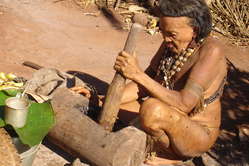
Amazon tribe down to five as oldest member dies: “The Akuntsu tribe in the Brazilian Amazon has lost its oldest member, Ururú, leaving the tribe with only five surviving members.

Ururú was the oldest member of this close-knit, tiny group and an integral part of it.
Altair Algayer, head of FUNAI’s (Brazilian government Indian affairs department) team which protects the Akuntsu’s land said, ‘She was a fighter, strong, and resisted until the last moment.’ In addition, the oldest-surviving Akuntsu, Ururú’s brother Konibú, is seriously ill.

Ururú witnessed the genocide of her people and the destruction of their rainforest home, as cattle ranchers and their gunmen moved on to indigenous lands in Rondônia state. Rondônia was opened up by government colonisation projects and the infamous BR 364 highway in the 1960s and 70s… [T]oday’s survivors say their family members were killed when ranchers bulldozed their houses and opened fire on them… The ranchers attempted to hide evidence of the crime, but wooden poles, arrows, axes and broken pottery were discovered.

…Survival’s Director Stephen Corry said today, ‘With Ururú’s death we are seeing the final stages of a 21st century genocide. Unlike mass killings in Nazi Germany or Rwanda, the genocides of indigenous people are played out in hidden corners of the world, and escape public scrutiny and condemnation. Although their numbers are small, the result is just as final. Only when this persecution is seen as akin to slavery or apartheid will tribal peoples begin to be safe.’ ” (Survival International)

R.I.P. Lucy Vodden, 46

‘ “I don’t relate to the song, to that type of song,” she told The Associated Press in June. “As a teenager, I made the mistake of telling a couple of friends at school that I was the Lucy in the song and they said, ‘No, it’s not you, my parents said it’s about drugs.’ And I didn’t know what LSD was at the time, so I just kept it quiet, to myself.” ‘
(New York Times obit)

Posted in Uncategorized | Tagged ,

R.I.P. Mary Travers

The folksinger, one third of Peter, Paul and Mary, has died after a battle with leukaemia, aged 72. Travers was an outspoken supporter of the civil rights and anti-war movements. “I am deadened and heartsick beyond words to consider a life without Mary Travers and honoured beyond my wildest dreams to have shared her spirit and her career,” Noel “Paul” Stookey said. (BBC obituary).

Posted in Uncategorized | Tagged ,

R.I.P. Jim Carroll

[Image 'https://i0.wp.com/graphics8.nytimes.com/images/2009/09/14/arts/14carroll190.jpg' cannot be displayed]

Poet and Punk Rocker Who Wrote ‘The Basketball Diaries’ Dies at 60: “As a teenage basketball star in the 1960s at Trinity, an elite private school on the Upper West Side of Manhattan, Mr. Carroll led a chaotic life that combined sports, drugs and poetry. This highly unusual combination lent a lurid appeal to “The Basketball Diaries,” the journal he kept during high school and published in 1978, by which time his poetry had already won him a cult reputation as the new Bob Dylan.” (New York Times obituary)

Even when I didn’t listen to punk, ‘People Who Died’ was in my regulsr rotation. Time to punch it up on the iPod and add one more name to the list…

R.I.P. Marmaduke

John Dawson is dead at 64: “Dawson, a singer and songwriter whose band New Riders of the Purple Sage began as a country-rock offshoot of the Grateful Dead but had a long life of its own, died on Tuesday in San Miguel de Allende, Mexico, where he lived. He was 64.

…Mr. Dawson, known as Marmaduke, founded New Riders of the Purple Sage in 1969 with David Nelson and Jerry Garcia, whom Mr. Dawson had known from Mother McCree’s Uptown Jug Band Champions, a Grateful Dead predecessor formed in 1964. Mr. Dawson was looking for a band to perform his country-inflected songs, and Mr. Garcia was eager for a project in which he could indulge his newest musical obsession, pedal-steel guitar.

… Mickey Hart and Phil Lesh of the Grateful Dead were briefly members, and New Riders became one of the Dead’s regular opening acts, its country-leaning sound complementing the older band’s psychedelic folk-rock.

The group’s formal association with the Grateful Dead did not last long: Mr. Hart and Mr. Lesh departed before New Riders’ self-titled debut album was released in 1971, and Mr. Garcia left shortly thereafter. But the band remained closely connected to many of the top psychedelic groups of the era: Mr. Nelson had played guitar in Big Brother and the Holding Company, and Spencer Dryden, formerly of Jefferson Airplane, joined as drummer in late 1970.

New Riders released a dozen albums into the early ’80s. One, “The Adventures of Panama Red,” from 1973, went gold, and a track from that album, “Panama Red” — a novelty song about marijuana, not so thinly veiled — became a staple. With Mr. Garcia and Robert Hunter, the longtime Grateful Dead lyricist, Mr. Dawson also wrote the song “Friend of the Devil,” which appears on the Grateful Dead’s 1970 album “American Beauty.” ” (New York Times obituary)

Posted in Uncategorized | Tagged ,

Rafe on Fallows on McNamara

United States Secretary of Defense Robert McNa...

Rafe Coburn: “James Fallows said the following in 1995 when Robert McNamara wrote his memoir expressing his regrets about the Vietnam War:

In the cycles of life, the desire to square accounts is natural, but Robert McNamara has forfeited his right to do so in public. You missed your chance, Mr. Secretary. It would have been better to go out silently, if you could not find the courage to speak when it would have done your country any good.

And today Fallows adds:

My tone then was harsher than I would be now. Perhaps that’s just because I’m older; perhaps because McNamara has now died; perhaps because he had fifteen more years to be involved in worthy causes, mainly containing the risk of nuclear war or accident. But mainly I think it is because of Errol Morris’ remarkable 2003 film The Fog of War, which portrayed McNamara as a combative and hyper-competitive man (in his 80s, he was still pointing out that he had been top of his elementary-school class) but as a person of moral seriousness who agonized not just about Vietnam but also the fire-bombing of Tokyo during World War II, which he had helped plans as a young defense analyst.

I think that there’s another reason for Fallows to leaven his tone, which is that it was not too late for McNamara to help his country. Had the Bush administration taken McNamara’s memoir to heart, the war in Iraq could have been avoided. Had President Obama done so, maybe we would be taking a different course in Afghanistan. Rarely does a week go by where we don’t hear about unarmed drones blowing up dozens of Afghans or Pakistanis. We are still failing to take the lessons McNamara learned too late to heart. But because he did eventually talk about the mistakes he made, we do have the opportunity to learn.”

via rc3.org.

What do you think? Were McNamara’s mistakes unforgiveable? Is there any sense yet that we learn from history?

Did Michael Jackson suicide?

There has been much web speculation at times past that he was suicidal (Google search). In a total vacuum about autopsy findings, I wonder if it is reasonable to speculate about whether he took his own life, as troubled as he evidently was mentally, and with incredible mounting financial woes.

Posted in Uncategorized | Tagged ,

R.I.P. Poet Harold Norse, 92

[Image 'https://i0.wp.com/graphics8.nytimes.com/images/2009/06/13/arts/13norse190.jpg' cannot be displayed]

“Although Mr. Norse is often classified with the Beats, he had already developed his themes and his style when, in the early 1960s, he fell in with Allen Ginsberg, William S. Burroughs and Gregory Corso, just a few of the many writers with whom he formed romantic or professional relationships. A disciple of William Carlos Williams, who once called him “the best poet of your generation,” Mr. Norse found common cause with the Beats in his rejection of academic poetry and traditional metric schemes and his outsider status as a gay man.” (New York Times obit)

R.I.P. Augusto Boal

Stage Director Who Gave a Voice to Audiences Is Dead at 78: “Augusto Boal, a Brazilian director and drama theorist who created interactive, politically expressive theater forms under the rubric of the Theater of the Oppressed, died last Saturday in Rio de Janeiro. He was 78.” (New York Times obituary)

My wife brought Boal’s pedagogical methods into the mental health world; and my son has taken a workshop with him as well.

Posted in Uncategorized | Tagged

R.I.P. poet Craig Arnold

An extended search of the Japanese island Kuchino-erabu for traces of Craig Arnold had offered up hope the poet might be injured, but still alive, among one of the island’s many crevices.

That hope died Friday afternoon once a search team announced that a trail discovered the previous day showed signs that Arnold, 41, suffered a leg injury, then fell from a steep cliff to his death soon afterward.

…Arnold graduated with a doctorate from the [University of Utah’s] creative writing program 2001 after earning his bachelor’s degree from Yale, and went on to teach poetry and literature at the University of Wyoming in Laramie in 2004. Arnold was exploring the island for a book he planned to write on the world’s active volcanos, and had been missing since April 27.

via Salt Lake Tribune.

Incubus, a poem by Arnold:

The chain uncouples, and his jacket hangs
on the peg over hers, and he’s inside.

She stalls in the kitchen, putting the kettle on,
buys herself a minute looking for two
matching cups for the lime-flower tea,
not really lime but linden, heart-shaped leaves
and sticky flowers that smell of antifreeze.
She talks a wall around her, twists the string
tighter around the teabag in her spoon.
But every conversation has to break
somewhere, and at the far end of the sofa
he sits, warming his hands around the cup
he hasn’t tasted yet, and listens on
with such an exasperating show of patience
it’s almost a relief to hear him ask it:
If you’re not using your body right now
maybe you’d let me borrow it for a while?

It isn’t what you’re thinking. No, it’s worse.

Why on earth did she find him so attractive
the first time she met him, propping the wall
at an awkward party, clearly trying to drink
himself into some sort of conversation?
Was it the dark uncomfortable reserve
she took upon herself to tease him out of,
asking, Are you a vampire? That depends,
he stammered, are you a virgin? No, not funny,
but why did she laugh at him? What made her think
that he needed her, that she could teach him something?
Why did she let him believe she was drunk
and needed a ride home? Why did she let him
take her shirt off, fumble around a bit
on the spare futon, passing back and forth
the warm breath of a half-hearted kiss
they kept falling asleep in the middle of?
And when he asked her, why did she not object?
I’d like to try something. I need you to trust me.

Younger and given to daydreams, she imagined
trading bodies with someone, a best friend,
the boy she had a crush on. But the fact
was more fantastic, a fairy-tale adventure
where the wolf wins, and hides in the girl’s red hood.
How it happens she doesn’t really remember,
drifting off with a vague sense of being
drawn out through a single point of her skin
(a bedsheet threaded through a needle’s eye)
and bundled into a body that must be his.
Sometimes she startles, as on the verge of sleep
you can feel yourself fall backward over a brink,
and snaps her eyelids open, to catch herself
slipping out of the bed, her legs swinging
over the edge, and feels the sudden sick
split-screen impression of being for a second
both she and her.
What he does with her
while she’s asleep, she never really knows,
flickers, only, conducted back in dreams:
Walking in neighborhoods she doesn’t know
and wouldn’t go to, overpasses, ragweed,
cars dry-docked on cinderblocks, wolf-whistles,
wanting to run away and yet her steps
planted sure and defiant. Performing tasks
too odd to recognize and too mundane
to have made up, like fixing a green salad
with the sunflower seeds and peppers that she hates,
pouring on twice the oil and vinegar
that she would like, and being unable to stop.
Her hands feel but are somehow not her own,
running over the racks of stacked fabric
in a clothing store, stroking the slick silk,
teased cotton and polar fleece, as if her fingers
each were a tongue tasting the knits and weaves.
Harmless enough.
It’s what she doesn’t dream
that scares her, panic she can’t account for, faces
familiar but not known, déjà vu
making a mess of memory, coming to
with a fresh love-bite on her left breast
and the aftershock of granting another’s flesh,
of having gripped, slipped in and fluttered tender
mmm, unbraided, and spent the whole slow day
clutching her thighs to keep the chafe from fading,
and furious at being joyful, less
at the violation, less the danger, than the sense
he’d taken her enjoyment for his own.
That was the time before, the time she swore
would be the last-returning to her senses,
she’d grabbed his throat and hit him around the face
and threw him out, and sat there on the floor
shaking. She hadn’t known how hard it was
to throw a punch without pulling it back.

Now, as they sit together on her couch
with the liquid cooling in the stained chipped cups
that would never match, no matter how hard
she stared at them, he seems the same as ever,
a quiet clumsy self-effacing ghost
with the gray-circled eyes that she once wanted
so badly to defy, that seemed to see her
seeing him-and she has to admit, she’s missed him.
Why? She scrolls back through their conversations,
searching for any reason not to hate him,
She’d ask him, What’s it like being a girl
when you’re not a girl? His answers, when he gave them,
weren’t helpful, so evasively poetic:
It’s like a sponge somebody else is squeezing.
A radio tuned to all stations at once.
Like having skin that’s softer but more thick.

Then she remembers the morning she awoke
with the smear of tears still raw across her cheeks
and the spent feeling of having cried herself
down to the bottom of something. Why was I crying?
she asked, and he looked back blankly, with that little
curve of a lip that served him for a smile.
Because I can’t.
And that would be their secret.
The power to feel another appetite
pass through her, like a shudder, like a cold
lungful of oxygen or hot sweet smoke,
fill her and then be stilled. The freedom to fall
asleep behind the blinds of his dark body
and wake cleanly. And when she swings her legs
over the edge of the bed, to trust her feet
to hit the carpet, and know as not before
how she never quite trusted the floor
to be there, no, not since she was a girl
first learning to swim, hugging her skinny
breastless body close to the pool-gutter,
skirting along the dark and darker blue
of the bottom dropping out –
Now she can stand,
and take the cup out of his giving hand,
and feel what they have learned inside each other
fair and enough, and not without a kind
of satisfaction, that she can put her foot
down, clear to the bottom of desire,
and find that it can stop, and go no deeper.

Arnold’s own biographical sketch of himself:

“Craig Arnold grew up in the United States, Europe and Asia. He graduated from Yale in 1990 with a BA in English, and received his PhD in Creative Writing from the University of Utah in 2001. W. S. Merwin chose his first book, Shells, as the 1998 volume of the Yale Series of Younger Poets. His writing has appeared in three volumes of Best American Poetry (1998, 2004, and 2006), as well as in Poetry, the New Republic, Paris Review, Yale Review, Denver Quarterly, Open City, Barrow Street, American Literary Review and Poetry Northwest. Among his numerous awards and honors are the Rome Prize, a National Endowment for the Arts fellowship, the Hodder Fellowship from Princeton, the Amy Lowell Poetry Traveling Scholarship, and a residency at the MacDowell Colony. His second collection, Made Flesh, was a finalist for the New Criterion Prize and the Pitt Poetry Series, and will now be published by Ausable Press in the spring of 2009.” He is currently working on a book of lyric essays about volcanoes and the end of the world as we know it. In real life, he teaches poetry at the University of Wyoming MFA Program, where he also directs the Visiting Writers Series. He lives in Laramie with his son.”

[via steve silberman]

What a Ride!

[Image 'http://www.nasa.gov/images/content/319335main_batontank226x.jpg' cannot be displayed]

“A bat that was clinging to space shuttle Discovery’s external fuel tank during the countdown to launch the STS-119 mission remained with the spacecraft as it cleared the tower, analysts at NASA’s Kennedy Space Center concluded.

Based on images and video, a wildlife expert who provides support to the center said the small creature was a free tail bat that likely had a broken left wing and some problem with its right shoulder or wrist. The animal likely perished quickly during Discovery’s climb into orbit.” via NASA.

R.I.P. Sal Salasin

And am pleased to inhabit the earth with this species. Goodbye and God bless you all. More of the evil work of Denise and her evil twin Denise, bleeding through my dreams. Man is the only animal that builds jails. He can also eat peanuts and chew tobacco. Let's go back to the phones where we'll discuss idempotent transactions in just a moment. Well, yes, I'm sorry I did the best I could which was obviously inadequate.

Fate and too many painkillers.

Recently I had the pleasure of driving alone in an American car on American roads listening to American radio from Perth Amboy to Seattle. And this had its rewards although it didn't do the planet any good.

And if it makes you feel any better, I didn't use my tongue. I'm also extremely good at removing the lint after each use and believe I should get some credit for that. “By the light of a thousand suns, I am become death.” I'd sympathize but all in all, I'd rather talk about me. Just get my butt back safe from the K-Mart and I'm yours forever.

via RealPolitik.

R.I.P. John Martyn

“John Martyn, a Scottish singer and guitarist whose gentle mix of folk and jazz and innovative use of electronic effects have influenced a broad range of musicians since the 1970s, died on Thursday in Kilkenny, Ireland. He was 60.

The cause was complications of pneumonia, said Jim Tullio, his longtime record producer.

Mr. Martyn emerged from the London folk scene of the mid-1960s with a crisp and distinctive guitar style, but he had his greatest impact in the ’70s with albums that took that sound in new directions. Inspired in part by the slow-burning, mystical jazz of the American saxophonist Pharoah Sanders, he devolved a keen sense of texture and atmospherics, transforming ballads into sensuous rhapsodies.

Making novel use of the Echoplex and other devices in songs like “Glistening Glyndebourne” (1971), he manipulated the sound of his acoustic guitar, making it pulse and throb hypnotically, an effect widely imitated throughout the ’70s and ’80s.

Although his music never had a wide appeal, Mr. Martyn released more than 20 albums and has been emulated by generations of musicians.” via NYTimes Obituary.

Solid Air and Grace and Danger have always been in heavy rotation in my listening. Today, they will be on continuous shuffle…

Posted in Uncategorized | Tagged ,

R.I.P. Patrick McGoohan

RIP Patrick McGoohan

“Patrick McGoohan, a multifaceted actor who spun television legend by creating and starring in the 1960s program The Prisoner, a mysterious allegory about a mysterious man in a mysterious seaside village that became a cult classic, died on Jan. 13 in Los Angeles. He was 80.”

via New York TImes obituary.

Posted in Uncategorized | Tagged

R.I.P. Delaney Bramlett


Singer-Songwriter and Slide Guitarist Dies at 69.

New York Times.

Oh no. I had been listening to my Delaney and Bonnie albums again the past few years, with incredible enjoyment, especially 1971’s Motel Shot (look at these “& Friends” in “Delaney and Bonnie & Friends”: Duane Allman – guitar; Joe Cocker – vocals; Kenny Gradney – bass; John Hartford – banjo, fiddle; Eddie James – guitar; Jim Keltner – drums; Bobby Keys – saxophone; Dave Mason – guitar; Gram Parsons – guitar, vocals; Carl Radle – bass; Leon Russell – piano, keyboards; Clarence White – guitar, vocals; Bobby Whitlock – vocals!!) and the 1970 live on tour disc with Eric Clapton (who joined their band after they opened for Blind Faith and he felt they blew Blind Faith away). They are in heavy rotation in my iTunes library. I’m deeply saddened to hear this.

Possibly related posts: (automatically generated)

Posted in Uncategorized | Tagged ,

R.I.P. Harold Pinter, 1930-2008

“Harold Pinter, who died at the age of 78 on Christmas Eve, was very likely the only writer ever to win the Nobel Prize, the French Légion d’honneur, and inspire an episode of Seinfeld. He was also a towering enough figure in modern theater to lend his name to a word: “Pinteresque.” It was most commonly used in reference to the famous pauses written into his plays, and many a theater lover born during or after Pinter’s first period of success knew long before discovering his plays that describing the sight of an actor daring the audience to wonder if he’d just forgotten his lines as Pinteresque was an easy way of seeming smart. More generally, and more and more as Pinter’s career went on, it came to stand for the whole mysterious, threatening world he created on stage, a place where everyone seemed to be nursing a secret grudge and perpetually squaring off against and testing each other, and the balance of power kept shifting. Pinter, who attended the Royal Academy of Dramatic Art in 1948, entered theater as an actor and spent twelve years struggling to get by as a member of various repertory companies; for about half that time, he performed under the name “David Baron.” His time as a starving young actor in London overlapped with that of Michael Caine, and Caine has often enjoyed telling interviewers about the time good old “David” stormed out of the pub, saying that he was bloody sick to death of this bloody business and was going home to try to write something.”

via The Screengrab.

Adrian Mitchell, R.I.P.

British Poetry’s Voice of the Left is Dead at 76: ‘Mr. Mitchell, a spiritual descendant of William Blake, Walt Whitman and Bertolt Brecht, combined ferocity, playfulness and simplicity, with a broad audience in mind, in his poetry, plays, novels, song lyrics, children’s books and adaptations for the stage. His voluminous output included white-hot tirades against the Vietnam War, rapturous nature poems, nonsense verse and children’s tales of a wooly mammoth who returns to the modern world.

“Mitchell is a joker, a lyrics writer, a word-spinner, an epigrammist, a man of passion and imagination,” the art critic and novelist John Berger once wrote. “Against the present British state, he opposes a kind of revolutionary populism, bawdiness, wit and the tenderness sometimes to be found between animals.”

via New York Times obituary.

My Literary Career So Far

As I prowled through Parentheses

I met an Robin and a Owl

My Grammarboots they thrilled

like bees

My Vowelhat did gladly growl

Tis my delight each Friedegg Night

To chomp a Verbal Sandwich

Scots Consonants light up my Pants

And marinade my Heart in Language

Alphabet Soup was all my joy!

From Dreadfast up to Winnertime

I swam, a naked Pushkinboy

Up wodka vaterfalls of rhyme

And reached the summit of Blue Howl

To find a shining Suit of Words

And joined an Robin and a Owl

In good Duke Ellington’s Band of Birds

R.I.P. Davy Graham

Davy Graham performing at the Troubadour with ...

Virtuoso guitarist and leading figure in Britain’s 60’s folk revival: “Graham drew on a range of influences, including jazz, classical, Indian and Arabic music. …[I]t was Graham’s unusual family background — his mother was from South America, his father from a remote Scottish island — and access to blues records through his work at the British Library that decisively shaped his sound.

”Davy started unusual alternate tunings for guitars that really caught on,” according to Dick Boak, the artist relations manager at C.F. Martin & Co., the famous U.S. guitar maker. ”He influenced Paul Simon, of course, and John Renbourn, and Laurence Juber, and many others. Just about anybody who has anything remotely to do with finger-style guitar has to in some way pay tribute to Davy.” “

via New York Times.

Posted in Uncategorized | Tagged ,

R.I.P. Forrest J Ackerman

Sci-Fi’s No. 1 Fanboy Dies at 92: Ackerman was the beloved founder and editor of Famous Monsters of Filmland magazine, which was one of my mainstays throgh my childhood from as soon as I was allowed to watch monster movies. Some say he was the inventor of the term sci-fi.

BBC.

R.I.P. Jean Baudrillard, 77

All of our values are simulated. “One of his better known theories postulates that we live in a world where simulated feelings and experiences have replaced the real thing. This seductive “hyperreality,” where shopping malls, amusement parks and mass-produced images from the news, television shows and films dominate, is drained of authenticity and meaning. Since illusion reigns, he counseled people to give up the search for reality.” New York Times R.I.P. Jean Baudrillard