‘An elephant named Hanako was given that distinction in 2015. But others like her are living out isolated lives in zoos across Japan…’
Source: National Geographic

Source: National Geographic
‘The good news is that 47.1 million sperm per milliliter is still pretty healthy. A person’s sperm count is considered “low” when he has fewer than 15 million sperm per milliliter of semen, and plenty of men with low sperm counts are still able to conceive children. Future studies should examine whether there has been a corresponding increase in men clocking in below the 15 million sperm threshold in addition to a general decrease in average sperm concentration. More good news: There are research-based behavioral changes men can make to combat sperm-count decline, such as quitting smoking, eating healthy meals, and avoiding food and drink that have touched pesticides or materials containing BPA.
The bad news, according to Levine, is that the new study’s results may foretell “the extinction of the human species” if we don’t figure out what’s causing the lack of sperm and take action…’
Source: Slate
First Actor to Play Godzilla Dies at 88
‘Haruo Nakajima, the Japanese actor who played the movie monster Godzilla in a dozen films and whose booming steps in a 200-pound rubber suit sent the denizens of Tokyo running into cinematic history, died on Monday. He was 88. His daughter, Sonoe Nakajima, said the cause was pneumonia. She did not say where he died.
Mr. Nakajima was a 25-year-old stunt actor with just four movies to his credit when he was cast in what are perhaps Japan’s two most famous films of that era, both released in 1954: Akira Kurosawa’s masterpiece “Seven Samurai,” in which he had a bit part, and “Godzilla.” ‘
Source: New York Times obituary
…a locomotive-size missile that would travel at near-treetop level at three times the speed of sound, tossing out hydrogen bombs as it roared overhead. Pluto’s designers calculated that its shock wave alone might kill people on the ground. Then there was the problem of fallout. In addition to gamma and neutron radiation from the unshielded reactor, Pluto’s nuclear ramjet would spew fission fragments out in its exhaust as it flew by. (One enterprising weaponeer had a plan to turn an obvious peace-time liability into a wartime asset: he suggested flying the radioactive rocket back and forth over the Soviet Union after it had dropped its bombs.)
Source: Jalopnik
‘…[R]esearchers at the Universidade Federal Rural do Rio de Janeiro published a study on a pair of conjoined bat twins discovered in southeastern Brazil back in 2001. The animals were dead when they were discovered, which is almost always the case with animals born with a rare condition that results in two heads on a single body…’
Source: Gizmodo
 On what would have been his 75th birthday, a reprint of the first half of an incisive 1980 interview with Jerry Garcia by consummate Deadhead Jeff Tamarkin.
Source: Relix
Patti Smith Remembers Sam Shepard : ”Our ways could not be defined or dismissed with a few words describing a careless youth. Sam Shepard and I were friends; good or bad, we were just ourselves.“
Source: The New Yorker
‘…[I]t turns out in some of the world’s most baffling criminal cases—notorious kidnappings, domestic terrorism, thinly veiled threats and collusion, false confessions, mysterious deaths—it was not the chance appearance of some wayward DNA, CSI-style, that finally cracked the code, but some seemingly harmless point about language.
Strange to think that a handful of mere words, short of a blatant confession, could end up pointing the finger at unknown perpetrators of a crime. Perhaps like DNA, words and the ways we use language can potentially reveal features of ourselves, our intentions, and our actions, left hastily at the scene without our being aware of it.
It’s thanks to the quirky use of idioms, oddly-placed punctuation, vocal tics, and certain other idiolectal, dialectal and stylistic markers, that anonymous speakers and authors have often been identified. Linguistic evidence left behind in wire taps, ransom notes, texts, tweets, and emails, (and even pet parrots!) has sometimes led to major breakthroughs and even the resolution of many famous cases. Just like DNA analysis, however, these linguistic markers have to be used cautiously in a forensic context.
Source: JSTOR Daily
‘Do echinacea & Vitamin C kill colds? Will turmeric, goji berries or wheatgrass help you live to 150? The supplements that pass randomised, controlled trials…and the ones that are snake oil…’
Source: Information is Beautiful (with thanks to Gabe Weatherhead)
Dara Lind writes:
'The president of the United States is explicitly encouraging police violence.
In a speech to law enforcement officials in Long Island on Friday, the president of the United States delivered a clear and chilling message: He thinks that unauthorized immigrants are subhuman, and that law enforcement should treat them accordingly. …'
Source: Vox
Miles Parks writes:
'"Cell phones are not just pervading our roadways, but pervading our sidewalks too," Maureen Vogel, a spokeswoman for the nonprofit National Safety Council, told Reuters. …'
Source: NPR
While this is certainly another aspect of our national epidemic of cell phone – mediated attention deficit disorder, weren't you taught, as I was, to look both ways and keep looking? This new Hawaiian law may be another example of overlegislating common sense. As an aside, who's at fault when a texting driver hits a texting street-crossing pedestrian? (Modern version of irresistible – force – meets – immovable – object? )
Ron Elving writes:
‘In an emotional return to the Senate floor on Tuesday afternoon, Sen. John McCain admonished the leaders of his party for how they managed the health care bill and called instead for “regular order.”…
That rather vague-sounding phrase — “regular order” — actually has a more concrete meaning, and it is highly relevant to the situation the Senate finds itself in right now…
“Regular order” refers to the procedures and processes that have governed the Senate for generations. It consists of rules and precedents that have been followed with few exceptions for legislation both big and small.
But regular order is not only a process, it is also a state of mind. It implies not only procedures but also a presumption of at least some degree of bipartisanship.
The supermajorities that are required in the Senate — notably the 60-vote minimum to end a filibuster and close debate — have meant leaders of both parties had to look for support across the aisle and to make accommodations.
That is the tradition that has been lost in recent years, as whichever party has the majority gets frustrated by the minority party’s power to jam the works. Pressured by presidents and the media, the majority leadership has done what it could to circumvent regular order…’
Source: NPR
However, as I wrote in my post below about ungovernability, meganations and devolution, McCain may have it backwards. We have crossed a tipping point, arguably, where the current gridlock is the regular order and there may be no going back. To wish for otherwise in the current United States may be Pie in the Sky.
Alexia Fernández Campbell writes:
‘…when McCain cast a performative last-minute vote against “skinny repeal,” it immediately overshadowed the two women Republican senators who did far more to halt Republicans’ reckless efforts to repeal Obamacare. Sens. Lisa Murkowski (AK) and Susan Collins (ME) repeatedly stood their ground against the three health bills their colleagues tried to ram through the Senate…’
Source: Vox
‘President Drumpf is, objectively speaking, a threat to the safety and security of the United States. And perhaps nothing demonstrated that better than when Drumpf started a tweetstorm that sent the Pentagon into a panic yesterday. The US military spent nine full minutes wondering if the president was about to start a war with North Korea…’
Source: Gizmodo
There are more than 250 self-determination political independence movements around the world, in the face of the fact that nearly 60% of the world’s population lives in the eleven ‘meganations’ with populations greater than one hundred million. Most of these have highly centralized and autocratic governments even if masquerading as democracies, as is the case with the US, indisputably controlled by corporate, investment and, increasingly, foreign interests. Doubts about the autocratic nature of American rule should, of course, be put to rest by the current dysadministration but the culture of incarceration, the suppression of civil liberties, burgeoning citizen surveillance, rendition of terrorist suspects, prisoner abuse, and torture long predate Drumpf.
The global megainstitutions that have arisen to deal with security, peacekeeping, international finance and trade, and development issues — the UN, the IMF, the WTO, the EU, NATO and other trade and treaty organizations — are crippled by their unwieldy size and are too big to fix.
Doubts about the EU, as well as the implosion of the Soviet Union and the breakup of Yugoslavia, have stoked the dozens of separatist movements in Europe, the highest-profile of which include Scottish devolution, Flanders (Belgium) and Catalonia (Spain). Separatist movements occur throughout Asia, most visibly the Kurdish movements, those in Indonesia and various Chinese regions including Tibet. Hundreds of African tribal groups are rebelling against the artificial conglomerations imposed by 19th-century European colonial rule. There are a number of secessionist movements in Canada, over and above the highly visible Parti Quebecois.
Secessionist sentiment in the US rests on factors such as:
— the loss of the US Government’s moral authority, controlled as it is by Wall Street and corporate interests
— the environmental, economic, social and political unsustainability of the country as manifested by the culture wars and Congressional gridlock.
In short, the US could be seen as a failed state, as recognized by the more than thirty active separatist movements that had arisen in this country by the time George W. Bush left office. Self-determination has a particularly strong voice in Vermont and Massachusetts’ Cape and Islands.
Such self-determination can be construed to be in the spirit of the American Declaration of Independence: “Whenever any form of government becomes destructive…it is the right of the people to alter or to abolish it, and to institute a new government.”
Read more: 3quarksdaily
Novelist Whose Life Was a Tale in Itself, Dies at 90, SAM ROBERTS writes:
‘The first time Clancy Sigal went to jail he was 5. His mother, a Socialist union organizer, had been arrested in Chattanooga, Tenn., for violating social and legal norms when she convened a meeting of black and white female textile workers. Hauled away to the jailhouse, she took Clancy with her. As an American Army sergeant in Germany, he plotted to assassinate Hermann Göring at the Nuremberg war crimes trials. A victim of the movie industry’s Communist-baiting blacklist, he represented Barbara Stanwyck and Humphrey Bogart as a Hollywood agent (but improvidently rejected James Dean and Elvis Presley as clients). During a 30-year self-imposed exile in Britain as an antiwar radical, Mr. Sigal was the Nobel Prize-winning novelist Doris Lessing’s lover and flirted with suicide as a sometime patient of R. D. Laing, the iconoclastic psychiatrist. In short, in a mixed-bag life of almost a century, Mr. Sigal had enough rambunctious experiences to fill a novel — or, in his case, several of them. He drew on his escapades in critically acclaimed memoirs and autobiographical novels, developing a cult following, especially in Britain. …’
Source: New York Times obituary
‘…Stonehenge was once part of a complicated network of structures: ancient burial mounds, unknown settlements, processional routes and even gold-adorned burials. The finds paint a picture of a far more mysterious and elaborate Neolithic and Bronze Age world than previously thought….’
Source: BBC
‘Nautilus: Is the flow of time real or an illusion?
Physicist Paul Davies: The flow of time is an illusion, and I don’t know very many scientists and philosophers who would disagree with that, to be perfectly honest. The reason that it is an illusion is when you stop to think, what does it even mean that time is flowing? When we say something flows like a river, what you mean is an element of the river at one moment is in a different place of an earlier moment. In other words, it moves with respect to time. But time can’t move with respect to time—time is time. A lot of people make the mistake of thinking that the claim that time does not flow means that there is no time, that time does not exist. That’s nonsense. Time of course exists. We measure it with clocks. Clocks don’t measure the flow of time, they measure intervals of time. Of course there are intervals of time between different events; that’s what clocks measure…’
Source: Nautilus
 Umair Haque:
‘It’s Over. So What Can the World Learn?
It’s safe to say, I think, that the American experiment is at an end. No, America might not be finished as in civil war and secession. But it is clearly at an end in three ways.
First, to the world, as a serious democracy. Second, to itself, as a nation with dignity and self-respect. Third, its potential lies in ruins. Even if authoritarianism is toppled tomorrow, the problems of falling life expectancy, an imploding middle class, skyrocketing inequality, and so on, won’t be.
Now, like many fallen nations, maybe America won’t learn much from the failure of its own experiment — but history and the world surely can. So what has the experiment disproven? What was the null hypothesis?
We don’t have to look very far. What does America not have that the rest of the rich world does? Public healthcare, transport, education, and so on. Every single rich nation in the world has sophisticated, broad, and expansive public goods, that improve by the year. Today, even many medium income and even poor nations are building public healthcare, transport, etc. America is the only one that never developed any.
Public goods protect societies in deep, profound, invisible ways …’
Source: Medium
‘The GOP’s 7-year promise to “repeal and replace Obamacare” ends in a flaming pile of fail…’
Source: Boing Boing
Thank you, Sens. Mike Lee and Jerry Moran!
 I have often questioned the characterization of survivors of disasters as heroes simply because they survived. This bolsters the impression that it was usually nothing extraordinary that they did but simply not being fools… or unlucky:
‘…Surprisingly, plenty of people in deadly scenarios don’t act fast enough to save their own lives. From arguing over small change while a ship sinks into stormy water, to standing idly on the beach as a tsunami approaches, psychologists have known for years that people make self-destructive decisions under pressure. Though news reports tend to focus on miraculous survival, if people escape with their lives it’s often despite their actions – not because of them…’
Source: BBC
‘I hate to break it to you, but humans probably don’t have that much longer before we go extinct—somewhere between 100 years and 5 billion years, depending on who you ask. Obviously, a human extinction event is unprecedented and incredibly hard to predict with any sort of accuracy. But according to new research from physicists at Harvard and Oxford, one thing is nearly certain: long after humans are gone, the tardigrade will live on.
Also known as the waterbear, the tardigrade is an 8-legged “extremophile” micro-animal that grows up to 1.2 millimeters and is renowned for its ability to survive where every other complex living organism cannot. It can live for up to 60 years, is able to survive for 30 years without food or water, endure temperatures up to 300 F, and can even survive exposure to the vacuum of space.
With credentials like these, it’s no wonder that physicists predict the tardigrade will inherit the Earth—pretty much the only way to destroy it is if all of Earth’s oceans were to boil.
Source: Motherboard
 ‘New research shows ravens are as skilled as humans as planning and bartering…’
Source: National Geographic
‘How to use Trump Tower and other luxury high-rises to clean dirty money, run an international crime syndicate, and propel a failed real estate developer into the White House…’
Source: New Republic

‘The lawyer representing the president of the United States just threatened a stranger in a string of angry and profane emails that included a blunt warning to “watch your back, bitch.”
ProPublica’s Justin Elliott shared the exchange between an unidentified man and President Trump’s personal lawyer Marc Kasowitz. It started when the stranger, a retired public relations professional in the western United States, sent Kasowitz an email late Wednesday night with the subject line “Resign Now” that asked him to “resign from your position advising the president.”Just five minutes later, Kasowitz responded, “F*ck you.” But it didn’t end there. Without receiving a response from the stranger, Kasowitz launched into an angry and threatening tirade.
Fifteen minutes after his first response, Kasowitz replied again, saying, “Watch your back, bitch.” …The stranger responded politely, and somewhat sarcastically, soon after, saying, “Thank you for your kind reply.”
Minutes later, Kasowitz then dared the stranger to challenge him to his face — “Don’t be afraid, you piece of shit.”
The exchange ended with another response from Kasowitz, again threatening the stranger and challenging the man to call him. “I already know where you live, I’m on you,” he said.
Yes, this actually happened. ProPublica verified the exchange of emails, and the stranger told ProPublica the whole incident disturbed him so greatly he forwarded the emails to the FBI.
The emails aren’t the only problems facing Trump’s lawyer
Kasowitz is representing Trump as the president and his team are being investigated for obstruction of justice and possible collusion with Russia. And as Vox’s Alex Ward and Rebecca Tan reported, Kasowitz and his small team already seemed outmatched when compared to the experienced lawyers and investigators working for special counsel Robert Mueller:
“Trump’s team, by contrast, is led by Marc Kasowitz, a Wall Street lawyer with minimal experience in federal investigations who burst onto the national scene with a typo-ridden statement defending the president. His top two partners so far, Michael Bowe and Jay Sekulow, are known more for their time on TV than their time in the courtroom, and don’t have anywhere near the background Mueller’s team boasts to take on this challenge.”
It’s also not looking like Kasowitz’s team is going to get much stronger anytime soon. Prominent lawyers with investigative experience at four major law firms declined to represent the president, citing concerns about Kasowitz’s leadership and influence over Trump. These lawyers include Brendan Sullivan of Williams & Connolly, a white-collar specialist who is consistently named as one of the top 100 trial lawyers in the country, and Ted Olson of Gibson, Dunn & Crutcher, who was the solicitor general under George W. Bush from 2001 to 2004.
Kasowitz has also rankled some in the White House by reportedly bypassing White House counsel Don McGahn and sparring with Trump adviser Jared Kushner, himself a target of several of the probes.Recently there have been reports that Kasowitz could be denied a security clearance, something he needs in order to access classified government information and continue working closely with Trump.
There may be a reason for that, and it’s a serious one: ProPublica spoke with more than two dozen people close with Kasowitz for a recent article who said that he has a history of intermittent alcohol abuse and spent time in rehab in the winter of 2014-’15.
A spokesperson for Kasowitz angrily denied the report, telling Law.com that Kasowitz “has not struggled with alcoholism” and that “much of what [ProPublica] reported is false and defamatory.”
But regardless of what caused the outburst, this email exchange offers a new and disturbing glimpse into the mindset of the person charged with protecting Donald Trump. That would be a tough job for any lawyer. It seems it may be even harder for this one.
Source: Vox
“As far as I can tell, the new bill is the same as the old bill,” the Kentucky senator told reporters on a conference call Wednesday. “I can’t support it.”
Source: Vox
Wrong reason, right move. By the way, did you hear the one about the Trump administration officials and Republican Congressional leaders on a fact-finding mission to the Middle East whose plane was hijacked by ISIS? The terrorists demanded $1m in ransom from the U.S. government otherwise they would begin returning their captives to us one by one.
‘NASA’s Juno probe just completed the closest ever flyby of Jupiter’s Giant Red Spot. The above is a processed version of an image created by Gerald Eichstädt from the Juno imaging data. Juno was passing about 5,600 miles (9,000 kilometers) above the Red Spot. See many more images here.
The Great Red Spot is a 10,000-mile-wide (16,000-kilometer-wide) storm that has been monitored since 1830 and has possibly existed for more than 350 years. In modern times, the Great Red Spot has appeared to be shrinking…’
Source: Boing Boing
‘…The iceberg that has been threatening to break from Antarctica’s Larsen C ice shelf has finally made its move. lt is now officially one of the largest icebergs ever recorded—more than 120 miles long, 1,100 feet thick, 2,240 square miles in area, and 230 cubic miles in volume.
Just how big is that? Reporters around the world are figuring out comparisons for an object this large for their readers. It is …
“Twice the volume of Lake Erie,” according to the Associated Press and Project Midas, which has been closely tracking the iceberg’s progress,
“Twice the size of Luxembourg” (poor Luxembourg!), according to The Guardian,
“The size of Delaware,” according to The New York Times,
“A quarter the size of Wales,” according to the BBC,
“The size of 10 cities like Madrid or four like Mexico City,” according to El Pais,
“Sixty times larger than Paris,” according to Le Figaro,
And “twice the size of the Australian Capital Territory, four times the size of London,” according to the AFP. …’
Source: Atlas Obscura
 Political editor Chris Uhlmann of the Australian Broadcasting Company writes:
‘The G20 became the G19 as it ended. On the Paris climate accords the United States was left isolated and friendless. It is, apparently, where this US President wants to be as he seeks to turn his nation inward.
Donald Trump has a particular, and limited, skill-set. He has correctly identified an illness at the heart of the Western democracy. But he has no cure for it and seems to just want to exploit it.
He is a character drawn from America’s wild west, a travelling medicine showman selling moonshine remedies that will kill the patient. And this week he underlined he has neither the desire nor the capacity to lead the world.
Given the US was always going to be one out on climate change, a deft American President would have found an issue around which he could rally most of the leaders.He had the perfect vehicle — North Korea’s missile tests. So, where was the G20 statement condemning North Korea? That would have put pressure on China and Russia? Other leaders expected it and they were prepared to back it but it never came.
There is a tendency among some hopeful souls to confuse the speeches written for Mr Trump with the thoughts of the man himself. He did make some interesting, scripted, observations in Poland about defending the values of the West. And Mr Trump is in a unique position — he is the one man who has the power to do something about it. But it is the unscripted Mr Trump that is real. A man who barks out bile in 140 characters, who wastes his precious days as President at war with the West’s institutions — like the judiciary, independent government agencies and the free press. He was an uneasy, awkward figure at this gathering and you got the strong sense some other leaders were trying to find the best way to work around him…’
‘Quantum physics has spawned its share of strange ideas and hard-to-grasp concepts – from Einstein’s “spooky action at a distance” to the adventures of Shroedinger’s cat. Now a new study lends support to another mind-bender – the idea of retrocausality, which basically proposes that the future can influence the past and the effect, in essence, happens before the cause.
At this point, retrocausality does not mean that you get to send signals from the future to the past – rather that an experimenter’s measurement of a particle can influence the properties of that particle in the past, even before making their choice.
The new paper argues that retrocausality could be a part of quantum theory. The scientists expound on the more traditionally accepted concept of time symmetry and show that if that is true, then so should be retrocausality. Time symmetry says that physical processes can run forward and backwards in time while being subject to the same physical laws…’
Source: Big Think
 Sarah Sentilles writes:
What if instead of sameness it were otherness that was the foundation for ethical action? What if being confronted by someone utterly different from you—someone you are opposed to, confused by, scared of, someone you can’t understand—was the urgent signal that there was a life in need of your protection?
Source: Literary Hub
 Emily Esfahani Smith writes:
‘…Freud believed that “oceanic feelings of oneness” were neurotic memories of the womb and the signs of a deranged mind.
But according David Yaden, a psychologist at the University of Pennsylvania and the lead author of the self-transcendence paper, the current research paints a very different picture. Along with his co-authors, Yaden has found that self-transcendent experiences can in fact have a profoundly positive effect on the human psyche.
“A consensus has emerged from the contemporary research data,” Yaden told me, “that Freud was wrong.”
The person who got transcendence right, Yaden says, is William James, the great American psychologist of the 19th century who wrote Varieties of Religious Experience. James was fascinated by transcendent states — so fascinated he took nitrous oxide, or laughing gas, to “stimulate the mystical consciousness” in himself. …’
Source: New York Magazine
‘For months, many of Trump’s opponents have warned against allowing the president’s thuggishness to be “normalized.” Alas, that isn’t an option. Americans “normalized” Trump by sending him to the White House. But the degradation of the presidency didn’t begin with him. …’
Source: Jeff Jacoby, Boston Globe
‘…Three fuzzy gray wolf pups are the newest additions to the Lassen Pack and were captured playing and following after their mother by a U.S. Forest Service trail camera last week.Their mother was captured by California Department of Fish and Wildlife biologists right before the photos were taken so she could be collared for tracking. The collar allows biologists to follow her movements and learn more about her food preferences, and they noted that she had recently given birth. After she was released, biologists went back out into the field to check up her. They saw that her prints were accompanied by pup paw prints too. The nearby trail camera provided the first glimpse of the young wolves…’
Source: Atlas Obscura
‘Praying mantises are among the most frightening insects on the planet, equipped with powerful front legs which they use to snatch unwary insects, spiders, and even the odd amphibian or reptile. But as new research reveals, praying mantises are also proficient at capturing birds—which they do more often than we thought.
New research published in The Wilson Journal of Ornithology shows that small birds often fall victim to praying mantises, and that this behavior exists among many different mantis species around the world. Most cases of this insect-on-bird violence were documented in North America, where small birds—particularly hummingbirds—are snatched by the predatory insects when visiting feeders or house gardens…’
Source: Gizmodo
So we ought to call them “preying mantises”??
‘NPR tweeted the entire Declaration of Independence in 140-character chunks yesterday to celebrate Independence Day. But more than a few people thought that the tweets were a political stance against Donald Trump. Seriously…’
Source: Gizmodo
 I have long been fascinated by rogue waves, finding them to be the stuff of nightmares (literally; as a child I had recurring dreams about being in the path of one). Well, now it appears there are rogue troughs as well:
‘Rogue waves in the ocean can take two forms. One form is an elevated wall of water that appears and disappears locally. Another form is a deep hole between the two crests on the surface of water. The latter one can be considered as an inverted profile of the former. For holes, the depth from crest to trough can reach more than twice the significant wave height. That allows us to consider them as rogue events. The existence of rogue holes follow from theoretical analysis but has never been proven experimentally. Here, we present the results confirming the existence of rogue wave holes on the water surface observed in a water wave tank …’
 ‘With 30 pages of handwritten calculations, Duke postdoctoral fellow Sho Yaida has laid to rest a 30-year-old mystery about the nature of glass and “disordered” materials at low temperatures. They may in fact be a new state of matter …’
Source: Duke Today
‘…[M]eet Coco Loko, a “snortable” chocolate powder being marketed as a drug-free way to get a buzz. The product, created by Orlando-based company Legal Lean, includes cacao powder, as well as gingko biloba, taurine and guarana, which are commonly found in energy drinks. …’
Source: Washington Post
‘We are told that apologising too much undermines our authority and damages our self-esteem, but saying you’re sorry has some surprising upsides.’
Source: New Scientist
There will be no posts here for two weeks. I will be gone and off the grid. Please have an enjoyable rest of June and come back after the 4th of July.
“I was a Flower of the mountain yes when I put the rose in my hair like the Andalusian girls used or shall I wear a red yes and how he kissed me under the Moorish Wall and I thought well as well him as another and then I asked him with my eyes to ask again yes and then he asked me would I yes to say yes my mountain flower and first I put my arms around him yes and drew him down to me so he could feel my breasts all perfume yes and his heart was going like mad and yes I said yes I will Yes.”
— Molly Bloom
‘…[E]levating chicanery and those who propagate its—even to debunk the lie—only spreads their nonsense. “Megyn Kelly interviewing Alex Jones is like taking a leaf of poison ivy that you know is making you itch and rubbing it all over someone’s face,” says Stephanie Kelley-Romano, who teaches rhetoric at Bates College and studies how and why conspiracy beliefs take root. “You don’t spread it around.” …’
Source: WIRED
‘That group includes doctors from across the country, including the University of Colorado, the CDC, Yale University, Stanford, and the University of California, San Francisco. In the CDC’s Morbidity and Mortality Weekly Report, the doctors reveal chilling accounts of five patients who pursued such bogus treatments. What followed was years of heart-wrenching suffering, avoidable life-threatening infections, and death…’
Source: Ars Technica
The fact that the diagnosis is not well-founded is less the problem than that the putative sufferers fall victim to snake oil salesmen. It seems to me that, if you seek help for a controversial syndrome you have to hold the caregiver to a higher, rather than a lower, bar regarding the plausibility of the approach they suggest.
‘Where did consciousness come from? A recent piece in New Scientist (paywalled, I’m afraid) reviewed a number of ideas about the evolutionary origin and biological nature of consciousness. The article obligingly offered a set of ten criteria for judging whether an organism is conscious or not…
- Recognises itself in a mirror
- Has insight into the minds of others
- Displays regret having made a bad decision
- Heart races in stressful situations
- Has many dopamine receptors in its brain to sense reward
- Highly flexible in making decisions
- Has ability to focus attention (subjective experience)
- Needs to sleep
- Sensitive to anaesthetics
- Displays unlimited associative learning..’
Source: Conscious Entities
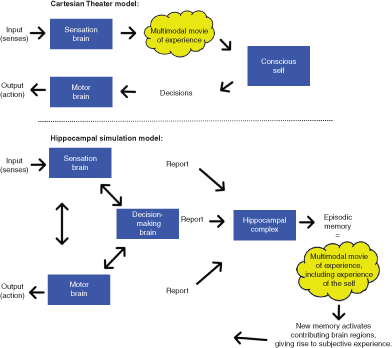 Matt Faw and Bill Faw:
“We propose that the phenomenon known to neurologically intact people as ‘Subjective Experience’ is best understood as the activation of various sites in both extrinsic and intrinsic networks by a brand new episodic memory engram (i.e., a complex theta wave coding pattern originating from field CA1 of the hippocampus)…”
Source: Wiley Online Library
‘Hypnosis refers to a set of procedures involving an induction — which could be fixating on an object, relaxing or actively imagining something — followed by one or more suggestions, such as “You will be completely unable to feel your left arm.” The purpose of the induction is to induce a mental state in which participants are focused on instructions from the experimenter or therapist, and are not distracted by everyday concerns. One reason why hypnosis is of interest to scientists is that participants often report that their responses feel automatic or outside their control.
Most inductions produce equivalent effects. But inductions aren’t actually that important. Surprisingly, the success of hypnosis doesn’t rely on special abilities of the hypnotist either — although building rapport with them will certainly be valuable in a therapeutic context.
Rather, the main driver for successful hypnosis is one’s level of “hypnotic suggestibility.” This is a term which describes how responsive we are to suggestions. We know that hypnotic suggestibility doesn’t change over time and is heritable. Scientists have even found that people with certain gene variants are more suggestible.
Most people are moderately responsive to hypnosis. This means they can have vivid changes in behavior and experience in response to hypnotic suggestions. By contrast, a small percentage (around 10-15 percent) of people are mostly non-responsive. But most research on hypnosis is focused on another small group (10-15 percent) who are highly responsive.
In this group, suggestions can be used to disrupt pain, or to produce hallucinations and amnesia. Considerable evidence from brain imaging reveals that these individuals are not just faking or imagining these responses. Indeed, the brain acts differently when people respond to hypnotic suggestions than when they imagine or voluntarily produce the same responses.
Preliminary research has shown that highly suggestible individuals may have unusual functioning and connectivity in the prefrontal cortex. This is a brain region that plays a critical role in a range of psychological functions including planning and the monitoring of one’s mental states.
There is also some evidence that highly suggestible individuals perform more poorly on cognitive tasks known to depend on the prefrontal cortex, such as working memory. However, these results are complicated by the possibility that there might be different subtypes of highly suggestible individuals. These neurocognitive differences may lend insights into how highly suggestible individuals respond to suggestions: they may be more responsive because they’re less aware of the intentions underlying their responses.
For example, when given a suggestion to not experience pain, they may suppress the pain but not be aware of their intention to do so. This may also explain why they often report that their experience occurred outside their control. Neuroimaging studies have not as yet verified this hypothesis but hypnosis does seem to involve changes in brain regions involved in monitoring of mental states, self-awareness and related functions.
Although the effects of hypnosis may seem unbelievable, it’s now well accepted that beliefs and expectations can dramatically impact human perception. It’s actually quite similar to the placebo response, in which an ineffective drug or therapeutic treatment is beneficial purely because we believe it will work. In this light, perhaps hypnosis isn’t so bizarre after all. Seemingly sensational responses to hypnosis may just be striking instances of the powers of suggestion and beliefs to shape our perception and behaviour. What we think will happen morphs seamlessly into what we ultimately experience.
Hypnosis requires the consent of the participant or patient. You cannot be hypnotized against your will and, despite popular misconceptions, there is no evidence that hypnosis could be used to make you commit immoral acts against your will…’
Source: Inverse
‘Tulpamancers are people who imagine companions, called tulpas, into being through meditation-like practices. While the word tulpamancer is derived from a Tibetan word for “incarnation,” one ethnographic study found that tulpamancers are mostly young, white men in their late teens and early 20s who congregate on Internet forums like Reddit. They tend to be empathetic, yet socially anxious. Tulpas are not considered a symptom of illness or a disorder, but they may be a coping mechanism for loneliness (or, in some cases, mental illness) for their creators. Many of those creators describe overwhelmingly positive experiences with tulpamancy, and some say the practice has helped ease their depression, anxiety, or obsessive compulsive disorder…’
Source: Pacific Standard
‘For the first time in a century, humpback whales have returned to the waters of New York harbor. And not just occasionally, either. They’re coming in enough numbers that a company can reliably trot tourists out to the ocean—within sight distance of Manhattan’s skyscrapers—to see them…’
Source: Popular Science
‘Any such move would, of course, be politically explosive and draw direct parallels to Richard Nixon’s conduct. But if Republicans on Capitol Hill are willing to go along with it, there’s nobody else out there who can actually stop Drumpf…’
Source: Vox
‘Yesterday, as the news cycles were dying down, the Drumpf Justice Department (DOJ) dropped a bombshell brief which Bloomberg reported. Citing George Washington as precedent, the DOJ is saying that it is AOK for President Drumpf to take foreign governments’ and state-controlled banks’ money for goods and services without congressional approval, that it is not a violation of the Emoluments Clause of the United States Constitution…’
Source: HuffPost
This is an utter outrage that must be stopped in its tracks, unlike our failure to stop Citizens United. Not only does it open the door to unprecedented influence-peddling by foreign powers but it seems to be a maneuver by Drumpf to exonerate himself for his and his family’s ongoing criminal graft. Is this enough to convince right-minded people to take action, which will probably have to be extra-judicial, against a President rapidly succeeding in removing any checks and balances on his tyranny?
‘The abortion issue of wildlife.’
Source: National Geographic
Clear where I stand. The wolf has always been my totem animal.
‘An involuntary manslaughter trial began Tuesday for a Massachusetts woman who as a teen texted her boyfriend and urged him to commit suicide.
The woman, Michelle Carter, faces a maximum 20-year prison term if convicted at a bench trial in Bristol County. Attorneys for Carter, who was 18 at the time of the texts, had tried to fend off the charges, saying her texts to 17-year-old Conrad Roy were protected speech under the First Amendment. The state’s top court, the Supreme Judicial Court, set no line in the sand on when speech loses its constitutional protection. Instead, the court upheld the indictment for involuntary manslaughter on “the basis of words alone.”
Roy, who was found dead about 50 miles south of Boston in a Fairhaven parking lot, took his own life via carbon monoxide fumes inside his truck. The authorities also claim Carter was on the phone with Roy for nearly an hour while he was killing himself….’
Source: Ars Technica
 REUTERS writes:
‘A free-speech institute on Tuesday sent a letter to President Donald Drumpf demanding the prolific tweeter unblock certain Twitter users on grounds the practice violates the First Amendment of the U.S. Constitution.
Drumpf’s @realDonaldTrump account recently blocked a number of accounts that replied to his tweets with commentary that criticized, mocked or disagreed with his actions. Twitter users are unable to see or respond to tweets from accounts that block them.
The Knight First Amendment Institute at Columbia University in New York said in its letter that the blocking suppressed speech in a public forum protected by the Constitution. …
Eric Goldman, a Santa Clara University law professor who focuses on internet law, said that previous cases involving politicians blocking users on Facebook supported the Knight Institute’s position.
If the institute should sue, Trump could claim his @realDonaldTrump account is for personal use and separate from his official duties as president, Goldman said. But he called that defense “laughable.”
Trump also has a presidential @POTUS Twitter account. The Knight Institute said its arguments would apply with “equal force” to both accounts…’
Source: NYTimes.com
PETER BAKER and MAGGIE HABERMAN writes:
‘ …in a series of stark early-morning postings on Twitter [Drumpf] faulted his own Justice Department for its defense of his travel ban on visitors from certain predominantly Muslim countries. [Drumpf] accused Mr. Sessions’s department of devising a “politically correct” version of the ban — as if the president had nothing to do with it. …’
Source: NYTimes.com
#schadenfreude
Maureen Dowd:
‘We’ve been conditioned by Hollywood to see the president of the United States step up to the lectern to confidently tell us how he will combat the existential threat to the planet — be it aliens, asteroids, tidal waves, volcanoes, killer sharks, killer robots or a 500-billion-ton comet the size of New York City.So it was quite stunning to see the president of the United States step up to the lectern to declare himself the existential threat to the planet…’
Source: NYTimes op ed
‘Poe’s Law: On the internet, it’s impossible to tell who is joking. …It’s… a diagnosis of exactly how the troll mentality has weakened internet culture. If nobody knows what anyone means, then every denial is plausible….’
Source: WIRED
‘Harvard rescinded admissions offers to at least ten prospective members of the Class of 2021 after the students traded explicit messages and memes in a Facebook group chat.’
Source: The Harvard Crimson
Interesting that the Crimson coverage focuses only on the misogyny. Other coverage I have read describes the vile racist attitudes in the Facebook group as well.
Oliver Roeder writes:
‘Since 1996, young spellers have attempted to spell over 14,000 words — from abactor to zymurgy. Twenty-five percent of those words, over 3,500, have been misspelled. This year, yet more words will be plucked from 470,000-odd options in Merriam-Webster’s unabridged dictionary. I sifted through all 21 years’ worth of errors, looking for reasons that some of the best spellers in the world stumbled when the stakes were highest. I found a gantlet of potential pitfalls …’
Source: FiveThirtyEight
‘Hitler appeared to have been highly sensitive to disgust, and research shows this trait is linked to numerous dimensions of ideology…’
Source: Big Think
‘We talked to nine Portland activists who think violence is necessary to fight fascism.’
Source: VICE
“Giles Martin and his engineers knocked it out of the park.”
Source: 3quarksdaily
Have you heard it yet?
 Performing on our porch next Saturday afternoon as part of the Brookline Porchfest!
Source: Sahil Warsi
‘The Frankfurt school argued that reason is dangerous, mass culture deadening, and the Enlightenment a disaster. Were they right?’
Source: Aeon Essays
Naomi Klein, writing on the day Donald Drumpf announced the U.S. would withdraw from the Paris climate accord, drew attention to a remedy proposed by some activists: that the U.S., which is vandalizing the climate, should face sanctions from the rest of the world. She also argues that pretty much everything that is inadequate about the Paris accord is the result of U.S. lobbying to weaken it.
Source: The Intercept
‘Why the placebo effect is weirder and potentially more useful than we imagined…’
Source: Vox
 Sean Spicer explains.
Source: The Boston Globe
‘Industry payouts to providers, unnecessary admissions to meet quotas, manipulating data for greater reimbursements: In The Huffington Post this week, Shannon Brownlee and Vikas Saini of the Lown Institute call out these ubiquitous practices for what they are – corruption.
“Our health care system is no longer about relieving the suffering of patients or the intrinsic value of maintaining the health of our population. It’s about making money,” Brownlee and Saini write. This systemic corruption contributes to ballooning health care costs and causes immeasurable harm to patients…’
Source: Lown Institute
 ‘On the corrosive privilege of the most mocked man in the world.” Elegant writing dripping with contempt in a most delicious way.
Source: Rebecca Solnit: Literary Hub
#schadenfreude
 Who knew? I live around the corner from the oldest playground in the US! Established in 1871 near Boston.
Source: Atlas Obscura
 “The times in which we could completely depend on others are, to a certain extent, over. […] We Europeans truly have to take our fate into our own hands…”
Source: Vox
‘Climate change may cause natural disasters, crop failures, and refugee crises. A new study finds a subtler but pervasive potential problem: people living in hotter places won’t sleep as well…’
Source: New York Times
‘Following President Donald Trump’s visit to Europe last week, German Chancellor Angela Merkel said that Germany and other Europeans powers can no longer rely on the United States… If it is politically harmful for America’s allies to be seen supporting America’s president, those alliances are not long for this world…’
Source: Pacific Standard
…making them one of a number of species with a mind that isn’t fully confined within the head
Source: 3quarksdaily
‘Physicist Lucien Hardy of the Perimeter Institute for Quantum Physics in Canada has an experiment he wants to try. His believes his experiment could provide evidence that the human mind operates outside the laws of classical physics. Specifically, he’s looking to see if the human mind can influence the behavior of entangled quantum particles using a test that first proved their existence.’
Source: Big Think
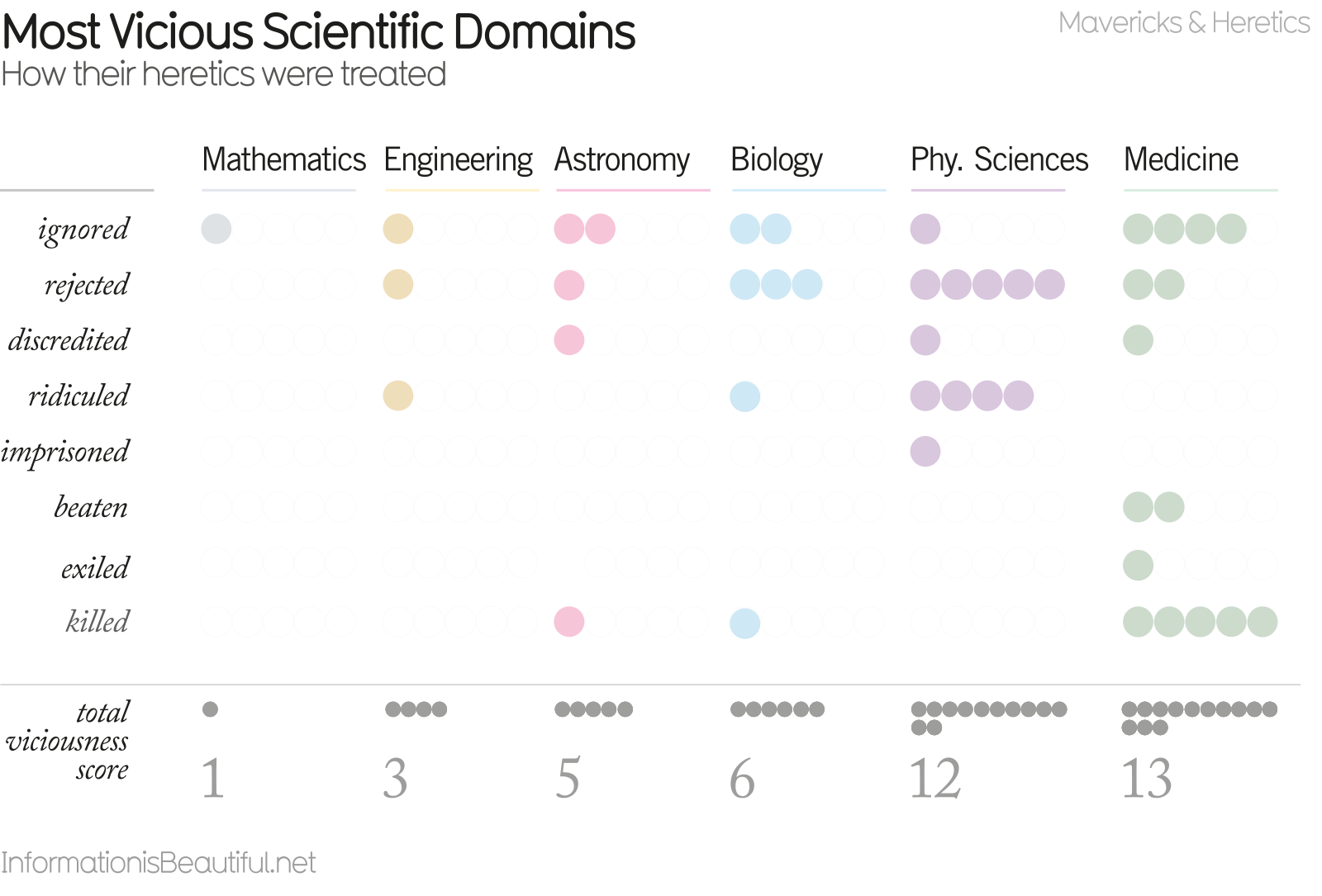 ‘Ignored, Scorned…Vindicated. The maverick scientists whose heretical ideas were ultimately proven correct.’
Source: Information is Beautiful (via Gabe)
Brilliant data visualization too.

Influential Force Behind the Allman Brothers Band Dies at 69
Gregg Allman, a founding member of the Allman Brothers Band, the incendiary group that inspired and gave shape to both the Southern rock and jam-band movements, died on Saturday at his home in Savannah, Ga. He was 69.
His death was announced in a statement on Mr. Allman’s official website. No cause was given, but the statement said he had “struggled with many health issues over the past several years.”
The band’s lead singer and keyboardist, Mr. Allman was one of the principal architects of a taut, improvisatory fusion of blues, jazz, country and rock that — streamlined by inheritors like Lynyrd Skynyrd and the Marshall Tucker Band — became the Southern rock of the 1970s.
The group, which originally featured Mr. Allman’s older brother, Duane, on lead and slide guitar, was also a precursor to a generation of popular jam bands, like Widespread Panic and Phish, whose music features labyrinthine instrumental exchanges.
Mr. Allman’s percussive Hammond B-3 organ playing helped anchor the Allman Brothers’ rhythm section and provided a chuffing counterpoint to the often heated musical interplay between his brother and the band’s other lead guitarist, Dickey Betts.
(From left, Duane Allman, Dickey Betts, Gregg Allman, Jai Johanny Johanson, Berry Oakley and Butch Trucks in 1969.)
Gregg Allman’s vocals, by turns squalling and brooding, took their cue from the anguished emoting of down-home blues singers like Elmore James, as well as from more sophisticated ones like Bobby Bland. Foremost among Mr. Allman’s influences as a vocalist, though, was the Mississippi-born blues and soul singer and guitarist known as Little Milton.
“‘Little Milton’ Campbell had the strongest set of pipes I ever heard on a human being,” Mr. Allman wrote in his autobiography, “My Cross to Bear,” written with Alan Light (2012). “That man inspired me all my life to get my voice crisper, get my diaphragm harder, use less air and just spit it out. He taught me to be absolutely sure of every note you hit, and to hit it solid.”
The band’s main songwriter early on, Mr. Allman contributed expansive, emotionally fraught compositions like “Dreams” and “Whipping Post” to the Allman Brothers repertoire. Both songs became staples of their epic live shows; a cathartic 22-minute version of “Whipping Post” was a highlight of their acclaimed 1971 live album, “At Fillmore East.”
More concise originals like “Midnight Rider” and “Melissa,” as well as Mr. Allman’s renditions of blues classics like “Statesboro Blues” and “Done Somebody Wrong,” revealed his singular affinity with the black Southern musical vernacular.
 Paul Simon stops by Stephen Colbert’s place and offers an updated “59th Street Bridge Song.”
Source: HuffPost
These are wonderful and at times hilarious.
‘The Coincidence Project is a special project started by a photographer named Denis Cherim. He had the idea of capturing pictures of certain harmonious moments where various scenic elements become aligned so that they portray a different perspective when you look at it. These could be pictures of people, landscapes, or monuments which have unusual shadowing, glaring or slopes that are interlocked into the scene to create a whole new visualization to them…’
Source: Design You Trust
 ‘One disability rights group from Colorado offers a lesson in how to make your representatives listen.’
Source: Pacific Standard
‘The two counselors at a drug treatment halfway house in Chester County, Pennsylvania, were supposed to help others recover from their addictions. But they were overwhelmed by their own drug problems — and on Sunday, they both overdosed and died on a mix of the opioids heroin and fentanyl. “If anybody is wondering how bad the opioid epidemic has become, this case is a frightening example,” Chester County District Attorney Tom Hogan said in a statement. “The staff members in charge of supervising recovering addicts succumbed to their own addiction and died of opioid overdoses.” …’
Source: Vox
‘…[M]any Montana voters, maybe most them, had already voted by the time he was charged. Montana is unusually reliant on mail-in ballots — any voter may request and cast an absentee ballot. The state legislature earlier this year debated transitioning to a fully mail-based system for the special election, though that effort fell short. Seasoned political analysts projected that two-thirds or more of the votes had already been cast by the time the news of Gianforte’s alleged assault broke.
Source: Vox
Source: Boing Boing
 This is the exact situation impeachment was meant for. Let’s hurry up.
Source: Matthew Yglesias, Vox
 Trump’s history of using insulting words mocks mental health
Source: The Washington Post
Freestyling We have to learn to dance with the robots, not to run away. However. we still need to make sure that Al is limited enough that it will still be dance-withable, and not not-runnab/e-away-from.
Emergent Leadership Emergent leadership: the ability to steer things in the right direction without the authority to do so. through social competence.
Constructive Uncertainty — The idea of constructive uncertainty is not predicated on eliminating our biases: they are as built into our minds as deeply as language and lust.
Complex Ethics All thinking touches on our sense of morality andjustice. Knowledge is justified belief, so our perspective of the world and our place in it is rooted in our ethical system, whether examined or not.
Deep Generalists — Deep generalists can ferret out the connections that build the complexity into complex systems, and grasp their interplay.
Design Logic It’s not only about imagining things we desire, but also undesirable things—cautionary tales that highlight what might happen if we carelessly introduce new technologies into society.
Postnormal Creativity — We should expect that in postnormal times creativity will have a few surprises in store for us.
Posterity, not History, nor the Future — While we need to learn from history, we must not be constrained by it, especially in a time where much of what is going on is unprecedented.
Sensemaking — Skills that help us create unique insights critical to decision making.
Source: Stowe Boyd
 Urge Your Lawmakers to Support Bipartisan TEAPSPA:
‘Lawmakers on both sides of the aisle have joined forces on a bill that would ban the use of exotic and wild animals in traveling circuses and any other entertainment act on wheels. In late March, Representatives Raul Grijalva, an Arizona Democrat, Ryan Costello, a Pennsylvania Republican, and 22 other lawmakers introduced the Traveling Exotic Animal and Public Safety Protection Act (TEAPSPA) in the House. It would require the 19 traveling circuses in the U.S. with performing animals to to use only human entertainers—or shut down.
If the bill passes, it will end life on the road for more than 200 big cats, bears, camels, and elephants still working as circus performers. Thirty-four other countries have instituted similar bans, as have dozens of cities and counties in the U.S., including Los Angeles and San Francisco.’
Source: National Geographic
‘…As the Trump administration’s been sent into a death spiral over the firing of FBI Director James Comey last week — a failed move to curtail the Justice Department investigation into contact between his campaign and the Russian government — Kushner hasn’t been the “adult in the room” urging caution and scrupulousness. To the contrary, he’s been urging aggression and retaliation.
And the White House’s reaction to the appointment of Robert Mueller as a special counsel in the Russia inquiry, including a possible attempt to use ethics rules to limit the scope of his investigation, shows that somebody in the White House is deeply worried about what might happen if Kushner were included in the probe…’
Source: Vox
#schadenfreude
 Why some say searching for ET is best done quietly.
Source: Nautilus
‘With most experts saying that federal prosecutors can’t charge him, the House and Senate are the only entities that can hold the president himself to account. Unless 218 representatives and 67 senators agree that it’s time for him to leave, he’ll stay in office and avoid criminal prosecution. However, that does not mean special counsel Robert Mueller’s hands are tied. On the contrary, Mueller has broad authority to bring charges against basically anyone besides the president, up to and including Mike Pence if he’s found to have committed a crime.’
Source: Vox
‘ “The intensity of the probe is expected to accelerate in the coming weeks.” A huge scoop from Devlin Barrett and Matt Zapotosky at the Washington Post…’
Source: Boing Boing
 ‘Why? Oh, no reason.’
Source: Vox
 Astrobiologist Lewis Dartnell explains why we shouldn’t be afraid of alien visitors:
Source: Big Think
‘The perfect
choicetoadie for America’s troll-in-chief.’
Source: Vox
‘If one had to choose a single moment that set off the “replication crisis” in psychology—an event that nudged the discipline into its present and anarchic state, where even textbook findings have been cast in doubt—this might be it: the publication, in early 2011, of Daryl Bem’s experiments on second sight.’
Source: Slate
‘Pseudoscientific claims that music helps plants grow have been made for decades, despite evidence that is shaky at best. Yet new research suggests some flora may be capable of sensing sounds, such as the gurgle of water through a pipe or the buzzing of insects.’
Source: Scientific American
‘The Justice Department’s decision to appoint former FBI director Robert Mueller as a special counsel charged with investigating possible collusion between the Trump campaign and Russia is a win for Democrats, a new blow to a reeling White House, and a clear sign that the scandal that has engulfed the administration will only accelerate in the weeks and months ahead…’
Source: Vox
‘In this video, you’ll learn why you shouldn’t rub chopsticks together to remove splinters, stick your chopsticks upright in a bowl of rice, pass morsels from one set of chopsticks to another, and two other dining taboos.’
Source: Boing Boing
‘[A] data-driven look at prose… plumbs the new, massive corpuses of digitized books to make quantitative — rather than the traditional qualitative — statements about our literary habits…’
Source: Boing Boing