
Robert Krulwich: There are people who live long enough to create a link — a one-generation link — to figures from what feels like a distant past, and their presence among us shrinks history. When “Long Ago” suddenly becomes “So I said to him …,” long ago jumps closer.There are many examples of people who shrink history this way. The blogger Jason Kottke has been collecting examples. He calls them “human wormholes,” because these people help us leap across space/time. Here are my favorites.’ (via NPR)
Author Archives: FmH


31 Rick Santorum Quotes That Prove He Would Be A Destructive President
 For instance:
— ”I don’t want to make black people’s lives better by giving them other people’s money. I want to give them the opportunity to go out and earn their money and provide for themselves and their families. The best way to do that is to get the manufacturing sector of the economy rolling.”
—
“(Same-sex marriage) is an issue just like 9-11. We didn’t decide we wanted to fight the war on terrorism because we wanted to. It was brought to us. And if not now, when? When the supreme courts in all the other states have succumbed to the Massachusetts version of the law?”
[via Addicting Info (thanks, jill)]
Satanic Ritual Viewed by Record Audience

Hollywood Illuminati explains that Madonna’s Superbowl halftime show was actually an elaborate homage to Baphomet.

The Death of the Cyberflâneur

Evgeny Morozov: “The other day, while I was rummaging through a stack of oldish articles on the future of the Internet, an obscure little essay from 1998 — published, of all places, on a Web site called Ceramics Today — caught my eye. Celebrating the rise of the “cyberflâneur,” it painted a bright digital future, brimming with playfulness, intrigue and serendipity, that awaited this mysterious online type. This vision of tomorrow seemed all but inevitable at a time when “what the city and the street were to the Flâneur, the Internet and the Superhighway have become to the Cyberflâneur.”
Intrigued, I set out to discover what happened to the cyberflâneur. While I quickly found other contemporaneous commentators who believed that flânerie would flourish online, the sad state of today’s Internet suggests that they couldn’t have been more wrong. Cyberflâneurs are few and far between, while the very practice of cyberflânerie seems at odds with the world of social media. What went wrong? And should we worry?” (via NYTimes.com)
Mission to Land on a Comet

‘Europe’s Rosetta spacecraft is en route to intercept a comet– and to make history. In 2014, Rosetta will enter orbit around comet 67P/Churyumov-Gerasimenkoand land a probe on it, two firsts.
Rosetta’s goal is to learn the primordial story a comet tells as it gloriously falls to pieces.
Comets are primitive leftovers from our solar system’s ‘construction’ about 4.5 billion years ago. Because they spend much of their time in the deep freeze of the outer solar system, comets are well preserved—a gold mine for astronomers who want to know what conditions were like back “in the beginning.” ‘ (via NASA Science)
Why President Obama Now Believes He Will Be a Two-Term President
Doug Schoen: “Today’s jobs report that the unemployment rate has fallen from 8.5% to 8.3% while total nonfarm payroll employment rose by 243,000 in January is just one of many reasons why there is an increasing air of optimism in the White House.” (via Forbes).

Vermont Inmates Hide Image Of Pig On Police Decals
“It took Vermont officials four years to notice a little creative editing by one or more inmates. Look at this police decal:
Look at the cow underneath the tree. Embedded within the cow’s spots is an image of a pig, which as the Burlington Free Press reminds us is the ’60s-era epithet used by protesters to refer to police.
Reuters reports that it was likely put there by inmates. The state, Reuters adds, “contracts with correctional facilities employing prisoners to make some print products, including the cruiser decals.” One or more inmates somehow accessed the computer program holding the image and rejiggered it. The quality assurance department failed to notice it and as far as the state police know, the modified decal was used on as many as 30 Vermont State Police cruisers.” (via NPR).
Close Your Eyes and Pull the Trigger
Self-guided bullet could hit laser-marked targets from a mile away: “A group of researchers at Sandia National Laboratories have built a prototype of a small-caliber bullet capable of steering itself towards a laser-marked target located approximately 2,000 meters (1.2 miles) away. The dart-like design has passed the initial testing stage… The four-inch (10 cm) long projectile is to be used with smoothbore arms, meaning ones with non-rifled barrels. Rifling involves cutting helical grooves in the barrel to give the bullet a spin that, thanks to the gyroscopic effect, improves its aerodynamic stability and accuracy. In a self-guided projectile, however, such spinning movement would prevent the bullet from reliably turning towards the target when in flight. For this reason, the group of researchers lead by Red Jones and Brian Kast decided to use a dart-like design that includes tiny fins to allow the projectile to fly straight, without a spin.” (via Gizmag).

Rethinking The Oreo For Chinese Consumers

“It turns out that if you didn’t grow up with Oreos and develop an emotional attachment to the cookie, it can be a weird-tasting little thing. And this started a whole process in the Chinese division of Kraft of rethinking what the essence of an Oreo really is.” (via Planet Money : NPR).
Children’s A.D.D. Drugs Don’t Work Long-Term

Psychologist L. Alan Sroufe, professor emeritus of psychology at the University of Minnesota’s Institute of Child Development: “Attention-deficit drugs increase concentration in the short term, which is why they work so well for college students cramming for exams. But when given to children over long periods of time, they neither improve school achievement nor reduce behavior problems. The drugs can also have serious side effects, including stunting growth.” (via NYTimes.com)
Boycott This

When It Comes To Depression, Serotonin Isn’t The Whole Story

‘ “Chemical imbalance is sort of last-century thinking. It’s much more complicated than that,” says Dr. Joseph Coyle, a professor of neuroscience at Harvard Medical School. “It’s really an outmoded way of thinking.”
…Still, the story of serotonin remains. Why does it continue to have such a powerful grip on the popular imagination?’ (via NPR).
Related?
- New Research on the Antidepressant-Versus-Placebo Debate (healthland.time.com)
- How Does Prozac Work? (wired.com)
- Prozac in the water makes shrimp go crazy (thestar.com)
- ‘Prozac defence’ stands in Manitoba teen’s murder case (news.nationalpost.com)
- Serotonin cell discoveries mean rethink of depression (newscientist.com)
- What if the drugs don’t work? (talesfromthelou.wordpress.com)
- Serotonin: 9 Questions and Answers (webmd.com)
- Big Pharma’s ‘Antidepressants’ Don’t Work (lewrockwell.com)
- Longevity Proteins Linked To Anxiety (medicalnewstoday.com)
- Antidepressants used by 11 percent of Americans (seattletimes.nwsource.com)
- Margot and the Nuclear So & So’s – “Prozac Rock” (donewaiting.com)
- Why Prozac Is Still a Mystery (bigthink.com)
- Fearless Youth: Prozac Extinguishes Anxiety by Rejuvenating the Brain (scientificamerican.com)
- Chemical imbalance myth takes a big public fall (no, antidepressants do NOT correct an imbalance of serotonin, nor do other psychiatric drugs correct anything at all) (beyondmeds.com)
- Psychiatry’s Grand Confession (victimsofatoscorruption.wordpress.com)
- Depression: How Long Should You Take Antidepressants? (webmd.com)
A physiological marker for false memories

“False memories can be distinguished from real ones with a simple physiological test, report researchers from Germany.” (via Guardian.UK)
At Sundance, there was ‘Beasts of the Southern Wild’ and then there was everything else
“The standout of this year’s Sundance and among the best films to play at the festival in two decades, “Beasts of the Southern Wild” isn’t an obvious studio-dependent title. Directed by Benh Zeitlin, who wrote the screenplay with Lucy Alibar, the film is a magical realist tale, as well as a hero’s journey, set in a gloriously mythologized part of southern Louisiana nicknamed the Bathtub. There, a 6-year old girl, Hushpuppy (Quvenzhané Wallis, a sensational find), lives in a state of grace and wonder with her hard-boozing father, Wink (Dwight Henry), amid wandering (and later cooked) chickens, stumbling drunks and rampaging creatures.
This is the first feature from Mr. Zeitlin, a Queens native who grew up in Westchester County, graduated from Wesleyan University and counts among his influences Mr. Malick, John Cassavetes and Emir Kusturica. After a stint working in the Czech Republic for another inspiration, the animator Jan Svankmajer, Mr. Zeitlin made his way, post-Katrina, to southern Louisiana, where he shot “Beasts” with a collective called Court 13. (“More of an idea than an organization,” as Mr. Zeitlin puts it, Court 13 takes its name from a Wesleyan squash court that he and some friends commandeered.) Shot on Super 16-millimeter film, “Beasts of the Southern Wild” is hauntingly beautiful both visually and in the tenderness it shows toward the characters, who live on the edge and perhaps somewhat in Hushpuppy’s head.” (via NYTimes)
Automatic Death

“The Navy is testing an autonomous plane that will land on an aircraft carrier. The prospect of heavily armed aircraft screaming through the skies without direct human control is unnerving to many.” (via LA Times)
What does Nancy Pelosi know about Newt?
‘Whenever someone plays all coy like “I know something you don’t know, nah-nah-na-nah-nah” it’s always maddening, but when the subject of the withheld secret is disgraced former Speaker of the House, Newton Leroy Gingrich, and the holder of the keys to that mystery taunting the American electorate is House Minority Leader Nancy Pelosi—who was on a House ethics committee that investigated Gingrich for a year and who looked at thousands of pages of documents—it’s got to be pretty explosive.
So far Pelosi has twice—not once, but twice—come right out and point-blank told the country that she knows “something” about Gingrich that insures that he will never become the President of the United States. As in never, ever, it ain’t gonna happen, no way, Jose, never, nope, sorry, uh-uh.’ (via Dangerous Minds).

Depression’s Criteria May Be Changed to Include Grieving

“In a bitter skirmish over the definition of depression, a new report contends that a proposed change to the diagnosis would characterize grieving as a disorder and greatly increase the number of people treated for it.” (via NYTimes).
As readers know, I have done intermittent coverage of the proposed revisions to the Diagnostic and Statistical Manual (DSM), the official ‘bible’ of psychiatric diagnoses in US practice and currently awaiting its 5th edition. While lat week’s scandal was about the possible contraction of the definition of autism (which has many parents and patient advocates up in arms about the potential loss of qualifications for services for thousands), most of the suggested changes have one thing in common. They broaden the criteria for various disorders or create new, questionable diagnoses. In so doing, many more aspects of emotional life become medicalized or pathologized and subject to treatment with powerful drugs. Proponents of these changes claim they will allow the more rapid, preemptive identification of people deserving treatment. Critics claim that millions would be labelled mentally ill for behaviors previously conceived as normal, with insufficient evidence that they would benefit from treatment and needless exposure to the malignant side effects of powerful medications. Not to mention lining the pockets of Big Pharma.
Hollywood is the real big bad wolf
‘Hollywood is acting like the Big Bad Wolf by portraying the animals as violent man-eating killers in the controversial action thriller The Grey, wildlife experts are complaining.Liam Neeson’s big-budget gore-fest, which shows a wolf pack picking off plane-crash survivors on the Alaskan tundra, couldn’t be further from the truth, said Maggie Howell, managing director of the Wolf Conservation Center in Westchester County.“Wolves don’t hunt humans — they actually shy away from them,” said Howell, a biologist.’ (via NYPost).
No matter how much Neeson appeals to you, please boycott this film.
The End of Culture?

In 2006, Adam Sternbergh wrote a memorable and snarky piece in New York magazine, “Up With Grups“, disparaging “40-year-old men and women who look, talk, act, and dress like people who are 22 years old”:
“This is an obituary for the generation gap. … It’s not about a fad but about a phenomenon that looks to be permanent. It’s about the hedge-fund guy in Park Slope with the chunky square glasses, brown rock T-shirt, slight paunch, expensive jeans, Puma sneakers, and shoulder-slung messenger bag, with two kids squirming over his lap like itchy chimps at the Tea Lounge on Sunday morning. It’s about the mom in the low-slung Sevens and ankle boots and vaguely Berlin-art-scene blouse with the $800 stroller and the TV-screen-size Olsen-twins sunglasses perched on her head walking through Bryant Park listening to Death Cab for Cutie on her Nano.”
But, while there are certainly some ‘grown-ups’ whose undying affectation of youth culture comes from some pitiful Peter Pan complex, I think the explanation often has more to do with this phenomenon. As Kurt Anderson observed recently in Vanity Fair, popular culture simply may not have changed that much in the past twenty years or so:
“Think about it. Picture it. Rewind any other 20-year chunk of 20th-century time. There’s no chance you would mistake a photograph or movie of Americans or an American city from 1972—giant sideburns, collars, and bell-bottoms, leisure suits and cigarettes, AMC Javelins and Matadors and Gremlins alongside Dodge Demons, Swingers, Plymouth Dusters, and Scamps—with images from 1992. Time-travel back another 20 years, before rock ’n’ roll and the Pill and Vietnam, when both sexes wore hats and cars were big and bulbous with late-moderne fenders and fins—again, unmistakably different, 1952 from 1972. You can keep doing it and see that the characteristic surfaces and sounds of each historical moment are absolutely distinct from those of 20 years earlier or later: the clothes, the hair, the cars, the advertising—all of it. It’s even true of the 19th century: practically no respectable American man wore a beard before the 1850s, for instance, but beards were almost obligatory in the 1870s, and then disappeared again by 1900. The modern sensibility has been defined by brief stylistic shelf lives, our minds trained to register the recent past as old-fashioned.” (via kottke)
It seems to me that this isn’t across the board, of course. Music and casual dress seem to have changed less than, for instance, literary style, cuisine, automobile design, or film, off the top of my head. It is no accident that Sternbergh focuses mostly on what his so-called ‘grups’ wear and listen to.
Could Conjoined Twins Share a Mind?

A mind-boggling piece on Tatiana and Krista, 4-year old sisters in rural British Columbia, which mounts a serious challenge to our “one-person-one-mind” convictions:
“Twins joined at the head — the medical term is craniopagus — are one in 2.5 million, of which only a fraction survive. The way the girls’ brains formed beneath the surface of their fused skulls, however, makes them beyond rare: their neural anatomy is unique, at least in the annals of recorded scientific literature. Their brain images reveal what looks like an attenuated line stretching between the two organs, a piece of anatomy their neurosurgeon, Douglas Cochrane of British Columbia Children’s Hospital, has called a thalamic bridge, because he believes it links the thalamus of one girl to the thalamus of her sister. The thalamus is a kind of switchboard, a two-lobed organ that filters most sensory input and has long been thought to be essential in the neural loops that create consciousness. Because the thalamus functions as a relay station, the girls’ doctors believe it is entirely possible that the sensory input that one girl receives could somehow cross that bridge into the brain of the other. One girl drinks, another girl feels it.” (via NYTimes).
How to Picture a Black Hole
“This month, researchers are inaugurating the Event Horizon Telescope, a project that will try to take the first detailed pictures of the supermassive black hole at the center of our galaxy.
This observation would be a remarkable achievement, underscoring the progress that has been made in black-hole research in just the last few decades. As recently as the 1970s, astronomers still argued over whether black holes were theoretical constructs or real physical objects. They now have ample evidence that black holes are not only real, but abundant in the cosmos.” (via Wired)

Subculture of Americans prepares for civilization’s collapse
“…a growing subculture of Americans who refer to themselves informally as “preppers.” Some are driven by a fear of imminent societal collapse, others are worried about terrorism, and many have a vague concern that an escalating series of natural disasters is leading to some type of environmental cataclysm.
They are following in the footsteps of hippies in the 1960s who set up communes to separate themselves from what they saw as a materialistic society, and the survivalists in the 1990s who were hoping to escape the dictates of what they perceived as an increasingly secular and oppressive government.
Preppers, though are, worried about no government.” (via Reuters).
Related:
- ‘Preppers’ the New American Subculture? (thewesternexperience.com)
- Preppers: suburban survivalists (boingboing.net)
Do some cultures have their own ways of going mad?

I have always been interested in the so-called culture-bound syndromes, having come to psychiatry from cross-cultural studies as I did. Throughout my teaching career, I have always found the opportunity to lecture on these disorders, since they are so bizarre and colorful. But I have not shared the sense that there are ‘unique’ ways of going mad in other cultures that are outside the framework of Western psychiatry’s official diagnoses embodied in the Diagnostic and Statistical Manual, or DSM. This is not, however, because I feel everyone’s distress fits neatly into the predefined pigeonholes. It is, on the other hand, that, the more I look, the more I feel that nobody fits the pigeonholes neatly, even psychiatric patients within my own culture. There are as many individual ways of going mad as there are distressed people. As someone once said (I’m paraphrasing), it is much more important to get to know who the person is that has the disease than what the disease is that the person has. (via Boston Globe).
Related?
- Why Psychiatry Needs to Scrap the DSM System: An… (psychcentral.com)
- Finding One’s Self, Losing One’s Self (themorningnews.org)
- Eleven Good Ideas for Inpatient Psychiatry (behindthelockeddoors.wordpress.com)
- Who Will Protest Against the DSM Harm? (my.psychologytoday.com)
- Psychiatry And Modern Science: Perspectives On The DSM (huffingtonpost.com)
In more DSM-related news, independent website DSM Watch was served with a cease-and-desist order by the American Psychiatric Association’s legal dept. to stop it from continuing to use the DSM name. Vaughan Bell, of the excellent Mind Hacks weblog, scratches his head over the rationale for this. And Mind Hacks also points to this excellent summary of DSM in a hundred words from the British Journal of Psychiatry:
“DSMis an American classification system that has dominated since 1980. It is disliked by many for reducing diagnostic skills to a cold list of operational criteria, yet embraced by researchers believing that it represents the first whiff of sense in an area of primitive dogma. It has almost foundered by confusing reliability with validity but the authors seem to recognise its errors and are hoping for rebirth in its 5th revision due in May 2013. The initials do not stand for Diagnosis as a Source of Money or Diagnosis for Simple Minds but the possibility of confusion is present.”

And Allen Frances,one of the shapers of DSM-IV who has become a sort of Don Quixote tilting at the windmills of the revision process leading up to the May 2013 arrival of DSM-V, writes in the Huffington Post, Preventive Psychiatry Can Be Bad for Our Health:
“Preventive psychiatry may someday be of significant service in reducing the burden of human suffering — but only if it can be done really well. And the sad truth is that we don’t yet have the necessary tools. More people will be harmed than helped if psychiatry stretches itself prematurely to do what is currently well beyond its reach. That’s what is so scary about the unrealistic prevention ambitions of DSM-5, the new manual of mental disorders now in preparation and set to become official in 2013. DSM-5 proposes a radical redefinition of the boundaries of psychiatry, giving it the impossible role of identifying and treating mental disorders in their nascent stages before they have fully declared themselves. Tens of millions of people now deemed normal would suddenly be relabeled mentally disordered and subjected to stigma and considerable risks consequent to inappropriate treatment.”
There’s A Darkness

(There’s A Darkness: Newt 2012). As one of the commenters said, maybe we’ll get lucky and he’ll leave us for another country. And what’s the deal about a politician named after a slimy bottom-feeder (although the newts might be offended by drawing the parallel) anyway?
Satellite Image of the Costa Concordia Wreck

The DigitalGlobe Image Gallery is full of high-resolution satellite images of today’s events, many of them natural and man-made disasters. (via boing boing)
R.I.P. Etta James

“A lot of people think the blues is depressing, but that’s not the blues I’m singing. When I’m singing blues, I’m singing life. People that can’t stand to listen to the blues, they’ve got to be phonies.” — Etta James, Los Angeles Times(1992).
“…[O]ne of the great voices in American popular music, with a huge range, a multiplicity of tones and vast reserves of volume.” — John Pareles, New York Times (1990)
SOPA and PIPA Are Pulled (For Now)

“After Wednesday’s all-day protest of SOPA and PIPA, the bills that want to censor your internet, both bills have been shelved for further consideration, and will not be voted on as scheduled. Rep. Lamar Smith, the sponsor of SOPA, said he’s still committed to fighting piracy, but that this legislation isn’t the way to do it…” (via Lifehacker).
I’ve wondered…

…why, in the past decade or so, car windows and windshields have started to have opaque black margins, rather than being clear all the way to the edges as they used to be. Is this stylistic or structural? Does anyone have a clue? How would one go about researching the answer to this question? Anyone have any contacts in the auto industry to whom this query could be directed?
Unsafe abortions rise as contraceptive funding is cut
“Global abortion rates have stopped falling, ending a period of rapid decline that began in 1995. However, the proportion of abortions that are dangerous continues to rise. Paradoxically, morally conservative US restrictions on foreign aid may have promoted the abortions they sought to restrict.” (via New Scientist).

Why should we stop online piracy?

Matthew Yglesia: “That Congress is weighing bills called the Stop Online Piracy Act (SOPA) and the Protect IP Act (PIPA) tells us that, at a minimum, the idea of stopping online piracy is popular.
It shouldn’t be. There’s no evidence that the US is currently suffering from an excessive amount of online piracy, and there is ample reason to believe that a non-zero level of copyright infringement is socially beneficial. Online piracy is like fouling in basketball. You want to penalise it to prevent it from getting out of control, but any effort to actually eliminate it would be a cure much worse than the disease.” (via New Scientist).
The Tiniest Vertebrate
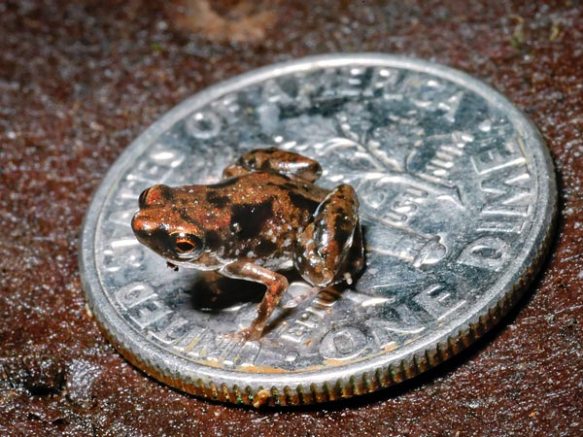
…frog is the size of a housefly (via National Geographic).
What kind of tourist are you?
- Tourism’s ‘Merry Mountain’
‘ “For as long as people have been able to travel, they have been drawn (…) towards sites, attractions or events that are linked in one way or another with death, suffering, violence or disaster. ” As disturbing as it may sound, chances are pretty high that you have been guilty of this so-called dark tourism yourself. Think about it…’ (via Getaway Travel Blog).

10 reasons the U.S. is no longer the land of the free

Jonathan Turley: “Even as we pass judgment on countries we consider unfree, Americans remain confident that any definition of a free nation must include their own — the land of free. Yet, the laws and practices of the land should shake that confidence. In the decade since Sept. 11, 2001, this country has comprehensively reduced civil liberties in the name of an expanded security state. The most recent example of this was the National Defense Authorization Act, signed Dec. 31, which allows for the indefinite detention of citizens. At what point does the reduction of individual rights in our country change how we define ourselves?
While each new national security power Washington has embraced was controversial when enacted, they are often discussed in isolation. But they don’t operate in isolation. They form a mosaic of powers under which our country could be considered, at least in part, authoritarian. Americans often proclaim our nation as a symbol of freedom to the world while dismissing nations such as Cuba and China as categorically unfree. Yet, objectively, we may be only half right. Those countries do lack basic individual rights such as due process, placing them outside any reasonable definition of “free,” but the United States now has much more in common with such regimes than anyone may like to admit.” (via The Washington Post).
The Milky Way Contains at Least 100 Billion Planets According to Survey

“Our Milky Way galaxy contains a minimum of 100 billion planets according to a detailed statistical study based on the detection of three extrasolar planets by an observational technique called microlensing. Kailash Sahu, of the Space Telescope Science Institute in Baltimore, Md., is part of an international team reporting today that our galaxy contains a minimum of one planet for every star on average. This means that there is likely to be a minimum of 1,500 planets within just 50 light-years of Earth.” (via HubbleSite ).
LA City Attorney to Occupy: pay for brainwashing lessons on limits of free speech and we’ll drop the charges

- LA City Atty Carmen Trutancih
Cory Doctorow: ‘The Los Angeles City Attorney’s Office has offered Occupy protesters a get-out-of-jail card: all they need to do to skip their court dates is pay $355 for private “free speech lessons” where they will be taught a highly selective version of Constitutional law that holds that the First Amendment doesn’t include the kind of protest they enjoy. It’s like they combined traffic school with Maoist “self-criticism sessions” from the Cultural Revolution to make something worse than both combined.’ (via Boing Boing).
Related:
- The Irony of Free Speech in California (jonathanturley.org)
- LA City Attorney to Occupy: pay for brainwashing lessons on limits of free speech and we’ll drop the charges (boingboing.net)
- #OccupyLA: Take ‘Free Speech’ Class After Arrests for Exercising Freedom of Speech (crooksandliars.com)
- City offers to teach Occupy L.A. protesters a free-speech lesson (latimesblogs.latimes.com)
No, SETI has not detected an alien signal from a Kepler planet
 There was some buzz last week in astronomical circles that SETI (the Search for Extra-Terrestrial Intelligence) had discovered a candidate radio signal. In this this post, Phil Platt (Bad Astronomy) explains why the detected signal did not originate with an ETI and, in so doing, gives an informative explanation of some of the principles of SETI.

Related:
- dustinmartian: Image of the Day: 1st Kepler “Search for… (kellysutton.tumblr.com)
- First Kepler SETI Signals ID’d: No Aliens – PC Magazine (pcmag.com)
- Kepler Receives First Images; Looks To Be From An Alien Civilization, But Isn’t (techie-buzz.com)
- First Alien Signals Found By SETI (disclose.tv)
- Deus Ex Alpha Centauri: Buy Euros Now As SETI May Have Discovered Aliens (zerohedge.com)
- SETI’s Search for Intelligent Alien Life Resumes (livescience.com)
William Gibson’s long-overdue essay collection

William Gibson
Cory Doctorow on Distrust That Particular Flavor:
“By many standards, Gibson is a slow writer — his book publishing career is 27 years old, and consists of nine and a half novels, a book of short stories and this collection of essays — but he is a very, very fine one. His work has been seminal to many key moments at the end of the last century and the start of this one, and it is a rare pleasure to read his direct reflections on society and his work, rather than inferring them from his fiction. This is a fine and even essential complement to the Gibson canon, and a delight to read.” (via Boing Boing).
Related:
- Books of The Times: William Gibson’s ‘Distrust That Particular Flavor’ – Review (nytimes.com)
- Timothy Leary and William Gibson in conversation (dangerousminds.net)
- Catching Up To the Future: An Appreciation of William Gibson (tor.com)
- William Gibson and Timothy Leary in conversation, 1989 (boingboing.net)
- William Gibson on writing, science fiction and digital panopticons in the 21st century [VIDEO] (digiphile.wordpress.com)
Samoa Cancelled Dec. 31st last year

There was no Dec. 31st in Samoa in 2011. At midnight on Dec. 30th, the country switched to the western side of the International Dateline (to be date-aligned with China, its main trading partner), thus setting the date to Jan. 1st instead of Dec. 31st. (via Discovery News). I wonder how many Samoans missed a Dec. 31st birthday.
Animals Like You’ve Never Seen Them Before
‘…[T]here’s something remarkable and whimsical that happens when a fine art photographer takes her lens to Earth’s creatures — they become poetry. Today, we turn to five such photographers, whose portraits of animals — unusual, otherworldly, kooky, tender, charismatic — make the eye swoon and the heart sing.’ (via Brain Pickings).

Emperor’s-New-Clothes Dept.

Violinists can’t tell the difference between Stradivarius violins and new ones: ‘The test was a true “ double-blind” one, as neither the players nor the people who gave them the violins had any way of knowing which instrument was which. The room was dimly lit. The players were wearing goggles so they couldn’t see properly. The instruments had dabs of perfume on the chinrests that blocked out any distinctive smells. And even though Fritz and Curtin knew which the identities of the six violins, they only passed the instruments to the players via other researchers, who were hidden by screens, wearing their own goggles, and quite literally in the dark.’ (via Not Exactly Rocket Science).
Related:
- How many notes would a virtuoso violinist pay for a Stradivarius? (guardian.co.uk)
- Researchers Use CT to Recreate Stradivarius Violin (prnewswire.com)
- Stradivarius-beating “fungus violins” could be mass-produced (gizmag.com)
F.D.A. Finds Short Supply of Attention Deficit Drugs
“Medicines to treat attention deficit hyperactivity disorder are in such short supply that hundreds of patients complain daily to the Food and Drug Administration that they are unable to find a pharmacy with enough pills to fill their prescriptions.
The shortages are a result of a troubled partnership between drug manufacturers and the Drug Enforcement Administration, with companies trying to maximize their profits and drug enforcement agents trying to minimize abuse by people, many of them college students, who use the medications to get high or to stay up all night.” (via NYTimes.com).

As a psychophwho did early research and treatment of the putative condition of “adult ADHD”, I have come to believe that around 90% of diagnoses with this disorder are specious. A careful clinical decision about whether stimulants should be prescribed has to go much further than simply deciding if the pt will benefit from (or enjoy) being on these medications, for that would be true of most people. Such care is rarely applied in the evaluation of those who end up receiving a stimulant prescription. While the NYTimes article touches upon the tragedy of auto accidents and job loss that arises from attention-disordered patients not getting their medications, I see patients all the time who are victims of misdiagnosis and misprescribing. This is no moralistic diatribe against “abuse”, which is often in the eyes of the beholder, but based rather on the real adverse and dire consequences, including strokes, seizures, addiction, depressive ‘crashes’ from abrupt cessation, and suicide. Not to mention the contribution to the shortsighed and pervasive promulgation of the paradigm that better living through chemistry is the only way to attain better living. We have crippled a generation of patients with such a message of pharmacological materialism.
The Buttered Cat Paradox
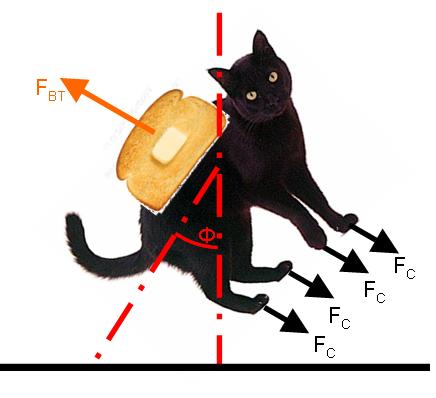
If a falling cat usually lands on its feet and toast usually lands buttered side down, what happens if you attach buttered toast to a cat’s back? Amazing the places you can go with this paradox. (via Mental Floss).
R.I.P. Cheetah
Tarzan and Jane’s sidekick was 80 years old. (via NYTimes.com).

Happy New Year
This is the annual update of my New Year’s post, a tradition I started early on on FmH:
 I once ran across a January 1st Boston Globe article compiling folkloric beliefs about what to do, what to eat, etc. on New Year’s Day to bring good fortune for the year to come. I’ve regretted since — I usually think of it around once a year (grin) — not clipping out and saving the article. Especially since we’ve had children, I’m interested in enduring traditions that go beyond getting drunk [although some comment that this is a profound enactment of the interdigitation of chaos and order appropriate to the New Year’s celebration — FmH], watching the bowl games and making resolutions.
A web search brought me this, less elaborate than what I recall from the Globe but to the same point. It is weighted toward eating traditions, which is odd because, unlike most other major holidays, the celebration of New Year’s in 21st century America does not seem to be centered at all around thinking about what we eat (except in the sense of the traditional weight-loss resolutions!) and certainly not around a festive meal. But…
Traditionally, it was thought that one could affect the luck they would have throughout the coming year by what they did or ate on the first day of the year. For that reason, it has become common for folks to celebrate the first few minutes of a brand new year in the company of family and friends. Parties often last into the middle of the night after the ringing in of a new year. It was once believed that the first visitor on New Year’s Day would bring either good luck or bad luck the rest of the year. It was particularly lucky if that visitor happened to be a tall dark-haired man.
![//tonos.ru/images/articles/dragon/ouroboros.jpg' cannot be displayed]](http://tonos.ru/images/articles/dragon/ouroboros.jpg "Ouroboros")
“Traditional New Year foods are also thought to bring luck. Many cultures believe that anything in the shape of a ring is good luck, because it symbolizes “coming full circle,” completing a year’s cycle. For that reason, the Dutch believe that eating donuts on New Year’s Day will bring good fortune.
“Many parts of the U.S. celebrate the new year by consuming black-eyed peas. These legumes are typically accompanied by either hog jowls or ham. Black-eyed peas and other legumes have been considered good luck in many cultures. The hog, and thus its meat, is considered lucky because it symbolizes prosperity. Cabbage is another ‘good luck’ vegetable that is consumed on New Year’s Day by many. Cabbage leaves are also considered a sign of prosperity, being representative of paper currency. In some regions, rice is a lucky food that is eaten on New Year’s Day.”
The further north one travels in the British Isles, the more the year-end festivities focus on New Year’s. The Scottish observance of Hogmanay has many elements of warming heart and hearth, welcoming strangers and making a good beginning:
“Three cornered biscuits called hogmanays are eaten. Other special foods are: wine, ginger cordial, cheese, bread, shortbread, oatcake, carol or carl cake, currant loaf, and a pastry called scones. After sunset people collect juniper and water to purify the home. Divining rituals are done according to the directions of the winds, which are assigned their own colors. First Footing:The first person who comes to the door on midnight New Year’s Eve should be a dark-haired or dark-complected man with gifts for luck. Seeing a cat, dog, woman, red-head or beggar is unlucky. The person brings a gift (handsel) of coal or whiskey to ensure prosperity in the New Year. Mummer’s Plays are also performed. The actors called the White Boys of Yule are all dressed in white, except for one dressed as the devil in black. It is bad luck to engage in marriage proposals, break glass, spin flax, sweep or carry out rubbish on New Year’s Eve.”
Here’s why we clink our glasses when we drink our New Year’s toasts, no matter where we are. Of course, sometimes the midnight cacophony is louder than just clinking glassware, to create a ‘devil-chasing din’.
 In Georgia, eat black eyed peas and turnip greens on New Year’s Day for luck and prosperity in the year to come, supposedly because they symbolize coppers and currency. Hoppin’ John, a concoction of peas, onion, bacon and rice, is also a southern New Year’s tradition, as is wearing yellow to find true love (in Peru, yellow underwear, apparently!) or carrying silver for prosperity. In some instances, a dollar bill is thrown in with the other ingredients of the New Year’s meal to bring prosperity. In Greece, there is a traditional New Year’s Day sweetbread with a silver coin baked into it. All guests get a slice of the bread and whoever receives the slice with the coin is destined for good fortune for the year. At Italian tables, lentils, oranges and olives are served. The lentils, looking like coins, will bring prosperity; the oranges are for love; and the olives, symbolic of the wealth of the land, represent good fortune for the year to come.
A New Year’s meal in Norway also includes dried cod, “lutefisk.” The Pennsylvania Dutch make sure to include sauerkraut in their holiday meal, also for prosperity.
In Spain, you would cram twelve grapes in your mouth at midnight, one each time the clock chimed, for good luck for the twelve months to come. (If any of the grapes happens to be sour, the corresponding month will not be one of your most fortunate in the coming year.) The U. S. version of this custom, for some reason, involves standing on a chair as you pop the grapes. In Denmark, jumping off a chair at the stroke of midnight signifies leaping into the New Year. In Rio, you would be plunging into the sea en masse at midnight, wearing white and bearing offerings. In many northern hemisphere cities near bodies of water, they will have a tradition of people plunging into the cold water on New Year’s Day. The Coney Island Polar Bears Club in New York is the oldest cold-water swimming club in the United States. They have had groups of people enter the chilly surf since 1903.
Ecuadorian families make scarecrows stuffed with newspaper and firecrackers and place them outside their homes. The dummies represent misfortunes of the prior year, which are then burned in effigy at the stroke of midnight to forget the old year. Bolivian families make beautiful little wood or straw dolls to hang outside their homes on New Year’s Eve to bring good luck.
 In China, homes are cleaned spotless to appease the Kitchen God, and papercuttings of red paper are hung in the windows to scare away evil spirits who might enter the house and bring misfortune. Large papier mache dragon heads with long fabric bodies are maneuvered through the streets during the Dragon Dance festival, and families open their front doors to let the dragon bring good luck into their homes.
 The Indian Diwali festival, welcoming in the autumnal season, also involves attracting good fortune with lights. Children make small clay lamps, dipas, thousands of which might adorn a given home. In Thailand, one pours fragrant water over the hands of elders on New Year’s Day to show them respect.
![//www.elanguages.org/images/16245' cannot be displayed]](http://www.elanguages.org/images/16245 "Revelry")
- a stack of pancakes for the New Year’s breakfast in France.
- banging on friends’ doors in Denmark to “smash in” the New Year, where it is also a good sign to find your doorstep heaped with broken dishes on New Year’s morning. Old dishes are saved all years to throw at your friends’ homes on New Year’s Eve.
- going in the front door and out the back door at midnight in Ireland.
- making sure the First Footer, the first person through your door in the New Year in Scotland, is a tall dark haired visitor.
- water out the window at midnight in Puerto Rico rids the home of evil spirits.
- cleanse your soul in Japan at the New Year by listening to a gong tolling 108 times, one for every sin
- it is Swiss good luck to let a drop of cream fall on the floor on New Year’s Day.
- Belgian farmers wish their animals a Happy New Year for blessings.
 In Germany and Austria, lead pouring” (das Bleigießen) is an old divining practice using molten lead like tea leaves. A small amount of lead is melted in a tablespoon (by holding a flame under the spoon) and then poured into a bowl or bucket of water. The resulting pattern is interpreted to predict the coming year. For instance, if the lead forms a ball (der Ball), that means luck will roll your way. The shape of an anchor (der Anker) means help in need. But a cross (das Kreuz) signifies death.
- “It’s a bit bizarre when you think about it. A short British cabaret sketch from the 1920s has become a German New Year’s tradition. Yet, although The 90th Birthday or Dinner for One is a famous cult classic in Germany and several other European countries, it is virtually unknown in the English-speaking world, including Britain, its birthplace.” (Watch on Youtube, 11 min.)
Some history; documentation of observance of the new year dates back at least 4000 years to the Babylonians, who also made the first new year’s resolutions (reportedly voews to return borrowed farm equipment were very popular), although their holiday was observed at the vernal equinox. The Babylonian festivities lasted eleven days, each day with its own particular mode of celebration.  The traditional Persian Norouz festival of spring continues to be considered the advent of the new year among Persians, Kurds and other peoples throughout Central Asia, and dates back at least 3000 years, deeply rooted in Zooastrian traditions.Modern Bahá’í’s celebrate Norouz (”Naw Ruz”) as the end of a Nineteen Day Fast. Rosh Hashanah (”head of the year”), the Jewish New Year, the first day of the lunar month of Tishri, falls between September and early October. Muslim New Year is the first day of Muharram, and Chinese New Year falls between Jan. 10th and Feb. 19th of the Gregorian calendar.
 The classical Roman New Year’s celebration was also in the spring although the calendar went out of synchrony with the sun. January 1st became the first day of the year by proclamation of the Roman Senate in 153 BC, reinforced even more strongly when Julius Caesar established what came to be known as the Julian calendar in 46 BC. The early Christian Church condemned new year’s festivities as pagan but created parallel festivities concurrently. New Year’s Day is still observed as the Feast of Christ’s Circumcision in some denominations. Church opposition to a new year’s observance reasserted itself during the Middle Ages, and Western nations have only celebrated January 1 as a holidy for about the last 400 years. The custom of New Year’s gift exchange among Druidic pagans in 7th century Flanders was deplored by Saint Eligius, who warned them, “[Do not] make vetulas, [little figures of the Old Woman], little deer or iotticos or set tables [for the house-elf] at night or exchange New Year gifts or supply superfluous drinks [another Yule custom].” (Wikipedia)
 The tradition of the New Year’s Baby signifying the new year began with the Greek tradition of parading a baby in a basket during the Dionysian rites celebrating the annual rebirth of that god as a symbol of fertility. The baby was also a symbol of rebirth among early Egyptians. Again, the Church was forced to modify its denunciation of the practice as pagan because of the popularity of the rebirth symbolism, finally allowing its members to cellebrate the new year with a baby although assimilating it to a celebration of the birth of the baby Jesus. The addition of Father Time (the “Old Year”) wearing a sash across his chest with the previous year on it, and the banner carried or worn by the New Year’s Baby, immigrated from Germany. Interestingly, January 1st is not a legal holiday in Israel, officially because of its historic origins as a Christian feast day.
 Auld Lang Syne (literally ‘old long ago’ in the Scottish dialect) is sung or played at the stroke of midnight throughout the English-speaking world (and then there is George Harrison’s “Ring Out the Old”). Versions of the song have been part of the New Year’s festivities since the 17th century but Robert Burns was inspired to compose a modern rendition, which was published after his death in 1796. (It took Guy Lombardo, however, to make it popular…)
Should auld acquaintance be forgot
and never brought to mind?
Should auld acquaintance be forgot
and days of auld lang syne?
For auld lang syne, my dear,
for auld lang syne,
we’ll take a cup of kindness yet,
for auld lang syne.Should auld acquaintance be forgot
and never brought to mind?
Should auld acquaintance be forgot
and days of auld lang syne?
And here’s a hand, my trusty friend
And gie’s a hand o’ thine
We’ll tak’ a cup o’ kindness yet
For auld lang syne
![//www.sfgate.com/chronicle/pictures/2005/02/09/ga_lunar01.jpg' cannot be displayed]](http://www.sfgate.com/chronicle/pictures/2005/02/09/ga_lunar01.jpg "Wake Up!")
Here’s how to wish someone a Happy New Year around the world:
- Arabic: Kul ‘aam u antum salimoun
- Brazilian: Boas Festas e Feliz Ano Novo means “Good Parties and Happy New Year”
- Chinese:
Chu Shen TanXin Nian Kuai Le (thanks, Jeff)- Czechoslavakia: Scastny Novy Rok
- Dutch: Gullukkig Niuw Jaar
- Finnish: Onnellista Uutta Vuotta
- French: Bonne Annee
- German: Prosit Neujahr
- Greek: Eftecheezmaenos o Kaenooryos hronos
- Hebrew: L’Shannah Tovah Tikatevu
- Hindi: Niya Saa Moobaarak
- Irish (Gaelic): Bliain nua fe mhaise dhuit
- Italian: Buon Capodanno
- Khmer: Sua Sdei tfnam tmei
- Laotian: Sabai dee pee mai
- Polish: Szczesliwego Nowego Roku
- Portuguese: Feliz Ano Novo
- Russian: S Novim Godom
- Serbo-Croatian: Scecna nova godina
- Spanish: Feliz Ano Nuevo
- Swedish: Ha ett gott nytt år
- Turkish: Yeni Yiliniz Kutlu Olsun
- Vietnamese: Cung-Chuc Tan-Xuan
- [If you are a native speaker, please feel free to offer any corrections or additions!]

However you’re going to celebrate, my warmest wishes for the year to come… and eat hearty! [thanks to Bruce Umbaugh for research assistance]
Related?
Happy Yule
“I salute you. I am your friend, and my love for you goes deep.
There is nothing I can give you which you have not already, but there is much, very much, which though I cannot give it, you can take.
No heaven can come to us unless our hearts find rest in today.
Take heaven.
No peace lies in the future which is not hidden in this precious little instant.
Take peace.
The gloom of the world is but a shadow. Behind it, yet within our reach is joy. There is radiance and courage in the darkness could we but see; and to see, we have only to look.
Life is so generous a giver, but we, judging its gifts by their coverings, cast them away as ugly or heavy or hard. Remove the covering, and you will find beneath it a living splendor, woven of love, and wisdom, and power. Welcome it, greet it, and you touch the angel’s hand that brings it.
Everything we call a trial, a sorrow, a duty, believe me, that angel’s hand is there, the gift is there, and the wonder of an overshadowing Presence.
Our joys, too, be not content with them as joys. They, too, conceal diviner gifts.
Life is so full of meaning and purpose, so full of beauty beneath its covering, that you will find earth but cloaks your heaven.
Courage, then, to claim it, that is all! But courage you have, and the knowledge that we are pilgrims wending through unknown country our way home.
And so, at this Christmas time, I greet you, not quite as the world sends greeting, but with profound esteem now and forever.
The day breaks and the shadows flee away.”

— Christmas greeting from a letter written by Italian friar and painter Giovanni da Fiesole (Fra Angelico) 1387-1455
A Warm and Happy Winter Solstice!
And so the Shortest Day came and the Year died,
And everywhere down the centuries of that snow white world
came people
Singing, Dancing
To drive the Dark away.
They lighted candles in the winter trees
They hung their homes with evergreens
They burned beseeching fires, all night long
To keep the Year alive
And when the new Year’s sunshine blazed awake, they shouted
Reveling!
Through all the frosty ages, you can hear them
Echoing behind us.
Listen.
All the long echos sing the same delight
this Shortest Day
As promise wakens in the sleeping land
They carol, feast, give thanks, and dearly love their friends,
And hope for peace.
And so do we, here, now
This year and every year: Welcome Yule!
All: Welcome Yule!— Susan Cooper, “The Shortest Day”
Can a Picture Of Your Mother Diagnose Depression?

“When attempting to diagnose depression using the patterns of activity exhibited by the brain, it turns out that we don’t need to ask people lots of questions or measure stress levels or investigate their mood. Rather, we only need to show them a picture of their moms.” (via Wired.com).
Simon Schama on How His Friend Christopher Hitchens Said Goodbye
“Christopher Hitchens confronted death with the same furious bravura that he deployed against purveyors of unreasoned pieties…. It was typical that his last essay for Vanity Fair was less a chronicle of his pain than an attack on Nietzsche’s assertion that “whatever does not kill you makes you stronger.” There was much in what he had endured lately, he insisted, that proved Nietzsche’s aphorism demonstrably false…” (via The Daily Beast).

R.I.P. Vaclav Havel
Dissident Playwright Who Led Czechoslovakia Dead at 75: A shy yet resilient, unfailingly polite but dogged man who articulated the power of the powerless, Mr. Havel spent five years in and out of Communist prisons, lived for two decades under close secret-police surveillance and endured the suppression of his plays and essays. He served 14 years as president, wrote 19 plays, inspired a film and a rap song and remained one of his generation’s most seductively nonconformist writers. (via NYTimes.com)

How Short Can A Very Short Story Be?
Krulwich Wonders… : “…Very short stories can get very, very short and still be good. The most famous example (supposedly written by Ernest Hemingway) draws a little sigh with only six words; it’s a sales ad.
‘For sale:
baby shoes,
never worn.’
Nobody has been able to beat that one, at least nobody I’ve read,…
But I’ve seen stories that are way richer, and much, much shorter, if we’re counting words. They use no words at all…” (via NPR).

US Out of Iraq

After nine years, the loss of hundreds of thousands of lives, the near bankruptcy of the US economy, the squandering of the goodwill of most of the world and the fueling of rabid anti-Americanism, Bush-Cheney’s American occupation of the Iranian province that was formerly the nation of Iraq finally ends. Mission accomplished!
For a stroll down memory lane, here is a Google search that should point you to all the posts I wrote about Iraq over the years of the war.

Related:
- American Mission In Iraq Formally Ended; Will Iraq Enter Iranian Sphere? (crazyjew.wordpress.com)
- Ravaged and Remade, Iraq Is on Its Own – New York Times (nytimes.com)
- Panetta formally shuts down US war in Iraq (sfgate.com)
- US formally draws curtain on the unpopular war in Iraq (video) (csmonitor.com)
Institute of Medicine: Most Use of Chimps in Biomedical Research is Unnecessary
Use of Chimps Halted in New U.S.-Funded Research: “The National Institutes of Health on Thursday suspended all new grants for biomedical and behavioral research on chimpanzees and accepted the first uniform criteria for assessing the necessity of such research. Those criteria require that the research be necessary for human health, and that there be no other way to accomplish it.
In making the announcement, Dr. Francis S. Collins, the director of the N.I.H., said the agency was accepting the recommendations released earlier in the day by an expert committee of the Institute of Medicine and would establish a working group to decide how to carry out those recommendations. The decision by the N.I.H. and the recomentions from the Institute of Medicine, a expert advisory group, do not put an end to research on chimps, but were claimed as victories by animal rights groups that have been fighting for ban on such research for decades, arguing that research on chimpanzees was unneeded and cruel to the animal that is human’s closest relative. They said that the move was a step toward eventually ending chimp research, already a tiny segment of federal research.” (via NYTimes).

Mink Assault
”
A jury has acquitted a Hoquiam, Wash., man accused of breaking into a home in June and throwing a dead mink at another man. Police said Jobie J. Watkins, 33, went to the other man’s apartment looking for his ex-girlfriend. The other man was struck after he asked Watkins why he had a dead weasel and Watkins reportedly insisted that it was a marten.” (via SFGATE).

Thanks to rich, who wonders if this is a problem of “infidelity or taxonomy.”
The Search-and-Rescue Dogs of 9/11

“Photographs by Charlotte Dumas of privately owned dogs who were mobilized, with their owners, to search for victims of the Sept. 11, 2001, attacks. They are now retired.” (slide show via NYTimes.com).
Vowels Control Your Brain
 This, from Robert Krulwich, is so good it deserves to be excerpted in full:
‘Here’s something you should know about yourself. Vowels control your brain. “I”s make you see things differently than “O”s. Here’s how. Say these words out loud:
- Bean
- Mint
- Slim
These “I” and “E” vowels are formed by putting your tongue forward in the mouth. That’s why they’re called “front” vowels.
Now, say:
- Large
- Pod
- Or
- Ought
With these words, your tongue depresses and folds back a bit. So “O”, “A” and “U” are called “back” of the throat vowels.
OK, here’s the weird part.When comparing words across language groups, says Stanford linguistics professor Dan Jurafsky, a curious pattern shows up: Words with front vowels (“I” and “E”) tend to represent small, thin, light things.Back vowels (“O” “U” and some “A”s ) show up in fat, heavy things.
It’s not always true, but it’s a tendency that you can see in any of the stressed vowels in words like little, teeny or itsy-bitsy (all front vowels) versus humongous or gargantuan (back vowels). Or the i vowel in Spanish chico (front vowel meaning small) versus gordo (back vowel meaning fat). Or French petit (front vowel) versus grand (back vowel).
Try this yourself. If I make up two words, “Frish” and “Frosh” and tell you each is about to become a new ice cream, which of the two seems richer, heavier?
For me, “Frosh,” (with the back vowel “o”) seems creamier. I don’t know why. Just feels that way. And not just to me. A study in the Journal of Consumer Research found most people imagined Frosh creamier than Frish.
Here’s another example. Richard Klink, a marketing professor at Loyola College in Maryland created a test using two sets of names. They were nonsense names, chosen at random:
Nidax vs. Nodax and Detal vs. Dutal
And then, slapping these names on various imaginary products, he asked a group of people:
- Which brand of laptop seems bigger; Detal or Dutal?
- Which brand of vacuum cleaner seems heavier, Keffi or Kuffi?
- Which brand of ketchup seems thicker, Nellen or Nullen?
- Which brand of beer seems darker, Esab or Usab?
“In each case,” reports Professor Jurasky, “the participants in the study tended to choose the product named by back vowels (dutal, nodax) as the larger, heavier, thicker, darker product. Similar studies have been conducted in various other languages.”
Jurasky then wondered, Do businesses know this about vowels? For example, would an ice cream company (looking to create a rich, creamy and satisfying product,) and a cracker manufacturer, (looking to make something, thin, light and crackily) use different vowels? He thought they might, so, on his blog, he writes:
To test the hypothesis I downloaded two lists of food names from the web. One was a list of 81 ice cream flavors that I constructed by including every flavor sold by either Haagen Dazs or Ben & Jerry’s. The second was a list of 592 cracker brands from a dieting website. For each list, I counted the total number of front vowels and the total number of back vowels (details of the study are here). The result, shown in the table [below], is that ice creams names indeed have more back vowels and cracker names have more front vowels. (Language of Food)
Ice cream companies mix in lots of “O”s and “A”s, says Jurasky, like…
Rocky Road, Jamoca Almond Fudge, Chocolate, Caramel, Cookie Dough, Coconut
But the cracker people stick pretty much to “E”s and “I”s.
Cheese Nips, Cheez It, Wheat Thins, Pretzel thins, Ritz, Krispy, Triscuit, Thin Crisps, Cheese Crisps, Chicken in a Biskit, Snack sticks, Toasted chips, Ritz bits
But Why? Why do we associate “front” vowels with small, thin light things and “back” vowels with big, solid, heavy things?
Two linguists, John Ohala and Eugene Morton proposed that over evolutionary time, humans instinctively associate pitch with size. Lions, bears, seals make low sounds, canaries, mice, rabbits higher sounds. Not always, but enough of the time that when we hear a low frequency (even in an “O” or a “U”) we may think big and heavy, whereas higher frequencies (even in “I’s and “E”s) suggest small and light.
The Origin Of The Smile? Dan Jurasky goes even further. Scholars have noticed, he says, that when people say “Boo!”, they form an o-shape with their lips and mouth, and look aggressive and a little dangerous.
But use the “front” vowels, like “I” and “E”, your mouth and lips will widen into a kind of smile. Why do we say “cheese” when it’s time to take the picture? Why does the word smile contain an “I”? These front vowels, he says, are the “smile” vowels. One day they may even explain why we smile, but in the meantime, the big news is that it’s old fashioned to think of vowels as just sounds.
They are more than that: they are little strings that pull on our brains and it turns out, “I”s pull us to different places than “O”s.
Who knew? (via NPR).
Can Broadened “Counterterrorism” Rules Open Door to Indefinitely Detaining Peaceful Protesters?
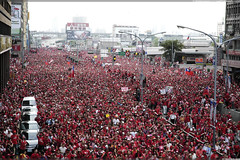
“A lot has been written recently about the recent militarization of US police forces. The impression is inescapable in an atmosphere saturated with imagery of Occupy protesters being bullied by domestic police who wield militarized weaponry, clad in what used to be thought of as riot gear, but is now a de rigueur feature of official responses to things that do not resemble nor threaten to become riots. It appears this militarization comes partly courtesy unprecedented and legally dubious collaboration between civilian police and the CIA…” (via Truthout, with thanks to hal).
Related:
- Occupy Ourselves | Truthout (indigenist.blogspot.com)
- Indefinite Military Detention: Revised Defense Bill Still Gives President Authority To Lock Up Citizens (huffingtonpost.com)
- | A Dangerous Woman: Indefinite Detention at Carswell Air Force Base! (truthaholics.wordpress.com)
Sen. Al Franken shreds the Republican economic theory

Senator Al Franken, speaking to AFL-CIO on Monday, points out the glaringly contradictory schools of thought that define the Republican economic theory. (via progressivetoo; thanks to hal).
Lists of Note
 “Lists are created, and have been for many centuries, for all manner of reasons. It’s my aim to feature some of the most notable examples right here. Updated as often as possible; usually on weekdays. Edited by me, Shaun Usher. I also run Letters of Note.” (Lists of Note).
Welcome to the new Arctic

‘Melting ice is beginning to transform the world’s shipping routes. But will it launch a new Cold War?’ (via Salon).
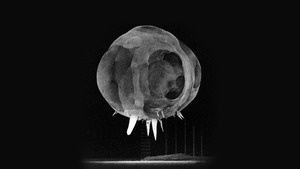
The True Face of Atomic Death
‘…a nuclear explosion from the Tumbler-Snapper tests performed in Nevada during 1952. It looks different from all nuclear explosions you’ve seen because it’s what it looks like one millisecond after detonation. It looks like a skull by Tim Burton.
The face of atomic death just one second away from unleashing its absolute destruction.
Only one millisecond after the bomb explodes, this 65.6-foot (20 meters) ball of fire appears in midair, with spikes that look like rotten teeth or stalactites of fire (called the rope trick effect).
The explosion was captured by a Rapid Action Electronic camera—a high speed device designed to photograph nuclear explosions just milliseconds after ignition. The rapatronic camera, as it is called, was created by Harold Edgerton in the 1940s using two polarizing filters and Kerr cell instead of a shutter, which is too slow for this job. A Kerr cell is a panel that changes its polarization depending on the voltage applied. This acts as a very high speed shutter, which allows the perfect exposition to capture this moment.’ (via Gizmodo).
Higgs boson particle close to being found says CERN

“…[G]rowing excitement that the first signs of the ultra-elusive Higgs boson particle have been detected by teams working at CERN’s Large Hadron Collider (LHC).’ (via Mail Online).
Rats Exhibit Kindness to Others

Free Trapped Friends, Hint at Universal Empathy: ‘With a few liberating swipes of their paws, a group of research rats freed trapped labmates and raised anew the possibility that empathy isn’t unique to humans and a few extra-smart animals, but is widespread in the animal world.
Though more studies are needed on the rats’ motivations, it’s at least plausible they demonstrated “empathically motivated pro-social behavior.” People would generally call that helpfulness, or even kindness.
“Rats help other rats in distress. That means it’s a biological inheritance,” said neurobiologist Peggy Mason of the University of Chicago. “That’s the biological program we have.” ‘ (via Wired.com).
Dollar ReDe$ign Project
 “We want to rebrand the US Dollar, rebuild financial confidence and revive our failing economy.” (via richardsmith.posterous.com).
The Power of Nothing
 Ted Kaptchuk’s Quest to Understand the Placebo Effect: ‘It boils down to one question, Kaptchuk asserts: “Do you think this entire field is based on a foundation of magical thinking, or do you not?” ‘ (via The New Yorker).
A Brief History of the Apocalypse
‘Is the idea that the End is near a recent phenomenon? Far from it. Indeed, Chicken Littles have crying doom since ancient times. The aim of this page is to debunk end-time prophecy by listing hundreds of failed doomsday predictions, allay the fears spread by end-time preachers, anddemonstrate that doomcrying is nothing new. I also hope you will derive amusement from some of the more bizarre prophecies.
I have strived for accuracy through careful cross-referencing amongsource materials. I’m constantly adding new information and correcting mistakes, yet there may still be some errors.
Please journey with me through the wild, wacky and wonderful world of failed doomsday prophecy!’ (via Abhota).

Related:
- And Just When I was Getting Prepared for the Apocalypse… (outsidethebeltway.com)
- Mayan Doomsday Prophecy of 2012 apocalypse ‘wrongly translated’ (news.bioscholar.com)
- Catholics Agree With Prophecies Contained in The ‘2012’ Mayan Prophecy and New Hollywood Movie (prweb.com)
- Author Presents Enlightening, Analytical Interpretation of the Book of Revelation (prweb.com)
- Apocalypse Predictions Are Nothing New: A Look Back At Doomsday Theories (newyork.cbslocal.com)
- Preacher apologizes for failed apocalypse prediction (abclocal.go.com)
- Why the World Will End (Again) on Friday (livescience.com)
SETI resumes at Allen Telescope Array

‘The Search for Extraterrestrial Intelligence (SETI) has resumed at the Allen Telescope Array in northern California. The ATA was in hibernation for months due to a lack of funding. But new cash came in from the public (yay, public support of science!) and also the US Air Force “as part of a formal assessment of the instrument’s utility for Space Situational Awareness.” Exoplanet candidates found via NASA’s Kepler space telescope will be one focus of the resumed effort.’ (via Boing Boing).
James Mollison Photographs

“James & Other Apes: While watching a nature program on primates I was struck by their facial similarity to our own. Humans are clearly different to animals, but the great apes inhabit that grey area between man and animal. I thought it would be interesting to try to photograph gorillas, chimpanzees, bonobos and orangutans using the aesthetic of the passport photograph- its ubiquitous style inferring the idea of identity.
I decided against photographing in zoos or using ‘animal actors’ but traveled to Cameroon, Republic of Congo, Democratic Republic of Congo and Indonesia to meet orphans of the bush meat trade and live pet trade.” (via Hunch).
Related:
- James Mollison’s Where Children Sleep series (lostateminor.com)
- The Disciples: Fans of Rock Concerts by James Mollison (amusingplanet.com)
- Random Excellence: James Mollison (theonlinephotographer.typepad.com)
- An Incredible Look At The Sleeping Conditions Of Children Around The World (businessinsider.com)
On Why Jazz Isn’t Cool Anymore

Jazz died in 1959.
There maybe cool individuals who say they play Jazz, but ain’t shit cool about Jazz as a whole.
Jazz died when cool stopped being hip.
Jazz was a limited idea to begin with.
Jazz is a label that was forced upon the musicians.
The musicians should’ve never accepted that idea.
Jazz ain’t shit.
Jazz is incestuous.
Jazz separated itself from American popular music.
Big mistake.
The music never recovered.
Ornette tried to save Jazz from itself by taking the music back to its New Orleanian roots, but his efforts were too esoteric.
Jazz died in 1959, that’s why Ornette tried to “Free Jazz” in 1960.
Jazz is only cool if you don’t actually play it for a living.
Jazz musicians have accepted the idea that it’s OK to be poor.
John Coltrane is a bad cat, but Jazz stopped being cool in 1959.
The very fact that so many people are holding on to this idea of what Jazz is supposed to be is exactly what makes it not cool.
People are holding on to an idea that died long ago.
Jazz, like the Buddha, is dead.
Let it go, people, let it go.
Paul Whiteman was the King of Jazz and someday all kings must fall.
Jazz ain’t cool, it’s cold, like necrophilia.
Stop fucking the dead and embrace the living.
Jazz worries way too much about itself for it to be cool.
Jazz died in 1959.
The number one Jazz record is Miles Davis’ Kind Of Blue.
Dave Brubeck’s Time Out was released in 1959.
1959 was the coolest year in Jazz.
Jazz is haunted by its own hungry ghosts.
Let it die.
You can be martyrs for an idea that died over a half a century if y’all want.
Jazz has proven itself to be limited, and therefore, not cool.
Lot’s wife turned to a pillar of salt from looking back.
Jazz is dead.
Miles ahead.
Some may say that I’m no longer the same dude who recorded the album with Doc Cheatham.
Correct: I’m not the same dude I was 14 years ago.
Isn’t that the point?
Our whole purpose on this planet is to evolve.
The Golden Age of Jazz is gone.
Let it go.
Too many necrophiliacs in Jazz.
You’re making my case for me.
Some people may say we are defined by our limitations.
I don’t believe in limitations, but yes, if you believe you are limited that will define you.
Definitions are retrospective.
And if you find yourself getting mad, it’s probably because you know Jazz is dead.
Why get upset if what I’m saying doesn’t ring true?
I can’t speak for anyone else, but I don’t play Jazz.
I play Postmodern New Orleans music.
Louis Armstrong and Danny Barker play Traditional New Orleans Music.
Ellis Marsalis and James Black play Modern New Orleans music.
Kidd Jordan and Clyde Kerr play Avant-garde New Orleans music.
Donald Harrison plays Neoclassical New Orleans music.
I play Postmodern New Orleans music.
I am a part of a lineage.
I am a part of a blood line.
My ancestors didn’t play Jazz, they played Traditional, Modern and Avant-garde New Orleans Music.
I don’t play Jazz.
I don’t let others define who I am.
I am a Postmodern New Orleans musician.
I create music for the heart and the head, for the beauty and the booty.
The man who lets others define him is a dead man.
With all due respect to the masters, they were victims of a colonialist mentality.
Blacks have been conditioned for centuries to be grateful for whatever crumbs thrown to them.
As a postmodern musician, it’s my duty to do better than my predecessors.
To question, reexamine and redefine what it is that we do.
They accepted it because they had to.
Because my ancestors opened the door for me, I don’t have to accept it.
Louis bowed and scraped so Miles could turn his back.
It’s called evolution.
It’s the colonialist mentality that glorifies being treated like a slave.
There is nothing romantic about poor, scuffling Jazz musicians.
Fuck that idea.
It’s not cool.
Jazz is a lie.
America is a lie.
Playing Jazz is like running on a treadmill: you may break a sweat, but ultimately you ain’t going nowhere.
Some people may say we are limited.
I say, we are as limited as we think.
I am not limited.
Jazz is a marketing ploy that serves an elite few.
The elite make all the money while they tell the true artists it’s cool to be broke.
Occupy Jazz!
I am not speaking of so-called Jazz’s improvisational aspects.
Improvisation by its very nature can never be passé, but mindsets are invariably deadly.
Not knowing is the most you can ever know.
It’s only when you don’t know that “everything” is possible.
Jazz has nothing to do with music or being cool.
It’s a marketing idea.
A glaring example of what’s wrong with Jazz is how people fight over it.
People are too afraid to let go of a name that is killing the spirit of the music.
Life is bigger than music, unless you love and/or play Jazz.
The art, or lack thereof, is just a reflection.
Miles Davis personified cool and he hated Jazz.
What is Jazz anyway?
Life isn’t linear, it’s concentric.
When you’re truly creating you don’t have time to think about what to call it.
Who thinks of what they’ll name the baby while they’re fucking?
Playing Jazz is like using the rear-view mirror to drive your car on the freeway.
If you think Jazz is a style of music, you’ll never begin to understand.
It’s ultimately on the musicians.
People are fickle and follow the pack.
Not enough artists willing to soldier for their shit.
People follow trends and brands.
So do musicians, sadly.
Jazz is a brand.
Jazz ain’t music, it’s marketing, and bad marketing at that.
It has never been, nor will it ever be, music.
Here lies Jazz (1916 – 1959).
Too many musicians and not enough artists.
I believe music to be more of a medium than a brand.
Silence is music, too.
You can’t practice art.
In order for it to be true, one must live it.
Existence is not contingent upon thought.
It’s where you choose to put silence that makes sound music.
Sound and silence equals music.
Sometimes when I’m soloing, I don’t play shit.
I just move blocks of silence around.
The notes are an afterthought.
Silence is what makes music sexy.
Silence is cool.
How Doctors Die
“It’s not a frequent topic of discussion, but doctors die, too. And they don’t die like the rest of us. What’s unusual about them is not how much treatment they get compared to most Americans, but how little. For all the time they spend fending off the deaths of others, they tend to be fairly serene when faced with death themselves. They know exactly what is going to happen, they know the choices, and they generally have access to any sort of medical care they could want. But they go gently.” (via Zócalo Public Square).

NASA confirms another Earth?
 ‘NASA has found a planet outside our solar system that looks to be an awful lot like Earth–or maybe even better, given that its climate is roughly like a balmy day in Key West.
The planet, Kepler-22b, is the first confirmed planet within the “habitable zone,” meaning that liquid water could exist on the surface and support life. It is almost 2.5 times the size of Earth and 600 light years away, so you may want to start saving your frequent flier miles now if you want your great-to-the-29th-power grandchildren to have a shot at vacationing there.’ (via CNET).
Artificial pancreas clinical trials begin in London
“Continuous glucose monitoring using a sensor implanted under the skin has been a recent technological improvement for patients with this illness. But the long-desired diabetes treatment has been an artificial pancreas: an implant that could both sense blood glucose levels and administer the appropriate amount of insulin instantaneously. Prof Toumazou’s innovation is to integrate sensing and treatment in one device, effectively creating a new pancreas outside the body.” (via Elements).

This has been one of the holy grails of medicine. If it works, it will be an incalculable benefit.
The 5 Best Toys of All Time
“I’ve worked really hard to narrow down this list to five items that no kid should be without. All five should fit easily within any budget, and are appropriate for a wide age range so you get the most play out of each one. These are time-tested and kid-approved! And as a bonus, these five can be combined for extra-super-happy-fun-time.” (via GeekDad).
Rainbows of mourning
“Psychology has a stereotype problem with grief and mourning. Over and over again false assumptions are repeated, not even valid in Western cultures, that there are certain ‘stages’ to grief, that people will reliably react in certain ways with certain key emotions – sadness, anger, resignation and so on.
This leads to both a professional pathologising of grieving people including endless variations on ‘the person hasn’t accepted their loss’, ‘they haven’t elaborated their grief’ and ‘they’re in denial’ applied to anyone who doesn’t mourn within the expected boundaries.
Moreover, it leads to a cultural blindness about how other societies feel and understand the loss of others with the implicit assumption that the experience of grief is somehow universal.” (via Mind Hacks).

The astronaut who played baseball all by himself

“No team? No sweat — at least for spaceman Satoshi Furukawa, who pitches, bats, fields, and floats all by his lonesome…” (via The Week).
China Announces ‘Extraterrestrial Post Office’
“China’s national post office is hoping to boost business by allowing customers to send letters postmarked from space. Emails will be sent to a computer aboard Tiangong-1 spacecraft currently orbiting the earth, and rerouted to a special China Space Post Office branch on the ground in Beijing, the country’s space program announced on its website.
The emails will be printed, placed in space-themed envelopes, stamped with a new galactic postmark and sent on in the mail. The service, which features China’s first astronaut, Yang Liwei, as head of the “space post office”, is the latest initiative devised by the postal service to drum up business as more and more Chinese go online.” (via Daily Galaxy).

The Library Phantom Returns!

Robert Krulwich: “…[S]omebody has been dropping glorious little paper sculptures into libraries and museums all over Edinburgh, Scotland, and we’ve just heard… that there are now three more.
And they will be the last.” (via NPR).
Related:
- Edinburgh book sculptures turn the page (guardian.co.uk)
- Mysterious paper sculptor back for grand finale (idlamit.wordpress.com)
- Anonymous library paper sculptor returns, and calls it quits (boingboing.net)
Finding and cleaning out your smartphone’s Carrier IQ poison
“Yes, there will be times when to troubleshoot a problem with your smartphone, you’re going to need to let your carrier look deeply into your network traffic. But, as a matter of course to let them snoop on your every click? And, the content of your messages!? I don’t think so!
So what can you do?” (via ZDNet).

To the man who called me an assh*le the other day in the doorway of Clear Flour,

I am grateful that you held the door open for me as I walked into the bakery. I am sorry that I was so preoccupied that I did not acknowledge your kindness quickly enough for your liking.
A great man once told me not to qualify my apologies with extenuation, but simply to take responsibility for my transgression. But, I’m sorry, I’m going to make an exception this time.
I am sorry that, for you, a benevolent act is ruined if it is not given proper recognition by the recipient. Pitiful.
Indeed, I am grateful that you have helped me identify that I am sometimes a pitiful assh*le. I don’t refer so much to times I fail to acknowledge a courtesy but, rather, to when I myself have muttered an epithet under my breath when someone else was not grateful enough for my egotistical kindness.
Sometimes, the contempt of the contemptible is akin to a compliment.
Stop badmouthing sharks that bite people
“I believe the time is right for science to reconsider its use of the phrase “shark attack” on humans. Such language creates a one-dimensional perception of these events and makes protecting threatened shark species more difficult. After all, why care about an animal that wants to eat us?
…The argument for change is compelling. Modern research has shown that bites by sharks are often investigatory or defensive, taking place in cloudy water and out of curiosity.” (via New Scientist).

Banishing consciousness
The mystery of anaesthesia: ‘The development of general anaesthesia has transformed surgery from a horrific ordeal into a gentle slumber. It is one of the commonest medical procedures in the world, yet we still don’t know how the drugs work. Perhaps this isn’t surprising: we still don’t understand consciousness, so how can we comprehend its disappearance?
That is starting to change, however, with the development of new techniques for imaging the brain or recording its electrical activity during anaesthesia. “In the past five years there has been an explosion of studies, both in terms of consciousness, but also how anaesthetics might interrupt consciousness and what they teach us about it,” says George Mashour, an anaesthetist at the University of Michigan in Ann Arbor. “We’re at the dawn of a golden era.” ‘ (via New Scientist)

Digital Narcotics: the Future of Drugs
- Opium poppy field, Burma
“Technologists will become the next drug dealers, administering narcotics through brain stimulation, according to Rohit Talwar, the founder of Fast Future Research, speaking at Intelligence Squared’s If conference.
Talwar was charged by the government to investigate the drugs landscape over the next 20 years, exploring scenarios going beyond the traditional model of gangs producing and shipping drugs around the world.
He described how the world of genomic sequencing and services such as 23 and Me open up possibilities for tailoring drugs to the individual, delivering effects based on your physiology — which could pply just as effectively to narcotics as it could medicines.” (via Wired Science).

The Cognitive Benefits Of Chewing Gum

Jonah Lehrer: “Chewing without eating seems like such a ridiculous habit, the oral equivalent of running on a treadmill. And yet, people have been chewing gum for thousands of years, ever since the ancient Greeks began popping wads of mastic tree resin in their mouth to sweeten the breath. Socrates probably chewed gum.
It turns out there’s an excellent rationale for this long-standing cultural habit: Gum is an effective booster of mental performance, conferring all sorts of benefits without any side effects. The latest investigation of gum chewing comes from a team of psychologists at St. Lawrence University…” (via The Loom, Wired Science).
Poop-Throwing Chimps Provide Hints of Human Origins
‘

Pick up an object that’s close at hand. Throw it at something, or even someone (but gently, of course!) You’ve just reenacted what appears to be a pivotal stage in human evolution, when a propensity for projectiles shaped cognitive powers that later became language and symbolic thought.’ (via Wired Science).
A Philosopher’s Mission to Save the EU
“Jürgen Habermas has had enough. The philosopher is doing all he can these days to call attention to what he sees as the demise of the European ideal. He hopes he can help save it — from inept politicians and the dark forces of the market.” (via SPIEGEL ONLINE).

On Cultural Critic Dwight Macdonald and Midcult
‘No matter how fervently Macdonald avowed that he detested middlebrow consumers, he needed them as much as they needed him. Much of the lucid, cutting criticism he wrote was addressed to that “intelligent layman” who might otherwise succumb to Midcult’s temptations; Macdonald, in turn, was the guide who discriminated between the phony gesture and the real thing. He was a predator who required a steady diet of prey to survive, and for all that he was vexed by middlebrow cultural consumption, he was sustained by it too. His panic now seems less prescient than misplaced. At a time when reading up on Kafka is neither more nor less valid than keeping up with the Kardashians, a thriving demographic of middle-class strivers looks to me less ludicrous or menacing than the vacancy it has left behind.’ — Jennifer Szalai (via The Nation).
Related:
- Masscult and Midcult by Dwight Macdonald – review (guardian.co.uk)
- Essay: Dwight Macdonald’s War on Mediocrity (nytimes.com)
- Louis Menand: Dwight Macdonald’s war on Midcult. (newyorker.com)
So Should I Start Cooking with Pepper Spray?
Fox News Food Products: “In my recent post on the poisonous nature of pepper spray, I noted that the name makes it sound more innocuous than it really is. We’re talking, after all, about a chemical agent potent enough that our soldiers are banned by international treaty from using it in other countries:
But we’ve taken to calling it pepper spray, I think, because that makes it sound so much more benign than it really is, like something just a grade or so above what we might mix up in a home kitchen. The description hints maybe at that eye-stinging effect that the cook occasionally experiences when making something like a jalapeno-based salsa, a little burn, nothing too serious.
As it turns out, this is exactly the message that Fox News is promoting to its views. And not subtly either. As Gawker reported, last night News co-hosts Bill O’Reilly and Megyn Kelly mulled over the pepper-spraying of peacefully protesting students at UC-Davis this weekend. Why all the outrage, Kelly wondered. After all “pepper spray is a food product, essentially.”
On Twitter, this has launched some fairly hilarious suggestions from my fellow science writers for potential Fox News Food Products…” — Deborah Blum (via Speakeasy Science).

Man-made super-flu could kill half humanity
“A virus with the potential to kill up to half the world’s population has been made in a lab. Now academics and bioterrorism experts are arguing over whether to publish the recipe, and whether the research should have been done in the first place.” (via RT).

What Kind of Fish are You?
Kalliopi Monoyios: ‘I can’t say for certain whether New York based photographer Ted Sabarese had science or evolution in mind when he conceived of this series. But I’m almost glad he never responded to my follow-up questions about his inspiration behind these. Part of the fun of art is its mirror-like quality: everyone sees something different when faced with it because everyone brings a different set of experiences and expectations to the table. When I look at these I see equal parts “you are what you eat,” “your inner fish,” and “United Colors of Benetton.” ‘ (via Symbiartic, Scientific American Blog Network.
“Use-By” Dates: a Myth that Needs Busting

“Here’s a superbly-kept secret: You know all those dates you see on food products—sell by, use by, best before? Those dates do not indicate the safety of your food, and generally speaking, they’re not regulated.” (via NRDC).
Microlives and Micromorts
An interesting way of quantifying the risks we take and their relationship to our life expectancy, with perhaps surprising implications for conceptualizing how fast we live our lives. (via Understanding Uncertainty).
The Mouse Trap

The shocking truth about the crackdown on Occupy

“The violent police assaults across the US are no coincidence. Occupy has touched the third rail of our political class’s venality.” — Naomi Wolf (via guardian.co.uk).
Related:
- Who Coordinated the Raids? (Riverdaughter)
- Glenn Greenwald: OWS-Inspired Activism (Salon)
- No, the Crackdown Against Occupy Wall Street is Not the Work of the Shadowy Elite (forbes.com)
- Feds Helped Coordinate Occupy X Crackdowns (yro.slashdot.org)
Wikipedia List of fictional diseases

‘This article is a list of fictional diseases — nonexistent, named medical conditions which appear in fiction where they have a major plot or thematic importance. They may be fictional psychological disorders, magical, from mythological or fantasy settings, have evolved naturally, been engineered artificially (most often created as biological weapons), or be any illness that came forth from the (ab)use of technology.’ (via boing boing)
Neanderthal Neuroscience
‘[Svante] Paabo has changed the way scientists study human evolution. Along with fossils, they can now study genomes that belonged to people who died 40,000 years ago. They can do experiments to see how some of those individual genes helped to make us human. During his talk, Paabo used this new research to sketch out a sweeping vision of how our ancestors evolved uniquely human brains as they swept out across the world.’ (via The Loom | Discover Magazine).

Related:
- Dear Professor, I think my husband may be a Neanderthal (guardian.co.uk)
- Admit it – you totally would have had sex with Neanderthals [Evolution] (io9.com)
- What Happened Between the Neanderthals and Us? : The New Yorker (gcmpacaquaticindustries.wordpress.com)
- Svante Paabo: DNA clues to our inner neanderthal [Greg Laden’s Blog] (scienceblogs.com)
The Anthropologists Begin to Weigh in About Afghanistan
‘Though …academic ethnographers have balked at working with the military — the American Anthropological Association issued a report condemning the Human Terrain program as a violation of professional ethics — they have not ignored the country. Noah Coburn’s “Bazaar Politics” is the first extended study of an Afghan community to appear since the Taliban fell. It follows an ambitious history of Afghanistan by the Boston University anthropologist Thomas Barfield, and an impassioned essay by Rory Stewart, the Conservative M.P., author-adventurer and Kabul preservationist, that faults the international .effort in Afghanistan for its neglect of ethnographic insight. Whatever anthropology has to say about America’s longest war, it’s saying it now.’ (via Book Review – NYTimes.com).

Why Kids With High IQs Are More Likely to Take Drugs

‘People with high IQs are more likely to smoke marijuana and take other illegal drugs, compared with those who score lower on intelligence tests, according to a new study from the U.K.’ (via TIME). This finding is universally referred to as ‘counterintuitive’, but I don’t think so. We are not talking about use of tobacco, and we are probably not talking about heroin addiction, but those with higher IQ are generally more open to novel experience, less credulous about anti-drug propaganda and less rigidly moralistic.
Did I do that? The psychology of alcohol-induced blackouts
‘When our autobiographical memory lets us down, how do we reconstruct the lost chapters?’ (via BPS Research Digest).
How to tell in 20 sec. if a stranger is trustworthy
“There’s definitely something to be said for first impressions. New research from the University of California, Berkeley, suggests it can take just 20 seconds to detect whether a stranger is genetically inclined to being trustworthy, kind or compassionate. The findings reinforce that healthy humans are wired to recognize strangers who may help them out in a tough situation. They also pave the way for genetic therapies for people who are not innately sympathetic, researchers said.
…Two dozen couples participated in the UC Berkeley study, and each provided DNA samples. Researchers then documented the couples as they talked about times when they had suffered. Video was recorded only of the partners as they took turns listening. A separate group of observers who did not know the couples were shown 20-second video clips of the listeners and asked to rate which seemed most trustworthy, kind and compassionate, based on their facial expressions and body language.
The listeners who got the highest ratings for empathy, it turned out, possess a particular variation of the oxytocin receptor gene known as the GG genotype.” (via e! Science News).

Ummm, okay, so we can recognize people with a particular oxytocin gene variant. and we think they are more empathic. But is there any evidence that truly correlates with greater empathy? (I know there is some evidence that, at least in animals, oxytocin has a relationship with strength of social affiliation.)
Related:
- The kindness of strangers: Caring and trust linked to genetic variation (eurekalert.org)
- Oxytocin Revisited (psychologytoday.com)
- A Kindness Gene? Researchers Say Caring, Trustworthiness May Be In Our DNA (huffingtonpost.com)
- Body Language Reveals ‘Empathy Gene’ (webmd.com)
- Is empathy in our genes? – CNN (edition.cnn.com)
- Being a jerk could be in your genes (windsorstar.com)
The Problem With Landing Humans on Mars (and How to Fix It)
‘With current technology, nothing larger or heavier than [the Mars Science Library, touching down on Mars in August 2012] can be put on the surface of Mars. Anything more massive, including a human mission, which NASA estimates would require landing at least 40 to 80 tons of machinery, is completely out of the question.
“We’ve maxed out our ability to take mass to the surface of Mars,” said engineer Bobby Braun, former NASA chief technologist and co-author of a 2005 research paper highlighting this problem.
The basic obstacle for large-scale missions is Mars’ tenuous atmosphere, which is more than 100 times thinner than that of Earth. The pressure of the Martian atmosphere at its surface is equivalent to what someone would experience flying at 100,000 feet on Earth.’ (via Wired.com).

Search for Alien Life Should Include Exotic Possibilities
“For most researchers’ money, an Earth-like planet is the best bet for finding alien life. But looking in such an exclusive range of possibilities might give them only half the story.
A team of scientists is now proposing an index that ranks a planet’s habitability using a much wider set of criteria.
“We are trying not to be geocentric, calculating planetary habitability independent of liquid water,” said physicist Abel Mendez of the University of Puerto Rico in Arecibo and one of the co-authors of the new index, published in Astrobiology on Nov. 21.
Astronomers have discovered more than 700 extrasolar planets, many of them gas giants that orbit too near or far from their parent star to be comparable to Earth. But Mendez and his group want to expand the narrow possibilities generally considered necessary for a planet to host life.
The team proposes to rank planets on both an Earth Similarity Index (ESI) and also a broader Planetary Habitability Index (PHI). The first index looks at how close a planet is to Earth in mass, temperature, and composition while the second is based on the whether or not it possesses more exotic chemistries, liquids, and energy sources than found on our planet. Alien life could be based on elements other than carbon, require liquids other than water, and gain energy through means other than sunlight.” (via Wired.com).
Related:
- Through data, evaluating the potential for life on other worlds (89lp63.wordpress.com)
- Lighting ‘sprites’ in outer space may signal alien life (news.bioscholar.com)
- New system would assess odds of life on other worlds (nextbigfuture.com)
- System for assessing the odds of life on other worlds (scienceblog.com)
- Scientists rate livability of alien worlds (cosmiclog.msnbc.msn.com)
