
Author Archives: FmH

From ‘Winter Morning Walks’
Kooser was recovering from cancer and a crisis of faith in poetry when he began to take early morning walks and was inspired to begin sending a friend short poems on postcards. This is one. It is National Poetry Month and today is Poem in Your Pocket Day. If you like this poem, print it out, carry it around in your pocket today, pass it around, unfold it at some time and share it. Or do so with a different poem.
The quarry road tumbles before me
out of the early morning darkness,
lustrous with frost, an unrolled bolt
of softly glowing fabric, interwoven
with tiny glass beads on silver thread,
the cloth spilled out and then lovingly
smoothed by my father’s hand
as he stands behind the wooden counter
(dark as these fields) at Tilden’s Store
so many years ago. “Here,” he says smiling,
“you can make something special with this.”
— Ted Kooser (thanks, Barbara)
First use of ‘fuck’ on American TV (1969)
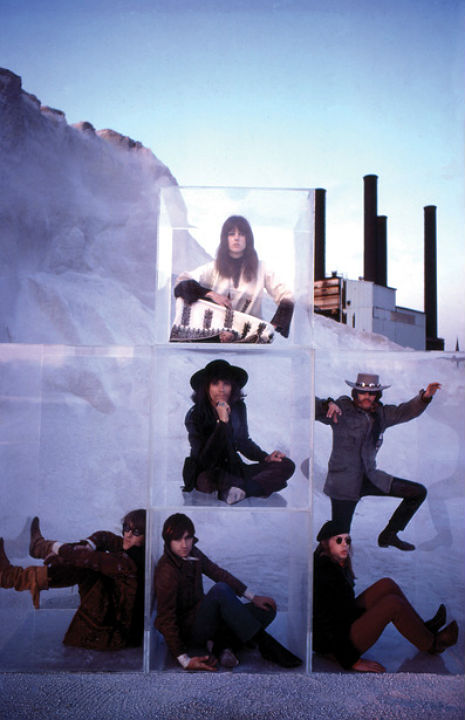
Courtesy of the incomparable pipes of Grace Slick, backed by Jorma’s soaring guitar. Jefferson Airplane on the Dick Cavett Show on 08-19-1969, the day after Woodstock. If they paid attention to the lyrics, this might have been the end of the line for the Airplane’s credibility with some Cavett viewers (and the beginning of their cred for others). (via Dangerous Minds). [Do these terms mean anything to you: Grace Slick? Jefferson Airplane? Dick Cavett? Woodstock? ‘Up against the wall, motherfucker’?]
Things you’ll find from the Japanese tsunami on NW beaches
“If you visit a Northwest ocean beach this summer, you’ll likely run across objects from last year’s Japanese tsunami.
The things you’ll likely see include milk jugs, detergent bottles, tooth brushes and bottles for water, pop or juices with Japanese stamps, marks and labels. Perhaps a soccer ball or a volleyball — two that washed up on an Alaskan island have been claimed by their Japanese owners.
The things you are highly unlikely to see are human remains, refrigerators or anything else that would have to be sealed to float or can come apart, like bigger parts of houses. Months on the ocean will breakup anything with parts, experts say.” (via KPLU News for Seattle and the Northwest).
The Drywall Chronicles
Paul Krugman: “So Mitt Romney gave a speech at a closed Ohio drywall factory, which he tried to use as a symbol of Obama’s economic failure. The symbolism was perfect — not as an illustration of Obama’s failure, but as an illustration of just how stupid Romney thinks we are.
Even regular reporters noticed that the factory in question closed under, yes, George W. Bush — a fact Romney failed to mention, although his campaign scrambled to cover for him afterwards.
What I didn’t see mentioned was the point that this was a drywall factory — that is, a supplier of a product largely used in home construction. It’s one thing to say that Obama should have revived the economy as a whole; it’s another to say that he should have brought back the housing bubble!
Finally, why should we believe that Romney’s policies — basically tax cuts for the rich, as usual — would yield great economic results? Well, I guess you can point to Bush’s example; how did his administration at this point compare with Obama? From BLS data:
You can offer various excuses for Bush’s record, I guess. But on the face of it, what possible reason is there to think that Bush-like policies would be an improvement?” (via NYTimes.com).

English or Gibberish? Ask a Baboon

“While baboons can’t read, they can tell the difference between real English words and nonsensical ones, a new study reports.” (via NYTimes).

Forgetfulness

- Forget-me-not
The name of the author is the first to go
followed obediently by the title, the plot,
the heartbreaking conclusion, the entire novel
which suddenly becomes one you have never read,
never even heard of,
as if, one by one, the memories you used to harbor
decided to retire to the southern hemisphere of the brain,
to a little fishing village where there are no phones.
Long ago you kissed the names of the nine Muses goodbye
and watched the quadratic equation pack its bag,
and even now as you memorize the order of the planets,
something else is slipping away, a state flower perhaps,
the address of an uncle, the capital of Paraguay.
Whatever it is you are struggling to remember,
it is not poised on the tip of your tongue,
not even lurking in some obscure corner of your spleen.
It has floated away down a dark mythological river
whose name begins with an L as far as you can recall,
well on your own way to oblivion where you will join those
who have even forgotten how to swim and how to ride a bicycle.
No wonder you rise in the middle of the night
to look up the date of a famous battle in a book on war.
No wonder the moon in the window seems to have drifted
out of a love poem that you used to know by heart.
— Billy Collins
“Restaurant Mental-Health-Code Violations”

Kevin Kelly on What You Don’t Have To Do

“As you educate yourself about your own talent and ambitions, you graduate from doing a task right to doing the right task. It takes some experience to realize that a lot of work is better left undone. It might be busywork that is performed out of habit, or it might be work that is heading in the wrong direction. Working smart means making sure you are spending your time on jobs that are effective and that actually need to be done.” (via Smarterware).
Gender-Reveal Parties and Cultural Despair
“I’m typically a year or two behind any cultural trend, so you probably already know about gender-reveal parties. I first heard of them over the weekend: a couple, strangers to me, had invited friends and relatives over to bite into cupcakes at the same instant and share the moment when the blue or pink custard inside would inform them all of the sex of the baby. (The sonogram result had gone from lab to baker without being seen by anyone else, including the parents-to-be.) Other couples choose different methods of revelation: grip the knife together and cut into a cake with blue or pink filling. Open a sealed box that releases pink or blue helium balloons. Then put the scene on the Web so that everyone not invited can participate vicariously.
These events are becoming more and more popular. The first video of a gender-reveal party was posted on YouTube in 2008, but in just the last six months almost two thousand have been uploaded. You can watch one from last month. (Spoiler alert: it’s a girl.)
Maybe it was the context—I happened to hear about the gender-reveal party in a rundown inner-city café full of ex-felons who were having a very hard time finding jobs—but my initial take was incredulity trending negative. These parties seem to marry the oversharing of Facebook and Instagram with the contrived ceremonies that modern people in search of meaning impose on normal life events: food journaling, birthday parties for grownups, workout diaries, birth-experience planning. (One birth-planning center offers a “baby gender selection kit” involving three safe and natural steps that turn sex itself into a gender-reveal party.)
In the case of gender-reveal parties, couples take a private moment made possible by science and oblige others to join in, with the result—as in so many invented rituals of our day—that the focus turns from where it ought to be (in this case, the baby) to the self. At a bris or christening, the emotional emphasis falls on the arrival of a new life in the embrace of family and community. At a gender-reveal party, the camera is on the expectant father tearing up at the sight of pink cake.
That’s the nature of manufactured customs and instant traditions. They emerge from an atomized society in order to fill a perceived void where real ceremonies used to be, and they end by reflecting that society’s narcissism. Is it too much to say that gender-reveal parties are a mild symptom of cultural despair?” (via The New Yorker)

R.I.P. Chris Ethridge
Flying Burrito Brother Dies at 65: “Chris Ethridge, a founding member of the country-rock band “The Flying Burrito Brothers,”died here on Monday. He was 65.He learned he had pancreatic cancer in September, his family said.Mr. Ethridge, a bassist and a songwriter, spent eight years on the road with Willie Nelson. He played alongside Gram Parsons in the Flying Burrito Brothers and the International Submarine Band and co-wrote several of Mr. Parsons’ solo tunes.In later years, Mr. Ethridge played with Jackson Browne, Linda Ronstadt, Ry Cooder and other stars, both as a session musician and touring player.” (NYTimes.com obituary)

Ethridge was smack dab at the center of the musical scene I enjoyed so much back in those years. Along with Levon Helm’s passing, the music is much diminished this week.
On, Like, Eliminating Words from the English Language
“Last Friday, …we asked readers to propose a single English word that should be eliminated from the language. Suggestions were made via Facebook or Twitter, with the hashtag #tnyquestion. We started the contest with high hopes that readers would help to streamline the language, but the first wave of responses was not auspicious…” (via The New Yorker).
Some of the scurrilous suggestions are not surprising, but the runaway favorite is.
What “Mad Men” Shows About American Pop Culture
The Forty-Year Itch (Adam Gopnik): “So it seems time to pronounce a rule about American popular culture: the Golden Forty-Year Rule. The prime site of nostalgia is always whatever happened, or is thought to have happened, in the decade between forty and fifty years past. (And the particular force of nostalgia, one should bear in mind, is not simply that it is a good setting for a story but that it is a good setting for you.)” (via The New Yorker).

Still following?
Here’s something I said on FmH ten years ago today:
“In case any FmH readers were wondering how I’ve come by my opinionated gall, it may have something to do with the fact that I turn 50 years old today. (Others may be thinking I probably shouldn’t be doing this at my age…). And my son turns eight today…”
So today my son is eighteen, and I’ve put on a few years too. Thanks to everyone for all the wonderful birthday greetings.
Research paper saves UCSD scientist from $400 traffic fine
‘Dmitri Krioukov, a senior research scientist at UCSD, successfully appealed his failure-to-stop ticket using a physics and math argument that ultimately swayed a San Diego judge.
In the paper, entitled “The Proof of Innocence,” Krioukov offered a series of equations and graphs to show that it was physically impossible for him to have broken the law, as an officer claimed.
The judge was “very, very smart,” Krioukov told The Times. “She got my point, I think, very precisely.”
Krioukov compared the problem to the way a person sees a train approaching from the platform and thinks it is moving slowly, when in fact it is barreling down the track. Using math and physics, Krioukov determined that a car moving at a constant speed can appear to move in the same way as a car that is moving fast but stops for a short time and then accelerates again.
In other words, a car that appears to be moving at a constant speed through a stop sign could have actually stopped at the stop sign, before speeding up again.’ (via LATimes).
Across the Great Divide

Levon Helm performing with The Band. Hamburg, May 1971.
Sad news. Levon Helm is near death, according to this note posted on his website by his family:
“Dear Friends,
Levon is in the final stages of his battle with cancer. Please send your prayers and love to him as he makes his way through this part of his journey.
Thank you fans and music lovers who have made his life so filled with joy and celebration… he has loved nothing more than to play, to fill the room up with music, lay down the back beat, and make the people dance! He did it every time he took the stage…
We appreciate all the love and support and concern.
From his daughter Amy, and wife Sandy”
The Band‘s brown album would be one of my ten desert island discs, for sure, and always has heavy rotation on my iPod. My best friend, if anything a more intense fiend for the Band, and I were always planning to get to one of the Midnight Rambles Helm had been holding on his farm. Sorrowfully, not to be. Saving grace is that he is soon to join Richard Manuel and Rick Danko in the Angel Band. (via Levon Helm Studios, with thanks to abby for the original heads-up).
And: Levon Helms’ finest musical moments. (via Recordonline)
What Happened to the Iceberg That Sank the Titanic?
“Exactly one hundred years ago Sunday, an ocean liner struck a block of ice and sank in the North Atlantic. The story of the ocean liner has been told hundreds of times. This story is about the block of ice.
[These] photos … are quite possibly the only known photographic evidence of the actual iceberg that struck the Titanic. Understandably, nobody had bothered to snap any photographs while the ship was actually sinking, so it’s impossible to make an absolutely confirmed positive identification. But both photographs feature the telltale sign of a collision with a ship, and likely a recent one at that: a streak of red paint.” (via Wired)

Best evidence yet that a single gene can affect IQ
“A massive genetics study relying on fMRI brain scans and DNA samples from over 20,000 people has revealed what is claimed as the biggest effect yet of a single gene on intelligence…” (via New Scientist).

But that is not the most significant aspect of this finding. The effect, although real, was miniscule, accounting for less than 2 points in IQ. So, is it any surprise that the authors conclude that, to the extent that genetics influences intelligence, it is a function of the interplay of multiple genes, not just one?
Must-See Video: Solar Flare Explodes From Sun’s Surface
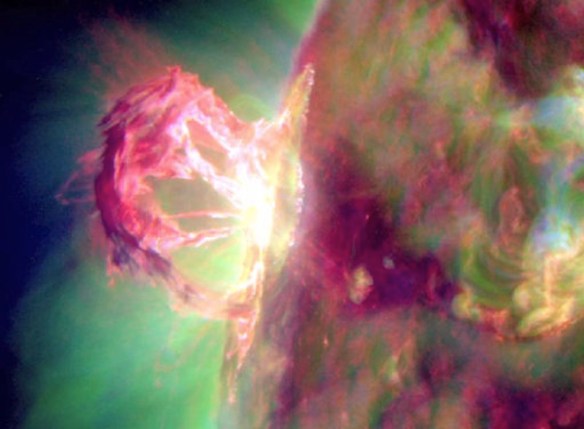
“An incredibly stunning solar flare erupted from the sun’s surface, throwing charged particles and searing plasma millions of miles out into space on Apr. 16.
NASA’s Solar Dynamics Observatory captured data from the flare — a medium-sized M-class event — which was turned into a movie by Steele Hill, media specialist at the Goddard Space Flight Center. The blast was not directed at the Earth and is unlikely to hit any of the planets in our solar system….
The sun is currently entering a time of renewed activity, following a quiet period in its 11-year solar cycle. Peak action is expected from early- to mid-2013. Though it is predicted to be one of the least active cycles in the last 100 years, we have already witnessed several massive flares this year.” (via Wired).
The last film in the Up series?
- Michael Apted
‘The latest installment of the Up Series of documentary films is due out in the UK in May. The films have followed the development of fourteen British children since 1964 with a new film appearing every seven years…the participants are now 56.
…
This may be the last film in the series…director Michael Apted will be 78 when the next film is due and he’s unwilling to pass it off to someone else to finish.” (via kottke)

Any documentary lover and any Anglophile (I count myself as both) should have been following this fascinating and unprecedented series of films.
Larkin v. the Gray Lady
Language Log discusses the New York Times’ relationship with obscenity. Update here.

2012 Pulitzer Prizes Awarded (and NOT Awarded)
“The New York Times won two Pulitzer Prizes on Monday, for its reporting on Africa and for an investigative series on obscure tax code provisions that let the wealthiest Americans and corporations avoid paying taxes. And in a sign of the changing media landscape, online news outlets made a significant mark among the winners, with The Huffington Post and Politico capturing their first Pulitzer Prizes.
Also notable this year was the absence of prizes in two categories. The Pulitzer Prize Board at Columbia University in New York, which administers the awards, did not name a winner in the editorial writing category and more notably declined to name a winner of the coveted prize for fiction. The last time no winner was named for fiction was in 1977.” (via NYTimes).

Related:
- Pulitzer Committee Confirms: Editorial Writing Is Worthless [Media] (gawker.com)
- Pulitzer prizes announced; no fiction? (newsday.com)
How Electroconvulsive Therapy Works
- 3D representation of brodmann areas
“It has not been know exactly how ECT works. It is known that ECT reduces brain activity and raises seizure threshold (makes it less likely to have a seizure). This implies that overall neuronal activity is reduced, so perhaps ECT is inhibiting overactivity in a part of the brain that is driving the depression. That hypothesis is supported by a recent study that uses fMRI scanning to look at brain activity in nine patients with major depression before and after ECT. They found:
A comparison of pre- and posttreatment functional connectivity data in a group of nine patients revealed a significant cluster of voxels in and around the left dorsolateral prefrontal cortical region (Brodmann areas 44, 45, and 46), where the average global functional connectivity was considerably decreased after ECT treatment (P < 0.05, family-wise error-corrected). This decrease in functional connectivity was accompanied by a significant improvement (P < 0.001) in depressive symptoms
Once way to interpret this result is that some patients with major depression have overactive connectivity between that part of the brain that generates the emotion of depression and the part of the brain involved in cognition and concentration. In these patients, therefore, their depressed mood has a significant effect on their thoughts and ability to concentrate. ECT appears to reduce this hyperconnectivity, which should significantly reduce the symptoms of depression.
This is all consistent with prior research on depression, and makes good sense. Still, it’s a small study that needs to be replicated and the whole question further explored.” (via NeuroLogica Blog ).

19 Regional Words All Americans Should Adopt Immediately
“When traveling across the United States, it sometimes feels like the locals are speaking a whole different language. That’s where the Dictionary of American Regional English comes to the rescue. The last installment of this staggering five-volume tome, edited by Joan Houston Hall, was published last month, and let me tell you, it’s a whoopensocker.
In celebration of slang, here’s a list of 19 delightful obscure words from around the U.S. that you’ll want to start working into conversation.” (via Mental Floss).

Police save words of blind author who wrote 26 pages after pen ran out
“A blind woman who did not realise the novel she was writing was blank after her pen ran out has been saved after a police force used forensic techniques to recover the words. Forensics experts agreed to use a special scientific process to recover what Trish Vickers had written by examining the dents she had made in the pages.
Mrs Vickers, 59, was left devastated when she learned that her pen had run out and there was nothing on the first 26 pages of the book. She lost her sight seven years ago through diabetes and decided to write a novel to pass the time and keep her mind active. She quickly penned the opening chapters while using a system of elastic bands to keep the lines separated on the pages of paper she was using. She waited for her son Simon to visit so he could read it back to her. But when he arrived he had to tell her that the pages were blank.
Incredibly, however, the manuscript was recovered after the family took it to their local police HQ and asked for help. Forensic experts worked in their spare time to read the indentations left on the A4 pages using a system of lights. It took five months of painstaking work, but the forensic team was able to recover the whole text – and they said how much they had enjoyed it and couldn’t wait for the rest. A Dorset police spokesman said a member of staff had completed the work during her lunch hours.” (via Telegraph.UK, with thanks to Steve)

Beautiful Realtime Wind Map of the US
“The wind map is a personal art project, not associated with any company. We’ve done our best to make this as accurate as possible, but can’t make any guarantees about the correctness of the data or our software. Please do not use the map or its data to fly a plane, sail a boat, or fight wildfires…” (via Wind Map)

Related:
- Wind and water current maps by van Gogh (kottke.org)
- Live, Interactive Wind Energy Map is a Thing of Beauty (ecogeek.org)
- This Undulating US Wind Map Is Utterly Hypnotic [Maps] (gizmodo.com)
- Beautiful Interactive Animated Wind Map of the U.S. (treehugger.com)
- QuickThing15: dazzling wind map (itsallonething.com)
Existential French cat doesn’t want your cheeseburgers

Nietzsche, summer 1899
‘Henri is the anti-Hello Kitty, a morose French feline who spends his time dissecting the absurdity of his daily grooming rituals and the despair of his solitary existence. Oh, and sometimes he updates his Facebook page. “I suppose that’s my lot in life,” he sighs. “To be watched endlessly, but never understood.” After seeing this, you’ll either immediately click to get to Henri’s first video or spend the afternoon wondering whatever happened to your Nietzsche-reading sophomore year roommate.’ (via msnNOW).
‘The only sin is the sin of being born’

Richard Metzger wishes Samuel Beckett a happy 106th birthday on Dangerous Minds.
8 Simultaneous Lightning Strikes on the San Francisco Bay Bridge

Single-exposure shot from the photographer’s apartment window. Wow. (Laughing Squid)
Artificial Intelligence Could Be on Brink of Passing Turing Test

“One hundred years after Alan Turing was born, his eponymous test remains an elusive benchmark for artificial intelligence. Now, for the first time in decades, it’s possible to imagine a machine making the grade…. There is reason to believe that code kernels for the first Turing-intelligent machine have already been written.” (via Wired.com).
Zombie Survival Maps Show Danger Zones, Armories and Food Sources for Entire U.S.
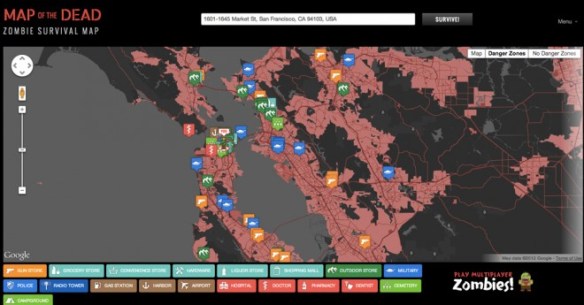
“…The Map of the Dead from Doejo… overlays zombie danger zones and potential supply locations on a Google Map of your local haunts. Red areas denote population centers where zombies might graze, while dark gray zones cover parks and wilderness areas, which are most likely to be walker-free. Supply locations are annotated with helpful descriptions — liquor stores, hospitals, gun shops, military bases and cemeteries are just some of the locations highlighted.” (via Wired.com).
America turns against capital punishment – proof that the people can be trusted
“Connecticut is set to become the fifth American state in as many years to abolish capital punishment, in one of the less commented trends in recent years. It would mean that over a third of the Union’s states are free of capital punishment, but the real coup would be if abolition campaigners won the battle in California, which will decide in November.” (via Telegraph.UK)

…a phenomenon attracting more attention in the European press than the US.
The Origin Of #Long Things

“We’re probably in a bubble in terms of the way we talk about reading longer pieces of writing. But where did #longreads and longform come from?” (via BuzzFeed).
Your Editor as a Neanderthal

Volunteers needed to test dream-controlling app

‘In what is being touted as “the world’s largest dream experiment,” a psychologist from Britain’s University of Hertfordshire is inviting volunteers to try using an iPhone app to control their dreams.’ (via GizMag).
Father of the underground press turns 80 today!
”

“A very happy birthday to the great Paul Krassner (left, with Tuli Kupferberg and unidentified party)! The father of the underground press (although he demanded a paternity test), editor of The Realist, Yippie co-founder and inspiration to two generations of rabble-rousers, turns 80 today.” (via Dangerous Minds)
Why Are So Many Americans Single?
Review of Going Solo: The Extraordinary Rise and Surprising Appeal of Living Alone by Eric Klinenberg, a sociologist at New York University:
“…[S]ingle living [is] not a social aberration but an inevitable outgrowth of mainstream liberal values. Women’s liberation, widespread urbanization, communications technology, and increased longevity—these four trends lend our era its cultural contours, and each gives rise to solo living. Women facing less pressure to stick to child care and housework can pursue careers, marry and conceive when they please, and divorce if they’re unhappy. The “communications revolution” that began with the telephone and continues with Facebook helps dissolve the boundary between social life and isolation. Urban culture caters heavily to autonomous singles, both in its social diversity and in its amenities: gyms, coffee shops, food deliveries, laundromats, and the like ease solo subsistence. Age, thanks to the uneven advances of modern medicine, makes loners of people who have not previously lived by themselves. By 2000, sixty-two per cent of the widowed elderly were living by themselves, a figure that’s unlikely to fall anytime soon.
What turns this shift from demographic accounting to a social question is the pursuit-of-happiness factor: as a rule, do people live alone because they want to or because they have to?” (via The New Yorker).

Related:
- Why More Americans Are Living Alone | PBS NewsHour | March 27, 2012 | PBS (rajcairnsreport.wordpress.com)
- Is Living Alone the New Shacking Up? (theatlanticwire.com)
- 20-Something Solo Dwellers Are Actually Helping The Economy (businessinsider.com)
- The New Normal: Living Alone (brandtstandard.com)
- Going Solo (csmonitor.com)
- Are Single People Discriminated Against? (thedailybeast.com)
- Better single than married? New book suggests yes (ctv.ca)
GeekDad to Tom Lehrer: Happy Birthday!

“Tom Lehrer – mathematician, satirist, singer-songwriter and hero to geeks taking chemistry tests everywhere – was born on April 9, 1928, making today his 84th birthday! …Mr. Lehrer, from all of the geeks who loved (and were educated by) your songs as kids, and who now teach those songs to our own children – thank you, and a very happy birthday to you!” (via Wired.com).
Related:
- Tom Lehrer The Masochism Tango (pinkbananaworld.com)
- Presty the DJ for April 9 (steveprestegard.com)
- Happy Birthday, Tom Lehrer!!! (kidzrockinc.co)
Sunny Days Are Here Again — But Is That Good?

“Across the country, more than 7,700 daily temperature records were broken last month, on the heels of the fourth warmest winter on record.
While it might be time to lie on a blanket in the park, climate scientists are worried. They say all these sunny days are actually an extreme weather event, one with local and global implications.” (via NPR).
Related:
- March Shatters Heat Records (myfoxphoenix.com)
- Weather Is ‘Stunning’ Evidence Of Global Warming (huffingtonpost.com)
- Start of 2012, March shatter U.S. heat records (washingtontimes.com)
- It’s already been a very record-breaking hot year (kansascity.com)
Fighting to Repeal California Execution Law They Championed
Thirty-four years after California’s Proposition 7 sailed through, making the state’s death penalty one of the toughest in the country, the two men who were the driving force behind its crafting are leading the charge to repeal the death penalty in that state. Their reasons are partly moral, but good politics as well. (via New York Times)

Death-penalty
Related:
- Connecticut may be latest state to repeal death penalty (claimyourinnocence.wordpress.com)
- Texas Prisoner Burials Are a Gentle Touch in a Punitive System – NYTimes.com (policyabcs.wordpress.com)
A Better Strategy for Hangman

“There’s no easy way to say it. You’ve probably been playing Hangman wrong your entire life.” (via Lifehacker). And, it turns out, I have.
Related:
- Help>>Hangman Project. I am a beginner to c++. (daniweb.com)
- Hangman online (str17.wordpress.com)
- Great blog post on optimal Hangman strategy. TL;DR our usual… (benjaminste.in)
- Hangman tips (andrewgelman.com)
Google testing heads-up display glasses in public
Won’t make you look like Robocop: “The good news: Google has started testing those augmented reality glasses we heard about earlier in the year. The bad news: if the artsy shots of the test units are to be believed, they won’t make you look like some ’80s cinematic anti-hero. In fact, the things wouldn’t look too out of place in a New York Times style story. The software giant let it be known that, while it hasn’t quite got a sale date on the wearables, it’s ready to test ProjectGlass amongst the non-augmented public. The company is also looking for feedback on the project, writing in a post today, “we want to start a conversation and learn from your valuable input.” Want some idea of what ProjectGlass might offer the public? Sure, it’s not quite as good as strapping a pair on your own eyes, but interested parties can check out a video of Google’s vision…” at the link (Engadget).

Violence Transformed

“Violence Transformed is an annual series of visual and performing arts events that celebrate the power of art, artists and art-making to confront, challenge and mediate violence.
Based primarily in the center and surrounding neighborhoods of Greater Boston and drawing upon the creative energies of artists throughout New England, Violence Transformed documents the ways in which our diverse communities harness art’s potential to effect social change and materially transform our environments.
Violence Transformed also represents a unique collaboration among artists, activists, museum professionals, academics, and community service providers from diverse segments of the greater Boston area. We share the conviction that art and art-making are essential to the well-being and vibrancy of our communities.”
Aviso!

Do not use if you have ever had an allergic reaction to this product or any of its ingredients.
Failure to follow all instructions and warnings can result in serious injury.
Please leave as clean on leaving as you would like to find on entering.
Any resemblance to actual persons living or dead is purely coincidental.
Place all seat backs and tray tables in fully upright position.
Post office will not deliver without proper postage affixed.
Do not operate heavy machinery while reading this weblog.
Caution: Dates on calendar are closer than they appear.
Please note locations of emergency exits upon arrival.
No animals were harmed in the production of this page.
May be used as flotation device in case of emergency.
No ideas were harmed in the making of this weblog.
Anything you say can and will be used against you.
Satisfaction guaranteed; return for full refund.
Names have been changed to protect the innocent.
All questions answered, all answers questioned.
Objects on screen are closer than they appear.
If condition persists, consult your physician.
Detach and include upper portion with payment.
Nutritional need is not established in humans.
Caution: do not swallow. May cause irritation.
Do not use if safety seal is torn or missing.
Please inform author if you cannot read this.
Product is sold by weight and not by volume.
In emergency, break glass, pull down handle.
Caution! The edge is closer than you think.
Contents may have settled during shipment.
Do not fold, staple, spindle or mutilate.
Prices subject to change without notice.
Freshest if used before date specified.
Valid only at participating locations.
If swallowed, do not induce vomiting.
You have the right to remain silent.
Do not remove under penalty of law.
This page intentionally left blank.
Use only in well-ventilated areas.
Do not exceed recommended dosage.
No user-serviceable parts inside.
Warning, contents are flammable.
No shirt, no shoes, no service.
Alarm will sound if door opened.
You break it, you’ve bought it.
You need not be present to win.
Keep out of reach of children.
Part of a daily balanced diet.
First pull up, then pull down.
Void where prohibited by law.
Apply only to affected areas.
Other restrictions may apply.
Close cover before striking.
Do not think of an elephant.
Viewer discretion advised.
You must be present to win.
Caution, low-flying ideas.
Honk if you can read this.
No purchase is necessary.
More taste, less filling.
Internet access required.
Not a low-calorie food.
Don’t try this at home.
Wash hands after using.
Consume in moderation.
Store in a cool place.
For external use only.
Mix well before using.
Your mileage may vary.
Shake well before use.
Use only as directed.
Results not typical.
Consume responsibly.
Ignore this notice.
Slippery when wet.
Unplug after use.
Same-day service.
No preservatives.
No trespassing.
No exit.
Nantucket: an accidental limerick detector
“I wrote a program that takes any text and tries to find any accidental limericks that might be hiding within (based on syllable counts and rhyme, ignoring punctuation and intent).
Limericks have a fairly loose form. The rhyme scheme is always AABBA, but the syllable count can be anything along the lines of 7-or-8-or-9/7-or-8-or-9/5-or-6/5-or-6/7-or-8-or-9. And as if that weren’t loosey-goosey enough, they can have either anapaestic meter (duh-duh-DUM, duh-duh-DUM) or amphibrachic meter (duh-DUM-duh, duh-DUM-duh)!
…(So) Nantucket is set to look for limericks that are AABBA (rhyme scheme) and 8/8/5/5/9 (syllable count per line). It currently ignores meter, but I may add that requirement in later. It also only looks at words through an American English accent.” (Danielle Sucher, via Neal Stephenson)

Here Come The Sons?

“James McCartney Looking to Form Band with Sean Lennon, Dhani Harrison and Zak Starkey…” (via Cool Album of the Day). Do those names mean anything to you? Do you expect that the music would be very good?
Earth Has Just One Moon, Right?

Think Again : “Everybody knows that there’s just one moon orbiting the Earth. But a new study by an international team of astronomers concludes that everybody is dead wrong about that.” (via NPR).
Are these the ugliest buildings in the world?

21 of them, in the Telegraph.UK’s opinion. On the other hand, I don’t know much about architecture but about half of these inspire admiration and wonder, not revulsion or derision, in me.
Creepy woman-stalking app exploited geolocation
‘
At Cult of Mac, John Brownlee writes about Girls Around Me, a creepy app that exploited geolocation APIs to make it easy to stalk women.
These are all girls with publicly visible Facebook profiles who have checked into these locations recently using Foursquare. Girls Around Me then shows you a map where all the girls in your area trackable by Foursquare area. If there’s more than one girl at a location, you see the number of girls there in a red bubble. Click on that, and you can see pictures of all the girls who are at that location at any given time. The pictures you are seeing are their social network profile pictures.
See also Charlie Sorrel’s guide to kill the Facebook and FourSquare features that enable apps like this.’ (via Boing Boing, with thanks to kerry).

Tell your daughters, wives, significant others, friends about this.
Tibet is burning

Exiles mourn latest in string of self-immolation suicide protests: “Dozens of Tibetans have self-immolated in the past year to protest Chinese oppression. In addition to dousing themselves with fuel, some drink kerosene, so that the flames will explode from within.” (via Boing Boing). Why is this phenomenon being largely ignored by the world press?
Related:
- Wave of Tibet Immolations Among History’s Biggest (abcnews.go.com)
- Opinon: Why Tibetans burn themselves (cnn.com)
- Tibet Protester Who Set Himself Alight Dies (news.sky.com)
- Thousands mourn at Jamphel Yeshi’s funeral (photoblog.msnbc.msn.com)
- Wave of Tibet immolations among history’s biggest (thehimalayantimes.com)
- Horrific‚ anti-China protests become Tibet’s norm (thehimalayantimes.com)
- Tibetan Monk, 20, Latest to Self-Immolate in China (abcnews.go.com)
MIT discovers the location of memories: Individual neurons
“MIT researchers have shown, for the first time ever, that memories are stored in specific brain cells. By triggering a small cluster of neurons, the researchers were able to force the subject to recall a specific memory. By removing these neurons, the subject would lose that memory.As you can imagine, the trick here is activating individual neurons, which are incredibly small and not really the kind of thing you can attach electrodes to. To do this, the researchers used optogenetics, a bleeding edge sphere of science that involves the genetic manipulation of cells so that they’re sensitive to light. These modified cells are then triggered using lasers; you drill a hole through the subject’s skull and point the laser at a small cluster of neurons.” (via ExtremeTech).

Neuroscientists Battle Furiously Over Jennifer Aniston

‘Think of Jennifer, or as we like to call her, “Jen.” Jen of the dazzling smile, Jen of the gorgeous chin, Jen with her hair down, Jen tousled, Jen as Rachel, Jen with Brad; Jen without Brad, Jen with Vince, Jen at the Oscars, and, of course, Jen as a neuron in the medial part of the temporal lobe.
Maybe you missed that last Jen.’ (via Krulwich Wonders… : NPR).
Seeing and Believing
A review of T. M. Luhrmann’s When God Talks Back: Understanding the American Evangelical Relationship with God: “Luhrmann is a well-qualified guide: an anthropologist specializing in esoteric faiths. Her dissertation was on witch-and-warlock cults in contemporary England. Later, she wrote a book on the Parsis, a Zoroastrian community in India. Her most recent book was the highly praised Of Two Minds, a study of psychiatric residents and their handling of patients who had visions, among other problems. Almost always, Luhrmann has written with sympathy, not scorn, for these convinced people.
Nevertheless, she is a scientist, and believes in evidence. She spent two years as a full-time member of an evangelical church in Chicago, and another two years in a congregation in Palo Alto. (Those are the cities where she was teaching during that period, first at the University of Chicago, then at Stanford.) Both churches were part of the Vineyard Christian Fellowship, which came together in California in the nineteen-sixties and seventies, and now has about fifteen hundred congregations around the world. Most of the members of the churches that Luhrmann attended were white, middle class, college-educated, and centrist. They weren’t Pentecostals (that is, most of them didn’t speak in tongues or heal the sick). But neither were they just conservative Christians. In Luhrmann’s words, they placed “a flamboyant emphasis on the direct experience of God.” If you made contact with him, they believed, he would become your intimate, someone “who loves and cuddles you.
How do you find this God?” (via The New Yorker)

The Sacrifices of War
A review of War and the American Difference by Stanley Hauerwas: “…the American version of modernity is uniquely defined by two special errors: the illusion that modern freedom and Christian witness are reconciled in America and the belief that America’s wars are redemptive, replacing the truly redemptive sacrifice of Christ with the blood sacrifices of soldiers who kill and die from one American generation to the next.
These two errors become one error: American patriotism becomes a false form of Christian piety, and killing for the nation becomes a dark and devilish project of killing for God. War, as Hauerwas puts it, is America’s altar.” (via First Things)

Related:
- Stanley Hauerwas on Abortion (mikefriesen05.wordpress.com)
- What Would A Just War Look Like? (mikefriesen05.wordpress.com)
Autism: Awareness is Not Enough

April 2 has been designated as World Autism Awareness Day (did you know?). But Steve Silberman explains why that is not enough:
“No matter where you stand on the rising numbers, there is one undeniably shocking thing about them. Once that 1-in-88 kid grows to adulthood, our society offers little to enable him or her to live a healthy, secure, independent, and productive life in their own community. When kids on the spectrum graduate from high school, they and their families are often cut adrift — left to fend for themselves in the face of dwindling social services and even less than the meager level of accommodations available to those with other disabilities.
Meanwhile, the lion’s share of the money raised by star-studded “awareness” campaigns goes into researching potential genetic and environmental risk factors — not to improving the quality of life for the millions of autistic adults who are already here, struggling to get by. At the extreme end of the risks they face daily is bullying, abuse, and violence, even in their own homes…”
He goes on to ask a group of self-advocates, parents and teachers how to go beyond once-a-year ‘awareness’ to create a truly neurodiverse society. (via NeuroTribes)
Petition for the Freedom to Buy Skittles Without Getting Shot

“As an American, I demand the basic freedom to walk my streets in safety — including the freedom to go to the store and buy Skittles without getting shot.” (via Brady Campaign to Prevent Gun Violence; thanks, laurie)
A Quantum Theory of Mitt Romney
“The recent remark by Mitt Romney’s senior adviser Eric Fehrnstrom that upon clinching the Republican nomination Mr. Romney could change his political views “like an Etch A Sketch” has already become notorious. The comment seemed all too apt, an apparent admission by a campaign insider of two widely held suspicions about Mitt Romney: that he is a) utterly devoid of any ideological convictions and b) filled with aluminum powder.
The imagery may have been unfortunate, but Mr. Fehrnstrom’s impulse to analogize is understandable. Metaphors like these, inexact as they are, are the only way the layman can begin to grasp the strange phantom world that underpins the very fabric of not only the Romney campaign but also of Mitt Romney in general. For we have entered the age of quantum politics; and Mitt Romney is the first quantum politician.” (via NYTimes)

Krokodil: The drug that eats junkies

A home-made heroin substitute is having a horrific effect on thousands of Russia’s drug addicts. (via Independent.UK)
Related:
- Desomorphine aka Krokodil The drug that eats junkies (disclose.tv)
- Catching the krokodil (mindhacks.com)
- Graphic effects of NEW DRUG! Krokodil rots flesh off bones! (disclose.tv)
- Crocodile: Drugs And Consequences (undeadinfinity.wordpress.com)
- Krokodil (pandemicpgh.com)
R.I.P. Harry Crews
‘His best books combine comedy and moral outrage, which he combined and lighted on the page like diesel fuel. Their swaggering characters had outsize personalities; so did he. A gruff gallery of faces squint from his dust jackets, from the grizzled swamp sage on the back of his 1978 memoir “A Childhood” to the Mohawk haircut and pit-bull grimace he later favored.Mr. Crews wrote about the South’s white poor, a world he knew intimately. He was a tenant farmer’s son, and he felt the burden of his hard upbringing. In an Esquire magazine essay, later collected in a book called “Blood and Grits,” he wrote:“I was so humiliated by the fact that I was from the edge of the Okefenokee Swamp in the worst hookworm and rickets part of Georgia I could not bear to think of it … Everything I had written had been out of a fear and loathing for what I was and who I was. It was all out of an effort to pretend otherwise.” ‘ (via NYTimes)

April Fools’ Day: Why Is It Prime Time for Pranks?

“The origins of April Fools’ Day are shrouded in mystery, experts say.” (via National Geographic).
Controversial Pesticide Linked to Bee Collapse

“A controversial type of pesticide linked to declining global bee populations appears to scramble bees’ sense of direction, making it hard for them to find home. Starved of foragers and the pollen they carry, colonies produce fewer queens, and eventually collapse.
The phenomenon is described in two new studies published March 29 in Science. While they don’t conclusively explain global bee declines, which almost certainly involve a combination of factors, they establish neonicotinoids as a prime suspect.
“It’s pretty damning,” said David Goulson, a bee biologist at Scotland’s University of Stirling. “It’s clear evidence that they’re likely to be having an effect on both honeybees and bumblebees.” (via Wired)
Why the U.S. Penny Won’t Die Like Canada’s Just Did
“Poor little guy. Starting in the fall, Canada’s government will stop producing the lowly Canadian penny. The fact that pennies are expensive to make and are virtually worthless in today’s economy led them to fall victim to Ottawa’s budget cuts. The government says the measure will save around $11 million a year because each new penny costs 1.6 Canadian cents to produce. (One Canadian dollar is essentially equal to $1 in the U.S.) And a Canadian penny buys you only about 1/20th of what it could when it was introduced in 1858: A penny that could hypothetically buy a whole loaf of bread then would only buy a few bites of bread now.
Canadian consumers will be able to use the 1¢ coins indefinitely, but the government is encouraging businesses to start rounding to the nearest nickel. Lest people forget their arithmetic lessons, the government has put out a fact sheet on proper rounding techniques.
The Canadian move, which cites costs and inflation, follows the long-held logic trumpeted by many economists to get rid of 1¢ pieces in the U.S. Economist Stephen Dubner alone has nearly 20 entries on his Freakonomics blog begging for a U.S. penny death. “Can we please be next?” he wrote this morning after learning of Canada’s move.
A 2008 New Yorker article lays out the counterarguments that have prevented the penny’s seemingly inevitable extinction. There are objections to rounding, which one economist estimated could cost U.S. consumers as much as $1.5 billion over five years. Also, cutting out the penny may just put more reliance on the nickel—which is even more expensive to produce. In the U.S. loses 1.4¢ on each penny it makes and 6.2¢ on each nickel, according to Coin Update, an industry news source. Plus, plenty of Americans like pennies and their Honest Abe heritage. Those enthusiasts, along with industry lobbies, have rallied to support the coins when there has been movement to kill them.” (via Businessweek)

The New Frontlines

Anti-fascists mobilise against English Defence League summit in Denmark: “Hundreds of demonstrators will confront the English Defence League tomorrow as the far-right group holds its first ever European summit in a bid to set up a Continent-wide alliance of anti-Islamic organisations.
Danish activists claimed that as many as 4,000 anti-fascist activists would make their way to the town of Aarhus, where the meeting is due to take place tomorrow afternoon, from the UK, Denmark and Germany.
Organisers said they would march one hour before an EDL rally in the town, in what they predicted would be the country’s largest anti-fascist mobilisation in 15 years.” (via Independent.UK)
TSA Waste

Image from the backscatter advanced imaging technology (AIT) machine used by the TSA to screen passengers. This is what the remote TSA agent would see on their screen.
A reader wrote to see if my audience would be interested in seeing this well-done infographic about TSA waste. (Thanks, Tony) If you think the tax dollars you have contributed to funding the TSA have made you safer, I’ve got a bridge to sell you.
Related:
- You Don’t Have To Be A Criminal Sexual Deviant To Work For The TSA… But It Helps (mountainrepublic.net)
- Bruce Schneier hands former TSA boss his ass (boingboing.net)
- TSA Manager Arrested For Running Prostitution Ring (thedaleygator.wordpress.com)
- End the TSA! (virginiaconservative.wordpress.com)
- Prison Planet.com ” TSA Blocks Security Expert From Testifying To Congress (gunnyg.wordpress.com)
- Lawmakers call airport screeners ineffective, rude (mercurynews.com)
- TSA Employees: Tell Me Your Story (tsaoutofourpants.wordpress.com)
- Congressional Testimony on the TSA (schneier.com)
R.I.P. Adrienne Rich
Influential Feminist Poet Dies at 82: “Widely read, widely anthologized, widely interviewed and widely taught, Ms. Rich was for decades among the most influential writers of the feminist movement and one of the best-known American public intellectuals. She wrote two dozen volumes of poetry and more than a half-dozen of prose; the poetry alone has sold nearly 800,000 copies, according to W. W. Norton & Company, her publisher since the mid-1960s. Triply marginalized — as a woman, a lesbian and a Jew — Ms. Rich was concerned in her poetry, and in her many essays, with identity politics long before the term was coined.” (via NYTimes)

…How Google Stopped Being Google

“…Searches are geospecific and social network-dependent. All of which is fine and useful, but that’s not what made us love Google’s search engine. The more the search engine — and the web more generally — adjust themselves to us, the less they represent a collective idea of what is known….” (via The Atlantic).
Overeating and Obesity: Should we really call it food addiction?
It is not a simple question, and it matters. Good discussion of why. (via Neurotic Physiology).
James Cameron Now at Ocean’s Deepest Point
“Explorer-filmmaker reaches Mariana Trench on deepest ever solo sub dive.” (via National Geographic).

Santorum and Opus Dei
- Josemaría Escriva
“In January 2002, prominent Catholics from around the world gathered in Rome to celebrate the Spanish priest who founded one of the church’s most conservative and devout groups, Opus Dei.The event drew cardinals, bishops and other powerful Vatican officials. And among those invited to speak was a future presidential candidate: Rick Santorum, whose faith had become so essential to his politics that on federal documents he listed the trip, paid for by an Opus Dei foundation, as part of his official duties as a U.S. senator from Pennsylvania. In a speech at the gathering, Santorum embraced the ideas of Opus Dei founder Josemaria Escriva, who had urged ordinary Catholics to bring an almost priestly devotion to Catholic principles in every realm of life and work.” (via The Washington Post, thanks to Perry).

Man Successfully Flies With Custom-Built Bird Wings
Nederlands: Scheveningen Circusplein. Kunstwerk "Icarus" (1999) van Jan Steen, detail. The Hague/The Netherlands. (Photo credit: Wikipedia)
“Using videogame controllers, an Android phone and custom-built wings, a Dutch engineer named Jarno Smeets has achieved birdlike flight. Smeets flew like an albatross, the bird that inspired his winged-man invention, on March 18 at a park in The Hague. “I have always dreamed about this. But after 8 months of hard work, research and testing it all payed off,” Smeets said on his YouTube page.” (via Wired.com).

To rule out god, first get to know him
‘ “Give me the child until he is seven, and I will show you the man.” This Jesuit maxim epitomises how many of us perceive religion: as something that must be imprinted on young minds.
The new science of religion begs to differ. Children are born primed to see god at work all around them and don’t need to be indoctrinated to believe in him (see “The God issue: We are all born believers”).
This is just one of many recent findings that are challenging standard critiques of religious belief. As we learn more about religion’s biological roots, it is becoming clear that secularists are often tilting at windmills and need to rethink.
Another such finding is that belief in a god or gods does appear to encourage people to be nice to one another. Humans clearly don’t need religion to be moral, but it helps (see “The God issue: Religion is the key to civilisation”).
An interesting corollary of this is a deeply held mistrust of atheists (see “In atheists we distrust”). In fact, atheists might consider themselves as unrecognised victims of discrimination. In a recent opinion poll, Americans identified atheists as the group they would most disapprove of their children marrying and the one least likely to share their own vision of American society. Self-declared atheists are now the only sizeable minority group considered unelectable as president.
Such antipathy poses a dilemma for opponents of religion, and may explain why “militant atheism” has failed to make headway.’ (via New Scientist).
The new issue of New Scientist, of which the piece linked above is the foreword, is “the God issue,” and is worth your time if you ever think about religion and its impact, or grip, on us, whether you believe or not.

What to call the particle formerly known as Higgs?
“Earlier this month, organisers of a physics meeting requested that the Higgs boson – the still-hypothetical particle thought to endow other particles with mass – instead be referred to as either the BEH or scalar boson. The name change might seem esoteric, but it hints at a complex past – and trouble ahead over credit for the boson, if it is found.To understand, rewind about 50 years.” (via New Scientist).

Free Will: A Dangerous Idea?
“Recent much-publicized studies have claimed that scepticism about free will makes people behave less morally. “Disbelief in Free Will Increases Aggression and Reduces Helpfulness” as the title of one of hese papers puts it.
In his article (free pdf), British ‘independent researcher’ James B. Miles says that these experiments are flawed, because they didn’t distinguish between determinism (lack of free choice) and fatalism (lack of the ability to change events).
More fundamentally, though, Miles says that free will is used to justify things, such as punishment and poverty, that would otherwise be seen as scandalous…” (via Neuroskeptic).

Toynbee tiles
“The Toynbee tiles (also called Toynbee plaques) are messages of mysterious origin found embedded in asphalt of streets in about two dozen major cities in the United States and four South American capitals.[1][2] Since the 1980s, several hundred tiles have been discovered. They are generally about the size of an American license plate, but sometimes considerably larger. They contain some variation on the following inscription:
TOYNBEE IDEA
IN Kubrick’s 2001
RESURRECT DEAD
ON PLANET JUPITER.
Some of the more elaborate tiles also feature cryptic political statements or exhort readers to create and install similar tiles of their own.” (via Wikipedia)

Mysterious Objects at the Edge of the Electromagnetic Spectrum

NASA’s Fermi Gamma-ray Space Telescope is finding hundreds of new objects at the very edge of the electromagnetic spectrum. Many of them have one thing in common: Astronomers have no idea what they are. (via NASA Science).
Kubrick’s Cover Story: the double narratives and hidden meanings of ‘2001’
“This close examination of Stanley Kubrick’s science fiction masterpiece 2001: A Space Odyssey theorises that Kubrick was working on this film with a “double narrative” structure. Thus, the imagery, set design and camera shots created a complex story all of their own that was separate, and sometimes in direct opposition to, the commonly accepted themes of the Arthur C. Clarke screenplay.
Ager’s work falls on just the right side of conspiracy-culture to be of interest to skeptics and conspiracist’s alike, and with this particular film analysis he is careful to avoid any “tin foil hat” readings of the text, which can be a major downfall of “critical” videos of this kind.
What Ager does posit is that Kubrick was working with a language of imagery that spoke directly to the subconscious and could be in contrast to the spoken words. This is more than a little believable when you take into account that Kubrick’s incredible talent and the huge amounts of time and effort that he spent on the various different aspects of his craft.” (via Dangerous Minds).

I haven’t watched this yet — waiting for a spare hour — but I am eager. I saw 2001 eleven times in the weeks after it came out in 1968 and several more times in the decades since. I think it was my introduction to having my mind blown, and it was also the occasion for my first work of film exegesis; I wrote a review about how profound it was for my high school newspaper, which I fantasized introduced my classmates to layers of meaning they otherwise would not have appreciated. Cocky me. I no longer recall what I said but perhaps I was responding to the unconscious narrative Ager posits here. I’ll see if it makes sense once I watch.
After-Birth Abortion: The pro-choice case for infanticide
‘Just when you thought the religious right couldn’t get any crazier, with its personhood amendments and its attacks on contraception, here comes the academic left with an even crazier idea: after-birth abortion.

No, I didn’t make this up. “Partial-birth abortion” is a term invented by pro-lifers. But “after-birth abortion” is a term invented by two philosophers, Alberto Giubilini and Francesca Minerva.’ (via Slate)
Bradley Manning’s treatment was cruel and inhuman, UN torture chief rules

“The UN special rapporteur on torture has formally accused the US government of cruel, inhuman and degrading treatment towards Bradley Manning, the US soldier who was held in solitary confinement for almost a year on suspicion of being the WikiLeaks source.” (via guardian.co.uk)
Strange Effects: The Mystifying History of Neutrino Experiments
“More often than not, neutrino experiments throughout history have turned up perplexing results. While most of these experiments didn’t get the high-profile attention that disputing Einstein provides, they’ve challenged scientists and helped them learn ever more about the natural world.
In this gallery, we take a look at some of the strangest historical neutrino results and the findings that still have scientists scratching their heads.” (via Wired.com)

There’s no sense in revising the psychiatrist’s bible
 Forget the Diagnostic and Statistical Manual of Mental Disorders – we need a new system based on brain physiology, says psychiatrist Nick Craddock.
You don’t believe we should update the Diagnostic and Statistical Manual (DSM) used to classify mental illness. Why not?
“There are many reasons we should pause. The DSM checklist of symptoms is not fit for purpose: its categories don’t map onto the emerging science of emotion and cognition, yet the DSM-5 rewriters plan to pull in more areas in the new categories and over-medicalise the situation further. Obviously the people rewriting DSM are not stupid, but the project is the wrong thing now. There are lots of great findings coming out of biology, neuroscience and psychology. We will need a new diagnostic system based on these…” (via New Scientist)
The QWERTY Effect
How Typing May Shape the Meaning of Words: ‘ “We know how a word is spoken can affect its meaning. So can how it’s typed,” said cognitive scientist Kyle Jasmin of the University of College London, co-author of a study about the so-called “QWERTY effect” in Psychonomic Bulletin and Review. “As we filter language, hundreds or thousands of words, through our fingers, we seem to be connecting the meanings of the words with the physical way they’re typed on the keyboard.”
The effect may arise from the fact that letter combinations that fall on the right side of the keyboard tend to be easier to type than those on the left.
“If it’s easy, it tends to lend a positive meaning. If it’s harder, it can go the other way,” Jasmin said.’ (via Wired.com).

100,000 AD: Living in the deep future

“In the 21st century, it can feel as if the future has already arrived. But we’re only getting started. It’s fashionable to be pessimistic about our prospects, yet our species may very well endure for at least 100,000 years. So what’s in store for us?” (via New Scientist)
Training New Jedis in the Ways of the Force
‘To an outsider, it might seem like stage-fighting with battery-powered lightsabers, but to Mr. Michael, it is aspiring righteous warriors communing with the Force, that energy that gives the Jedi his power and binds the galaxy. So what if the place attracts, as Mr. Michael said, “a bunch of ‘Star Wars’ dorks.” ‘ (via NYTimes)
The Curator’s Code
“While we have systems in place for literary citation, image attribution, and scientific reference, we don’t yet have a system that codifies the attribution of discovery in curation as a currency of the information economy, a system that treats discovery as the creative labor that it is.
This is what The Curator’s Code is – a system for honoring the creative and intellectual labor of information discovery by making attribution consistent and codified, the celebrated norm.
It’s an effort to make the rabbit hole open, fair, and ever-alluring.” (via curator’s ǝpoɔ)

Free Self-Replicating Machines are here
‘RepRap is a free desktop 3D printer capable of printing plastic objects. Since many parts of RepRap are made from plastic and RepRap can print those parts, RepRap is a self-replicating machine – one that anyone can build given time and materials. It also means that – if you’ve got a RepRap – you can print lots of useful stuff, and you can print another RepRap for a friend…
RepRap was the first of the low-cost 3D printers, and the RepRap Project started the open-source 3D printer revolution. It is described in the video on the right.’ (via RepRapWiki).

Does anyone have one of these and want to print me out one?
Buffalo buffalo Buffalo buffalo buffalo buffalo Buffalo buffalo
“Buffalo buffalo Buffalo buffalo buffalo buffalo Buffalo buffalo.” is a grammatically valid sentence in the English language, used as an example of how homonyms and homophones can be used to create complicated linguistic constructs. It has been discussed in literature since 1972 when the sentence was used by William J. Rapaport, an associate professor at the University at Buffalo. It was posted to Linguist List by Rapaport in 1992. It was also featured in Steven Pinker’s 1994 book The Language Instinct. Read on to parse the sentence. (via Wikipedia).

R.I.P. Peter Bergman
- Firesign Theatre
Satirist at Firesign Theater Dies at 72: “We started out as four friends, up all night, taking calls from people on bad acid trips and having the time of our lives,” Mr. Austin said in a phone interview Friday. “And that’s what we always were: four friends talking.”
Mr. Bergman and his friends recorded their first album, “Waiting for the Electrician or Someone Like Him,” in 1968, followed the next year by “How Can You Be in Two Places at Once When You’re Not Anywhere At All?”
By 1970, their mordant humor and their mastery of stereophonic recording techniques had made them to their generation of 20-somethings what Jon Stewart and Stephen Colbert are to today’s (if Mr. Colbert and Mr. Stewart had a weakness for literary wordplay, psychedelic references and jokes about the Counter-Reformation).
Their records employed sound effects in ways considered pioneering in audio comedy at the time. More generally, they were considered important forerunners of comedy shows like “Saturday Night Live.”
Ed Ward, writing in The New York Times in 1972, described the third Firesign album, “Don’t Crush That Dwarf, Hand Me the Pliers,” as “a mind-boggling sound drama” and a “work of almost Joycean complexity.”
“It’s almost impossible to summarize any Firesign album,” Mr. Ward wrote, because most of their albums were so filled with “intricate wordplay, stunning engineering and use of sound effects, breakneck pacing and, of course, a terribly complex story line.”
When the Library of Congress placed “Don’t Crush That Dwarf” in its National Recording Registry in 2005, The Los Angeles Times described Firesign Theater as “the Beatles of comedy.” (via NYTimes)

Ultra-efficient LED puts out more power than is pumped in

Is it akin to a perpetual motion machine? Does it violate the first law of thermodynamics? No; it turns out that it sucks in ambient heat energy to make up the difference. Commercial application is unlikely, though. (via Wired UK).
Mark Sunday’s Anniversary With a Moment of Silence
”

The Japanese people will be recovering from this catastrophe for years to come. For those of us outside of Japan, however, it’s all too easy to forget. That’s why, to commemorate the one-year anniversary of the earthquake and tsunami, GOOD will join the Japan Society of New York in observing a moment of silence led by Ambassador Shigeyuki Hiroki, Japan’s consul general in New York, at 2:46 p.m. this Sunday, March 11. We invite you to join us, wherever you are. At 2:46 p.m. in your time zone, take a minute to reflect on the incredible challenge facing Japan.” (via GOOD).
Why so little flu this year?

Fukushima and mental health

Maggie Koerth-Baker writes on Boing Boing:
“Yesterday, I got to host an eye-opening Q&A with Dan Edge, a PBS FRONTLINE producer who just finished a documentary about what happened at Fukushima during the first few days of the nuclear crisis there.
During that discussion, we touched a bit on the psychological impact all of this—the earthquake, the tsunami, the nuclear meltdowns—has had on the Japanese people. From studies of what’s happened to the people who lived near Chernobyl and Three Mile Island, we know that the fear and stress associated with these kinds of disasters can have complex and long-ranging health effects.
Today, Paul Voosen, a journalist with Greenwire, emailed me a story he wrote last year, during the first month of the Fukushima crisis, that delves into some of the science behind how disasters (and especially nuclear disasters) affect the human psyche. If you’ve already read it, it’s worth reading again.”
Why shrinks diagnose anti-authoritarians with mental illness

“Bruce Levine, a clinical psychologist, has written on Mad in America about his colleagues’ propensity for diagnosing anti-authoritarians with mental illness. Levine says diagnoses like oppositional defiant disorder, attention deficit hyperactive disorder and anxiety disorder are applied to people who question authority’s legitimacy by mental health practitioners who are, themselves, unconsciously deferential to authority.” (via Boing Boing)
Oh London, You Drama Queen

Was Jesus intersex?
Theologian Susannah Cornwall of Manchester: “…[T]hose who met and interacted with Jesus seem to have had no doubt that he was a man – but, crucially, this is not the same as certainty that he was biologically male. Most of us will meet people on a regular basis who identify as completely unremarkable men or women, but who also have an interest condition. There will hardly ever be any need for us to know about the specificities of someone else’s chromosomes, gonads, hormone levels or sex cells – but if we did, we might be surprised by the number of people whose physical sex varies in some way from what we consider “normal”.
Some of those who argue that women should not be consecrated as priests or bishops do so because they believe that there is something intrinsic to maleness which makes males able to govern and lead in a way females cannot. Others who oppose women priests and bishops argue that a priest or bishop somehow participates in Jesus’ own priesthood, standing in Jesus’ place, and that since Jesus was male, a female cannot take on this role.
However, I believe that most people who argue in this way never make the distinction between sex and gender which I have outlined above.” (via Boing Boing)

How Not to Apologize

“Rush Limbaugh’s statement on Sandra Fluke was a textbook example of what not to say.” (via Slate).
Also: The Advertisers Sticking By Limbaugh
Advertisers really know their demographics. I would of course never listen to Rush Limbaugh and, with his latest offensive idiocy, was all set to stop patronizng his sponsors. But apparently they don’t want me as a customer either, because none of the advertisers on this list from The Atlantic Wire.have the least bit of appeal to me. The sole exception, and they say they do not really support Limbaugh, is Netflix.
Related:
- “People In My Position Never Apologize”: Is Rush Limbaugh Too Big To Fail? (mykeystrokes.com)
- Sandra Fluke Rebukes Rush Limbaugh’s Apology (pinkbananaworld.com)
- Jacoby: Rush needs better apology (bostonglobe.com)
- “From The Mouth Of A Bully”: Rush Limbaugh’s 53 Smears Against Sandra Fluke (mykeystrokes.com)
- If you believe Rush Limbaugh’s apology was ‘sincere,’ how’s that Tooth Fairy working out for you? (thehill.com)
- Rush Limbaugh Advertisers’ Exodus Hits 29 (newser.com)
- Sandra Fluke On Limbaugh Apology “I Don’t Think [It] Changes Anything” (alan.com)
The myth of the eight-hour sleep

“We often worry about lying awake in the middle of the night – but it could be good for you. A growing body of evidence from both science and history suggests that the eight-hour sleep may be unnatural.
In the early 1990s, psychiatrist Thomas Wehr conducted an experiment in which a group of people were plunged into darkness for 14 hours every day for a month.
It took some time for their sleep to regulate but by the fourth week the subjects had settled into a very distinct sleeping pattern. They slept first for four hours, then woke for one or two hours before falling into a second four-hour sleep.” (via BBC News).
Happy Leap Day

Monsters Attack!

26 Epic Retro Horror Movie Posters; how many of these have you seen? By my count, I’m 18:26. This collection includes my all-time favorite, The Crawling Eye (1958). (via WebUrbanist)
A Military Diagnosis, ‘Personality Disorder,’ Is Challenged
“…Military commanders pressure clinicians to issue unwarranted psychiatric diagnoses to get rid of troops.” (via NYTimes). In civilian psychiatry, as well, the status of personality disorder diagnoses is dubious. Especially when applied loosely, these diagnoses are little more than pejorative.
Composite sketches of literary characters
‘The Composites blog takes descriptions of literary characters and runs them through police composite sketch software to produce composite sketches… This is one of those “why didn’t I think of this?” projects…well done,’ says kottke.
