
Isaac Stanley-Becker via The Atlantic:
‘Lithuania, Latvia, and Estonia are readying themselves to fend off a Russian attack—with the help of the United States, or without it.…’

Isaac Stanley-Becker via The Atlantic:
‘Lithuania, Latvia, and Estonia are readying themselves to fend off a Russian attack—with the help of the United States, or without it.…’
Oh, this is wonderful.
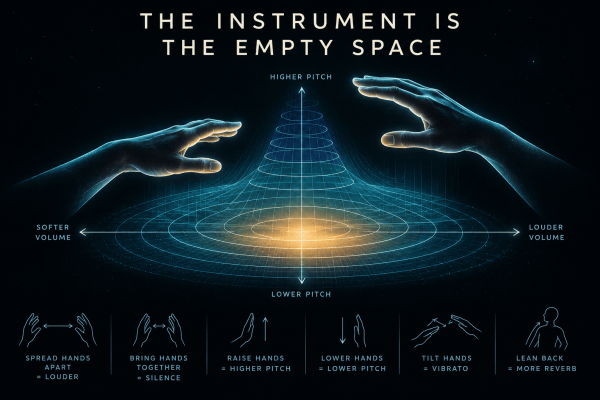
Air Theremin turns your phone or laptop into a musical instrument you play by waving your hands around in empty space. No controller. No keyboard. No touching anything. Just grant the browser access to your camera, hold up both hands, and suddenly you’re performing in that wonderfully eerie, swooping musical territory traditionally occupied by mad scientists, 1950s flying saucers, and Clara Rockmore.
And it actually understands your gestures.
Spread your hands apart and the sound gets louder. Raise them and the pitch climbs. Bring your palms together and it falls silent. Tilt your hands like a seesaw and you get vibrato. Lean backward and the sound darkens and acquires more room and reverberation. It’s an instrument whose control surface is simply the space around your body.
On a phone you can switch to gyroscope mode and play by tilting the device instead: left-right controls volume and forward-back controls pitch. If neither camera nor motion sensor is available, you can even drive the thing with a mouse.
Then things get more elaborate. Choose sine, triangle, warm or reed-like waveforms; add reverb, vibrato, tremolo or echo; snap pitches toward musical notes; and record the resulting extraterrestrial aria.
The original theremin, invented by Léon Theremin more than a century ago, was already an uncanny proposition: an electronic instrument played without touching it. Air Theremin takes that idea one step further and removes the instrument itself. What remains is gesture, space and sound.
It takes about five seconds before you stop regarding this as a clever web demo and begin waving your arms around like an orchestra conductor attempting first contact with Alpha Centauri.
Go play it: theremin.bizibah.com

Carl Zimmer via The New York Times:
‘Scientists have discovered a virus that is a tiny bit human, carrying a gene it stole from our ancestors about 100,000 years ago. And this virus may be using our own gene to infect us.
Previous studies have demonstrated that viruses can pick up genes from their hosts. But the new discovery, reported Thursday in the journal Science, may be the first known instance of a virus with a human gene acquired in recent evolutionary history…Dr. Feschotte and his colleagues discovered the human gene in molluscum contagiosum virus, a distant relative of smallpox. It causes small sores on the skin that typically disappear after a few months. It only infects humans, often children…’
..’
Via The Guardian:
‘If more cities start regulating outdoor lighting, we humans could make the environment better for all living creatures…’

Via The Verge:
The US executive branch is no longer acknowledging the existence of “artificial intelligence.” Going forward, official policy websites, policy documents, and press releases will refer only to “Super Intelligence,” thanks to a new executive order signed by President Donald Trump.
“The word super is the best word of all, and it’s the simplest,” Trump said at an event announcing the launch of America.gov earlier on Tuesday, and said Chinese President Xi Jinping, who visited the White House last week, “loves it” too. “We don’t want to hear artificial. Because it’s not artificial. It’s very powerful, it’s very brilliant. It’s going to mostly be put to good use and we’ll stop the bad use.” Artificial, he added, “is like the news. Fake news.”
Via JSTOR Daily:
‘In 2019, 550 students evacuated the University of Canberra’s library because of one fruit: durian. Its sulfuric odor had been mistaken for a gas leak, a common occurrence that has grounded planes and baffled fire departments worldwide. Known colloquially as the “King of the Fruits,” durian commands attention with its pungent scent and spiky husk. Despite these seemingly unsavory qualities, durian’s sweet flesh has created a multibillion-dollar consumer market that fuels economic growth in countries like Vietnam, Malaysia, Cambodia, and Thailand. Central to Southeast Asia’s ecological systems, economic development, and sociopolitical organization, durian’s overpowering presence shapes local customs and mobilizes transnational supply chains, testifying to the sensorial hold that plants have over us.For those unacquainted with the peculiar odor, taste, and texture of durian, American botanist Francis Ramaley’s 1905 account offers a helpful starting point. He describes durian’s smell as a “rare combination of vile odors”: “first one thinks of rotten eggs, then of sewer gas and garlic and finally he gives up any attempt at a classification of the different smells.” By contrast, in one of the most vehement defenses of the fruit, British naturalist and “confirmed Durian eater” Alfred Russel Wallace waxes lyrical in his 1869 travelogue The Malay Archipelago…’
