
Via Neuroscience Stuff:
‘Two years after discovering a way to neutralize a rogue protein linked to Alzheimer’s disease, University of Alberta Distinguished University Professor and neurologist Jack Jhamandas has found a new piece of the Alzheimer’s puzzle, bringing him closer to a treatment for the disease.
In a study published in Scientific Reports, Jhamandas and his team found two short peptides, or strings of amino acids, that when injected into mice with Alzheimer’s disease daily for five weeks, significantly improved the mice’s memory. The treatment also reduced some of the harmful physical changes in the brain that are associated with the disease.
“In the mice that received the drugs, we found less amyloid plaque buildup and a reduction in brain inflammation,” said Jhamandas, who is also a member of the Neuroscience and Mental Health Institute.
“So this was very interesting and exciting because it showed us that not only was memory being improved in the mice, but signs of brain pathology in Alzheimer’s disease were also greatly improved. That was a bit of a surprise for us.”…’

 Things did not end well for him.
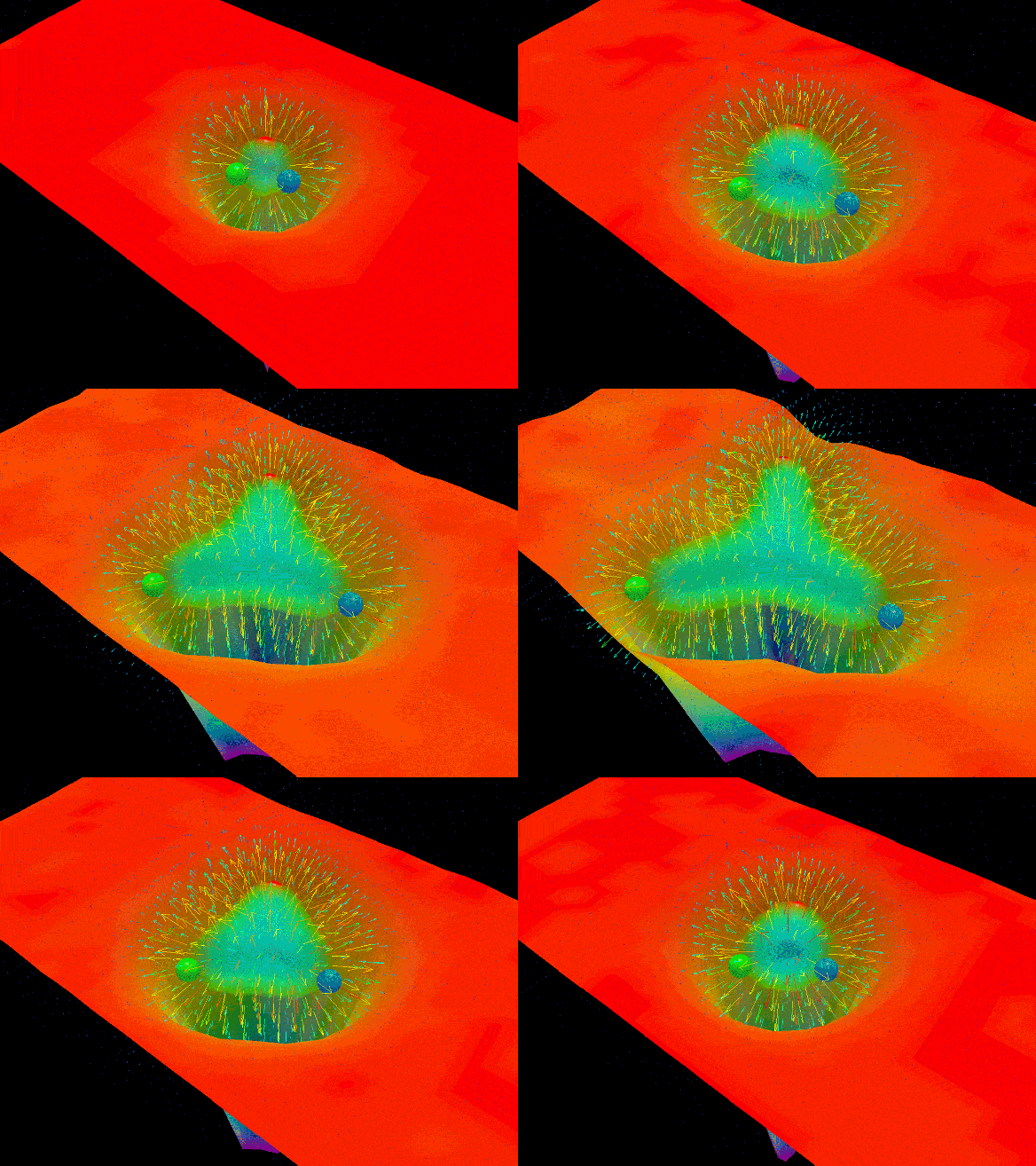 Objects are made of atoms, and atoms are likewise the sum of their parts — electrons, protons and neutrons. Dive into one of those protons or neutrons, however, and things get weird. Three particles called quarks ricochet back and forth at nearly the speed of light, snapped back by interconnected strings of particles called gluons. Bizarrely, the proton’s mass must somehow arise from the energy of the stretchy gluon strings, since quarks weigh very little and gluons nothing at all.
 Republicans broadly agree that mass deaths are an acceptable sacrifice in the effort to “reopen” an economy savaged by the coronavirus pandemic. This approach got its media moment yesterday as Trump toured a mask factory to Paul McCartney’s classic hit Live and Let Die.
 ‘In this essay, Roy Scranton asks what we mean when we say “the world is ending.” Examining the nature of the narratives we tell ourselves about the future, he explores what revelation may be before us.