Via Gawker, ‘Prince George, heir to the British throne, turned one human year old on Tuesday. An occasion for celebration, perhaps, and yet we find ourselves troubled: If one thing has become clear over the last year, it is that George Alexander Louis of Cambridge is far from ready to serve as the solemn figurehead of a commonwealth of nations whose combined population numbers in the hundred millions.
Even with a restrained British press, palace media offices have been unable to quell the yearlong deluge of photographs of Prince George at official events crying, screaming, sneering, leering, pouting, shouting, squirming, flailing, grabbing a boob, eating his moms hair, and looking on with chilling coolness as the world around him descends into godless chaos.’
Author Archives: FmH
This Molecule Can Prove Youre a Supertaster… Or a Caffeine Junkie
Via io9, ‘Some patients found the drug to be unbearably bitter. Some found it only slightly bitter. Some didnt notice a flavor at all. With a little research, scientists found that those who could taste the bitterness in PROP tended to have more taste receptors, and that this ability seemed to run in families. Now PROP is used in one of tests that determines if someone is a supertaster. Patients swish a cup of liquid, with some PROP mixed in, around in their mouths, or they put a paper saturated with PROP on their tongue. If theyre supertasters, they wont want to be tasting long. Supertasters find PROP overwhelmingly bitter and unpleasant. People with slightly heightened senses of taste find it only slightly bitter. Everyone else tastes only the water or the paper.
Supertasters arent only repulsed by the bitterness in PROP. They can also taste the bitterness in alcohol, and in caffeinated drinks. Adding a lot of sugar to the drinks can mitigate the taste, and supertasters, like everyone else, love the taste of sugared-up coffees. Still, for the most part, people who respond badly to PROP tend to be the sort of people who only go into coffee shops for the pastries, and sit hollowed-eyed in bars, wondering why they never serve cake. Lifes bitter enough already.
An interesting side note – PROP is the first test for a supertaster. The next one? A peppermint LifeSaver. If Wrigley announced on the wrapper that peppermint LifeSavers were medical-strength candy, Id start buying them.’
This Tree Is Growing 40 Different Kinds Of Fruit At Once
Via io9, ‘This single and quite colorfully blossoming tree grows 40 different varieties of peaches, plums, apricots, nectarines, cherries, and even almonds… After sculptor Sam Van Aken bought a failing orchard in upstate New York full of hundreds of different fruit trees, he began the painstaking process of grafting several of the different varieties together into one tree. Six years later, the result is this 40-fruit bearing tree, which includes some heirloom varieties that are centuries old.’
New Poll Reveals The U.S. Is Number One In Climate Change Denial
Via io9, ‘54% of Americans agreed with the statement, “The climate change we are currently seeing is largely the result of human activity.” While thats a slight majority, it ranks last compared to the other countries polled, including France 80%, Brazil 79%, South Korea 77% and Great Britain 64%. That result could help explain why the U.S. also ranked last on whether “we are heading for environmental disaster unless we change our habits quickly.” On that question, 57.3% of Americans agreed, compared to France 74.7%, Brazil 78.4%, South Korea 77.2% and Great Britain 58.8%.’
Want to Be a Better Person? Take a Walk in the Park
Via Pacific Standard, ‘Plenty of research has suggested immersing yourself in nature has significant mental and physical health benefits. But can it also make you a better person? New research from France suggests it just might.’
Worlds largest aquatic insect discovered in China
Via Gizmodo, ‘A new specimen of an insect was found this month in a mountain in Chengdu, Sichuan province, China. The insect belongs to the order of Megaloptera and has a wingspan of 21 centimeters—8.3 inches.’

Why No One Bothers Putting Apostrophes in “Dont Walk” Signs
21 July, 2014 13:55
White holes: Hunting the other side of a black hole
Via New Scientist, ‘Black holes suck – but do they have mirror twins that blow? A far-flung space telescope is peering into galactic nuclei to spot one for the first time…’

[Hmmm… What about that mysterious white hole in Siberia?]
Related?
Free Arturo
via Telegraph.UK, ‘More than 200,000 people have signed an online petition calling for a polar bear living in ‘deplorable’ conditions in an Argentinian zoo to be moved.Supporters of the online appeal want to transfer Arturo, who has been dubbed the ‘world’s saddest animal’, to Assiniboine Park Zoo in Winnipeg, Canada.’
Stop calling soldiers “heroes”
Via Salon.com: ‘It stops us from seeing them as human — and dismisses their experience. “Hero” sounds like praise, but its not: It glosses over the human cost of war, and keeps us from helping our vets. ‘ — CARA HOFFMAN
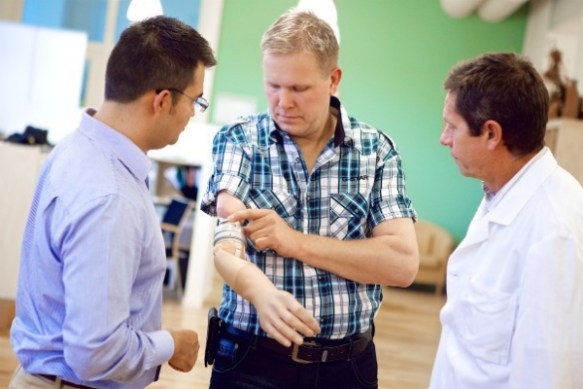
[In fact, mightn’t it be more appropriate to refer to many of them as “victims”?]
I’m Presumably in this Database. How About You?
Via Boing Boing, ‘US “suspected terrorist” database had 1.5M names added to it in past 5 years: The scale of the secret blacklist was revealed in a civil suit over the Terrorist Screening Database, and it shocked the judge.99 percent of the names submitted to the list are accepted; the court called this “wildly loose.” The database has grown from 227,932 names in 2009 to its current stratospheric heights. There is no official, public procedure for having your name removed from the list.’
Related articles
HIV Undetectable In Two Patients Following Bone Marrow Transplants
Via IFLScience, ‘The two men, ages 47 and 53, respectively received bone marrow transplants three and four years ago to treat lymphoma and leukemia. Though the HIV virus is no longer detectable in either of them, they are still undergoing antiretroviral therapy ART as a precaution, and Cooper refuses to say that the men have been “cured” due to the possibility of relapse, as witnessed in other patients whose viral loads had dropped to undetected levels only to reappear later.’
An Experimental Stem Cell Treatment Lead To A Woman Accidentally Growing A Nose On Her Spine
Via IFLScience, ‘Who knows where a nose grows? Here’s a curious case. An 18-year-old woman sustained a spinal cord injury that left her legs paralyzed. Three years later, stem cells from her nose were transplanted into the injury site. She developed back pain eight years afterwards, and imaging revealed a mass at the implantation site. The 3-centimeter-long spinal cord mass was mostly nasal tissue and contained large amounts of thick, mucus-like material.’
Annals of Emerging Disease
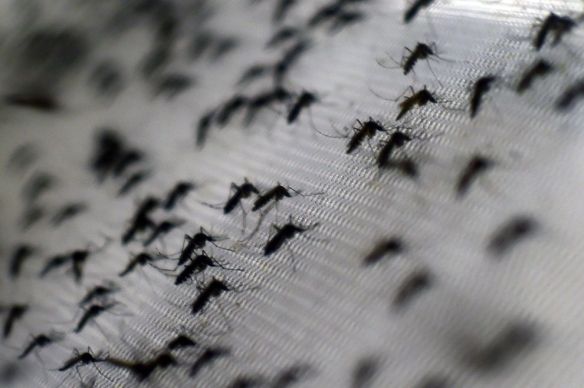
‘It’s only a matter of time before the chikungunya virus spreads in the U.S. When the name of a virus translates as “to become contorted” as in, with joint pain you know it is not something you want to catch. Unfortunately, your chances of encountering chikungunya are increasing.Chikungunya is a mosquito-borne illness that has no cure. On the plus side, its unlikely to kill you. On the downside, if you catch it, treatment is about easing the discomfort of symptoms and waiting for it to pass.’ Via Boing Boing.
Related articles
The polar flip
Via kottke, ‘According to data collected by a European satellite array, the Earths magnetic field is shifting and weakening at a greater pace than previously thought. One of the reasons for the shift might be that the magnetic North and South poles are swapping positions.’
Whats So Funny?
Via The Chronicle of Higher Education, ‘There is, in short, far too much written—and still being written—on the subject of laughter for any one person to master; nor, frankly, would it be worthwhile to try. Confronted with the product of centuries of analysis and investigation, one is tempting to suggest that it is not so much laughter that defines the human species, as Aristotle is supposed to have claimed, but rather the drive to debate and theorize laughter.
Partly in response to the profusion of views and speculation, theories of laughter are typically divided into three main strands. Few books on laughter fail to offer, somewhere near the beginning, a brief enumeration….’
The three theories, broadly, are described as the superiority theory, the incongruity theory, and the relief theory. Each has attractions and shortcomings. What appeals to you? (What makes you laugh?)
There Is Some Hope That We Aren’t Living Inside a Computer Simulation
Via io9, ‘Philosopher Nick Bostroms famous Simulation Argument suggests its highly probable that we live inside a supercomputer. But one philosopher takes this hypothesis to task, arguing in a new paper that there are other post-human scenarios that need to be taken into account.’
Peacemaker Bangle
Via Combat Flip Flops, ‘This was a bomb.
270 million bombs were dropped on Laos during the Vietnam War. 30% of them are still sitting there ready to explode, in fields, behind trees, next to schools.
But local artisans are melting down some of the unexploded ordnance (“UXO“) to hand craft art like this Peacemaker bangle.
Double Bottom Line: When you buy one you help fund the clearing of 3 square meters of UXO. You literally help save life and limb. And you help create jobs. Look good. Feel Good. Do Good.
Made from Unexploded Ordnance UXO and War Scrap2.6” diameter, 8.3” circumference. Made in Laos.’
Related articles
A Comeback for the Passenger Pigeon?
Via Audubon Magazine, ‘A new project aims bring a famous bird back from extinction.’
We must kill the McMansion! Good riddance to an American embarrassment
Via Salon.com, ‘Our homes dwarf those in every country on Earth. We cant control our environmental impact until that changes…’
The American Century is over: How our country went down in a blaze of shame
Via Salon.com, ‘We face a triple crisis in foreign policy, economics and democracy. Heres how it all went to hell…’
R.I.P. Charlie Haden
Influential Jazz Bassist Is Dead at 76: ‘His jazz career crossed seven decades, with barely a moment of obscurity. He was in his early 20s in 1959, when, as a member of the Ornette Coleman Quartet, he helped set off a seismic disruption in jazz. Mr. Coleman, an alto saxophonist, had been developing a brazen, polytonal approach to improvisation — it would come to be known as free jazz — and in his band, which had no chordal instrument, Mr. Haden served as anchor and pivot.
Mr. Coleman’s clarion cry, often entangled with that of the trumpeter Don Cherry, grabbed much of the attention, but Mr. Haden’s playing was just as crucial, for its feeling of unerring rightness in the face of an apparent ruckus.
In addition to Mr. Coleman, with whom he continued to play intermittently in the 1960s and ’70s and later, in the occasional reunion, Mr. Haden worked with many principal figures of an emerging jazz avant-garde. For a decade starting in 1967, he was a member of a celebrated quartet led by the pianist Keith Jarrett, with Dewey Redman on saxophone and Paul Motian on drums.
The Liberation Music Orchestra, which released its debut album in 1969, was Mr. Haden’s large ensemble, and an expression of his left-leaning political ideals. The band, featuring compositions and arrangements by the pianist Carla Bley, mingled avant-garde wildness with the earnest immediacy of Latin American folk songs. Mr. Haden released each of the band’s four studio albums during Republican administrations; the most recent, in 2005, was “Not in Our Name,” a response to the war in Iraq.
Mr. Haden, who liked to say he was driven by concern for “the struggle of the poor people,” hardly restricted his opinions to the Liberation Music Orchestra. While playing a festival with Mr. Coleman in Lisbon, in 1971, he dedicated his “Song for Ché” to the black liberation movements of Mozambique and Angola, and was promptly jailed.’ (NYTimes obituary)
Related articles
10 things America does so much worse than Europe
Via Salon.com, ‘Bad healthcare. Limited vacation time. Lower life expectancy. “American exceptionalism” has never rung so hollow.’
Girl believed to be cured of HIV now has detectable levels of the virus
Via Salon.com, ‘In a disappointing turn of events, representatives from the National Institutes of Health announced on Thursday that a young girl previously believed to have been cured of HIV now has detectable levels of the virus. The nearly 4-year-old Mississippi girl was treated aggressively with anti-retroviral drugs for the first 30 hours after her birth and remained without treatment for nearly two years, leading researchers to declare her the first child to be cured of HIV. But, after two recent tests, doctors say the girl has relapsed.’
That Feeling When You Walk Down a Dark Street and Meet a Jellyfish
Via io9, ‘ Every night, at 10 pm, something mystical happens at a derelict building in Liverpool. The storefront shutter opens, revealing a massive, ethereal water tank filled with live jellyfish.
The installation, created by the artistic duo Walter Hugo & Zoniel, is called “The Physical Possibility of Inspiring Imagination in the Mind of Someone Living.” Although its part of the Liverpool Biennial—the largest contemporary art festival in the UK—the artists didnt promote or even announce the exhibit. It just quietly appeared one evening, in order to allow the random passerby to experience the surreal encounter with fresh eyes.
The installation will be on display until July 27. And, if you dont happen to find yourself wandering the streets of Liverpool late at night, you can watch video recordings of streamed footage…’
So Just Swallow!
Via io9, ‘You Have a Painkiller Six Times Stronger Than Morphine In Your Saliva. Right now, you are walking around with a mouth full of extremely powerful, untested pharmaceuticals. Your saliva contains opiorphin, a painkiller thats about six times more powerful than morphine.
After so many decades spent prodding lab rats, one would think that there is nothing more to be discovered about the horrid little things, or how they relate to humans. One would be wrong. What a fool one is! In the early 2000s, scientists discovered that rat saliva contains sialorphin, a powerful painkiller. Rats are, in many ways, analogous to humans. Researchers began wondering if human saliva contained its own painkilling compound.
Enter opiorphin, a painkiller that seems to be both very effective and very simple. It works by preventing the breakdown of little chemicals called enkephalins. These chemicals stimulate the bodys opiate receptors, which block pain signals. Liberal application of opiorphin keeps the bodys own pain-blocking system going. Why such a powerful pain-killer is in saliva is up for debate…
Don’t We Learn Anything??
Via National Geographic: ‘Second Silent Spring? Bird Declines Linked to Popular Pesticides.
Pesticides don’t just kill pests. New research out of the Netherlands provides compelling evidence linking a widely used class of insecticides to population declines across 14 species of birds.
This new paper, published online Wednesday in Nature, gets at another angle of the story—the way these chemicals can indirectly affect other creatures in the ecosystem.Those insecticides, called neonicotinoids, have been in the news lately due to the way they hurt bees and other pollinators. (Related: “The Plight of the Honeybee.”) ‘
Related articles
How Hot Your City Could Be By 2100 If Climate Change Goes Unchecked
Via Gizmodo, ‘Its a sorry truth that hits you mid-July: Average summer temperatures have been rising since the 1970s. If we continue down this path, according to a new study by Climate Central, in 2100, summers in Boston will feel more like sticky Miami—and summers in Miami will feel like toasty Harlingen, Texas.
Simply type where you live into the chart… and youll get an instant comparison between the average summer high temperature in your city today and the city your home is more likely to feel like in 86 years. If greenhouse gasses and climate change keep chugging along at the rates they are right now, anyway. Its more of a fun thought experiment than an exact science.
It’s surprising to see not only the temperature increase but the comparison city. San Diego average high 78.17 degrees will only be as warm as Lexington, Kentucky 84.61. But Fargo average high 80.24 degrees will warm by over 12 degrees by 2100, making it feel more like Tyler, Texas 92.08. In fact, most American cities will end up feeling like somewhere in Texas or Florida by 2100.Type in Las Vegas, however, and theres no American comparison. Youll be shuttled halfway around the world to Riyadh, Saudi Arabia, where the average summer high is a balmy 111 degrees.
This map cant tell the future though. This is only a prediction based only on current trends—if greenhouse gas emissions continue to increase at the rate that they have been increasing since the 1970s. Even though this map shows a very dystopian future, its one that we can hopefully avoid.’
Previously Uncontacted Amazon Tribe Make Contact With Outside World
Via IFLScience, ‘Brazilian officials reported recently that a tribe of people living in the Peruvian Amazon, who previously had no contact with the outside world, have just contacted a settled tribe near the Brazil-Peru border while attempting to flee illegal loggers. The group was first discovered in 2011 from aerial photographs taken by the Brazilian government.
José Carlos Meirelles worked for the Brazilian government agency FUNAI for 20 years in order to protect these indigenous people and their rights. He told Survival International that this situation felt a bit desperate, as it was the first time in 30 years that the uncontacted group were the ones to make first contact with outsiders. “Something serious must have happened. It is not normal for such a large group of uncontacted Indians to approach in this way. This is a completely new and worrying situation and we currently do not know what has caused it.” ‘
A cultural view of agony
Via Mind Hacks, ‘New Statesman has a fascinating article on the ‘cultural history of pain’ that tracks how our ideas about pain and suffering have radically changed through the years. One if the most interesting, and worrying, themes is how there have been lots of cultural beliefs about whether certain groups are more or less sensitive to pain. Needless to say, these beliefs tended to justify existing prejudices rather than stem from any sound evidence.’
Why has the idea of hell survived so long?
Landscape with Charon Crossing the Styx by Joachim Patinir, c. 1515–1524. Museo del Prado, Madrid.
Via Aeon, ‘Younger Christians may be ditching doctrines of fire and brimstone – but will Christianity ever get rid of hell entirely?’
Federal judge: Supreme Court should “stfu”
Via Salon, ‘In the wake of the Hobby Lobby ruling, George H.W. Bush appointee Judge Richard George Kopf has some advice for how the Supreme Court can guard against losing even more prestige and legitimacy in the eyes of the public: STFU.
“[T]his term and several past terms has proven that the court is now causing more harm division to our democracy than good by deciding hot button cases that the court has the power to avoid,” Kopf writes at his personal blog, Hercules and the Umpire.
“As the kids say,” Kopf continues, “it is time for the Court to stfu.” ‘
When you fly a drone into fireworks, its quite beautiful
Via CNET, ‘The proliferation of controlled flying objects has incited many an imagination. Some believe drones should be used to deliver vacuum cleaners. Others might have more nefarious, prurient intentions. However, one man thought it might be entertaining to fly a DJI Phantom 2 drone into a fireworks display…
The drone was, according to the poster, Jos Stiglingh, equipped with a GoPro Hero 3 Silver camera. Once the footage was nicely edited and put together with an appropriate sliver of opera, the effect was rather greater than at your average fireworks display. It seems that so many now look all the same. They begin with a small bang and end with multiple bangs and flashes, as if you should always say goodbye with an assault on the senses. Seen from the drone, the whole thing takes on a far greater poetry.
Apparently, the flying machine was undamaged by its experience.’
Facebook manipulation experiment has connections to DoD “emotional contagion” research
Via Boing Boing, ‘here’s a new wrinkle on the massive emotion-manipulation study that Facebook conducted in concert with researchers from Cornell and UCSF: one of its researchers is funded under a US Department of Defense program to study “emotional contagion” and civil unrest.’
A spook’s guide to the psychology of deception
‘Last February, a file from the Edward Snowden leaks was released from a 2012 GCHQ presentation called ‘The Art of Deception: Training for Online Covert Operations’. It describes the ‘Online Covert Acti
on Accreditation’ course which draws heavily on the psychology of influence and persuasion. This post will look at how they’re piecing together the science that forms the basis for these online operations.’ (Mind Hacks).
The answer in a few words: not very systematically. The deceivers don’t know what they’re doing but they do it well.
Do we really hate thinking so much we’d rather electrocute ourselves?
‘The story: Quiet contemplation is so awful that when deprived of the distractions of noise, crowds or smart phones, a bunch of students would rather give themselves electric shocks than sit and think.
What they actually did: Psychologists from the universities of Virginia and Harvard in the US carried out a series of 11 studies in which participants – including students and non-students – were left in an unadorned room for six to 15 minutes and asked to “spend time entertaining themselves with their thoughts.” Both groups, and men and women equally, were unable to enjoy this task. Most said they found it difficult to concentrate and that their minds wandered.
In one of the studies, participants were given the option to give themselves an electric shock, for no given reason or reward. Many did, including the majority of male participants, despite the fact that the vast majority of participants had previously rated the shocks as unpleasant and said they would pay to avoid them.
How plausible is this? This is a clever, provocative piece of research. The results are almost certainly reliable; the authors, some of whom are extremely distinguished, discovered in the 11 studies the same basic effect – namely, that being asked to sit and think wasn’t enjoyable. The data from the studies is also freely available, so there’s no chance of statistical jiggery-pokery. This is a real effect. The questions, then, are over what exactly the finding means.’ (Mind Hacks).
Can Your Spinach Hear You Chomping Down on Your Salad?
‘A small, flowering plant called Arabidopsis thaliana can hear the vibrations that caterpillars trigger when they chew on its leaves. According to a new study, the plants can hear danger loud and clear, and they respond by launching a chemical defense.
From anecdotes and previous studies, we know that plants respond to wind, touch, and acoustic energy. “The field is somewhat haunted by its history of playing music to plants. That sort of stimulus is so divorced from the natural ecology of plants that it’s very difficult to interpret any plant responses,” says Rex Cocroft from the University of Missouri, Columbia. “We’re trying to think about the plant’s acoustical environment and what it might be listening for.” ‘ (IFLScience).
Tiny Blood-Slurping Bird Terrorizes the Galapagos
If a vampire bird looks at you like this and you’re for some reason dressed up like a bird, flee immediately.
‘Wolf Island, an often brutally dry rock in the [Galapagos] archipelago, is ruled by vampires—hordes and hordes of tiny vampires. These are the so-called vampire finches, enterprising critters in a brutal environment that have figured out how to nip at the tail feathers of other birds until they draw blood, somehow without their victim putting up much of a fight. Even though they don’t sparkle or battle werewolves or whatever, they’re marvels among the many marvels that are the famed Darwin’s finches.’ (Wired)
Dick Cheney’s demented last laugh
Lindsey Graham, John McCain, William Kristol
‘Neoconservatives destroyed American exceptionalism, but made Obama collateral damage… This July 4, we know our foreign policy must change after the neocons Iraq disaster. Lets take the right lessons.’ (Salon).
Researchers May Have Discovered The Consciousness On/Off Switch
‘Researchers from the George Washington University have managed to switch consciousness on and off in an epileptic woman by stimulating a single region of the brain with electrical impulses. While this is a single case study, it provides an exciting insight into the neural mechanisms behind consciousness, a subject of great interest that is poorly understood despite decades of research. The study has been published in Epilepsy & Behavior.’ (IFLScience).
Ecuadors “Superleaf” Tea
Could It Replace Your Afternoon Coffee? ‘Guayusa reportedly has health benefits for those who drink it as a brew and economic benefits for the indigenous people who grow it.’ (Nat Geo).
Read Boing Boing? The NSA considers you a deep surveillance target
‘The NSA says it only banks the communications of “targeted” individuals. Guess what? If you read Boing Boing, youve been targeted. Cory Doctorow digs into Xkeyscore and the NSAs deep packet inspection rules.’ (Boing Boing). If you click on the link, one bonus is that you get to say hello to my friends at the Puzzle Palace.
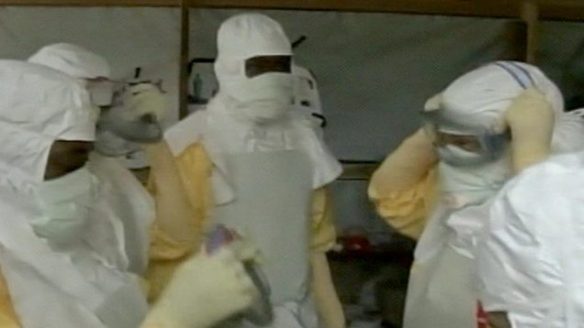
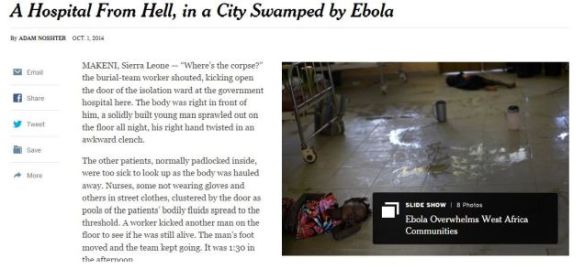
Worst Ebola Outbreak Ever
The current outbreak has been overwhelming in terms of both magnitude — more than 500 victims so far — and extent, encompassing parts of three West African nations. Part of the problem is that people who suspect they are affected have noticed that no one who goes into quarantine comes out alive, so they have fled and disseminated the disease much further. No end in sight. (CDC).
Related articles
The Invention Of The Letter G
The American Heritage Guide to Contemporary Usage and Style tells the story of just how G secured its spot in the alphabet — and how it also changed the position of where we find some of our other letters in the alphabet:
The earliest form of the Roman alphabet had no letter g. Instead, c could represent both the sound g and the sound k. The Roman letter c was in fact a development of the Greek letter gamma. This is why c, not g, still occupies the place in the Roman alphabet corresponding to gamma in the Greek alphabet, even thought the sounds of gamma and g might seem to correspond better than gamma and c from a modern point of view. In order to to make the distinction between g and k clear in writing, the Romans developed the letter g by the addition of a small stroke to c. The Greek historian Plutarch ascribes the invention of g to a Roman named Spurius Carvilius Ruga, who lived in the 3rd century BC. The new letter g was given the place corresponding to the letter z zeta in the Greek alphabet, since zeta was not used to write native Latin words. When the Romans later began to use the letter z again, it was added to the very end of the alphabet, the place it still holds today.
Encouraging science news today
R.I.P. Stephen Gaskin
‘Stephen Gaskin, a Marine combat veteran and hippie guru who in 1971 led around 300 followers in a caravan of psychedelically painted school buses from San Francisco to Tennessee to start the Farm, a commune that has outlived most of its countercultural counterparts while spreading good works from Guatemala to the South Bronx, died on Tuesday at his home on the commune, in Summertown, Tenn. He was 79…
Timothy Miller, a religious studies professor at the University of Kansas who has studied communes, said in an interview that the Farm was “the archetypal hippie commune” in its commitment to higher consciousness, self-sufficiency, a clean environment and a “flamboyant hippie style.”
But where it departed from most of its counterparts was in embracing an entrepreneurial spirit: It created a book-publishing business, marketed pickles and sorghum syrup under the Old Beatnik label, and even dealt in hand-held Geiger counters to measure radiation leaks at nuclear power plants.
It also spurned insularity for outreach. Answering Mr. Gaskin’s call to “change the world,” Farmies, as they called themselves, built 1,200 houses for the victims of a 1976 earthquake in Guatemala, set up volunteer ambulance services in the South Bronx and on an Indian reservation in upstate New York, and started a school lunch program in Belize and an agricultural training program in Liberia. They were among the earliest volunteers to arrive in New Orleans after Hurricane Katrina.
In 1980, Plenty International, a charitable organization Mr. Gaskin started, was awarded one of the first Right Livelihood Awards. Sometimes called the alternative Nobel Prize, the award is presented by the Swedish Parliament to those who have demonstrated “practical and exemplary solutions to the most urgent challenges facing the world today.”
Mr. Gaskin and his wife, the former Ina May Middleton, developed a free midwifery service for women, communard or not. Ms. Gaskin became a widely known advocate for giving birth outside of hospitals, and has written popular books on the subject.
To a degree that startled outsiders in the ’60s, the Farm’s young men in straw hats and beards and women in long skirts lived an almost puritanical life. They took vows of poverty and pooled their assets. Vegetarianism was mandatory. Mr. Gaskin banned alcohol, tobacco and, to the surprise of many, LSD, though not marijuana. Plenty of work — considered a form of meditation — was assigned. Artificial birth control was forbidden.
Mr. Gaskin, who became a minister under Tennessee law, decreed that if couples had sex they must be considered engaged, and if the woman became pregnant, they must marry. Men were expected to treat women with “knightly” chivalry, he said…
In 2000, Mr. Gaskin sought the Green Party’s presidential nomination but drew just 10 of 319 votes. The winner, Ralph Nader, received 295.
His campaign statement declared: “I want it to be understood that we are a bunch of tree-huggers and mystics and peaceniks. My main occupations are Hippy Priest, Spiritual Revolutionary, Cannabis Advocate, shade tree mechanic, cultural engineer, tractor driver and community starter. I also love science fiction.” ‘ (NYTimes.com obituary).
A friend and I visited The Farm in 1980 and stayed for awhile, meeting Stephen. The impression that I was in the midst of something genuine, profound and, even, holy has never left me.
Time To Redraw the Map of the Brain?
‘A provocative and important paper just out claims to have identified a pervasive flaw in many attempts to map the function of the human brain.’ (Neuroskeptic)
Fluid Experiments Support Deterministic “Pilot-Wave” Quantum Theory
The implications could be earth-shattering.
‘[The] idea that nature is inherently probabilistic — that particles have no hard properties, only likelihoods, until they are observed — is directly implied by the standard equations of quantum mechanics. But now a set of surprising experiments with fluids has revived old skepticism about that worldview. The bizarre results are fueling interest in an almost forgotten version of quantum mechanics, one that never gave up the idea of a single, concrete reality.
The experiments involve an oil droplet that bounces along the surface of a liquid. The droplet gently sloshes the liquid with every bounce. At the same time, ripples from past bounces affect its course. The droplet’s interaction with its own ripples, which form what’s known as a pilot wave, causes it to exhibit behaviors previously thought to be peculiar to elementary particles — including behaviors seen as evidence that these particles are spread through space like waves, without any specific location, until they are measured.
Particles at the quantum scale seem to do things that human-scale objects do not do. They can tunnel through barriers, spontaneously arise or annihilate, and occupy discrete energy levels. This new body of research reveals that oil droplets, when guided by pilot waves, also exhibit these quantum-like features.
To some researchers, the experiments suggest that quantum objects are as definite as droplets, and that they too are guided by pilot waves — in this case, fluid-like undulations in space and time. These arguments have injected new life into a deterministic as opposed to probabilistic theory of the microscopic world first proposed, and rejected, at the birth of quantum mechanics.’ (Simons Foundation).
Everything You Need to Know About the ‘Emotion Experiment’
‘The closest any of us who might have participated in Facebook’s huge social engineering study came to actually consenting to participate was signing up for the service. Facebook’s Data Use Policy warns users that Facebook “may use the information we receive about you…for internal operations, including troubleshooting, data analysis, testing, research and service improvement.” This has led to charges that the study violated laws designed to protect human research subjects. But it turns out that those laws don’t apply to the study, and even if they did, it could have been approved, perhaps with some tweaks. Why this is the case requires a bit of explanation.’ (Wired)
Related articles
Why Future Generations May Consider Us Barbaric
‘Factory farming, eating meat, Internet porn, overprescribing antibiotics, obesity, the maintenance of nuclear weapon stockpiles: these are just some of the reasons that future generations may criticize the morals of our present society, just as we object to yesterdays child labor, bear baiting, slavery, and oppression of women.
Nick Bostrom, the founding director of the Future of Humanity Institute at Oxford, UK, argues that our unpreparedness for existential threats most risks the ire of our childrens children… “For Bostrom, the question is not simply how we deal with obvious threats; it’s whether we should take seriously even the slight chance of something happening that could end human life as we know it.” ‘ (Big Think).
Related articles
The Map Of Native American Tribes Youve Never Seen Before
‘Finding an address on a map can be taken for granted in the age of GPS and smartphones. But centuries of forced relocation, disease and genocide have made it difficult to find where many Native American tribes once lived.
Aaron Carapella, a self-taught mapmaker in Warner, Okla., has pinpointed the locations and original names of hundreds of American Indian nations before their first contact with Europeans.
As a teenager, Carapella says he could never get his hands on a continental U.S. map like this, depicting more than 600 tribes — many now forgotten and lost to history. Now, the 34-year-old designs and sells maps as large as 3 by 4 feet with the names of tribes hovering over land they once occupied.’ (NPR).
How A Womans Plan To Kill Herself Helped Her Family Grieve
“It was just so obvious that this is about as good as it gets for a human exit,” Emily says. “She was surrounded by everyone who loved her, they were telling her how and why they loved her. This was not a bad way to go.” (NPR).
Researchers find clue to stopping Alzheimer’s-like diseases
“We have to take a completely different tack: instead of targeting the cause of the disease, we need to disrupt the plaque building process.” (University of Leeds).
Related articles
This rare giant flower smells like a corpse
‘With its sweet, sweet stench, the beautiful titan arum Amorphophallus titanium is quite a spectacle that draws crowds of avid tourists every time it blooms in a botanic garden.
Last week an even rarer spectacle involving this three-metre-tall flower, native to the tropical rainforests of Sumatra and Indonesia, occurred at the Marie Selby Botanical Gardens in the US, where two corpse flowers bloomed at the same time. The event, according to The Sydney Morning Herald, is the equivalent of a lunar eclipse in the world of botany.
The flower stays dormant for up to 10 years, hiding its fleshy red and cream petals from nosey humans—and saving the world’s nostrils for its putrid smell, which has been described by members of the United States Botanic Gardens as “the essence of rotting fish” and “a farm on a hot day, where a cow has died”.
Although it’s considered the stinkiest flower on Earth, titan arum’s smell is like Chanel No 5 for dung beetles and flies. When these creatures smell the rotten scent of the flower, they hurry towards it to make sure no other animal steals their precious meal—and they are greedy, going into every nook and cranny until they are satisfied. Once the animals are satiated, they fly away covered in pollen. Titan arum’s mission has been accomplished—the insects will pollinate other flowers.
The flower closes 48 hours after blooming. Its putrid smell disappears, and the titan arum it not seen until years later.’ (Science Alert).
Can You Feel Something If You Dont Have a Word For It?
‘In the early 1960s, Robert Levy, an anthropologist, spent two years in the Society Islands in Tahiti. Ten years later he came out with a book that coined the word
“hypocognition“, which was all about a societys inability to coin an appropriate word. Hypocognition is the lack of a necessary, or at least helpful, word to express an experience. In the case of the Tahitians that Levy studied, the missing word was “grief.” In the Society Islands, just like everywhere else, people lost loved ones and felt that loss, but they described themselves as feeling “sick” or “strange” afterwards. They didnt seem to have words like “grief” and “sorrow.”
Hypocognition, Levy argued, was not just a personal problem. It isnt like having a word stuck on the tip of the tongue. It marked a cultural deficit that wounded people. Without terms for grief and sorrow, people didnt come up with many rituals to alleviate them. Levy found that the islands had a high suicide rate, and believed that the lack of ability to express grief might have been a reason for it.’ (io9).
Bust card: Constitutionally protected smartphone edition
‘Now that the Supreme Court has ruled that warrantless smartphone searches are unconstitutional, heres a bust-card for you to print, carry, and commit to memory so that youll have it to hand when John Law wants to muscle his way into your mobile life.’ (Boing Boing).
‘If you forgot to lock your phone (or just didn’t feel like it), the next step you must take is to “calmly and respectfully tell the officer that his search is in violation of the Constitution under the court’s Riley decision,” says Stanley. (Riley v. United States is the name of the court case that triggered this new search warrant rule.)
Stanley suggests that anyone who is arrested “repeatedly” state to the arresting officer and any nearby witnesses, “I do not consent to this search.” By saying this key phrase more than once, you help ensure that “there is no question or ambiguity about whether you’ve consented” to the search, Stanley adds.
Making your feelings known is vitally important in this situation. And if you leave any room for the officer to legally justify the search, then no warrant is necessary.’ (Daily Dot)
Related articles
Weird gremlin photographed in China
‘What is this mysterious beast photographed by a tourist in the Huairou District valleys in northern Beiking, China? “Over the weekend I and my friends went to the mountains to take a mini sci-fi film,” wrote one online commenter when the photo was first posted. “And when I was having a pee, a person popped up and took pictures of me and shot away.” ‘ (The Telegraph via Boing Boing).
Update: ‘ET Today reports this is a man dressed up to promote online game Guild Wars 2. Apparently, he was mistaken for being an actual monster, whether thats Gollum or Dobby from Harry Potter or whatever.
The game’s official Chinese social networking account uploaded behind-the-scenes photos to show that, yes, this is just a photo shoot to promote the game. ET Today reports that the actor was getting a drink from the stream when his photo was snapped. Though, The Telegraph reports the local Huairou government states, “The actor was taking a loo-break and was still wearing his costume”. ” (io9).
Related articles
Secrets of the Creative Brain
Preeminent neuroscientist and psychiatrist Nancy Andreasen discusses the sources of creativity, its relationships to IQ and to mental illness. (The Atlantic).
Related articles
Inside the Worlds Largest Gathering of Snakes
‘Each spring, masses of red-sided garter snakes congregate inside limestone caves [in the Narcisse Snake Dens of Manitoba, Canada
] to form mating balls, in which up to a hundred male snakes vie for a single female. She, in turn, “is desperately trying to get out of the pit,” said [Paul] Colangelo, an environmental documentary photographer.
These slithery swarms appear to be a “frenzy, but a closer look reveals a much finer dance,” Colangelo said in his field notes. “The small males court the larger female by rubbing her head with their chins and maintaining as much contact between their long bodies as possible.”‘ (National Geographic).
Controversial Copenhagen Zoo Official: Zoos Are Selling Disney “Fairy Tales”
‘The zoo official who euthanized a giraffe and four lions earlier this year may be stoking more controversy.
Many zoos, especially in the United States, are perpetuating a fairy-tale world that masks the realities of nature from visitors, he said this week in Copenhagen.”We should not tell the Disney story that animals are only cute and only get born and never die,” said Bengt Holst, the Copenhagen Zoos science director, at the 2014 Euroscience Open Forum. “We have to tell the real story: Death is a natural consequence of life. If [we] dont tell that story, [were doing] a bad job, because then we dont work for conservation—we work for an imaginary world.”
Zoos in Europe have been euthanizing, or culling, captive animals for about 30 years. The goal has been to create a healthy and genetically diverse population of different species, many of which are threatened by extinction. Animals are sometimes killed to make room for other animals or to avoid inbreeding.European zoos also breed more animals than they need, because its impossible to predict how many females will get pregnant and give birth to healthy offspring. Holst told National Geographic on Wednesday that the need to euthanize is actually a “positive sign,” since it means that zoos are breeding animals well enough to create a surplus.’ (National Geographic).
If You Want to Understand Cities in the 21st Century, Read This Essay
‘In 2008, a young model from rural Canada was brutally murdered in a Shanghai apartment building. The story of how her assailant was maybe caught, chronicled by journalist Mara Hvistendahl her engrossing essay And the City Swallowed Them, reveals how 21st century cities are changing the world.’ (io9)
David Duchovny on The X-Files: Its Not Done Until One of Us Dies
‘With the series finale of Californication airing this weekend, David Duchovny says he feels like he has comfortably closed the book on his character Hank Moody. Thats not the case, though, for another one of his iconic characters: The X-Files‘ Fox Mulder. During an in-depth interview with Rolling Stone about the end of the long-running Showtime drama, which will run next week after the finale, he said that he would be up for making a sequel to the 2008 movie The X-Files: I Want to Believe.
Duchovny said that he remains friends with both X-Files creator Chris Carter and his costar, Gillian Anderson. Moreover, he loves the Fox Mulder character. “Once I was able to branch out and do some other movies and do Californication, I didn’t feel like, ‘People only think I do that,'” he said. “I no longer have that anxiety.” ‘ (Rolling Stone).
Related articles
Higgs Physics Should Have Destroyed Universe
‘In addition to the presence of gravity in the early Universe, there was also the Higgs field. This field isn’t a force like gravity and doesn’t accelerate particles or transfer energy, but it does interact with particles to give them mass. We can’t detect the Higgs field directly, but we can detect the Higgs boson, which is kind of like a mediator between particles and the field. The rapid expansion of the Universe should have caused a quantum fluctuation, which would have disturbed the Higgs field, creating a lower energy state that would have forced the Universe to collapse. And yet, here we are.
In order to explain the survival of the Universe in the face of that certain death, the authors “present two possible cures: a direct coupling between the Higgs field and the inflation and a nonzero temperature from dissipation during inflation.” The only problem with this explanation is that it involves the use of physics and particles that don’t currently exist in any theories. Minor detail, right?’ (IFLScience).
Related articles
Powdered caffeine in salt shakers is now a thing
‘Thats right, researchers have developed powdered caffeine, so you can skip the coffee and instead simply grab a salt shaker filled with energy.
Known as CaffeinAll, the new salt shaker product is developed by Caffex, the company who brought us caffeinated marshmallows, and its ready to turn everything into energy food think caffeine-laced french fries.
Ignoring the fact that this sounds like a pretty bad idea for a second, Caffex are claiming the product is “the worlds only odourless, non-bitter, take-with-you-anywhere, use with anything caffeine powder”. They also claim it offers a cheaper and more efficient way for people to get a caffeine hit.
Although powdered caffeine has been around for a few years, Caffex have just recently launched the new salt shaker packaging, which theyre attempting to fund via IndieGoGo its still not even a third of the way to its funding goal of US$25,000 with only nine days left. The creators suggest that just one sprinkle – around 33mg of caffeine – will be enough to get most people buzzing. Three sprinkles have more caffeine than a Red Bull.’ (Science Alert).
Related articles
USAs no-fly list is unconstitutional, says federal judge in landmark ruling
‘A federal judge ruled today that the US deprived 13 people on its no-fly list of a constitutional right to travel, and provided no effective way to challenge being on the list. Her decision is the first ruling in the country to find the no-fly list redress procedures unconstitutional.’ (Boing Boing).
Is the US Headed for Failed Statehood?
Since 2005, the think-tank Fund for Peace and the magazine Foreign Policy have published an annual Failed States Index. The list only assesses sovereign states as determined by membership in the United Nations… Ranking is based on the total scores of 12 indicators (four social, two economic and six political) each scored on a 0-10 scale. The indicators are not designed to forecast when states may experience violence or collapse. Instead, they are meant to measure a state’s vulnerability to collapse or conflict. Read this with current trends in US sociopolitical life in mind, if you will.
Indicators of state vulnerability
All countries in the red (Alert, FSI of 90 or more), orange (Warning, FSI of 60 or more), or yellow (Moderate, FSI of 30 or more) categories display some features that make parts of their societies and institutions vulnerable to failure. Some in the yellow zone may be failing at a faster rate than those in the more dangerous orange or red zones, and therefore could experience violence sooner [emphasis added –FmH]. Conversely, some in the red zone, though critical, may exhibit some positive signs of recovery or be deteriorating slowly, giving them time to adopt mitigating strategies.
Social indicators
- Demographic pressures: including the pressures deriving from high volume population density relative to food supply and other life-sustaining resources. The pressure from a population’s settlement patterns and physical settings, including border disputes, ownership or occupancy of land, access to transportation outlets, control of religious or historical sites, and proximity to environmental hazards.
- Massive movement of refugees and internally displaced persons: forced uprooting of large communities as a result of random or targeted violence and/or repression, causing food shortages, disease, lack of clean water, land competition, lack of public housing, and turmoil that can spiral into larger humanitarian and security problems, both within and between countries.
- Legacy of vengeance-seeking group grievance: based on recent or past injustices, which could date back centuries. Including atrocities committed with impunity against communal groups and/or specific groups singled out by state authorities, or by dominant groups, for persecution or repression. Institutionalized political exclusion. Public scapegoating of groups believed to have acquired wealth, status or power as evidenced in the emergence of “hate” radio, pamphleteering and stereotypical or nationalistic political rhetoric.
- Chronic and sustained human flight: both the “brain drain” of professionals, intellectuals and political dissidents and voluntary emigration of “the middle class.” Growth of exile/expatriate communities are also used as part of this indicator.
Economic indicators
- Uneven economic development along group lines: determined by group-based inequality, or perceived inequality, in education, jobs, and economic status. Also measured by group-based poverty levels, infant mortality rates, education levels.
- Sharp and/or severe economic decline: measured by a progressive economic decline of the society as a whole (using: per capita income, GNP, debt, child mortality rates, poverty levels, business failures.) A sudden drop in commodity prices, trade revenue, foreign investment or debt payments. Collapse or devaluation of the national currency and a growth of hidden economies, including the drug trade, smuggling, and capital flight. Failure of the state to pay salaries of government employees and armed forces or to meet other financial obligations to its citizens, such as pension payments.
Political indicators
- Criminalization and/or delegitimisation of the state: endemic corruption or profiteering by ruling elites and resistance to transparency, accountability and political representation. Includes any widespread loss of popular confidence in state institutions and processes.
- Progressive deterioration of public services: a disappearance of basic state functions that serve the people, including failure to protect citizens from terrorism and violence and to provide essential services, such as health, education, sanitation, public transportation. Also using the state apparatus for agencies that serve the ruling elites, such as the security forces, presidential staff, central bank, diplomatic service, customs and collection agencies.
- Widespread violation of human rights: an emergence of authoritarian, dictatorial or military rule in which constitutional and democratic institutions and processes are suspended or manipulated. Outbreaks of politically inspired (as opposed to criminal) violence against innocent civilians. A rising number of political prisoners or dissidents who are denied due process consistent with international norms and practices. Any widespread abuse of legal, political and social rights, including those of individuals, groups or cultural institutions (e.g., harassment of the press, politicization of the judiciary, internal use of military for political ends, public repression of political opponents, religious or cultural persecution.)
- Security apparatus as “state within a state”: an emergence of elite or praetorian guards that operate with impunity. Emergence of state-sponsored or state-supported private militias that terrorize political opponents, suspected “enemies,” or civilians seen to be sympathetic to the opposition. An “army within an army” that serves the interests of the dominant military or political clique. Emergence of rival militias, guerilla forces or private armies in an armed struggle or protracted violent campaigns against state security forces.
- Rise of factionalised elites: a fragmentation of ruling elites and state institutions along group lines. Use of aggressive nationalistic rhetoric by ruling elites, especially destructive forms of communal irredentism or communal solidarity (e.g., “ethnic cleansing“, “defending the faith“).
- Intervention of other states or external factors: military or Paramilitary engagement in the internal affairs of the state at risk by outside armies, states, identity groups or entities that affect the internal balance of power or resolution of the conflict. Intervention by donors, especially if there is a tendency towards over-dependence on foreign aid or peacekeeping missions. (Wikipedia)
Study Strengthens Link Between Prenatal Pesticide Exposure and Autism
‘Autism Spectrum Disorder [ASD] affects about 1 in 68 children in the United States, and a combination of genetic and environmental factors, along with complications during pregnancy have been associated with ASD diagnoses. A new study from the National Institute of Environmental Health Services has strengthened the link between prenatal exposure to agricultural pesticides and ASD. The study’s findings have been published in the journal Environmental Health Perspectives….
The researchers compared addresses during pregnancy to state records of applications of organochlorines, organophosphates, pyrethroids, and carbamates within 1.25 km, 1.5 km, and 1.75 km from those addresses. About a third of the 970 study participants lived within 1.5 km 0.9 miles of pesticide applications during pregnancy. While proximity to any of the four classes of pesticide resulted in an increased risk of a child with ASD or DD, some of the chemicals presented a greater risk at different stages during pregnancy.’ (IFLScience).
A Mysterious Sound Is Driving People Insane — And Nobody Knows Whats Causing It
‘ “The Hum” refers to a mysterious sound heard in places around the world by a small fraction of a local population. Its characterized by a persistent and invasive low-frequency rumbling or droning noise often accompanied by vibrations. While reports of “unidentified humming sounds” pop up in scientific literature dating back to the 1830s, modern manifestations of the contemporary hum have been widely reported by national media in the United Kingdom, the United States and Australia since the early 1970s.
Regional experiences of the phenomenon vary, and the Hum is often prefixed with the region where the problem centers, like the “Windsor Hum” in Ontario, Canada, the “Taos Hum” in New Mexico, or the “Auckland Hum” for Auckland, New Zealand. Somewhere between 2 and 10% of people can hear the Hum, and inside isolation is no escape. Most sufferers find the noise to be more disturbing indoors and at night. Much to their dismay, the source of the mysterious humming is virtually untraceable.
While the uneven experience of the Hum in local populations has led some researchers to dismiss it as a “mass delusion,” the nuisance and pain associated with the phenomenon make delusion a dissatisfying hypothesis. Intrigued by the mysterious noise, [Dr. Glen] MacPherson launched The World Hum Map and Database in December 2012 to collect testimonies of other Hum sufferers and track its global impact. He now also moderates a decade-old Yahoo forum…
MacPherson quickly discovered that what to him was a strange rumbling was actually having pernicious effects on hundreds of people, from headaches to irritability to sleep deprivation. There are reports that weeks of insomnia caused by the Bristol Hum drove at least three U.K. residents to suicide. “It completely drains energy, causing stress and loss of sleep,” a sufferer told a British newspaper in 1992. “I have been on tranquilizers and have lost count of the number of nights I have spent holding my head in my hands, crying and crying.” Thousands of people around the world have shared similar experiences of the Hum; some, like MacPherson, are devoting their time to finally uncovering its source.’ (Mic).
Related articles
A Mesmerizing Site That Tracks and Displays Real-Time Lightning Strikes
‘Did you know that a lightning strike emits a broadband pulse of radio waves that can be detected thousands of miles away? It’s that phenomenon which allows a website called Blitzortung to show lightning strikes as they happen all around the world, in real-time. If you thought it was hard to tear your eyes away from the World Cup, this is somehow even more entertaining to watch.’ (Gizmodo).
Related articles
How fossilised ideas live on even in science
Andrew Crumey: ‘I would like to propose what I shall call the principle of eternal folly. It states that in nearly every era there arises, in some form, nearly every idea of which humans are capable. Certainly, there is the emergence of new ideas: technological ones are the most obvious, but there are others, too. I do think it fair to say that Jane Austen, Beethoven, and even the occasional entrepreneur have invented radically new things. However, the vast majority of ideas are recycled – and it is when we fail to recognise this, as we eternally do, that we commit folly.’ (Aeon).
Are We Approaching the End of Solitary Confinement?
‘As a new class-action lawsuit out of California’s infamous Pelican Bay State Prison that may definitively determine the future of solitary in that state moves forward, more people are taking the position that the practice amounts to inhumane punishment.’ (Pacific Standard)
The Supreme Court Green-Lighted Gun-Control Legislation
‘In a 5-4 decision, the SCOTUS blocked a conservative effort to overturn a law that makes it illegal to buy a gun for someone else. While the ruling maintains the status quo by preserving long-standing legislation, it opens the door for stricter limits on gun ownership.’ (Pacific Standard)
Related articles
This U.S. Map Shows the Millions of Streets That Have No Name
‘Cartographer Kenneth Field is making a series of maps inspired by song lyrics about geography. Taking a cue from U2’s song “Where the Streets Have No Name,” he created this visualization of the 15 million unnamed street segments in the U.S.’ (
Study Suggests Salamanders Could Hold The Key To Human Limb Regeneration
‘Researchers have identified how a key molecular pathway in salamanders is different than in mammals, possibly revealing the amphibians’ secret for regrowing their body parts. The findings tell us more about the mechanisms behind regeneration, and maybe one day they could be useful for regenerating human cells.’ (IFLScience).
Open Wireless Movements router OS will let you securely share your Internet with the world
‘Open Wireless Movement, a joint project of the Electronic Frontier Foundation, Fight for the Future, Mozilla, Free Press and others, will reveal its sharing-friendly wifi router firmware at the HOPE X conference in NYC next month. The openwireless operating system allows you to portion out some of your bandwidth to share freely with your neighbors and passersby, while providing a high degree of security and privacy for your own communications.
The Open Wireless Movements goals are to both encourage the neighborliness that you get from sharing in your community, and undermining the idea that an IP address can be used to identify a person, establishing a global system of anonymous Internet connectivity. The project includes an excellent FAQ on the myths and facts about your legal liability for things that other people do with your network.’ (Boing Boing).
A Verbal Tour of the British Isles By Regional Accent
Especially for the anglophiles among us, this is utterly delightful.
‘Siobhan Thompson of Anglophenia gives a wonderful verbal tour of the British Isles, performing 17 of the regional accents found in the United Kingdom and Ireland.’ (Laughing Squid)
An Archaeologist Excavates a Hippie Commune, Preserved in 1969 by Fire
Loads of compelling material in io9 tonight:
‘In 79 AD, the eruption of Mt. Vesuvius covered Pompeii in ash, preserving the city for millennia. In 1969 AD, a fire broke out at the mansion of the famed Chosen Family commune north of San Francisco. Most of the possessions were left behind—providing archaeologists with a one-of-a-kind time capsule of hippie life.
If youre a Grateful Dead fan, youre already familiar with the commune, which was founded at Olompali State Park in 1967. The band—one of many musical legends who played there—used a photograph of the bucolic commune as the back cover for their album, Aoxomoxoa.’ (io9)
Can you dig it? [Sorry, couldn’t help myself.]
Related articles
10 Pseudo-Science Theories Wed Like to See Retired Forever
Amen. (io9)
For The First Time Since WWII, Global Peace Is On The Decline
‘In what should be a surprise to nobody, a new report by the Institute for Economics and Peace shows that world peace is on the decline — a reversal of six decades of steady improvement. The annual report, called the Global Peace Index, cites militant attacks and growing crime as the primary culprits, particularly in Iraq, Syria, Afghanistan, Sudan, and the Central African Republic. The number of people killed in militant attacks has risen in such areas as the Middle East, South Asia, and Africa. Murder rates are escalating in growing urban centers and more refugees are having to flee war zones. (io9)
Related articles
Weve Now Lost So Much Arctic Ice That We Have to Change Our Atlases
‘The amount of Arctic ice left has been steadily shrinking. But its now dwindled by so much that National Geographic has said their updated maps will feature a much smaller ice sheet, in what theyre calling the most visible change to the atlas since the break up of the U.S.S.R. National Geographic drew its current map of the Arctic in its 1989 edition of the Atlas. Since then, though, the decrease of not just the area, but the volume of Arctic sea ice as seen in the graphic below, charting sea ice volume from 1979 to the present has been sharp. The newest edition, which comes out in September, will redraw the lines into a significantly smaller area, based on NASA and the NSIDC data on the amount of remaining multiyear ice.’ (io9)

Striking Photographs Of Sea Slugs Expose The Alien World Under the Sea
‘While we may call them sea slugs, these diverse and colorful gastropods look like theyve come from another planet, a place of brilliant oranges, greens, and blues, where even camouflage is beautiful.’ (io9)
The Graciousness and Dignity of Richard B. Cheney
James Fallows: ‘A few hours ago I said sincerely that a number of prominent officials who had set the stage for todays disaster in Iraq deserved respect for their silence as their successors chose among the least-terrible of available options.I unwisely included Dick Cheney, former vice president and most ill-tempered figure to hold national office since Richard Nixon, on that list.If Id waited a little while, I would have seen a new op-ed by Cheney and his daughter Liz in where else! the WSJ denouncing the Obama administrations fecklessness about Iraq and much else. They say, unironically, about the current occupant of the White House:Rarely has a U.S. president been so wrong about so much at the expense of so many. You want a specimen of being so wrong about so much at the expense of so many? Consider the thoughts of one Richard B. Cheney, in a major speech to the VFW in August 2002, in the run-up to the war…’ (The Atlantic).
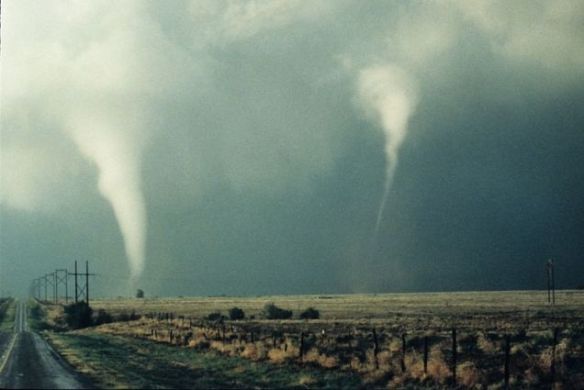
Massive twin tornadoes touch down simultaneously in Nebraska
‘Someone recorded two tornadoes touching down at the same time on US-275 near Pilger, Nebraska. The footage is absolutely nuts.’ (Gizmodo)
10 Scientific Ideas That Scientists Wish You Would Stop Misusing
‘Many ideas have left the world of science and made their way into everyday language — and unfortunately, they are almost always used incorrectly. We asked a group of scientists to tell us which scientific terms they believe are the most widely misunderstood. Here are ten of them.’ (io9)
Related articles
Study: Morality Can Trump Tribalism
‘Encouraging research points to a way to decouple loyalty to one’s own tribe with disdain for outsiders…
The results suggest a strong sense of moral identity could temper “some of the less-desirable effects of the binding foundations,” Smith and his colleagues conclude. They add that this could potentially be achieved by “creating environments that increase the salience of people’s moral self-concepts.” ‘ (Pacific Standard)
How Are You Related To That Stranger On The Bus, or Barack Obama?
‘AJ Jacobs’ TED talk on the far-flung branches of family trees is one of the more entertaining takes on genealogy I’ve watched in some time. Join him at the worlds largest family reunion, and find out how you’re related to… well… everyone.’ (Boing Boing)
Meet the Cute, Wellies-Wearing, Wikipedia-Reading Robot That’s Going to Hitchhike Across Canada
‘…no joke. [A team of roboticists at Ryerson University in Canada is] going to put their cute little bot on the side of the road in Halifax and hope that somehow the robot can talk its way to Victoria.
“This is both an artwork and social robotics experiment,” Zeller and Harris told me in an email. “Usually, we are concerned whether we can trust robots, e.g. as helpers in our homes. But this project takes it the other way around and asks: can robots trust human beings?” ‘ (The Atlantic).
A Library of White-Supremacist Hand Gestures
‘The Anti-Defamation League has published an online catalog of the symbols, flags, and slogans used by hate groups. Is this an educational tool or a portal for perverse curiosity?’ (The Atlantic).
Why the First Antibiotic-Resistant Superbug Found in Food Is a Big Deal
‘In very bad news, a superbug resistant to last-resort antibiotics was found in imported squid, according to a report this week. This is a scary development in antibiotic resistance—even if you dont eat squid. Here is why one small finding has frightening implications.’ (Gizmodo)
Related articles
A Short History of the Executioner
‘The history of the professional executioner is a chronicle of perfecting the choreography of death. It’s a story of exacting skill and the never-ending search for a more efficient means to enact and contain the spectacle of death. The professionalization of death—a chilling business—was cultivated for centuries by a profane tribe of men who were denied civil status and ostracized from nearly every aspect of daily life. Forced to live at the margins, the executioner was defined by ambiguities: a pivotal actor in the multipart drama of public killing, an extension of the crown, and yet morally hazy and universally despised.’ (The Appendix).
Related articles
Opt Out From Online Behavioral Advertising By Participating Companies
‘Welcome to the consumer opt out page for the Self-Regulatory Program for Online Behavioral Advertising. Our participating companies are committed to transparency and choice.Some of the ads you receive on Web pages are customized based on predictions about your interests generated from your visits over time and across different Web sites. This type of ad customization — sometimes called “online behavioral” or “interest-based” advertising — is enabled through your computer browser and browser cookies. Such online advertising helps support the free content, products and services you get online.Using the tools on this page, you can opt out from receiving interest-based advertising from some or all of our participating companies.’ (AboutAds)
Related articles
Stop Facebook and Other Companies from Using Your Web History for Ads
‘We already knew that Facebook is tracking our every move on the web, just like everyone else is, but now the social network says it’s going to use data from the other sites we visit and the apps we use to deliver more relevant ads. If you want to opt out of this enhanced behavioral targeting, there’s a form for that…’ (Lifehacker)
How BBQ Transcends Race
Michael Pollen: “When I was talking to historians of barbecue, and we now have historians of barbecue, they said that even during the tensest periods of racial strife, during the civil rights movement, if the good barbecue place in town was black, whites wanted to eat there and they would,” he says. “Barbecue is something that blacks and whites in the South share.” (Big Think).
10 Real-Life Laws That Regulate The Supernatural World
‘When do you need to tell a prospective buyer your house is haunted? Where do you need a license to practice necromancy or to be reincarnated? And where can you file a lawsuit against a supernatural being? These real-life laws will tell you all that and more.’ (io9).
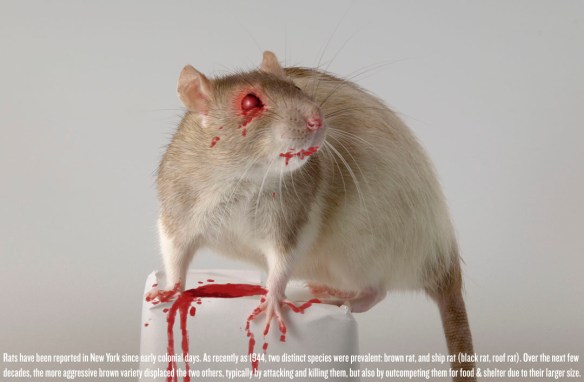
Study Suggests Rats Capable Of Feeling Regret Over Poor Choices
‘Choosing a restaurant can be somewhat serious business if you’re anything like me, that is. Many animals can have a favorite food, but what if they choose something that isn’t what they wanted? New research from scientists at the University of Minnesota suggests that rats can actually experience regret after making the “wrong” food choice. The study was conducted by David Redish and Adam Steiner, and the paper was published in Nature Neuroscience.’ (IFLScience).
Male faces may have evolved to take a punch, study suggests
‘Researchers in the US have studied the skulls of ancient human ancestors and concluded that fist-fighting may have played a role in shaping the male face.The new study is published in Biological Reviews, and it isnt the first time scientists have suggested the idea. As George Dvorsky reports for io9, back in 2012 researchers controversially made the claim that fists had changed the course of our evolution. Now the new theory, based on the study of the skulls of distant hominid relatives known as australopiths, is likely to stir up similar debate over the role violence has played in human evolution.’ (Science Alert).
R.I.P. Sasha Shulgin
Psychedelia Researcher Dies at 88: ‘Alexander Shulgin, a chemist who specialized in the creation of and experimentation with mind-altering substances, and who introduced the controversial drug popularly known as Ecstasy for potential therapeutic use, died on Monday at his home in Lafayette, Calif., east of Oakland. He was 88.The cause was cancer, his wife, Ann, said.
Dr. Shulgin, whose interest, as he put it once, was “in the machinery of the mental process,” was both a rogue and a wizard, a legitimate scientist and a counterculture hero. Over more than four decades, working generally within the law if occasionally on the edge, trying out his concoctions on himself, his wife and a few friends, and publishing his results, he was the creator of almost 200 chemical compounds capable of rejiggering the quotidian functions of the mind.’ (NYTimes obituary)
Related articles
George W. Bush “competency” myth: Why Beltway media is dangerously confused again
‘Washington Post piece suggests a presidents ability to “get things done” and “competency” are analogous. Nope! We’re not going to argue that Obama is the most “competent” president in history and George W. Bush is the least. Neither really seems to make the Presidential All-Star team in that respect. But the question about a president’s ability to “get things done” seems more an issue of how well Washington is working and the state of gridlock at any given time than about an individual president’s competency.’ (Salon.com).
Robert Reich: Mississippi is turning back the clock on the civil rights movement
‘Mississippi used its new voter-identification law for the first time Tuesday — requiring voters to show a driver’s license or other government-issued photo ID at the polls.The official reason given for the new law is alleged voter fraud, although the state hasn’t been able to provide any evidence that voter fraud is a problem.The real reason for the law is to suppress the votes of the poor, especially African-Americans, some of whom won’t be able to afford the cost of a photo ID.It’s a tragic irony that this law became effective almost exactly fifty years after three young civil rights workers — Michael Schwerner, James Chaney, and Andrew Goodman – were tortured and murdered in Mississippi for trying to register African-Americans to vote.’ (Salon.com).
Via 


‘Thats right, researchers have developed powdered caffeine, so you can skip the coffee and instead simply grab a salt shaker filled with energy.