
Jamelle Bouie writes:
‘…The conceit of “A Voice of Hate in America’s Heartland,” the New York Times’ profile of Tony Hovater—a neo-Nazi who helped start the Traditionalist Worker Party, a white nationalist group—is that there’s something incongruent in Hovater’s ordinary Midwestern life and his virulently racist and anti-Semitic beliefs. “Why did this man—intelligent, socially adroit and raised middle class amid the relatively well-integrated environments of United States military bases—gravitate toward the furthest extremes of American political discourse?” asks the writer, Richard Fausset, in a subsequent piece explaining the editorial decisions behind the story and reflecting on his conversations with Hovater.
Hovater’s extremism may demand some additional explanation, but there’s nothing novel about virulent white racism existing in banal environments. That, in fact, is what it means to live in a society structured by racism and racist attitudes. The sensational nature of Hovater’s identification with Nazi Germany obscures the ordinariness of his racism. White supremacy is a hegemonic ideology in the United States. It exists everywhere, in varying forms, ranging from passive beliefs in black racial inferiority to the extremist ideology we see in groups like the League of the South….’
via Slate
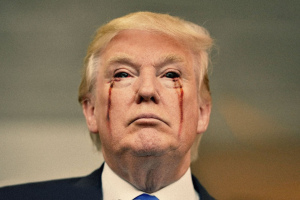 ‘…[I]n tying himself to Mr. Moore even as congressional leaders have abandoned the candidate en masse, the president has reignited hostilities with his own party just as Senate Republicans are rushing to pass a politically crucial tax overhaul. Mr. McConnell and his allies have been particularly infuriated as Mr. Trump has reacted with indifference to a series of ideas they have floated to try to block Mr. Moore.