‘The most inconvenient truth of all’

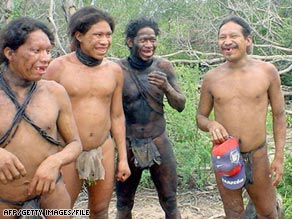
Brazilian Indigenous chiefs of the Kayapo trib...
Brazilian indigenous chiefs of the Kayapo tribe

“Measures to stop global warming risk being as harmful to tribal peoples as climate change itself, according to a new report from Survival.

The report, ‘The most inconvenient truth of all: climate change and indigenous people’, sets out four key ‘mitigation measures’ that threaten tribal people:

1. Biofuels: promoted as an alernative, ‘green’ source of energy to fossil fuels, much of the land allocated to grow them is the ancestral land of tribal people. If biofuels expansion continues as planned, millions of indigenous people worldwide stand to lose their land and livelihoods.

2. Hydro-electric power: A new boom in dam construction in the name of combating climate change is driving thousands of tribal people from their homes.

3. Forest conservation: Kenya’s Ogiek hunter-gatherers are being forced from the forests they have lived in for hundreds of years to ‘reverse the ravages’ of global warming.

4. Carbon offsetting: Tribal peoples’ forests now have a monetary value in the booming ‘carbon credits’ market. Indigenous people say this will lead to forced evictions and the ‘theft of our land’.” (Survival International)
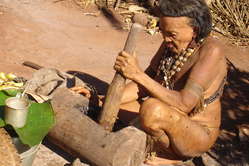
R.I.P. Ururu

Amazon tribe down to five as oldest member dies: “The Akuntsu tribe in the Brazilian Amazon has lost its oldest member, Ururú, leaving the tribe with only five surviving members.

Ururú was the oldest member of this close-knit, tiny group and an integral part of it.
Altair Algayer, head of FUNAI’s (Brazilian government Indian affairs department) team which protects the Akuntsu’s land said, ‘She was a fighter, strong, and resisted until the last moment.’ In addition, the oldest-surviving Akuntsu, Ururú’s brother Konibú, is seriously ill.

Ururú witnessed the genocide of her people and the destruction of their rainforest home, as cattle ranchers and their gunmen moved on to indigenous lands in Rondônia state. Rondônia was opened up by government colonisation projects and the infamous BR 364 highway in the 1960s and 70s… [T]oday’s survivors say their family members were killed when ranchers bulldozed their houses and opened fire on them… The ranchers attempted to hide evidence of the crime, but wooden poles, arrows, axes and broken pottery were discovered.

…Survival’s Director Stephen Corry said today, ‘With Ururú’s death we are seeing the final stages of a 21st century genocide. Unlike mass killings in Nazi Germany or Rwanda, the genocides of indigenous people are played out in hidden corners of the world, and escape public scrutiny and condemnation. Although their numbers are small, the result is just as final. Only when this persecution is seen as akin to slavery or apartheid will tribal peoples begin to be safe.’ ” (Survival International)

Solidaridad con Peru

“The government of Alan Garcia in Peru is implementing free trade policies that are demeaning the rights of Indigenous peoples to their territories in the Amazon forest and the Andes mountains. Mining, oil, gas, logging and other extractive industries are damaging the environment, leaving hundreds of thousands of people sick with high levels of air, water and food pollution. Thousands of Andean Indigenous peoples are dying because of freezing temperatures, but the government doesn’t want to invest in social infrastructure even though it exported over $37 billion dollars of natural resources in 2008.

Since 2007 the social protest has been criminalized by the government of Peru, and over 1,000 community leaders have been prosecuted as criminals. Media in Peru is being manipulated, the rights of most Peruvians are not considered, campaigns criminalize Indigenous peoples protests. Violent repression has caused dozens of civilian casualties since 2006.

Racism in the media and government policies, in education and in every level of society have created a huge gap in living conditions and opportunities, discriminating people of Indigenous and African heritage, especially rural communities where over 70% of people live in poverty. Meanwhile corruption is wide spreading.

Join this group to coordinate simple but effective actions of protest and to advocate for social justice in Peru, and to create worldwide awareness of the negative impact of free trade and racist policies of the current government in Peru.”

‘Grisi Siknis’ outbreak grips indigenous towns in Nicaragua

Hans Baldung Grien: Witches.
Hans Baldung Grien: Witches

A team of traditional indigenous healers and regional health authorities from the North Atlantic Autonomous Region (RAAN) trekked out to visit three rural Miskito communities along the Río Coco on Tuesday to investigate reports of an outbreak of a mysterious collective hysteria, known as “grisi siknis,” or “crazy sickness.”

Centuriano Knight, the regional health coordinator for the RAAN, told The Nica Tim es yesterday in a phone interview that 34 people have reportedly fallen ill with grisi siknis in the river community of Santa Fe, seven people in the nearby community of Esperanza and two in the neighboring community of San Carlos. The outbreak of grisi siknis, which has no scientific explanation, is the largest case of collective hysteria since a massive outbreak in the RAAN community of Raití in 2003.

Though doctors, anthropologists and sociologists have all studied previous cases, no one has been able to explain the phenomena, Knight said. Traditional healers and witches have explained the mysterious illness with different theories ranging from a curse to incomplete witchcraft.

The strange illness apparently affects young people more than old, putting people in a strange trance and apparently giving them super-human strength, according to Knight and other witnesses.” via The Tico Times.

Perhaps because I was a student of cross-cultural studies before I became a psychiatrist, these reports of indigenous illnesses or culture-bound syndromes have always fascinated me. I used to teach a class on them to medical students, which was pure entertainment as far as I was (and, I hope, many of the students were) concerned. Because psychiatric illnesses are as much social constructs as biological realities, a culture-specific syndrome is in a real sense culture-specific. That is why it makes so much more sense that it be dealt with by indigenous practitioners rather than a WHO swat team. Of course, when I moved into psychiatry, I felt I was still utilizing my skills in cross-cultural communication, as every interpersonal interaction is in a sense cross-cultural, if you take my meaning. Thus, every episode of emotional distress is in a sense a culture-bound syndrome, despite what DSM-IV or functional MRI studies might tell you.

Uncontacted Amazonian tribe victor in legal battle it didn’t file

“A small tribe of Indians in Paraguay who have had virtually no contact with the outside world won a legal battle this week when rights groups stopped a Brazilian company from continuing to bulldoze the forest to clear land for cattle ranches.

About 2,000 members of the Ayoreo ethnic group live in 13 settlements in Bolivia and Paraguay.

About 2,000 members of the Ayoreo ethnic group live in 13 settlements in Bolivia and Paraguay.

The Totobiegosode tribe, said to number no more than 300, is the last group of uncontacted Indians in South America outside the Amazon River basin, indigenous rights groups say.

The Totobiegosode, who are part of the larger Ayoreo ethnic group, are nomadic Indians who hunt and fish, as well as gather fruit and honey and cultivate small temporary plots during the rainy season. They live communally, four to six families to a dwelling, in the dense forests of northwestern Paraguay.”

via CNN