
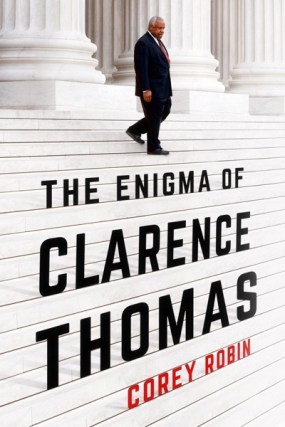
 Lidija Haas reviews The Enigma of Clarence Thomas by Corey Robin:
’Robin suggests that the misreadings of Thomas are themselves based in racism, comparing the justice to Ralph Ellison’s “invisible man,” the one people “refuse to see.” (Invisible Man is, he notes, alongside Richard Wright’s Native Son, Thomas’s favorite novel.) Introducing the common idea of Thomas as “an intellectual nonentity, a dim bulb in a brightly lit room,” Robin rehearses a host of clichés about his supposed incompetence or laziness—qualities that would, some have implied, explain why he doesn’t speak up on the bench, is rarely assigned the majority opinion in important cases, and gets his clerks to write his opinions for him (this last accusation strikes me as odd, since Thomas’s opinions hardly seem the bland, predictable stuff you’d expect to get by paying someone else to do your homework). Robin claims that the only other justice “subject to all of these kinds of insinuations” was, not coincidentally, also the Supreme Court’s only other black justice, Thurgood Marshall, whom Thomas replaced.
Robin’s Thomas is no dimwit but a man of ideas, albeit dark, furious, and terrifying ones. “His beliefs,” Robin announces in an introduction, “are disturbing, even ugly; his style is brutal.” Robin recognizes no essential contradiction or vacillation in this man who by the late ’80s, several years into his career within the Reagan administration, could still lovingly recite Malcolm X by heart. He sees a powerful continuity between Thomas’s black nationalism and his conservatism, extrapolating from his words a coherent worldview that helps explain his approach to a slew of issues, from voting rights to gun ownership, from the Commerce Clause to gender relations. In Robin’s account, Thomas sees American racism as foundational, permanent, and ineradicable, such that African Americans should never hope for justice or advancement to come through either political representation (since they will remain a loathed minority) or any strategy dependent on the generosity of white institutions.…’
 ’Based on what we know so far, Trump and his top aides could be implicated in four different types of federal crimes.…’
 ’The case for impeachment, even if it can’t oust Trump.…’

 Gun control supporters are desperate — and have already taken drastic steps — to get the Supreme Court to dismiss this case: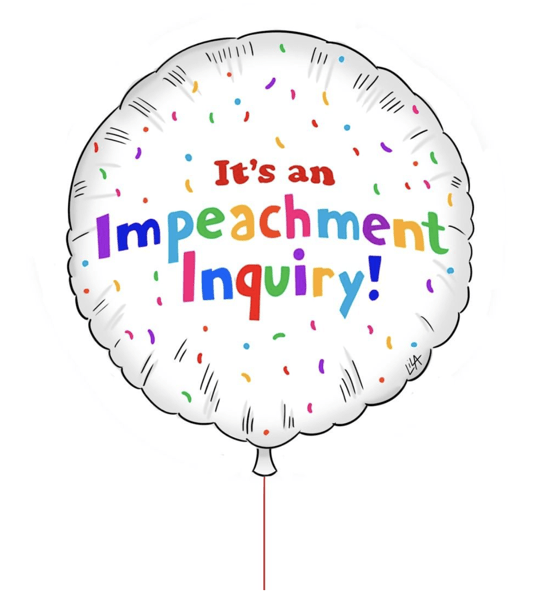
 A childhood friend of Jerry Garcia, Hunter was the band’s primary lyricist and collaborator in Garcia’s songs, responsible for some of the most iconic of the Dead’s mind-bending imagery.



 Stage set in Nevada as Earthlings arrive for Area 51 events
 ’If you’re trying to live in a way that helps mitigate the effects of climate change, you might resolve to fly less often or eat less meat. But what about switching banks?
 ’Trump’s use, or misuse, of language has also been disturbing to experts of constitutional law. Take Laurence Tribe, a Harvard constitutional law professor. He said, according to Osnos, “Trump’s language borders on incapacity.” When the president was asked to explain his reversal on branding China a currency manipulator, Trump said, of President Xi Jinping, “No. 1, he’s not, since my time. You know, very specific formula. You would think it’s like generalities, it’s not. They have—they’ve actually—their currency’s gone up. So it’s a very, very specific formula.” This response could count as an example of “gross and pathological inattention or indifference to, or failure to understand” the mandatory duties of the president mentioned in the 25th Amendment, Tribe said.
 ’One of the great environmental crises today — and there are many — is the loss of biodiversity on planet Earth. Human actions have lead to an extinction rate higher than anything seen on Earth in the last 10 million years, as a sweeping UN report recently explained. It’s estimated the average vertebrate (bird, fish, mammal, amphibian) population has lost around 60 percent of its individual members since the 1970s.
 Dan Sperber and Hugo Mercier’s book The Enigma of Reason:
 Dan Nosowitz writes:
 Joker’s most vocal critics thus far are concerned that in the United States’s current climate, giving the spotlight to the character emboldens and galvanizes a type of thinking that can inspire mass shooters.

 In a paper presented at the International Conference on Affective Computing and Intelligent Interaction, the researchers describe a method to quantify pain in patients. To do so, they leverage an emerging neuroimaging technique called functional near infrared spectroscopy (fNIRS), in which sensors placed around the head measure oxygenated hemoglobin concentrations that indicate neuron activity. For their work, the researchers use only a few fNIRS sensors on a patient’s forehead to measure activity in the prefrontal cortex, which plays a major role in pain processing. Using the measured brain signals, the researchers developed personalized machine-learning models to detect patterns of oxygenated hemoglobin levels associated with pain responses. When the sensors are in place, the models can detect whether a patient is experiencing pain with around 87 percent accuracy.
 So much for rest in peace.

 “A big tree has fallen.”
