
’If you bled when you brushed your teeth this morning, you might want to get that seen to. We may finally have found the long-elusive cause of Alzheimer’s disease: Porphyromonas gingivalis, the key bacteria in chronic gum disease.
That’s bad, as gum disease affects around a third of all people. But the good news is that a drug that blocks the main toxins of P. gingivalis is entering major clinical trials this year, and research published today shows it might stop and even reverse Alzheimer’s. There could even be a vaccine.
Alzheimer’s is one of the biggest mysteries in medicine. As populations have aged, dementia has skyrocketed to become the fifth biggest cause of death worldwide. Alzheimer’s constitutes some 70 per cent of these cases and yet, we don’t know what causes it.…’
Via New Scientist
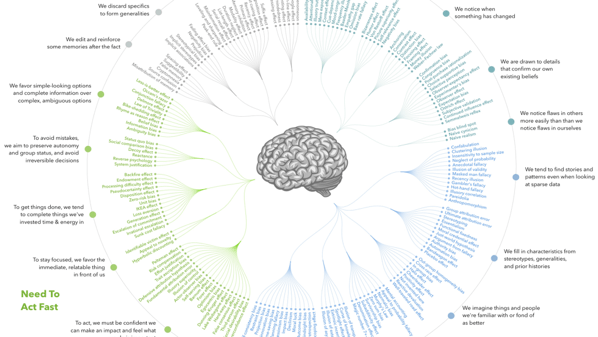 ’Buster Benson (a marketing manager at Slack) decided to organize 175 known biases into a giant codex… Benson (with help from illustrations by John Manoogian III), sorted biases for duplicates and grouped them into four larger categories, each called a “conundrum” or “problem”. All four of these limit our intelligence but are actually trying to be helpful. According to Benson, “Every cognitive bias is there for a reason — primarily to save our brains time or energy.” But the end result of utilizing such mental shortcuts, which are often useful, is that they also introduce errors into our thinking. By becoming aware of how our minds make decisions, we can be mindful of the inherent inaccuracies and fallacies and hopefully act with more fairness and grace.…’

 Sure, it sounds like science fiction. But some researchers suggest that warp drives might actually be a possibility: