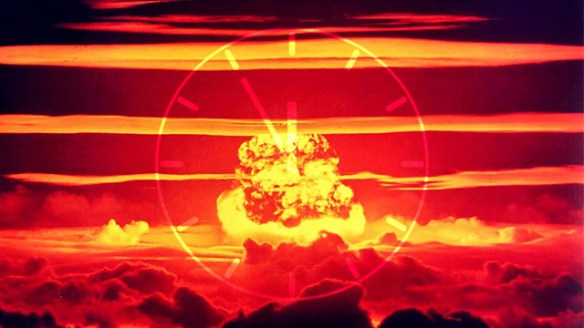
‘ Each year since 1945, the Bulletin of the Atomic Scientists sends a letter to the UN Security Council in which they tell them how close we are from nuclear holocaust using a Doomsday Clock. In 1960 we were two minutes from midnight. Their new 2014 report says we\’re still five minutes from the Apocalypse. “Five minutes is too close,” they say.
The organization—which was founded by some of the researchers who participated in the Manhattan Project—counts with the collaboration of a board of sponsors that includes 18 Nobel laureates to analyze current data to give this estimate. They always give good reasons:
“Speaking at Berlin’s historic Brandenburg Gate in mid-June, President Obama proposed a reduction in the limit on US and Russian deployed strategic nuclear warheads from the current New START level—1,550 warheads on each side—to 1,000.
Obama’s speech came just days after Iran elected a new president, Hassan Rouhani, who quickly changed the tone of the country’s foreign policy, clearing the path for the first direct talks between the United States and Iran in 35 years.
[…]
Around the world, much nuclear material remains unsecured.
Soon after Obama’s Brandenburg Gate speech, Russia offered political asylum to Edward Snowden, the former National Security Agency contractor who leaked US classified documents, creating an international media sensation, and Obama called off a planned summit with Russian leader Vladimir Putin. There appears to have been little movement since on nuclear agreements between the United States and Russia.
China is reported to be modernizing and quantitatively increasing its nuclear arsenal, albeit at a slow pace. India and Pakistan continue to expand their arsenals and stockpiles of fissile materials. Both countries are developing and testing new missiles, many nuclear-capable. India plans to build a nuclear submarine fleet and to develop a ballistic missile-defense system, the deployment of which could destabilize the subcontinent.
Despite authoritative reports that it has a nuclear weapons arsenal, Israel continues a policy of nuclear ambiguity while strenuously trying to scuttle talks on Iran\’s nuclear efforts. In February 2013, North Korea conducted yet another nuclear weapon test, the first under its new leader, Kim Jong-un, and issued a series of military threats, some involving the use of nuclear weapons.” ‘ (Sploid)