Inestimable curmudgeon Theordore Dalrymple comments on the recent UNESCO report on childhood:
In Praise of Melancholy
![]() |
Eric G, Wilson: “We are eradicating a major cultural force, the muse behind much art and poetry and music. We are annihilating melancholia.” (Chronicle of Higher Education)
|

In Defense of the Beta Blocker
One of the most compelling arguments against performance enhancing drugs is that they produce an arms race among competitors, who feel compelled to use the drugs even when they would prefer not to, simply to stay competitive. But this argument falls away if the effects of the drug are distributed so unequally. If it’s only the nervous performers who are helped by beta blockers, there’s no reason for anyone other than nervous performers to use them.” — Carl Elliott, University of Minnesota bioethicist (Atlantic)
Sukiyaki Western Django
But why? The answer is simple: It’s a Takashi Miike film. The hardest-working man in showbiz, he’s made close to 80 movies, ranging from the good to the bad to the ugly, and if he’s going to make a Western, then it’s going to pay tribute to the truth that Westerns have never been solely an American undertaking—they’re an international language. With a title that’s one part Japanese (sukiyaki: the everything-in-a-bowl beef dish) and one part Italian (Django: the title character of Sergio Corbucci’s 1966 spaghetti-Western classic), Miike offers up an explosion of influences that mocks the idea of a monoculture that’s immune to foreign influence. Sukiyaki Western Django is a blend of Buddhist philosophy, film noir fatalism, Shakespeare’s Henry VI, and Japan’s very own 12th-century Genpei War. It’s a Wild West pageant of American history seen through Japanese eyes, reducing our entire frontier mythology to an ultraviolent grab for gold.” (Slate)
End of the line?
The Smell of Cancer
Road Tolls Hacked
This means that fraudsters could clone transponders, says Lawson, by copying the ID of another driver onto their device. As a result, they could travel for free while others unwittingly foot the bill. ‘It’s trivial to clone a device,’ Lawson says. ‘In fact, I have several clones with my own ID already.’
Lawson says that this also raises the possibility of using the FasTrak system to create false alibis, by overwriting one’s own ID onto another driver’s device before committing a crime. The toll system’s logs would appear to show the perpetrator driving at another location when the crime was being committed, he says.” (Technology Review)
Ants bite, phones fly
Shut Up And Eat Your Toad
The disorganization to which I currently belong
has skipped several meetings in a row
which is a pattern I find almost fatally attractive.
Down at headquarters there’s a secretary
and a janitor who I shall call Suzie
and boy can she ever shoot straight.
She’ll shoot you straight in the eye if you ask her to.
I mow the grass every other Saturday
and that’s the day she polishes the trivets
whether they need it or not, I don’t know
if there is a name for this kind of behavior,
hers or mine, but somebody once said something or another.
That’s why I joined up in the first place,
so somebody could teach me a few useful phrases,
such as, “Good afternoon, my dear anal-retentive Doctor,”
and “My, that is a lovely dictionary you have on, Mrs. Smith.”
Still, I hardly feel like functioning even on a brute
or loutish level. My plants think I’m one of them,
and they don’t look so good themselves, or so
I tell them. I like to give them at least several
reasons to be annoyed with me, it’s how they exercise
their skinny spectrum of emotions. Because.
That and cribbage. Often when I return from the club
late at night, weary-laden, weary-winged, washed out,
I can actually hear the nematodes working, sucking
the juices from the living cells of my narcissus.
I have mentioned this to Suzie on several occasions.
Each time she has backed away from me, panic-stricken
when really I was just making a stab at conversation.
It is not my intention to alarm anyone, but dear Lord
if I find a dead man in the road and his eyes
are crawling with maggots, I refuse to say
have a nice day Suzie just because she’s desperate
and her life is a runaway carriage rushing toward a cliff
now can I? Would you let her get away with that kind of crap?
Who are you anyway? And what kind of disorganization is this?
Baron of the Holy Grail? Well it’s about time you got here.
I was worried, I was starting to fret.
Related
‘You Probably Knew This but Just In Case’ Dept.
Spider Webs Glamour & Architecture
| A beautiful collection of astounding works of nature, wonderfully photographed, from Dark Roasted Blend, to which readers of FmH will notice I have linked more and more frequently. | ![]() |
35 Greatest Works of Reverse Graffiti
Confidence game
![]() |
“How impostors like Clark Rockefeller capture our trust instantly – and why we’re so eager to give it to them.” (Boston Globe)
|
‘You Probably Knew This but Just In Case’ Dept.
FDA Approves Sale Of Prescription Placebo
The long-awaited approval will allow pharmaceutical companies to market placebo in pill and liquid form. Eleven major drug companies have developed placebo tablets, the first of which, AstraZeneca’s Sucrosa, hits shelves Sept. 24.
“We couldn’t be more thrilled to finally get this wonder drug out of the labs and into consumers’ medicine cabinets,” said Tami Erickson, a spokeswoman for AstraZeneca. “Studies show placebo to be effective in the treatment of many ailments and disorders, ranging from lower-back pain to erectile dysfunction to nausea.”
Pain-sufferers like Margerite Kohler, who participated in a Sucrosa study in March, welcomed the FDA’s approval.’
Physician substance use by medical specialty
I’m certainly interested in the results for my own specialty, psychiatry. Does the proportional overuse of benzodiazepines indicate that the work is more anxiety-provoking than other specialties? I am not aware of significant benzo- use/abuse among anyone I have come across in the field, although of course I wouldn’t necessarily notice. But could prescribing predilections be an indicator? I have long been concerned with the rates at which psychiatrists in the communities in which I have practiced prescribe benzos for their clientele, seemingly oblivious to the adverse effects I see and to the established medical body of evidence about the risk/benefit balance for this class of medications.
Who Framed George Lakoff?
(The Chronicle of Higher Education)
Could this be the presidential campaign in which the Democrats finally take his work seriously enough to make the difference I believe it should and could?
The essay runs down a number of influential objections to Lakoff’s position from both hte political and academic domains. The political objections strike me as pitiful efforts to cling to the outmoded paradigm that it is the message, not the medium, that matters. Some of the academics say that Lakoff’s appeal is based on the new neuroenthuiasm. Put neuro- in front of anything and it seems novel and exciting. This is a more credible objection, I feel (as one who can often be seen as a neuroenthisiast myself). Much of what Lakoff wants to convey would do as well without the trappings of neurocognitive science. It is about the power of metaphor, essentially, certainly an old concern. But, perhaps, in terms of grappling with its appeal, shouldn’t we understand that the medium is the message as well?

An anthropological introduction to YouTube
Where else? On YouTube If humans are by nature tribal, what happens to tribalism in a digital culture?
The news you didn’t read
Why is it not considered newsworthy when the rate of murders by the mentally ill declines substantially, in the face of an overall rising murder rate? (Bad Science) Certainly, the contrary news would be plastered all over the media.
A Skeptic’s Guide to Bigfoot
![]() |
I want to believe, I really do, but what about the objections raised here? (Discovery)
Related: Does anybody know……what happened to www.cryptomundo.com? |
13 things that do not make sense
I do not know anything about the author of this page, but s/he has a handle on a number of mysteries. Even if there are innocent explanations for many or most, those for which there are none present important challenges to the adequacy of our understanding of the universe.
Do Subatomic Particles Have Free Will?
RulesofThumb.org
The Chameleon
![]() |
Incredible story of a serial impostor and the role-play that finally caught up with him. If the film rights to this haven’t already sold for a fortune, I’d be very surprised. (New Yorker) |
FDA Approves Sale Of Prescription Placebo
The long-awaited approval will allow pharmaceutical companies to market placebo in pill and liquid form. Eleven major drug companies have developed placebo tablets, the first of which, AstraZeneca’s Sucrosa, hits shelves Sept. 24.
“We couldn’t be more thrilled to finally get this wonder drug out of the labs and into consumers’ medicine cabinets,” said Tami Erickson, a spokeswoman for AstraZeneca. “Studies show placebo to be effective in the treatment of many ailments and disorders, ranging from lower-back pain to erectile dysfunction to nausea.”
Pain-sufferers like Margerite Kohler, who participated in a Sucrosa study in March, welcomed the FDA’s approval.’
Caught in the grips of linguistic paranoia
Designing Monopoly
Do you know that there are states in which you can be prosecuted for practicing interior design without a license? Heights of regulatory absurdity. (Marginal Revolution thanks to walker)
Why Should We Care About Georgia and Russia?
The Schiavo Case: Are Mass Media To Blame?
A forthcoming article in the neurological literature examines the media coverage of the Schiavo case and the misconceptions about ‘persistent vegetative state’ they purveyed. (Science Daily)
Demons Inner and Outer
Tthe Death of English?
Despite widespread fears that the explosion of text messaging may mean the death of English grammar and spelling, it appears that those who are most adept at texting are also the best spellers and writing writers. (Newsweek)
The Descent of Men
Himalayan mountaineering is an inherently dangerous pastime, and climbers are always at risk from the unexpected. But mountaineering has become more dangerous in recent decades as the traditional expeditionary culture of the early- and mid-20th century, which had emphasized mutual responsibility and common endeavor, gave way to an ethos stressing individualism and self-preservation.” (New York Times op-ed)
Chile Volcano Erupts With Ash…
Why Should We Care About Georgia and Russia?
Large Hadron Collider nearly ready
Invisible Streetlight By Jongoh Lee
"Shining Eyes"
Passionate conductor Benjamin Zander on why you like classical music, it is just that you don’t necessarily know it yet. (TED Talks)
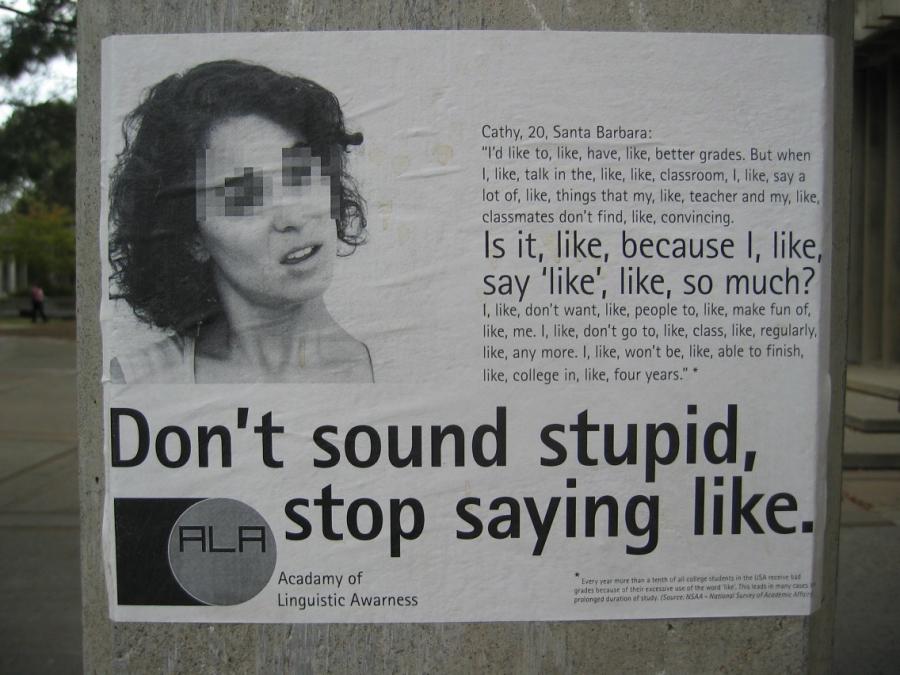
Academy of Linguistic Awareness sez:
Vital unresolved anthrax questions and ABC News
Seven years later, it’s difficult for many people to recall, but, as I’ve amply documented, those ABC News reports linking Saddam and anthrax penetrated very deeply — by design — into our public discourse and into the public consciousness. Those reports were absolutely vital in creating the impression during that very volatile time that Islamic terrorists generally, and Iraq and Saddam Hussein specifically, were grave, existential threats to this country.”
"Shining Eyes"
Passionate conductor Benjamin Zander on why you like classical music, it is just that you don’t necessarily know it yet. (TED Talks)
Senate bill would restrict Bush from secret executive orders
Sen. Russ Feingold… and Sen. Sheldon Whitehouse sponsored the bill as a response to an unreleased statement from the Justice Department Office of Legal Council that the President can alter or deviate from a previous executive order without public or Congressional knowledge.” (The Raw Story)
This is one to call your senators about…
"Is John McCain Stupid?"
How hospitals are killing E.R. patients
…E.R. boarding allows hospitals to insulate themselves from the burgeoning needs of the poor. E.R.s are safety nets: By law, we who work in them see any and all patients, regardless of their ability to pay. But as more E.R. beds are devoted to boarders, the E.R. has less space for new patients, which keeps a lid on the number of un- and underinsured. So unless you are having a heart attack and can jump the line, your emergency—though it may still be serious—may wait for so long that you give up and go home. Bad for you, good for the hospital’s bottom line. ” (Slate)
How hospitals are killing E.R. patients
…E.R. boarding allows hospitals to insulate themselves from the burgeoning needs of the poor. E.R.s are safety nets: By law, we who work in them see any and all patients, regardless of their ability to pay. But as more E.R. beds are devoted to boarders, the E.R. has less space for new patients, which keeps a lid on the number of un- and underinsured. So unless you are having a heart attack and can jump the line, your emergency—though it may still be serious—may wait for so long that you give up and go home. Bad for you, good for the hospital’s bottom line. ” (Slate)
Neurotosh, Neurodosh and Neurodash
…Wishing I’d attended that conference…
Exposed: Harvard Shrink Gets Rich Labeling Kids Bipolar
This is part of what makes me despair about my profession. From my position in the trenches in Boston psychiatry, you have to take my word for how influential Biederman’s influence has been on diagnostic and therapeutic practices… and how few clothes I have always thought the Emperor was wearing.
The Science of Happiness: Is It All Bullshit?
Stewart, however, politely gives Ben-Shahar a chance to explain the value of his book and his course on positive psychology. Ben-Shahar is proud that his course is the most popular one at Harvard, to which Stewart gets an audience laugh by suggesting that perhaps the real reason it is so popular is because it is easy. This results in a nervous laugh from Ben-Shahar, who retorts that his exams are “actually quite difficult.” Ben-Shahar then explains that there is now a “science of happiness” and offers a study to prove it, but an unimpressed Stewart quips, “How is that science?”
Finally, Stewart is no longer able to restrain his amazement that platitudes are considered profound at Harvard nowadays (the “Six Happiness Tips” on Ben-Shahar’s website are about acceptance of negative feelings, positive attitude, meaningful activities, being grateful, simplifying life and physical health). Stewart ends the interview in Groucho Marx fashion by saying, “It’s a fascinating subject and one that I can’t believe you are getting away with.” ‘ (AlterNet)
Esquire Print Mag Will Use E-Ink Cover
Esquire first thought up the idea eight years ago, but the technology was still too clunky. Since then, the Kindle has gone on sale, and the same company that invented the tech used in Amazon’s device — E Ink — is making the covers. The price, although undisclosed, is prohibitive, and Ford has been brought in as a ‘sponsor’: A moving car ad will appear on the inside cover. Esquire even had to design a battery (a ‘six-figure investment’) that was small enough to fit into a magazine and keep things running until the mags are sold. The batteries will last for 90 days.” (Wired)
Obama is saying the wrong things about Afghanistan
Too Weird for The Wire
The ‘flesh-and-blood’ defense; or: how black Baltimore drug dealers are using white supremacist legal theories to confound the Feds. The twisted tale of the strange linkage between the Posse Comitatus movement, the bombing of the Murragh Federal Building, and street-corner Baltimore drug defendants. A historian of extremist hate groups says he is surprised this didn’t happen sooner. (Washington Monthly via kottke)
Why you should not drive in Rhode Island
R.I. police say man had 0.491 blood alcohol level… reportedly the highest ever recorded in someone who was not dead highest ever recorded in Rhode Island in someone who was not dead. (SFGate via boing boing)
Effects of alcohol in terms of blood alcohol concentration (BAC) (drugrecognition.com)
* 0.04 BAC – Federal prohibited limit for commercial drivers license.
* 0.05 BAC – Increased risk taking and American Medical Association recommended prohibited limit.
* 0.08 BAC – Recommended prohibited limit for criminal charges and impaired vision.
* 0.10 BAC – Poor large muscle control, loss of balance, and prohibited limit in most states.
* 0.17 BAC – National average blood alcohol level of drivers in a fatal crash.
* 0.19 BAC – National average for first time DUI offender and of persons who have killed police officers.
* 0.20 BAC – Loss of emotional control.
* 0.22 BAC – National average for repeat DUI offenders at time of arrest.
* 0.30 BAC – Loss of orientation as to time and place.
* 0.35 BAC – Blackouts and stupor.
* 0.50 BAC – Published overdose level leading to death.
* 0.74 BAC – Highest recorded blood alcohol level by a US hospital.
Jenny Diski Tries to Stay Awake
Mirrors Used to Explore How the Brain Interprets Information
The social psychology revolution is reaching its tipping point
Those who doubt that there is something going on in the world of ideas should get themselves a publisher’s catalogue. One month there is a book called Nudge, the next a book called Sway. A volume called Predictably Irrational follows another called Irrationality. Since the success of Malcolm Gladwell’s Tipping Point, books on tipping points have reached a tipping point.
Behind this publishing explosion, with its PR hoopla, is real and solid intellectual progress. It comes from two streams of thought, developing alongside each other. The first is the idea of evolutionary psychology… The second stream of thought is behavioural economics. For twenty years now, some economists have been looking at the psychology of economic decision-making. Instead of seeing humans as rational calculating machines, behavioural economists have been conducting experiments to assess how real choices are made…” (Times of London)
Karadzic Under Arrest in War Crimes
![]() |
Bosnian Serb Hid in Plain Sight in Belgrade for Thirteen Years. Did Serbia cough him up to curry favor around joining the EC? (New York Times) |
R.I.P. Artie Traum
Stalwart of ’60s Folk Music Scene Is Dead at 65. “In a long and varied career, Mr. Traum played folk music and smooth jazz; recorded 10 albums of his own and four with his brother; produced albums; composed film scores; created guitar-instruction books and videos; teamed with his brother for a radio program; and made a documentary film about the Catskill water system.” (New York Times)
The 2008 Perseid Meteor Shower
“Mark your calendar: The 2008 Perseid meteor shower peaks on August 12th and it should be a good show.” (NASA)
Synthetic Pot as a Military Weapon?
Meet the Man Who Ran the Secret Program: “‘Paradoxical as it may seem,’ Ketchum asserted, ‘one can use chemical weapons to spare lives, rather than extinguish them.'” (AlterNet)
Gone, and Being Forgotten
Where Can I Find a Clover?
Related: What’s the fuss? (Boston Globe)
Personal Genome Project
Where Can I Find a Clover?
Related: What’s the fuss? (Boston Globe)
The Woolly Thinker’s Guide to Rhetoric
Admit it, you’re as bored as I am
Queenan objects. I pity him his boredom…
Pauline Kael & trash cinema
Reentry
Toddlers who dislike spicy food racist, say report
The motivation for blocking investigations into Bush lawbreaking
Pathologists Believe They Have Pinpointed Achilles Heel Of HIV
The weak spot is hidden in the HIV envelope protein gp120. This protein is essential for HIV attachment to host cells, which initiate infection and eventually lead to Acquired Immunodeficiency Syndrome or AIDS. Normally the body’s immune defenses can ward off viruses by making proteins called antibodies that bind the virus. However, HIV is a constantly changing and mutating virus, and the antibodies produced after infection do not control disease progression to AIDS. For the same reason, no HIV preventative vaccine that stimulates production of protective antibodies is available.
The Achilles heel, a tiny stretch of amino acids numbered 421-433 on gp120, is now under study as a target for therapeutic intervention. Sudhir Paul, Ph.D., pathology professor in the UT Medical School, said, “Unlike the changeable regions of its envelope, HIV needs at least one region that must remain constant to attach to cells. If this region changes, HIV cannot infect cells. Equally important, HIV does not want this constant region to provoke the body’s defense system. So, HIV uses the same constant cellular attachment site to silence B lymphocytes – the antibody producing cells. The result is that the body is fooled into making abundant antibodies to the changeable regions of HIV but not to its cellular attachment site. Immunologists call such regions superantigens. HIV’s cleverness is unmatched. No other virus uses this trick to evade the body’s defenses.”…
Paul’s group has engineered antibodies with enzymatic activity, also known as abzymes, which can attack the Achilles heel of the virus in a precise way. “The abzymes recognize essentially all of the diverse HIV forms found across the world. This solves the problem of HIV changeability. The next step is to confirm our theory in human clinical trials,” Paul said. ” (Science Daily)
McDumb As Bush
Kafka Dept.
‘Members of Congress, nuns, war heroes and other ‘suspicious characters,’ with names like Robert Johnson and Gary Smith, have become trapped in the Kafkaesque clutches of this list, with little hope of escape,’ said Caroline Fredrickson, director of the ACLU Washington Legislative Office.” (American Civil Liberties Union)
eBay listing offers Bigfoot Hunting services
The Itch
Another fascinating ‘Annals of Medicine’ essay from Atul Gawande gets at some of the new verities in perceptual theory, notably debunking the assumption that ‘perception is reception’, through consideration of itching gone wild. In so doing, it also suggests much about such phenomena as phantom limb pain and chronic pain in general. (New Yorker)
How to nap
…and why (Boston Globe)
In Japan, Buddhism May Be Dying Out
When it comes to funerals, though, the Japanese have traditionally been inflexibly Buddhist — so much so that Buddhism in Japan is often called “funeral Buddhism,” a reference to the religion’s former near-monopoly on the elaborate, and lucrative, ceremonies surrounding deaths and memorial services.
But that expression also describes a religion that, by appearing to cater more to the needs of the dead than to those of the living, is losing its standing in Japanese society.” (New York Times)
Living Our Lives Without Chocolate?
The Outquisition: Post-apocalypse without the militias
Alex wrote up a great post about this and 24 hours later, some WorldChanging readers created Outquisition.org. I’m not sure what they’ll do there, but in my dreams, they’re off building a non-secret society of emergency-preparedness Nice People who think that the response to catastrophe isn’t lifeboat rules and militias, but humanitarian aid and kick-ass tools.” (Boing Boing)
Rethinking psychosis
As readers of FmH know, I have always been a psychiatric classificatory skeptic. In particular, the attempt to decide whether a patient presenting with psychotic symptoms has a schizophrenic disorder or an affective psychosis has always seemed flawed to me. Rarely have I seen a patient present as a pure, unmixed exemplar of one of those categories. The central distinction between ‘thought disorder’ and ‘affective disorder’ may be specious. (Should we, in fact, rethink our dichotomization of ‘thoughts’ and ‘feelings’?)
Lost Jimi Hendrix Rock Conjured From Beyond
Prescription Narcotic Consumption
This interactive map from the Las Vegas Sun accompanies a feature article on Nevada’s no.-1 ranking in national rates of narcotic abuse. You can pick a narcotic medication and a year since 1997 and see the relative rates of consumption in the 50 states. (NB: although the map accompanies an article about drug abuse and the data on which the map is based came from the D.E.A., it details consumption and as far as I can tell does not distinguish licit from illicit use.) Some who pointed me to this map were intrigued by the regional differences in choice of particular narcotic drug. This is probably a function of regional prescribing differences among physicians, marketing and distribution decisions by drug manufacturers, and the shaping of consumer preferences largely by word of mouth. What is more interesting is the overall increase across the years listed. Is this a function of increasing abuse or dramatic increases in rates of legitimate prescribing? (All the medications listed are manufactured pharmaceuticals, not cooked up in backyard home labs.)
It would be more interesting to see this type of data for other classes of drugs of abuse as well — cocaine, amphetamines, benzodiazepines, barbiturates, hallucinogens, ‘club drugs’ etc., as well as heroin. In addition to reflecting differences in distribution patterns, such a comprehensive map might have something to say about regional lifestyle and temperamental differences. (Pet peeve of mine: many people use the term ‘narcotic’ broadly, and inaccurately, as a synonym for illicit drugs in general, or for drugs with addictive potential in general. The term means neither of these; it is synonymous with ‘opiates’.)
‘Don’t Get in Your Patient’s Boat’
I was pointed to this New York Times article on the pitfalls of psychotherapy with the superrich from kottke. As a psychiatrist myself (who never, alas, treats the superrich), I was interested by the number of notable psychiatrists who seem to be making it their niche. True, treating the superrich overlaps with the issues, long considered very challenging in psychotherapy, of treating the very narcissistic. But the article is, I think, too polite about what I assume are added ingredients of a mix of therapists’ voyeuristic and purely mercenary interests in taking on the extremely wealthy in particular. The patients and their struggles are not inherently more interesting; in fact, they are probably less so, on the whole, despite the pat statement quoted by a therapist of the rich that she “considered a rich person’s unhappiness or emotional anguish no less serious than anybody else’s”. As the writer correctly points out, most of these patients have less of an impetus to work things through than the rest of us, and even than the rich patients of days past, more and more insulated from a recognition of personal dissatisfaction in an ever more materialistic and spiritually vacuous society as they are. Thus, a therapist treated more often as just another member of the client’s personal entourage flirts with being readily disposed of if s/he too readily emphasizes unpleasant aspects of these clients’ lives, which is after all what therapy is all about. And if the therapist refrains. s/he of necessity becomes a sycophantic supporter of self-indulgence.
In fact, arguably, psychotherapeutic practice originated with the treatment of the affluent, and the psychoanalytic style of practice inherited by those in Freud’s lineage has remained expensive, largely unreimbursed by health insurance, and only affordable by the wealthy. (Perhaps that has shaped the compelling focus of this school of treatment on narcissism as a central issue?) Only relatively recently in the lifespan of psychotherapy has it migrated down to other strata of society, its techniques and the nature and extent of the problems upon which it focuses morphing in the process. This in large measure helps to explain the two divergent cultures of the modern practice of therapy and psychiatry — the rarefied, isolated and often interminable world of the psychoanalytic psychotherapy practice, and the urgent unsystematic intensity of community mental health aimed at the lower and middle classes. Only as psychotherapy transmuted to deal with the ‘real world’ problems of the rest of us has there been an impetus to incorporate consideration of social, economic and political factors urgently impacting on patients’ lives and welfare. Ironically, only the superrich can afford the possibility of change from lengthy depth analysis, and only they can afford not to change…
Related: While we’re on the topic of unethical mercenary behavior among psychiatric luminaries, the name Alan Schatzberg will certainly mean something to any psychiatrist FmH readers.
dazzle ships
‘Don’t Get in Your Patient’s Boat’
I was pointed to this New York Times article on the pitfalls of psychotherapy with the superrich from kottke. As a psychiatrist myself (who never, alas, treats the superrich), I was interested by the number of notable psychiatrists who seem to be making it their niche. True, treating the superrich overlaps with the issues, long considered very challenging in psychotherapy, of treating the very narcissistic. But the article is, I think, too polite about what I assume are added ingredients of a mix of therapists’ voyeuristic and purely mercenary interests in taking on the extremely wealthy in particular. The patients and their struggles are not inherently more interesting; in fact, they are probably less so, on the whole, despite the pat statement quoted by a therapist of the rich that she “considered a rich person’s unhappiness or emotional anguish no less serious than anybody else’s”. As the writer correctly points out, most of these patients have less of an impetus to work things through than the rest of us, and even than the rich patients of days past, more and more insulated from a recognition of personal dissatisfaction in an ever more materialistic and spiritually vacuous society as they are. Thus, a therapist treated more often as just another member of the client’s personal entourage flirts with being readily disposed of if s/he too readily emphasizes unpleasant aspects of these clients’ lives, which is after all what therapy is all about. And if the therapist refrains. s/he of necessity becomes a sycophantic supporter of self-indulgence.
In fact, arguably, psychotherapeutic practice originated with the treatment of the affluent, and the psychoanalytic style of practice inherited by those in Freud’s lineage has remained expensive, largely unreimbursed by health insurance, and only affordable by the wealthy. (Perhaps that has shaped the compelling focus of this school of treatment on narcissism as a central issue?) Only relatively recently in the lifespan of psychotherapy has it migrated down to other strata of society, its techniques and the nature and extent of the problems upon which it focuses morphing in the process. This in large measure helps to explain the two divergent cultures of the modern practice of therapy and psychiatry — the rarefied, isolated and often interminable world of the psychoanalytic psychotherapy practice, and the urgent unsystematic intensity of community mental health aimed at the lower and middle classes. Only as psychotherapy transmuted to deal with the ‘real world’ problems of the rest of us has there been an impetus to incorporate consideration of social, economic and political factors urgently impacting on patients’ lives and welfare. Ironically, only the superrich can afford the possibility of change from lengthy depth analysis, and only they can afford not to change…
Related: While we’re on the topic of unethical mercenary behavior among psychiatric luminaries, the name Alan Schatzberg will certainly mean something to any psychiatrist FmH readers.
This persecution of Gypsies is now the shame of Europe
Schadenfreude Dept.
Spiritual effects of hallucinogens persist, researchers report
Writing in the Journal of Psychopharmacology, the Johns Hopkins researchers note that most of the 36 volunteer subjects given psilocybin, under controlled conditions in a Hopkins study published in 2006, continued to say 14 months later that the experience increased their sense of well-being or life satisfaction.” (PhysOrg)
Spiritual effects of hallucinogens persist, researchers report
Writing in the Journal of Psychopharmacology, the Johns Hopkins researchers note that most of the 36 volunteer subjects given psilocybin, under controlled conditions in a Hopkins study published in 2006, continued to say 14 months later that the experience increased their sense of well-being or life satisfaction.” (PhysOrg)
A timeline to Bush government torture
…SERE training has nothing to do with effective interrogation, according to military experts. Trained interrogators don’t work in the program. Skilled, experienced interrogators, in fact, say that only a fool would think that the training could somehow be reverse-engineered into effective interrogation techniques.
But that’s exactly what the Bush government sought to do. As the plan rolled forward, military and law enforcement officials consistently sent up red flags that the SERE-based interrogation program wasn’t just wrongheaded, it was probably illegal.
On Tuesday, the Senate Armed Services Committee conducted a hearing on the evolution of abusive interrogations under the Bush administration. Through a series of memos and documents released by the committee, some old and some new, the following timeline has now been established.” (Salon)
There are more than 11 miliion refugees in the world
How to Balance 17 Dominos on One
Video (5min)
Waiting for the Water to Fall
|
“New York City is now 10 days away from the unveiling of “Waterfalls,” the much anticipated (and hyped) $15 million public art project by the Danish-Icelandic artist Olafur Eliasson. The project, the biggest public art installation since “The Gates,” the Christo and Jeanne-Claude work in Central Park in 2005, is already being hyped, with Mayor Michael R. Bloomberg saying the work could evoke the awe that led 16th-century European explorers to compare the New York shoreline to the Garden of Eden. (Seriously.)” (New York Times)
|
![]() |
Looking Forward to Intelligent Civilized Discourse in the Coming Presidential Race?
Think Again’ (Thnik Progress)
Wired Nostalgia
On the occasion of its fifteenth anniversary, Kevin Kelly waxes nostalgic about Wired‘s early years. Probably interesting only if you are a Wired fan.
A McCain-Lieberman ticket?
Not as if he is the first to have thought of this likelihood.
Happy Bloomsday
| Bloomsday resources from Jorn Barger.
Molly Bloom’s soliloquy from Penelope (Episode 18): …the sun shines for you he said the day we were lying among the rhododendrons on Howth head in the grey tweed suit and his straw hat the day I got him to propose to me yes first I gave him the bit of seedcake out of my mouth and it was leapyear like now yes 16 years ago my God after that long kiss I near lost my breath yes he said was a flower of the mountain yes so we are flowers all a womans body yes that was one true thing he said in his life and the sun shines for you today yes that was why I liked him because I saw he understood or felt what a woman is and I knew I could always get round him and I gave him all the pleasure I could leading him on till he asked me to say yes and I wouldnt answer first only looked out over the sea and the sky I was thinking of so many things he didnt know of Mulvey and Mr Stanhope and Hester and father and old captain Groves and the sailors playing all birds fly and I say stoop and washing up dishes they called it on the pier and the sentry in front of the governors house with the thing round his white helmet poor devil half roasted and the Spanish girls laughing in their shawls and their tall combs and the auctions in the morning the Greeks and the jews and the Arabs and the devil knows who else from all the ends of Europe and Duke street and the fowl market all clucking outside Larby Sharans and the poor donkeys slipping half asleep and the vague fellows in the cloaks asleep in the shade on the steps and the big wheels of the carts of the bulls and the old castle thousands of years old yes and those handsome Moors all in white and turbans like kings asking you to sit down in their little bit of a shop and Ronda with the old windows of the posadas glancing eyes a lattice hid for her lover to kiss the iron and the wineshops half open at night and the castanets and the night we missed the boat at Algeciras the watchman going about serene with his lamp and O that awful deepdown torrent O and the sea the sea crimson sometimes like fire and the glorious sunsets and the figtrees in the Alameda gardens yes and all the queer little streets and pink and blue and yellow houses and the rosegardens and the jessamine and geraniums and cactuses and Gibraltar as a girl where I was a Flower of the mountain yes when I put the rose in my hair like the Andalusian girls used or shall I wear a red yes and how he kissed me under the Moorish wall and I thought well as well him as another and then I asked him with my eyes to ask again yes and then he asked me would I yes to say yes my mountain flower and first I put my arms around him yes and drew him down Jo me so he could feel my breasts all perfume yes and his heart was going like mad and yes I said yes I will Yes.
|
Mind like a comic strip
David Bainbridge’s description of consciousness (26 January, p 40), including, for example, the fact that we do not know where in the brain consciousness happens, was evocative. Scott McCloud, in his book Understanding Comics, describes a comic’s story as whatever is happening in the blank spaces between the panels.
What if our minds function like a comic: they snap pictures, and our consciousness is simply the story the mind constructs around those pictures?” (New Scientist)
A Remarkable Photo From Tornado Country
Wake Up and Smell the Coffee?
An Interview with Jeff Warren
Warren is an engaging field guide in these adventures, and The Head Trip will interest anyone curious about the black box of consciousness. In the interview below, he explains why “dreaming is bananas,” why we shouldn’t listen too seriously to the evolutionary psychologists’ Just-So stories, and why we should think more explicitly about our habits of mind.” (Bookslut)
![Melancholy //fragility.freeblog.hu/files/melancholy.jpg' cannot be displayed]](https://i0.wp.com/fragility.freeblog.hu/files/melancholy.jpg)
![Arachnophobics, Beware! //lh6.ggpht.com/abramsv/SKseXYv9aeI/AAAAAAAAZT0/G4lbdiAbEZA/s640/1525624962_3346e1646b_o.jpg' cannot be displayed]](https://i0.wp.com/lh6.ggpht.com/abramsv/SKseXYv9aeI/AAAAAAAAZT0/G4lbdiAbEZA/s640/1525624962_3346e1646b_o.jpg)
![Clark, perhaps? //www.timesonline.co.uk/multimedia/archive/00376/RockefellerDad360_376004a.jpg' cannot be displayed]](https://i0.wp.com/www.timesonline.co.uk/multimedia/archive/00376/RockefellerDad360_376004a.jpg)
![Bigfoot //img.dailymail.co.uk/i/pix/2007/10_04/BigFootPatCORB_468x567.jpg' cannot be displayed]](https://i0.wp.com/img.dailymail.co.uk/i/pix/2007/10_04/BigFootPatCORB_468x567.jpg)
![Frederic Bourdin //www.newyorker.com/images/2008/08/11/p233/080811_r17588_p233.jpg' cannot be displayed]](https://i0.wp.com/www.newyorker.com/images/2008/08/11/p233/080811_r17588_p233.jpg)
![//theworld.com/%7Eemg/volcanicstorm.jpg' cannot be displayed]](https://i0.wp.com/theworld.com/~emg/volcanicstorm.jpg)

![Genocidal maniac in 'happier times'... //graphics8.nytimes.com/images/2008/07/21/world/serbs.gif' cannot be displayed]](https://i0.wp.com/graphics8.nytimes.com/images/2008/07/21/world/serbs.gif)
![We'll miss you, Artie... //graphics8.nytimes.com/images/2008/07/22/arts/traum190.jpg' cannot be displayed]](https://i0.wp.com/graphics8.nytimes.com/images/2008/07/22/arts/traum190.jpg)
![Perseids Ahoy! //science.nasa.gov/headlines/y2008/images/perseiddawn/westerberg1_med.jpg' cannot be displayed]](https://i0.wp.com/science.nasa.gov/headlines/y2008/images/perseiddawn/westerberg1_med.jpg)
![//lh6.ggpht.com/abramsv/SIGypyxtIRI/AAAAAAAAVtc/zB-g0Z6Qyro/s640/038_pics.jpg' cannot be displayed]](https://i0.wp.com/lh6.ggpht.com/abramsv/SIGypyxtIRI/AAAAAAAAVtc/zB-g0Z6Qyro/s640/038_pics.jpg)
![21st Century Falling Water //graphics8.nytimes.com/images/2008/06/16/nyregion/waterfalls-533.jpg' cannot be displayed]](https://i0.wp.com/graphics8.nytimes.com/images/2008/06/16/nyregion/waterfalls-533.jpg)
![//graphics8.nytimes.com/images/2008/06/13/us/13tornado-blog.jpg' cannot be displayed]](https://i0.wp.com/graphics8.nytimes.com/images/2008/06/13/us/13tornado-blog.jpg)