The New York Times comes out against confirming Roberts: “Senators should vote against Mr. Roberts not because they know he does not have the qualities to be an excellent chief justice, but because he has not met the very heavy burden of proving that he does.” (New York Times editorial)
"I’ve been firefighting for over 35 years and I’ve never come across anything like this"
“An Australian man built up a 40,000-volt charge of static electricity in his clothes as he walked, leaving a trail of scorched carpet and molten plastic and forcing firefighters to evacuate a building.
Frank Clewer, who was wearing a woolen shirt and a synthetic nylon jacket, was oblivious to the growing electrical current that was building up as his clothes rubbed together.
When he walked into a building in the country town of Warrnambool in the southern state of Victoria Thursday, the electrical charge ignited the carpet.
…’We tested his clothes with a static electricity field meter and measured a current of 40,000 volts, which is one step shy of spontaneous combustion, where his clothes would have self-ignited,’ Barton said.” (Reuters Oddly Enough)
Shoreline Spotted on Saturn’s Moon Titan
“The idea of a large sea on Saturn’s moon Titan was all but ruled out after the Cassini mission found no evidence early in its mission.
Scientists have long speculated that Titan might contain liquid methane or other hydrocarbons. The chemistry resembles prebiotic Earth, but Titan lacks liquid water. Nonetheless, earlier this month another group of researchers speculated that Titan might actually harbor life today.” (Yahoo! News)
The Big Here
“You live in the big here. Wherever you live, your tiny spot is deeply intertwined within a larger place, imbedded fractal-like into a whole system called a watershed, which is itself integrated with other watersheds into a tightly interdependent biome. (See the world eco-region map ). At the ultimate level, your home is a cell in an organism called a planet. All these levels interconnect. What do you know about the dynamics of this larger system around you? Most of us are ignorant of this matrix. But it is the biggest interactive game there is. Hacking it is both fun and vital. The following exercise in watershed awareness was hatched 30 years ago by Peter Warshall, naturalist extraordinaire.” (Kevin Kelly’s Cool Tools [via walker])
Blair calls BBC coverage ‘full of hate of America’
Blair, ever Bush’s lapdog, is essentially complaining abut media coverage of the US government’s shortcomings in the aftermath of Katrina while at a conference on peace and development convened by Bill Clinton. Ever the diplomat, Clinton agreed, wishing the media had counterbalanced the no-holds-barred reportage on Bush’s failures with coverage of acts of individual heroism in the disaster response. No surprises. The only real bit of new news appears to be this conjecture:
“Blair’s remarks, as reported by Murdoch, are sure to aggravate the already difficult relations between the prime minister’s government and the BBC.
A government weapons expert, David Kelly, killed himself in 2003 after he was revealed as the source for BBC allegations that intelligence on the Iraqi threat was exaggerated to secure public support for the US-led war.” (Yahoo! News)
Shoreline Spotted on Saturn’s Moon Titan
“The idea of a large sea on Saturn’s moon Titan was all but ruled out after the Cassini mission found no evidence early in its mission.
Scientists have long speculated that Titan might contain liquid methane or other hydrocarbons. The chemistry resembles prebiotic Earth, but Titan lacks liquid water. Nonetheless, earlier this month another group of researchers speculated that Titan might actually harbor life today.” (Yahoo! News)
Bush administration promises speedier response to national disasters
Finally, some specific proposals beyond the facile mea culpas.
Making Light of Hot Peppers
Teresa Nielsen Hayden tells us how to deal with habaneros. (Making Light)
Advice From the Dalai Lama
Controversial Groups Database
“The Rick A. Ross Institute has assembled one of the largest databases of information about controversial groups, some called ‘cults,’ and related information on the Internet. The database contains thousands of press articles, court documents, and essays.”
Activist Jiu Jitsu Dept:
Hacking the Wingnuts: “Planned Parenthood in Philadelphia came up with an ingenious way to fight back against anti-choice fundamentalists who block clinic doors and harass workers and patients. The idea: hold a fund drive in which donors give cash for each protestor that shows up. The more there are, the more money Planned Parenthood receives. And, let the harassers know how much their presence is helping the clinic raise funds.” [via boing boing]
Bill Maher’s Sept. 15th Open Letter to George Bush
“‘Mr. President, this job can’t be fun for you any more. There’s no more money to spend–you used up all of that. You can’t start another war because you used up the army. And now, darn the luck, the rest of your term has become the Bush family nightmare: helping poor people. Listen to your Mom. The cupboard’s bare, the credit cards maxed out. No one’s speaking to you. Mission accomplished.
‘Now it’s time to do what you’ve always done best: lose interest and walk away. Like you did with your military service and the oil company and the baseball team. It’s time. Time to move on and try the next fantasy job. How about cowboy or space man? Now I know what you’re saying: there’s so many other things that you as President could involve yourself in. Please don’t. I know, I know. There’s a lot left to do. There’s a war with Venezuela. Eliminating the sales tax on yachts. Turning the space program over to the church. And Social Security to Fannie Mae. Giving embryos the vote.
‘But, Sir, none of that is going to happen now. Why? Because you govern like Billy Joel drives. You’ve performed so poorly I’m surprised that you haven’t given yourself a medal. You’re a catastrophe that walks like a man. Herbert Hoover was a shitty president, but even he never conceded an entire city to rising water and snakes.
‘On your watch, we’ve lost almost all of our allies, the surplus, four airliners, two trade centers, a piece of the Pentagon and the City of New Orleans. Maybe you’re just not lucky. I’m not saying you don’t love this country. I’m just wondering how much worse it could be if you were on the other side.
‘So, yes, God does speak to you. What he is saying is: ‘Take a hint.’ ‘” (The Huffington Post)
Doctors Talking to Patients About Themselves: How Much and What?
Is physician self-disclosure a boundary violation or a clinical tool? (Bioethics Discussion Blog)
Stiff upper lips may impair memories
Expending effort to keep your emotion in check during an upsetting event can interfere with your recall for the event. (New Scientist) [Not a problem for me…]
Mind Cymru art gallery 2005
Depictions of their distress by sufferers of mental illness, submitted for an exhibiton at the National Eisteddfod of Wales this summer.
Secretary of State: It’s About the Lattes
Bill O’Reilly: “The truth of the matter is our correspondents at Fox News can’t go out for a cup of coffee in Baghdad.”
Condoleezza Rice: “Bill, that’s tough. It’s tough. But what — would they have wanted to have gone out for a cup of coffee when Saddam Hussein was in power?”
The Shape of the New New Deal?
Ed Fitzgerald continues to do a great job thinking about the aftermath of Katrina. I particularly appreciated his pulling together some links and thoughts about whether New Orleans will, and should, be rebuilt. I am not sure I agree with his emphasis on it being largely a function of how much the residents want to return, however, both because of the environmental factors and the fiscal. While the pronouncements on the toxicity of the stew in which the city has been bathed and the residue that will remain on everything are so far more fraught with emotion and political agenda than scientific appraisal, I think it remains an open question whether we have the capability to make New Orleans safe to live in again. On the other hand, given the demographics of the displaced people, who will be the advocates for protecting those who wish to return from the environmental risks? And, of course, economic interests — both insurance industry and government budgetary concerns — mitigate against recreating the same diverse lively city. Despite Dubya’s glorious and empty vision of reconstruction, the people bringing you this project are the same people who tried to do the Iraq war on the cheap, with too few troops and too little armor to do the job (although giving plenty of funding to their cronies at Halliburton), and they still defend it in the face of the results coming home in the body bags every week. My guess is that this represents an unprecedented opportunity for the neocons to do a social experiment with wiping a city clean of an underclass that is in their minds a burden rather than a contribution; a shadow economy largely disconnected from their notions of the economic life of the city. In terms of the psychogeographical argument that New Orleans has a unique and irreplaceable place in the American psyche we cannot afford to lose, look for the rebuilt New Orleans to be a theme park caricature of itself. What else do you expect when the reconstruction effort is shaped by people who live a caricature of leadership?
Fitzgerald also published the text of Al Gore’s compelling Sept. 9th remarks to the Sierra Club on the moral choices facing us in the wake of the Gulf Coast disaster.
Global warming ‘past the point of no return’?
“The greatest fear is that the Arctic has reached a ‘tipping point’ beyond which nothing can reverse the continual loss of sea ice and with it the massive land glaciers of Greenland, which will raise sea levels dramatically.” (Independent.UK)
No Surprise
E-mail suggests government seeking to blame groups: “Federal officials appear to be seeking proof to blame the flood of New Orleans on environmental groups, documents show.” (Clarion-Ledger)
Reuters Explains Photo Of Bush Bathroom Note
Reuters picture editor says don’t blame the photographer, denies malicious intent, and defends Photoshop-enhancement of the photo.
Earth Asteroid Bombardment Mystery Solved?
“Scientists turned planetary detectives say they may have solved a solar system whodunit: What caused a cataclysmic asteroid assault on Earth and neighboring planets some 3.9 billion years ago?” (National Geographic)
Think NOLA shows our unpreparedness for ecological disaster? Watch this…
Indonesia Reports 4th Human Bird Flu Death: “Indonesia on Friday confirmed its fourth human death from the bird flu virus, and warned that more cases in the sprawling country were inevitable.” (Yahoo! News)
Low-dose bird flu vaccine tested on humans
New Scientist reports that the first clinical trials of a low-dose H5N1 bird flu vaccine are already under way.
![//us.news3.yimg.com/us.i2.yimg.com/p/rids/20050914/i/r2587077477.jpg?x=380&y=217&sig=Hh355TcloLG7aLsST74eYA--' cannot be displayed]](http://news.yahoo.com/news?tmpl=story&ncid=1756&e=1&u=/050914/ids_photos_ts/r2587077477.jpg "I think I may need a bathroom break? Is this possible...") |
“U.S. President George W. Bush writes a note to Secretary of State Condoleezza Rice during a Security Council meeting at the 2005 World Summit and 60th General Assembly of the United Nations in New York September 14.” (Yahoo! News) |
Sexism May Shorten Men’s Lives: Study
“(S)ocietal male dominance over women — patriarchy — may help explain why men have a lower life expectancy than women worldwide…” (Yahoo! News)
America’s Battered Wife Syndrome
“Dear America:
As a friend of the family I can’t sit back and watch you do this to yourself without saying something. Consider this a long distance intervention.
Your man is no good. He treats you like crap, lies to you, abuses you, bullies you, exploits you, takes your money. As a friend I want to tell you that you deserve better. You deserve a person that treats you with respect, cares about your welfare, and your children’s welfare, but that’s not George and it never will be.
Do you tell yourself that he’ll stop, or that it won’t get worse? He won’t ever stop, every insult, injury and death he has caused are a line that once crossed will never be uncrossed. Forget the dream. You will never have the American dream with George. You have to forget about what might have been, what George might have been, and realise that at the end of the day you are what you do, and look at George’s track record.” [more] (12thharmonic)
‘Human remains link’ to BSE cases
“The first cases of BSE or ‘mad cow disease’ could have been caused by animal feed contaminated with human remains, says a controversial theory.
Some raw materials for fertiliser and feed imported from South Asia in the 60s and 70s contained human bones and soft tissue, the Lancet reports. Bone collectors could have picked up the remains of corpses deposited in the Ganges river to sell for export.
If infected with prion diseases, they could have been the source for BSE.” (BBC)
Aurora Alert
“A coronal mass ejection (CME) is racing toward Earth and it could spark a severe geomagnetic storm when it arrives–perhaps tonight (Sept. 14th and 15th). People everywhere should be alert for auroras.” (SpaceWeather)
FU Cheney
See Movie, Buy Shirt: “In the past two weeks, Dr. Ben Marble of Gulfport, Mississippi, lost his house, saw his wife give birth by flashlight, and became an instant celebrity for telling Vice President Dick Cheney to go fuck himself.
…The incident, remarkable for an administration renowned for screening its audiences, was not only captured live on CNN but replayed on numerous websites and blogs, and even earned a Daily Show screening.
Marble, an emergency room doctor and indie rock musician who looks as though he were torn from the pages of Spin, said he doesn’t consider his actions heroic. ‘A lot of people are saying that. I was just mad and I lost my temper,’ he said.
Still, Marble hasn’t exactly been shy about getting his 15 minutes, either. HurricaneKatrinaSucked.com, a website Marble created to post pictures of the wreckage of his home and neighborhood, quickly sprouted a ‘Go fuck yourself Mr. Cheney’ link, complete with links to the Daily Show clip, a Cafe Press store selling ‘Go Fuck Yourself Mr. Cheney’ merchandise, and two eBay auctions, one selling permission to download his original 30-minute video for $20.” (Wired News)
Killer Buzz Flocks to New Browser
“Perhaps the world does not need another web browser — but it may want Bart Decrem’s.
Decrem and a small cadre of programmers in Palo Alto, California, have spent this summer quietly readying Flock, an open-source browser, for an early October beta launch. Several members of the team, including Decrem, hail from the Mozilla Foundation, which produced the Firefox browser upon which Flock is built.
Flock advertises itself as a ‘social browser,’ meaning that the application plays nicely with popular web services like Flickr, Technorati and del.icio.us. Flock also features widely compliant WYSIWYG, drag-and-drop blogging tools. The browser even promises to detect and authenticate all those user accounts automatically. It’s a clear attempt to be the browser of choice for the Web 2.0 user.
It’s no coincidence that the buzz has built rapidly to a rolling boil. Blogger and tech pundit Robert Scoble simply calls it “awesome.” Given the recent swell of anticipation surrounding Flock, the preceding stealth period seems quaint by contrast. Since an August demo at Bar Camp, enthusiastic blog posts have amounted to love letters in their enthusiasm. ” (Wired News)
International Disputes
The CIA World Factbook field listing of territorial and border disputes. [via robot wisdom]
Talabani Says Iraqis Could Replace Many U.S. Troops
President’s Claim About Major American Withdrawal by Year’s End Conflicts With White House Position: “Iraqi President Jalal Talabani said in an interview yesterday that the United States could withdraw as many as 50,000 troops by the end of the year, declaring there are enough Iraqi forces trained and ready to begin assuming control in cities throughout the country.
After the White House and Pentagon were contacted for comment, however, a senior adviser to Talabani called The Washington Post to say Talabani did not intend to suggest a specific timeline for withdrawal.” (Washington Post)
End of the Bush Era
“The Bush Era is over. The sooner politicians in both parties realize that, the better for them — and the country.
Recent months, and especially the past two weeks, have brought home to a steadily growing majority of Americans the truth that President Bush’s government doesn’t work. His policies are failing, his approach to leadership is detached and self-indulgent, his way of politics has produced a divided, angry and dysfunctional public square. We dare not go on like this.” — EJ Dionne (Washington Post op-ed)
March of the Conservatives
Penguin Film as Political Fodder: “…(C)onservative groups have turned its stirring depiction of the mating ordeals of emperor penguins into an unexpected battle anthem in the culture wars.” (New York Times )
All the President’s Friends
Paul Krugman: “…(w)hat we really should be asking is whether FEMA’s decline and fall is unique, or part of a larger pattern. What other government functions have been crippled by politicization, cronyism and/or the departure of experienced professionals? How many FEMA’s are there?” (New York Times op-ed)
Midnight caller-foiler
Invention: “Ever been plagued by wrong numbers or midnight calls from far-flung time zones? No problem, says SK Telecom of Seoul.
Instead of the caller getting a standard brrrp-brrrp tone after dialling a number, their system allows subscribers to play a personalised message back to the dialler.
The approach works for fixed or cellphone lines, and the message heard by the dialler can be the subscriber’s number, name or nickname, interspersed with normal ring-tone and the time of day at the subscriber’s end. So anyone who has mis-dialled, or called from across the world and forgotten the time difference, immediately knows to hang up.” (New Scientist)
iTunes 5 Disasters
For those of you who remain in the newer-is-better school of software use, this entry at The Digital Music Weblog may make you think for a moment before reflexively installing iTunes 5.0 over your 4.x version.
‘Unbearable decision: we had to kill our patients’
“Doctors working in hurricane-ravaged New Orleans killed critically ill patients rather than leaving them to die in agony as they evacuated hospitals, The Mail on Sunday can reveal.
With gangs of rapists and looters rampaging through wards in the flooded city, senior doctors took the harrowing decision to give massive overdoses of morphine to those they believed could not make it out alive.
In an extraordinary interview with The Mail on Sunday, one New Orleans doctor told how she ‘prayed for God to have mercy on her soul’ after she ignored every tenet of medical ethics and ended the lives of patients she had earlier fought to save.
Her heart-rending account has been corroborated by a hospital orderly and by local government officials. One emergency official, William ‘Forest’ McQueen, said: ‘Those who had no chance of making it were given a lot of morphine and lain down in a dark place to die.'” (Mail.UK)
Given that euthanasia is illegal in Louisiana, the paper has concealed the names of the doctor. Morphine in escalating doses is often given as a ‘comfort measure’, even if it hastens the end, when a patient’s death is judged to be inevitable and imminent. In this case, however, the imminence and inevitability may have been a function of the government failure to respond to the disaster promptly. Would you have done differently under the circumstances?
Open Letter to Kansas School Board on Intelligent Design Debate
![[Image 'FSM3d.jpg' cannot be displayed]](FSM3d.jpg "Our Lord, the Flying Spaghetti Monster") |
The Flying Spaghetti Monster meme advances. [thanks, Seth] [Anyone remember the classic 1958 sci-fi film, The Crawling Eye, by the way?] |
Saramago’s Blindness Revisited
The following was sent by Tobias Wolff to his father, Robert Paul Wolff, professor in the Afro-American Studies Department at UMass Amherst, and contains an eyewitness account of two paramedic friends of Tobias who were trapped in New Orleans in the aftermath of Hurricane Katrina. It is being forwarded around through email channels.
Sent: Tuesday, September 06, 2005 11:07 PM
Subject: Saramago’s Blindness Revisited — an eyewitness account from New Orleans
Hurricane Katrina — Our Experiences (Larry Bradshaw, Lorrie Beth Slonsky)
Two days after Hurricane Katrina struck New Orleans, the Walgreen’s store at the corner of Royal and Iberville streets remained locked. The dairy display case was clearly visible through the widows. It was now 48 hours without electricity, running water, plumbing. The milk, yogurt, and cheeses were beginning to spoil in the 90-degree heat. The owners and managers had locked up the food, water, pampers, and prescriptions and fled the City. Outside Walgreen’s windows, residents and tourists grew increasingly thirsty and hungry.The much-promised federal, state and local aid never materialized and the windows at Walgreen’s gave way to the looters. There was an alternative. The cops could have broken one small window and distributed the nuts, fruit juices, and bottle water in an organized and systematic manner. But they did not. Instead they spent hours playing cat and mouse, temporarily chasing away the looters.
We were finally airlifted out of New Orleans two days ago and arrived home yesterday (Saturday). We have yet to see any of the TV coverage or look at a newspaper. We are willing to guess that there were no video images or front-page pictures of European or affluent white tourists looting the Walgreen’s in the French Quarter.
We also suspect the media will have been inundated with “hero” images of the National Guard, the troops and the police struggling to help the “victims” of the Hurricane. What you will not see, but what we witnessed,were the real heroes and sheroes of the hurricane relief effort: the working class of New Orleans. The maintenance workers who used a fork lift to carry the sick and disabled. The engineers, who rigged, nurtured and kept the generators running. The electricians who improvised thick extension cords stretching over blocks to share the little electricity we had in order to free cars stuck on rooftop parking lots. Nurses who took over for mechanical ventilators and spent many hours on end manually forcing air into the lungs of unconscious patients to keep them alive. Doormen who rescued folks stuck in elevators.
Refinery workers who broke into boat yards, “stealing” boats to rescue their neighbors clinging to their roofs in flood waters. Mechanics who helped hot-wire any car that could be found to ferry people out of the City. And the food service workers who scoured the commercial kitchens improvising communal meals for hundreds of those stranded.
Most of these workers had lost their homes, and had not heard from members of their families, yet they stayed and provided the only infrastructure for the 20% of New Orleans that was not under water.
On Day 2, there were approximately 500 of us left in the hotels in the French Quarter. We were a mix of foreign tourists, conference attendees like ourselves, and locals who had checked into hotels for safety and shelter from Katrina. Some of us had cell phone contact with family and friends outside of New Orleans. We were repeatedly told that all sorts of resources including the National Guard and scores of buses were pouring in to the City. The buses and the other resources must have been invisible because none of us had seen them.
We decided we had to save ourselves. So we pooled our money and came up with $25,000 to have ten buses come and take us out of the City. Those who did not have the requisite $45.00 for a ticket were subsidized by those who did have extra money. We waited for 48 hours for the buses, spending the last 12 hours standing outside, sharing the limited water, food, and clothes we had. We created a priority boarding area for the sick, elderly and new born babies. We waited late into the night for the “imminent” arrival of the buses. The buses never arrived. We later learned that the minute the arrived to the City limits, they were commandeered by the military.
By day 4 our hotels had run out of fuel and water. Sanitation was dangerously abysmal. As the desperation and despair increased, street crime as well as water levels began to rise. The hotels turned us out and locked their doors, telling us that the “officials” told us to report to the convention center to wait for more buses. As we entered the center of the City, we finally encountered the National Guard. The Guards told us we would not be allowed into the Superdome as the City’s primary shelter had descended into a humanitarian and health hellhole.
The guards further told us that the City’s only other shelter, the Convention Center, was also descending into chaos and squalor and that the police were not allowing anyone else in. Quite naturally, we asked, “If we can’t go to the only 2 shelters in the City, what was our alternative?” The guards told us that that was our problem, and no they did not have extra water to give to us. This would be the start of our numerous encounters with callous and hostile “law enforcement”.
We walked to the police command center at Harrah’s on Canal Street and were told the same thing, that we were on our own, and no they did not have water to give us. We now numbered several hundred. We held a mass meeting to decide a course of action. We agreed to camp outside the police command post. We would be plainly visible to the media and would constitute a highly visible embarrassment to the City officials. The police told us that we could not stay. Regardless, we began to settle in and set up camp. In short order, the police commander came across the street to address our group. He told us he had a solution: we should walk to the Pontchartrain Expressway and cross the greater New Orleans Bridge where the police had buses lined up to take us out of the City.
The crowed cheered and began to move. We called everyone back and explained to the commander that there had been lots of misinformation and wrong information and was he sure that there were buses waiting for us. The commander turned to the crowd and stated emphatically, “I swear to you that the buses are there.”
We organized ourselves and the 200 of us set off for the bridge with great excitement and hope. As we marched pasted the convention center, many locals saw our determined and optimistic group and asked where we were headed. We told them about the great news. Families immediately grabbed their few belongings and quickly our numbers doubled and then doubled again. Babies in strollers now joined us, people using crutches, elderly clasping walkers and others people in wheelchairs. We marched the 2-3 miles to the freeway and up the steep incline to the Bridge. It now began to pour down rain, but it did not dampen our enthusiasm.
As we approached the bridge, armed Gretna sheriffs formed a line across the foot of the bridge. Before we were close enough to speak, they began firing their weapons over our heads. This sent the crowd fleeing in various directions. As the crowd scattered and dissipated, a few of us inched forward and managed to engage some of the sheriffs in conversation. We told them of our conversation with the police commander and of the commander’s assurances. The sheriffs informed us there were no buses waiting. The commander had lied to us to get us to move.
We questioned why we couldn’t cross the bridge anyway, especially as there was little traffic on the 6-lane highway. They responded that the West Bank was not going to become New Orleans and there would be no Superdomes in their City. These were code words for if you are poor and black, you are not crossing the Mississippi River and you were not getting out of New Orleans.
Our small group retreated back down Highway 90 to seek shelter from the rain under an overpass. We debated our options and in the end decided to build an encampment in the middle of the Ponchartrain Expressway on the center divide, between the O’Keefe and Tchoupitoulas exits. We reasoned we would be visible to everyone, we would have some security being on an elevated freeway and we could wait and watch for the arrival of the yet to be seen buses.
All day long, we saw other families, individuals and groups make the same trip up the incline in an attempt to cross the bridge, only to be turned away. Some chased away with gunfire, others simply told no, others to be verbally berated and humiliated. Thousands of New Orleaners were prevented and prohibited from self-evacuating the City on foot.
Meanwhile, the only two City shelters sank further into squalor and disrepair. The only way across the bridge was by vehicle. We saw workers stealing trucks, buses, moving vans, semi-trucks and any car that could be hotwired. All were packed with people trying to escape the misery New Orleans had become.
Our little encampment began to blossom. Someone stole a water delivery truck and brought it up to us. Let’s hear it for looting! A mile or so down the freeway, an army truck lost a couple of pallets of C-rations on a tight turn. We ferried the food back to our camp in shopping carts.
Now secure with the two necessities, food and water; cooperation, community, and creativity flowered. We organized a clean up and hung garbage bags from the rebar poles. We made beds from wood pallets and cardboard. We designated a storm drain as the bathroom and the kids built an elaborate enclosure for privacy out of plastic, broken umbrellas, and other scraps. We even organized a food recycling system where individuals could swap out parts of C-rations (applesauce for babies and candies for kids!).
This was a process we saw repeatedly in the aftermath of Katrina. When individuals had to fight to find food or water, it meant looking out for yourself only. You had to do whatever it took to find water for your kids or food for your parents. When these basic needs were met, people began to look out for each other, working together and constructing a community.
If the relief organizations had saturated the City with food and water in the first 2 or 3 days, the desperation, the frustration and the ugliness would not have set in.
Flush with the necessities, we offered food and water to passing families and individuals. Many decided to stay and join us. Our encampment grew to 80 or 90 people.
From a woman with a battery powered radio we learned that the media was talking about us. Up in full view on the freeway, every relief and news organizations saw us on their way into the City. Officials were being asked what they were going to do about all those families living up on the freeway? The officials responded they were going to take care of us. Some of us got a sinking feeling. “Taking care of us” had an ominous tone to it.
Unfortunately, our sinking feeling (along with the sinking City) was correct. Just as dusk set in, a Gretna Sheriff showed up, jumped out of his patrol vehicle, aimed his gun at our faces, screaming, “Get off the fucking freeway”. A helicopter arrived and used the wind from its blades to blow away our flimsy structures. As we retreated, the sheriff loaded up his truck with our food and water.
Once again, at gunpoint, we were forced off the freeway. All the law enforcement agencies appeared threatened when we congregated or congealed into groups of 20 or more. In every congregation of “victims” they saw “mob” or “riot”. We felt safety in numbers. Our “we must stay together” was impossible because the agencies would force us into small atomized groups.
In the pandemonium of having our camp raided and destroyed, we scattered once again. Reduced to a small group of 8 people, in the dark, we sought refuge in an abandoned school bus, under the freeway on Cilo Street. We were hiding from possible criminal elements but equally and definitely, we were hiding from the police and sheriffs with their martial law, curfew and shoot-to-kill policies.
The next days, our group of 8 walked most of the day, made contact with New Orleans Fire Department and were eventually airlifted out by an urban search and rescue team. We were dropped off near the airport and managed to catch a ride with the National Guard. The two young guardsmen apologized for the limited response of the Louisiana guards. They explained that a large section of their unit was in Iraq and that meant they were shorthanded and were unable to complete all the tasks they were assigned.
We arrived at the airport on the day a massive airlift had begun. The airport had become another Superdome. We 8 were caught in a press of humanity as flights were delayed for several hours while George Bush landed briefly at the airport for a photo op. After being evacuated on a coast guard cargo plane, we arrived in San Antonio, Texas.
There the humiliation and dehumanization of the official relief effort continued. We were placed on buses and driven to a large field where we were forced to sit for hours and hours. Some of the buses did not have air-conditioners. In the dark, hundreds if us were forced to share two filthy overflowing porta-potties. Those who managed to make it out with any possessions (often a few belongings in tattered plastic bags) we were subjected to two different dog-sniffing searches.
Most of us had not eaten all day because our C-rations had been confiscated at the airport because the rations set off the metal detectors. Yet, no food had been provided to the men, women, children, elderly, disabled as they sat for hours waiting to be “medically screened” to make sure we were not carrying any communicable diseases.
This official treatment was in sharp contrast to the warm, heart-felt reception given to us by the ordinary Texans. We saw one airline worker give her shoes to someone who was barefoot. Strangers on the street offered us money and toiletries with words of welcome. Throughout, the official relief effort was callous, inept, and racist. There was more suffering than need be. Lives were lost that did not need to be lost.
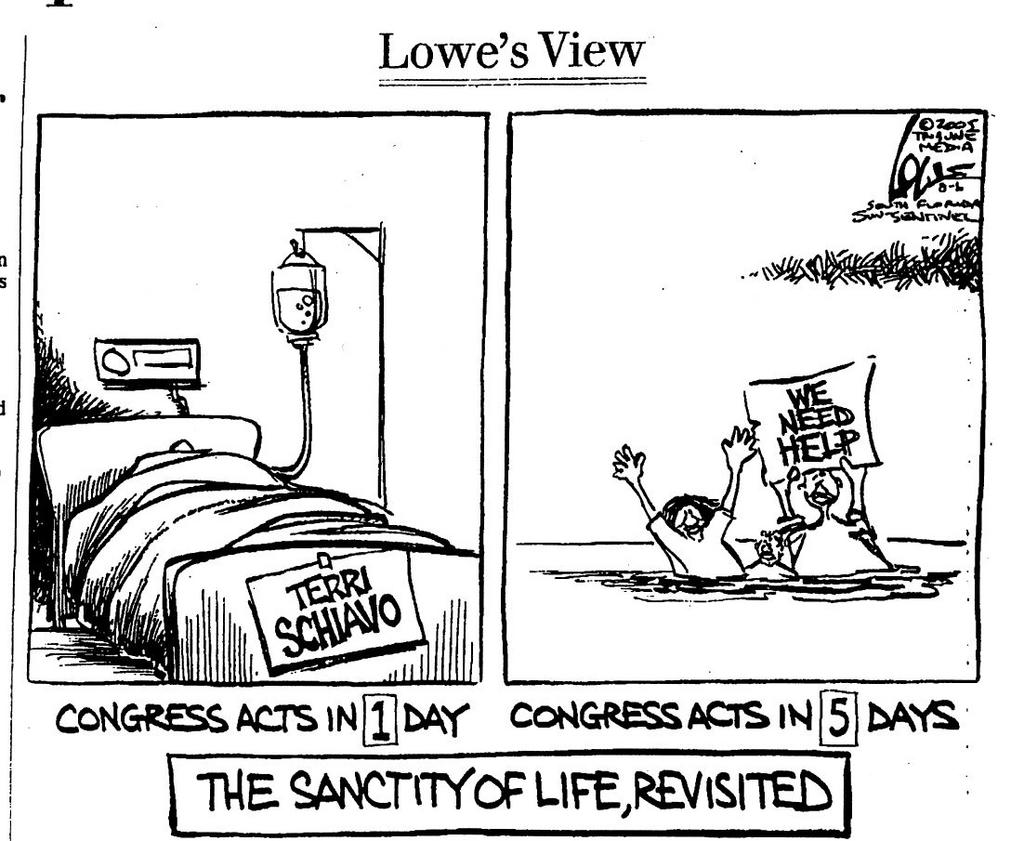
Sanctity of Life, Revisited
![//photos1.blogger.com/blogger/5558/718/1600/Sanctity%20of%20Life.jpg' cannot be displayed]](https://i0.wp.com/photos1.blogger.com/blogger/5558/718/1600/Sanctity%20of%20Life.jpg "Lowe's View")
Could Earth survive the Sun’s demise?
“Solar systems may continue to exist around stars that have reached the end of their lifetimes, flared up and collapsed. New evidence shows that asteroids and dust discs, and perhaps even planets, may circle white dwarf stars, the burned-out remnants of stars that have already undergone their all-consuming red-giant phase.” (New Scientist)
Television shows scramble forensic evidence
“Forensic science’s spell in the limelight has given it huge kudos. Glitzy TV shows like CSI: Crime Scene Investigation have sent students flocking to forensics courses. But while this interest is sexing up the image of scientists, is it also stopping police catching criminals and securing convictions?” (New Scientist)
Jurors familiar with the glitzy triumphs of the t.v. forensic investigators are no longer impressed with the tentativeness of real scientific testimony. And criminals are becoming savvy to ways to avoid leaving damning evidence at the scene of their crimes.
Reframing Mental Illness
I am reprinting in full this entry from the excellent Mind Hacks weblog, describing a conference raising most of the challenges to contemporary psychiatric diagnosis that I have come to myself in my career:
“A recently concluded confererence at London’s Institute of Psychiatry has been debating the classification and boundaries of mental illness and has been challenging the traditional views of psychiatric medicine.
There have been longstanding critics of psychiatry, notably people like R.D. Laing and Thomas Szasz, who have argued that the medical concepts of mental illness are flawed, or that they are used to unjustly silence society’s outsiders.
More recently, psychiatric classification, and particularly the separation of mental disorder into diagnoses such as ‘schizophrenia’ and ‘bipolar disorder’ have been challenged by mainstream psychiatrists on the basis of scientific discoveries.
For example, an editorial in May’s British Journal of Psychiatry argued that that schizophrenia and bipolar disorder are on a continuum, based on genetic evidence that is increasingly showing that similar genes are found in people who receive either diagnosis.
Other criticisms, echoed at the recent London conference, have been based on the coherence of psychiatric definitions and how well they reflect the diverse experiences of people who live through mental distress.
The conference discussed how understanding the first-person conscious experience of mental illness (as opposed to, or in combination with, scientific measures) can make for a more accurate understanding, and hopefully, treatments for those in need.
This approach is known as phenomenology and was championed by a number of continental philosophers who argued that science will only ever give a partial explanation because objective measures always leave something of the ‘lived experience’ missing.
One increasingly popular view of psychosis, the reality-bending mental state that can involve hallucinations and delusions, suggests that it is not an all or nothing state as psychiatric diagnosis suggests, but a range of experiences that are distributed throughout the population.
Recent studies have typically reported that about 10-11% of the general population score about the average of psychotic patients in psychiatric wards, on measures of unusual thinking or perceptual distortion, despite not needing psychiatric help or becoming significantly distressed or disabled.
Link to details of the recent conference on ‘Phenomenology and Psychiatry for the 21st Century’.
Link to BBC News on the conference and the boundaries of madness.”
Some Ways to Prepare for the Absolute Worst
“Getting ready for the next disaster doesn’t seem so crazy anymore, and survivalist outfitters have advice on how to be prepared.” (New York Times )
What Will It Take to Safeguard New Orleans?
Experts say the best protection for New Orleans would include major improvements in five areas. “New Orleans has long lived with the hurricane protection that it, and the nation, were willing to pay for. Measured against the costs of Katrina’s fury, however, better armor may suddenly seem more affordable.
With officials vowing to rebuild New Orleans, the question of how fully to defend the city against another catastrophe will be examined as never before.
Unlike San Francisco or Los Angeles, where there is no way to prevent widespread destruction from the most powerful earthquakes, New Orleans is uniquely dependent on one feature: its aging network of levees. If levees hold back the water, the city is spared. If they fail, much of the city is ruined.
…The success of levees in a restored New Orleans will depend partly on the resilience of other civil engineering, and on wetlands between the city and the Gulf of Mexico. Today, the condition of these outer defenses is poor: Barrier islands and wetlands are disappearing, and gates to protect against storm surges and waves are years away.” (New York Times )
War? Turmoil? Try Fantasy Instead
“Do we expect too much from our movies, or do we settle for too little? I ask myself this question periodically, especially at this time of year, when the movie industry emphasis shifts, in principle anyway, from the frivolous to the serious. Behind us is another summer of large-scale commercial entertainment, sprinkled with a handful of documentaries and art films, while ahead lies another round of biopics (Capote), literary adaptations (Memoirs of a Geisha) and costume epics (The New World) intended to dominate the end-of-the-year critics’ lists and midwinter awards broadcasts.” — A.O.Scott (New York Times )
The New iPod Nano
|
A review: “There are dozens of small, flash-based music players, but I haven’t seen any that combine the nano’s size and features. These features include the relatively large, 1.5 inch high-resolution color screen; Apple’s famous iPod navigation wheel; and the standard iPod connector port, which links to numerous iPod accessories. Most flash players have tiny screens that are hard to read, lousy navigation and few or no accessories.” (WSJ)
|
![//online.wsj.com/public/resources/images/ipod_nano09072005144257.jpg' cannot be displayed]](https://i0.wp.com/online.wsj.com/public/resources/images/ipod_nano09072005144257.jpg "iPod Nano") |
Among the Believers
“In an age of blogging, reflexive ironizing and ceaseless celebrity worship, two small literary-intellectual magazines try to make a different kind of big noise.” (New York Times Magazine)
The New iPod Nano
|
A review: “There are dozens of small, flash-based music players, but I haven’t seen any that combine the nano’s size and features. These features include the relatively large, 1.5 inch high-resolution color screen; Apple’s famous iPod navigation wheel; and the standard iPod connector port, which links to numerous iPod accessories. Most flash players have tiny screens that are hard to read, lousy navigation and few or no accessories.” (WSJ)
|
|
"…storming the convention center…"
Defense Department Briefing on Ongoing National Guard Response to Hurricane Katrina: “…We waited until we had enough force in place to do an overwhelming force. Went in with police powers, 1,000 National Guard military policemen under the command and control of the adjutant general of the State of Louisiana, Major General Landreneau, yesterday shortly after noon stormed the convention center, for lack of a better term, and there was absolutely no opposition, complete cooperation, and we attribute that to an excellent plan, superbly executed with great military precision. It was rather complex. It was executed absolutely flawlessly in that there was no violent resistance.. .” — Lt. Gen. H. Steven Blum (chief, National Guard Bureau, Defense Dept.) [via Respectful of Otters, thanks to walker]
20 Things They Don’t Want You to Know
“We reveal some of what vendors are keeping mum, such as: You never have to pay full price, extended warranties rarely pay for themselves, and the big sites do have customer service numbers.” (PCWorld via walker)
The ‘Voice of the Incas’ is 75
Happy birthday, Yma Sumac, “she has a panther and a nightingale in her throat.”
Knowing Which Way is Up
On the Vestibular System: “Small, intricately formed and locked in the skull, the vestibular organs continuously bombard the brain with messages. The messages are quite unlike any others. They tell of accelerations, how the head is rotating and translating and its orientation in space. The messages never stop and cannot be turned off. Even when we are completely motionless, they signal the relentless pull of gravity. Perhaps because of their constant monologue, the vestibular sensation is different to the other senses. There is no overt, readily recognizable, localizable, conscious sensation from these organs. They provide a silent sense.” (ScienceWeek)
New Word for the Dictionaries
“Fe·ma (‘fE-mä)adj 1: foreboding imminent disaster 2: inadequate or unsuited to a purpose to the point of ultimate doom
Nancy’s babysitting job went from bad to fema when she accidentally put the spaghetti O’s in the litterbox and the cat in the microwave.
Nancy’s babysitting job went from bad to fema when she accidentally put the spaghetti O’s in the litterbox and the cat in the microwave.
Fe·ma (‘fE-mä)vb Fe·ma·rized, Fe·ma·rated 1: to bungle, damage or ruin in such a way that people sing songs about your paramount ineptitude for millenia to come
Jack femarized himself by cutting his toenails with a chainsaw while sniffing gold colored spray paint.
Fe·ma (‘fE-mä)n 1: a steaming pile of feces 2: a U.S. government agency used to cause chaos in any emergency situation 3: mother of all clusterfucks
George W. Bush femarized the nation once again with his femarated decision to appoint a failed horse show manager to run FEMA. ” (Cynical-C Blog via walker)
I had independently begun to use the word fema’ed with my friends in related but simpler ways. It’s mostly used as an adjective, and I predict a glorious future in the vernacular: (1) A situation can be fema’ed, in a sense that will replace snafu’ed or fubar. (2) A person can be fema’ed. “I’m fema’ed” will replace I’m up the creek without a paddle, I’m screwed or I’m totally fucked. To anticipate some of your objections, I am of course not talking about the sexual act here, but rather some of the less pretty things people frequently do to one another.
F.D.A. Panel Endorses Inhaled Form of Insulin
“The first inhaled form of insulin, a product that could reduce or eliminate the daily injections needed by millions of diabetics, moved closer to federal approval yesterday.” (New York Times )
Political Issues Snarled Plans for Troop Aid
“The debate began after officials realized that Hurricane Katrina had exposed a critical flaw in the national disaster response plans created after the Sept. 11 attacks. According to the administration’s senior domestic security officials, the plan failed to recognize that local police, fire and medical personnel might be incapacitated.” (New York Times )
Unless you operate on a child’s fantasy level taking your parents’ reassurances that the police and firemen will always protect you and should always be trusted, it seems as if considering the possibility of the incapacitation of local emergency personnel would be basic to any disaster response plan!
In case you wondered…
Storm Leaves Legal System a Shambles: “They have no paperwork indicating whether they are charged with having too much to drink or attempted murder. There is no judge to hear their cases, no courthouse designated to hear them in and no lawyer to represent them. If lawyers can be found, there is no mechanism for paying them. The prisoners have had no contact with their families for days and do not know whether they are alive or dead, if their homes do or do not exist.” (New York Times )
Seeking Justice, of Gods or the Politicians
“In the history of humankind, there has rarely been a disaster like the New Orleans flood without a theodicy to go along with it. The word ‘theodicy,’ coined in the 18th century by the philosopher Gottfried Leibniz, derives from Greek roots invoking the ‘justice of the gods.’ A theodicy is an attempt to show that such justice exists, to prove that we really do live in what Leibniz insisted was the ‘best of all possible worlds.'” — Edward Rothstein (New York Times )
Rothstein claims that with the Enlightenment the notion that natural disasters represented the justice of the gods and thus sustained the moral order faded, replaced by an amoral randomness and the challenge of understanding causality in natural science terms. He is on more dicy ground in suggesting that the political blame game in the aftermath of the Gulf Coast disaster represents the emergence of a new theodicy which explains why bad things happen to good, or at least innocent, people in terms of the failures of their political leaders.
I have difficulty with this assertion on several grounds. First, this is not a new theme. Only the fundamentalist crazies have been blaming the victims for the human devastation of Katrina, but the myth of the Fisher King, the ruler whose personal moral failure lays waste to the country he rules, is archetypal (and has, BTW, long formed the mythic justification for regicide).
Secondly, we continue to conceive of the impact of public policy decisions as being in the realm of natural causality, not some separate and rarefied moral sphere. The abandonment of wetlands protection, the diversion of public preparedness resources to a specious terrorist threat, the gutting of public works funding for flood protection projects, and the abandonment of the urban poor (in New Orleans and everywhere else) to their own resources are rational, if reprehensible, causal factors for the magnitude of the catastrophe in New Orleans.
But perhaps there is a sense in which this disaster, like others, does represent a human moral failing — that of hubris. Our conceit in insisting on living on lowlying hurricane-ridden coasts, in wildfire and mudslide zones, on earthquake fault lines, on flood plains, at the mercy of increasingly vigorous weather caused by manmade precipitants of climate change, is a moral decision, and should be made deliberately, recognizing that it relies on our dubious interminable belief that we can live at odds with nature and can vanquish natural forces no matter what their fury. Increasingly, that ‘war with nature’ requires the protection of massive public expenditure and institutional support to be sustainable. People need to wake up to realize that, in voting as they did in the last two presidential elections for an administration that inherently believes government should have no role in protecting its citizens against larger forces, they have voted against the safety they need to continue to inhabit dubious environmental niches.
Saxophone Colossus at 75
![//www.popmatters.com/music/interviews/images/rollins-sonny-050826.jpg' cannot be displayed]](https://i0.wp.com/www.popmatters.com/music/interviews/images/rollins-sonny-050826.jpg "Sonny Rollins")
Happy birthday, Sonny Rollins! (PopMatters)
Planet New Orleans
Bill McKibben: “Our rulers have insisted by both word and deed that the laws of physics and chemistry do not apply to us. That delusion will now start to vanish. Katrina marks Year One of our new calendar, the start of an age in which the physical world has flipped from sure and secure to volatile and unhinged. New Orleans doesn’t look like the America we’ve lived in. But it very much resembles the planet we will inhabit the rest of our lives.” (Tomgram)
Among Other Ineptitudes…
“We are now learning that in the hours following Katrina’s landfall, FEMA — the Federal Emergency Management Agency, now a part of the Department of Homeland Security — rightly encouraged Americans to make charitable donations, but wrongly placed Pat Robertson at the top of that list.
Making matters worse is that as soon as this insult came under scrutiny, after millions of Americans had already been urged by FEMA to give to Robertson, FEMA began covering its tracks — erasing any sign of its actions from its Internet site.” (National Jewish Democratic Council [thanks, Seth])
Press Your Luck
The Michael Larsen incident: a fascinating read. [thanks, abby]
White House Enacts a Plan to Ease Political Damage
Rove orchestrates a response comprising by-now familiar elements:
“…Mr. Rove had told administration officials not to respond to Democratic attacks on Mr. Bush’s handling of the hurricane in the belief that the president was in a weak moment and that the administration should not appear to be seen now as being blatantly political. As with others in the party, this Republican would discuss the deliberations only on condition of anonymity because of keen White House sensitivity about how the administration and its strategy would be perceived.
In a reflection of what has long been a hallmark of Mr. Rove’s tough political style, the administration is also working to shift the blame away from the White House and toward officials of New Orleans and Louisiana who, as it happens, are Democrats.” (New York Times )
Amid horror, 2 officers commit suicide
“Police Superintendent Eddie Compass announced the two suicides yesterday morning, telling WWL Radio in New Orleans that ”the world really can’t understand’ what has happened in New Orleans in recent days, and that the two suicides were tragic parts of an already horrible situation.
…”He lost everything he owned. ‘He just could not find a way to wrap his mind around what had happened. There was despair in his eyes and sorrow. All I can say is it is more than he could handle.'” (Boston Globe)
Dear Mr. President: New Orleans is angry
A Times-Picayune open letter to Bush: “Every official at the Federal Emergency Management Agency should be fired, Director Michael Brown especially.
In a nationally televised interview Thursday night, he said his agency hadn’t known until that day that thousands of storm victims were stranded at the Ernest N. Morial Convention Center. He gave another nationally televised interview the next morning and said, ‘We’ve provided food to the people at the Convention Center so that they’ve gotten at least one, if not two meals, every single day.’
Lies don’t get more bald-faced than that, Mr. President.
Yet, when you met with Mr. Brown Friday morning, you told him, ‘You’re doing a heck of a job.'”
Enough said
Halliburton subsidiary gets Katrina repair contracts: “A Halliburton subsidiary has a Navy contract to do emergency repairs at Hurricane Katrina-damaged Gulf Coast military sites.
Kellogg, Brown and Root Services was awarded the competitive bid contract last July to provide debris removal and other emergency work after natural disasters.
Kellogg, Brown and Root Services was awarded the competitive bid contract last July to provide debris removal and other emergency work after natural disasters.
It’s a 500 (M) million dollar contract for the unit of Houston-based Halliburton.” (KLTV 7 Tyler-Longview-Jacksonville, TX)
United States of Shame
Maureen Dowd: “Why does this self-styled ‘can do’ president always lapse into such lame ‘who could have known?’ excuses.
Who on earth could have known that Osama bin Laden wanted to attack us by flying planes into buildings? Any official who bothered to read the trellis of pre-9/11 intelligence briefs.
Who on earth could have known that an American invasion of Iraq would spawn a brutal insurgency, terrorist recruiting boom and possible civil war? Any official who bothered to read the C.I.A.’s prewar reports.
Who on earth could have known that New Orleans’s sinking levees were at risk from a strong hurricane? Anybody who bothered to read the endless warnings over the years about the Big Easy’s uneasy fishbowl.” (New York Times op-ed)
The Most Intense Hurricanes in the United States 1851-2004
Brown pushed from last job
“Horse group: FEMA chief had to be `asked to resign'” (Boston Herald)
Parasites brainwash grasshoppers into death dive
It is not clear how, but in an ‘intriguing parasitic strategy’, the parasitic Nematomorph hairworm ‘hijacks’ the brain of the grasshoppers and crickets inside which it grows when it is time for it to transform into an aquatic adult. The worm produces proteins which directly affect its insect host’s CNS to make the land-dwelling host behave in ways it would never ordinarily do, by seeking out and plunging into water. This allows the mature hairworm to emerge and swim away to find a mate, leaving the insect host dead or dying in the water. (New Scientist) I know, not everything is a political parable, but although it is certainly a fascinating story in its own right, it it also an apt description of what the parasites in the White House are doing to the body of the U.S.
The 29 Healthiest Foods on the Planet
“The following is a ‘healthy food hot list’ consisting of the 29 food that will give you the biggest nutritional bang for you caloric buck, as well as decrease your risk for deadly illnesses like cancer, diabetes and heart disease. Along with each description is a suggestion as to how to incorporate these power-foods into your diet. ” [via robot wisdom]
Hawking reduced to talking with his blinks
“Disabled scientist Professor Stephen Hawking is using a hi-tech gadget to communicate by blinking because his deteriorating health limits movement.” (BBC)
New Orleans mayor fears CIA to take him out
New Orleans Mayor Ray Nagin, who cuts a fine media figure these days, thinks he might be a target for elimination because of the choice words he has had for George Bush and Louisiana Gov. Kathleen Blanco. Hey, so what if it’s from World Net Daily? It’s a great story.
One More Word
Video: Distraught Louisiana Sen. Mary Landrieu threatens to punch out the President. (onegoodmove)
U.S. the new Saddam
“The U.S. Air Force’s senior officer, Gen. John Jumper, stated U.S. warplanes would remain in Iraq to fight resistance forces and protect the American-installed regime ‘more or less indefinitely.’ Jumper’s bombshell went largely unnoticed due to Hurricane Katrina.
Gen. Jumper let the cat out of the bag. While President George Bush hints at eventual troop withdrawals, the Pentagon is busy building four major, permanent air bases in Iraq that will require heavy infantry protection.
Jumper’s revelation confirms what this column has long said: The Pentagon plans to copy Imperial Britain’s method of ruling oil-rich Iraq. In the 1920s, the British cobbled together Iraq from three disparate Ottoman provinces to control newly-found oil fields in Kurdistan and along the Iranian border.” — Eric Margolis (Toronto Sun via Common Dreams)
Look to Looka!
One of my long-term favorite weblogs has always had been an authentic New Orleans voice. One of the first places to which I turned for a real perspective on Katrina when I came out of the woods at the end of the week and learned what had happened while my family and I were out of range of news updates. I am very glad all of Chuck Taggart’s family are safe and sound and that his voice has not been silenced by the catastrophe.
It’s a miracle
Mice regrow hearts, amputated limbs and damaged organs. The self-healing strain of mice could regenerate any damaged body part except the brain. Scientists at the Wistar Institue, a US biomedical research center, serendipitously discovered the regenerating ability of the strain of mice when the identification holes they punch in the ears of the mice healed without a scar. The ability seems to be controlled by about a dozen genes, comparable genes to which are “almost certain” to exist in humans. When fetal cells from the self-healing strain were transferred to other mice, the recipients too acquired the ability to regenerate. To my knowledge, this is the first demonstration of this phenomenon, well-known in less complex vertebrates, in a mammalian species. (The Australian)
Conservative Blog Taxonomy
Mithras’ Fables of the reconstruction has this acerbic roster. I have one quibble, however. Jeff Jarvis (“Buzzmachine”) doesn’t just hate liberals and Democrats, he hates whomever doesn’t reflect his grandeur. Mithras is right about the essential ludicrousness of a man whose basis for punditry rests on being a TV Guide writer. ` [via Just Between Strangers]
Curiouser and curiouser
Designer models interpret Alice in Wonderland, as photographed by Annie Liebovitz. [via boing boing]
Vitamin E gives mice a longer, more acrobatic life
Great if you are a tightrope walker with an accelerated aging syndrome. (New Scientist)
Do You Know What It Means to Lose New Orleans?
Anne Rice: “What do people really know about New Orleans?
Do they take away with them an awareness that it has always been not only a great white metropolis but also a great black city, a city where African-Americans have come together again and again to form the strongest African-American culture in the land?” (New York Times op-ed)
The Bursting Point
David Brooks: “It’s already clear this will be known as the grueling decade, the Hobbesian decade. Americans have had to acknowledge dark realities that it is not in our nature to readily acknowledge: the thin veneer of civilization, the elemental violence in human nature, the lurking ferocity of the environment, the limitations on what we can plan and know, the cumbersome reactions of bureaucracies, the uncertain progress good makes over evil.
As a result, it is beginning to feel a bit like the 1970’s, another decade in which people lost faith in their institutions and lost a sense of confidence about the future.
…Reaganite conservatism was the response to the pessimism and feebleness of the 1970’s. Maybe this time there will be a progressive resurgence. Maybe we are entering an age of hardheaded law and order. (Rudy Giuliani, an unlikely G.O.P. nominee a few months ago, could now win in a walk.) Maybe there will be call for McCainist patriotism and nonpartisan independence. All we can be sure of is that the political culture is about to undergo some big change.” (New York Times op-ed)
It’s not the ’70’s again; it’s always been the ’70’s, but it took a long time for people like Brooks to notice.
United States of Shame
Maureen Dowd: “Why does this self-styled ‘can do’ president always lapse into such lame ‘who could have known?’ excuses.
Who on earth could have known that Osama bin Laden wanted to attack us by flying planes into buildings? Any official who bothered to read the trellis of pre-9/11 intelligence briefs.
Who on earth could have known that an American invasion of Iraq would spawn a brutal insurgency, terrorist recruiting boom and possible civil war? Any official who bothered to read the C.I.A.’s prewar reports.
Who on earth could have known that New Orleans’s sinking levees were at risk from a strong hurricane? Anybody who bothered to read the endless warnings over the years about the Big Easy’s uneasy fishbowl.” (New York Times op-ed)
Housekeeping…Not!
My family and I will be off in parts unknown, and I will be away from the keyboard, through Labor Day, so no new posts here until then. Enjoy the rest of your summer and, as always, thank you for your patronage.
"There’s real concern in the West Wing that the President is losing it…"
Is Bush Out of Control? “Buy beleaguered, overworked White House aides enough drinks and they tell a sordid tale of an administration under siege, beset by bitter staff infighting and led by a man whose mood swings suggest paranoia bordering on schizophrenia.
They describe a President whose public persona masks an angry, obscenity-spouting man who berates staff, unleashes tirades against those who disagree with him and ends meetings in the Oval Office with “get out of here!”” — Doug Thompson (Capitol Hill Blue)
Thompson is not much of a diagnostician, and he legitimizes alot of his psychiatric namecalling by invoking the deprecated psychoanalyst Justin Frank, author of Bush on the Couch, who many of us feel violated an ethical canon of the field by diagnosing sight unseen (although I feel the the potential impact of the President’s mental stability or lack thereof on every living soul on the planet makes him fair game in a different way even than other public figures whose behavior is under scrutiny). Thompson’s other claim to the authority to bandy about the labels is his own status as a recovering alcoholic with 11 years sobriety. (“I know all too well the symptoms that Dr. Frank describes and, after watching Bush for the past several years, I have to, unfortunately, agree with him.”) Diagnostic acumen apart, if Bush’s behavior is really as Thompson’s putative White House sources describe it, we had better hope he is being attended to by a good psychopharmacologist. Not that we would ever know, since evidence bearing on the President’s mental health is a state secret, unlike the public status of the results of his annual physical. I would argue that the public has even more of an abiding interest in knowing about the President’s mental health than his physical, and that, if there is not, there ought to be some sort of periodic checkup in this sphere as well, the results being made public. (Bush’s own white paper on reforming the mental health delivery system in the United States, which I read in detail and wrote about in FmH last year, comes close to suggesting a mandatory annual mental health checkup for every citizen, in the interpretation of some, by the way…) Of course, someone as beady-eyed, petty and defensive as Dubya (and, uhh, that’s no psychiatric diagnosis, in case you were wondering) would take exception to such a requirement and fire any White House mental health professional who took their job responsibilities too seriously.
Explaining Those Vivid Memories of Martian Kidnappers
Review of Abducted: How People Come to Believe They Were Kidnapped by Aliens by Susan Clancy. Harvard University Press, $22.95:
“People who have memories of being abducted by aliens become hardened skeptics, of a kind. They dismiss the procession of scientists who explain away the memories as illusions or fantasy. They scoff at talk about hypnosis or the unconscious processing of Hollywood scripts. And they hold their ground amid snickers from a public that thinks that they are daft or psychotic.
They are neither, it turns out, and their experiences should be taken as seriously as any strongly held exotic beliefs, according to Susan Clancy, a Harvard psychologist who interviewed dozens of self-described abductees as part of a series of memory studies over the last several years.
In her book Abducted, due in October, Dr. Clancy, a psychologist at Harvard, manages to refute and defend these believers, and along the way provide a discussion of current research into memory, emotion and culture that renders abduction stories understandable, if not believable. Although it focuses on abduction memories, the book hints at a larger ambition, to explain the psychology of transformative experiences, whether supposed abductions, conversions or divine visitations.” (New York Times )
Soul of a New Machine
IBM brains capture a PC’s soul: “Researchers at IBM are testing software that would let you tote your home or office desktop around on an iPod or similar portable device so that you could run it on any PC.
The virtual computer user environment setup is called SoulPad, and consumers install it from a x86-based home or office PC. SoulPad uses a USB (universal serial bus) or FireWire connection to access the network cards for connecting to the Internet, the computer’s display, the keyboard, the main processor and the memory, but not the hard disk.
After the person disconnects the system, SoulPad saves all work to the device, including browser cookies or other digital signatures that a PC keeps in its short-term memory.” (C/NET)
Black holes born through a brutal labour
“Black hole births are messy, chaotic events that take place in fits and starts and can take up to a day, suggest new observations from NASA’s Swift spacecraft. The research surprised astronomers, who expected the objects to burst forth fully formed in single explosive events.” (New Scientist)
NASA accused of ‘cycle of smugness’ over shuttle
“In its launch of the space shuttle Discovery, NASA made mistakes similar to those it made before the Columbia disaster, compromising safety. That is the conclusion of seven members of the 25-strong advisory task group that watched over the space shuttle’s return-to-flight improvements.” (New Scientist)
Color Code
A Color Portrait of the English Language: “The artwork is an interactive map of more than 33,000 words. Each word has been assigned a color based on the average color of images found by a search engine. The words are then grouped by meaning. The resulting patterns form an atlas of our lexicon.” [via kottke]
Piano Man: Sham or Shame?
“The mysterious Piano Man has finally broken his silence after more than four months – and has been exposed as a fake.
What is more, the man thought to be a musical genius can hardly play a note on the piano, according to latest reports.” (Nirror.UK)
I wrote about this story when it first broke in May and felt that the British mental health system was markedly remiss in terms of the lack of resources they devoted to his care. For someone the only clue to whose mysterious identity was that he appeared to be a composer and performer of captivating piano music to be treated by a staff whose knowledge of music could be summed up in statements like “I know it’s classical music, that’s all” (to paraphrase) and then to be transferred for internal reasons to a facility that did not even have a piano appalled me.
Now, at least according to a pulp tabloid ‘exclusive’, mental health treaters are reduced to name-calling. ‘Fakery’ is not a useful term to employ in this situation. We use the term “malingering” in psychiatry when a person deliberately, with conscious decision and purpose, simulates psychiatric symptoms for specific advantage. But it is a very difficult diagnosis to make, and one of last resort, even acknowledging that someone who malingers will always have the healthcare system (that is biased in favor of taking patients’ displays or reports of their distress at face value) over a barrel.
This patient’s actions over the ensuing months in the hospital themselves would seem to confirm, rather than disconfirm, that he is quite disturbed. Naive untrained staffs in mental health facilities often try to sort patients with disturbing behaviors into those who “can’t help it” and those who are “doing it deliberately” (so does the legal system when dealing with deranged behavior, trying to determine whether someone is “not guilty by reason of insanity” or “criminally responsible”) instead of realizing that there are all sorts of gradations of intentionality and all sorts of disturbances of the will. Instead of thinking about suing him for wasting their time, officials should examine their own seeming ineptitude in embodying that naiveté and in not getting to the bottom of this sooner. “Physician, heal thyself”, the saying goes, and also “Fool me once, shame on you. Fool me twice, shame on me.”
Killers in the Neighborhood
“A murder spree has erupted in … countless neighborhoods across Baghdad. Death squads, which tend to move in Opel sedans, are entering what once were tight-knit communities and killing ordinary citizens, apparently to stir up sectarian hatred. The goal: to incite a civil war that each side hopes will give its sect dominance over the other. In Baghdad, a city of more than 5 million, there were at least 880 violent deaths last month, according to Faiq Amin Bakr, director of the Baghdad central morgue. (In New York City, with a population of more than 8 million, the total number of homicides for all of 2004 was 571.) And the figure for Baghdad excludes those killed by car bombings and suicide attacks, which, if included, would add nearly 100 to the total.” (Time)
"I’m outta here…"
Discussion thread on The Onion‘s A.V. Club site about what movies people have walked out of. In almost each instance, they should’ve known better than to go to those dogs in the first place. Most are apologetic defensive about their choices and they deserve to be.
Walking the Wrong Way
“The Bush administration has announced plans for a Freedom Walk on Sept. 11, which will start at the Pentagon and end at the National Mall, and include a country music concert. The event is an ill-considered attempt to link the Iraq war to the terrorist attacks of 2001, and misguided in almost every conceivable way. It also badly misreads the public’s mood. The American people are becoming increasingly skeptical about the war. They want answers to hard questions, not pageantry.” (New York Times editorial)
Weird Words: Zenzizenzizenzic
(It is real.) (World Wide Words)
A Cartoon by Mr. Fish
![//harpers.org/art/cartoons/mrfish/Sheehan_350x344.jpg' cannot be displayed]](https://i0.wp.com/harpers.org/art/cartoons/mrfish/Sheehan_350x344.jpg "A cartoon by Mr. Fish")
Why Grow Flowers?
An Evolutionary Perspective (Human Nature)
Assault and Batteries
Just changed and upgraded my iPod’s battery. Trepidations about popping the case, but an easy five-minute procedure. Painfree. Cute little 40-gig drive inside. If that ever failed, it would be deadly easy to replace too. Does anyone know if there is a program to format a naked drive for an iPod? If so, it would be easy to upgrade to a larger drive as well if a person wanted to, for example to clog the iPod up with podcasts as well as music…
Hagel Says Iraq War Looking Like Vietnam
“A leading Republican senator and prospective presidential candidate said Sunday that the war in Iraq has destabilized the Middle East and is looking more like the Vietnam conflict from a generation ago.
Nebraska Sen. Chuck Hagel (news, bio, voting record), who received two Purple Hearts and other military honors for his service in Vietnam, reiterated his position that the United States needs to develop a strategy to leave Iraq.” (Yahoo! News)
And: Army Planning for Four More Years in Iraq (Yahoo! News)