
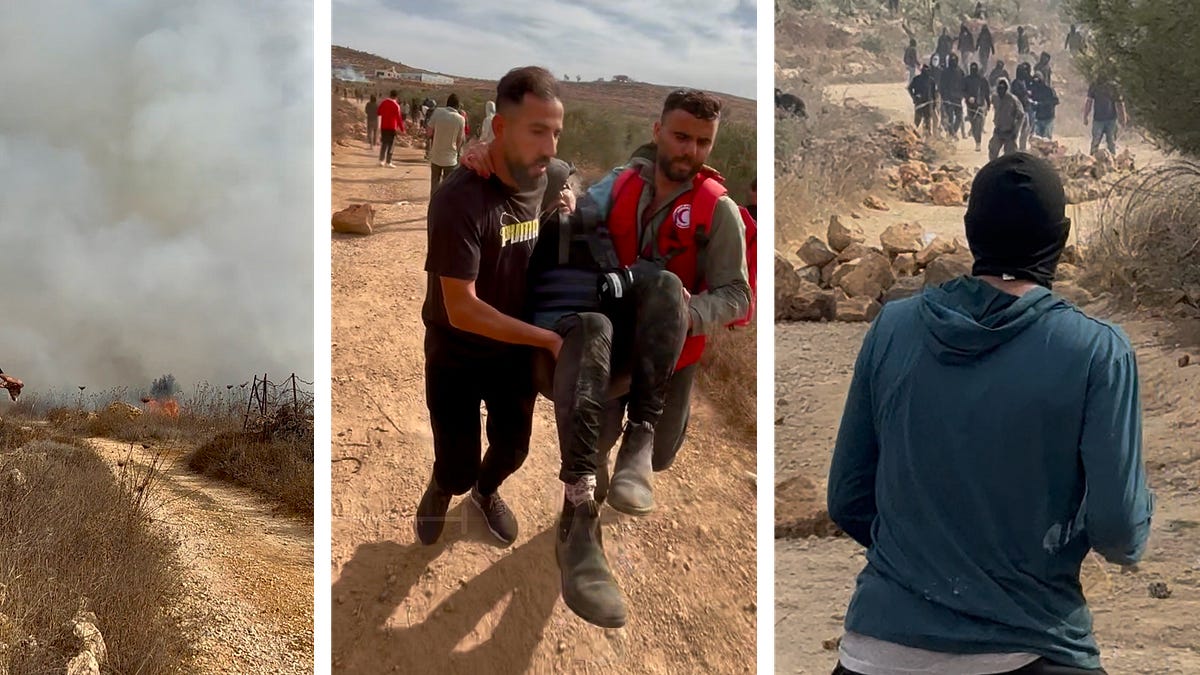
Jasper Diamond Nathaniel via Infinite Jaz Substack:
‘As I’ve written many times, there is nothing random about where settler violence strikes or where outposts are planted. It is all part of a methodical plan, carried out by settlers in collaboration with the IDF and the Israeli government, to sever Palestinian villages from one another, link outposts to settlement blocs, and ultimately empty the land of its indigenous people. The settlers watching us that morning live in an outpost called Netzach Shmuel, atop that hill. Armed with military-grade weaponry, they routinely attack the village. So no one was surprised to see the settlers gearing up for an assault. It was the reason I, and many other journalists, were there in the first place.…’
A dear friend of mine is currently at the olive harvest in the West Bank, offering support, bearing witness, acting as a sort of human shield and buffer between Palestinian villagers and Israeli settlers. We have been unable to obtain any information on her safety or that of those she is accompanying. Her family, some of whom vociferously objected on safety grounds to her decision to go, are equally in the dark.
The annual olive harvest in the occupied West Bank has become a particularly dangerous period for Palestinian villagers and the international volunteers who accompany them. The latter often serve as protective witnesses, documenting confrontations, discouraging violence through their presence, and sometimes physically interposing themselves between villagers and armed settlers. Their presence can offer some protection, but it does not guarantee safety. International volunteers themselves have been assaulted, detained, or threatened.
Awaiting more news and reading accounts such as the above, I remain in suspense as to whether my friend’s silence reflects disrupted communications, the demands of fieldwork, or actual adverse events.

