
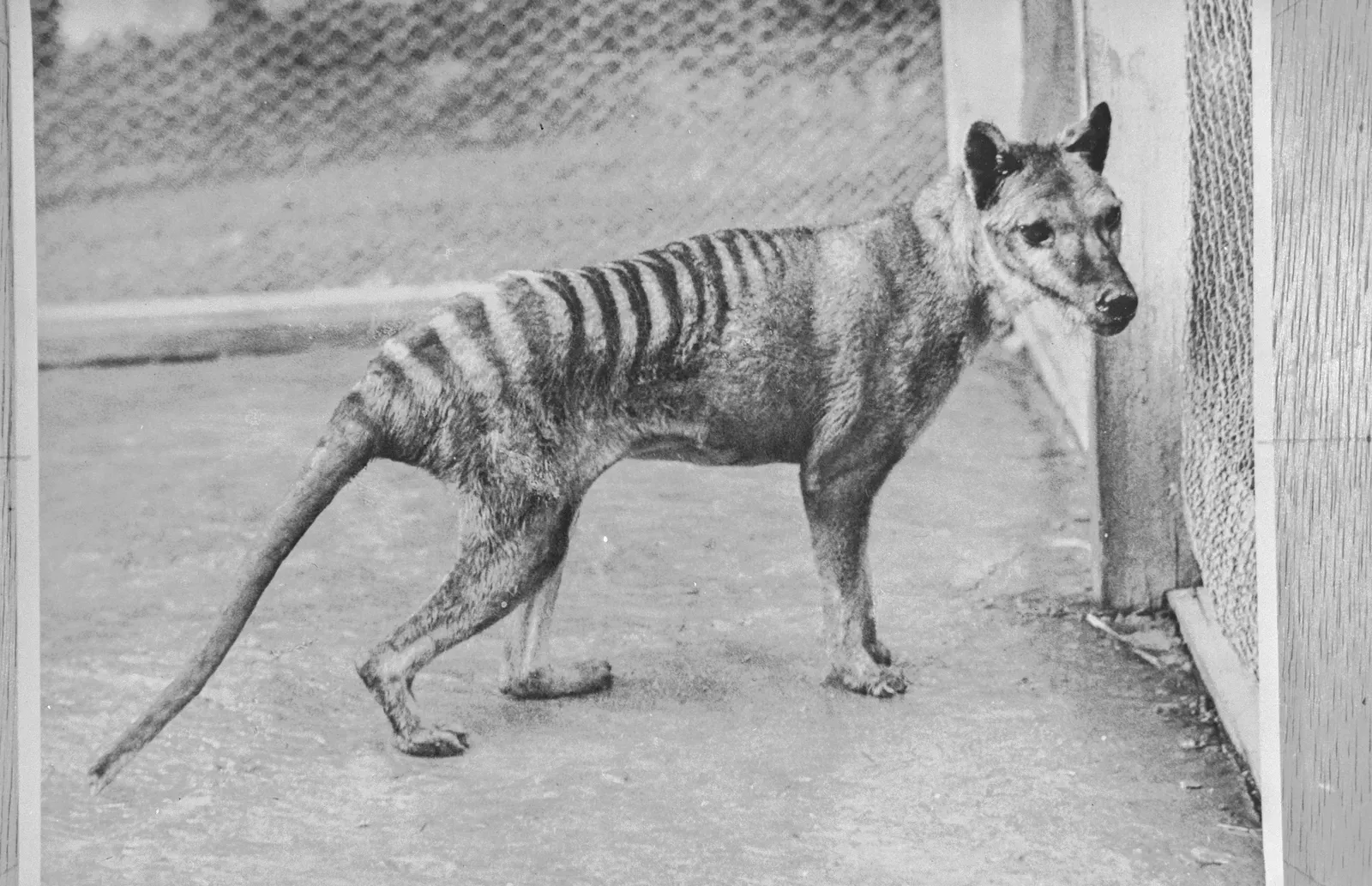
Via dino-world.com:
‘Most people assume the thylacine simply died out from natural causes, the way species quietly fade when their world changes around them. It didn’t. Humans hunted it into oblivion on purpose, and that single fact changes everything about whether a few survivors could have slipped through.
The thylacine once ranged across most of mainland Australia, but competition with dingoes pushed it to extinction there roughly 2,000 years ago, leaving an isolated population in Tasmania. When British colonists arrived, they paid bounty hunters to kill every thylacine they could find to protect sheep flocks. That’s not a slow habitat collapse – it’s systematic, government-funded slaughter, the kind that could easily leave a scattered, secretive remnant hiding in Tasmania’s least accessible wilderness. A species can be functionally invisible long before it’s actually gone, and that possibility has kept researchers searching for nearly 90 years straight.
The 1982 Sighting That Restarted an Entire Search Effort
The 1982 Sighting That Restarted an Entire Search Effort (Image Credits: Pexels)
If there’s one encounter that legitimized the “maybe it’s not extinct” camp, it’s this one. A government employee, not a tourist chasing folklore, filed the report that changed everything.
Hans Naarding, a park ranger, said he observed one of the creatures for several minutes under torchlight near Togari in 1982. He wasn’t some amateur cryptid-hunter – he was trained wildlife personnel whose detailed field notes carried real weight with the agency that employed him. The sighting was considered credible enough that Tasmania Parks, working with a wildlife scientist, launched a formal search that lasted more than two years. That government-funded hunt never found conclusive proof, but it never ruled the possibility out either….’

