
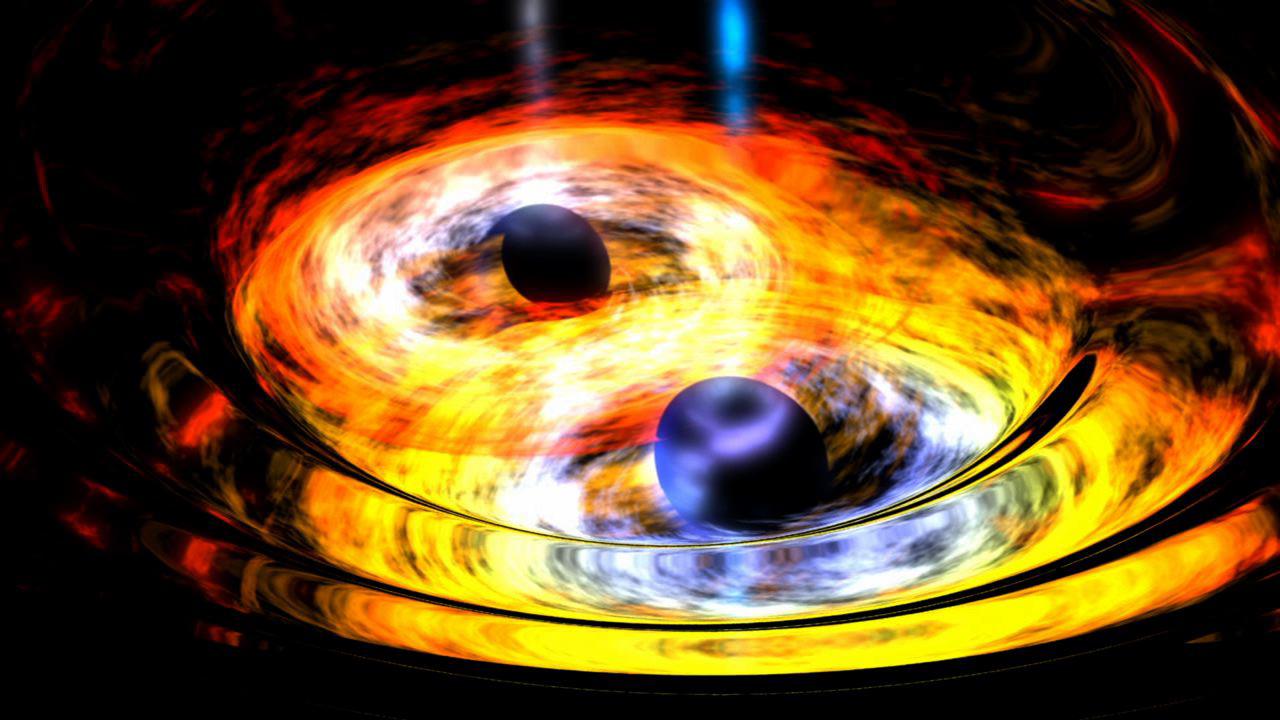
‘AN INTERNATIONAL TEAM of astrophysicists has found evidence that the universe recycles black holes, merging them to form even larger ones. Gravitational waves recorded in recent years show that some of the heaviest black holes within star clusters exhibit clear signs of being “second-generation” black holes—products of past collisions—and therefore could not have originated from the collapse of a massive star.
The evolutionary theory of stars explains that, at the end of the lives of the most massive stars, their cores compress until they form a point so dense that it curves space-time to infinity. This is the classic black hole, with masses 10 to 40 times that of the sun. There are also supermassive black holes in the center of galaxies, with millions or billions of solar masses, whose origin is related to processes that occurred in the earliest moments of the universe.
Between these two extremes lies a contested category: black holes with masses between 40 and 100 solar masses. They are too heavy to be born after the death of a star, but they do not reach the necessary dimensions to emerge from the collapse of a gigantic cloud of matter. Conventional stellar physics considers them “impossible,” yet they appear frequently in detections.
Astrophysicists propose that these massive black holes could form by the merging of two or more smaller, ultradense objects. The idea was plausible, but it needed evidence. Until relatively recently, there was no way to obtain it….’ (Jorge Garay via WIRED)

