
‘Shortly before his death, the physicist Richard Feynman inscribed these legendary words onto a blackboard: “What I cannot create, I do not understand.”
AI researchers have really taken this idea to heart. Since it kicked off in the middle of the last century, the field has sought to recreate the physical processes of the human brain—hence the phrase neural networks. So-called transhumanists have taken this a step further, arguing that human consciousness itself can ultimately be transferred to silicon. Now, a San Francisco startup called Eon Systems is aiming to achieve both goals. Its first major breakthrough? A virtual fly.
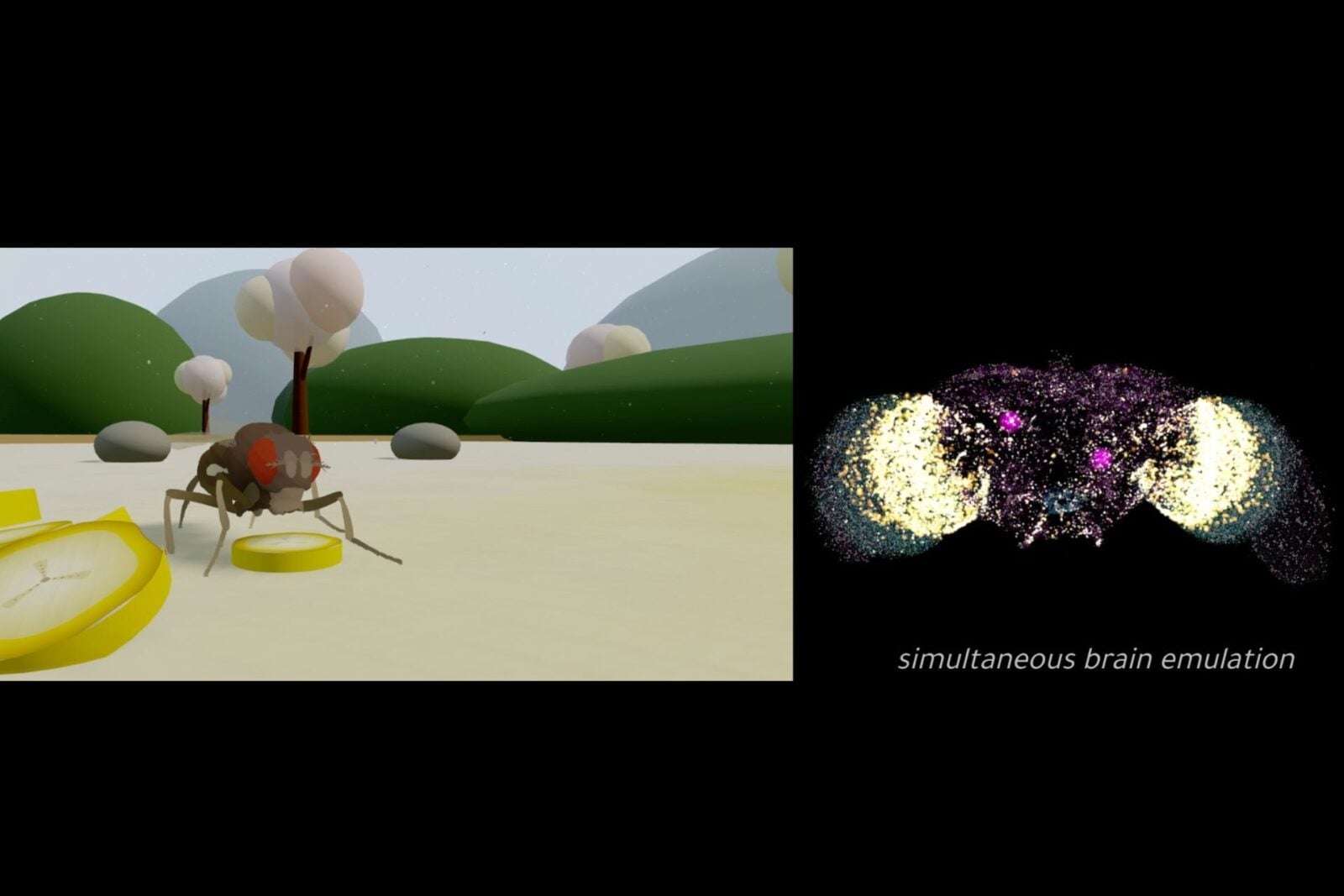
Last month, the company posted a video of a virtual fly scurrying around a Sims-like environment, pausing to wipe some digital dust off its antennae, and moments later arriving in front of some simulated banana slices, which it promptly slurped up. The video went viral, attracting the attention not only of AI researchers and roboticists but also that of the longevity influencer (and mind-uploading enthusiast) Bryan Johnson.
Why all the buzz (terrible pun intended) about a virtual fly? In short, the excitement stems from the technology working behind the scenes: The fly’s “body” is powered by a digital replica of a complete fruit fly connectome—i.e., a complete map of the neuronal pathways within its brain—comprising around 125,000 neurons and 50 million synaptic connections. Constructed using a powerful electron microscope, the digital connectome was paired with an AI algorithm that can match the firing of the virtual neurons to those found in an actual fruit fly brain with an accuracy of 95%, according to Eon.
This is as good as the real thing, according to Alex Wissner-Gross, a computer scientist and Eon’s cofounder: “What you are seeing is not an animation,” Wissner-Gross wrote in a Medium post following the video’s release. “It is not a reinforcement learning policy mimicking biology. It is a copy of a biological brain […] making a body move.”…’ (via Gizmodo)

