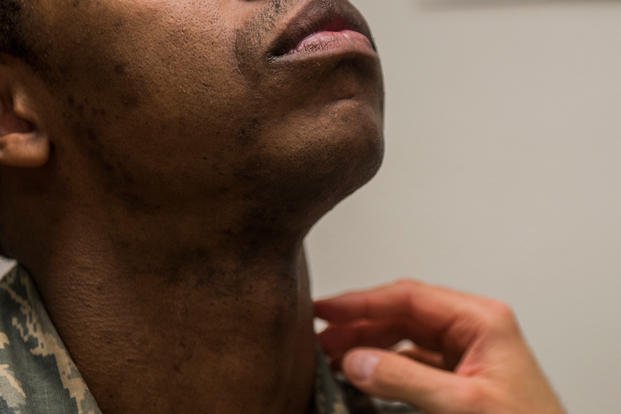
‘The Pentagon has found an efficient way to purge Black service members from the military without saying that’s what they’re doing. As reported by Military Times, Defense Secretary Pete Hegseth announced that troops requiring medical shaving waivers for more than 12 months will face administrative separation—discharged through non-criminal processes. It’s being kicked out, just not for committing a crime. The medical condition is pseudofolliculitis barbae, painful, scarring bumps that occur when curly hair grows back into the skin after shaving. Between 45 and 83 percent of Black men experience this condition, according to the American Osteopathic College of Dermatology. White men with straight hair? Rarely affected.
The only effective treatment is to stop shaving closely. But the military demands clean-shaven faces, even though beards don’t impair combat effectiveness. Thousands of service members—disproportionately Black—have used medical waivers to serve without destroying their skin. Now those waivers are being eliminated. Soldiers can pursue treatment plans that dermatologists confirm don’t work, or they can leave. The American Osteopathic College of Dermatology states what medical professionals have known for decades: you can’t cure pseudofolliculitis barbae by shaving more aggressively.
The military acknowledges PFB as the primary reason for shaving waivers. They know who this policy targets. It ends careers, terminates benefits, and forces out experienced service members—all without calling it punishment. The military frames it as an inability to meet standards, but the result is the same: people lose their jobs because their genetics make shaving dangerous to their health.…’ (Ellsworth Toohey via Boing Boing)