A reprise of my traditional Hallowe’en post of past years:
It is that time of year again. What has become a time of disinhibited hijinx and mayhem, and a growing marketing bonanza for the kitsch-manufacturers and -importers, has primeval origins as the Celtic New Year’s Eve, Samhain (pronounced “sow-en”). The harvest is over, summer ends and winter begins, the Old God dies and returns to the Land of the Dead to await his rebirth at Yule, and the land is cast into darkness. The veil separating the worlds of the living and the dead becomes frayed and thin, and dispossessed dead mingle with the living, perhaps seeking a body to possess for the next year as their only chance to remain connected with the living, who hope to scare them away with ghoulish costumes and behavior, escape their menace by masquerading as one of them, or placate them with offerings of food, in hopes that they will go away before the new year comes. For those prepared, a journey to the other side could be made at this time.
With Christianity, perhaps because with calendar reform it was no longer the last day of the year, All Hallows’ Eve became decathected, a day for innocent masquerading and fun, taking its name Hallowe’en as a contraction and corruption of All Hallows’ Eve.
All Saints’ Day may have originated in its modern form with the 8th century Pope Gregory III. Hallowe’en customs reputedly came to the New World with the Irish immigrants of the 1840’s. The prominence of trick-or-treating has a slightly different origin, however.
The custom of trick-or-treating is thought to have originated not with the Irish Celts, but with a ninth-century European custom called souling. On November 2, All Souls Day, early Christians would walk from village to village begging for “soul cakes,” made out of square pieces of bread with currants. The more soul cakes the beggars would receive, the more prayers they would promise to say on behalf of the dead relatives of the donors. At the time, it was believed that the dead remained in limbo for a time after death, and that prayer, even by strangers, could expedite a soul’s passage to heaven.
English: A traditional Irish turnip Jack-o’-lantern from the early 20th century.
Jack-o’-lanterns were reportedly originally turnips; the Irish began using pumpkins after they immigrated to North America, given how plentiful they were here. The Jack-o-lantern custom probably comes from Irish folklore. As the tale is told, a man named Jack, who was notorious as a drunkard and trickster, tricked Satan into climbing a tree. Jack then carved an image of a cross in the tree’s trunk, trapping the devil up the tree. Jack made a deal with the devil that, if he would never tempt him again, he would promise to let him down the tree.
According to the folk tale, after Jack died, he was denied entrance to Heaven because of his evil ways, but he was also denied access to Hell because he had tricked the devil. Instead, the devil gave him a single ember to light his way through the frigid darkness. The ember was placed inside a hollowed-out turnip to keep it glowing longer.
Nowadays, a reported 99% of cultivated pumpkin sales in the US go for jack-o-lanterns.
Folk traditions that were in the past associated with All Hallows’ Eve took much of their power, as with the New Year’s customs about which I write here every Dec. 31st, from the magic of boundary states, transition, and liminality.
The idea behind ducking, dooking or bobbing for apples seems to have been that snatching a bite from the apple enables the person to grasp good fortune. Samhain is a time for getting rid of weakness, as pagans once slaughtered weak animals which were unlikely to survive the winter. A common ritual calls for writing down weaknesses on a piece of paper or parchment, and tossing it into the fire. There used to be a custom of placing a stone in the hot ashes of the bonfire. If in the morning a person found that the stone had been removed or had cracked, it was a sign of bad fortune. Nuts have been used for divination: whether they burned quietly or exploded indicated good or bad luck. Peeling an apple and throwing the peel over one’s shoulder was supposed to reveal the initial of one’s future spouse. One way of looking for omens of death was for peope to visit churchyards
The Witches’ Sabbath aspect of Hallowe’en seems to result from Germanic influence and fusion with the notion of Walpurgisnacht. (You may be familiar with the magnificent musical evocation of this, Mussorgsky’s Night on Bald Mountain.)
Although probably not yet in a position to shape mainstream American Hallowe’en traditions, Mexican Dia de los Muertos observances have started to contribute some delightful and whimsical iconography to our encounter with the eerie and unearthly as well. As this article in The Smithsonian reviews, ‘In the United States, Halloween is mostly about candy, but elsewhere in the world celebrations honoring the departed have a spiritual meaning…’
Reportedly, more than 80% of American families decorate their homes, at least minimally, for Hallowe’en. What was the holiday like forty or fifty years ago in the U.S. when, bastardized as it has now become with respect to its pagan origins, it retained a much more traditional flair? Before the era of the pay-per-view ’spooky-world’ type haunted attractions and its Martha Stewart yuppification with, as this irreverent Salon article from several years ago [via walker] put it, monogrammed jack-o’-lanterns and the like? One issue may be that, as NPR observed,
‘”Adults have hijacked Halloween… Two in three adults feel Halloween is a holiday for them and not just kids,” Forbes opined in 2012, citing a public relations survey. True that when the holiday was imported from Celtic nations in the mid-19th century — along with a wave of immigrants fleeing Irelands potato famine — it was essentially a younger persons’ game. But a little research reveals that adults have long enjoyed Halloween — right alongside young spooks and spirits.’
Is that necessarily a bad thing? A 1984 essay by Richard Seltzer, frequently referenced in other sources, entitled “Why Bother to Save Hallowe’en?”, argues as I do that reverence for Hallowe’en is good for the soul, young or old.
“Maybe at one time Hallowe’en helped exorcise fears of death and ghosts and goblins by making fun of them. Maybe, too, in a time of rigidly prescribed social behavior, Hallowe’en was the occasion for socially condoned mischief — a time for misrule and letting loose. Although such elements still remain, the emphasis has shifted and the importance of the day and its rituals has actually grown.…(D)on’t just abandon a tradition that you yourself loved as a child, that your own children look forward to months in advance, and that helps preserve our sense of fellowship and community with our neighbors in the midst of all this madness.”
That would be anathema to certain segments of society, however. Hallowe’en certainly inspires a backlash by fundamentalists who consider it a blasphemous abomination. ‘Amateur scholar’ Isaac Bonewits details academically the Hallowe’en errors and lies he feels contribute to its being reviled. Some of the panic over Hallowe’en is akin to the hysteria, fortunately now debunked, over the supposed epidemic of ‘ritual Satanic abuse’ that swept the Western world in the ’90’s.
The horror film has become inextricably linked to Hallowe’en tradition, although the holiday itself did not figure in the movies until John Carpenter took the slasher genre singlehandedly by storm. Googling “scariest films”, you will, grimly, reap a mother lode of opinions about how to pierce the veil to journey to the netherworld and reconnect with that magical, eerie creepiness in the dark (if not the over-the-top blood and gore that has largely replaced the subtlety of earlier horror films).
The Carfax Abbey Horror Films and Movies Database includes best-ever-horror-films lists from Entertainment Weekly, Mr. Showbiz and Hollywood.com. I’ve seen most of these; some of their choices are not that scary, some are just plain silly, and they give extremely short shrift to my real favorites, the evocative classics of the ’30’s and ’40’s when most eeriness was allusive and not explicit. And here’s what claims to be a compilation of links to the darkest and most gruesome sites on the web. “Hours and hours of fun for morbidity lovers.”
Boing Boing does homage to a morbid masterpiece of wretched existential horror, two of the tensest, scariest hours of my life repeated every time I watch it:
‘…The Thing starts. It had been 9 years since The Exorcist scared the living shit out of audiences in New York and sent people fleeing into the street. Really … up the aisle and out the door at full gallop. You would think that people had calmed down a bit since then. No…
The tone of The Thing is one of isolation and dread from the moment it starts. By the time our guys go to the Norwegian outpost and find a monstrous steaming corpse with two merged faces pulling in opposite directions the audience is shifting in their seats. Next comes the dog that splits open with bloody tentacles flying in all directions. The women are covering their eyes….’
Meanwhile, what could be creepier in the movies than the phenomenon of evil children? Gawker knows what shadows lurk in the hearts of the cinematic young:
‘In celebration of Halloween, we took a shallow dive into the horror subgenre of evil-child horror movies. Weird-kid cinema stretches back at least to 1956’s The Bad Seed, and has experienced a resurgence recently via movies like The Babadook, Goodnight Mommy, and Cooties. You could look at this trend as a natural extension of the focus on domesticity seen in horror via the wave of haunted-house movies that 2009’s Paranormal Activity helped usher in. Or maybe we’re just wizening up as a culture and realizing that children are evil and that film is a great way to warn people of this truth. Happy Halloween. Hope you don’t get killed by trick-or-treaters.’
In any case: trick or treat! …And may your Hallowe’en soothe your soul.
‘The Pentagon has found an efficient way to purge Black service members from the military without saying that’s what they’re doing. As reported by Military Times, Defense Secretary Pete Hegseth announced that troops requiring medical shaving waivers for more than 12 months will face administrative separation—discharged through non-criminal processes. It’s being kicked out, just not for committing a crime. The medical condition is pseudofolliculitis barbae, painful, scarring bumps that occur when curly hair grows back into the skin after shaving. Between 45 and 83 percent of Black men experience this condition, according to the American Osteopathic College of Dermatology. White men with straight hair? Rarely affected.
The only effective treatment is to stop shaving closely. But the military demands clean-shaven faces, even though beards don’t impair combat effectiveness. Thousands of service members—disproportionately Black—have used medical waivers to serve without destroying their skin. Now those waivers are being eliminated. Soldiers can pursue treatment plans that dermatologists confirm don’t work, or they can leave. The American Osteopathic College of Dermatology states what medical professionals have known for decades: you can’t cure pseudofolliculitis barbae by shaving more aggressively.
The military acknowledges PFB as the primary reason for shaving waivers. They know who this policy targets. It ends careers, terminates benefits, and forces out experienced service members—all without calling it punishment. The military frames it as an inability to meet standards, but the result is the same: people lose their jobs because their genetics make shaving dangerous to their health.…’ (Ellsworth Toohey via Boing Boing)
‘To understand the threat to democracy, and how it might be stopped, I spoke with experts on election administration, constitutional law, and law enforcement. Many of them are people I have known to be cautious, sober, and not prone to hyperbole. Yet they used words like nightmare and warned that Americans need to be ready for “really wild stuff.” They described a system under attack and reaching a breaking point. They enumerated a long list of concerns about next year’s midterms, but they largely declined to make predictions about the 2028 presidential election. The speed of Trump’s assault on the Constitution has made forecasting difficult, but the 2026 contests—both the way they work, and the results—will help determine whether democracy as we know it will survive until then. “If you are not frightened,” Hannah Fried, the executive director of the voter-access group All Voting Is Local, told me, “you are not paying attention.”’ (David A Graham via The Atlantic)
How to translate “No Kings” energy to actual political power
‘Despite the protests and mass mobilizations of the first Trump term, he was ultimately reelected — with greater support. It leaves a few open questions: just how effective can organized protest be? What can protestors learn since then, and what are the limits to what mass mobilization can do? And how can these movements adapt in the face of an administration that seems eager to wield every power of the state against its perceived enemies?
To answer these questions and more, I spoke with Theda Skocpol, the Victor S. Thomas Professor of Government and Sociology at Harvard University, and a renowned expert on both the history and the nuts-and-bolts of political organizing in the US. And although Skocpol, who is decidedly not a Trump supporter, is optimistic about what the No Kings protests could suggest, she is doggedly focused on what she sees as the ultimate goal of mass protests.…’ (Christian Paz via Vox)
‘A wild, very “polite” and possibly lonely black bear recently paid a visit to its neighbors at a Northern California zoo.
Before opening for the day, staff at Sequoia Park Zoo in Eureka were conducting a routine inspection of the Redwood Sky Walk — a self-guided tour of local redwood history and ecology — when they were surprised by a unique visitor.
On the tour trail was a wild American black bear leaning on a gate to peer in at the three black bears in their habitat within the park…’ (By Karen Garcia via Los Angeles Times)
‘In her eulogy for her brother Steve Jobs, writer Mona Simpson closes with the technology guru’s final words:
Steve’s final words, hours earlier, were monosyllables, repeated three times.
Before embarking, he’d looked at his sister Patty, then for a long time at his children, then at his life’s partner, Laurene, and then over their shoulders past them.
Steve’s final words were:
OH WOW. OH WOW. OH WOW.
When I quickly read through the eulogy yesterday, I assumed that Jobs was referring to his family (and how much he was in awe of them). But Steve Volk pointed out to me that Simpson says he looked at his family and then “over their shoulders past them”. Which made me think – did Steve Jobs experience a death-bed vision?
This would not actually be all that surprising – in the 2009 paper “Comfort for the Dying” (Fenwick et al), researchers found that almost two thirds of doctors, nurses and hospice carers that they surveyed reported witnessing transpersonal end-of-life experiences such as deathbed-visions. And one of the features of these visions is often looking past ‘real’ people in the room at ‘intrusions’ from another realm.…’ —via Daily Grail
‘So here’s what you should keep in mind about surveillance now that you’ve done something deeply un-American by declaring publicly that you don’t support monarchy in the United States.…’ —Mike Pearl via Gizmodo
‘His willingness to bring scientific rigor to Sasquatch studies earned him the gratitude of enthusiasts and the withering scorn of debunkers…’ —Trip Gabriel via New York Times
‘I’m experiencing a ton of fomo over the fact that I don’t live near this mini trinket library. I feel like every single neighborhood needs one of these. Life can be difficult, but opening the door to the trinket library every day and seeing what’s inside seems like its own form of therapy.
The trinket library in the video is called Philly’s tiny treasure spot, and you can find it at 15th & South. The purpose of the project is to spread joy and build community. People are actually participating in good faith — swapping plastic dinosaurs and vintage buttons instead of just stealing everything or leaving their trash. In 2025. In a major American city.…’ —Popkin via Boing Boing
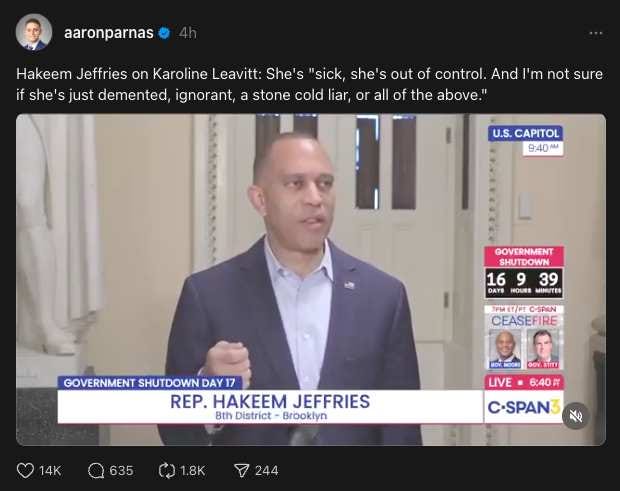
‘After months of deceiving the American people, spewing disdain, and attacking journalists who dare ask probing questions, Karoline Leavitt has surpassed even the awfulness of her predecessors. If Jeffries and other Democrats start attacking her wildly untrue statements, it could reframe the political conversation from “who yells louder” to “who has facts and credibility.” It seems Hakeem is finally adding some “opposition” to “principled opposition.”…’ —Jason Weisberger via Boing Boing
‘This year is a boom time for comets. Not only did we have the interstellar object 3I/ATLAS gracing our skies (and Mars’) earlier this year, but now we have another brand new comet to look out for.
Expected to be at its brightest on October 21, this month you might have the chance to spot the comet Lemmon (C/2025 A6) blazing across the night sky—no telescope or binoculars required…
Conditions are near-perfect to spot this celestial visitor, which won’t appear again in our night sky for another millennium…’ ( via Gizmodo)
‘Just because Donald Trump can dupe half of the United States into thinking he’s a hero doesn’t mean his parlor tricks extend to the rest of the world. Case in point: Trump did not win his coveted Nobel Peace Prize. Instead, it went to Venezuela’s antifascist politician, María Corina Machado.
The Norwegian Nobel Committee describes Machado, Venezuela’s opposition leader who is now in hiding, as a “brave and committed champion of peace” who “keeps the flame of democracy burning during a growing darkness,” according to The Guardian.
And if there is any confusion as to why the vindictive U.S. Department of War commander did not snag the peace prize: “The Nobel Committee clearly chose to highlight democracy as a priority area, underscoring that this award comes at a time of global backsliding of democratic values and norms,” Karim Haggag, director of the Stockholm International Peace Research Institute (SIPRI), told CNN….’ (via Boing Boing)
‘Fungi-made prosthetic device named 79th Organ filters, extracts, and breaks down microplastics inside the human body. The project takes its name from the assumption that the human body has 78 organs today, but in the future, a 79th will be necessary. Designer Odette Dierkx refers to research from 2011 that uncovered plastic-eating mushrooms and imagines their potential use in a future prosthetic organ designed to help humans survive in a plastic-polluted world by 2110. Enters the 79th Organ, which is made from fungi such as the Pleurotus ostreatus (the humble oyster mushroom), bioengineered to make it capable of digesting certain plastics. …’ (via Designboom)
If a devoted and passionate reader you may already know much of this but it will change the way i pick you a book. (Henrik Karlsson via Escaping Flatland)
‘The Desertas petrel, a small agile seabird with long slender wings, seeks out powerful storms to hitch a ride. It darts into the spinning air, reaching areas within 200km (124 miles) of the storm’s eye.
“I can’t imagine the conditions,” says Francesco Ventura, a biologist and postdoctoral investigator at Woods Hole Oceanographic Institution. “These pigeon-sized birds, just a few hundred grams, experience winds up to 100km/h (62mph) and gigantic waves with ocean swells up to 8m (26ft). They’re amidst the storm’s madness.”
After the tropical cyclone passes, Ventura explains, “the birds align their movement along the hurricane’s wake. Now, they ride on the storm’s tail, foraging on creatures churned up from the twilight zone.”…’ ( via BBC)
‘For lovers of cool astronomy and math, this finding is a real treat. Citizen astronomers stumbled upon not one but two rings of extragalactic radio signals crossing each other to form a near-perfect Venn diagram.
A paper published October 2 in Monthly Notices of the Royal Astronomical Society identifies this strangely geometric object as an “odd radio circle” (ORC), vast rings of magnetized plasma. These rings, only visible at radio wavelengths, emit non-thermal synchrotron radiation. They’re also gigantic, typically spanning hundreds of thousands of light-years. Astronomers have only documented a small handful of cases, but this particular pair of rings is reportedly the most distant and most powerful so far.…’ (Gayoung Lee via Gizmodo)
‘According to Einstein’s general theory of relativity, light bends around objects with large masses, such as galaxies. This sometimes causes a phenomenon known as gravitational lensing, which brightens, magnifies, and distorts light from objects behind.
In rare cases, a gravitational lens can even split light passing through it and make it appear multiple times. Such a phenomenon is called an “Einstein’s cross” due to the shape that these split repetitions of light form.
A new Einstein’s cross has recently been observed and described in a scientific paper. The discovery was made by a research team from the Atacama Large Millimeter/Submillimeter Array (ALMA), a space telescope located in northern Chile, using observation data from ALMA and other telescopes. The light of the cross comes from HerS-3, a galaxy located 11.6 billion light years away, with the gravitational lensing being generated by four giant galaxies located between HerS-3 and the Earth. These giant galaxies are located some 7.8 billion light years away.
The gravitational lensing not only splits the light source, but magnifies it, allowing a detailed view of the light source behind the lens. Thanks to this, the team says that HerS-3 appears to be a bright starburst galaxy—a galaxy undergoing explosive star formation—and was formed at a time when star formation was at its peak throughout the universe. HerS-3 also has a tilted, rotating disk, from the center of which gas is gushing out at a furious rate, the team say.…’ —Shigeyuki Hando via WIRED
‘The latest video from Kurzgesagt imagines a scenario in which an advanced civilization called the Noxans can potentially survive the heat death of the universe.
With five hours of the full energy emitted by the Sun, we could power present day humanity for about 10 billion years.
So the Noxans harvest the last stars and build a gigantic complex of batteries around their home star. In principle, this energy could keep them alive for a few hundred trillion years, a long time but not even close to forever.
So now the hard part of the plan begins. The Noxans need to change the nature of life itself.…’ ( via kottke)