

‘The president delivered a campaign-style speech to West Point cadets, touting his election “mandate” and how it “gives us the right to do what we want”…’ Naomi Lachance via Rolling Stone
Daily Archives: 24 May 25
Make This Switch to Eat 90% Less Microplastics

‘One of the best ways to reduce your exposure is by refusing bottled water, which can cut your intake by 90 percent.…’ Sammi Caramela via Vice
Close Reading Is For Everyone

‘Reading, a skill easily taken for granted, is difficult—all the more so when reading literature that wields language as a medium for art. In the wake of Richards’ revelations, scholars in Britain and the United States developed a technique to address our failures. Eventually that technique took the name “close reading,” and it remains the principal methodology of literary studies.
Close reading is untimely. It bristles against today’s universities, which treat students as customers to please and as future workers to train rather than as people in pursuit of human flourishing. Jeff Bezos’ empire—Amazon; Goodreads; Kindle Direct Publishing, which dominates the perfervid world of self-publishing—encourages readers to “talk about a book as if it were just another thing, like a dish, or a product like an electronic device.” Social media compels us to attend to what we’re seeing for as long as it takes to scroll by. Every day, AI produces more of the words we come across, making it hard—maybe impossible—to care about reading them. I’m sure there were college courses this semester where students completed their work with AI and professors graded it with AI, cutting humans from the loop. It’s easy to see why close reading, which demands patience, openness to others, and slow, careful thought, is having a moment among academics.
In January, literary critic John Guillory, emeritus faculty at NYU, well known in the small world of literary studies, published a slim volume, On Close Reading, accompanied by an exhaustive annotated bibliography compiled by Rhodes College professor Scott Newstok that demonstrated that more people are writing about close reading now than ever. Jonathan Kramnick’s Criticism and Truth has garnered disproportionate attention, occasioning roundtables, special sections of journals, and many reviews. Much more, including a volume I co-edited, is forthcoming. After a spell of taking it for granted, academics are rediscovering the quiet excitement of close reading, a relief from the overheated corporate pablum routinely suffocating us.…’ via Defector
Odd Choice for Billionaire Tech Bros:
‘One of the most momentous developments of the new Trump era is how major billionaires in the tech industry — frequently known as the broligarchs — have thrown their weight behind the president. During the 2024 election, they offered high-profile support and made big donations; after the inauguration, they announced new company policies that aligned them with President Donald Trump’s regressive cultural ideologies.Elon Musk had already turned Twitter into a right-wing echo chamber since purchasing it in 2022, and spent several chaotic months earlier this year as Trump’s government efficiency henchman. Jeff Bezos has revamped the Washington Post’s editorial section to build support for “personal liberties and free markets.” Mark Zuckerberg decided to get rid of fact-checkers at Meta.
It was a massive show of power that revealed how possible it is for these wealthy men to remake our culture in their own image, transforming how we speak to each other and what we know to be true. Using that power on Tr*mp’s behalf seems to have paid mixed dividends for Silicon Valley, but it nonetheless makes clear how important it is to understand their worldview and their vision for the future.
Which is why it is striking to note that Musk, Bezos, and Zuckerberg share a favorite author: Iain M. Banks, the Scottish science fiction writer best known for his Culture series. Banks is an odd choice for a bunch of tech billionaires. The author, who died in 2013, was a socialist and avowed hater of the super-rich.
“The Culture series is certainly, in terms of more modern science fiction, one of my absolute favorites,” Bezos told GeekWire in 2018, adding, “there’s a utopian element to it that I find very attractive.” Bezos has attempted twice to adapt the series for TV at Amazon, once in 2018 and again in February. Meanwhile, Zuckerberg picked the Culture novel Player of Games for his book club in 2015.
Banks is an odd choice for a bunch of tech billionaires. The author, who died in 2013, was a socialist and avowed hater of the super-rich.
The most avowed Culture fan among the broligarchs, however, is Musk. Musk has named Space X drone ships after the starships in the Culture books. His original name for the neuralink — a computer chip that can be implanted in human brains, pioneered by his neurotechnology company — was the neural lace, a piece of telepathic technology that Banks came up with in the Culture books. In 2018, Musk declared himself “a utopian anarchist of the kind best described by Iain Banks.” (It’s worth noting that in 2018, Musk was under fire for union busting but had not yet waded so far into national politics or declared public war against the “woke mind virus.”)
Plenty of us like and even identify with pieces of pop culture whose politics we don’t entirely agree with, like the libertarian Little House on the Prairie books or the Christian Chronicles of Narnia. Still, the Banks Culture series, which consists of 10 books released between 1987 and 2012, is not politically coded so much as it is downright didactic. “The Culture is hippy commies with hyper-weapons and a deep distrust of both Marketolatry and Greedism,” Banks said in an interview with Strange Horizons in 2010, in a line that’s only barely more explicit than the books themselves…’ Constance Grady via Vox
The Scourge of Nonsensical Corporate Jargon
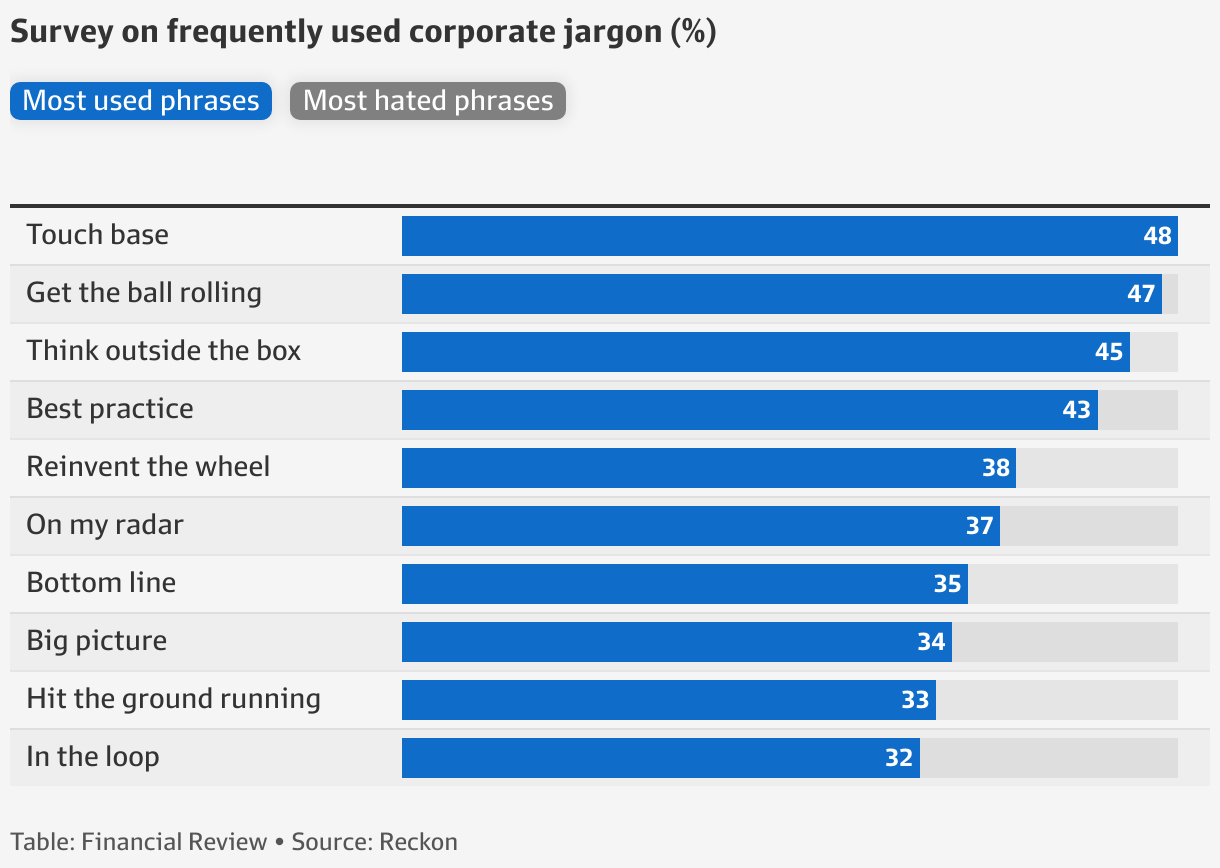
‘[Corporate jargon] has evolved into a whole dictionary of phrases that mean pretty much nothing, but it does pad the conversation out. We are inundated with corporate jargon that is designed to be vague and noncommittal, often as a way to give plausible deniability or else cover the fact that your supervisor just doesn’t know what he’s talking about. Master a good amount of corporate jargon, and you can talk for hours and still not say anything useful.
Linguist Dr. Erica Brozovsky explains how this language evolved from regular workplace talk, and why it is so frustrating whether you understand it or not.…’ Rommel Santor via Neatorama
