
‘In Japan’s stormy summer of 1983, Ikuo Ishiyama couldn’t stop thinking about a chilling pattern among his patients. They were dead, but that wasn’t what troubled him. As a specialist in forensic medicine at Tokyo University, Ishiyama was accustomed to seeing dead bodies. However, these victims—numbering in the hundreds—shared a similar demise. “The symptoms are the same,” he told the Los Angeles Times. “Young men without medical problems are essentially dying in the same way, without warning.” What way was that? That may be the most mysterious detail: All of the victims died in their sleep.
Ishiyama’s concern grew when he heard about similar deaths halfway around the world, in the Midwestern and Western United States. There, they called it “nocturnal death syndrome,” but the circumstances were just as unsettling. “They passed away in the early hours of the morning,” the science journalist Alice Robb wrote in her book Why We Dream, “lying on their backs, with looks of horror in their eyes.” To this day, their exact cause of death is a mystery. But one University of Arizona anthropologist, who spent a decade studying the phenomenon, argued the victims suffered cardiac arrest due to what Robb describes as “stress, biology, and sheer terror.”
Were they victims of their nightmares?…’ (via Atlas Obscura )
Daily Archives: 4 Nov 24
‘May You Live in Interesting Times’
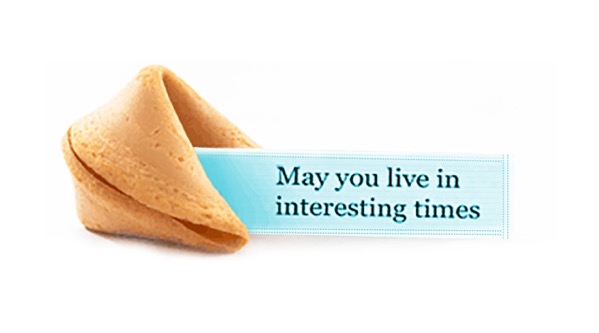
‘There are certain things you can say that can be a blessing or a curse at the same time, like when I would tell my kids, “May you have children just like you!” usually when I was angry. It’s the same with the phrase “May you live in interesting times.” I hadn’t thought much of it, but in the back of my mind I thought that was something Mr. Spock said on Star Trek. In that I may have been a victim of the Mandela effect. It was said in the Star Trek Universe, but by Harry Kim on the show Voyager, in the episode “The Cloud” from 1995. So where did I know it from, and where did the saying originally come from?
Robert F. Kennedy used the phrase in a speech in 1966, and attributed it to an old Chinese curse. From there, it was quoted by many memorable people. But Kennedy was not the first documented use of the phrase, and it may be much older -and it’s not an old Chinese curse. Read what we know about the history of “May you live in interesting times” at Mental Floss….’ (via Neatorama)
What was the most popular candy in your state?
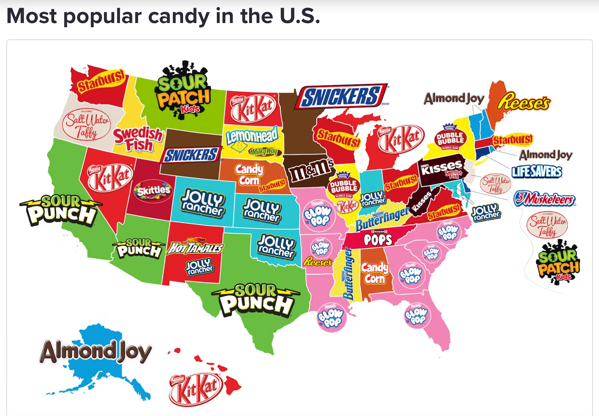
‘Hopefully you’re all recovering from the candy comas you might have slipped into after eating too much candy on Halloween. Judging from your (or your kids’) candy hauls, do you think you could guess the most popular candy in your state? …Innerbody analyzed Google Trends search data over a year to identify the most popular candy in each state….
Here are some highlights from their findings:
- Dubble Bubble Gum was the least popular candy in the U.S. by far in 44 states.
- 28 states showed no interest in Dubble Bubble Gum and at least one other type of candy.
- Charms Blow Pops and Jolly Ranchers were tied for the type of candy of greatest interest to the most states (seven).
- In second place was Starburst (six states), Kit Kat (five states) stole third place, and Almond Joy (four states) was our runner-up.
- With the highest combined search value (1,508), Utah is the most candy-loving state.
- Alaska, with the lowest combined search value (616), loved (or at least searched for) candy the least…’ (via Boing Boing)
