
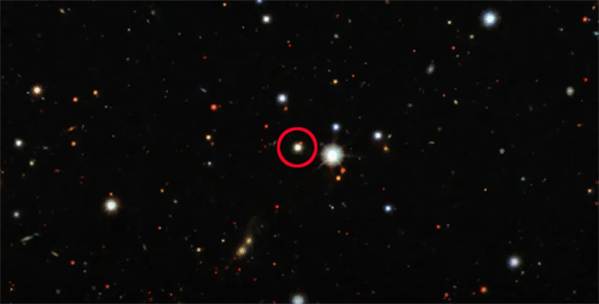
‘…It’s a quasar – the bright core of a galaxy that is powered by a gargantuan black hole some 17 billion times the mass of our Sun. Known as J0529-4351, the object’s power was confirmed in observations by the Very Large Telescope in Chile.
Scientists, reporting in the journal Nature Astronomy, say the black hole has a voracious appetite, consuming the mass equivalent to one Sun every day.
J0529-4351 was actually recorded in data many years ago but its true glory has only just been recognised.
“We have discovered an object which has previously not been recognised for what it is; it’s been staring into our eyes for many years because it’s been glowing at its brightness for longer than humankind has probably existed. But we’ve now recognised it, not as being one of the many foreground stars in our Milky Way but as a very distant object,” Christian Wolf, from the Australian National University (ANU), told BBC News.
The term quasar is used by astronomers to describe a particular type of AGN, or Active Galactic Nucleus. It’s the very energetic core of a galaxy which is being powered by an immense black hole that’s pulling matter towards itself at a prodigious rate. As this material is accelerated around the hole, it is torn apart and emits a huge amount of light, so much so that even an object as distant as J0529-4351 is still visible to us. This quasar’s emission has taken a staggering 12 billion years to reach the detectors at the VLT.
Everything about the object is astonishing.
The scientists involved say the energy emitted makes the quasar over 500 trillion times more luminous than the Sun….’ (BBC)
Daily Archives: 20 Feb 24
Venus/Mars Conjunction
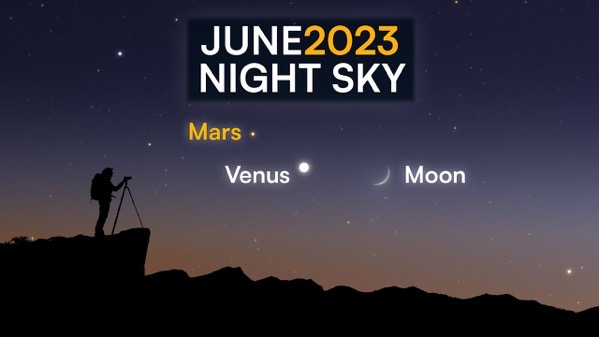
‘There is a Venus/Mars conjunction happening in the sky and you can see it basically any morning for the next 3 mornings. (It’s only a true conjunction on Friday 23 Australia time, but it’s probably easier to see the day before/after, the Thursday and Saturday. That’s Weds & Friday for most of the world.) Anyway this is mainly an excuse to tell you some great facts I’ve been hoarding about Venus. But first: conjunction details. It’s neat because Venus and Mars are both bright, so it’s an astronomical event you can see with the naked eye even with bad light pollution. It’s best seen 30-60 minutes before sunrise (between “astronomical twilight” and “nautical twilight” if your weather app gives you those times). Look for Venus in the east (it’s the brightest ‘star’ in the sky) and then see Mars next to it, smaller and redder. If you have a lot of obstacles on your horizon, you’ll want to look closer to sunrise, when Venus and Mars are higher in the sky – but not so close to sunrise that the sky’s too bright to see stars…’ ((The Whippet )
