That Feeling When You Walk Down a Dark Street and Meet a Jellyfish

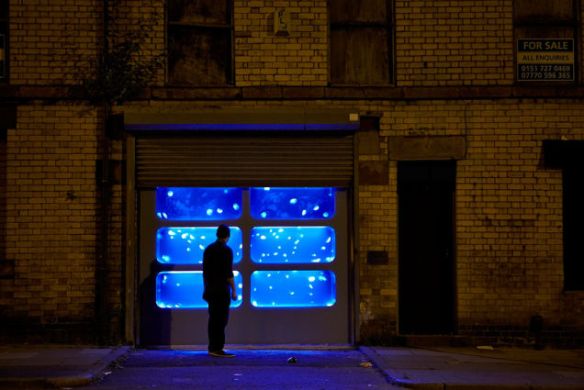
Via io9, ‘ Every night, at 10 pm, something mystical happens at a derelict building in Liverpool. The storefront shutter opens, revealing a massive, ethereal water tank filled with live jellyfish.

The installation, created by the artistic duo Walter Hugo & Zoniel, is called “The Physical Possibility of Inspiring Imagination in the Mind of Someone Living.” Although its part of the Liverpool Biennial—the largest contemporary art festival in the UK—the artists didnt promote or even announce the exhibit. It just quietly appeared one evening, in order to allow the random passerby to experience the surreal encounter with fresh eyes.

The installation will be on display until July 27. And, if you dont happen to find yourself wandering the streets of Liverpool late at night, you can watch video recordings of streamed footage…’

 

So Just Swallow!

Via io9, ‘You Have a Painkiller Six Times Stronger Than Morphine In Your SalivaRight now, you are walking around with a mouth full of extremely powerful, untested pharmaceuticals. Your saliva contains opiorphin, a painkiller thats about six times more powerful than morphine.

After so many decades spent prodding lab rats, one would think that there is nothing more to be discovered about the horrid little things, or how they relate to humans. One would be wrong. What a fool one is! In the early 2000s, scientists discovered that rat saliva contains sialorphin, a powerful painkiller. Rats are, in many ways, analogous to humans. Researchers began wondering if human saliva contained its own painkilling compound.

Enter opiorphin, a painkiller that seems to be both very effective and very simple. It works by preventing the breakdown of little chemicals called enkephalins. These chemicals stimulate the bodys opiate receptors, which block pain signals. Liberal application of opiorphin keeps the bodys own pain-blocking system going. Why such a powerful pain-killer is in saliva is up for debate…


Don’t We Learn Anything??


PINE WARBLER (Dendroica pinus).

Via National Geographic: ‘Second Silent Spring? Bird Declines Linked to Popular Pesticides.

Pesticides don’t just kill pests. New research out of the Netherlands provides compelling evidence linking a widely used class of insecticides to population declines across 14 species of birds.

This new paper, published online Wednesday in Nature, gets at another angle of the story—the way these chemicals can indirectly affect other creatures in the ecosystem.Those insecticides, called neonicotinoids, have been in the news lately due to the way they hurt bees and other pollinators. (Related: “The Plight of the Honeybee.”) ‘


How Hot Your City Could Be By 2100 If Climate Change Goes Unchecked


Via Gizmodo, ‘Its a sorry truth that hits you mid-July: Average summer temperatures have been rising since the 1970s. If we continue down this path, according to a new study by Climate Central, in 2100, summers in Boston will feel more like sticky Miami—and summers in Miami will feel like toasty Harlingen, Texas.

Simply type where you live into the chart… and youll get an instant comparison between the average summer high temperature in your city today and the city your home is more likely to feel like in 86 years. If greenhouse gasses and climate change keep chugging along at the rates they are right now, anyway. Its more of a fun thought experiment than an exact science.

It’s surprising to see not only the temperature increase but the comparison city. San Diego average high 78.17 degrees will only be as warm as Lexington, Kentucky 84.61. But Fargo average high 80.24 degrees will warm by over 12 degrees by 2100, making it feel more like Tyler, Texas 92.08. In fact, most American cities will end up feeling like somewhere in Texas or Florida by 2100.Type in Las Vegas, however, and theres no American comparison. Youll be shuttled halfway around the world to Riyadh, Saudi Arabia, where the average summer high is a balmy 111 degrees.

This map cant tell the future though. This is only a prediction based only on current trends—if greenhouse gas emissions continue to increase at the rate that they have been increasing since the 1970s. Even though this map shows a very dystopian future, its one that we can hopefully avoid.’