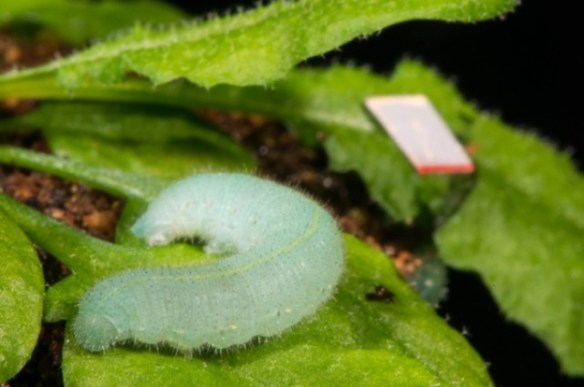
‘A small, flowering plant called Arabidopsis thaliana can hear the vibrations that caterpillars trigger when they chew on its leaves. According to a new study, the plants can hear danger loud and clear, and they respond by launching a chemical defense.
From anecdotes and previous studies, we know that plants respond to wind, touch, and acoustic energy. “The field is somewhat haunted by its history of playing music to plants. That sort of stimulus is so divorced from the natural ecology of plants that it’s very difficult to interpret any plant responses,” says Rex Cocroft from the University of Missouri, Columbia. “We’re trying to think about the plant’s acoustical environment and what it might be listening for.” ‘ (IFLScience).
Daily Archives: 4 Jul 14
Tiny Blood-Slurping Bird Terrorizes the Galapagos
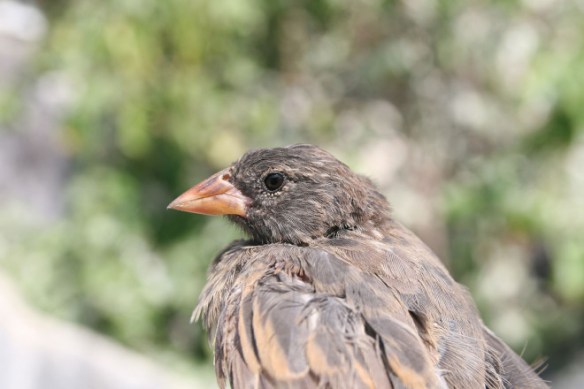
If a vampire bird looks at you like this and you’re for some reason dressed up like a bird, flee immediately.
‘Wolf Island, an often brutally dry rock in the [Galapagos] archipelago, is ruled by vampires—hordes and hordes of tiny vampires. These are the so-called vampire finches, enterprising critters in a brutal environment that have figured out how to nip at the tail feathers of other birds until they draw blood, somehow without their victim putting up much of a fight. Even though they don’t sparkle or battle werewolves or whatever, they’re marvels among the many marvels that are the famed Darwin’s finches.’ (Wired)
Dick Cheney’s demented last laugh

Lindsey Graham, John McCain, William Kristol
‘Neoconservatives destroyed American exceptionalism, but made Obama collateral damage… This July 4, we know our foreign policy must change after the neocons Iraq disaster. Lets take the right lessons.’ (Salon).
Researchers May Have Discovered The Consciousness On/Off Switch
‘Researchers from the George Washington University have managed to switch consciousness on and off in an epileptic woman by stimulating a single region of the brain with electrical impulses. While this is a single case study, it provides an exciting insight into the neural mechanisms behind consciousness, a subject of great interest that is poorly understood despite decades of research. The study has been published in Epilepsy & Behavior.’ (IFLScience).

Ecuadors “Superleaf” Tea

ilex guayusa
Could It Replace Your Afternoon Coffee? ‘Guayusa reportedly has health benefits for those who drink it as a brew and economic benefits for the indigenous people who grow it.’ (Nat Geo).
Read Boing Boing? The NSA considers you a deep surveillance target

‘The NSA says it only banks the communications of “targeted” individuals. Guess what? If you read Boing Boing, youve been targeted. Cory Doctorow digs into Xkeyscore and the NSAs deep packet inspection rules.’ (Boing Boing). If you click on the link, one bonus is that you get to say hello to my friends at the Puzzle Palace.
Worst Ebola Outbreak Ever

The current outbreak has been overwhelming in terms of both magnitude — more than 500 victims so far — and extent, encompassing parts of three West African nations. Part of the problem is that people who suspect they are affected have noticed that no one who goes into quarantine comes out alive, so they have fled and disseminated the disease much further. No end in sight. (CDC).
Related articles


The Invention Of The Letter G
The American Heritage Guide to Contemporary Usage and Style tells the story of just how G secured its spot in the alphabet — and how it also changed the position of where we find some of our other letters in the alphabet:
The earliest form of the Roman alphabet had no letter g. Instead, c could represent both the sound g and the sound k. The Roman letter c was in fact a development of the Greek letter gamma. This is why c, not g, still occupies the place in the Roman alphabet corresponding to gamma in the Greek alphabet, even thought the sounds of gamma and g might seem to correspond better than gamma and c from a modern point of view. In order to to make the distinction between g and k clear in writing, the Romans developed the letter g by the addition of a small stroke to c. The Greek historian Plutarch ascribes the invention of g to a Roman named Spurius Carvilius Ruga, who lived in the 3rd century BC. The new letter g was given the place corresponding to the letter z zeta in the Greek alphabet, since zeta was not used to write native Latin words. When the Romans later began to use the letter z again, it was added to the very end of the alphabet, the place it still holds today.