Social media is making us anxious and paranoid…

So why can’t we stop using it? ‘In my research I have found that social software may inadvertently promote inequality rather than countering it. Metrics, like follower count or number of “likes” on a photo, facilitate this process by rendering social status into something that can be quantified, qualified, and publicized.

The process of what I call “digital instantiation” works similarly toward quantification, qualification, and publicity by rendering users’ lives in piecemeal fashion, unintentionally creating a whole that is larger than the sum of its parts. Social media tools digitize formerly ephemeral pieces of information, like what one had for breakfast, making it possible to create a bigger picture of a person or community’s actions. Once “breakfast” is captured in a Foursquare check-in or Instagram photo, it can be combined, searched, or aggregated with other pieces of information to create mental models of actions, beliefs, and activities. Within this context, social surveillance, or the monitoring of friends’ and peers’ digital information, becomes normal.

While lifestreaming has plenty of social and emotional benefits, it also comes with costs. Lifestreamers must see themselves through the gaze of others, altering their behavior as needed to maintain their desired self-presentation. This constant monitoring against the backdrop of a networked audience creates anxiety and encourages jockeying for status, even as it brings forth new forms of social information.’ (Medium).

Was humanitarian intervention just a passing fad?

‘During the 1990s, a previously little-known concept rapidly became the hottest term in international relations. “Humanitarian intervention”—at its simplest, the use of military force to protect human rights—established itself in the political lexicon following a series of brutal conflicts in Africa and the Balkans.

As with most political concepts, humanitarian intervention became voguish thanks to circumstances. The Soviet Union had collapsed. We hadn’t fully grasped the threat posed by Islamist terrorism. With the expulsion of Saddam Hussein from Kuwait and the relative success of the Israel-Palestinian peace process, even the Middle East seemed uncommonly stable.

Most important, there was an acute awareness in Western countries that our impressive military strength hadn’t deterred some of the worst slaughters of the 20th century. For around 14 weeks in 1994, Rwanda was the site of the most rapacious extermination since the Holocaust, with more than 800,000 Tutsis and moderate Hutus murdered by machete-wielding Hutu extremists. Between 1992 and 1995, the war in Bosnia spawned countless atrocities, such as the massacre of more than 8,000 Muslim men and boys by Serb forces in the town of Srebrenica. To many—especially American Jews—it seemed that these failures showed the hollowness of oft-repeated promises of “never again.”

Humanitarian intervention was the response to these failures. When the United States and the United Kingdom led a “coalition of the willing” to stop the Serb onslaught in Kosovo in 1999—supported by an ideologically broad coalition of liberal internationalists and neoconservatives—it wasn’t to pursue a strategic interest but to arrest yet another episode of ethnic cleansing on European soil. Similarly, when the British intervened in Sierra Leone’s civil war in 2000, the sole purpose was to prevent drug-addled paramilitaries controlled by a psychopath named Foday Sankoh from hacking off the limbs of young children.

The images of those wars—the long columns of refugees, the mass graves, the flowers and candy and cheers that greeted the liberating foreign armies—all seem very distant now. The combined experiences of Iraq and Afghanistan have persuaded many Westerners that any kind of military action, even when it’s undertaken in the defense of basic human rights, is just plain wrong—morally, politically, and strategically.

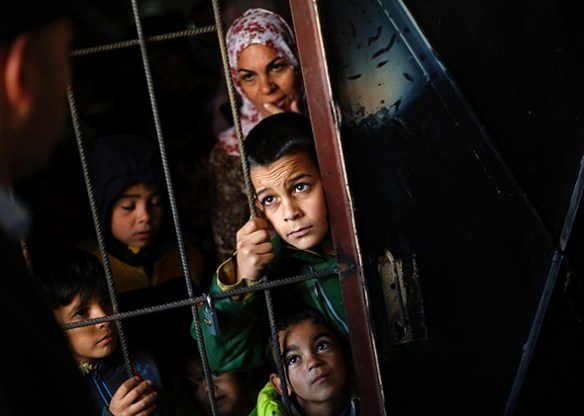
Thus do we come to the debacle in Syria. Once Syrian President Bashar al-Assad unleashed chemical weapons against his own people, Western policymakers were confronted with a textbook case for humanitarian intervention. In a different context, they might have acted. But there was little domestic backing, even from those who had spoken strongly in the 1990s of “never again.” This lack of support was one critical reason America and its allies caved under Russian pressure, calling off planned air strikes in favor of a dubious diplomatic process guided by Moscow.

Was humanitarian intervention just a passing fad, or can it be resuscitated? Can we ever reach agreement among both liberals and conservatives that military action in defense of human rights is sometimes justified, or are we fated to remain polarized, to the detriment of those under the boot of tyrannical regimes?’ (Slate)