(Boing Boing).

(Boing Boing).

‘If I had a chauffeur, I’d want it to be Tom Vanderbilt. I have no idea if Tom is a good driver, but he has a wealth of compelling, curious, and provocative knowledge about the psychology and science of our lives behind the wheel. He’s the author of the bestselling book Traffic: Why We Drive The Way We Do (And What It Says About Us) that has enlightened everyone from transportation policy groups to road safety consortiums to those of us who just insist that no matter what lane we’re in, the other one is moving faster. Tom gave a fantastic talk at Boing Boing: Ingenuity, our theatrical experience last month in San Francisco, where he imparted wisdom on late merging, the demographics of honking, and highway hypnosis.’ (Boing Boing).

The Meaning of the Loss of Darkness: ‘For Earth’s first 4 billion years of existence, light and dark followed a predictable 24-hour cycle. Across an ever-increasing amount of Earth’s surface, that’s no longer the case. With the advent of artificial lighting came the ability to transform night — inside buildings, under streetlights and neon signs, and in those vast areas where night’s simply not so dark as it used to be.
For journalist Paul Bogard, author of The End of Night: Searching for Darkness in an Age of Artificial Light, one such place his family’s lakeside camp in rural Minnesota. Thirty years ago the nights were pitch-black, the starscapes incandescent. Now there’s a glow at the edge of the horizon, a growing dullness to the stars.“That firsthand experience of a child, standing out on a dock and staring at the Milky Way, stays with you,” said Bogard. “That’s one of the biggest things we’re losing, or have lost, for our kids. More and more people have no idea what it’s like.
”It’s not only lost starscapes that he laments, but darkness itself. WIRED talked to Bogard about what this could mean for humanity’s existential and even physical health.’ (Wired Science).
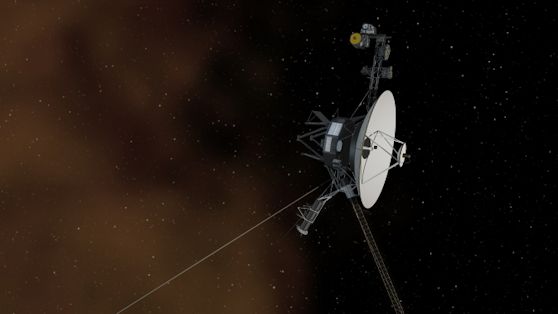
‘NASA’s Voyager 1 spacecraft officially is the first human-made object to venture into interstellar space. The 36-year-old probe is about 12 billion miles (19 billion kilometers) from our sun.
New and unexpected data indicate Voyager 1 has been traveling for about one year through plasma, or ionized gas, present in the space between stars. Voyager is in a transitional region immediately outside the solar bubble, where some effects from our sun are still evident. A report on the analysis of this new data, an effort led by Don Gurnett and the plasma wave science team at the University of Iowa, Iowa City, is published in Thursday’s edition of the journal Science.’ (NASA Science).