This map displays key sites and potential U.S. targets. (The Daily Beast)
Monthly Archives: August 2013
Scientists Grow Human Brain From Stem Cells
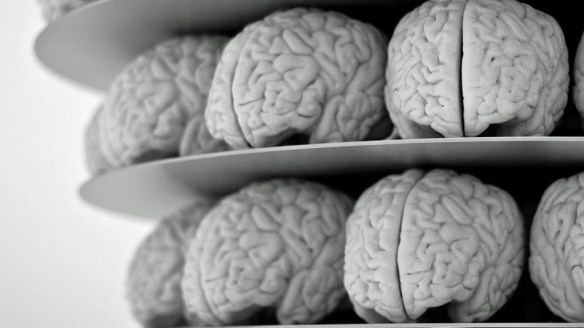
‘Ear, eye, liver, windpipe, bladder and even a heart. The list of body parts grown from stem cells is getting longer and longer. Now add to it one of the most complex organs: the brain.A team of European scientists has grown parts of a human brain in tissue culture from stem cells. Their work could help scientists understand the origins of schizophrenia or autism and lead to drugs to treat them, said Juergen Knoblich, deputy scientific director at the Institute of Molecular Biotechnology of the Austrian Academy of Sciences and one of the papers co-authors.The advance could also eliminate the need for conducting experiments on animals, whose brains are not a perfect model for humans.’ (Mashable).
Bradley Manning comes out as transgender
‘ “As I transition into this next phase of my life, I want everyone to know the real me,” Manning said. “I am Chelsea Manning. I am a female. Given the way that I feel, and have felt since childhood, I want to begin hormone therapy as soon as possible.’ (Washington Post).
How many uncontacted tribes are left in the world?
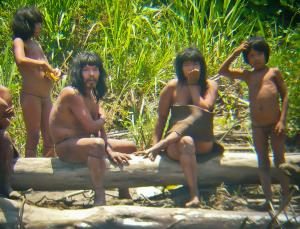
How many uncontacted tribes are still left? Have they really had no contact with the outside world? Are there guidelines for how best to approach such tribes? Why would tribes choose to end their isolation? (New Scientist).
» Pardon Bradley Manning
‘Starkly showcasing the US government officials’ misplaced priorities when it comes to human rights, whistleblower and Nobel Peace Prize nominee Bradley Manning was sentenced to 35 years in prison. The information that Bradley gave to the public exposed the unjust detainment of innocent people at Guantanamo Bay, the true human cost of our wars in Iraq and Afghanistan, and forever changed investigative journalism. There is no evidence that anyone was harmed as a result of the information exposed.Join Amnesty International and the Bradley Manning Support Network in signing a petition to President Obama, demanding that Bradley Manning be given clemency and be released immediately. After having been tortured and abused at Quantico prison for 9 months where he was held in solitary confinement against the recommendations of every health professional who assessed him, and after having already spent more than 1190 days in prison more than 3 years confinement before the trial even began, Bradley Manning should be set free! Uphold your promise Obama: protect whistleblowers!’ Sign the petition and show your support! (Bradley Manning Support Network).
This Optical Illusion Lets You See Your Own Brain Waves
‘The pinwheel-like drawing above is nothing but black and white lines. When you look at it the right way, though, something strange and beautiful happens: it begins to flicker. You may think it’s just a regular old optical illusion at first, but actually, you’re looking at your very own brain waves.
To see the optical illusion takes a little bit of work. Look at the pinwheel shape and then stare at a spot that’s just a few inches away from it. When the pinwheel is in your peripheral vision, you should start to see the center flicker, kind of like a really bright star does. The effect also works as an afterimage. So once you find a spot that gets the flicker going, stare at it for about a minute and then look at a blank white wall. You’ll see the inverse image of the pinwheel, flicker and all.’ (Gizmodo).

US doesn’t know what Snowden took, sources say
‘Officials, including NSA Director Keith Alexander, have assured the public that the government knows the scope of the damage, but two separate sources briefed on the matter told NBC News that the NSA has been unable to determine how many documents he took and what they are.’ (NBC Investigations).

Birds are aware of speed limits on roads
‘Birds cannot read road signs, but they know that some roads have higher speed limits than others. They will take off further away from an approaching car on a faster road than on a slower road – regardless of the speed of the car.’ (New Scientist).

Suicide risk could show up in a blood test
‘Could a blood test predict whether a person is at risk of committing suicide? For the first time, a set of proteins in the blood have been linked to suicidal behaviour. People who commit suicide appear to share a number of biological traits, regardless of any underlying conditions. This hints that suicidal behaviour may be a distinct disorder.
To investigate, Alexander Niculescu of Indiana University in Indianapolis and colleagues collected blood from the cadavers of nine men who had bipolar disorder and suicidal tendencies, and nine with bipolar but no suicidal thoughts, and compared levels of all the genes expressed in their blood.
Four genes were expressed at significantly higher levels in the blood of people who had been suicidal. Some proteins that these genes code for are known to be involved in stress and cell death.’ (New Scientist).

The Comforts of the Apocalypse

‘For some, it is a short mental step from “my end is imminent” to “the end of everything is imminent.” Call it apocalyptic narcissism.’ (The Chronicle Review)
R.I.P. Cedar Walton
Pianist and Composer Dies at 79: ‘Cedar Walton, a pianist who distinguished himself as both an accompanist and a soloist, and who wrote some of the most enduring compositions in modern jazz while a member of Art Blakey’s Jazz Messengers in the early 1960s, died on Monday at his home in Brooklyn. He was 79.’ (NYTimes.com obituary)

Book-writing moratorium
Colin Robinson’s advice for the 81% of Americans who believe they have a book in them: Don’t let it out!. (The Guardian)
New Carnivore Discovered, Rare With Teddy Bear Looks
‘A fuzzy, fog-dwelling mammal is the first carnivore found in the Western Hemisphere in three decades, a new study says.’ (National Geographic).

10 Places You’re Prohibited From Seeing on Google Maps

Afflicting Computers with Schizophrenia
‘Computer networks that can’t forget fast enough can show symptoms of a kind of virtual schizophrenia, giving researchers further clues to the inner workings of schizophrenic brains, researchers at The University of Texas at Austin and Yale University have found.
The researchers used a virtual computer model, or “neural network,” to simulate the excessive release of dopamine in the brain. They found that the network recalled memories in a distinctly schizophrenic-like fashion.
Their results were published in April in Biological Psychiatry.
“The hypothesis is that dopamine encodes the importance — the salience — of experience,” says Uli Grasemann, a graduate student in the Department of Computer Science at The University of Texas at Austin. “When there’s too much dopamine, it leads to exaggerated salience, and the brain ends up learning from things that it shouldn’t be learning from.”
The results bolster a hypothesis known in schizophrenia circles as the hyperlearning hypothesis, which posits that people suffering from schizophrenia have brains that lose the ability to forget or ignore as much as they normally would. Without forgetting, they lose the ability to extract what’s meaningful out of the immensity of stimuli the brain encounters. They start making connections that aren’t real, or drowning in a sea of so many connections they lose the ability to stitch together any kind of coherent story.’ (University of Texas News).

Related?
- Impaired visual signals might contribute to schizophrenia symptoms (sciencedaily.com)
- Simple Ramblings (schizophrenicmath.wordpress.com)
- Druggability: A Philosophical Investigation (pipeline.corante.com)
Give Up the Ghost
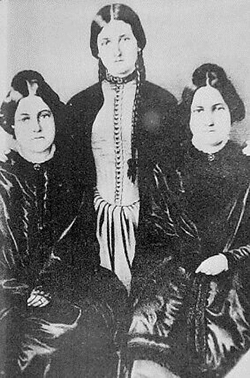
What was behind the sudden boom of apparitions in late 19th century America? (The Smart Set).
Living With Less. A Lot Less.
‘I like material things as much as anyone. I studied product design in school. I’m into gadgets, clothing and all kinds of things. But my experiences show that after a certain point, material objects have a tendency to crowd out the emotional needs they are meant to support.
I wouldn’t trade a second spent wandering the streets of Bangkok with Olga for anything I’ve owned. Often, material objects take up mental as well as physical space.
I’m still a serial entrepreneur, and my latest venture is to design thoughtfully constructed small homes that support our lives, not the other way around. Like the 420-square-foot space I live in, the houses I design contain less stuff and make it easier for owners to live within their means and to limit their environmental footprint. My apartment sleeps four people comfortably; I frequently have dinner parties for 12. My space is well-built, affordable and as functional as living spaces twice the size. As the guy who started TreeHugger.com, I sleep better knowing I’m not using more resources than I need. I have less — and enjoy more.’ — Graham Hill (NYTimes.com).


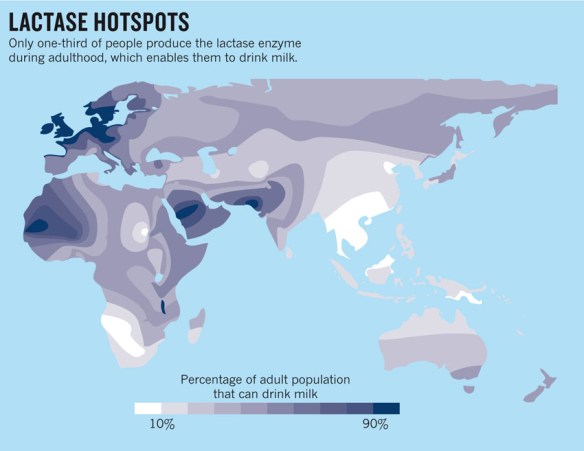
The milk revolution
‘During the most recent ice age, milk was essentially a toxin to adults because — unlike children — they could not produce the lactase enzyme required to break down lactose, the main sugar in milk. But as farming started to replace hunting and gathering in the Middle East around 11,000 years ago, cattle herders learned how to reduce lactose in dairy products to tolerable levels by fermenting milk to make cheese or yogurt. Several thousand years later, a genetic mutation spread through Europe that gave people the ability to produce lactase — and drink milk — throughout their lives. That adaptation opened up a rich new source of nutrition that could have sustained communities when harvests failed.
This two-step milk revolution may have been a prime factor in allowing bands of farmers and herders from the south to sweep through Europe and displace the hunter-gatherer cultures that had lived there for millennia. “They spread really rapidly into northern Europe from an archaeological point of view,” says Mark Thomas, a population geneticist at University College London. That wave of emigration left an enduring imprint on Europe, where, unlike in many regions of the world, most people can now tolerate milk. “It could be that a large proportion of Europeans are descended from the first lactase-persistent dairy farmers in Europe,” says Thomas.’ (Nature News & Comment).
Related articles


Aspergers and Autism: Brain Differences Found

Major brain structures implicated in autism. (Photo credit: Wikipedia)
‘Children with Asperger’s syndrome show patterns of brain connectivity distinct from those of children with autism, according to a new study. The findings suggest the two conditions, which are now in one category in the new psychiatry diagnostic manual, may be biologically different.
The researchers used electroencephalography (EEG) recordings to measure the amount of signaling occurring between brain areas in children. They had previously used this measure of brain connectivity to develop a test that could distinguish between children with autism and normally developing children.’ (LiveScience)
Trivial finding, consistent with the new pseudo neuroscience. Of course differences are found, as individuals with Asperger’s and autism function very very differently. Tell me something I don’t know. (“Information can be defined as a difference that makes a difference…” — Gregory Bateson)
Related:
- Autism Information- Few Essential Facts About Autism (helpthemshine.wordpress.com)
- Fresh fuel reignites Asperger’s debate (sciencedaily.com)
- Fresh fuel reignites Asperger’s debate (medicalnewstoday.com)
- Review: The Shadow Constant (nrgallowaymiller24.wordpress.com)
- Autism May Be Caused By Maternal Antibodies that Target the Fetus (scienceworldreport.com)
- Asperger’s and Creativity (blogs.psychcentral.com)
- Asperger Syndrome Part 2 (revdoc1.wordpress.com)
The NYT can spend multiple paragraphs avoiding quoting a naughty word
‘

Yes, this is old, but it’s on Twitter again today, so it’s new enough: Joe Coscarelli’s perfectly foul-mounted demand that the New York Times let itself quote naughty words, citing the circumlocutory fucking around below as evidence that it is “ridiculously prude with regards to printing curse words.”
Her writing could be earthy, with at least three messages using variations on the two most common swear words.
In one, she responded to a message with a single word, weaving one of them into “unbelievable.”
In another, she said her staff should not take on empty tasks. “You should go,” she said, “but don’t volunteer us for the” scutwork — though she substituted an epithet for the first part of that last word.
Things seem not to have improved since Joe’s 2010 missive, with no fucks or shits in the past year. Plenty of piss, though.
But hey, give The Times some credit: its editors can avoid using the word “torture” with just a single sentence.’ — Rob Beschizza (Boing Boing).
Climate change may make civil wars much more common
- Global mean surface temperature difference from the average for 1880–2009 (Photo credit: Wikipedia)
‘As the mercury rises, so too will a tide of human violence, according to a new analysis that puts a fresh spin on the phrase “dangerous climate change”.
Indeed, if societies respond to future warming in the same way as they have responded to historical surges in temperature, the frequency of civil wars could increase by more than 50 per cent by the middle of the century…
The new study is by economists at the University of California, Berkeley, who sought to make sense of a recent explosion of research into the relationship between climate and conflict. Marshall Burke and his colleagues used a meta-analysis of multiple studies, combining the different findings to try to find definitive answers.’ (New Scientist).

Wars, Murders to Rise Due to Global Warming?
‘The research, detailed in this week’s issue of the journal Science, synthesizes findings scattered across diverse fields ranging from archaeology to economics to paint a clearer picture of how global warming-related shifts in temperature and rainfall could fuel acts of aggression.Though scientists don’t know exactly why global warming increases violence, the findings suggest that it’s another major fallout of human-made climate change, in addition to rising sea levels and increased heat waves.’ ((National Geographic).

NASA Releases Images of Earth Taken from Beyond Saturn by Cassini
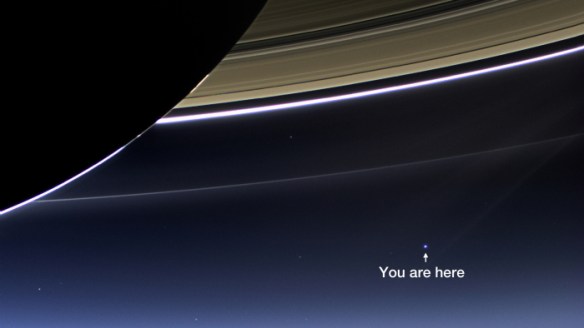
In this rare image taken on July 19, 2013, the wide-angle camera on NASA’s Cassini spacecraft has captured Saturn’s rings and our planet Earth and its moon in the same frame. It is only one footprint in a mosaic of 33 footprints covering the entire Saturn ring system (including Saturn itself). At each footprint, images were taken in different spectral filters for a total of 323 images: some were taken for scientific purposes and some to produce a natural color mosaic. This is the only wide-angle footprint that has the Earth-moon system in it.’