
British ‘addicted to curry’. “…sitting
down to eat a chicken
korma increases our heart beat by an extra
three beats a minute, a tikka masala increases
it by four and a half, and a rogan josh by
seven.” They didn’t rate the vindaloo?? BBC
Daily Archives: 26 Oct 00
Best wishes restoring, Ftrain.com.
Jungle Fever – Did two U.S. scientists start a genocidal epidemic in the Amazon? UC Santa Barbara anthropologist John Tooby (arguably the founder of evolutionary psychology) has a go at the controversy over journalist Patrick Tierney’s forthcoming book Darkness in El Dorado: How Scientists and Journalists Devastated the Amazon, to which I’ve devoted space in “Follow Me Here…” before. Tooby’s take on it, after being involved in the academic ethics investigation of Napoleon Chagnon, one of the supposed villains of the scandal: the book should have been published in the fiction category. Tooby wonders if Tierney was knowlingly perpetrating a hoax on the publishing world. Phrases like “pattern of falsification” and “comically self-aggrandizing” pepper this essay. The scandal, the raciest issue to rock the usually sober field of anthropology (which was my undergraduate concentration in college), seems to be getting dangerously close to the slippery slope of libel and litigation. The best may be yet to come…Slate
What Global Language? Contradiction: as English is supposedly consolidating its position as the world’s lingua franca, the U.S. is becoming more polyglot. The English language is becoming more complex while at the same time most speakers’ experience of the language is being dumbed-down. Despite the self-involved certainty of those who think web-centrically, “…the globalization of English does not mean that if we who speak only English just sit
back and wait, we’ll soon be able to exchange ideas with anyone who has anything to say.
We can’t count on having much more around the world than a very basic ability to
communicate. Outside certain professional fields, if English-speaking Americans hope to
exchange ideas with people in a nuanced way, we may be well advised to do as people
elsewhere are doing: become bilingual.” A fascinating thoughtful article exploring the futures market for the English language from a variety of vantage points.
Eventualities such as “political alliances that have yet to
be formed; the probable rise of regional trading
blocs, in such places as Asia; the Arab world, and
Latin America, in which the United States and other
primarily English-speaking countries will be little
involved; the possibility that world-changing
technological innovations will arise out of nations
where English is little spoken; a backlash against
American values and culture in the Middle East or
Asia” could transform the language picture. Demographically, English will probably lose its second-place standing (after Chinese) to the South Asian linguistic group (Hindi, Urdu, etc.), and will possibly fall behind Arabic and Spanish as well. China could in one fell swoop alter the English dominance pattern by withdrawing state support for efforts to teach English to its populace, for instance if political relations between China and the US deteriorate further.
And even with its spread would come an accentuation of communication difficulties among disparate English-speakers. Witness the need for subtitles for Americans to understand the recent Scottish films My Name is Joe and Trainspotting [both highly recommended, IMHO]. The Atlantic
San Francisco anti-SUV activist Robert Lind stalks “these gas-guzzling SUVs being used by people who don’t really need them” and slaps bumper stickers on them pointing their owners to his website, where they hear about the harm Lind claims their vehicles are doing to the environment and receive helpful hints aboout how to remove the bumper stickers. “If you ‘tag’ ANY of the three trucks I own, you will wake up in the hospital” is one response he receives on the site’s bulletin board. [via Spike Report]
Desert of Memory. “Paul Bowles, the American writer, composer, and expatriate, died eleven months ago in
Tangier, the northern Moroccan city where he had lived for more than half a century.
Bowles was controversial in Morocco, and his death was a major news event there; yet the
Moroccan response to Bowles has not made it into American accounts. Next to nothing has
been written here about the last decades of Bowles’s life, nor about his often tense
residence in Morocco, where he had as many enemies as friends. Even with various articles
and memorials planned to commemorate the first anniversary of Bowles’s death — a two-day
tribute is planned at New York City’s 92nd Street Y on October 29 and 30 — it’s safe to wager
that his fans will be fed the tired and typical version of Bowles’s life abroad.” This essay by a professor of literature at Northwestern looks at the complicated legacy both in Morocco and the West of the “expatriate’s expatriate.” Bowles’ own Moroccan stories and the Arabic tales he brought to Western readers were a predilection of mine long before the film of The Sheltering Sky revived interest in him in the last decade of his life. Feed
Jonathan Yardley used to be a bibliophile, he says. But it seems that, with the thrill of progress he finds inevitable, he won’t bemoan the passing of the bookstore. Publishing on demand will get stories and information to readers so much “easier, faster and cheaper” that the death knell tolls. Me, I think the reports of the death of conventional books and bookselling are greatly exaggerated (to coin a phrase). Washington Post
Stone Age ‘Atlantis’ Found in North Sea. More evidence of catastrophic primeval sea level changes. I previously blogged the work of the National Geographic expedition claiming to have found archaeological validation of the Great Deluge in the Mideast. National Geographic
Being there. Tele-immersion could profoundly alter long-distance communication, allowing a new kind of intermingled presence of people geographically separated. Despite Jaron Lanier’s current skepticism about cybertechnological advances, a recent experiment was the culmination of a three-year National Tele-Immersion Initiative project he directed. It seems a natural next extension of his pioneering work in VR. Plans include building in haptics — touch simulation — to allow a fuller simulation of tele-presence at a distance. Consider, first, the demand for bandwidth expansion this would stimulate if realized. And some of the novel uses to which it might be put.
The fast-food
chain McDonalds showed interest at one early workshop… McDonalds envisioned fitting tele-immersion booths in
its restaurants so people away from home could have dinner
with their family. “The technology for that is not that far off”… The gaming industry is another potential user.
Players could tele-immerse themselves in a virtual reality
environment, chasing monsters or firing phasers at each other.
[And then there’s another, even more obvious, use about which many will likely soon be, if not already, salivating…] New Scientist
US concern over new Palestinian ‘alliance’. Seeming new coordination of plans between Yasser Arafat loyalists and more radical Palestinian groups to direct the uprising in the West Bank and Gaza has reportedly involved the release by Palestinian civil authorities of dozens of jailed Hamas and Islamic Jihad militants. BBC [Change of heart, failure of will, or loss of control by Arafat vis a vis his peacemaking role?]
Court orders Texas death-row inmate resentenced. Til now, I hadn’t heard of much, if any, effective judicial review of the seemingly rampant abuses associated with Texas capital sentencing. Nando Times
Now Jupiter’s got a great white spot Three giant storms on Jupiter have merged to form a massive
storm half the size of the planet’s famous Great Red Spot.
Observations of the new “great white spot” could reveal if this
was how the Red Spot formed… New Scientist
Fast-Forward Election: the way the debates were meant to be watched. 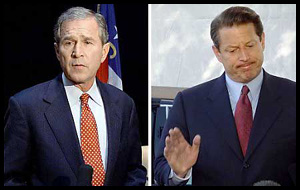
That
little FF button liberated me. No longer am I
enslaved by the spin doctors and news
analysts. No longer do I have to listen to the
what Bush and Gore actually say. In
fast-forward, it’s the more basic stuff of life.
You know, the nervous twitches, subliminal
thoughts and repetitious grimaces.Sped up, Gore, with his quick and jutting
movements, is a cross between Max
Headroom and the Tin Man. He’s a twitchy
Vulcan struggling with “technical difficulties.”Bush’s perpetually droopy grin shows a
conniving boy caught with his hand in the
cookie jar. He’s a used car salesman, asking
us: “Hey folks, what do I have to do to get
you to vote for me today?”In double time, their running mates are also
transparently clear. Joseph Lieberman,
whose mouth moves but little else, is a
sappy ventriloquist’s dummy. Dick Cheney,
folded hands and sideways glances, is a
plotting old woman. Getting It
U.S. learns of terrorist plans; analyst quits over Cole warning. “During a hearing on Capitol Hill on Wednesday, senators said that a Pentagon intelligence expert on terrorism in the Persian Gulf warned of
possible terrorist attacks on U.S. forces there before the bombing of the USS Cole, but that higher-ups failed to pass the information to military
commanders.
The intelligence official, whose name was not disclosed, resigned in protest the day after the Cole attack.” Nando Times
Ford shows off newest bells, whistles for safety, “(including) a tiny video camera in the rearview mirror linked to a cell phone and a crash sensor. If the car is in a wreck, its computer
sends out an alert routed to the nearest emergency dispatcher.
That dispatcher would get data from the car regarding the position the vehicle came to rest in, the severity of the crash, the number of people in
the car, the number wearing seat belts and even a rough estimate of injuries. The camera would transmit two photos of the interior – one taken
just before the crash and one taken just after – so doctors would know what kind of injuries were suffered.” Some privacy advocates have expressed concerns about a camera taking pictures of you every few minutes… AP
Protesters storm Justice Department entrance:
“More than 100
protesters stormed the entrance of the U.S.
Justice Department building Wednesday
afternoon to demand the prosecution of a
police officer who killed a college student.” CNN
“All of these people are here for poetry? If you locked me in a room full of poets, I’d be looking for any way to get out.” CSM
Silly New-Age Pseudo Science Gets a Sound Thrashing. A review of “veteran
science writer and playful gadfly” Martin Gardner’s Did Adam and Eve Have Navels? ‘Most of the essays…are “attacks on far-out cases of
pseudoscience.” Gardner’s targets are generally not the religious notions or
superstitions of people swept along by their ancient cultures but phony science
promulgated by, and believed in, by people who should know better. Thus he does
not attack the pious millions who, in Brazil, are devoted to the cult of the Virgin
Mary that they celebrate in Belen on the Amazon every October. Rather, he
skewers such “preposterous” claims that “positions of stars correlate with character
and future events.” ‘ LA Times
Prostitution and the sex discrepancy in reported number of sexual partners: “One of the most reliable and perplexing findings from surveys of sexual behavior is that men report substantially more sexual partners
than women do….We find that prostitute women are underrepresented in the national surveys. Once their
undersampling and very high numbers of sexual partners are factored in, the discrepancy disappears. Prostitution’s role in the discrepancy
is not readily apparent because men are reluctant to acknowledge that their reported partners include prostitutes.” Proceedings of the National Academy of Sciences [Is this restating the obvious?]
Children With Mental Problems Not Getting the Care They Need. Federal health officials, mental health experts and mental health advocacy groups agree. The problem is multifactorial, involving families’ lack of resources or adequate insurance, shortages of qualified professionals, and the complexities and fragmentation of the care delivery system. Last month’s conference on the issue convened by US Surgeon General David Satcher is expected to result in a national action plan by the end of this year. Journal of the American Medical Association
My infatuation with Phil Agre‘s work only begins with the Red Rock Eaters’ mailing list, to items from which I often link. If you read my blog, you may find something of use or of interest on this list of his recent or forthcoming work (the annotations are his, not mine):
Life after cyberspace, EASST Review 18(2),
1999, pages 3-5.Yesterday’s tomorrow, Times Literary Supplement,
3 July 1998, pages 3-4.The Internet and
public discourse, First Monday 3(3), 1998.Advice for undergraduates considering graduate
school A brief how-to, perhaps ten pages, for undergraduates who
think they might want to go to graduate school. I originally wrote it for
students in my own department, but over time I have extended it in response
to comments from people in other fields. It emphasizes the value of getting
involved in research and is especially intended for sophomores and juniors.
Designing effective action alerts for the
Internet This is a guide to designing political action alerts. It
also suggests what kinds of badly designed action alerts you should refrain
from forwarding to others.Find your voice Writing for a webzine: how to
build a public voice on the Internet that communicates your values in a way
that people can understand.Hosting a speaker A guide for graduate
students concerning the practicalities of playing host to a visiting
speaker, for example in a weekly seminar series.How to help someone use a computer
A short set of practical guidelines on helping people use computers without
oppressing them. I learned most of these ideas from teachers of young
children, but they apply equally well to anyone.Information and institutional change
This is an annotated syllabus for an upper-division undergraduate class
that I taught at UCLA in the spring of 2000 on the role of information
and information technology in the process of institutional change.The literature on institutions My
research takes an institutional perspective on the place of information
technology in people’s lives, and this article summarizes the literature
in sociology and and political science about the concept of an institution.
Networking on the network A detailed
guide to professional networking both on and off the Internet. Although
written principally for advanced graduate students and others in academia,
the underlying principles apply widely.Cyberspace as American culture, to appear in Science
as Culture.Designing a wired life, paper prepared for the WebNet
2000 Conference.Growing a democratic culture: John Commons on the
wiring of civil society, to appear in David Thorburn and Henry Jenkins,
eds, Democracy and New Media, Cambridge: MIT Press, 2000.Hazards of design: Ethnomethodology and the ritual
order of computing, submitted to Mind, Culture, and Activity.
Imagining the wired university, paper presented
at the Symposium on the Future of the University, University of Newcastle,
September 2000.Portents of planning: A critical reading of the first
paragraph of Miller, Galanter, and Pribram’s Plans and the Structure of
Behavior, paper presented at the Conference on Narrative in the Human
Sciences University of Iowa, July 1990.Writing and representation, to appear in Michael Mateas
and Phoebe Sengers, eds, Narrative Intelligence, Amsterdam: John
Benjamins, 2001.
I guess I expected that a number of you would react with surprise (or alarm??) to my Ira Glass blink below. To each her own, of course…
