
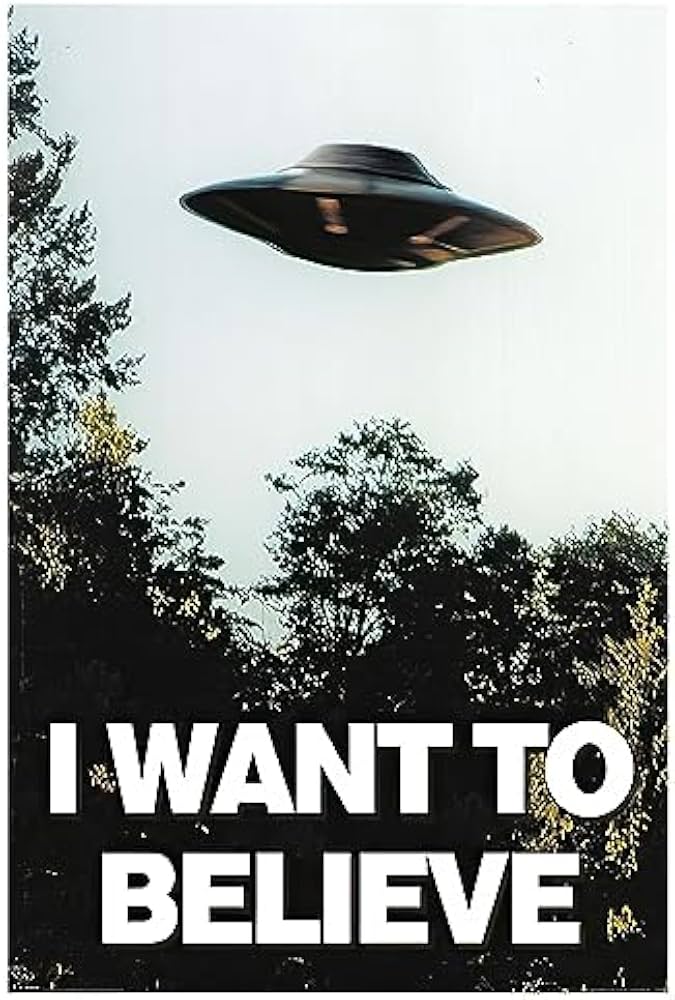
When I read Michael Shermer’s recent Washington Post piece on UFOs—now more carefully labeled unidentified anomalous phenomena—I found myself less drawn to the familiar question—are these extraterrestrial?—than to a more interesting one: why does uncertainty in this domain exert such gravitational pull on the modern imagination?
Unidentified phenomena, in the literal sense, are unremarkable. Every mature scientific field has residual anomalies—observations that resist immediate classification because the data are partial, the instruments imperfect, or the conceptual framework still evolving. Aviation and sensor-rich environments are no exception. What is distinctive here is not the existence of unexplained sightings, but the interpretive haste that often follows.
In clinical work, one becomes attuned to the difference between experience and explanation. People encounter events—internal or external—that feel discontinuous with their prior understanding of the world. The event itself may be brief and ambiguous; what endures is the pressure to make it intelligible. Meaning-making is not optional. It is constitutive of human cognition.
UAPs sit at an uncomfortable intersection of perception, technology, and ontology. They are often described under conditions that privilege ambiguity: high speed, unusual vantage points, degraded sensory input, unfamiliar contexts. In such circumstances, the mind reliably does what it has always done—infers agency, intention, or design. This tendency is not pathological. It is an evolved bias toward coherence.
As compelling as Fox Mulder’s “I Want to Believe” is, what Shermer insists upon—quietly but firmly—is epistemic restraint. Most cases dissolve into prosaic explanations when examined carefully. A smaller subset remains unresolved, not because it points clearly toward new physics or nonhuman intelligence, but because the evidentiary chain is weak. From a scientific standpoint, “unexplained” is not a conclusion; it is a placeholder.
What complicates matters is that extraterrestrial explanations do more than explain. They situate. They place human affairs within a broader cosmological narrative at a time when many traditional sources of orientation—religious, institutional, even scientific—feel unstable or distrusted. In that sense, contemporary UFO discourse functions less as hypothesis-testing and more as symbolic reasoning.
This is where psychiatric perspective becomes useful, not as debunking but as contextualization. Humans tolerate uncertainty poorly when it touches existential questions. We are more comfortable with speculative answers than with suspended judgment. The danger lies not in curiosity, but in prematurely converting ambiguity into belief—mistaking narrative closure for understanding.
None of this forecloses the possibility of future discovery. It simply insists on proportionality. Claims that would radically revise our understanding of physics, biology, and history demand correspondingly robust evidence. At present, that threshold has not been met.
What seems most valuable, then, is a capacity increasingly in short supply: the ability to remain intellectually open without being epistemically promiscuous; to acknowledge the limits of current knowledge without filling the gap with certainty; to say, without embarrassment, we do not yet know.
In that sense, UFOs may be less a problem for astrophysics than for intellectual temperament. They test whether we can live with unanswered questions—whether mystery must always be resolved, or whether it can sometimes be allowed to remain, provisionally, unexplained.

