
Like the fissionable atom, punctuation marks are wee items capable of causing a tremendous release of energy. Passionate disagreement over the use of exclamation points is so familiar that a “Seinfeld” plotline saw Elaine’s new romance with a writer blow up because he didn’t share her enthusiasm. F. Scott Fitzgerald, in the anti-exclam brigade, famously said using them is “like laughing at your own joke.”
Tell that to Tom Wo!fe. Or just about anyone who texts in this angry age, when the exclamation point signals “I’m not fuming!” and a period can go off like a gunshot.
Apostrophes? George Bernard Shaw loathed ’em, often leaving the “uncouth bacilli” out of contractions, including didnt, wont and aint. Today, capricious apostrophe usage is so widespread (Its banana’s out there!), and meets with such predictable fury, that one suspects a vast prank-the-English-teachers campaign.
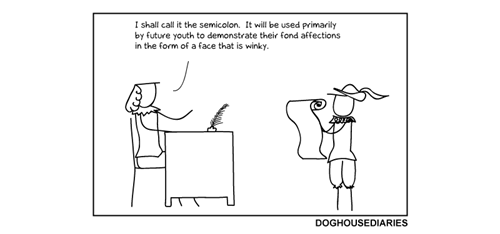
No piece of punctuation, though, stirs people up more than the humble semicolon. Too demure to be a colon but more assertive than a comma, the semicolon was introduced in 1494 by Venetian printer and publisher Aldus Manutius. What a useful little tool it has been in its primary role of inserting a graceful pause between two related independent clauses, as in: “RFK Jr. came to my house; he tore out the medicine cabinet with a crowbar.”
But now the semicolon is dead. Or semi-dead. Its use has collapsed, as underlined last month by a study from Babbel, an online language-learning platform. “Semicolon usage in British English books has fallen by nearly 50% in the past two decades,” the survey said — and this sudden drop followed a steady decline across the past two centuries.…’ — Mark Laswell via The Washington Post

