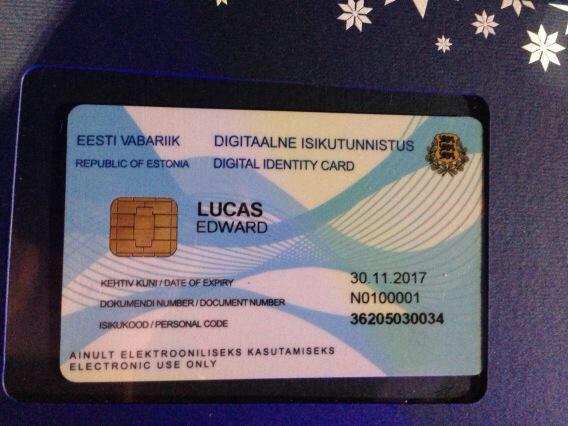
Via The Atlantic: ‘Edward Lucas has a habit of popping up at pivotal moments in European history. In March 1990, shortly after Lithuania declared independence from the Soviet Union, the Economist editor caught a flight to Vilnius and received the first Lithuanian visa: number 0001, a stamp-sized chink in the Iron Curtain that got him arrested and deported by Soviet authorities. On Monday, Lucas helped chip away at borders once again. In a ceremony in the Estonian capital of Tallinn, President Toomas Hendrik Ilves, a friend of Lucas’s from Ilves’s previous career as a journalist, made Lucas Estonia’s first e-resident. And just like that, the word “resident” took on new meaning, distilled in the smart card below: To be clear: E-residency is not a path to citizenship; it’s not legal residency. It cannot be used as a travel document or a picture ID. Instead, it’s a form of supranational digital identity issued, for the first time, by a country. It’s the online self, now with a government imprimatur. And it’s the latest innovation from a tech-savvy nation that brought you Skype, the world’s first digitally signed international agreement, and an intricate national ID system that allows citizens to speedily elect politicians and file taxes online. The Baltic republic is so wired that officials are even contemplating uploading the government’s digital infrastructure to the cloud so that it can continue operating if Russia invades Estonia.’
Follow Me Here…
“I am the world crier, & this is my dangerous career… I am the one to call your bluff, & this is my climate.” —Kenneth Patchen (1911-1972)