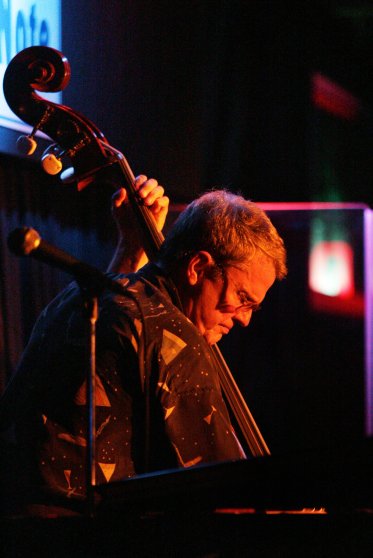
Influential Jazz Bassist Is Dead at 76: ‘His jazz career crossed seven decades, with barely a moment of obscurity. He was in his early 20s in 1959, when, as a member of the Ornette Coleman Quartet, he helped set off a seismic disruption in jazz. Mr. Coleman, an alto saxophonist, had been developing a brazen, polytonal approach to improvisation — it would come to be known as free jazz — and in his band, which had no chordal instrument, Mr. Haden served as anchor and pivot.
Mr. Coleman’s clarion cry, often entangled with that of the trumpeter Don Cherry, grabbed much of the attention, but Mr. Haden’s playing was just as crucial, for its feeling of unerring rightness in the face of an apparent ruckus.
In addition to Mr. Coleman, with whom he continued to play intermittently in the 1960s and ’70s and later, in the occasional reunion, Mr. Haden worked with many principal figures of an emerging jazz avant-garde. For a decade starting in 1967, he was a member of a celebrated quartet led by the pianist Keith Jarrett, with Dewey Redman on saxophone and Paul Motian on drums.
The Liberation Music Orchestra, which released its debut album in 1969, was Mr. Haden’s large ensemble, and an expression of his left-leaning political ideals. The band, featuring compositions and arrangements by the pianist Carla Bley, mingled avant-garde wildness with the earnest immediacy of Latin American folk songs. Mr. Haden released each of the band’s four studio albums during Republican administrations; the most recent, in 2005, was “Not in Our Name,” a response to the war in Iraq.
Mr. Haden, who liked to say he was driven by concern for “the struggle of the poor people,” hardly restricted his opinions to the Liberation Music Orchestra. While playing a festival with Mr. Coleman in Lisbon, in 1971, he dedicated his “Song for Ché” to the black liberation movements of Mozambique and Angola, and was promptly jailed.’ (NYTimes obituary)
Follow Me Here…
“I am the world crier, & this is my dangerous career… I am the one to call your bluff, & this is my climate.” —Kenneth Patchen (1911-1972)