
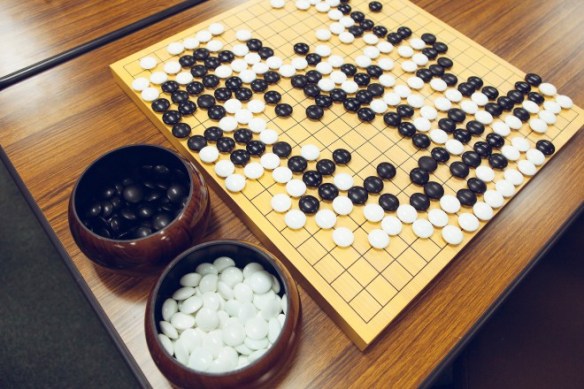
‘In 1994, machines took the checkers crown, when a program called Chinook beat the top human. Then, three years later, they topped the chess world, IBM’s Deep Blue supercomputer besting world champion Garry Kasparov. Now, computers match or surpass top humans in a wide variety of games: Othello, Scrabble, backgammon, poker, even Jeopardy. But not Go. It’s the one classic game where wetware still dominates hardware.
Invented over 2500 years ago in China, Go is a pastime beloved by emperors and generals, intellectuals and child prodigies. Like chess, it’s a deterministic perfect information game — a game where no information is hidden from either player, and there are no built-in elements of chance, such as dice.1 And like chess, it’s a two-person war game. Play begins with an empty board, where players alternate the placement of black and white stones, attempting to surround territory while avoiding capture by the enemy. That may seem simpler than chess, but it’s not. When Deep Blue was busy beating Kasparov, the best Go programs couldn’t even challenge a decent amateur. And despite huge computing advances in the years since — Kasparov would probably lose to your home computer — the automation of expert-level Go remains one of AI’s greatest unsolved riddles.’ (WIRED).
I have always been a Go fan, but not a very good player. Not very many people to play with these days…

